

This guide takes a closer look at return on marketing investment without oversimplifying it. Not just the formula, but how it actually plays out across channels, teams, and timelines. Some parts are straightforward. Others… not so much. Things like attribution, delayed impact, and customer lifetime value tend to complicate the picture.
The blog walks through all of that in a grounded way. Where ROMI works well, where it falls short, and how to make better decisions with it anyway. There’s also a practical angle running throughout, small shifts, better measurement, and cleaner thinking. Nothing flashy, but the kind of clarity that tends to improve results over time
Table of Contents
What Is Return on Marketing Investment (ROMI)?
At its core, Return on Marketing Investment (ROMI) is a way to measure how much revenue your marketing efforts generate compared to what you spend on them. It sounds simple, and in theory it is. But once you start applying it across channels, campaigns, and timelines, things get… a bit messy.
Definition of Return on Marketing Investment
ROMI is a performance metric that evaluates the efficiency and effectiveness of marketing spend. It answers a very practical question:
“For every rupee (or dollar) I spend on marketing, how much am I getting back?”
Unlike vanity metrics like impressions or likes, ROMI ties marketing directly to business outcomes. That’s why leadership teams care about it so much.
ROMI Meaning in Digital Marketing
In digital marketing, ROMI becomes even more powerful because you can track almost everything. Clicks, conversions, revenue, user journeys, it’s all measurable (well, mostly).
But here’s the catch: just because something is trackable doesn’t mean it’s accurately attributed. And that’s where many marketers get ROMI wrong.
ROMI in digital marketing typically includes:
- Paid ads (Google, Meta, LinkedIn)
- SEO and content marketing
- Email campaigns
- Affiliate and influencer marketing
Each of these contributes differently to revenue, which makes ROMI both useful and… tricky.
Why ROMI Is Different from General ROI
People often use ROI and ROMI interchangeably. They shouldn’t.
- ROI (Return on Investment) looks at overall business returns across all investments.
- ROMI, on the other hand, focuses specifically on marketing activities.
The difference matters because marketing doesn’t always produce immediate returns. Some efforts (like branding or SEO) pay off months later, while others (like paid ads) can generate results almost instantly.
So ROMI isn’t just about profit. It’s about understanding marketing’s contribution to growth.
Simple Example of Marketing ROI Calculation
Let’s say you run a campaign:
- Marketing spend: ₹1,00,000
- Revenue generated: ₹3,00,000
Your ROMI would be:
- (3,00,000 – 1,00,000) / 1,00,000 = 2.0 (or 200%)
This means you earned ₹2 for every ₹1 spent.
Sounds great, right? But this is a simplified view. It doesn’t account for margins, repeat purchases, or delayed conversions. We’ll get into those nuances later.
Why Return on Marketing Investment Matters in Marketing Strategy
ROMI isn’t just a reporting metric. It shapes how you plan, prioritize, and justify your marketing efforts.
And honestly, without it, marketing decisions tend to become… guesswork dressed up as strategy.
Aligning Marketing ROI with Business Goals
Marketing doesn’t exist in isolation. Or at least it shouldn’t.
A high ROMI campaign that brings in low-quality leads might look good on paper, but hurt the business long-term. On the flip side, a branding campaign with no immediate return might actually be building future demand.
So alignment matters.
Revenue Growth vs Brand Awareness
- Performance campaigns focus on immediate revenue
- Brand campaigns focus on long-term demand generation
Both are important. But they require different ways of thinking about ROMI.
Performance Marketing vs Long-Term Marketing ROI
Performance marketing is easy to measure:
- Click – Conversion – Revenue
Brand marketing is harder:
- Awareness – Consideration – Preference – Conversion (eventually)
If you judge both using the same ROMI lens, you’ll likely undervalue brand-building efforts.
Proving Marketing Value to Stakeholders
If you’ve ever had to defend a marketing budget, you already know this.
ROMI is your strongest argument.
ROMI for CMOs and Decision-Makers
Executives don’t care about CTRs or engagement rates. They care about:
- Revenue contribution
- Cost efficiency
- Growth scalability
ROMI translates marketing into a language they understand.
Budget Justification Using Marketing ROI
When budgets get tight, marketing is often the first to be questioned.
With clear ROMI data, you can:
- Show which campaigns are profitable
- Identify wasteful spending
- Make a case for increasing investment in high-performing channels
Without it, you’re relying on intuition. And that’s rarely enough.
Improving Customer Acquisition and Retention Efficiency
ROMI isn’t just about revenue. It’s about efficiency.
Cost per Acquisition vs ROMI
CPA tells you how much it costs to acquire a customer.
ROMI tells you whether that cost is actually worth it.
You could have:
- Low CPA but low revenue – poor ROMI
- High CPA but high lifetime value – strong ROMI
So CPA alone can be misleading.
Linking ROMI with Customer Lifetime Value (CLV)
This is where things get interesting.
If a customer spends ₹500 today but ₹5,000 over time, your ROMI calculation changes dramatically.
That’s why mature marketing teams don’t just track:
- First purchase revenue
- But lifetime value
ROMI becomes much more meaningful when viewed over the entire customer journey.
Return on Marketing Investment Formula (ROMI Calculation Explained)
Let’s talk formulas. Not the intimidating kind, just the practical ones you’ll actually use.
Basic ROMI Formula
The simplest version looks like this:
(Revenue – Marketing Cost) / Marketing Cost
This gives you a ratio or percentage that shows how profitable your marketing is.
When to Use the Simple Formula
- Short-term campaigns
- Paid advertising with direct conversions
- Quick performance analysis
It’s clean, fast, and useful. But also… incomplete.
Because revenue alone doesn’t tell the full story.
Advanced ROMI Formula with Gross Profit
A more accurate approach includes profit margins:
(Gross Profit – Marketing Cost) / Marketing Cost
Why this matters:
- Revenue doesn’t equal profit
- Different products have different margins
- High-revenue campaigns can still be unprofitable
For example:
- ₹1,00,000 revenue with 20% margin = ₹20,000 profit
- Spend ₹30,000 on marketing – you’re actually losing money
So yeah, revenue-only ROMI can be misleading.
ROMI Formula with Customer Lifetime Value (CLV)
Now we’re getting into long-term thinking.
Instead of using immediate revenue, you use CLV:
(Customer Lifetime Value – Marketing Cost) / Marketing Cost
This is especially useful for:
- SaaS businesses
- Subscription models
- E-commerce with repeat purchases
Because the first transaction rarely reflects the true value of a customer.
ROMI Calculation Example (Step-by-Step)
Let’s break it down with a slightly more realistic scenario:
- Ad spend: ₹50,000
- Customers acquired: 100
- Average purchase value: ₹1,000
- Total revenue: ₹1,00,000
Basic ROMI:
- (1,00,000 – 50,000) / 50,000 = 1.0 (100%)
Now let’s include margins:
- Profit margin: 40%
- Gross profit: ₹40,000
Adjusted ROMI:
- (40,000 – 50,000) / 50,000 = -0.2 (-20%)
Suddenly, what looked like a successful campaign is actually losing money.
Now include CLV:
- Average lifetime value: ₹3,000
- Total CLV revenue: ₹3,00,000
- Profit (40% margin): ₹1,20,000
CLV-Based ROMI:
- (1,20,000 – 50,000) / 50,000 = 1.4 (140%)
Same campaign. Three completely different interpretations.
That’s why context matters so much in ROMI analysis.
Key Metrics Required to Calculate Marketing ROI Accurately
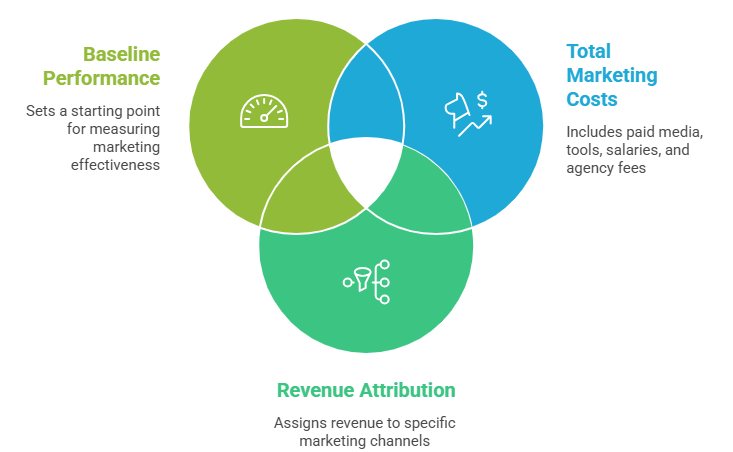
ROMI is only as good as the data behind it. And honestly, most teams struggle here more than they’d like to admit.
Tracking Total Marketing Costs
This is where many calculations go wrong. People underestimate costs.
You need to include:
- Paid media spend
- Marketing tools and software
- Salaries (or at least a proportion)
- Agency or freelancer fees
Hidden Costs in Marketing ROI
These often get ignored:
- Creative production
- Landing page development
- Marketing ops and analytics tools
- Time spent by internal teams
If you exclude these, your ROMI will look artificially high.
Accurate Revenue Attribution in Marketing
This is probably the hardest part.
When a customer converts, which channel gets credit?
- First-click attribution
- Last-click attribution
- Multi-touch attribution
Each model tells a different story.
Impact of Attribution on ROMI
- Last-click often overvalues paid search
- First-click favors awareness channels
- Multi-touch gives a more balanced view, but is harder to implement
There’s no perfect model. But ignoring attribution altogether is worse.
Establishing a Baseline for Marketing Performance
You need to understand what would have happened without marketing.
That’s your baseline.
Organic vs Paid Contribution
Not all conversions come from paid efforts. Some users:
- Already know your brand
- Would have converted anyway
If you attribute everything to marketing, you inflate ROMI.
Incrementality in Marketing ROI
Incrementality measures the true lift created by marketing.
For example:
- If sales increase by 20%, but 10% would have happened anyway
- Your actual marketing impact is only 10%
This is harder to measure, but incredibly important.
Because real ROMI isn’t about total revenue.
It’s about incremental revenue driven by marketing efforts.
ROI vs ROMI vs ROAS: Key Differences Explained
There’s a lot of casual mixing of these terms in marketing conversations. ROI, ROMI, ROAS. They sound interchangeable, but they really aren’t. And the differences matter more than people think.
ROI vs Marketing ROI vs Return on Ad Spend
ROI is the broad umbrella. It looks at total return across any kind of investment in the business. Hiring, infrastructure, product, marketing… everything gets bundled into that one number.
ROMI narrows the lens. It isolates marketing and asks a more specific question: is marketing spend actually generating profitable growth?
Then comes ROAS. Even narrower. It focuses only on advertising spend and the revenue tied directly to it.
So the scope keeps shrinking:
- ROI looks at the whole business
- ROMI looks at marketing as a function
- ROAS looks at ad spend only
The problem starts when ROAS is treated like the ultimate truth. It’s convenient, yes. Easy to track, easy to report. But it leaves out a lot.
When to Use ROAS Instead of ROMI
ROAS works best when looking at campaign-level performance. Paid ads, especially. If a campaign is live and decisions need to be made quickly, ROAS gives a fast signal.
But it’s a partial view.
It doesn’t account for:
- Creative costs
- Team bandwidth
- Landing page performance beyond the click
- Any upstream or downstream impact
So a campaign might show a strong ROAS and still not contribute meaningfully to overall profitability. That happens more often than most teams admit.
ROMI steps in at that point. It connects the dots across the broader system.
Limitations of Each Metric
None of these metrics is complete on its own.
ROI tends to be too slow and too high-level for day-to-day decisions.
ROAS is sharp but narrow. Useful, but easy to over-trust.
ROMI sits somewhere in between, but even that depends heavily on attribution and clean data. And those are rarely perfect.
The better approach usually isn’t choosing one. It’s knowing when each one makes sense. Context does most of the heavy lifting here.
What Is a Good Return on Marketing Investment?
This is where expectations can get a bit unrealistic.
Everyone wants a clear benchmark. A number to aim for. But ROMI doesn’t really work like that. What’s “good” shifts depending on the business model, margins, and even the stage of growth.
Still, there are rough patterns.
Industry Benchmarks for ROMI
A 5:1 return is often cited as strong. Meaning, for every ₹1 spent, ₹5 comes back. Sounds ideal. But not every business can operate at that level consistently.
A 3:1 ratio is usually seen as stable. Sustainable, at least in many cases.
Anything below that starts raising questions. Not always a red flag, but definitely something to look into.
But these are just reference points. Not rules.
A high-growth company might intentionally operate at a lower ROMI for a while. Prioritizing scale over efficiency. On the other hand, a mature business with tighter margins might need much higher returns just to stay viable.
B2B vs B2C Marketing ROI Expectations
B2B and B2C behave very differently, and ROMI reflects that.
In B2B, the journey is longer. Deals take time. Multiple touchpoints, multiple stakeholders. So the return doesn’t show up immediately. But when it does, it can be substantial.
In B2C, the cycle is shorter. Faster decisions, quicker conversions. ROMI is often evaluated in shorter windows. Daily, weekly, sometimes even in real time.
Comparing the two directly doesn’t really help. The timelines don’t match.
Factors Affecting a “Good” ROMI
Several factors quietly shape what “good” actually looks like:
- Profit margins play a big role. Higher margins allow more flexibility in spending
- Customer lifetime value changes the equation entirely. Repeat customers improve long-term returns
- Growth stage matters. Early-stage companies often tolerate lower returns to build momentum
- Competition drives costs up, sometimes unpredictably
So instead of chasing a fixed number, it’s more useful to define acceptable ranges based on how the business operates. That tends to lead to better decisions.

Enroll Now: AI-Powered Performance Marketing Course
What Is a Bad Return on Marketing Investment?
On the surface, a bad ROMI is easy to spot. Spending goes up, returns don’t keep pace. Or worse, returns drop.
But the underlying reasons aren’t always obvious.
Negative ROMI Explained
Negative ROMI simply means the cost of marketing exceeds the value it brings in. At least in the timeframe being measured.
But timing matters here.
Some campaigns take longer to show results. Especially in channels like SEO or content. Judging them too early can give a misleading picture.
Other times, though, the issue is more fundamental. The economics don’t work. And no amount of optimization will fix that.
Distinguishing between the two is where most of the real thinking happens.
Common Reasons for Low Marketing ROI
Low ROMI tends to come from a few recurring patterns.
Targeting is often one of them. Reaching the wrong audience, or even the right audience at the wrong time. That alone can drag performance down.
Then there’s the funnel itself. Traffic might be decent, but if conversion points are weak, the drop-off adds up quickly.
Attribution gaps also play a role. Some channels assist conversions but don’t get credited. Others take more credit than they should. The result is a distorted view of performance.
And sometimes, it’s just over-optimization in the wrong direction. Chasing cheaper clicks instead of better customers. It looks efficient… until it doesn’t.
When Low ROMI Is Acceptable (Branding Campaigns)
Not all low ROMI is bad.
Brand campaigns often fall into this category. They don’t always produce immediate revenue, but they influence future behavior. Awareness, trust, recall… all of that builds over time.
The impact shows up later, often in subtle ways. Lower acquisition costs, higher conversion rates, and stronger retention.
That said, “brand” shouldn’t become a blanket excuse for underperformance. There still needs to be a clear role in the overall strategy.
Short-Term vs Long-Term Return on Marketing Investment
This is where things get a bit tricky.
Most marketing teams operate under short-term pressure. Monthly targets, quarterly goals. Understandable. But not all marketing efforts are designed to perform on that timeline.
And forcing them to can backfire.
Performance Marketing ROI (Short-Term)
Performance marketing is built for immediacy.
Paid ads, especially. Launch a campaign, monitor the numbers, adjust quickly. The loop is tight and fairly predictable.
Spending leads to traffic. Traffic leads to conversions. Conversions generate revenue.
ROMI here is easier to calculate because the path is clearer. Attribution is more direct, even if not perfect.
But there’s a limitation.
Performance marketing mostly captures existing demand. People already looking, already interested. It doesn’t necessarily create new demand at scale.
So over time, costs can creep up. Competition increases. Audiences get saturated.
Brand Marketing ROI (Long-Term)
Brand marketing works on a different timeline.
It’s slower. Less direct. Sometimes frustratingly hard to measure.
But it plays a deeper role. It shapes how people perceive the brand. Builds familiarity. Reduces friction when a purchase decision finally happens.
The effects compound.
Stronger brand presence often leads to:
- Better conversion rates across channels
- Lower dependency on paid acquisition
- Higher customer retention
The challenge is patience. Results don’t show up instantly, and that makes it harder to justify in the short term.
Balancing Short-Term Gains with Long-Term Growth
This is where most strategies either work… or quietly fall apart.
Too much focus on short-term performance can lead to diminishing returns. Rising costs, lower efficiency, constant pressure to optimize.
Too much focus on long-term brand building can slow down revenue generation, especially when cash flow is tight.
The balance isn’t fixed. It shifts based on goals, market conditions, and growth stage.
But ignoring either side usually comes at a cost. And that cost tends to show up later, when it’s harder to fix.
How to Calculate ROI for Different Marketing Channels
ROMI starts to get interesting when it’s broken down by channel. Because not every channel behaves the same way. Some drive quick conversions. Others quietly assist in the background. And if everything is measured with the same lens, the conclusions can get… off.
SEO ROI (Search Engine Optimization)
SEO rarely shows clean, immediate returns. That’s just how it works.
There’s upfront effort. Content creation, optimization, and technical fixes. Then a waiting period. Rankings move slowly, traffic builds gradually, and conversions follow later. Sometimes much later.
So ROI here usually involves estimating the value of organic traffic. One way to think about it is: what would it cost to acquire the same traffic through paid ads?
But even that feels a bit incomplete.
Organic visitors don’t always convert on the first visit. They come back. They search again. They compare. SEO often plays the long game, influencing decisions over time rather than closing them instantly.
Which is why short-term ROI calculations tend to undervalue it. Quite a bit, actually.
Content Marketing ROI
Content is broader than SEO, though they overlap a lot.
Blogs, guides, case studies, videos… all of it contributes in different ways. Some pieces drive traffic. Some generate leads. Others just build trust quietly in the background.
Attribution becomes tricky here.
A user might read a blog today, sign up for a newsletter next week, and convert a month later through a completely different channel. Where does the credit go? Hard to say with certainty.
There’s also a clear split between evergreen content and campaign-driven content.
Evergreen pieces age slowly. They keep delivering over time, sometimes long after they were published. Campaign content tends to spike, then fade. Both are useful, but the ROI curves look very different.
PPC ROI (Pay-Per-Click Advertising)
PPC feels more straightforward on the surface.
Spends go in, traffic comes out, conversions are tracked. The loop is tight. Easy to monitor, easier to adjust.
But even here, things can get misleading.
A campaign might show strong returns at a smaller scale. Increase the budget, and efficiency starts to drop. Costs rise, audience quality shifts, competition kicks in.
And then there’s the margin question.
Revenue might look healthy, but once margins are factored in, the actual return could be thinner than expected. Happens more often than people admit.
Social Media Marketing ROI
Social media doesn’t fit neatly into one category.
Some campaigns are built for conversions. Others are clearly aimed at reach, engagement, or brand recall. Mixing those objectives in one ROI calculation usually leads to confusion.
For conversion-focused campaigns, the math looks similar to PPC. Spend versus revenue.
But for broader campaigns, the signals are softer. Engagement, shares, comments… they don’t translate directly into revenue, at least not immediately.
Influencer campaigns make it even more nuanced.
Sometimes results are immediate. Traffic spikes, sales follow. Other times, the impact is more subtle. Increased search volume, better conversion rates later on.
Not everything shows up in a neat dashboard. That’s the reality.
Common Challenges in Measuring Marketing ROI (and Solutions)
On paper, ROMI looks clean. Numbers in, numbers out.
In practice, it’s rarely that tidy.
Data is scattered. Journeys are messy. And a lot of what actually drives decisions isn’t directly measurable.
Data Silos and Fragmented Marketing Data
One of the biggest issues is fragmentation.
Different platforms hold different pieces of information. Ad platforms show clicks and conversions. CRM systems track leads and sales. Analytics tools capture behavior.
None of them tells the full story on their own.
So decisions end up being made on partial views. Which… doesn’t always end well.
A campaign might look underwhelming in one report and highly effective in another. Not because something is broken, but because the data isn’t connected.
Pulling everything into a single, consistent view helps. Not perfect, but at least it reduces blind spots.
Attribution Complexity in Multi-Channel Marketing
Customer journeys aren’t linear anymore. They haven’t been for a while.
Someone might discover a brand on social media, search for it later, click a paid ad, and finally convert through a direct visit.
So which channel gets the credit?
Last-click attribution gives it to the final interaction. Simple, but often misleading.
First-click does the opposite. Useful in some cases, but still incomplete.
Multi-touch models try to spread credit across the journey. More balanced, but also harder to implement and interpret.
There’s no perfect answer here. Just trade-offs.
Ignoring attribution complexity, though, tends to skew decisions. Usually toward bottom-of-funnel channels.
Measuring Offline and Long-Term Impact
Some marketing effects don’t show up immediately. Or digitally.
Offline campaigns, word-of-mouth, brand perception… all of these influence outcomes. But they’re harder to measure directly.
Then there’s the time factor.
A campaign might influence a decision weeks or months later. By then, the connection isn’t obvious anymore.
So alternative signals start to matter.
Branded search volume. Direct traffic. Repeat purchases.
Not perfect indicators, but they help fill in the gaps.
Customer lifetime value also adds perspective. It shifts the focus from short-term wins to long-term contribution. Which is often where the real impact lies.
Actionable Strategies to Improve Return on Marketing Investment
Improving ROMI rarely comes from one big change. It’s usually a series of smaller adjustments that compound over time.
Some are obvious. Others tend to get overlooked.
Conduct A/B Testing to Improve Conversion Rates
Small changes can make a noticeable difference.
A headline tweak. A different call-to-action. A cleaner layout. These things don’t seem dramatic, but they influence behavior.
Over time, consistent testing leads to better-performing pages. Better pages lead to higher conversions. And that feeds directly into ROMI.
The key is not treating testing as a one-off task. It needs to be ongoing. Quietly, in the background.
Refine Audience Targeting and Segmentation
Not every user has the same intent. Or the same value.
Some convert quickly. Some take time. Some never convert at all.
Better segmentation helps focus efforts where they matter most.
Messaging becomes more relevant. Offers feel more aligned. And wasteful spending starts to drop.
It’s not always about reaching more people. Sometimes it’s about reaching the right ones.
Optimize the Marketing Funnel
A lot of attention goes to traffic. Less to what happens after.
Users move through stages. Awareness, consideration, conversion. At each step, there’s potential for drop-off.
Sometimes it’s friction. Slow pages, confusing layouts.
Sometimes it’s clarity. Unclear messaging, weak value propositions.
Fixing these doesn’t require massive changes. But it does require attention. And consistency.
Use Marketing Automation for Efficiency
Efficiency isn’t just about revenue. Cost plays a role, too.
Automating repetitive tasks helps reduce manual effort. Follow-ups, segmentation, nurturing… all of it becomes more consistent.
And consistency tends to improve outcomes.
It also frees up time for more strategic work. Which often has a bigger impact on ROMI than operational tasks.
Reallocate Budget to High-Performing Channels
Not every channel performs equally. That’s expected.
Some consistently deliver stronger returns. Others lag behind.
The challenge is acting on that insight.
It’s not always easy to pause underperforming campaigns, especially if they’ve been running for a while. But holding onto them usually drags overall performance down.
Shifting budget toward what’s working tends to improve efficiency fairly quickly. Assuming the underlying data is reliable.
Building a Scalable ROMI Reporting Framework
Without a structured approach, ROMI tracking becomes reactive. Reports get pulled when needed, and decisions get made on partial insights.
A more consistent framework helps. Not overly complex, just… structured enough.
Step 1: Prepare and Integrate Marketing Data
Everything starts with data. But not just collecting it.
Data needs to be usable. That means:
- Consistent naming across platforms
- Clean enough to analyze without constant fixing
- Centralized, so teams aren’t jumping between tools
When data is scattered, reporting slows down. And confidence in the numbers drops.
Bringing it together doesn’t solve everything, but it’s a solid starting point.
Step 2: Analyze Marketing ROI Data
Once the data is in place, the next step is making sense of it.
Looking at overall performance is useful, but not enough.
Breaking it down reveals more:
- Which channels are driving actual returns
- Which campaigns are underperforming
- Which audience segments respond best
Patterns start to emerge. Not always immediately, but over time.
Those patterns guide decisions. Budget shifts, campaign adjustments, targeting changes.
Without this layer of analysis, ROMI remains just a number.
Step 3: Monitor and Optimize Continuously
ROMI isn’t fixed. It changes as campaigns evolve, markets shift, and competition adjusts.
So tracking it once isn’t enough.
Regular reviews help keep things on track. Weekly check-ins for campaign performance. Monthly reviews for broader trends.
It doesn’t need to be overly complicated. Just consistent.
Over time, this creates a rhythm. Data informs decisions, decisions improve performance, and the cycle continues.
Not perfect. But a lot more reliable than reactive guesswork.
How to Monitor Return on Marketing Investment in Real-Time
Real-time ROMI sounds ideal. In reality, it’s a bit of a moving target.
Not every channel updates instantly. Not every conversion happens right away. But still, getting closer to real-time visibility changes how decisions are made. It shifts marketing from reactive to… something more controlled.
Real-time tracking mostly comes down to how quickly signals can be captured and interpreted.
Campaign-level performance is usually the easiest place to start. Paid channels, especially, provide near-instant feedback. Spend, clicks, conversions, even revenue in some cases. That gives a rough sense of ROMI early on, even if it’s not perfectly accurate.
Tracking URLs play a quiet but important role here. UTMs, when set up properly, help trace where traffic is coming from and how it behaves. Without them, things get blurry very quickly.
Then come dashboards.
A good dashboard doesn’t try to show everything. It focuses on a few key metrics that actually matter for decision-making. Revenue, spend, conversion rates, maybe customer acquisition cost alongside ROMI. Enough to spot trends without getting lost in details.
There’s also value in layering in qualitative signals. Customer feedback, support queries, even comments on campaigns. Not directly tied to ROMI, but often early indicators of what’s working or not.
One thing to keep in mind, though. Real-time data can be noisy.
A campaign might look weak in the first few hours and stabilize later. Or the opposite. So while speed is useful, it still needs a bit of patience. Acting too quickly on incomplete data can do more harm than good.
Tools for Tracking and Optimizing Marketing ROI
Tools don’t fix ROMI problems on their own. But without the right setup, measuring and improving ROMI becomes unnecessarily difficult.
What matters more than the number of tools is how well they connect.
Marketing Analytics Platforms
Analytics platforms are usually the starting point.
They track user behavior. Where traffic comes from, what users do on-site, where they drop off. All of that feeds into understanding how marketing efforts translate into outcomes.
Some platforms focus on web analytics, others on attribution. The choice depends on how deep the analysis needs to go.
But the common issue isn’t a lack of data. It’s interpreting it correctly.
CRM Systems for ROI Tracking
CRM systems bring in another layer. They connect marketing efforts to actual revenue.
Leads, opportunities, closed deals… this is where things move beyond clicks and conversions into business outcomes.
Without this connection, ROMI stays somewhat incomplete. Marketing might look effective on the surface, but the quality of leads remains unclear.
When CRM data is tied back to marketing channels, patterns start to emerge. Which campaigns bring high-value customers? Which ones don’t?
Data Integration & Warehousing Tools
At some point, data lives in too many places.
Ad platforms, analytics tools, CRM systems… each holds part of the picture. Integration tools help bring everything together.
This doesn’t need to be overly complex, but it does need to be consistent.
When data is unified, reporting becomes more reliable. Less time spent reconciling numbers, more time actually analyzing them.
BI and Visualization Tools for ROMI Reporting
Once data is centralized, visualization becomes important.
Raw data is hard to work with. Dashboards and reports make it easier to spot trends, compare performance, and communicate insights.
But there’s a balance.
Too many metrics, and the dashboard becomes cluttered. Too few, and important signals get missed.
The goal isn’t to track everything. It’s to track what actually influences decisions around spend and performance.
Conclusion:
How to Maximize Return on Marketing Investment
ROMI isn’t just a metric. It’s more like a lens.
It forces marketing decisions to be grounded in outcomes, not just activity. And over time, that changes how strategies are built.
A few things tend to stand out.
First, accuracy matters. Not perfect accuracy, that’s rarely possible, but close enough to make confident decisions. That means better data, clearer attribution, and a realistic understanding of what’s being measured.
Second, context matters just as much as the number itself.
A high ROMI isn’t always good if it limits growth. A lower ROMI isn’t always bad if it’s building long-term value. Looking at the number without context can be misleading.
And then there’s consistency.
ROMI improves through steady optimization. Small adjustments across targeting, creative, funnel experience, and budget allocation. Nothing dramatic, just continuous refinement.
Over time, those small changes compound.
Marketing becomes more predictable. More efficient. Less dependent on guesswork.
That’s really the goal. Not just higher returns, but better control over how those returns are generated.
FAQs: Return on Marketing Investment
What is return on marketing investment (ROMI)
ROMI is simply a way to check whether marketing is pulling its weight. It compares what’s being spent with what actually comes back. Not clicks, not impressions… real outcomes. Revenue, sometimes profit. It sounds basic, but once real numbers are involved, it quickly becomes less comfortable than most expect.
How do you calculate marketing ROI?
The formula itself is easy. Subtract marketing cost from revenue, then divide by that cost. The tricky part sits underneath. Figuring out what revenue actually came from marketing isn’t clean. Attribution overlaps, costs get missed, and suddenly the number looks better than reality. That gap is where most mistakes happen.
What is the difference between ROI and ROMI
ROI looks at the full business picture. Everything rolled into one. ROMI isolates marketing. That distinction matters because marketing doesn’t behave like other investments. It’s often delayed, sometimes indirect. So, judging it using general ROI can flatten out details that actually matter when making decisions.
What is a good ROMI benchmark?
People tend to throw around 3:1 or 5:1 as solid benchmarks. Fair enough, those numbers give direction. But they’re not universal. A business with strong repeat purchases might accept lower returns upfront. A tight-margin business usually can’t. So benchmarks help, but they don’t tell the whole story.
Can marketing ROI be negative?
Yes, and it’s not rare. Negative ROMI just means spend is higher than returns, at least for that period. Sometimes it’s a real issue. Other times it’s just timing, especially with slower channels. The important part is knowing whether it’s temporary or structural before making any big changes.
How does customer lifetime value impact ROMI?
Customer lifetime value changes how everything looks. A campaign that feels weak at first can make complete sense once repeat purchases are included. This shows up a lot in subscription or retention-driven businesses. The first sale isn’t the full story. Often, it’s just the entry point.
Which marketing channel has the highest ROI?
There isn’t a single winner here. It shifts. SEO and email often look strong over time because costs stabilize. Paid channels deliver faster, but scaling them gets expensive. Usually, the best results come from a mix. One channel supports another, even if that’s not obvious at first glance.
How often should ROMI be measured?
Depends on the channel, honestly. Paid campaigns can be checked frequently, even daily. SEO or content needs more breathing room. Looking too often creates noise. Waiting too long hides issues. Somewhere in between works better, with a bit of judgment rather than a fixed rule.
What tools help track marketing ROI?
Most setups include analytics platforms, CRM systems, and reporting dashboards. Each one holds part of the picture. The challenge isn’t having tools, it’s connecting them properly. When data sits in silos, the story breaks. When it’s connected, patterns start to show up more clearly.
How can I improve my return on marketing investment?
Improvement rarely comes from one big change. It’s usually smaller adjustments. Better targeting, tighter funnels, clearer messaging. Over time, these things compound. Also, cutting waste matters. Letting underperforming spend continue quietly can drag down overall results more than expected.
What is the formula for calculating ROMI with profit margins?
Instead of using revenue, this version uses gross profit. So profit minus marketing cost, divided by marketing cost. It’s a more grounded view. Revenue alone can be misleading, especially when margins are thin. Profit gives a clearer sense of what’s actually being gained.
How is ROMI different from customer acquisition cost (CAC)?
CAC looks only at the cost side. How much does it take to acquire a customer? ROMI connects the cost to what comes back. Revenue, sometimes long-term value. So CAC is one piece of the puzzle. ROMI brings in the outcome, which makes it more useful for bigger decisions.
What are the limitations of measuring return on marketing investment?
ROMI isn’t perfect. Attribution gaps, delayed conversions, and offline influence… all of these create blind spots. Some of the most valuable marketing effects don’t show up immediately in numbers. So ROMI works best as a guide. Not something to follow blindly without context.
How does attribution modeling impact marketing ROI?
Attribution models decide who gets credit. Change the model, and ROMI can shift quite a bit. Last-click favors the final touchpoint. Multi-touch spreads credit across the journey. Neither is fully accurate, but the choice changes how performance is interpreted, sometimes more than expected.
Can brand awareness campaigns generate positive ROMI?
Yes, but usually over time. Brand campaigns don’t always show immediate returns. They build familiarity, trust, and recognition. That influence shows up later, often through better conversion rates or lower acquisition costs. Judging them too early tends to undervalue what they’re actually doing.
What is the role of data analytics in improving ROMI?
Data helps make sense of what’s happening beneath the surface. Which channels are actually contributing, where users drop off, and what’s quietly underperforming. It doesn’t fix anything on its own, but it sharpens decisions. Over time, that clarity leads to better outcomes.
How do you calculate ROMI for multi-channel campaigns
Multi-channel campaigns complicate things. Revenue doesn’t come from a single source. It builds across touchpoints. So the usual approach is to combine total revenue and costs, then apply an attribution model. It’s not perfect, but it’s more realistic than treating each channel in isolation.
What are common mistakes when calculating marketing ROI?
Ignoring hidden costs is a big one. Relying too much on a single attribution model is another. Many also focus only on short-term results and miss long-term value. And then there’s the tendency to trust surface metrics instead of looking at actual revenue impact.
How long does it take to see a positive return on marketing investment?
It varies more than people expect. Paid campaigns can show results quickly. SEO and content take longer, sometimes months. Expecting instant returns from slower channels usually leads to frustration. Different strategies work on different timelines, and ROMI needs to be judged accordingly.
Is ROMI more important than ROAS for business decisions?
ROMI usually gives a broader view because it includes more than just ad spend. ROAS is useful for quick campaign-level checks, especially in paid media. But relying only on ROAS can hide costs that matter. So both have their place, just at different levels of decision-making.