

Sales reps still spend roughly 70% of their working hours on tasks that have nothing to do with selling, according to Fin’s 2026 sales agent research. Research. Follow-ups. Data entry. CRM cleanup. Meanwhile, the cost of winning a single new customer keeps climbing no matter how efficient a team gets at manual outreach. That’s the exact gap an AI agent for customer acquisition is built to close: software that can research, qualify, personalize, and follow up without a human touching every step.
This isn’t a chatbot with better copy. It’s a system that makes decisions, takes action across your tools, and keeps working after your reps log off. Growth teams that get this right aren’t just saving time. They’re changing the math on how much it costs to bring in the next customer.
Below, you’ll find what these systems actually are, why they matter right now, where they fit across the funnel, and which platforms are worth your budget in 2026.
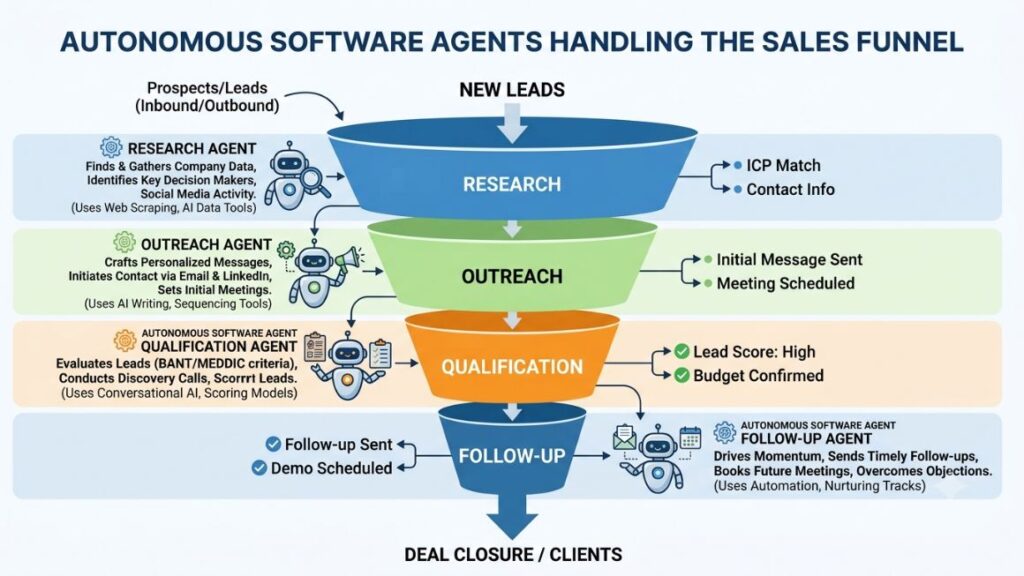
Table of Contents
What Is an Agentic AI System, and How Does It Actually Work?
An AI agent is software that can perceive a situation, decide what to do about it, and act on that decision with little or no human input. That’s the whole definition. No fluff needed.
Where this differs from a regular chatbot or automation script matters a lot. A script follows a fixed path: if X happens, do Y. An agent reasons through ambiguity. It can look at a website visitor’s behavior, check that against your ideal customer profile, pull context from a CRM, draft a personalized message, and send it, all without someone writing a rule for that exact scenario in advance.
Clay’s Claygent feature is a good illustration. It goes out and researches a prospect across the web, then feeds specific, personalized findings back into an outbound campaign, something a static enrichment tool simply can’t do. Salesforge’s Agent Frank works the same way on the outreach side: it takes verified leads and runs prospecting, personalization, sending, and reply handling end to end.
Honestly, the term “agent” gets thrown around loosely by vendors right now. Most of what’s marketed as agentic is still closer to smart automation. A true agent should be able to handle a change in context without a human rewriting its instructions. That distinction is worth checking before you buy anything.
An AI agent is a software system that perceives information, makes a decision, and takes action with minimal human oversight. Unlike scripted automation, it can adapt when the situation changes rather than following a fixed set of rules. The difference between a true agent and a smart chatbot comes down to whether it can reason through a new scenario on its own.
Why Growth Teams Are Turning to Autonomous Systems to Win New Business
Budgets are tighter and prospects are harder to reach, so the math on customer acquisition has stopped working the old way. According to Ringly’s 2026 ecommerce data, customer acquisition cost is up roughly 40% since 2023, and the average ecommerce CAC now sits between $68 and $84, with Shopify’s 2026 Global Commerce Report pegging the merchant-wide average closer to $318 once every cost is counted. On the B2B side, GTM 8020’s 2026 benchmarks show the average SaaS company now spends $1,200 to land a single customer, a 70% jump from earlier baselines.
That’s the pressure point. And it’s why so many teams are reaching for automation that can do more than send an email on a schedule.
The data backs up the shift. GTM 8020 reports that companies using AI for this exact problem have seen cost reductions of up to 50% in certain industries, and 88% of marketers already use AI daily in some part of their workflow. Master of Code’s 2026 agentic AI statistics point to similar gains elsewhere: one revenue-focused deployment produced a 35% increase in marketing ROI within six months alongside a 22% drop in cost per acquisition.
To be fair, not every result is that clean. Gartner projects that more than 40% of agentic AI projects will be canceled by the end of 2027 over unclear value or runaway cost, based on reporting cited in Drag’s 2026 coverage. The tools work. Sloppy implementation still fails, same as it always has with new tech.
Key Benefits of Using These Systems Across the Funnel
The appeal isn’t really about replacing people. It’s about giving a small team leverage that used to require ten extra hires.
Round-the-clock coverage. A website visitor who lands at 11 p.m. gets engaged instantly instead of filling out a form and waiting until Monday. Speed matters more than most teams assume. Companies that respond within five minutes are 21 times more likely to qualify a lead than those that wait 30 minutes, per Fin’s 2026 sales research.
Lower cost per result. Salesforge reports that UniteSync achieved an 85.26% positive reply rate at a cost of just $2.86 per acquisition using its Forge stack, a number that would be almost impossible to hit through manual outbound alone.
Personalization at a scale humans can’t match. These systems can pull a prospect’s recent funding round, a leadership change, or a technology switch and reference it directly in outreach, rather than sending the same templated line to everyone on a list.
Freed-up rep time. Reps get their research and admin hours back and can spend them on the calls that actually need a human voice, tone, and judgment.
Better prioritization. Rather than working a list in order, the system flags which accounts are showing real buying signals right now, so effort goes where it’s most likely to convert.
None of this means the tools run themselves. They need clean data, a clear ideal customer profile, and someone checking outputs early on. Skip that step and the benefits above shrink fast.
Top Use Cases: Where Agentic AI Fits Into Your Growth Motion
Most teams don’t deploy one system across the whole funnel on day one. They start at a single stage and expand once it proves out.
Prospecting and Lead Enrichment
This is the most common entry point. Clay chains together multiple data providers, scrapes public sources, and hands reps a clean, enriched list instead of a spreadsheet full of gaps and outdated titles. ZoomInfo’s GTM Context Graph does something similar at enterprise scale, unifying CRM history, intent signals, and firmographic data so reps see not just who to contact but why now is the right moment.
Inbound Qualification
Qualified’s platform greets a website visitor, asks the right questions conversationally instead of through a rigid form, and routes the ones who match your ideal profile straight to a rep’s calendar. Fin for Sales does something related, using AI-generated playbooks pulled from a company’s existing documentation to qualify inbound leads without a human building the logic manually.
Outbound Personalization and Sequencing
11x.ai handles autonomous outbound prospecting and qualification, then hands off warmed leads to a conversion tool like Consensus, which sends a tailored demo before the first live meeting even happens. Lemlist layers in custom images and video inside outreach messages, a personalization tactic that’s hard to replicate manually at any real volume.
Onboarding and Early Activation
Master of Code’s case data on a GenAI onboarding agent showed a 22% lift in conversions, a 17% drop in acquisition cost, and a 20% improvement in onboarding completion, all from intelligent routing that guided new users through setup instead of dropping them into a generic welcome flow.
Retention-Driven Reacquisition
Acquiring a new customer costs five to 25 times more than keeping an existing one, per commonly cited retention research. Some of the strongest agentic deployments now watch for dormant accounts and trigger a re-engagement sequence the moment a signal appears, a funding round, a leadership change, a renewed website visit, rather than waiting for a rep to notice.
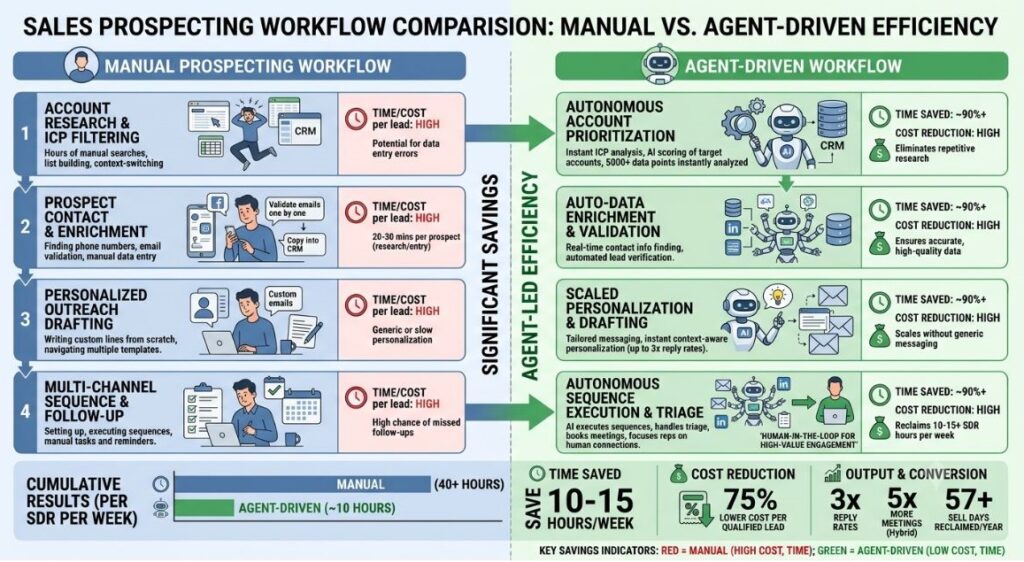
Autonomous systems now touch nearly every stage of the growth funnel, from enriching prospect data and qualifying inbound leads to personalizing outbound sequences and reactivating dormant accounts. Teams typically start with one stage, usually prospecting or inbound qualification, before expanding to the rest of the funnel. The biggest gains tend to show up where manual research and personalization used to eat the most rep time.
Read More: AI Agents for Marketers: The Complete 2026 Guide
Best Platforms to Power Autonomous Growth in 2026
If you’re evaluating an AI agent for customer acquisition for the first time, the market has split into a few clear categories rather than one obvious winner.
Clay remains the standout for data enrichment and research. Its Claygent feature lets an agent go find deeply personalized information about a contact across the open web, and teams report near-total retention once it’s embedded in a workflow.
Apollo combines a database of 230 million-plus contacts with built-in sequencing, dialing, and AI-drafted outreach in one interface, with a free tier and paid plans starting around $49 a month, which makes it an accessible starting point for smaller teams.
ZoomInfo goes further upmarket with 500 million-plus contacts, a GTM Context Graph that fuses CRM and intent data, and Leader recognition in Forrester’s Wave for Intent Data Providers, making it a strong fit for enterprise account-based programs.
Salesforge and Agent Frank cover the full outbound motion, from lead sourcing through booked meeting, with pricing built around unlimited mailboxes rather than per-seat fees.
Fin (Intercom) leads on the support-to-sales handoff, switching seamlessly between answering a product question and qualifying a sales opportunity in the same conversation, priced per resolved outcome rather than per seat.
Qualified and Gumloop round things out for teams that want either a ready-made inbound agent or a flexible, no-code builder to wire together their own workflow across whatever tools they already run.
Pricing across the category is genuinely inconsistent, worth flagging before you commit budget. Some vendors charge per outcome, some per conversation, some through opaque annual contracts, and identical sticker prices can produce very different bills depending on the model.
Read More: Top 10 AI Agent Frameworks to Build Smarter AI in 2026
How to Choose the Right Platform for Your Team
Start with where the pain actually is, not with the flashiest demo. If reps are drowning in research, an enrichment tool like Clay solves that specific problem. If inbound leads sit unanswered for hours, an inbound qualification agent like Qualified or Fin closes that gap directly.
Check the pricing model against your volume before signing anything. A per-conversation fee looks cheap until you realize you’re paying for every failed interaction, not just the resolved ones.
Ask what happens when the agent doesn’t know the answer. The strongest systems escalate cleanly to a human with full context intact. The weak ones either guess or drop the thread entirely, and that’s where trust with a prospect gets damaged fast.
And test on a small segment before rolling out company-wide. Gartner’s cancellation data on failed agentic projects is a reminder that most failures trace back to rushing full deployment before anyone validated the workflow on a smaller scale.
Common Mistakes Teams Make When Deploying Autonomous Growth Systems
The biggest mistake is treating deployment as a plug-and-play purchase instead of an ongoing process. Feeding an agent messy CRM data or an outdated ideal customer profile guarantees messy output, no matter how capable the underlying model is.
A close second: skipping human review during the first few weeks. Even the best-performing systems need a person checking tone, accuracy, and edge cases early on, or a single bad message sent to hundreds of prospects becomes a real reputation problem.
Teams also tend to underestimate integration work. An agent that can’t write back to your CRM, or that duplicates records instead of updating them, creates more manual cleanup than it saves.
And a lot of teams chase full autonomy on day one instead of proving value at one stage first. The programs that stick tend to expand gradually, stage by stage, once each one is actually working.
Read More: 10 Essential Skills to Build AI Agents in 2026
What’s Next for Agentic Growth Tools
Voice is the clearest signal to watch. Forrester’s 2026 Wave research shows voice-AI now handles 19% of inbound contact center volume, up from just 6% in 2024, and that same shift toward autonomous voice interaction is starting to show up on the outbound growth side too.
Pricing is also converging toward hybrid models. Pickaxe’s 2026 pricing research found that companies using hybrid pricing, a base platform fee plus usage-based charges, report 38% higher revenue growth than firms running pure subscription models, and 43% of SaaS companies have already adopted this approach.
The honest read for where things stand: 2026 is a year of foundational, unglamorous work rather than dramatic transformation, as Forrester’s Kate Leggett put it in the firm’s 2026 predictions. Most teams are still closing the gap between a working pilot and full production, not chasing some sweeping overnight change.
Final Thoughts
The pattern across every stat in this article points the same direction. Acquisition costs keep rising, reps keep losing time to non-selling work, and the teams pulling ahead are the ones using automation to close that gap instead of just spending more to fight it.
Start with one stage of your funnel, whether that’s prospecting, inbound qualification, or onboarding, prove the workflow works, then expand from there. The tools covered here, from Clay to Fin to Salesforge, all started as single-purpose solutions before teams stitched them into something bigger.
If you want to go deeper on building and prompting these kinds of workflows yourself, YUP’s AI Marketing course walks through exactly this, from picking the right tool to writing the prompts that make an agent actually useful for your team.
Frequently Asked Questions
What is an AI agent for customer acquisition?
It’s a software system that can research prospects, qualify leads, personalize outreach, and take action across your sales and marketing tools with minimal human input at each step. Unlike a basic chatbot, it adapts its approach based on real-time context rather than following a fixed script.
How is an AI agent different from marketing automation?
Traditional automation follows pre-built rules: if a condition is met, a fixed action happens. An agent reasons through a situation and decides what to do, which lets it handle scenarios nobody explicitly programmed for. That flexibility is the core difference.
Do I need a large sales team to use one of these tools?
No. Tools like Apollo and Clay have self-service pricing starting around $49 a month, which makes them accessible to solo founders and small teams, not just enterprise sales orgs with dedicated ops staff.
Which is better, Clay or Apollo?
They solve different problems. Clay is built for deep, chained data enrichment and research through its Claygent feature, while Apollo combines a large contact database with built-in sequencing and dialing in one interface. Many teams use both, Clay for enrichment and Apollo for engagement.
How much does it cost to deploy one of these systems?
Costs vary widely by pricing model. Per-outcome tools like Fin charge under a dollar per resolved conversation, per-seat tools like Apollo start near $49 a month, and enterprise platforms like ZoomInfo require custom contracts that can run into thousands per month.
Is this actually worth it for a small B2B company?
For most small teams facing rising acquisition costs, yes, particularly for research and follow-up tasks that eat rep time. The exception is highly relationship-driven, long-cycle B2B sales, where personal rapport still does more work than automation.
What’s the biggest risk in deploying one of these systems?
Poor data quality and skipped human review during the rollout. An agent built on outdated CRM records or an unclear ideal customer profile will personalize outreach based on bad assumptions, which damages trust with prospects faster than no outreach at all.
Can these tools completely replace a sales development rep?
Not yet, and probably not soon. They remove research, data entry, and repetitive follow-up from a rep’s day, but judgment calls, like when to push harder on a deal or when to back off, still need a human making the decision.
How do I know if my deployment is actually working?
Track deflection or resolution rate, cost per qualified lead, and reply rate against your pre-automation baseline. If those numbers aren’t improving within the first few weeks of a small pilot, the workflow needs adjusting before you scale it further.
What industries benefit most from this kind of automation?
Ecommerce and B2B SaaS see the clearest gains right now, largely because their buying signals (page visits, funding events, technology changes) are structured and easy for a system to detect and act on. Highly regulated industries with complex, judgment-heavy sales cycles tend to see smaller, slower gains.