

Job descriptions for product managers all say roughly the same thing: owns the roadmap, drives product strategy, works cross-functionally to deliver customer value. None of that tells you what actually happens between 9 AM and 7 PM. And that gap is a real problem, because a lot of people take their first PM role expecting a day built around big strategic thinking and end up disoriented by how much of it is actually meetings, messages, and documents.
Here’s what a realistic day in the life of a product manager actually looks like, and why the parts that don’t make it into the job description are usually the parts that determine whether someone succeeds in the role.
Table of Contents
The Day Starts Before the First Meeting Does
For most PMs, the workday starts with a dashboard, not a to-do list. Overnight metrics, anything that shipped in a different time zone, and any alerts that came in while you were asleep all need a quick scan before the calendar takes over. If a feature launched yesterday in a market that’s several hours ahead, this is when you find out whether it’s working.
This is also when the mental prioritization happens, before anyone else is awake to interrupt it. What actually needs attention today. What can wait. What looked urgent in a late-night Slack message but isn’t, once you’ve had coffee and a clearer head.
It’s a quiet stretch, and it doesn’t last long. The moment the wider team logs on, the day stops being yours to structure.
Morning: Stand-ups, Triage, and the Inbox That Never Empties
The daily stand-up is usually the first scheduled event, short, focused on blockers, and deceptively important. A stand-up that runs well surfaces the one dependency that would’ve derailed a sprint if it went unnoticed for another day. A stand-up that runs badly turns into a status readout nobody needed.
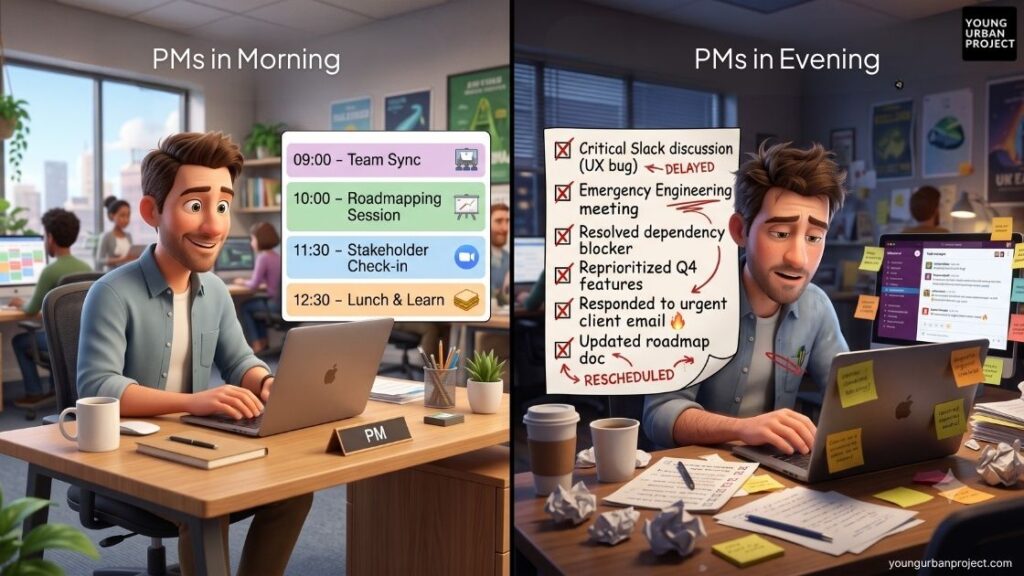
After that comes triage, and this is where a lot of a PM’s morning quietly disappears. According to Product Focus’s 2026 Product Management Profession Survey, based on responses from 677 product professionals across 40 countries, “too much firefighting” ranks among the top three challenges PMs report facing in their role, alongside lack of resources and weak or missing company strategy. That’s not a small-sample anecdote, it’s a consistent, large-scale finding: reactive, unplanned work is a structural feature of the job for most PMs, not a sign that something’s being managed poorly.
And then there’s the fire. Almost every PM day has one, a customer escalation, a bug that shipped, a stakeholder who wants an answer by noon. The morning plan gets reshuffled, and the actual skill here isn’t avoiding the fire. It’s deciding fast whether it’s genuinely urgent or just loud.
Midday: Where the Real Job Happens – Meetings With a Purpose
This is the part of the day most people picture when they think of product management, and it’s also the part most PMs feel conflicted about. Design reviews. Engineering planning syncs. Stakeholder alignment calls. Done well, these meetings are where actual decisions get made. Done badly, they’re just another version of the inbox, reactive and draining.
The difference between a useful meeting and a wasted one usually comes down to whether the PM walked in with a clear decision to make, rather than a topic to discuss. A design review that ends with “let’s think about it more” wasted everyone’s time. One that ends with “we’re shipping option B, here’s why” moved the product forward.
Here’s the honest gap worth naming. According to time allocation research from workplace analytics firm eMonitor, a genuinely healthy PM time split looks something like 40 to 50 percent on strategic work, 20 to 30 percent on customer-facing and market research activity, and the remaining 20 to 30 percent on coordination and execution oversight. PMs operating in a mostly reactive mode show close to the inverse of that, with 50 to 60 percent of their time absorbed by communication and execution tools, and strategic work squeezed into whatever margin is left. A separate survey by product management platform UXCam found 61% of PMs say they’d want to shift more of their time toward strategy specifically, believing it would meaningfully improve project outcomes. Most PMs know exactly which side of that split they’re actually living on.
A healthy product manager time allocation splits roughly 40 to 50 percent toward strategic work, 20 to 30 percent toward customer-facing activity, and 20 to 30 percent toward coordination, according to time allocation research from eMonitor. PMs stuck in a reactive mode instead see that ratio reversed, with the majority of their day absorbed by communication and execution tools rather than strategic thinking.
The Unscripted Hours: Customer Calls, User Research, and Data Digging
The part of the job that doesn’t show up in a calendar screenshot is often the part that actually determines whether the roadmap is any good.
Some PMs build real structure around this. Jun Loayza, a product leader who’s written about time management frameworks for PMs, describes a 70-20-10 rule he used while running product at design tool company Gliffy: roughly 70% of time on core roadmap execution tied to existing KPIs, 20% on validating new opportunities through customer interviews and data analysis, and 10% left open for exploring ideas that fall outside the current plan entirely. He specifically blocks two days a week as meeting-free time to protect space for this kind of work, a habit far easier to describe than to actually defend on a calendar full of other people’s requests.
The customer conversation itself is where a lot of the real signal comes from, and it’s easy to skip when the calendar is already full. A rushed PM tells themselves they already know what customers want. An experienced one keeps making time for the call anyway, because the assumptions that felt certain three months ago are usually the ones quietly wrong today.
Afternoon: Writing – PRDs, Specs, and the Documents Nobody Sees
Writing is one of the most underestimated parts of a PM’s day, and it’s also one of the most consequential. A product requirements document, a feature spec, a one-pager justifying a prioritization call, none of these are glamorous, and all of them shape what actually gets built.
Amazon’s internal culture offers one of the most well-documented examples of how seriously this can be taken. The company is known for requiring six-page narrative documents instead of slide decks for major decisions, along with a specific PR/FAQ format, writing a mock press release and a set of anticipated customer questions before a product is even built. The exercise forces a level of clarity that a bullet-point deck simply doesn’t demand, and it’s a big part of why the practice has been widely adopted and referenced well beyond Amazon itself.
Most PMs won’t write with quite that level of formal structure every day. But the underlying discipline holds everywhere: a spec that’s vague on paper stays vague in the build, and the hour spent tightening the writing usually saves several hours of confusion down the line.
How This Day Changes by Company Stage and Seniority
Everything above describes a fairly typical mid-level PM day at a reasonably structured company. That day looks meaningfully different depending on where you sit.
At an early-stage startup, a PM often wears far more hats, doing rough positioning work a PMM would normally own, writing their own user research questions without a dedicated researcher, and making calls with far less data than they’d like because there simply isn’t a research team to lean on. The upside is speed and ownership. The tradeoff is a much noisier, less predictable day, and less institutional process to fall back on when a decision gets hard.
At a larger, more structured company, the scope typically narrows but the stakeholder count grows. A PM might own a single feature area deeply rather than an entire product, but getting anything shipped requires alignment across legal, security, localization, and multiple engineering teams that don’t report to the same leadership chain. The day fills up with more meetings, not because the work is harder, but because more people have a legitimate stake in the outcome.
Seniority shifts the day too, and this is worth being honest about. A junior PM’s day skews execution-heavy: writing specs, running triage, coordinating the details of a launch someone more senior already decided on. A senior or director-level PM’s day skews toward influence and strategic framing, shaping which problems the team even works on, defending a prioritization call to leadership, and mentoring more junior PMs through their own version of this same daily grind. The mechanics don’t disappear at the senior level. They just take up a smaller share of the day, replaced by more time spent on the “why” behind the roadmap rather than the day-to-day “how.”
What This Day Actually Reveals About the Skills That Matter
Step back from the hour-by-hour detail and a pattern shows up clearly. The job isn’t really about vision-setting in the abstract sense most job descriptions imply. It’s about constant context-switching between a customer conversation, a technical constraint, and a business goal, often within the same hour. It’s about writing clearly enough that a spec doesn’t need three follow-up meetings to clarify. And it’s about defending a prioritization call under real pressure, repeatedly, often to people who disagree with you and have their own legitimate priorities pulling in a different direction.
None of that shows up in a job posting. All of it shows up by 11 AM on a normal Tuesday.
The Bottom Line
A day in the life of a product manager rarely looks like the strategic, big-picture work the job title implies, especially early in a PM career. It’s triage, meetings with a purpose, unscripted customer conversations, and a surprising amount of writing, all held together by the ability to keep switching contexts without losing the thread. The strategic, vision-setting version of the job is real, but it’s usually earned by first getting genuinely good at the unglamorous daily mechanics.
If you’re building toward a PM career and want to understand these mechanics deeply rather than learning them the slow way on the job, our Product Management Course walks through prioritization frameworks, stakeholder management, and the practical daily workflow of the role.
Frequently Asked Questions About Day in the Life of a Product Manager
Is a product manager’s job mostly meetings?
For many PMs, yes, a large share of the day involves cross-functional meetings, and research from eMonitor suggests PMs operating in reactive mode can spend 50 to 60 percent of their time in communication and coordination activities rather than strategic work. The goal for a healthy PM day is closer to a 40-50% strategic split, though most PMs report wanting more of that balance than they actually get.
How many hours does a product manager actually work in a day?
This varies significantly by company and stage, but most PMs report a workday in the 8 to 10 hour range, with the mental load often continuing beyond clocked hours since product decisions don’t stop being top of mind after a meeting ends. Startup PMs in particular often report longer or less predictable hours due to wearing multiple roles at once.
Does a product manager write code?
Most product managers don’t write production code as part of their core role, though technical fluency to understand engineering constraints is important, especially for technical or platform products. The core skill set centers on prioritization, writing, and cross-functional communication rather than hands-on development.
How is a product manager’s day different from a product marketing manager’s day?
A product manager’s day centers on roadmap decisions, specs, and engineering coordination, while a product marketing manager’s day centers on positioning, messaging, and go-to-market coordination with sales. The two roles overlap heavily around launches but spend most of the day working with different teams toward different outputs.
Does a product manager’s daily routine change with seniority?
Yes, significantly. A junior PM’s day tends to be execution-heavy, focused on writing specs and coordinating details of decisions already made higher up, while a senior or director-level PM spends more time shaping which problems get prioritized and defending those calls to leadership. The core daily mechanics, meetings, writing, triage, remain present at every level, just in different proportions.
Is a product manager’s day-to-day stressful?
It can be, largely due to constant context-switching and the responsibility of making prioritization calls without complete information. The stress tends to come less from any single hard task and more from the cumulative load of switching between customer concerns, technical constraints, and stakeholder pressure throughout the day.
What’s the hardest part of a product manager’s day that nobody talks about?
The writing. Specs, one-pagers, and documents that justify a decision take real time and mental effort, and they rarely get acknowledged the way a shipped feature does, even though unclear writing is one of the most common reasons a build goes sideways.
How does a startup PM’s day differ from a big company PM’s day?
A startup PM typically handles a broader range of responsibilities with less process and fewer dedicated specialists to lean on, trading structure for speed and ownership. A PM at a larger, more structured company usually owns a narrower scope but navigates more stakeholders and more formal approval processes to get anything shipped.