

Every agency owner knows the math doesn’t work anymore. Clients want faster turnarounds and lower retainers. Your best people spend half their week on reporting decks and campaign tweaks instead of the strategy work that actually justifies your rate card. Hire more juniors and margins shrink. Don’t hire, and delivery slips.
That’s the gap AI agents are built to close, and it’s why 2026 has become the year agencies stopped treating them as a novelty. According to a Q1 2026 survey of 250 marketing and development agencies by Digital Applied, 41% of agencies had at least one AI agent in production by April 2026, running tasks like brief drafting, SEO audits, ad copy iteration, and lead qualification. This isn’t a future-of-work thought experiment. It’s already changing how agencies staff accounts.
This guide covers what AI agents actually are, why agencies are adopting them now, where they’re delivering real results, the tools worth your budget, and the rollout mistakes that get client trust burned fast.
Table of Contents
What Are AI Agents (And How They Differ From Chatbots)
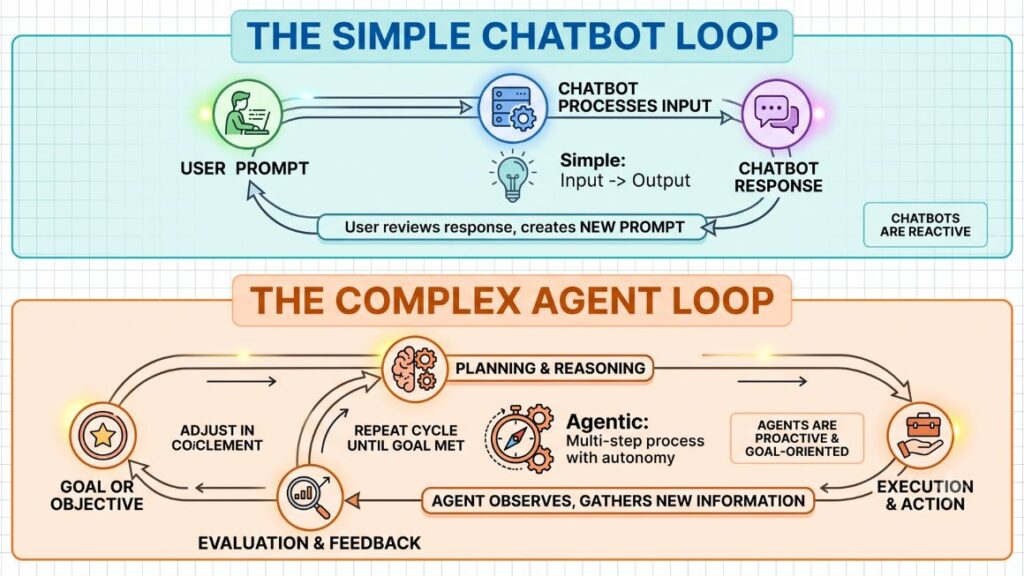
An AI agent is a system that takes a goal, plans the steps to reach it, and executes those steps across connected tools with minimal human input at each stage. That’s the standalone definition worth remembering, because it’s the line that separates agents from everything that came before them.
A chatbot answers one question at a time. A Zap moves data from A to B when a trigger fires, but it can’t decide what to do next if the situation changes. An AI agent for an agency, by contrast, can pull last week’s ad spend, notice a channel underperforming, draft a reallocation recommendation, and flag it to an account manager, all without someone building that exact workflow step by step in advance.
Honestly, this distinction gets blurred by marketing copy more than almost any other term in the AI space right now. The line between true autonomous agents and AI-powered automation platforms is genuinely blurring, and plenty of vendors slap “agent” on features that are closer to smart automation. What matters for an agency isn’t the label. It’s whether the system can reason through a multi-step task and hand you a finished output instead of a half-done draft you still need to babysit.
Why Agencies Are Turning to AI Agents Right Now
The short version: the margin problem got worse, and the technology finally caught up to the promise.
The Margin Problem Every Agency Owner Knows
Client budgets flattened while expectations for turnaround time went the opposite direction. A social media client that used to accept a monthly content calendar now wants same-week iterations. An SEO client wants audits refreshed quarterly instead of annually. None of that comes with a bigger retainer attached.
Traditional automation helped at the edges. It scheduled posts. It moved leads between systems. But it never touched the actual thinking work, the parts that used to require a strategist or a senior copywriter sitting down and making judgment calls. That’s the layer AI agents move into, and it’s the layer where agency margin actually lives.
What Changed Technically Between 2025 and 2026
Two things shifted. First, models got significantly better at multi-step reasoning and at using tools reliably across a chain of actions instead of one prompt at a time. Second, the ecosystem around agents matured fast. Platforms like Salesforce Agentforce and HubSpot Breeze AI shipped agent frameworks built specifically for marketing operations, and orchestration tools like Zapier and Make added native agentic steps rather than treating AI as a bolt-on. Make now positions itself explicitly as a platform to build and orchestrate agentic workflows, which is a very different pitch than the “connect two apps” framing automation tools used even two years ago.
AI agents differ from traditional automation because they reason through multi-step goals rather than executing fixed triggers. By April 2026, 41% of surveyed marketing and development agencies had at least one agent in production, according to Digital Applied’s 250-agency survey, most commonly for brief drafting and SEO audits.
Key Benefits of AI Agents for Agencies
The appeal isn’t abstract. Agencies adopting AI agents point to three concrete wins, and they show up on the P&L, not just in a case study slide.
Faster Client Delivery Without Adding Headcount
Give an agent a goal like “pull last week’s performance across Google Ads and Meta and draft the Monday client summary” and it connects to both platforms, formats the numbers, and produces a draft your account manager edits instead of builds from scratch. That’s hours back every week, per account, without a new hire.
Consistent Quality Across Accounts
New account managers ramp up slowly. Judgment calls vary person to person. Agents built around a defined process (a specific audit checklist, a specific reporting template, a specific brand voice guide) apply that process the same way every time, whether it’s account three or account thirty.
Freeing Senior Talent for Strategy, Not Execution
This is the one agency owners care about most. When an agent handles the first draft of a brief, the first pass of an SEO audit, or the routine parts of ad optimization, your senior strategists spend their time on the judgment calls that actually need a human. That’s a better use of a $120,000-a-year salary than pulling analytics screenshots.
Where Agencies Are Actually Deploying AI Agents (Use Cases)
Adoption isn’t even across every workflow. Some tasks are a natural fit for agents right now. Others still need a human in the loop for good reason.
Client Reporting and Analytics Agents
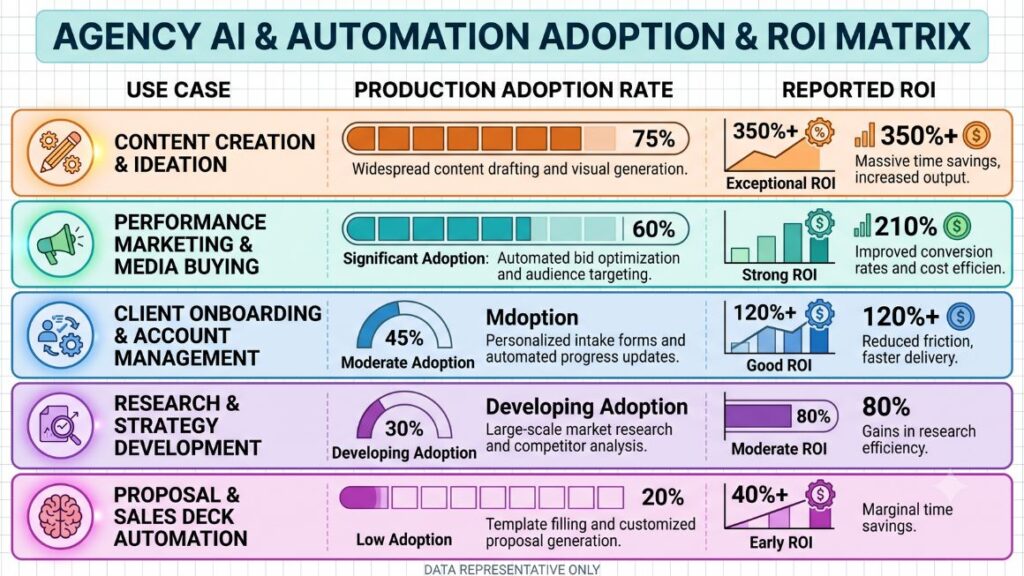
This is the easiest starting point for most agencies, and it shows in the data. Reporting-adjacent workflows are where agencies see the fastest payback, because the inputs are structured (ad platform APIs, GA4, CRM exports) and the output format rarely changes month to month. An agent that pulls, formats, and drafts commentary on a weekly performance report can save an account team several hours every single week.
SEO and Content Agents
SEO audit agents are the second most common deployment among agencies, trailing only brief and outline generation. Digital Applied’s survey found SEO audit agents running in production at 51% of surveyed agencies, with the highest reported ROI of any workflow type measured. Tools like Surfer SEO and Semrush have built agentic features that crawl a site, flag technical issues, and draft optimization recommendations without a human running each check manually.
Content briefing follows a similar pattern. Brief and outline generation is the most common agentic workflow among agencies, running in production at 64% of surveyed shops, largely because a human strategist reviews the output before it goes anywhere near a client, which keeps the quality bar forgiving enough for an agent to clear it.
Paid Media Optimization Agents
Platforms like Salesforce Agentforce and specialized tools such as Tofu now let agencies set a budget-reallocation goal and let an agent monitor spend across channels, flagging or executing shifts within guardrails the account team sets in advance. Agentic platforms in this category are evaluated on integration depth, personalization granularity, and orchestration scope, which is a fair way to judge whether a paid media agent is doing real work or just generating a nicer dashboard.
Client Onboarding and Account Management Agents
A new-client kickoff involves the same repeatable steps every time: intake forms, access requests, brand guideline collection, kickoff deck assembly. Agents built on platforms like HubSpot Breeze or custom-built with Zapier’s agentic steps can run that entire sequence and only surface exceptions to a human.
Social Media and Community Management Agents
This is the category agencies stay most cautious about, and for good reason. Drafting and scheduling posts works well with an agent in the loop. Responding live to comments or DMs on a client’s public account is where most agencies still keep a person reviewing before anything goes out, because one badly-timed autonomous reply can do real brand damage.
Best AI Agent Tools for Agencies in 2026
There’s no single “best” tool, because agency needs split by function. Here’s how the current landscape breaks down.
| Tool | Best For | Notes |
|---|---|---|
| Salesforce Agentforce | Enterprise clients, CRM-native agents | Deep integration with existing Salesforce data; strongest for agencies serving larger accounts |
| HubSpot Breeze AI | Mid-market inbound and account management | Native to HubSpot’s CRM and marketing hub, good fit if clients already run on HubSpot |
| Zapier Agents | Fast, low-code agent builds across a fragmented stack | Highlights integrations across 8,000-plus apps, Generation Digital easiest entry point for agencies without dev resources |
| Make | Visual orchestration of multi-step agentic workflows | Best for teams that want to see and control the logic behind each automation step |
| Surfer SEO / Semrush | SEO audit and content optimization agents | Purpose-built for the highest-ROI agency use case identified in the 2026 agency survey |
| Jasper | Brand-voice-consistent content agents at volume | Positions itself explicitly around AI agents for marketing and brand voice management, Generation Digital useful for agencies juggling many client voices |
| Gumloop | Custom agent workflows for technical teams | Fits dev-forward agencies building bespoke agent chains rather than using off-the-shelf platforms |
For most small and mid-size agencies, the practical starting stack looks like one CRM-native agent platform (Agentforce or Breeze, whichever matches the client’s existing tools), one orchestration layer (Zapier for speed, Make for control), and one SEO or content agent tool layered on top. Adding every category at once is how pilots stall before they ever reach a client account.
The strongest agency AI stacks in 2026 pair a CRM-native agent platform with an orchestration layer and a purpose-built SEO or content agent, rather than adopting a single all-in-one tool. Reporting and SEO audit agents deliver the fastest payback, while live client-facing social responses remain the workflow agencies are slowest to automate.
How to Roll Out AI Agents Without Breaking Client Trust
Deploying agentic AI across every account at once is the fastest way to damage the relationships you’re trying to protect. A staged rollout gets you to production without that risk.
- Pick one workflow, not the whole agency. Reporting or brief generation are the safest starting points because a human already reviews the output before a client sees it.
- Run it on internal or low-stakes accounts first. Test the agent against a client relationship you can afford a rough draft with, not your biggest retainer.
- Set explicit guardrails. Define exactly what the agent can execute autonomously and what it must flag for a human, especially anything client-facing or budget-related.
- Keep a human checkpoint on anything client-facing. Draft generation can be autonomous. Sending, posting, or spending on a client’s behalf should not be, at least not in the first six months of use.
- Measure token spend against actual hours saved. Agentic tools aren’t free to run, and it’s easy to over-report ROI if you’re not tracking the real cost per task.
- Expand only after the first workflow is stable. Move to the next use case only once the first one has run cleanly for a full billing cycle.
That’s the whole game. Start with a workflow, not the whole agency. What most agencies get wrong isn’t picking the wrong tool. It’s skipping the guardrail step because the demo looked convincing.
What Could Go Wrong With Agentic AI (Risks and Limitations)
Agencies rushing to deploy agents everywhere run into the same wall enterprise IT teams hit first. The most-cited statistic in 2026 enterprise AI conversations is that 88% of agent pilots never reach production, a figure that originated with Anaconda and Forrester research and has since been replicated by independent surveys. Non-deterministic outputs are the single largest barrier leaders name to getting an agent production-ready, which is a polite way of saying the agent gives a slightly different answer every time you ask it the same question.
For an agency, that unpredictability matters more than it does inside a single company, because your output goes directly to a paying client. An agent that occasionally misreads a metric or drafts an off-brand line of copy is a minor annoyance internally. Sent straight to a client account without review, it’s a trust problem you don’t get back easily.
There’s also the token spend issue nobody likes to mention out loud. The Digital Applied agency survey found systematic over-reporting on ROI of about 18% on average, alongside under-reporting on token spend of roughly 24%. Agencies that don’t track the real cost per agent task tend to overstate how much money they’re saving.
None of this means agents aren’t worth deploying. It means they’re worth deploying with the same skepticism you’d apply to a new junior hire: give them defined tasks, review the early work closely, and expand responsibility only once they’ve earned it.
Conclusion
AI agents for agencies aren’t a staffing replacement. They’re a way to get the repeatable parts of delivery, reporting, audits, briefs, off your senior team’s plate so those people can spend their time where judgment actually matters. The agencies pulling ahead in 2026 aren’t the ones that deployed agents everywhere at once. They’re the ones that picked one workflow, kept a human checkpoint on anything client-facing, and expanded only once the first use case proved out.
If you’re figuring out where AI fits into your agency’s operations beyond a single tool decision, that’s exactly what YUP’s AI Marketing course walks through, from picking the right first workflow to building the internal process around it. Worth a look if you’re past the “should we do this” question and into the “how do we do this without breaking anything” part.
FAQs
What is an AI agent for an agency?
An AI agent for an agency is a system that takes a defined goal and autonomously plans and executes the steps to reach it across connected tools, unlike a chatbot that only responds to one prompt at a time. In practice this looks like an agent that pulls campaign data, drafts a client report, and flags anomalies without a person building each step manually.
How is an AI agent different from marketing automation?
Automation executes a fixed sequence you built in advance and can’t adapt if the situation changes. An AI agent reasons through the task and can adjust its approach, which is why agencies use automation tools like Zapier for simple triggers and agentic tools for tasks that need judgment, like drafting a reallocation recommendation.
Do agencies actually use AI agents, or is this mostly hype?
They do, and the adoption numbers are specific rather than vague. A Q1 2026 survey of 250 agencies found 41% already running at least one agent in production, most commonly for brief drafting and SEO audits. That said, adoption is uneven, and plenty of pilots never make it past testing.
Which AI agents should a small agency start with?
Start with a reporting or brief-generation agent, since those workflows already have a human reviewing the output before a client sees it. Tools like Zapier Agents or a CRM-native option like HubSpot Breeze are the lowest-friction entry points for agencies without dedicated dev resources.
Are AI agents safe to use on live client accounts?
They’re safe for drafting and internal tasks, but most agencies keep a human checkpoint on anything client-facing, like sending emails, posting on social, or reallocating ad spend. That review step is what separates a productive agent from a risky one.
How much does it cost to run AI agents for agency workflows?
Cost varies by platform and task volume, since most agent tools charge based on tasks run or tokens consumed rather than a flat license fee. Agencies that skip tracking actual token spend tend to underestimate their real cost, so it’s worth measuring cost per task before scaling any single agent across more accounts.
Will AI agents replace agency jobs?
Agents are replacing specific tasks, like first-draft reporting and routine audits, not entire roles. The agencies seeing the best results are using agents to free senior strategists from execution work rather than cutting headcount outright, though junior roles built purely around manual reporting are the most exposed.
What’s the biggest reason AI agent pilots fail at agencies?
Unpredictable output is the top-cited barrier, since an agent that gives a slightly different answer each run is harder to trust with client-facing work. Agencies that succeed tend to start with low-stakes, review-gated workflows rather than trying to automate an entire account at once.
Do AI agents work for every type of marketing agency?
They work best where tasks are repeatable and structured, like reporting, SEO audits, and content briefing. Agencies built around highly bespoke creative work or live community management have found agents useful for drafts and first passes, but less useful for anything requiring real-time human judgment.
How do I know if my agency is ready to adopt AI agents?
If your team is spending significant hours on reporting, audits, or brief generation that follow a repeatable process, you’re a good candidate to start. If your account teams are still figuring out consistent processes for those tasks manually, fix the process first, since an agent will just automate an inconsistent workflow faster.