
Picking between ChatGPT and Claude used to be simple. One was better at writing, the other was better at code, and most people just picked based on price. That’s not true anymore. Both tools now run agents that browse the web, operate your computer, write spreadsheets, and finish multi-hour projects without you sitting there prompting every step.
That changes what “better” even means. A ChatGPT vs Claude decision today isn’t about which one gives smarter answers. It’s about which one fits how you actually work: your budget, your tools, and whether you need an agent that lives in your browser or one that lives in your terminal.
This guide breaks down both platforms end to end. Model lineups, benchmarks, writing quality, coding tools, agentic features, context handling, safety, pricing, and where each one clearly wins. By the end, you’ll know exactly which assistant belongs in your workflow, and why.
Table of Contents
What ChatGPT and Claude Actually Are
ChatGPT is OpenAI’s consumer and developer AI assistant, built on the GPT model family, that handles chat, coding, research, and increasingly, autonomous multi-step tasks. It launched in November 2022 and has since grown into a full product suite spanning chat, an agentic coding tool called Codex, and a task-completion agent called ChatGPT Work.
Claude is Anthropic’s AI assistant family, built around the Opus, Sonnet, and Haiku model tiers, with a research-focused Mythos tier now sitting above them. Anthropic has leaned hard into safety-first design since day one, and that shows up in how Claude handles ambiguous or risky requests.
Here’s the thing. Both products stopped being “just chatbots” a while ago.
Which Models Power ChatGPT and Claude Right Now
Model names change fast in this space, and if you read an article from even three months ago, it’s probably already stale. Here’s where things stand as of July 2026.
OpenAI’s Current Lineup: From GPT-5.5 to GPT-5.6
GPT-5.6 reached general availability on July 9, 2026, replacing the GPT-5.5 lineup as ChatGPT’s frontier family. It ships in three tiers: Sol, the flagship reasoning model; Terra, a balanced everyday option priced at roughly half of Sol; and Luna, a fast, low-cost model for high-volume work. Sol introduces a new “ultra” mode that delegates parts of a task to subagents, and OpenAI says it’s about 54% more token-efficient on agentic coding work than its predecessor.
Before GPT-5.6, GPT-5.5 held the flagship spot from April 2026 onward, scoring 82.7% on Terminal-Bench 2.0 and running a 1-million-token context window. GPT-4o, GPT-4.5, and the o-series reasoning models were retired from the consumer picker back in February 2026. If you’re still referencing those model names in a workflow, it’s time to update.
Read More: 100 AI Tools for Performance Marketers to Scale Campaigns Faster in 2026
Anthropic’s Current Lineup: Sonnet 5, Opus 4.8, and the Mythos Tier
Claude Sonnet 5 launched June 30, 2026, and is now the default model on Free and Pro plans. Anthropic describes its performance as close to Opus 4.8 but at a lower price, and it’s the first Sonnet-tier model to plan, drive browsers and terminals, and check its own output without being asked. It runs a 1-million-token context window with 128,000 max output tokens.
Above Sonnet 5 sits Opus 4.8, released May 28, 2026 as the reliable flagship for daily agentic work, and Anthropic reports it’s roughly four times less likely than Opus 4.7 to let coding mistakes slide unremarked. At the very top is the Mythos tier: Claude Fable 5, generally available since June 9, 2026, and Claude Mythos 5, restricted to vetted partners through Anthropic’s Project Glasswing. Both briefly went dark in mid-June 2026 when a US export-control directive forced Anthropic to suspend access, before the Department of Commerce lifted the restriction and access returned on July 1, 2026.
That kind of model churn is exactly why any Claude AI comparison needs a date stamp. What was true in March may not be true today.
As of July 2026, ChatGPT’s frontier model is GPT-5.6 Sol, while Claude’s default is Sonnet 5, with Opus 4.8 as the higher-accuracy option and the Mythos-tier Fable 5 sitting above both as Anthropic’s most capable public model.
Performance Benchmarks: Reasoning, Coding, and Agentic Tasks
Benchmark scores move so quickly that a table from last quarter is often outdated by the time you read it. Still, a few patterns hold. On coding benchmarks like SWE-bench Pro, Claude Sonnet 5 scores 63.2%, trailing Opus 4.8’s 69.2%, while GPT-5.5 posted 82.7% on the newer Terminal-Bench 2.0 suite, a different but related agentic-task benchmark, according to OpenAI’s April 2026 release notes.
On raw coding capability, GPT-5.3-Codex and its successors have consistently led general-purpose coding indexes, per Artificial Analysis’s Coding Index. But developers testing GPT-5.6 against Anthropic’s Fable model gave mixed verdicts. MagicPath AI’s Pietro Schirano called GPT-5.6 the best model he’d used, while Every’s Dan Shipper compared GPT-5 to a reliable daily driver and Fable to a “warp drive” for the hardest, longest tasks, according to comments both made on X in July 2026.
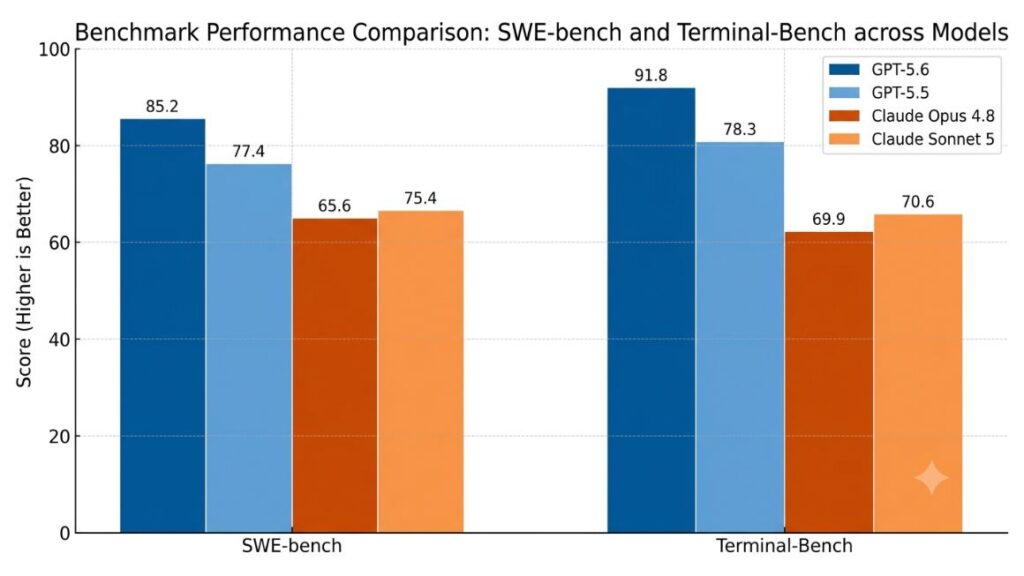
What actually matters for most people isn’t the top-line number. It’s consistency. Claude has historically been praised for following instructions literally and flagging its own uncertainty. ChatGPT has closed a lot of that gap with GPT-5’s push toward reduced hallucination and sycophancy, per OpenAI’s own GPT-5 release notes.
Read More: Best 12 AI Graphic Design Tools in 2026
Writing and Content Creation Compared
OpenAI positions GPT-5 as its strongest writing collaborator to date, with better handling of structural forms like unrhymed verse and long-form narrative flow, and that same writing improvement carries into everyday tasks like drafting reports and emails. Claude, by contrast, tends to produce writing that reads a touch more measured and less “smoothed over,” which some writers prefer for professional documents where tone control matters more than flourish.
Neither model is dramatically better across the board. The difference shows up in editing behavior. ChatGPT’s Canvas tool lets you edit inline with tracked suggestions, closer to a Google Docs workflow. Claude’s Artifacts panel renders a document, webpage, or code file separately from the chat, so you can iterate on one version while keeping the conversation history intact.
If you’re doing high-volume content work, blog posts, ad copy, product descriptions, this is where most teams run their own AI chatbot comparison test before committing to one tool for their content pipeline. Run the same brief through both, and you’ll usually find one produces cleaner first drafts for your specific brand voice.
Brands like Nykaa and boAt have both leaned on generative AI tools internally for early-stage content drafts before a human editor takes over, a pattern that’s become standard across Indian D2C marketing teams over the past year.
Coding and Developer Workflows
This is where the two ecosystems diverge the most. ChatGPT’s coding stack runs through Codex, OpenAI’s agentic coding tool available in the CLI, VS Code extension, and as a cloud sandbox. Codex usage is billed against your ChatGPT plan’s shared credit pool, with GPT-5.6 Sol available from Plus upward.
Claude’s coding stack runs through Claude Code, a terminal-first agent that reads repositories, runs shell commands, and edits files directly, plus the newer Claude Cowork, which brings that same agentic architecture to non-coding knowledge work like spreadsheets and slide decks. Claude also scores well on MCP-based tool integration: Claude Opus 4.7 hit 77.3% on MCP-Atlas, ahead of Gemini 3.1 Pro’s 73.9% and GPT-5.4’s lower score, according to Suprmind’s 2026 feature tracking.
Step 1: Decide whether your work is primarily code-first or task-first. If you live in a repository all day, Claude Code’s terminal-native design tends to fit better. If you need an agent that also touches spreadsheets, slides, and email, Cowork or ChatGPT Work both aim at that broader surface.
Step 2: Check your usage caps before committing. Codex on ChatGPT Plus gives you 15 to 90 messages per 5-hour window on GPT-5.6 Sol, which sounds generous until you’re running long agentic sessions daily.
Step 3: Test both on your actual codebase, not a toy example, since real repositories expose context-handling differences that demo tasks don’t.
Read More: No-Code Workflow Automation Tools: Why They Matter in 2026
Agentic Features: Computer Use, Browsing, and Tool Calling
Both companies have raced to ship browser agents in 2026. Claude for Chrome navigates, clicks, and fills forms inside your existing Chrome browser, and it pairs directly with Cowork so Claude can research on the web and then hand that research to a polished document, spreadsheet, or deck without any copy-pasting. It’s in beta on all paid plans.
ChatGPT’s equivalent is Atlas, its standalone agentic browser, alongside the Operator agent bundled into the higher Pro tier. Reviewers testing all three major browser agents in 2026, Claude for Chrome, ChatGPT Atlas, and Perplexity Comet, found Claude’s execution quality and its tie-in with Cowork gave it an edge for multi-step research tasks, though Claude for Chrome on the Pro plan is currently limited to the smaller Haiku 4.5 model, which creates a real quality gap against Max-tier access.
Claude Cowork itself expanded from a desktop-only tool to web and mobile access on July 7, 2026, letting you start a task on your phone and pick up the finished output at your desk. Anthropic’s own usage data across 1.2 million Cowork sessions found software development made up less than 9% of usage; the bulk was everyday business tasks like reconciling spend, building onboarding checklists, and drafting decks from meeting transcripts.
Anthropic reports that across 1.2 million Cowork sessions, business operations and content creation made up roughly half of total usage, with coding tasks accounting for less than 9%, showing that agentic AI adoption is being driven by everyday office work, not just software engineering.
Context Windows and Long-Task Handling
Both Claude Sonnet 5 and GPT-5.5/5.6 now run 1-million-token context windows, so on paper they’re evenly matched for long documents or codebases. There’s a catch worth knowing about on the Claude side: Sonnet 5 uses a new tokenizer that produces roughly 30% more tokens for the same text compared to Sonnet 4.6, according to Anthropic’s own migration documentation. That means the effective amount of text you can fit in that 1-million-token window is actually smaller than the raw number suggests, even though per-token pricing didn’t change.
For anyone budgeting token costs or output limits, that’s a detail that can quietly break a workflow tuned for the previous model generation. Test your actual documents rather than assuming the numbers translate one to one.
Safety, Guardrails, and Reliability
Anthropic built its identity around safety-first model design, and that still shows. Claude Sonnet 5 launched with real-time cybersecurity safeguards that can refuse high-risk requests outright, and Anthropic’s safety evaluations found it shows an overall lower rate of undesirable behavior than Sonnet 4.6. The Mythos-tier models carry even tighter classifier systems that automatically reroute flagged biology, chemistry, or cybersecurity requests to the safer Opus 4.8 model instead.
OpenAI has moved in a similar direction. Its Model Spec update in 2026 strengthened guidance around user wellbeing, extending guardrails around self-harm signals to cover signs of delusion and mania, with examples showing how models should respond to distress without reinforcing inaccurate beliefs.
Neither company publishes a perfect hallucination rate, and independent trackers show real gaps depending on whether web search is enabled. One audit found ChatGPT’s citation hallucination rate on the free tier without search reached 67% in testing by the Columbia Journalism Review, a reminder that free-tier limitations matter more than most people assume when accuracy is on the line.
Pricing and Plans Compared
Here’s where budget usually settles the debate. ChatGPT runs six tiers: Free, Go ($8/month), Plus ($20/month), Pro ($100 or $200/month depending on usage multiplier), Business (around $20 to $25 per seat), and custom Enterprise pricing. Plus unlocks GPT-5.6 Sol, Codex, image generation, and the Work agent. The $200 Pro tier adds unlimited Sora video and a higher-accuracy Sol Pro model.
| Plan | Price | Key Access |
|---|---|---|
| ChatGPT Free | $0 | GPT-5.5 Instant, limited messages, ads (US) |
| ChatGPT Plus | $20/mo | GPT-5.6 Sol, Codex, Work agent, Canvas |
| ChatGPT Pro | $100-$200/mo | 5x-20x usage, Sol Pro, unlimited Sora (at $200) |
| Claude Free/Pro | $0-$20/mo | Sonnet 5 default, limited Cowork/Chrome |
| Claude Max | $100+/mo | Higher usage limits, Opus 4.8, Fable 5 access |
| Claude Team/Enterprise | Custom | Cowork, admin controls, Compliance API |
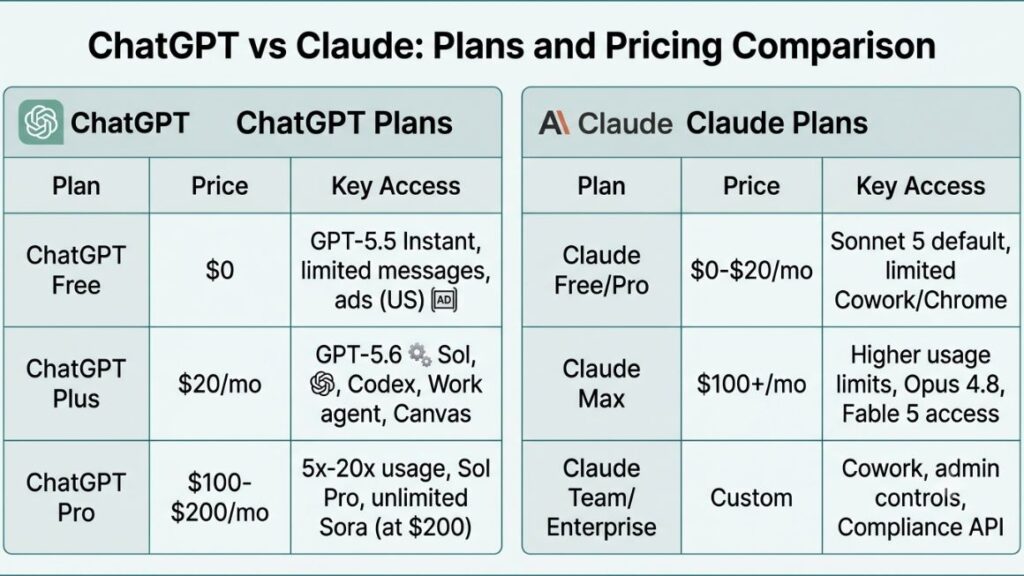
Claude’s structure runs Free, Pro ($20/month), Max (from $100/month, with a 5x tier), Team, and Enterprise. Anthropic recently extended broader access to Fable 5 across all paid plans through July 12 before shifting it to a token-based usage model, so check current terms before assuming ongoing flagship access is included at every tier.
For anyone running an AI assistant comparison purely on cost, Plus and Claude Pro land at the same $20/month starting point, which makes the real decision about feature fit rather than price.
Which One Should You Actually Use?
Honestly, this comes down to your workflow more than either model’s raw intelligence. If you’re a developer living in a terminal all day, Claude Code’s design and Opus 4.8’s coding reliability tend to win out. If you want one agent that touches your inbox, calendar, spreadsheets, and slides without switching apps, ChatGPT Work and Claude Cowork are both aiming at that same job, and the deciding factor is usually which ecosystem your other tools already live in.
For long-form writing and editing, either model handles the job well, though Claude’s more measured tone tends to need less rewriting for professional documents. And if you need the absolute highest reasoning ceiling for research-grade work, Anthropic’s Mythos-tier Fable 5 and OpenAI’s GPT-5.6 Sol Ultra mode are both reaching for that same frontier, just through different pricing models.
That’s really the whole ChatGPT vs Claude question in practice: it’s not about which one wins a benchmark, it’s about which one matches how your day actually runs.
Conclusion
Both platforms have converged on the same idea: an assistant that doesn’t just answer questions but finishes real work, across your browser, your files, and your terminal. The gap that’s left isn’t really about intelligence anymore. It’s about fit. Claude tends to win for developers and anyone who wants a more careful, safety-conscious agent; ChatGPT tends to win for broad ecosystem reach and Sora-adjacent creative tools.
Test both on your actual daily tasks before committing to either subscription, since a benchmark win rarely predicts which tool will actually save you time. If you want to build a repeatable system for choosing and prompting the right AI tool for your team’s workflow, that’s exactly what we cover inside Hotskill and YUP’s AI Marketing course, with hands-on frameworks for evaluating new AI tools as they launch.
FAQs
What is the main difference between ChatGPT and Claude?
ChatGPT is built on OpenAI’s GPT model family and leans into a broad consumer ecosystem with Codex and Work agents, while Claude is Anthropic’s family built around Opus, Sonnet, and Haiku tiers with a stronger safety-first design philosophy. Both now handle chat, coding, and autonomous agentic tasks.
ChatGPT vs Claude, which one is better for coding?
It depends on your workflow. Claude Opus 4.8 and Claude Code tend to edge ahead on complex, long-horizon coding tasks and terminal-based work, while GPT-5.6 and Codex offer strong general-purpose coding with a large ecosystem of IDE and CLI integrations.
How do I decide between ChatGPT Plus and Claude Pro?
Both cost $20 a month, so start by testing your actual daily tasks on each. If you rely heavily on a browser agent or spreadsheet automation, compare Claude Cowork against ChatGPT Work directly, since usage limits and integrations differ meaningfully between the two.
Is Claude better than ChatGPT for writing?
Claude’s writing tends to read more measured and requires less editing for professional documents, while ChatGPT’s GPT-5 generation improved significantly at handling complex literary structure and everyday writing tasks like emails and reports. Many writers find the difference comes down to personal preference rather than a clear winner.
Do ChatGPT and Claude use the same amount of context?
Both currently offer 1-million-token context windows on their top-tier models. However, Claude Sonnet 5’s newer tokenizer produces roughly 30% more tokens for the same text than its predecessor, meaning the same word count consumes more of that window than before.
Is ChatGPT or Claude safer to use?
Both companies have invested heavily in safety guardrails. Claude was built around a safety-first philosophy from the start and added real-time cybersecurity safeguards to its Sonnet 5 model, while OpenAI updated its Model Spec in 2026 to strengthen protections around user wellbeing and distress signals.
What is Claude Cowork and how does it compare to ChatGPT Work?
Claude Cowork is Anthropic’s agent that handles multi-step knowledge work like spreadsheets, reports, and research across your files and connected tools, similar in scope to ChatGPT Work, OpenAI’s own multi-step task agent launched alongside GPT-5.6. Both aim to complete real deliverables rather than just answering questions.
Do I really need a paid plan to use either tool seriously?
For casual use, both free tiers work fine, but neither gives you the flagship model, full agentic features, or reliable accuracy for citation-heavy work. If AI is part of your daily job, a $20/month plan on either platform pays for itself quickly in time saved.
Why do model names keep changing so fast?
Both OpenAI and Anthropic have moved to rapid release cycles, often shipping meaningful updates every four to eight weeks rather than waiting for full generational leaps. It’s worth checking each company’s official model page before assuming a name you’ve seen is still current.
What do most people get wrong when comparing ChatGPT and Claude?
The most common mistake is relying on outdated benchmark screenshots or model names from a few months ago. Because both platforms update models and pricing so frequently, any real ChatGPT comparison should be based on the current lineup, not on articles written even one quarter earlier.