

Your rankings look fine. Position 3, maybe position 1 on a good day. And your traffic is still down 20% from last year. That gap is the whole reason AI Overviews tracking tools exist now. Google answers the query before anyone reaches your page, and the rank tracker you’ve used for a decade has no idea it happened.
According to SparkToro’s 2026 clickstream data, roughly 65% of Google searches now end without a click to any external website. When an AI Overview appears on the page, that number climbs to 83%. Eight out of ten searchers get their answer and leave. Your rank tracker still shows you sitting pretty at position 2. It just doesn’t tell you that position 2 doesn’t matter anymore for that query, because the AI Overview answered it first.
This guide breaks down what AI Overviews tracking tools actually do, why they’ve become a separate category from traditional rank tracking, and which ones are worth paying for in 2026. You’ll also get a practical framework for choosing one based on your team size, budget, and how many AI engines you actually need to watch.
Table of Contents
What Are AI Overviews Tracking Tools?
AI Overviews tracking tools are software platforms that monitor whether, how, and where your brand appears inside AI-generated answers, including Google’s AI Overviews, ChatGPT, Perplexity, and Gemini. They’re built to answer a question traditional rank trackers were never designed to handle: am I being cited, not just ranked?
Understanding Google AI Overviews
Google AI Overviews are AI-generated summaries that appear above or alongside traditional search results, synthesizing information from multiple sources into a single answer block. They launched widely in 2024 and now appear on an estimated 48-58% of queries, depending on the vertical, according to Digital Applied’s May 2026 zero-click data update. The summary often pulls from several pages at once, citing two or three of them as sources while ignoring the rest of the page entirely.
That last part is the uncomfortable bit for anyone used to classic SEO. Ranking first doesn’t guarantee a citation. Google might lift a paragraph from the page sitting at position 7 because it answered the question more cleanly than the page at position 1.
How AI Overviews Tracking Tools Are Different From Rank Trackers
A traditional rank tracker checks where your URL sits in the organic results for a keyword. An AI Overviews tracking tool checks whether your brand or page is mentioned, cited, or quoted inside the AI-generated answer itself, regardless of where you rank below it. One measures position. The other measures presence inside a synthesized response that may not even include a clickable link to you.
Otterly AI’s “Share of AI Voice” metric is a good example of how different this measurement really is. It calculates what percentage of relevant AI responses mention your brand against your competitors, a number that has no equivalent in classic rank tracking.
Who Should Use AI Overviews Tracking Software
SEO agencies managing multiple client accounts, in-house enterprise SEO teams, SaaS companies competing on category terms, e-commerce brands fighting for product-comparison queries, and publishers whose entire business model depends on click-through traffic. Honestly, if your organic strategy still treats AI Overviews as a footnote, you’re already behind whoever’s tracking this for your category.
AI Overviews tracking tools monitor whether a brand is mentioned or cited inside AI-generated search answers, not just where a URL ranks in organic results. This distinguishes them from traditional rank trackers, which measure position but cannot detect AI citation, brand mentions, or share of voice inside synthesized responses from Google AI Overviews, ChatGPT, Perplexity, and Gemini.
Why AI Overviews Tracking Matters in 2026
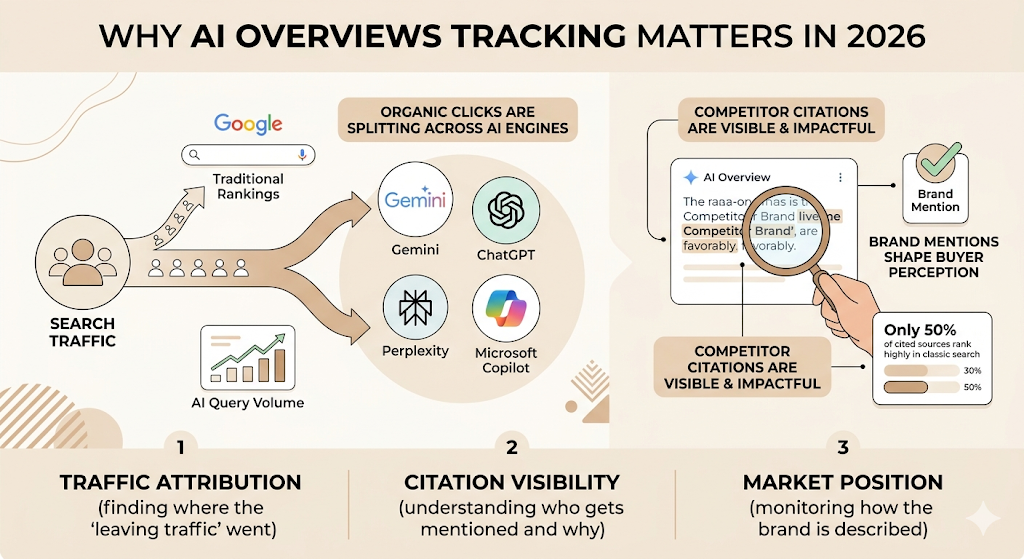
The honest answer is that the traffic is leaving, and most teams don’t have a way to see where it went.
Organic Clicks Are Splitting Across Multiple AI Engines
Search isn’t just Google anymore. Perplexity, ChatGPT, Gemini, and Microsoft Copilot all generate their own AI-driven answers, each pulling from a different mix of sources. Similarweb’s 2026 zero-click research found that AI Mode alone has surpassed one billion monthly users globally, with query volume more than doubling every quarter. If you’re only watching Google rankings, you’re missing four other places your audience might be getting answered without you.
Brand Mentions Now Matter as Much as Rankings
A mention inside an AI Overview, even without a link, still shapes how a buyer perceives your category position. Peec AI’s research found that only about 50% of the sources AI platforms cite also rank highly in traditional Google search, which means a page can win an AI citation while sitting on page two of classic search. Rankings and AI visibility are correlated, but they’re not the same game.
Competitor Citations Are Visible If You’re Tracking Them
This is the part most teams skip. If a competitor is being cited for your category’s commercial-intent prompts and you’re not tracking it, you won’t know until a prospect mentions it on a sales call. Nightwatch’s 2026 alternatives guide notes that comprehensive AI tracking now covers prompt-level citation sentiment, not just whether a brand showed up at all, but how favorably it was described.
AI search visibility now spans Google AI Overviews, ChatGPT, Perplexity, Gemini, and Copilot, and these platforms frequently cite different sources than traditional Google rankings do. A brand can rank poorly in classic SEO while still earning strong AI citation, or rank well while being invisible inside AI-generated answers, which is why tracking the two separately has become necessary rather than optional.
How AI Overviews Tracking Tools Actually Work
Most platforms in this category combine four or five distinct monitoring mechanisms, and the ones that do it best run them in parallel rather than as separate, disconnected reports.
SERP and AI Overview Monitoring
The tool runs your target keywords through search at regular intervals and checks whether an AI Overview appears for that query at all, then logs which domains it cites. Some tools, like Peec AI and Superlines, use UI scraping that simulates an actual user’s screen rather than hitting an API directly, which tends to produce results closer to what a real searcher sees.
Citation and Source Detection
Once an AI Overview or chatbot answer is captured, the tool parses which URLs, brands, and passages were used to build it. This is the data that tells you whether you were cited, ignored, or misrepresented.
Prompt-Based Tracking Across LLMs
Rather than only watching keywords, these tools track specific prompts, the actual questions a buyer might type into ChatGPT or Perplexity, and check whether your brand surfaces in the response. Ahrefs Brand Radar, for instance, pulls from a database exceeding 239 million search-backed prompts across six AI platforms.
Visibility Scoring and Historical Trends
Step 1: The tool aggregates citation frequency across all tracked prompts and keywords. Step 2: It weighs that frequency against competitor citation frequency for the same set. Step 3: It produces a single visibility score, plotted over time, so you can see whether last month’s content push actually moved the number.
AI Overviews tracking tools work by running target keywords and prompts through search and chat interfaces on a recurring schedule, then parsing the resulting AI answers to detect brand mentions, citations, and competitor presence. The output is typically aggregated into a visibility score that can be tracked over time and benchmarked against competitors.
Key Features to Look for in an AI Overviews Tracking Tool
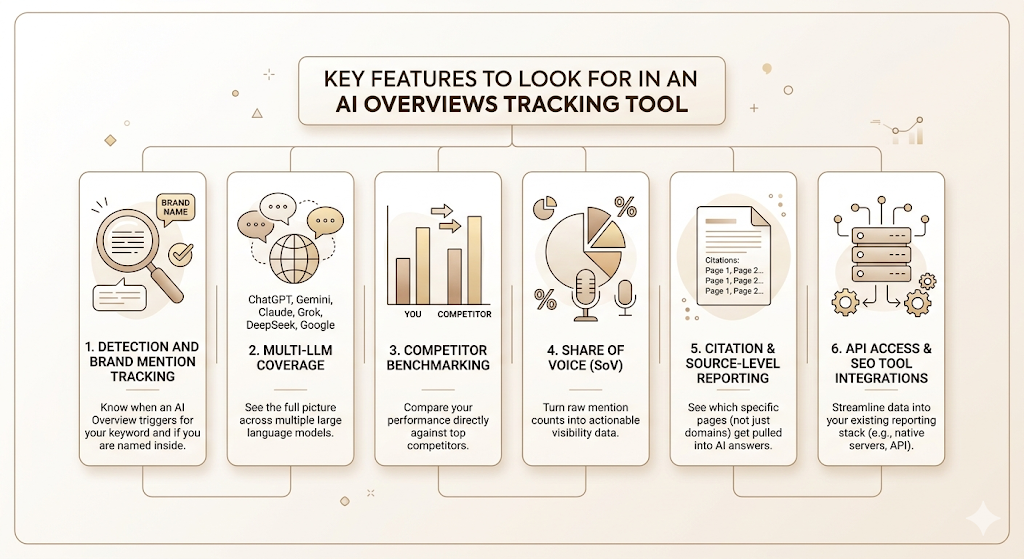
Not every platform in this space does the same job well, and the feature list matters more than the marketing page makes it look.
AI Overview: detection and brand mention tracking is the baseline. If a tool can’t reliably tell you when an AI Overview triggered for your keyword and whether you were named inside it, nothing else on the feature list matters.
Multi-LLM coverage decides how much of the picture you’re actually seeing. KIME tracks ten AI models on every plan tier, including ChatGPT, Gemini, Claude, Grok, DeepSeek, and Google AI Overviews. Profound also reaches ten models, but gates full coverage behind its Enterprise plan, so check what’s included before assuming parity with a competitor’s headline claim.
Competitor benchmarking and Share of Voice turn raw mention counts into something you can act on. Knowing you were cited eleven times last month means nothing without knowing your top competitor was cited forty times for the same prompts.
Citation and source-level reporting show you which specific pages, not just which domains, are getting pulled into AI answers. This is the data you use to figure out what’s actually working on your site.
API access and SEO tool integrations matter once you’re past the trial phase. SE Ranking’s native MCP Server, for example, lets agencies pull AI visibility data directly into their existing reporting stack instead of exporting CSVs by hand every Monday.
Benefits of Using AI Overviews Tracking Software
The case for paying for one of these tools comes down to a handful of concrete outcomes, not abstract “visibility” talk.
You improve AI search visibility by finally seeing which prompts trigger an AI Overview for your category and whether you’re inside it, which turns a vague goal into a list you can actually work through. You identify lost traffic opportunities by spotting high-volume queries where an AI Overview now answers the question directly, meaning the organic click you used to get there simply isn’t coming back, no matter how well you rank.
You discover citation opportunities that classic SEO would never surface, since a page sitting outside the top five organic results can still be the one Google or ChatGPT quotes if it answers the question more directly than higher-ranking pages do. You measure content performance beyond rankings, which matters because a page can be doing real work for your brand’s AI presence while showing flat numbers in a traditional rank tracker.
You gain competitive insight that’s otherwise invisible, since most teams have no idea how often a rival is being cited until a prospect brings it up unprompted. And for larger organizations, you get the reporting infrastructure enterprise SEO teams need to justify continued investment in content and technical SEO when the click-through-rate story alone looks discouraging on paper.
AI Overviews tracking software helps teams identify which queries trigger AI-generated answers, whether their brand is cited inside those answers, and how that citation rate compares to competitors. The practical benefit is replacing a vague visibility goal with a specific, trackable list of prompts and pages to optimize, supported by data that traditional rank tracking cannot provide.
Common Use Cases Across Teams and Industries
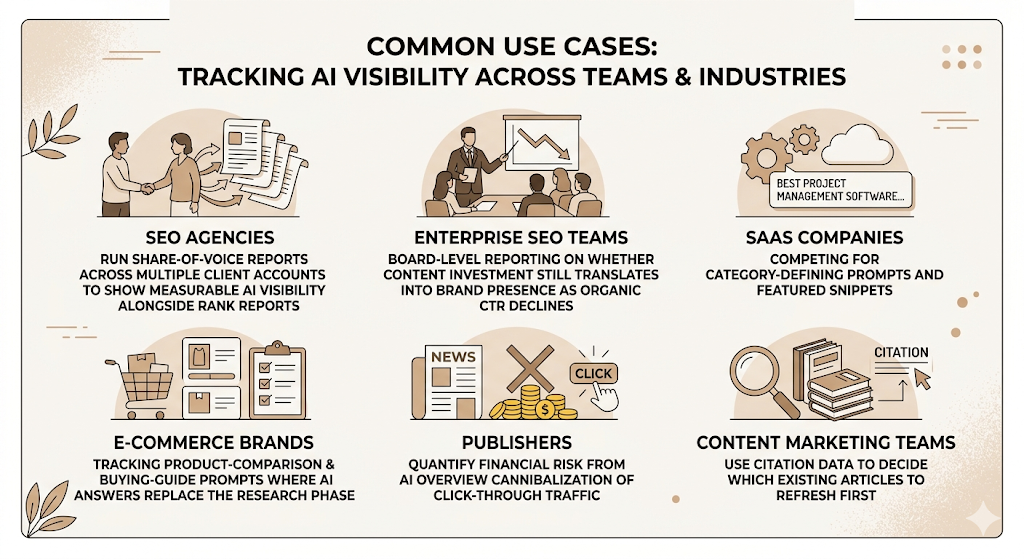
- SEO agencies running share-of-voice reports across multiple client accounts to show measurable AI visibility alongside classic rank reports.
- Enterprise SEO teams that need board-level reporting on whether content investment is still translating into brand presence as organic CTR declines.
- SaaS companies competing for category-defining prompts like “best project management software for remote teams.”
- E-commerce brands tracking product-comparison and buying-guide prompts where AI answers increasingly replace the research phase of a purchase.
- Publishers whose revenue model depends directly on click-through traffic, making AI Overview cannibalization a financial risk they have to quantify.
- Content marketing teams use citation data to decide which existing articles to refresh first, instead of guessing.
Best AI Overviews Tracking Tools in 2026
| Tool | Best For | AI Citation Tracking | Competitor Analysis | Multi-LLM Support | Starting Price |
| Profound | Enterprise brands, Fortune 500 reporting | Yes | Yes | 10 engines (Enterprise tier) | Custom enterprise pricing |
| Otterly AI | Budget-conscious teams, agencies | Yes | Yes (Share of AI Voice) | 4 engines on Lite | $29/month |
| Peec AI | Mid-market teams wanting a clean UI | Yes | Yes | 3-4 base, add-ons for more | €89/month |
| Ahrefs Brand Radar | Existing Ahrefs users with a budget | Yes | Yes | 6 engines (bundled add-on) | $699/month bundled |
| Semrush AI Toolkit | Existing Semrush users | Yes | Yes | Multiple, per-domain pricing | $99/month add-on |
| SE Ranking / SE Visible | Agencies needing MCP integration | Yes | Yes | Multiple | $89/month add-on |
| Scrunch AI | Brand perception and knowledge hubs | Yes | Yes | Multiple | Custom |
| Nightwatch | Teams wanting full-spectrum AI + SEO tracking | Yes | Yes | Multiple | Custom |
| AthenaHQ | Teams needing ROI case studies for leadership | Yes | Yes | Multiple | $295/month |
| Knowatoa | Sentiment-focused brand monitoring | Yes | Yes | Multiple | $59/month |
Profound
Profound is the enterprise name in this category, and it’s positioned that way deliberately, with Fortune 500 clients and a reported $1 billion valuation. Its Answer Engine Insights feature lets brands see exactly where they’re mentioned across ChatGPT, Perplexity, Google AI Overviews, and Copilot, along with the context behind each mention. Its Conversation Explorer surfaces the actual questions people are asking AI platforms, which is genuinely useful for content planning.
Pros: Deep multi-LLM coverage, strong enterprise reporting, unique prompt-volume data showing real AI search demand. Cons: Full ten-engine coverage is locked to the Enterprise tier; pricing isn’t published and skews high. Best for: Large brands with dedicated SEO or brand teams and the budget to match.
Otterly AI
Otterly was one of the earliest dedicated AI-search monitoring platforms, and its Share of AI Voice metric remains one of the cleaner ways to quantify competitive position inside AI answers. At $29/month for the Lite plan, it’s also the most accessible entry point with a published price in the category.
Pros: Affordable, straightforward reporting, white-label options for agencies, available across 40+ countries. Cons: Lighter on traditional SEO integration; lower tiers cover fewer engines. Best for: Brand marketing teams and small agencies that want focused AI visibility tracking without paying enterprise rates.
Peec AI
Peec AI uses UI scraping rather than API calls, simulating how a real user would actually see an AI response. That distinction matters more than it sounds, since API-only tools can miss the live citations and RAG-retrieved content that real users see on screen. Pricing runs from a Starter plan with 25 prompts up to Enterprise tiers with 300 or more.
Pros: High accuracy through UI-level tracking, unlimited seats on most plans, strong Slack support. Cons: Prompt volume is capped by plan tier, and additional AI models cost extra. Best for: Mid-market teams that want clean, intuitive monitoring without an enterprise contract.
Ahrefs Brand Radar
If you’re already paying for Ahrefs, Brand Radar extends the platform you know into AI visibility tracking, drawing from a database of more than 239 million search-backed prompts across six engines. The catch is the pricing structure. A realistic minimum to monitor all six platforms runs $828 a month once you stack the base Lite plan with the bundled AI index.
Pros: Massive prompt database, familiar interface for existing Ahrefs users, six-engine coverage. Cons: Genuinely expensive once fully stacked; documented accuracy gaps on ChatGPT tracking; you can only view one AI platform’s top topics at a time, not a unified cross-platform view. Best for: Teams already inside the Ahrefs ecosystem with a budget to absorb the add-on cost.
Semrush AI Toolkit
Semrush’s AI Visibility Toolkit sits at $99/month per domain as a standalone add-on, which makes it the more transparent entry point of the two major SEO-suite players. Bundled into the larger Semrush One plan, the all-in cost climbs toward $199-549/month depending on tier.
Pros: Lower entry cost than Ahrefs Brand Radar, inherits Semrush’s mature reporting infrastructure. Cons: Per-domain and per-user pricing adds up fast for agencies managing several client accounts. Best for: Teams already living inside Semrush who want AI visibility without switching platforms.
SE Ranking / SE Visible
SE Ranking has built what’s currently the tightest integration between AI visibility and traditional rank tracking in the category, including the only native MCP Server among the major players, which lets agencies pipe AI visibility data directly into existing reporting workflows.
Pros: Strong combined AI and SEO reporting, agency-friendly pricing, native automation support. Cons: Newer entrant to AI tracking, specifically, so prompt database depth trails Ahrefs and Profound. Best for: Agencies running ten or more client accounts who need the economics to scale.
Scrunch AI
Scrunch differentiates with a knowledge hub angle, focused less on raw citation counts and more on how AI systems characterize and describe a brand once they do mention it.
Pros: Strong brand-perception and sentiment data layered on top of basic citation tracking. Cons: Smaller prompt-tracking footprint than the larger players. Best for: Brand teams that care as much about how they’re described as whether they’re mentioned at all.
Nightwatch
Nightwatch positions itself as the most complete option for teams that want LLM monitoring, traditional search engine tracking, prompt research, and citation-level sentiment analysis under one roof.
Pros: Full-spectrum coverage in a single platform, more reasonable pricing than the largest enterprise names. Cons: Breadth can mean less specialization than dedicated single-purpose AI visibility tools. Best for: Teams that want to consolidate AI and traditional SEO tracking into fewer subscriptions.
AthenaHQ
AthenaHQ leans on documented ROI, with published case studies showing measurable outcomes like a reported $126,000 in media value and a 10x increase in citations for one client. For teams that need to justify the spend to leadership, that’s a meaningfully different pitch than a feature list.
Pros: Strong proof-of-ROI case studies, useful for internal budget conversations. Cons: Mid-tier pricing at $295/month puts it above the entry-level tools. Best for: Teams that need to prove AI visibility ROI to leadership before expanding the program.
Knowatoa
Knowatoa’s angle is sentiment first. It’s less concerned with raw mention frequency and more focused on understanding how AI systems actually describe a brand once it does appear.
Pros: Affordable at $59/month, useful complementary layer to a citation-frequency tool. Cons: Not a full replacement for a tool with deep multi-LLM citation tracking. Best for: Teams that already track citation volume elsewhere and want a sentiment layer on top.
Pricing for AI Overviews tracking tools in 2026 ranges from around $29 a month for entry-level platforms like Otterly AI to over $800 a month for full six-engine coverage on Ahrefs Brand Radar, with enterprise platforms like Profound priced on custom contracts. The right choice depends less on headline price and more on how many AI engines a team actually needs to monitor and whether citation data needs to be integrated with existing SEO reporting.
AI Overviews Tracking vs. Traditional SEO Rank Trackers
| Feature | AI Overviews Tracking | Traditional Rank Tracker |
| AI Citation Tracking | Yes | No |
| Organic Rankings | Limited | Yes |
| Brand Mentions | Yes | No |
| Competitor AI Visibility | Yes | Limited |
| AI Search Monitoring | Yes | No |
The two aren’t competing products. They’re answering different questions. A rank tracker tells you where you sit in classic organic results. An AI Overviews tracking tool tells you whether you exist inside the answer that’s increasingly replacing the click to that result altogether. Most mature SEO stacks in 2026 run both, because dropping either one leaves a real blind spot.
How to Choose the Right AI Overviews Tracking Tool
Define Your Visibility Goals
Are you trying to protect existing brand search traffic, win new category visibility against competitors, or build a case for leadership that the content budget is still working? Each goal points toward a different feature set, and tools built for enterprise reporting look very different from those built for fast agency turnaround.
Check LLM and AI Engine Coverage
Don’t take a “10 models tracked” headline at face value. Check whether that coverage applies to every plan tier or only the top one, as it does with Profound’s Enterprise-only full coverage.
Compare Reporting and Integrations
If you’re an agency, ask whether the tool offers white-label reporting and whether it integrates with your existing dashboard through an API or MCP server, the way SE Ranking does.
Match Pricing to Team Size
A single-brand small agency can run on $19-99/month tools. A mid-market agency managing five to ten brands typically needs $199-700/month. Enterprise agencies and large brands often land at $1,500 and up, according to Slate’s 2026 agency pricing breakdown. Pick based on what you’re actually managing, not what looks impressive on a vendor’s homepage.
Best Practices to Improve AI Overview Visibility
Build Topical Authority and E-E-A-T
AI systems weigh source credibility heavily when deciding what to cite. Comprehensive coverage of a topic area, consistent publishing, and clear author expertise all feed into this, the same signals Google has rewarded with E-E-A-T for years.
Use Structured Data and Clean Formatting
Direct-answer formatting, like a clear one-sentence definition immediately after introducing a term, is exactly what AI engines extract for citation. Structured data markup helps machines parse your content the same way.
Earn Citations, Not Just Backlinks
A backlink helps your domain authority. A citation inside an AI answer puts your brand in front of someone who may never click anything at all. Both matter, but they’re earned differently. Citations come from content that answers a specific question more precisely than anything else available.
Write for Conversational, Question-Based Queries
People don’t type the same way into ChatGPT that they search on Google. Headings phrased as actual questions, the way a person would type them, tend to match better against the prompts that AI tracking tools and AI engines themselves are built around.
Challenges and Limitations of AI Overviews Tracking
Google doesn’t publish exactly how AI Overviews select sources, so every tool in this category is reverse-engineering a moving target, not reading documented rules. AI responses also change fast. The same prompt can return a different answer with different citations within days, which is why one-off audits are close to useless and recurring tracking is the only approach that works.
Citation volatility compounds this. A brand cited today might be gone from the same answer next week, with no clear cause. Regional variations add another layer, since AI Overviews can cite entirely different sources depending on the user’s location. And accuracy genuinely differs between tools. Independent reviews have flagged documented gaps in ChatGPT tracking accuracy, even on established platforms like Ahrefs Brand Radar, so cross-checking a single tool’s numbers against a second source is worth the extra effort before reporting them upward.
What’s Next for AI Overviews Tracking
Multi-LLM Visibility Becomes the Default, Not the Add-On
Coverage that used to be a premium feature, tracking ten engines instead of three or four, is moving toward standard inclusion as the category matures and competition between vendors increases.
Predictive AI Search Analytics
Expect more tools to move from reporting what already happened toward forecasting which prompts are likely to trigger AI Overviews next, based on query pattern shifts.
Unified Dashboards Across Search and AI
The split between “your SEO tool” and “your AI visibility tool” is already collapsing for platforms like SE Ranking and Nightwatch. That consolidation will likely continue as buyers get tired of stitching together two separate subscriptions to answer one question.
Conclusion
The traffic isn’t coming back the way it used to arrive, and that’s the part worth sitting with. AI Overviews now appear on roughly half of all Google queries, and when they do, the vast majority of searchers never click through to a website at all. Rankings still matter. They’re just no longer the full scoreboard.
The teams getting ahead of this aren’t necessarily ranking higher than they were a year ago. They’re the ones who know whether they’re being cited inside the answer itself, and they’re adjusting content based on that data instead of guessing. Start by picking one tool from this list that matches your budget and the number of AI engines you actually need to watch, then run it alongside your existing rank tracker for a full quarter before concluding.
FAQs
What are AI Overviews tracking tools?
AI Overviews tracking tools are software platforms that monitor whether your brand is mentioned or cited inside AI-generated search answers, including Google’s AI Overviews, ChatGPT, and Perplexity. They track citation presence rather than just classic ranking position.
How do AI Overviews tracking tools work?
They run target keywords and prompts through search and AI chat interfaces on a recurring schedule, then parse the resulting answers to detect brand mentions, source citations, and competitor presence, aggregating the results into a visibility score over time.
Why can’t traditional rank trackers monitor AI Overviews?
Traditional rank trackers only check where a URL lands in classic organic results. They have no mechanism for parsing an AI-generated answer block or detecting whether your brand was cited inside it, since that’s a fundamentally different data structure than a ranked list of links.
Which is the best AI Overviews tracking tool in 2026?
There’s no single best option. Profound leads for enterprise reporting depth, Otterly AI is the strongest budget entry point, Peec AI offers the cleanest mid-market experience, and Ahrefs Brand Radar or Semrush’s AI Toolkit make sense if you’re already inside those ecosystems.
Can AI Overviews tracking improve SEO?
Yes, indirectly. It shows you which queries and content formats are earning AI citation, which usually correlates with the kind of clear, well-structured, authoritative content Google also rewards in classic search.
What metrics should I track in Google AI Overviews?
Citation frequency, Share of AI Voice against named competitors, which specific URLs get cited, and how often an AI Overview triggers at all for your target queries.
Do AI Overviews tracking tools monitor ChatGPT, Gemini, and Perplexity?
Most do, though coverage varies by plan tier. KIME and Profound track up to ten engines, while entry-level plans on tools like Otterly AI or Peec AI typically cover three or four engines before requiring an upgrade.
Are AI Overviews tracking tools suitable for small businesses?
Yes. Entry-level options like Otterly AI Lite at $29/month or Knowatoa at $59/month give small teams a workable starting point without enterprise pricing.
How much do AI Overviews tracking tools cost?
Pricing in 2026 ranges from roughly $19-29/month for entry-level tools to $700-1,000+/month for full multi-engine coverage on platforms like Ahrefs Brand Radar, with enterprise tools like Profound priced on custom contracts.
What’s the difference between AI visibility tracking and keyword rank tracking?
AI visibility tracking measures whether your brand is cited inside AI-generated answers across platforms like ChatGPT and Google AI Overviews. Keyword rank tracking measures where your URL lands in classic organic search results. They’re complementary, not interchangeable.