

Something odd is happening in enterprise AI budgets this year. CFOs are pulling back on open-ended generative AI experimentation. They are tightening approval processes and asking every pilot to justify itself in hard ROI terms. At the same time, spending on agentic systems keeps climbing- those that can actually complete a task rather than just answer a question. This is the story conversational AI trends are telling in 2026. This is not a slowdown, but a sorting.
If you’re planning content, budgets or a product roadmap around AI right now, the difference really matters. Any chatbot that answers FAQs is being funded very differently this year compared to an agent rescheduling a delivery, applying a refund or books a table. Enterprises are not throwing money at any generative AI pilot now. They are asking a sharper question: does this system finish the job or does it just talk about it?
You can see this shift everywhere, be it in contact centers, WhatsApp commerce or HR screening. Voice is becoming the default interface in more categories than most marketers expected. Indian platforms are shipping voice-led commerce in eleven regional languages. And if we look at Gartner’s own research, that suggests something. A large share of the agentic AI projects launched this year won’t even survive to see 2028.
This piece breaks down what’s actually driving the numbers, where the real examples are (not the hypothetical ones), and what it means for how you plan content, tools, and campaigns from here.
Table of Contents
What Are Conversational AI Trends Telling Us About the Market in 2026?
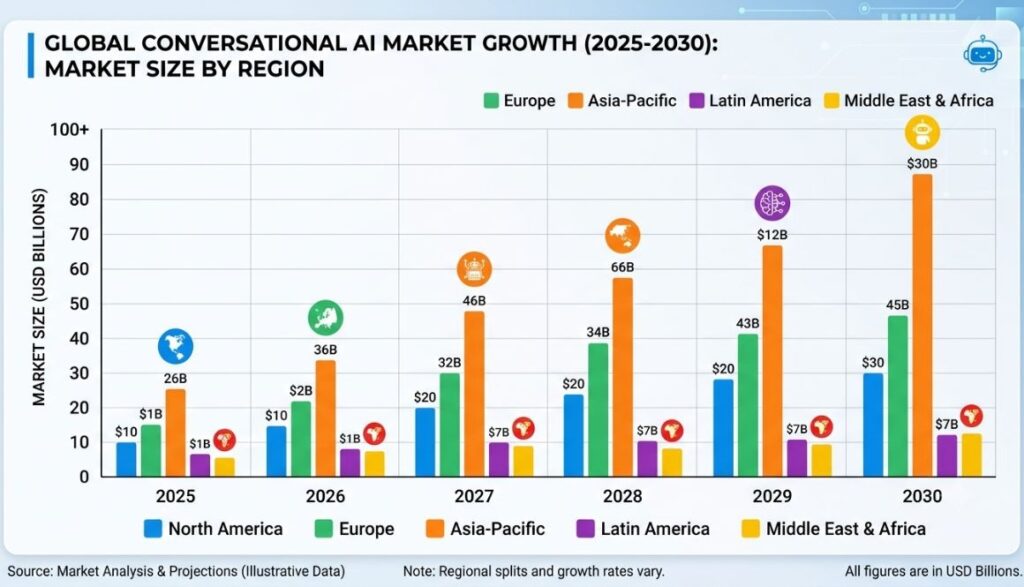
The global conversational AI market reached about $17.7 billion in 2026, up from $14.3 billion in 2025. According to Grand View Research’s 2026 industry report, it is also projected to hit $78.9 billion by 2033 at a 23.8% CAGR. Asia Pacific is the fastest growing region in that forecast. That is largely driven by the rapid smartphone and internet penetration in India and China.
That top line number hides the more interesting story. Growth isn’t evenly spread across every category of conversational AI. It’s concentrating in the systems that finish tasks, not the ones that just field questions.
As per Grand View Research, the global conversational AI market is valued at roughly $17.7 billion in 2026 and is projected to grow at a 23.8% CAGR through 2033. Asia Pacific is the fastest growing region where the conversational AI market in India is expanding from $653 million in 2025 toward nearly $6 billion by 2034, according to IMARC Group.
Why 2026 counts as an inflection point. Enterprise generative AI spending tripled from $11.5 billion in 2024 to roughly $37 billion in 2025, according to Menlo Ventures’ enterprise research. Most of that money went into experimentation. This year, that pattern broke. CFOs started demanding proof of return before renewing budgets, and Forbes reported in mid-2026 that companies are moving aggressively to impose budget controls on AI projects that were previously funded on faith.
What’s actually driving the spend that remains isn’t curiosity anymore. It’s three things: Measurable cost-per-resolution. Task completion instead of conversation quality. Integration with existing systems (CRM, payments, order management) rather than standalone chat widgets. A chatbot that can answer “what’s your return policy” no longer impresses. A system that can actually process the return is where budget is going.
BFSI and healthcare used to be slow to adopt chatbots because of regulatory constraints. But they are now expected to be one of the fastest growing adopters between 2026 and 2030, according to Mordor Intelligence’s sector analysis. Retail is still the largest deployment base by volume. But the growth curve is shifting toward regulated industries that need governance to be built in from day one.
Read More: Best Conversational Analytics Software
From Reactive Chatbots to Agentic AI: The Biggest Shift of 2026
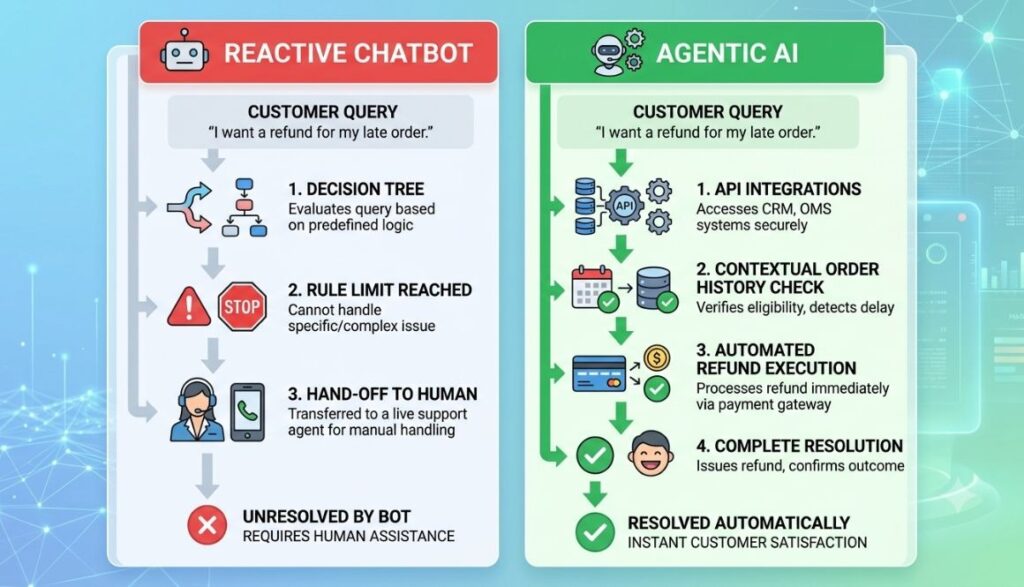
Agentic AI resolves a task end to end, without needing any human to route each step. A reactive chatbot answers a question and stops there. That single difference is the defining shift of this year’s conversational AI landscape.
Picture a customer asking about a return. A traditional chatbot checks a decision tree: is the item within 30 days? If not, route to a human. An agentic system instead reads the full order history. It recognizes the item is a repeat purchase from a loyal customer and checks the return policy against the specific product category. That said, it processes the refund itself while flagging only genuine edge cases for a person to review.
Read More: Agentic AI Trends: The Future of Intelligent Autonomous Systems
What Makes an AI System “Agentic” vs. Merely Generative
An agentic AI system plans a sequence of steps and takes actions using tools or APIs. It adjusts based on what it finds along the way instead of just generating a single response and stopping. By contrast, Generative AI produces content (a reply, an image, a summary) but doesn’t act on the world beyond that output. The difference isn’t marketing language. It’s whether the system can complete a multi-step task without a human moving it from one stage to the next.
This distinction is getting muddier in vendor pitches than it should be. Gartner has openly called out “agent washing,” where vendors rebrand existing chatbots and robotic process automation tools as agentic without adding real autonomy. Gartner estimates only about 130 of the thousands of vendors claiming agentic capabilities are building the real thing.
Real-World Agentic AI Examples in Customer Service
The clearest large scale example right now actually sits in India. Razorpay and the National Payments Corporation of India launched Agentic Payments on Claude at the India AI Impact Summit in February 2026. This enables customers to order from Zomato, Swiggy and Zepto entirely inside a conversation, without even opening a separate app. A user can simply ask for Italian food under their set budget or request their usual match-day snacks. That agent handles discovery, ordering and UPI payment in only one exchange.
Walmart offers a different kind of example. This one is internal rather than customer facing. Walmart cut its product workflow timeline from more than 30 weeks down to roughly 8 weeks using multi-agent orchestration, according to a 2026 Product School case analysis. That’s not a chatbot improvement. That’s a full operational redesign around agents that plan and execute.
Gartner projects agentic AI customer service systems will resolve 80% of common support issues without human intervention by 2029, while lowering operational costs by roughly 30%. That’s still three years out, and Gartner’s own framing treats it as a milestone most organizations aren’t close to yet. Reliability, not model capability, is the obstacle most teams report.
Multimodal and Voice AI Are Becoming the Default Interface
Multimodal AI is not just a differentiating feature anymore. It’s the baseline API surface for every frontier model in 2026, from GPT-5 to Claude to Gemini. It handles text, image, and audio within a single call instead of stitching together separate transcription, vision and generation systems.
For marketers, the practical shift is this: your customer’s next question might not be typed at all. It might be spoken, or it might include a photo of a broken product alongside a spoken complaint. Systems built only for typed text are already behind.
Voice AI in Contact Centers and Phone-Based Screening
Voice has become the leading investment priority in contact centers for 2026, according to CX Network’s industry research, because phone calls remain the channel customers choose for emotionally charged issues like cancellations, complaints, or missed deliveries. Rigid and scripted IVR flows handle these a lot poorly. Modern voice AI can assess tone and sentiment in real time while adjusting its response, and escalating to a human the moment risk is detected.
This isn’t just limited to customer support. HR teams are running phone-based candidate screening through conversational voice agents, letting recruiters review structured transcripts instead of sitting through every initial call themselves.
Read More: Conversational Intelligence Software in 2026
Why Multimodal Matters for Indian Users Specifically
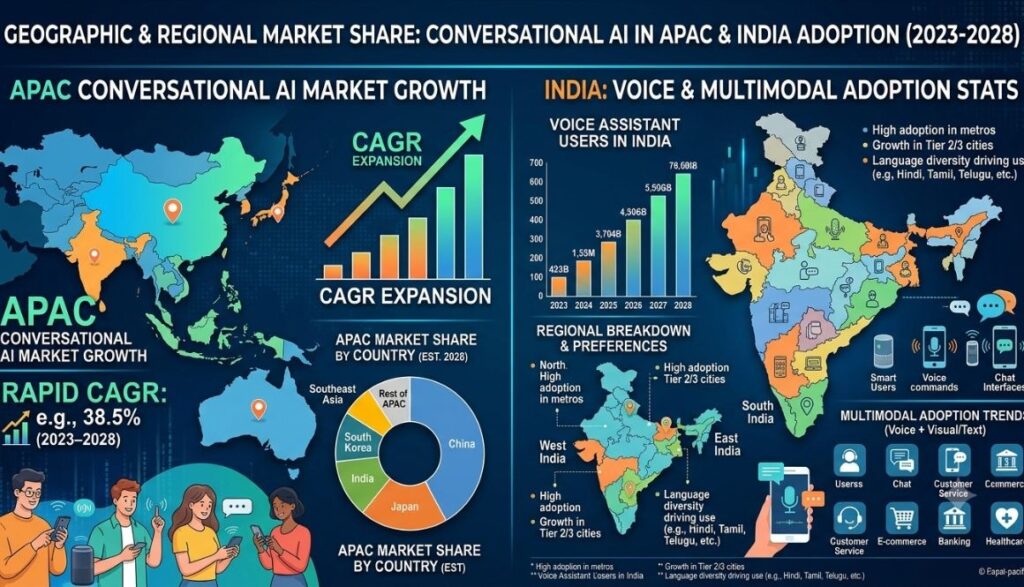
The internet base in India includes hundreds of millions of people who are more comfortable speaking than typing. Many prefer conversing in a regional language rather than English. That’s exactly the gap voice led multimodal AI is made to close.
The clearest case is the partnership of Swiggy with Sarvam AI in March 2026. It has brought multilingual, voice-led commerce to Swiggy’s Food Delivery, Instamart, and Dineout platforms. Users can place orders by speaking in one of 11 Indian languages. These include Hindi, Tamil, Telugu, Kannada, Bengali and Marathi. Discovery, ordering, and checkout happen inside the conversation itself, and Razorpay handles payment through UPI. According to the Internet in India Report 2025 by IAMAI and Kantar, India has over 950 million internet users. But only around 200 million currently shop online. That gap between internet access and e-commerce usage is largely a language and interface problem. And voice AI is the tool pointed directly at it.
Read More: How AI Is Transforming Product Marketing in 2026
Hyper-Personalization and Proactive, Signal-Triggered Conversations
The most useful conversations in 2026 very often start before the customer does. Instead of waiting for someone to type “where’s my order,” systems are now watching for the signal that would trigger that question and reaching out first.
When Telecom companies detect a network issue, they message the affected customers before the outage even fully lands. In the case of E-commerce platforms, they proactively send an update with a compensation offer attached after spotting a delayed shipment. Banking systems flag an anomaly in an account and trigger a preventive outreach message rather than waiting for a complaint. This is a genuine behavior shift, not just a UX polish: 71% of customers say they prefer brands that deliver proactive support, according to Master of Code’s 2026 conversational AI research. 65% specifically want offers that reflect their individual behavior instead of just generic promotions.
The mechanism behind this is inventory data, compliance triggers and service anomaly detection. Feeding it directly into the conversation layer is the way to go instead of sitting in a separate dashboard for a human to check. That’s a meaningful shift in how marketing and operations teams need to think about data plumbing. If your CRM, inventory system, and support platform don’t talk to each other in near real time, proactive conversational AI simply isn’t available to you yet, no matter how good your chatbot’s replies sound.
Read More: 20 AI Chatbot Tools Businesses Use in 2026
Enterprise Adoption Is Accelerating, But Governance Is the Bottleneck
Adoption numbers look strong on the surface. McKinsey reports that 88% of organizations now use AI in at least one business function. But only 23% are actually scaling an agentic system past the pilot stage, with another 39% still experimenting. The gap between “using AI somewhere” and “trusting AI to run a workflow unsupervised” is enormous, and it’s the real bottleneck slowing this market down.
Why Gartner Predicts a Wave of AI Project Abandonment
Gartner analyst Roxane Edjlali predicted something in February 2025. That is, about how organizations may abandon 60% of AI projects that aren’t supported by AI-ready data by the end of 2026. That said, Gartner’s Anushree Verma also predicted in June 2025 that over 40% of agentic AI projects specifically may be canceled by the end of 2027. It was escalating costs, unclear business value and inadequate risk controls as the three named causes. Notice what’s absent from that list: model capability isn’t the problem. The failures are organizational, not technical.
Gartner projects organizations will abandon 60% of AI projects lacking AI-ready data by the end of 2026, and separately expects over 40% of agentic AI projects to be canceled by the end of 2027 due to escalating costs, unclear ROI, and weak risk controls. Model performance is not among the cited causes.
This may not apply evenly across every setup. Teams that spend the majority of their budget on data engineering rather than model selection before launching a pilot fare far better, per Gartner’s own guidance, which recommends allocating at least 60% of an AI project’s budget to data readiness work.
Data Readiness, Risk Controls, and Where Chatbots Still Fail
More than half of organizations deploying generative AI in support functions cite hallucination and inconsistent output as their top challenge, according to Panorama Consulting’s 2026 customer service research. That’s the practical failure mode behind most abandoned projects: a system that sounds confident but gives an answer that’s simply wrong, with no guardrail catching it before the customer does.
The fix isn’t more prompting. It’s planning and execution separation (one system proposes an action, a deterministic layer validates and executes it), mandatory human approval for anything with real financial or safety impact, and full audit trails for every decision an agent makes. Teams skip these controls when they’re racing to ship a demo. They pay for it later when the demo becomes a production incident.
How Indian Businesses Are Adopting Conversational AI
According to IMARC Group’s 2026 India market report, the conversational AI market in India reached $653.24 million in 2025. It is projected to grow to $5,907.5 million by 2034 at a 25.61% CAGR. That growth rate outpaces the global average and it’s also being shaped by two forces that are unique to the Indian market: Dominance of WhatsApp as a channel plus the sheer number of regional languages a business needs to support to reach its full addressable audience.
Regional-Language and WhatsApp-First Deployments
India is the single largest market for WhatsApp, with more than 500 million monthly active users. Over 60% of Indian WhatsApp users message a business account directly, according to Meta data cited by TechCrunch. So, WhatsApp isn’t a marketing add-on for most Indian consumers. It’s the default interface for talking to a brand at all while being ahead of a website or a native app.
Yellow.ai, which was founded in Bengaluru, supports conversational depth in Hindi, Tamil, Telugu, Bengali, Marathi, Kannada, Malayalam, Gujarati, and Punjabi. Not just that, it also includes code-mixed conversation handling for Hinglish. Haptik is now owned by Reliance Jio and powers more than 1 billion conversations annually for enterprise clients. It includes HDFC Life, Jio, and Tata, with particular strength in BFSI and telecom. Both platforms exist mostly because a single language chatbot leaves most of the population in India out of the conversation.
India’s Market Size and Sector-Wise Adoption
Retail, BFSI, and hiring are the three sectors that are showing the fastest conversational AI adoption in India this year. Retail and quick commerce lead in volume. They are driven by platforms like Swiggy and Zepto. BFSI is also catching up quickly. This is seen as regulatory frameworks around AI governance are maturing enough to support automated financial conversations. And hiring platforms are seeing some of the sharpest growth of all. According to Naukri.com data, India has recorded a 340% year over year increase in agentic AI job postings in Q2 2026 compared to Q2 2025.
Conversational AI Is Moving Beyond Customer Support Into Internal Operations
Customer support was conversational AI’s first use case. It’s no longer its biggest growth area. HR and internal operations are absorbing conversational AI faster than most marketers are tracking. This is largely because the ROI case is simpler to prove internally than externally.
Gartner predicts that chatbots may handle more than 70% of all HR-related inquiries by 2027. That is according to research cited by Yellow.ai’s HR chatbot analysis. A separate Oracle survey found that 50% of HR leaders have already implemented AI chatbots or plan to within the next year. Recruitment screening is an especially strong fit: conversational agents can conduct structured first round screening calls. They can also collect candidate responses and hand a clean transcript to a recruiter. This cuts the manual scheduling and note-taking load that can eat a recruiter’s entire morning.
Named platforms like HireVue now combine text-based candidate matching with on-demand video interviewing. Recruiters can review them asynchronously. The employee facing side is growing just as fast. Internal HR bots now handle leave requests, policy questions plus onboarding checklists that used to sit in a shared inbox nobody checked until Monday.
This matters for marketers because it changes where your organisation’s AI budget conversation is actually happening. If HR and operations are proving ROI faster than customer-facing marketing use cases, that’s where the next internal champion for conversational AI investment is likely to come from. It’s worth having that conversation before the budget gets allocated elsewhere.
What This Means for Marketers: Skills, Tools, and Next Steps
The marketer’s job is shifting from writing every message by hand. Now it’s more about designing the system that decides what message gets sent, to whom and when. That’s a real change in what “doing marketing” means day to day, instead of just a new tool added to the stack.
Marketing teams now report that AI saves them more than an hour a day on average by streamlining creative tasks. That is according to ContentGrip’s 2026 marketing productivity research. But the skills that matter are shifting away from execution speed and toward judgment: knowing which AI-generated output to trust, which to override, and how to design the guardrails that keep an automated conversation on-brand when nobody’s reviewing it line by line.
Three skills are worth prioritizing right now.
- Context engineering over basic prompting. You get a single good output by writing a single good prompt. Structuring the context an AI agent has access to (customer history, brand voice guidelines, escalation rules) plays a role here. This is what determines whether a whole automated conversation stays on brand across hundreds of interactions.
- Evaluating AI output for accuracy, not just tone. The tone almost always sounds right. Whether the underlying claim, price, or policy detail is actually correct is a separate check, and it’s the one most teams skip until something goes wrong publicly.
- Designing the escalation path, not just the happy path. Every conversational AI deployment needs a clear answer to “what happens when this goes wrong,” documented before launch, not improvised after a customer complains on social media.
From what we’ve seen with YUP course learners building conversational AI campaigns, the teams that succeed aren’t the ones with the most sophisticated tooling. They’re the ones who mapped their escalation rules and data sources before they wrote a single line of chatbot copy.
Read More: What is Prompt Engineering and Popular Prompting Techniques?
The sceptic’s checklist is short if you’re evaluating a conversational AI tool for your own team: can it show you a real cost per resolution number from an existing client? Does it separate proposal from execution (so a bad decision doesn’t fire automatically)? Can it hand off to a human with full context rather than making the customer repeat themselves? Most vendor demos are built to dodge exactly these three questions.
Getting good at this doesn’t require a computer science background. It requires understanding how a conversation actually resolves a business problem end to end. This a skill YUP’s AI Marketing course builds specifically around real campaign scenarios rather than abstract tool tutorials.
Conclusion
The 2026 conversational AI market isn’t slowing down. It’s getting more selective. Enterprises are cutting the open-ended generative AI experimentation that defined 2024 and 2025, while doubling down on agentic systems that can prove a real cost-per-resolution number. India’s own market is growing faster than the global average, driven by WhatsApp’s dominance and a genuine breakthrough in regional-language voice AI that’s finally closing the gap between internet access and actual digital commerce.
The businesses winning this shift aren’t the ones with the flashiest chatbot demo. They’re the ones that got their data readiness and escalation rules sorted before launch, the exact discipline Gartner’s abandonment numbers say most projects skip. For marketers, that means the job is moving from writing every message by hand toward designing the system, and the guardrails, that decide what gets sent automatically.
If you want to build that skill set properly rather than piecing it together from scattered tutorials, YUP’s AI Marketing course walks through real campaign scenarios, from prompt structuring to escalation design, built specifically for marketers rather than developers. It’s a practical next step if this piece left you with more questions about where to actually start than answers.
FAQ
What is conversational AI?
Conversational AI is technology that lets a computer system understand and respond to human language, in text or voice. This uses natural language processing and machine learning. It powers chatbots, virtual assistants and voice agents across customer service, sales and internal operations. The term covers everything from a simple FAQ bot to a fully agentic system that completes tasks on its own.
Conversational AI vs. generative AI, what’s the difference?
Conversational AI is built specifically for back and forth dialogue, understanding intent and maintaining context across a conversation. Generative AI is the broader category of technology. It creates new content, text, images, audio or code and conversational AI is one application built on top of generative AI models. Not all generative AI is conversational, but most modern conversational AI is powered by generative models underneath.
Conversational AI vs. agentic AI, what’s the difference?
Conversational AI focuses on understanding and responding to a message. Agentic AI goes further. It plans a sequence of actions and executes them using tools or system access. That said, it doesn’t need a human moving the process from one step to the next. A conversational AI system might tell you your order is delayed. An agentic system would rebook the delivery and issue a credit without being asked.
How do I get started with conversational AI for my business?
Start by mapping one specific, high-volume, low-risk conversation (order status, appointment booking, a common FAQ) rather than trying to automate everything at once. Get your data sources connected and clean before choosing a platform. Gartner’s research shows that data readiness is the biggest predictor of whether a pilot survives past its first few months and not model quality.
Who should actually invest in conversational AI right now?
Businesses with high and repeatable conversation volume across support, sales, or HR see the fastest return, particularly in retail, BFSI, and hiring, the three sectors showing the sharpest adoption growth in India this year. If your conversation volume is low or highly variable, the ROI case is much weaker and a simpler tool may serve you better for now.
Is conversational AI worth it for small and mid-sized businesses?
It depends on your conversation volume and margins. But generally yes for repetitive and high frequency interactions like order status or booking confirmations. Basic SMB chatbot deployment in India starts around ₹20,000 to ₹1.5 lakh annually. This is a far lower barrier than the enterprise-grade multilingual platforms larger brands use. Start small on one channel rather than committing to a full omnichannel rollout upfront.
Why do so many chatbot deployments fail?
Most failures trace back to poor data readiness and unclear ownership of what the system is actually supposed to accomplish, not to weak AI models. Gartner projects that organizations may abandon 60% of AI projects unsupported by AI-ready data by the end of 2026. Hallucination and inconsistent answers are the most commonly cited operational failures. Both usually stem from a system launched before its data and guardrails were properly built.
Does conversational AI work well in Hindi and regional Indian languages?
Yes, and this has improved significantly through 2026. Platforms like Sarvam AI now support voice-led commerce in 11 Indian languages. These include Hindi, Tamil, Telugu, Kannada, Bengali and Marathi. Yellow.ai supports text-based conversation across nine or more regional languages, including code-mixed Hinglish. Regional-language support is no longer an afterthought bolted onto an English-first product. It’s being built as the primary interface for platforms targeting India’s broader internet population.
Will conversational AI replace human customer support agents?
Not entirely and not soon. Gartner projects agentic AI may resolve 80% of common support issues without human intervention by 2029. That still leaves a meaningful share of interactions, particularly emotionally sensitive or complex ones, requiring a person. The realistic shift is agents handling routine volume while human support staff focus on escalations, relationship-building, and the cases where empathy genuinely changes the outcome.
What skills do marketers need to work with conversational AI tools?
Context engineering (structuring what an AI system knows before it responds), output evaluation for factual accuracy rather than just tone, and escalation-path design are the three highest-value skills right now. Basic prompt writing is becoming table stakes rather than a differentiator, while the ability to judge when an AI-generated answer is wrong, and design what happens next, is where the real value sits.