

Your media buyer can launch a new audience split in under a minute. Your design team needs three days to turn around one static ad. That gap isn’t a staffing problem. It’s a structural mismatch between how fast platforms let you test and how slow humans can produce, and it’s why an AI agent for ad creative generation has gone from nice-to-have to the thing separating accounts that scale from accounts that stall.
This isn’t one tool that spits out a single image on request. It’s a system that takes a brief, generates ad variants across formats, and often tests and refines them with minimal manual input. According to an IAB study spanning late 2025 into early 2026, 83% of ad executives now say their company has deployed AI somewhere in the creative process, up from 60% just a year earlier. That’s not a pilot program. That’s the new baseline.
This guide breaks down how these agents work, which platforms lead the category right now, and how to build a workflow around one that produces creative your audience hasn’t already learned to scroll past.
Table of Contents
How Do AI Ad Generators Work?
AI ad generators combine large language models for copy with image and video diffusion models. These are trained on huge datasets of high-performing advertising creative to produce new ad assets from a brief instead of a blank canvas.
Most tools lean on a handful of underlying engines rather than building their own from scratch. Text generation typically runs on GPT-class or Gemini models. Image generation usually routes through Midjourney, Adobe Firefly, or Google’s Imagen family, marketed publicly as Nano Banana. Video is the newest frontier: Veo 3 and Sora 2 have both crossed from novelty to genuinely usable ad output in the last year, per Social Media Examiner’s 2026 creative report.
The image side runs on a generative adversarial network, or GAN. These are two neural networks, a generator and a discriminator, competing against each other. The generator makes an image, the discriminator checks how convincing it is against real examples. The loop repeats until the output passes. That arms race is why output quality has jumped so sharply in the last eighteen months.
What separates a basic ad creative generator from a true agent is what happens after generation. A generator hands you a file. An agent takes a brief, produces variants, routes them for testing, and often feeds performance data back into the next round automatically. That closes a loop that used to need a human at every handoff.
Why Ad Creative Production Became The Biggest Bottleneck in Advertising
Media buying has been automated for years. Creative production hasn’t kept pace, and that gap is now the single biggest constraint on account growth for most performance marketing teams.
At $50,000 a month in ad spend across Google, Meta, and LinkedIn, you should be testing 5 to 10 new creative variants per week per platform, according to Synter’s 2026 creative platform research. That’s 15 to 30 new ads a week minimum. Most in-house teams produce two or three.
It’s gotten worse because creative doesn’t last as long as it used to. Meta’s Andromeda ranking system reads creative-level signal with far more precision than its predecessor, saturating an audience faster and marking a concept “spent” sooner. Rocketium’s 2026 ad fatigue research found the average shelf life of a Meta creative has fallen from 4-6 weeks in 2024 to 2-3 weeks now.
The cost of not keeping pace isn’t abstract. Triple Whale’s creative fatigue framework estimates that 15% to 25% of monthly ad spend goes toward creative that’s already fatigued, because most teams catch the decline after it has already cost them money. And creative isn’t a rounding error next to targeting or bidding: research from Circana and NCSolutions, built on nearly 450 CPG campaigns, found creative drives 49% of advertising’s incremental sales lift, more than brand, reach, targeting, and recency combined.
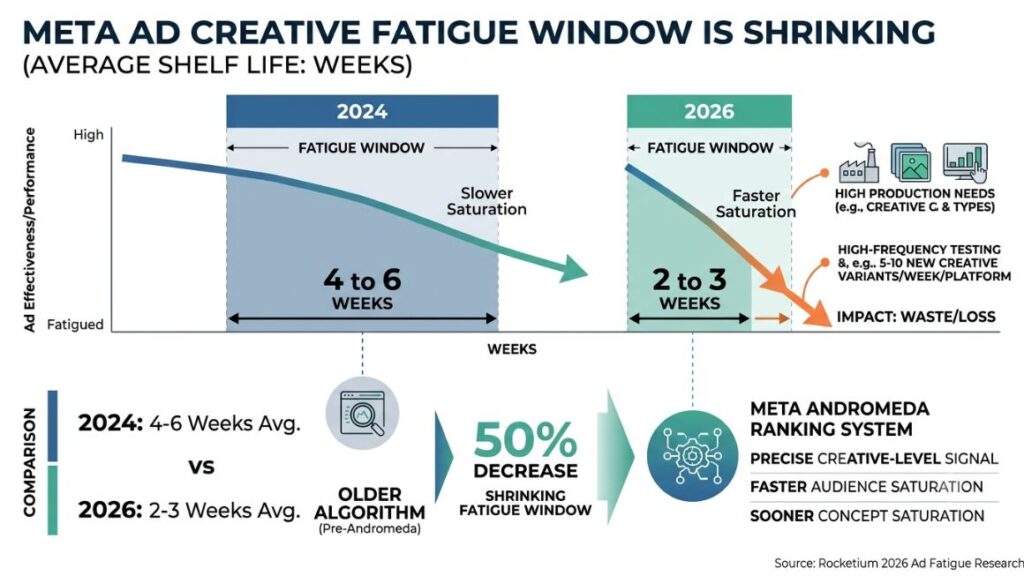
Ad creative production has become advertising’s tightest bottleneck because refresh cycles have shortened while output hasn’t scaled to match. Meta’s Andromeda algorithm cut average creative shelf life from 4 to 6 weeks in 2024 to 2 to 3 weeks in 2026. Triple Whale estimates 15 to 25% of monthly ad spend now goes toward creative that’s already fatigued before teams catch it.
What Is an AI Agent for Ad Creative Generation and How Does It Work?
An AI agent for ad creative generation is a system that takes a structured brief, produces multiple ad variants across image, video, and copy formats, and often routes them through a testing loop with limited manual input at each stage. Three stages make up how these systems operate in practice.
Briefing and Input
Every agent starts with an input: a product URL, brand guidelines, past top-performing creative, or a written brief. The quality of that input decides almost everything downstream. Tools like Creatify and QuickAds work directly from a product link, scraping images and pricing automatically. Others, like Pencil, expect a fuller brief covering tone of voice, banned phrases and target audience. This is also where brand governance gets locked in: fonts, colors, and logo placement, so every later variant stays on-brand without a human checking each one.
Generation and Variation
Once briefed, the agent produces multiple concepts at once. Some tools generate static images only. Others, like Creatify, build UGC-style video with an AI avatar, script, voiceover and captions in one pass. Batch generation is the real differentiator for volume. Instead of one ad and iterating, you request ten variants on a hook and let the platform surface the strongest candidates.
Testing and Optimization Loop
The most advanced agents push creative into live testing, read back CTR and conversion signal and generate the next round automatically, closing a loop that used to need a human at every step. Not every tool does this. Many stop at export, leaving distribution and testing entirely up to you, which is worth knowing before you commit budget.
How AI-Generated Advertising Boosts Efficiency
The efficiency gain isn’t one metric. It shows up as fewer design hours per ad, faster time from brief to live campaign, and the ability to test volume that would be financially impossible with a human-only workflow.
A designer producing one polished static ad by hand typically needs two hours from brief to final export, per Synter’s research. An AI generator producing the same asset from a pre-loaded brand kit takes seconds, with a human reviewing rather than building. That doesn’t eliminate creative judgment. It moves the bottleneck from production to review, a far easier problem for a small team to solve.
The case gets stronger across channels. A brand advertising on Meta, Google and TikTok needs differently sized and differently paced creative for each. Manually resizing one concept for nine placements eats a full day; tools with built-in multi-format automation, like The Brief, collapse that into minutes from a single source asset.
The catch: speed without a review layer produces volume without quality. Platforms are getting better at recognizing generic, templated creative and quietly down-ranking it in the auction. So teams that publish everything an agent produces tend to see engagement drop even as output climbs.
Best Practices for Creating Effective AI-Generated Ads
AI isn’t a silver bullet. It’s a force multiplier for people who already understand what makes an ad work, and a fast way to produce a lot of mediocre creative for people who don’t.
1. AI + Human Talent = Results
Can quality creative be left entirely to AI? Not yet. The technology automates a huge share of repetitive production work: resizing, background variation, copy permutations. What it can’t do is replace years of understanding a specific audience, or read cultural nuance the way a human strategist can.
2. Make Branding Matter
Consistency means giving an AI agent clear instructions rather than a vague prompt. Short prompts default to the model’s generic style. Detailed ones, covering palette, tone, product specifics, and audience, produce output that actually looks like your brand made it. Too little direction and output drifts generic; too much and the model gets confused. Most teams find the balance after two or three iterations.
3. Monitor and Tweak
The real value comes from what happens after launch: tracking which elements actually drive performance and feeding that back into the next brief. A hook that wins this week won’t necessarily win in four. That’s especially given how fast Meta’s fatigue window has compressed. Treat every AI-generated batch as a live experiment, not a finished deliverable.
AI Agent for Ad Creative Generation: Leading Tools in 2026
The category splits into pure generation tools, generation-plus-distribution agents, managed creative services, and native platform tools built into Meta and Google’s own ad managers. The right pick depends less on overall score and more on where your bottleneck actually sits.
| Tool | Type | Starting Price | Best For |
| Superside | Managed AI + human service | Custom | Enterprise teams wanting a full creative stack |
| Pencil | Enterprise generation platform | $14/mo | In-house teams needing governance and cost tracking |
| Admiral Media | Managed creative agency | EUR 4,000/mo | App, game, and ecommerce brands wanting AI creative as a service |
| AdCreative.ai | Static image + copy generator | $39/mo | SMBs and agencies producing static ads fast |
| Creatify | UGC-style video generator | $39/mo | Performance marketers making video ads from a product URL |
| HubSpot Campaign Assistant | Ad copy generator | Free (paid tiers for full ads tool) | Teams already inside the HubSpot ecosystem |
| Meta Advantage+ Creative | Native platform tool | Included with ad spend | Advertisers running native Meta campaigns |
| Google Performance Max | Native platform tool | Included with ad spend | Advertisers running Google Search, Display, YouTube inventory |
| Smartly.io | Enterprise creative + media suite | Custom | Enterprises unifying creative and media buying |
| Synter | AI agent + distribution | $20/mo | Teams wanting generation plus direct publishing |
| Omneky | Generation + optimization | ~$29/mo | Performance brands wanting creative tied to analytics |
| Canva for Teams | Design platform with AI | $15/mo/user | Teams wanting design plus brand governance |
| Zeely AI | Mobile-first ad app | $29.95/mo | Solo Shopify sellers wanting fast ads from a phone |
| Predis.ai | Social + ad generator | ~$32/mo | Solopreneurs needing bulk content |
| Copy.ai | Ad copywriting | $36/mo | Teams needing fast multi-platform copy |
| The Brief (Creatopy) | Ad design automation | $29/mo | In-house teams resizing display variants at scale |
| Jasper AI | Ad copywriting | $49/mo | Copywriters needing on-brand copy at speed |
| QuickAds | Static + video from product link | ~$9/mo | Startups wanting cheap, ready-to-run ads |
AI Ad Creative Generators
AdCreative.ai
The fastest self-serve route from a brand kit to conversion-focused static ads. It learns your fonts and palette and scores each variant, giving non-designers a performance signal before spending on tests. The catch: video sits behind the $249/month Professional tier. That is a steep jump from the $39 entry plan, and credits burn on download rather than generation.
Pricing: $39/mo ($20/mo annually), Professional $249/mo.
Best for: SMBs and agencies producing high-volume static ads fast.
QuickAds
Feed it a product link and it returns platform-ready static and video ads in under a minute, with virtual product photography replacing an actual shoot. Its searchable ad swipe library adds a useful research layer. The cheapest entry point here, with matching trade-offs in customization.
Pricing: From ~$9/mo, agency tier ~$69/mo.
Best for: Startups turning product links into cheap, ready-to-run ads.
Creatify
The strongest pure UGC video generator for paid social hook testing. Paste a product URL and it returns an avatar-led video with script, voiceover, and captions. Batch Mode generates ten-plus variations at once and surfaces the strongest performer. Output can carry a recognizable house look, and lip-sync drift is a recurring complaint, so budget time for editing.
Pricing: Free tier, Starter $39/mo, Pro $99/mo.
Best for: Performance marketers producing UGC-style video at volume.
Zeely AI
A mobile-first app that turns a product link into static ads and AI-avatar video ads, then launches directly to Meta from your phone. Built for speed over craft, aimed at solo Shopify sellers and dropshippers. A service fee of up to 12% on managed Meta spend applies on top of the subscription, so read billing terms closely.
Pricing: Starter $29.95/mo, Plus $49.95/mo, Growth $79.95/mo.
Best for: Solo founders and small Shopify sellers wanting fast ad creative.
Predis.ai
Sits at the intersection of ad generation and social media management. One subscription covers creative generation, scheduling, publishing and competitor analysis, removing the tool-switching most small teams struggle with.
Pricing: Free tier, paid plans from roughly $32/mo.
Best for: Solopreneurs and small social teams needing bulk content.
AI Ad Creative Agents
Synter
Positions itself as an AI agent operator rather than a generation tool. Tell it to create ad variants and ship them to a specific Google Ads campaign ID or Meta ad account. Its agents write, assemble, and upload without a manual export step, across a 27-platform catalog including Google, Meta, LinkedIn, TikTok, and Amazon DSP.
Pricing: SOLO $20/mo, SCALE $500/mo, CUSTOM sales-led.
Best for: Teams wanting generation plus direct platform publishing combined.
Omneky
Paste a brand URL and it extracts brand elements, generates ads across Meta, Google, TikTok, LinkedIn, and Reddit, launches campaigns, and reports back so the next generation round improves. Removes photoshoot costs through product image generation. Published pricing and reviews vary noticeably between sources, so verify current tiers directly.
Pricing: From roughly $29/mo, custom enterprise available.
Best for: Performance brands wanting generation tied to cross-channel optimization.
The Brief (Creatopy)
Rebranded from Creatopy in October 2025 into an end-to-end AI agency built around four agents running discovery, creation, launch and optimization as a loop. The core strength hasn’t changed: best-in-class multi-size automation, one ad in, hundreds of correctly sized variants out. Post-rebrand reviews mention interface bugs more than most competitors.
Pricing: Pro $29/mo, Ultra $79/mo, Team $49/seat/mo.
Best for: In-house teams resizing display and banner variants at scale.
Jasper AI
Templates for Facebook, Google, and LinkedIn ads, with a Brand Voice feature that learns from your existing copy to keep new output consistent. Templates follow platform-specific character limits automatically.
Pricing: From $49/mo.
Best for: Copywriters needing fast, on-brand copy variants.
Enterprise Creative Platforms
Pencil
Running AI in enterprise marketing production since 2018, acquired by The Brandtech Group in 2023, making it the most enterprise-serious platform here. Predictive scoring trains on real ad spend rather than aesthetic preference, and its “Open Garden” approach routes generation across OpenAI, Google, Adobe Firefly, Bria, and Runway instead of one model. Every deliverable tracks cost-per-asset.
Pricing: Core $14/mo (50 generations), Growth $55/mo, Enterprise on request.
Best for: In-house teams needing governed, model-agnostic generation at scale.
Smartly.io
The most complete enterprise system, treating creative and media buying as one closed loop rather than two handoffs. Its Creative Suite assembles dynamic formats from component parts (images, headlines, CTAs, prices). Its Media Suite handles buying across Meta, Google, TikTok, Pinterest, Snapchat, Amazon, Reddit, Spotify, and connected TV.
Pricing: Custom enterprise.
Best for: Enterprises unifying creative production with media buying across channels.
Superside
Not a self-serve generator but a creative subscription service where AI-certified designers use generative tools to produce ad creative and brand libraries at a fixed monthly rate. The bet is that generation in expert hands beats a raw tool in a marketer’s hands, which suits enterprise teams with continual demand.
Pricing: Custom.
Best for: Larger companies needing ongoing, high-volume ad creative.
Admiral Media
The one non-software entry: a Barcelona-based performance agency managing over EUR 500 million in ad spend for 150-plus brands across 35-plus markets since 2019. It packages AI creative as a managed retainer, strategy, human QA, and formatting included.
Pricing: From EUR 4,000/mo (20 videos) up to EUR 21,500/mo, plus 15-20% of managed spend.
Best for: App, game, and ecommerce brands wanting AI creative fully managed.
Native Advertising AI
HubSpot Campaign Assistant
Generates ad copy directly inside HubSpot’s native ads tool for Google, Facebook, and LinkedIn. Not an image or video generator, it’s a copy engine for teams already running marketing through HubSpot’s CRM. Copy generates up to 1,000 times a day per account. There are length and tone controls before it goes live.
Pricing: Free tier; full ads tool needs Marketing Hub Professional or Enterprise.
Best for: Teams already inside the HubSpot ecosystem.
Meta Advantage+ Creative
Built directly into Ads Manager, covering image expansion, background generation, text overlays, AI music, and video generation from a static image, each clearly labeled AI-generated versus rule-based. Meta reported advertisers using its AI video tool for most campaign ads saw average gains of 10% in CTR and 8% in conversion rate during 2026 beta testing, per eMarketer’s IAB NewFronts coverage. No export-and-upload step since it lives inside the platform you’re already buying on.
Pricing: Included with Meta ad spend.
Best for: Advertisers running native Meta campaigns.
Google Performance Max Asset Generation
Type in a website URL and PMax’s AI writes headlines, generates images through Asset Studio, and produces auto-generated video, powered by Gemini, Imagen, and Veo. Google reports campaigns with “excellent” Ad Strength see an average 6% lift in conversions. The trade-off is visibility: PMax decides what runs where and doesn’t clearly report which creative element drove the result. So most serious users pair it with a third-party creative analytics layer.
Pricing: Included with Google Ads spend.
Best for: Advertisers running Search, Display, YouTube, and Shopping inventory.
AI Design & Creative Platforms
Canva for Teams
Pairs a familiar collaborative design surface with AI image generation (Magic Media), AI copy suggestions, and brand kit enforcement. Magic Resize converts one design into every platform-required size automatically. A design tool first, not a distribution one: nothing publishes directly to an ad account.
Pricing: From $15/mo per person.
Best for: Teams wanting design plus strong brand governance.
Also Read: Best Free AI Tools for Marketers in 2026
Copy.ai: AI Copywriting with Marketing Templates
Templates covering Google, Meta, LinkedIn, and X, with a Workflow feature generating an entire campaign’s copy, headlines, descriptions, and CTAs, from a single brief. Copy only, no image generation or distribution, which makes it a strong pairing tool for teams that already have a visual generator.
Pricing: From $36/mo.
Best for: Teams needing fast copy generation across multiple platforms.
Also Read: 100 AI Tools for Performance Marketers to Scale Campaigns Faster in 2026
How to Choose an AI Creative Platform?
The decision usually comes down to one question buyers skip: do you need generation, or generation plus distribution? Most tools solve generation and leave distribution manual, downloading, formatting, and uploading per platform, which eats 30 to 60 minutes per campaign per Synter’s research.
If you want both in one workflow, an agent like Synter or Omneky that ships to connected ad accounts saves that step entirely. If video at scale is your bottleneck, Creatify’s native Meta and TikTok publishing fits better than a generalist tool. If speed and cost matter more than governance, AdCreative.ai or QuickAds get you to a testable ad fastest.
Budget matters more than comparison charts admit. A solo Shopify seller doesn’t need Smartly.io’s enterprise DCO engine, and an eight-figure D2C brand running Meta, Google, and TikTok in parallel will outgrow a $9-a-month tool within a quarter. Match the platform to the volume you’re actually producing, not the volume you hope to reach eventually.
Choosing an AI creative platform comes down to whether you need generation alone or generation paired with direct platform distribution. Most tools stop at the exported file, leaving manual upload as a 30-to-60-minute step per campaign, so teams running high creative volume should weight distribution as heavily as generation quality.
How to Build an Automated Ad Creative Workflow With AI Agents?
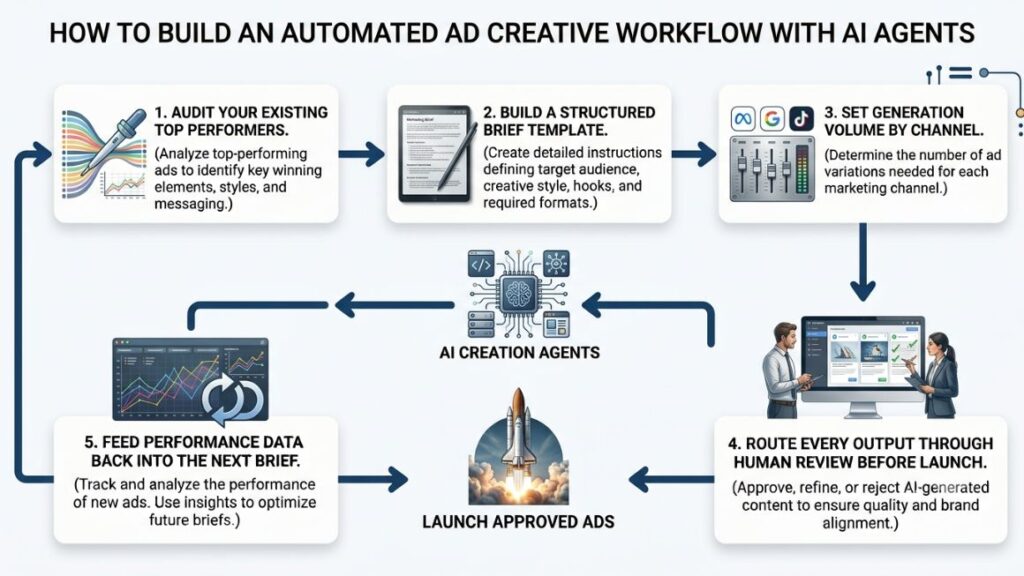
Buying a tool isn’t the same as building a workflow. Here’s how automated ad creative generation gets implemented well.
- Audit your existing top performers. Pull the last 90 days of ad data and identify your three to five strongest creatives by CTR and ROAS. These become the training reference for whatever tool you choose.
- Build a structured brief template. Include brand voice rules, banned phrases, required disclaimers, and product feed access. An agent is only as consistent as the brief it’s fed.
- Set generation volume by channel. Static-heavy platforms like Google Display handle high variant counts; video needs fewer, higher-quality outputs given cost and review time.
- Route every output through human review before launch. Even a capable agent produces the occasional off-brand or wrong variant. A fast review pass is usually enough.
- Feed performance data back into the next brief. Whatever wins this cycle informs the next batch, closing the loop manually if your tool doesn’t automate it.
Also Read: Agentic Marketing Platforms: The Complete Guide to AI Agents That Plan, Execute & Optimize Marketing
Generate and Test Multiple Ad Variations at Scale
Generating one good ad isn’t the goal. Generating ten testable variations from a single brief, and knowing which three to kill by Friday, is what actually moves an account.
Batch tools like Creatify’s Batch Mode or AdCreative.ai’s unlimited-generation model let you produce a wide spread of hooks and visual treatments in one pass rather than iterating on a single concept. The discipline that makes this work isn’t the volume; it’s isolating one variable per test, a headline or a hook, rather than changing five things at once and learning nothing when a variant wins.
Run enough variants and a pattern usually emerges within the first week: certain hooks consistently outperform regardless of visual treatment, or one CTA phrasing beats every alternative. That signal should shape your next brief, not a fresh guess.
Is an AI Marketing Agent Worth It for Your Team?
For teams under $10,000 a month in ad spend, probably not yet. The time saved rarely justifies a new subscription plus the learning curve when a designer working two hours a week can keep pace.
Above roughly $20,000 to $50,000 a month, the math flips. That’s the spend level where you need 15 to 30 new creatives a week just to stay competitive, a volume no small in-house team produces by hand. At that scale, an AI agent typically pays for itself within the first month through reduced design hours alone, before counting the performance lift from faster refresh.
The honest caveat: this works best for D2C and performance accounts with short, measurable feedback loops. It applies less cleanly to B2B campaigns with long sales cycles, where message precision matters more than creative volume.
How to Make Agency-Level Video Ads With One AI Agent?
Agency-quality video used to need a script writer, videographer, editor, and voice actor. A single AI agent now compresses most of that into one workflow starting from a product URL or a brief.
The process typically runs in four steps: the agent generates a script based on your product and audience, selects or generates an AI avatar or voiceover, assembles visuals with captions and platform-specific pacing, and exports cuts sized for each channel. Creatify and Zeely both follow close variants of this flow, and Meta’s Advantage+ now offers a native version that skips export entirely.
What separates agency-level output from obviously AI-made output is the review pass in between. Lip-sync drift, awkward pacing, and generic voiceover tone are the most common tells, and every one is fixable in a five-minute edit if someone actually watches the output before it goes live.
Ad-Ready Formats for Every Major Channel
Different platforms reward different creative shapes, and an agent that can’t produce the right format for the right placement creates extra work rather than saving it.
- Meta (Facebook and Instagram): 1:1 and 4:5 for Feed, 9:16 for Reels and Stories, with Advantage+ handling automatic aspect-ratio expansion from a single source image.
- Google (Display, YouTube, PMax): Responsive display assets in multiple sizes, plus 16:9 and vertical video for YouTube and Shorts.
- TikTok: 9:16 native vertical video, typically under 60 seconds, with UGC-style pacing outperforming polished production in most accounts.
- LinkedIn: 1:1 static and single-image ads perform reliably for B2B, video kept short and captioned for sound-off viewing.
- Amazon DSP and Shopping: Product-forward static imagery with minimal text overlay, matching Amazon’s stricter creative policy.
Platform-native tools, Advantage+ and Performance Max especially, handle format expansion automatically from one clean source asset. Third-party generators vary widely here, so check supported export sizes before assuming a tool covers every channel you run.
Where AI-Generated Ad Creatives Still Fall Short
Three gaps show up consistently across every tool in this category. Brand nuance is the biggest: models default to generic, safe output unless heavily directed, and even well-briefed generations can miss a cultural reference a human on your team would catch instinctively.
Authenticity in AI-avatar video is the second gap. Lip-sync and voiceover issues are recurring complaints across Creatify, Zeely, and comparable tools, and they’re the fastest way for an ad to read as synthetic to a scrolling audience. Platform down-ranking of templated creative is the newer risk: as generative tools proliferate, Meta and TikTok’s ranking systems have gotten better at recognizing formulaic output and quietly limiting its reach.
Legal and compliance review still needs a human. No tool here reliably catches every regulatory claim or platform policy issue before launch. That is exactly why every workflow in this guide includes a human review step before anything goes live.
AI-generated ad creative still falls short in three places: brand nuance requiring cultural judgment, authenticity in AI-avatar voice and lip-sync and legal or compliance review that no generation tool performs reliably. Every AI creative workflow needs a human review step before launch, regardless of how capable the underlying model is.
Tips and Common Mistakes When Choosing Creative AI Models
Start with a narrower brief than feels natural. Most first attempts fail because the prompt is too vague, not because the model can’t handle the request. Specify brand voice, audience, product specifics and format in every brief rather than relying on a saved brand kit alone.
Test one variable at a time, even when batch generation tempts you to change everything: a ten-variant batch that only shifts the hook tells you far more than one where hook, visual, and CTA all move together. Set a hard cap on how many generated variants launch without review; unlimited generation is a feature until it becomes a liability.
The most common selection mistake is choosing a tool based on its cheapest advertised tier rather than the tier you’ll actually need once video access, credits, or seats are factored in; AdCreative.ai’s $39 entry plan looks affordable until video, the thing most teams actually want, requires the $249 Professional tier.
A close second is picking a pure generation tool when the real bottleneck is distribution: teams that need creative live across multiple accounts fast often buy a generator, then discover manual upload still eats most of the time they were trying to save.
The third is skipping brand governance setup entirely; tools that support brand kits and banned phrases only add value once someone configures them, and skipping that step defaults every tool to generic output.
Conclusion
The gap between how fast media buying moves and how slow creative production moves used to be an accepted cost of doing business. It isn’t anymore. An AI agent for ad creative generation closes that gap by compressing briefing, generation and testing into one workflow instead of three separate handoffs.
The tools that matter most in 2026 aren’t the ones that generate the flashiest single image. They’re the ones that fit your actual bottleneck, whether that’s volume, distribution, video quality or brand governance, and that get out of the way fast enough for a human to still make the final call before anything goes live.
If your team is still briefing one ad at a time and hoping it survives past week two, the fastest fix isn’t hiring another designer. It’s learning to direct an AI agent the way a creative director directs a team. YUP’s AI Marketing course walks through exactly how to build that workflow from brief to launch.
FAQs
What is an AI agent for ad creative generation?
A system that takes a brief and produces multiple ad variants across image, video, and copy formats, often testing and refining them with minimal manual input. It differs from a single-purpose generator by chaining briefing, generation, and testing into one workflow.
How do AI ad creative generators work?
They combine large language models for copy with image and video diffusion models trained on large datasets of high-performing ad creative. You provide a brief, brand guidelines, or a product URL, and the model produces new variants based on learned patterns.
What are the steps to create an ad using an AI agent?
Brief the agent with brand guidelines and product details, generate multiple variants in one batch, review and approve the strongest candidates, publish through the platform’s distribution feature or export manually, then monitor performance and feed results into the next brief.
What are the best AI models or platforms for generating ad creatives?
It depends what you’re producing. Pencil and Superside lead for enterprise governance, Creatify leads for UGC-style video, AdCreative.ai is fastest for self-serve static ads, and Synter is strongest when you need generation and direct distribution combined.
Can AI replace human ad creative production, especially for UGC ads?
Not entirely. AI generates scripts, avatars, and voiceover fast, but lip-sync drift and a recognizable “house look” remain common complaints, and genuine UGC authenticity still benefits from human editing before launch.
What are the benefits of using AI for ad creative generation?
Speed, cost reduction, and the ability to test creative volume that would be financially impossible manually. Faster production also means faster response to Meta’s shortened fatigue window, which has compressed from 4-6 weeks to 2-3 weeks since 2024.
How do AI ad creative tools handle brand guidelines and consistency?
Most accept brand colors, fonts, logos, and tone of voice as structured inputs that constrain output. Canva for Teams enforces this through a formal brand kit, while agent platforms like Pencil apply brand guardrails automatically across every generation.
What are the common mistakes to avoid when choosing AI creative models?
Choosing the cheapest advertised tier without checking what’s actually included, buying a generation-only tool when distribution is the real bottleneck, and skipping brand governance setup. Each leads to unexpected cost or generic, off-brand output.
How much does an AI ad generation tool typically cost?
Entry tools like QuickAds start around $9 a month, mid-tier self-serve platforms like AdCreative.ai and Creatify run $39 to $99, and enterprise platforms like Smartly.io and Superside use custom pricing that often starts in the thousands per month.
What are the ethical considerations or risks associated with AI in advertising?
Disclosure transparency around AI-generated content, the authenticity gap in AI-avatar UGC ads, and the compliance risk of unreviewed generated copy making claims that violate platform or regulatory rules. None get caught reliably by the generation tool itself.
Are AI-generated ads effective for real marketing campaigns?
Yes, paired with human oversight. Meta reported average gains of 10% in CTR and 8% in conversion rate for advertisers using its AI video tool across most campaign ads during 2026 beta testing, but the consistent finding is that AI speeds up production while human judgment still drives the best results.
Can AI generate ad creatives automatically for Google, Meta, and LinkedIn?
Yes. Native tools like Meta’s Advantage+ Creative and Google’s Performance Max generate directly inside their own platforms, while agent tools like Synter generate copy and creative briefs, then distribute across Google, Meta, LinkedIn, and other connected platforms from one instruction.