
Most performance marketers are putting in more hours than ever, but the results aren’t matching the effort. Ad costs keep going up. Tracking is getting harder. And the old approach of “set up a campaign, fix a budget, check it on Friday” doesn’t work the way it used to.
The teams doing well right now are the ones using AI performance marketing, not as a fancy buzzword, but as a real tool layered on top of how they already work. They let the algorithm handle bid decisions while they focus on creative strategy. They use AI to spot high-value customers before those people even show up in a retargeting list. They run dozens of ad versions at the same time and get clear answers in days instead of months.
This article breaks down exactly how that works, which tools are actually worth your time, and what you should think about before you start adding AI to your campaigns.
Read More: performance marketing basics
Table of Contents
What Is Performance Marketing With AI?
AI performance marketing means using machine learning and artificial intelligence to plan, run, improve, and measure paid ad campaigns, with the goal of getting better results like higher ROAS, lower CPA, better conversion rates, and stronger customer lifetime value.
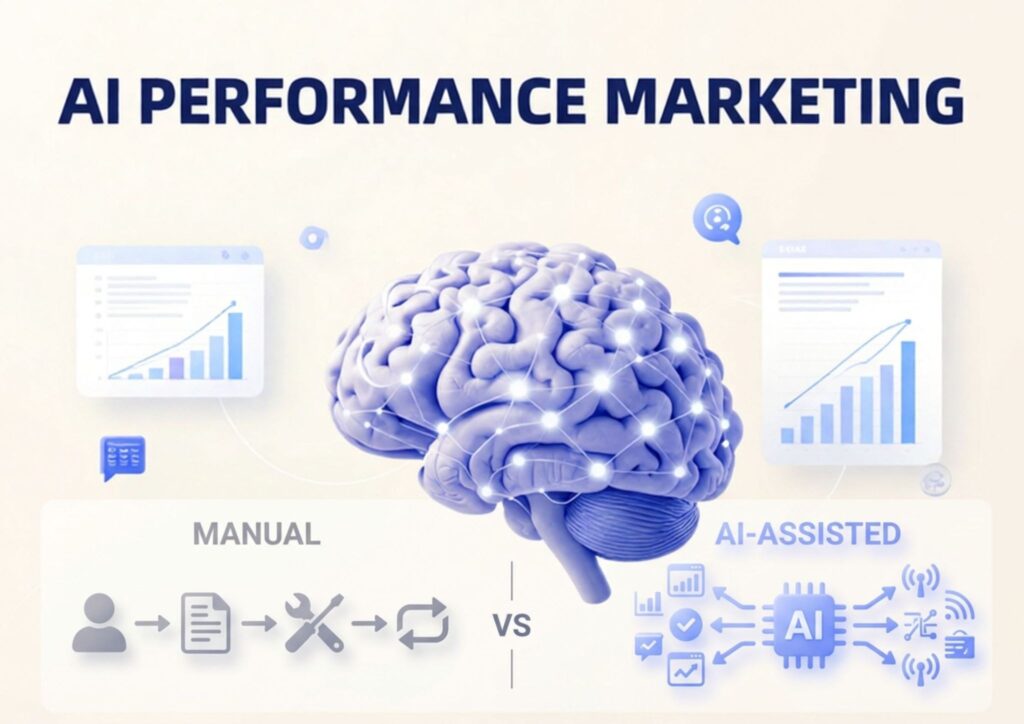
Regular performance marketing has always been data-driven. But it still needs a person to pull reports, adjust bids, and test one thing at a time. AI changes that completely. Instead of looking at what happened and reacting to it, AI systems read signals as they happen and keep making small adjustments across thousands of factors, all at once.
So the real difference isn’t that AI “runs marketing for you.” It’s that AI takes over the parts of campaign management that are honestly too complex and too fast for any human to handle well. Your job as a marketer shifts from doing the execution to setting the direction, shaping the creative, and making calls that a machine simply can’t.
Why AI Matters More Than Ever in Performance Marketing
Here’s the uncomfortable truth most performance marketers are dealing with right now: the data you’re working with has gotten worse, not better.
Third-party cookies are mostly gone. Apple’s privacy changes made Facebook attribution unreliable. Google Analytics 4 now estimates a portion of your data using modelling, which means some of what you’re reading in reports is an educated guess. And through all of this, ad costs have kept going up.
According to McKinsey’s 2025 Global AI Survey, businesses that used AI in marketing and sales saw revenue grow by 5% to 10%, with about two-thirds reporting higher revenues in the second half of 2024. That’s the gap AI is stepping into. When your tracking signals get weaker, you need smarter models to fill in the gaps. When your audience data gets noisier, you need sharper targeting. When human bid management can’t keep up with live auction changes happening every millisecond, you need automation to stay competitive.
The numbers back this up, too. According to a 2024 survey by Influencer Marketing Hub of 1,290 marketers, 70.6% believe AI can do certain marketing tasks better than humans. And according to SurveyMonkey’s 2025 research, 88% of marketers are already using AI somewhere in their daily work.
The question isn’t whether to use AI in performance marketing anymore. It’s which problems to point at first?
AI performance marketing refers to the use of machine learning systems to optimize paid campaigns in real time, adjusting bids, targeting, and creative delivery across thousands of variables simultaneously. Teams using AI for performance marketing consistently report lower CPAs, higher ROAS, and faster time-to-insight than those relying on manual optimization. The advantage is most pronounced in high-volume, multi-channel environments where no human team can process auction signals fast enough to compete.
How Does AI Actually Help in Performance Marketing?
“AI helps with optimization” sounds good on a slide. But what does it actually mean in practice? Let’s break it down properly.
Real-Time Bid Management
Every time one of your ads is about to appear somewhere, there’s a tiny auction happening behind the scenes. Who wins that auction depends on dozens of things: what time it is, what device the person is using, their browsing history, what the page is about, whether they’ve visited your site before, and a lot more. No human can process all of that in a few milliseconds. Google’s Smart Bidding and Meta’s Advantage+ both use machine learning to handle this, adjusting how much you bid for each individual auction based on which ones are most likely to lead to a conversion at your target CPA or ROAS.
The result is simple: your budget stops going to people who were never going to buy, and starts concentrating on the moments that actually matter.
Audience Segmentation and Lookalike Modeling
AI can look at your existing customers and find patterns that no human analyst would catch. Not just the obvious stuff like “camera buyers also buy lenses,” but deeper signals: how often someone visits before buying, how far they scroll, how long they wait between visits, and whether their price sensitivity suggests they’re likely to buy at full price or wait for a discount. Meta’s Advantage+ Shopping Campaigns use exactly this kind of modeling to find buyers you’d never have identified on your own.
For D2C brands especially, this is where the real value compounds over time. The more conversion data your campaigns collect, the smarter the model gets at finding the next customer.
Predictive Lifetime Value Modeling
Standard performance marketing optimizes for the first sale. AI lets you go further and optimize for the customer, not just the transaction. Predictive lifetime value modeling, often called pLTV, uses a customer’s purchase history, how they engage with your brand, and behavioral patterns to estimate how much revenue they’ll likely bring in over time.
This changes your entire bidding logic. Instead of spending the same amount to win over a one-time shopper and a loyal repeat buyer, you can afford to spend more to acquire the person who’s going to stick around. Your short-term CPA might look a little higher, but the long-term return is significantly better.
Creative Testing and Optimization
Manual A/B testing is slow by design. You set up two versions of an ad, wait long enough to get statistically valid results, declare a winner, and then start the next test. It can take months to work through a handful of ideas. AI-powered creative testing runs experiments across dozens of combinations at the same time, finds winning patterns much faster, and doesn’t need a human to sit in the middle of every decision. Google’s Performance Max and Meta’s Dynamic Creative Optimization both work this way.
Which AI Tools Are Best for Performance Marketing?
There are a lot of tools out there. Most of them are decent. A few are genuinely worth building your workflow around.
Google Performance Max
Performance Max is Google’s AI-driven campaign type that runs your ads across Search, Display, YouTube, Gmail, Discover, and Maps, all from one campaign. You give it your creative assets (headlines, descriptions, images, videos) and tell it your conversion goals, and it figures out which combination of placement and audience will work best, in real time.
It works well when you give it plenty of good creative options and at least 30 to 50 conversions per month to learn from. Without enough conversion data, the system doesn’t have enough signals to optimize properly. Give it what it needs, and it tends to reward you for it.
Meta Advantage+ Shopping Campaigns
Meta’s Advantage+ Shopping Campaigns, often shortened to ASC, use AI to handle audience targeting, ad placement, and creative delivery for e-commerce brands automatically. Instead of building audience segments by hand, you let Meta’s system find buyers across its network on your behalf. Like Performance Max, it needs conversion volume to learn, so it’s more effective for accounts that are already seeing steady sales.
Albert AI
Albert is a fully autonomous AI platform that manages paid campaigns across Google, Facebook, Instagram, YouTube, and Bing. It handles bid management, audience targeting, budget decisions, and creative testing on its own. Harley-Davidson used Albert to reduce CPA while increasing overall spend, which is a combination that’s genuinely hard to pull off manually.
Smartly.io
Smartly.io is built around social advertising automation. It helps teams create, test, and grow their creative output across Meta, TikTok, Pinterest, and Snapchat, with AI-powered optimization baked in. If your team produces a large volume of ads and spends a lot of time on creative management, Smartly.io is worth looking at closely.
Madgicx
Madgicx sits on top of Meta Ads Manager and adds an AI layer for audience management, creative insights, and budget decisions. It’s a good fit for D2C teams who want smarter targeting without fully handing control over to automation. Indian D2C brands like Mamaearth and boAt are operating at exactly the scale where a tool like this starts to make a real commercial difference.
Read More: Meta Ads strategy
Key Benefits of AI in Performance Marketing
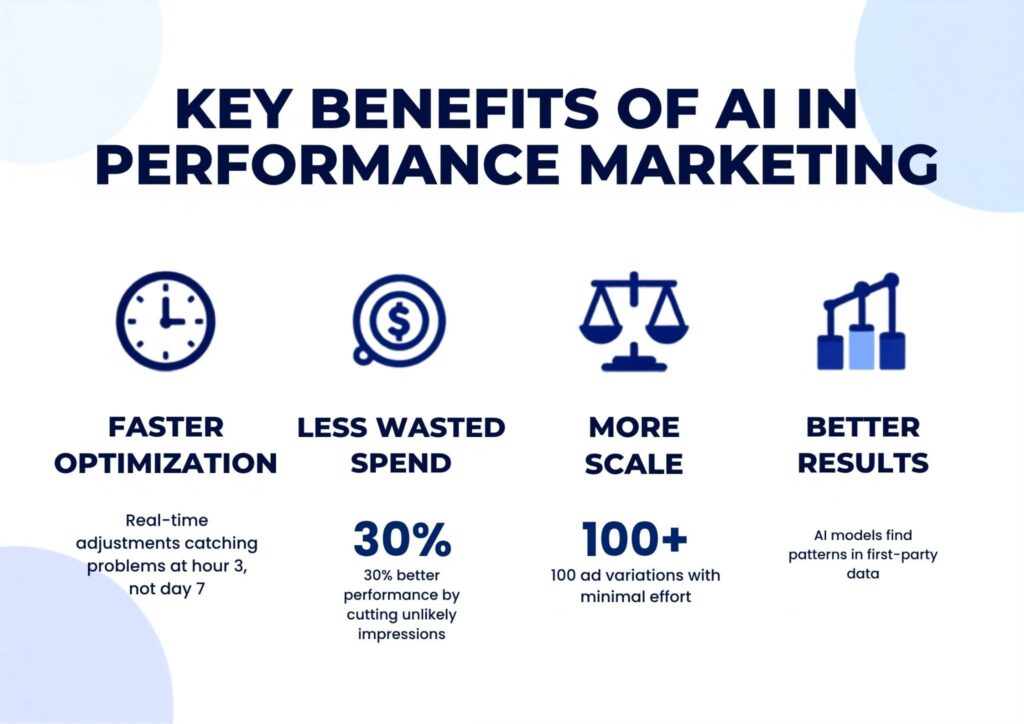
The clearest benefits show up in four areas, and they’re all connected.
Faster optimization cycles. A human campaign manager might check performance once a week. An AI system adjusts in real time, around the clock. That’s the difference between catching a problem on day 7 and catching it at hour 3. For campaigns with big daily budgets, that time gap is expensive.
Less wasted spend. According to OwlClaw Digital Marketing Research (2025), AI-driven campaigns perform 30% better than campaigns without AI. Most of that improvement comes from the system cutting spending on ad impressions that were unlikely to convert in the first place.
More scale without more people. Running 100 ad variations manually requires a whole team and a lot of time. Running 100 variations with AI creative tools requires a clear brief, a few solid assets, and maybe an hour of work. For performance marketers managing multiple clients or product lines, that’s the biggest practical win.
Better results even when the data is limited. When third-party data is restricted and attribution is patchy, AI’s probabilistic models still outperform old rules-based manual targeting. The machine finds patterns in your first-party data that no spreadsheet could surface on its own.
The key benefits of AI in performance marketing include real-time bid optimization, AI-driven audience segmentation, automated creative testing, and predictive lifetime value modeling. According to OwlClaw Digital Marketing Research (2025), AI-driven campaigns achieve 30% better performance than non-AI equivalents. The advantage is most visible in high-volume campaigns where manual optimization simply cannot match the speed and scale of machine learning systems.
3 Ways to Implement AI in Your Performance Marketing Strategy
1. Invest in AI-Powered Marketing Platforms
Start with what you’re already paying for. Google Ads and Meta Ads both have AI optimization built in, and most advertisers are barely scratching the surface of it. Before you buy anything new, check that you’ve switched on Smart Bidding with the right conversion goals, given your Performance Max campaigns a good variety of creative assets to work with, and turned on Meta Advantage+ Shopping where it fits.
After that, look at third-party AI tools based on where your current workflow breaks down the most. If creating enough content is the bottleneck, look at Smartly.io or Pencil. If splitting the budget across channels is eating up your time, look at cross-channel AI platforms like Albert or Skai.
Don’t try to bring in everything at once. Pick the one thing that’s costing you the most time or money and start there.
2. Focus on Data Quality and Upskilling
AI tools are only as good as what you feed them. This is the step most brands skip, and it’s usually why the results disappoint.
Before you invest in intelligent campaign platforms, do a proper audit of your conversion tracking. If your Google Ads conversion events are missing 20% of purchases because of Apple’s privacy changes, your AI bidding system is optimizing against incomplete data. Fix that first, using Google’s Enhanced Conversions, server-side tagging, or Meta’s Conversions API.
Training your team matters just as much. According to Salesforce’s 2024 research, 70% of marketers say their employer hasn’t provided any AI training. That gap has real consequences. A team that doesn’t understand how Smart Bidding learns will override it at exactly the wrong time, which breaks the optimization process entirely. From what we’ve seen with YUP course learners in performance marketing roles, the most common misuse of AI bidding tools comes down to impatience: marketers make manual changes before the learning phase is done, and then blame the tool when results don’t improve.
3. Start Small With Pilot Projects and Cross-Team Collaboration
The worst way to adopt AI in performance marketing is to switch all your campaigns to full automation on the same day. Learning periods overlap, your baseline data becomes useless, and when something goes wrong, there’s no way to know what caused it.
A smarter approach: pick one campaign, run it with AI bidding and AI creative testing, give it six to eight weeks, and compare it against a control campaign using your usual approach. Keep the test clean, write down your results, and use them to build confidence internally before expanding.
Bring your creative team in early. AI creative tools produce much better work when there’s a clear brief behind them. The brief tells the system who the audience is, what the offer is, what the message hierarchy should be, and what the visual direction looks like. Without that, AI will generate ads that are technically fine but strategically empty.
Considerations Before Implementing AI in Performance Marketing
Data Privacy and Compliance
AI optimization depends on data. The more signals it has, the better it performs. But the rules around collecting and using that data have tightened significantly. GDPR in Europe, India’s PDPB, and CCPA in California all set limits on how you can use consumer data for advertising.
Before enabling AI features that pull in customer lists, purchase history, or behavioral signals, check that your consent setup, data agreements, and privacy policy are current. This isn’t just a legal box to tick. Google and Meta will actually limit or disable certain AI features on accounts that flag compliance issues.
Resource Allocation and Third-Party Integrations
AI tools cost money, and the pricing models can vary a lot. Some charge a percentage of your ad spend. Some charge per account. Some lock you into annual contracts. Budget for the tool itself, but also budget for the time it takes to set it up properly, integrate it with your other systems, and get through the learning period where performance may actually dip before it improves.
Third-party integrations add another layer of work. If you want to feed CRM data into your Performance Max campaigns to sharpen audience targeting, your CRM and Google Ads need to be connected reliably. That usually means involving a developer, not just a marketer.
Expectation Management and Ethical Considerations
AI bidding systems go through learning phases. During those phases, your numbers often look worse before they get better. That’s completely normal, but it can cause real problems internally if stakeholders aren’t prepared for it. Someone will pull the campaign, call it a failure, and you’ll lose weeks of learning data.
Set clear expectations before you launch any AI campaign test. Write down what success looks like, how long the learning phase will last, and what would actually count as a failure versus just expected ups and downs.
On the ethics side: AI targeting can accidentally exclude certain groups of people, or concentrate spending in ways that raise fairness concerns. That’s partly why Meta’s Special Ad Categories exist. Keep an eye on how your AI tools are making decisions and whether that reflects the values you want your brand to stand for.
Implementing AI in performance marketing requires more than turning on Smart Bidding. Brands need clean conversion data, proper consent infrastructure for privacy compliance, and internal alignment on learning phase expectations before they can accurately evaluate AI performance. The most common implementation failure isn’t a bad tool. It’s premature optimization during the learning period, combined with no baseline for comparison.
5 Future Trends in AI Performance Marketing
1. AI-Driven Media Buying and Budget Optimization
The manual process of deciding how much to spend on which channel on which day is being replaced by AI budget systems that shift spend in real time based on performance signals across all your channels at once. Tools like Skai and Marin Software are already doing versions of this. The direction is clear: a human sets the overall goals and guardrails, and the machine handles where the money goes. AI media buying at this level is still maturing, but it’s moving fast.
2. Hyper-Personalized Ad Creatives With Dynamic AI
Dynamic AI creatives go much further than old-school dynamic ads that just swapped out product images. Today, AI systems can generate full ad copy, visual layouts, and even video content in real time based on individual user signals. Google’s Demand Gen campaigns and Meta’s generative AI creative tools are early versions of this. Over the next two to three years, the creative brief will likely become the most important thing a performance marketer produces, with AI handling the actual production.
3. Predictive Lifetime Value (pLTV) Modeling
PLTV modeling used to be something only large enterprises with dedicated data science teams could afford. That’s changing. Google’s customer lifetime value bidding strategy already lets you tell the algorithm to bid more aggressively for users predicted to have higher LTV. As first-party data becomes more central to how performance marketing works, predicting customer LTV will become a standard input for most D2C and subscription businesses, not a specialist capability.
4. Creative Testing and Multivariate Experimentation at Scale
The standard A/B test is being replaced by AI testing systems that evaluate thousands of combinations at the same time. Platforms like Persado and Pattern89 use AI to figure out which emotional tones, word choices, and visual elements drive the best results for specific audience segments. Testing that used to take months now takes days. And the insights that come out are more specific because the system is looking at interaction effects between variables, not just one thing at a time.
5. Attribution Modeling Gets Smarter (And Less Annoying)
Attribution has been a problem since iOS 14 changed how much data advertisers could see. Right now, most marketers are either trusting platform-reported numbers (which always favour that platform) or defaulting to last-click in GA4 (which undersells upper-funnel channels like YouTube or Meta awareness campaigns). AI-driven attribution tools like Northbeam and Triple Whale pull together signals from multiple sources, use modelling to fill in the gaps, and give you a more accurate read on what’s actually driving conversions.
The next step isn’t just a better dashboard, though. It’s a recommendation engine: “Move 15% of your Meta budget to Google branded search this week based on what we’re seeing in incrementality data.” That’s where the better tools are heading.
Read More: marketing attribution
3 Real-World AI Performance Marketing Wins
KEH Camera: Boosting Revenue With Google’s Performance Max
KEH Camera is an online retailer that sells secondhand professional camera gear. They carry over 60,000 products. Before switching to Performance Max, KEH was running Smart Shopping campaigns that were working well but required a lot of hands-on management.
When Google started phasing out Smart Shopping in 2022, KEH’s agency Inflow moved its campaigns to Performance Max. The switch was handled carefully, with clean product feed data and a wide variety of creative assets fed into the system so the algorithm had enough to work with. The result: a 76.3% increase in revenue and a 44% increase in transactions.
The takeaway isn’t that Performance Max always wins. It’s that the transition was done properly, with a clear before-and-after comparison, which is what made the results real and measurable.
Studio Cappello: Leveraging AI for Revenue Growth
Studio Cappello, part of WMR Group, ran into a problem that a lot of e-commerce advertisers face with Performance Max: the automation reduces how much control you have over which products get the budget. Their fix was to bring business intelligence data directly into their campaign setup using DataFeedWatch.
They created custom labels based on stock availability and profit margin data. This gave Performance Max’s machine learning a signal it wouldn’t have had otherwise: which products were actually worth spending on. The outcome was an 80% increase in Performance Max campaign revenue. The insight here is simple but powerful: AI optimization gets better when you give it commercially meaningful signals, not just raw conversion data.
Joybird: Scaling Furniture Sales With AI Optimization
Joybird is a US furniture e-commerce brand that jumped into Performance Max during its alpha phase, before there were any established best practices or benchmarks to follow. They already had strong Smart Shopping results and wanted to know if an AI-driven campaign type could beat what was already working.
Go Fish Digital built a controlled test: same products, same audience signals, clean creative assets, and a clear measurement framework. The result was a 95% increase in revenue and a 40% improvement in ROAS compared to their Smart Shopping campaigns.
What makes the Joybird case worth studying is the discipline of the test. They didn’t just flip the switch and hope. They ran a real experiment, tracked it properly, and used the data to build the case for scaling. That’s an approach any team can repeat.
How to Measure the Impact of AI on Your Performance Marketing
Setting up AI tools is only half the job. If you can’t measure what they’re actually doing, you can’t improve them, and you can’t justify the investment to anyone else.
The most important step is to document your baseline before you launch. What was your CPA, ROAS, conversion rate, and overall spend efficiency in the four to six weeks before the AI campaign started? Write it down. When you have results to compare later, you need that number to measure against, not against platform benchmarks or what some case study from a different industry managed to achieve.
Use incrementality tests, not just last-click attribution. Most AI campaigns will look impressive in platform reporting. That’s partly because every platform tends to take credit for conversions that other channels contributed to. A holdout test, where you hold back the AI campaign from a slice of your audience and compare their conversion rates to the group that saw the campaign, gives you a much cleaner read on actual lift.
Watch the leading indicators during the learning phase. While the algorithm is still learning, your overall ROAS might look flat or even slightly down. But if your impression-level conversion rates are trending up, or your cost-per-click is falling on high-intent search terms, those are signs the model is working. Don’t call it a failure based on headline ROAS alone in week two.
Build a 90-day view into your reporting from the start. AI-optimized campaigns tend to show compounding returns as the model collects more data. A four-week snapshot will undervalue what the campaign is actually doing. Set the right expectations with stakeholders from day one.
Common Mistakes Marketers Make With AI Performance Marketing
The tools are genuinely good. The mistakes are almost always human.
Mistake 1: Overriding the algorithm too soon. Smart Bidding and Performance Max both need a learning phase, usually two to four weeks. During this time, performance often looks worse than what you were seeing before. Most marketers get nervous and start making manual changes, which resets the learning clock and keeps the model from ever reaching full performance. Give yourself a rule: don’t touch your bid strategy for at least 14 days after any significant change.
Mistake 2: Garbage in, garbage out. AI bidding systems optimize toward whatever conversion event you tell them to. If your tracking is broken, incomplete, or pointed at the wrong thing (say, page views instead of actual purchases), the machine will optimize for that wrong thing very efficiently. Before turning on any AI bidding feature, make sure your conversion tracking is clean.
Mistake 3: Treating AI as a replacement for strategy. Performance Max can find the right person for your message. It can’t figure out what the message should be. AI handles the how. The what (your offer, your positioning, your creative direction, your audience logic) still needs a human. Teams that hand everything to the algorithm and stop thinking strategically consistently underperform teams that treat AI as something that speeds up their strategy, not something that replaces it.
Mistake 4: Adding too many tools at once. Every new AI tool brings a learning period, a data integration need, and a new interface to learn. Adding five tools at once means five overlapping learning phases, and when something goes wrong, you won’t know which tool caused it. Pick one problem, use one tool, measure it properly, and then move on to the next.
Conclusion
AI performance marketing isn’t a separate lane from performance marketing. It’s just what performance marketing looks like now.
The teams winning are the ones who’ve stopped trying to manually manage what machines can handle better, and put that time toward creative direction, data strategy, and the business judgment that algorithms genuinely can’t replicate. They’re using predictive models to go after better customers, not just more customers. They’re testing at a scale that simply wasn’t possible a few years ago.
Three things worth holding onto from everything above: clean data is the foundation and no AI tool works well without it; learning phases are real, and they require patience from everyone on the team; and your strategy will always matter more than the sophistication of the tools you’re using.
If you’re not running AI-assisted campaigns yet, the starting point isn’t a new subscription. It’s getting Smart Bidding set up correctly, making sure your conversion data is clean, and measuring results against a real, documented baseline.
If you want to go deeper on performance marketing strategy, from attribution models to ROAS targets to scaling across channels, YUP’s Performance Marketing course covers all of it. Start there and build the foundation the AI tools actually need to work.
Frequently Asked Questions
What is performance marketing with AI?
Performance marketing with AI is the use of machine learning systems to automate and improve paid campaigns based on measurable results like conversions, ROAS, and CPA. Unlike manual campaign management, AI systems adjust bids, targeting, and ad delivery in real time using thousands of data signals at once. The marketer sets the goals and the strategy. The AI handles the execution at a speed and scale no human team can match.
Is AI important for performance marketing?
Yes, and the gap between teams using it and teams not using it is getting wider. According to McKinsey’s 2025 Global AI Survey, businesses using AI in marketing and sales saw revenue grow 5% to 10%. But beyond the revenue numbers, AI is becoming necessary because the tracking environment has changed: fewer cookies, weaker attribution, and higher ad costs all make old-school manual optimization less effective. AI fills in where the data gaps are.
How does AI help in performance marketing?
AI helps in five main ways: managing bids in real time, segmenting audiences automatically, predicting which customers are worth more long-term, testing creative at scale, and building smarter attribution models. Each of these used to be done manually and slowly. AI handles them continuously, across a volume of signals no person could process, and usually more accurately because of it.
Which AI tools are best for performance marketing?
The most widely used include Google Performance Max for search and e-commerce, Meta Advantage+ Shopping Campaigns for social, Albert AI for autonomous cross-channel management, Smartly.io for social creative automation, Northbeam and Triple Whale for AI-driven attribution, and Madgicx for Meta-specific optimization. The right tool depends on which channel you’re on, how much volume you’re running, and where your current process is breaking down.
What’s the difference between AI performance marketing and regular performance marketing?
Regular performance marketing depends on marketers making decisions manually: setting bids, choosing audiences, testing one ad at a time, and reviewing results when they get the time. AI performance marketing automates those execution decisions, making changes in real time at a scale humans can’t match. Strategy, creative direction, and goal-setting still need human judgment. The difference is speed, scale, and the ability to process thousands of auction-level signals in real time.
Does AI performance marketing actually improve ROAS?
Yes, when it’s set up properly. KEH Camera saw a 76.3% revenue increase after switching to Performance Max. Joybird saw a 95% revenue lift and a 40% improvement in ROAS. Studio Cappello achieved an 80% revenue increase by adding business intelligence data to their Performance Max setup. The results depend on data quality, having enough creative variety, and giving the algorithm enough time and conversion volume to learn from.
How long does it take for AI bidding to start working?
Most AI bidding systems, including Google Smart Bidding and Meta Advantage+, need a learning phase of one to four weeks. During that time, your numbers might look worse than usual. That’s expected. The system is processing conversion signals and adjusting how it works. The most common mistake is stepping in with manual changes during this period, which restarts the learning process and stops the system from ever reaching full performance.
What data does AI need to optimize performance marketing campaigns?
AI campaign optimization works best with clean conversion tracking, first-party customer data (things like purchase history, email lists, and CRM records), enough conversion volume (at least 30 to 50 per month as a minimum), and a good variety of creative assets to test. The quality of your conversion data matters more than which AI tool you’re using. A well-set-up Smart Bidding campaign with solid data will outperform a complex AI platform built on broken tracking every single time.
Is AI performance marketing suitable for small businesses?
It depends on your conversion volume. Most AI bidding systems need at least 30 conversions a month to learn from. If you’re below that, automated bidding won’t have enough data to work with, and manual CPC bidding will likely serve you better until your volume grows. For creative testing and audience targeting specifically, some tools like Madgicx have lower volume requirements and can still add value for smaller accounts.
What are the biggest risks of using AI in performance marketing?
The three biggest risks are: running AI tools on top of broken conversion tracking (the system optimizes for the wrong thing), pulling campaigns during the learning phase (which stops the algorithm from ever working properly), and treating AI as a substitute for creative and strategic thinking (which produces technically polished but commercially ineffective campaigns). AI amplifies whatever you put into it. If the underlying strategy is weak, AI will execute that weak strategy faster and at greater cost.