

Two years ago, running a shopping campaign meant picking keywords, writing ad copy, setting a bid and watching a dashboard. Much of that work can now be automated inside major ecommerce advertising platforms. An AI agent for shopping campaigns now reads your product feed, matches it against what a shopper actually types or asks, writes the ad, picks the landing page and moves the budget, mostly without anyone clicking approve.
That shift didn’t happen quietly. Google rolled AI Max into Shopping campaigns in April 2026. Meta’s Advantage+ now handles the majority of ecommerce ad spend on the platform. A growing share of product discovery is happening inside ChatGPT and Perplexity, not Google Search. If your team is still treating shopping campaigns as something a human configures line by line, you’re already behind the brands that handed the wheel to an agent.
This piece breaks down what these agents actually do, how Google and Meta’s versions differ, where standalone tools fit in and what changes for a brand selling in India. Learn where catalogs are messier and margins are tighter than the case studies usually admit.
Table of Contents
What Is an AI Agent for Shopping Campaigns?
An AI agent for shopping campaigns is software that reads a product feed and plans, builds and adjusts shopping ad campaigns from it with little manual input, deciding what to bid, which query to match and which creative to show. That’s different from the rules-based automation most teams grew up on, where a human still wrote the “if this, then that” logic and the tool just executed it faster.
The distinction matters more than it sounds like it should. A rules-based tool raises your bid by 10% when ROAS crosses a threshold you set. An agent decides the threshold, the bid, the audience, and often the ad copy itself. It keeps deciding as conditions shift, hour to hour, without you writing a new rule.
How This Differs From Traditional Shopping Campaign Automation
Traditional automation, think Google’s old Smart Shopping or a scripted bid rule, optimized inside a fixed structure you built. You still chose the product groups, set the starting bids, and picked the campaign type. The system adjusted within those walls.
An agent removes the walls. It reads the Merchant Center feed directly, generates the ad text, decides whether a query deserves a Shopping ad or a text ad, and picks the landing page, sometimes a category page you never explicitly targeted. The human’s job moves from “configure the campaign” to “set the goals and guardrails, then check the work.”
Why 2026 Is the Inflection Point
A few things landed in the same year. Google extended AI Max, its conversational-query matching layer, into standard Shopping campaigns on April 30, 2026, after a year of testing it in Search to celebrate one year of AI Max, with new ways to steer performance and expand its reach to more advertisers.
Meta’s Meta Advantage+ Shopping Campaigns now account for a majority of ecommerce conversion spend on the platform, up sharply from where they sat two years ago. Advantage+ Shopping Campaigns now make up 62% of ecommerce conversion spending on Meta. And outside the two duopoly platforms, ChatGPT and Perplexity have gone from novelty to a measurable share of retail discovery. ChatGPT alone carries more than 900 million weekly active users. A chunk of them are now shopping, not just chatting.
Put those three together and shopping ads stopped being a Google-and-Meta story. They became a story about feeds, agents and surfaces you don’t fully control.
How an AI Agent for Shopping Campaigns Actually Works
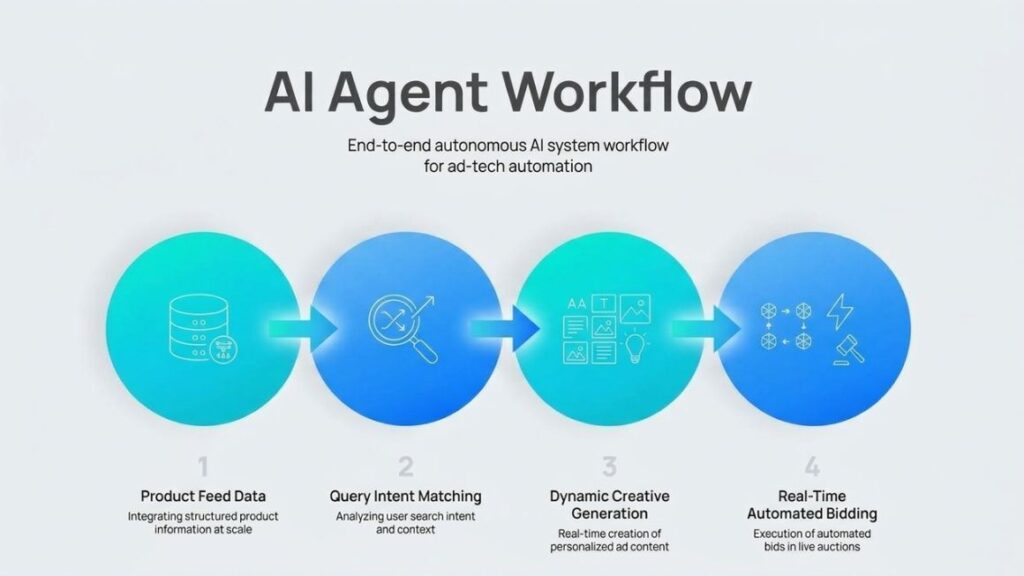
The mechanics are less mysterious than the marketing copy suggests. Every AI agent for shopping campaigns, whether it’s Google’s, Meta’s or a third-party tool, runs the same basic pipeline: read the feed, match intent, generate creative and execute bids. The differences are in how aggressively each step is automated and how much visibility you get into it.
Reading the Product Feed
Everything starts with your Google Merchant Center feed or its Meta Commerce Manager equivalent. The agent doesn’t just read the title and price. Google’s documentation on AI Max for Shopping says the system pulls granular attributes, things like fabric softness, material durability, and fit, to understand what a product actually is beyond its category label. Enhance creative relevance by transforming static product data into hyper-relevant and dynamic assets that map to complex long-tail searches and native AI search surfaces.
That’s a bigger deal than it sounds. A feed that only lists “Men’s T-Shirt, Blue, ₹899” gives the agent almost nothing to work with. A feed with material composition, fit notes, and use-case language gives it the raw material to match a query like “breathable cotton t-shirt for humid weather.”
An AI agent for shopping campaigns reads structured attributes from a product feed, not just titles and prices, to match products against conversational search queries. The depth and accuracy of the feed directly determines how many queries the agent can win, which makes product feed optimization a prerequisite, not an afterthought.
Matching Conversational and Discovery-Stage Queries
Shoppers stopped typing “blue running shoes” and started asking “what are good running shoes for flat feet under ₹5,000.” Static Shopping campaigns, triggered by close keyword matches, miss most of that. An AI agent for shopping campaigns is built specifically to catch it, matching the intent behind a question rather than the words in it.
Google’s own framing of the problem is blunt about this gap: shoppers now ask questions like “what are the best high-quality clothes for lounging” instead of searching for a specific SKU, and static creative simply doesn’t show up for that kind of query If your ad creatives are static and only triggered by exact product queries, you’re missing shoppers during the discovery phase.
Generating and Testing Creative Automatically
Once the agent has matched a query to a product, it writes the ad. This is where AI Max for Shopping’s text customization feature comes in, generating copy that speaks to the specific intent behind the search rather than reusing the static product title on every impression.
The catch, and every practitioner writing about this in 2026 flags it, is that generative ad copy is only as good as the feed underneath it. One agency writing about the rollout put it plainly: you cannot fake data density, and if your feed is messy, the AI-generated copy will be too.
Executing Bids and Budget Without Manual Approval
The last step is the one that used to be a full-time job: deciding how much to bid and where to spend. Modern agents, both Google’s and Meta’s, run this continuously, reallocating budget across products, audiences, and placements in near real time based on which combinations are converting.
This is also where the agent asks for trust it hasn’t fully earned yet. Meta’s Advantage+, for instance, needs a minimum volume of weekly purchase events before its algorithm has enough signal to bid with confidence, and Meta lowered that threshold from 50 to 25 conversions a week in April 2026 Meta lowered the weekly conversion threshold in April 2026, from 50 down to 25, which tells you something about how data-hungry these systems still are.
Also Read: AI Performance Marketing Strategies That Drive Measurable Growth
Google’s AI Max for Shopping vs Performance Max: What Changed in 2026
Performance Max has run automated, AI-driven bidding across Search, Shopping, YouTube, Display and Gmail from one campaign since 2022. AI Max for Shopping is newer and more focused: it adds AI-powered text customization, Final URL Expansion and Optimal Format Selection to Shopping campaigns. These are the ones advertisers kept running precisely because they wanted more control than Performance Max gives them.
Google announced AI Max for Shopping on April 30, 2026, introducing three key features: text customization, Final URL Expansion, and Optimal Format Selection.
Text customization writes and tests ad copy pulled from your feed attributes rather than relying on a static product title, aiming to make ads relevant to both long-tail search queries and newer AI-driven surfaces like AI Overviews. Text customization: Optimize your ad copy (for example, product titles) to help make them more relevant across Shopping ads and serve on new AI-driven surfaces, like AI Overviews.
Final URL Expansion is the more disruptive of the two. Instead of sending traffic only to the specific product URL in your feed, Google crawls your site and decides, in real time, whether a category page, a “new arrivals” page, or an editorial post is a better match for the shopper’s intent.
Instead of relying solely on the specific product URLs in your Merchant Center feed, the system crawls your website to identify other high-value “commercial URLs,” for example, category pages, “new arrivals,” or editorial pages. Some practitioners have described it less charitably, as Google taking the wheel on landing page selection whether you fully trust it to or not Google takes the wheel by dynamically selecting landing pages based on what the AI assumes is the user’s intent.
Format selection is what actually executes that decision. If the system decides a category page beats a product page for a given query, it can serve a text ad instead of a Shopping ad entirely. That is a functional shift in what “running a Shopping campaign” even means If the AI decides a category page is more relevant than a product page, it will serve a text ad instead of a Shopping ad.
Take a fictional example close to the ones Google itself has used in its rollout materials: an espresso machine retailer. A shopper searching “best entry-level espresso machine for someone who doesn’t want to learn latte art” would have gone unmatched under a keyword-based Shopping campaign built around “espresso machine” and “coffee maker.” Under AI Max for Shopping, the agent reads feed attributes like automation level and skill requirement, matches the query, and writes ad copy that speaks to the actual concern, not just the product category.
The strategic shift underneath all of this is what it does to feed quality. AI Max for Shopping raises the stakes on Merchant Center data that many teams still treat as a catalog export rather than a live merchandising asset. AI Max for Shopping is not just a feature extension. It changes the strategic importance of Merchant Center data. Shopping campaigns have always depended on feed quality, but many teams still treat the feed as a catalog export rather than a live merchandising asset.
AI Max for Shopping, launched by Google on April 30, 2026, adds conversational query matching, generative ad copy and Final URL Expansion to standard Shopping campaigns. Unlike Performance Max, it lets advertisers keep the structural control of Shopping campaigns while still capturing long-tail and question-style search queries.
Meta’s Advantage+ Shopping Campaigns and Where the Agent Takes Over
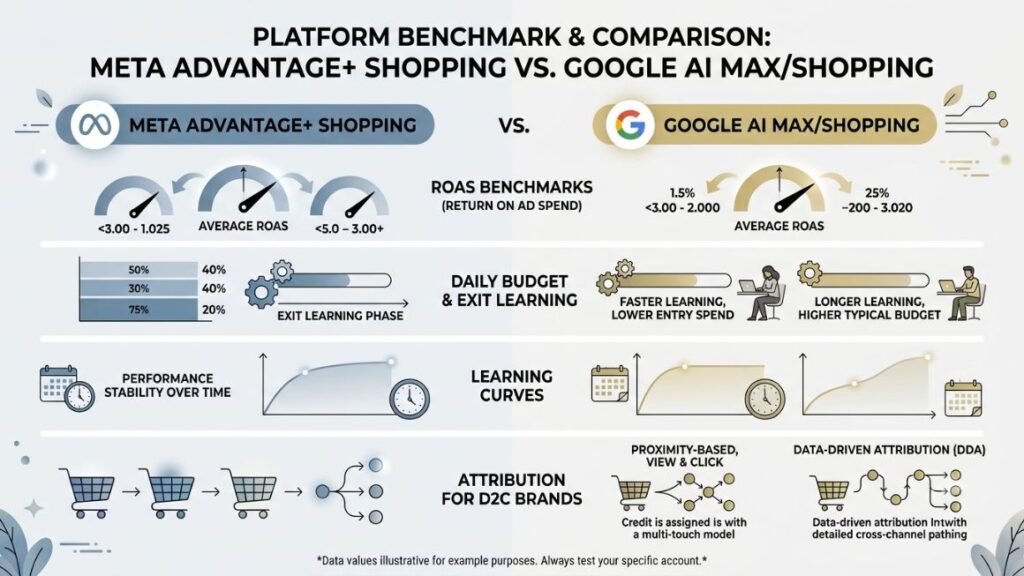
Meta Advantage+ is Meta’s fully automated campaign system. It controls targeting, placement, creative selection, and budget allocation once you hand it a catalog and a conversion goal, with none of the manual audience-building that defined Meta ads for a decade Meta Advantage+ is Meta’s fully automated campaign system that uses machine learning to control targeting, placement, creative selection, and budget allocation without manual inputs.
The performance case for it is now well documented, though the numbers vary depending on whose benchmark study you read. One 2026 DTC benchmark set puts Advantage+ ROAS at 4.52x against 1.86 to 2.19x for manually managed campaigns at the same spend. The result: average ROAS of 4.52:1 vs 1.86-2.19:1 for manually managed campaigns per 2026 DTC benchmarks.
A separate 2026 industry analysis lands on a smaller but still meaningful gap: 4.5x versus roughly 3.7x for manual campaigns, alongside about 32% lower cost per acquisition across ecommerce verticals. The headline numbers: ASC averages around 4.5x ROAS versus about 3.7x for manually configured campaigns, a lift in the 15% to 25% range, with roughly 32% lower cost per acquisition across ecommerce verticals.
What’s automated is close to everything: audience selection, placement across Feed, Reels, and Stories, and budget pacing. What still needs a human is the input layer, creative assets, conversion signal quality, and catalog completeness, because the algorithm can only optimize what it’s given.
Also Read: Meta Ads Optimization Checklist: The Complete Guide for Andromeda-Era Campaigns (2026)
Catalog maturity changes the math meaningfully. One 2026 benchmark report found Advantage+ underperforms for brands with fewer than 10 SKUs, since the algorithm doesn’t have enough product variety to work with, while it consistently outperforms manual setups for brands with 30 or more SKUs and at least 15 active creative assets 8% lower ROAS for brands with under 10 SKUs (insufficient product variety for algorithm). That’s a real constraint for a small or early-stage brand, not just a hedge in a case study.
Creative quality, not targeting, has become the bottleneck. Meta’s own performance data attributes more than half of campaign outcomes to creative rather than structure or budget, a finding that shows up consistently across client accounts too. Creative quality now accounts for over 50% of Meta Ads performance. That’s not an estimate. It’s what Meta’s data shows consistently. Unedited product demos and founder-led video have been outpacing polished lifestyle shoots. That is not the direction most brand teams expect automation to push them. Unedited product demos, founder-led content, UGC from real customers and POV-style videos regularly outperform agency-produced lifestyle shoots by significant margins.
Beyond Google and Meta: Standalone AI Shopping Agent Platforms
Google and Meta’s agents only ever optimize inside their own walls. A brand running Google, Meta, TikTok, and a retail media network at once needs someone, or something, coordinating across all four. That’s the gap standalone platforms are built to fill.
The landscape splits roughly into two shapes. Cross-platform agent operators, tools like Synter, take a human’s stated goal and execute it across a dozen or more ad platforms from a single interface, with the human directing and the agent doing the clicking. Platforms like Synter provide AI Agents capable of managing campaigns across multiple ad platforms from a single interface. These are human-directed: you set goals, and the AI Agents execute.
Enterprise creative-and-media platforms like Smartly.io and Albert.ai sit at the other end, running full-stack media buying with predictive budget allocation across several channels at once, typically at a price point built for teams already spending well into six figures a month. Albert.ai, one of the earliest autonomous marketing platforms, operates as a full-stack media agent, analyzing performance data, identifying underperforming segments, shifting spend across Google, Meta, TikTok, and programmatic exchanges, and generating weekly campaign strategy revisions without human input.
Also Read: AI Agent for Marketing Operations: How to Automate Campaigns, Data, and Reporting in 2026

What to Actually Check Before Trusting One With Budget?
Every platform in this category claims autonomy. The differences that matter show up in three places.
- Autonomy level. Some tools only recommend changes for a human to approve. Others write live to the ad account. A few, aware of how nervous that makes marketers, deliberately stage changes rather than executing them outright, one platform in this category explicitly cannot delete campaigns and only makes staged writes Cannot delete campaigns, staged writes only.
- Integration depth. A tool that reads your data through a read-only connector is fundamentally different from one with write access to bids and budgets. Confirm which you’re getting before you hand over a catalog.
- Audit trail. When an agent moves budget overnight, you need a record of why. Platforms without transparent logging turn a bad week into a mystery instead of a lesson.
None of this replaces the platform-native agents inside Google and Meta. It sits on top of them, coordinating what each one is told to do.
Agentic Commerce: Why Shopping Campaigns Now Have to Reach AI Shoppers, Not Just Humans
Agentic commerce is the layer above shopping ads entirely: it’s what happens when the shopper isn’t scrolling a results page at all, but asking ChatGPT, Perplexity, or Gemini to find and sometimes buy a product on their behalf. A shopping campaign agent optimizes how you show up in Google and Meta’s auctions. Agentic commerce determines whether you show up at all when the “search” happens inside a chat window.
The scale of this shift is no longer speculative. McKinsey projects agentic commerce will reach $3 to $5 trillion globally by 2030. McKinsey projects it will reach $3 to $5 trillion globally by 2030, and the near-term consumer numbers back the direction: a January 2026 IBM study found 45% of consumers already use AI for some part of the buying journey A January 2026 IBM Institute for Business Value study found 45% of consumers already use AI for some part of the buying journey.
The Agentic Commerce Protocol, or ACP, is the open standard co-developed by Stripe and OpenAI, released in September 2025, that lets ChatGPT complete purchases directly through Instant Checkout. The Agentic Commerce Protocol (ACP) was co-developed by Stripe and OpenAI and released as an open standard in September 2025. It is the protocol that powers ChatGPT’s Instant Checkout.
Google’s answer is the Universal Cart, backed by its own protocol and partnered with Walmart, Target, Shopify, and Etsy, among others. Google’s UCP (partnered with Walmart, Target, Shopify, Etsy, and 20+ others): open protocol, intent-based discovery. Shopify’s Winter ’26 release lets a single merchant catalog syndicate simultaneously to ChatGPT, Perplexity and Microsoft Copilot. Shopify’s Winter ’26 Agentic Storefronts feature lets merchants syndicate one catalog to ChatGPT, Perplexity, and Microsoft Copilot simultaneously.
Not every platform is playing along. Amazon has blocked the crawlers that let ChatGPT surface its products, protecting an advertising business worth billions but ceding early ground to brands that sell direct or through Shopify. Amazon has blocked ChatGPT-User and OAI-SearchBot crawlers in robots.txt, meaning Amazon product listings cannot be surfaced in ChatGPT shopping results in real time. That standoff escalated into litigation in March 2026, when a federal court blocked Perplexity’s Comet browser from completing purchases on Amazon at all. In March 2026, a US federal court issued a preliminary injunction preventing Perplexity’s Comet browser from making purchases on Amazon after Amazon argued the agent’s automated sessions were being presented as human traffic.
For a brand that isn’t Amazon, this is oddly good news. Being outside Amazon’s fight means your Shopify or DTC catalog can appear in ChatGPT results where Amazon listings can’t, at least for now.
Read More:
Agentic commerce refers to AI agents like ChatGPT and Perplexity discovering and completing purchases on a shopper’s behalf, without the shopper ever visiting a retailer’s site directly. It runs on open protocols like the Agentic Commerce Protocol and Google’s Universal Cart, and it rewards brands with clean, structured product feeds over brands with only well-designed web pages.
What actually gets a product surfaced inside these agents has nothing to do with traditional SEO. Structured data quality, matched to the specific attributes a shopper asks about, matters more than page design or backlinks, and shoppers who arrive through an AI agent convert differently once they land AI-referred shoppers browse 13% more pages, spend 48% longer on site and generate 37% more revenue per visit than average.
Setting Up Your First AI Agent for Shopping Campaigns: A Practical Walkthrough
Handing budget to an agent without prep is how brands end up with a horror story to tell at a marketing meetup. Here’s the order that actually works.
- Audit and clean your product feed first. Every downstream feature, conversational matching, generative copy, landing page selection, depends on this. Fix missing GTINs, thin titles, and inconsistent pricing before you touch a campaign setting.
- Choose the right level of autonomy. Google and Meta both let you scope how much control the agent gets, from suggestion-only to fully automated bidding and creative. Start scoped. Expand once you’ve seen a few weeks of decisions you’d have made yourself.
- Set guardrails before you hand over budget. Define a maximum CPA or minimum ROAS floor, brand exclusions, and which URLs are off-limits for expansion. Guardrails are cheap insurance against a landing page decision you’d never have approved manually.
- Monitor closely in the first 30 days. The learning phase is when an agent makes its worst mistakes and its most useful discoveries. Check daily for the first week, then weekly. Don’t touch bids during this window unless something is clearly broken; interrupting the learning phase resets it.
Auditing and Cleaning Your Product Feed First
Start with the fields the agent actually reads: title, description, GTIN, availability, and the category-specific attributes (material, fit, size) that AI Max and Advantage+ both lean on. A feed audit here isn’t a one-time task. It’s the maintenance cost of running an agent at all.
Choosing the Right Level of Autonomy
Neither Google nor Meta forces an all-or-nothing choice. You can run AI Max for Shopping with text customization on and Final URL Expansion off, or vice versa. The same goes for Advantage+, where creative automation and budget automation can be scoped independently. Match the scope to how much risk your catalog can absorb, not to what the platform defaults to.
Setting Guardrails Before You Hand Over Budget
This is the step most teams skip, and it’s the one that determines whether “the agent did something weird” becomes a minor annoyance or a five-figure mistake. A maximum CPA cap, a brand-safety exclusion list, and a defined budget ceiling per product line cost nothing to set up and save real money the first time the algorithm gets aggressive.
What to Monitor in the First 30 Days
Watch three numbers specifically: CPA trend, the query report (to catch mismatches before they scale), and landing page performance if Final URL Expansion is on. A spike in any one of these in week two is normal. The same spike in week four means something needs a manual correction.
Common Mistakes Brands Make With AI Shopping Agents
Ignoring feed hygiene. This is the mistake behind almost every other mistake on this list. An agent with a thin, inconsistent feed produces thin, inconsistent ads, no matter how sophisticated the bidding layer underneath it is.
Blind trust in bid recommendations. These systems optimize toward the goal you gave them, not the goal you meant. A ROAS target set too low tells the algorithm to chase volume at the expense of margin, and it will do exactly that.
No measurement layer outside the platform’s own dashboard. Google and Meta both report performance against their own attribution model, which tends to flatter their own channel. A brand running an agent on Google and an agent on Meta without a third-party measurement layer is comparing two numbers that were never meant to be compared directly.
Treating it as set-and-forget. The phrase “AI Max” and “Advantage+” both imply a level of hands-off automation that doesn’t match reality. These systems need feed updates, creative refreshes, and guardrail adjustments on an ongoing basis. Walking away for a quarter is how a brand ends up spending against a stale catalog.
Is an AI Agent for Shopping Campaigns Worth It for Indian D2C and Ecommerce Brands?
For most Indian D2C and ecommerce brands running 50 or more SKUs with a clean Google Merchant Center feed, an AI agent for shopping campaigns is worth adopting now, especially through Performance Max or AI Max for Shopping, where catalog-driven automation tends to outperform manually managed Search campaigns.
The catalog complexity that trips up Indian brands is real and specific. Multi-variant listings, regional pricing across marketplaces, and inconsistent sizing conventions across categories like apparel and footwear all make feed hygiene harder here than in the tidier catalogs most case studies come from. Brands selling across Meesho, Flipkart, and Myntra in addition to their own Shopify or WooCommerce store are effectively maintaining three or four versions of the same product data, and any inconsistency between them confuses an agent that’s trying to build a single coherent picture of the product.
Google’s Universal Cart makes this sharper still. It pulls directly from Merchant Center, and if a feed is incomplete or inconsistently priced, the product simply doesn’t get surfaced. Nobody penalizes the brand; the brand is just invisible to the system. If your product feed is incomplete, inconsistently priced, or missing structured attributes (size, colour, material, SKU), Google’s AI simply cannot include you. This is not a penalty. It is just the system working as designed. You are not being excluded; you are being invisible.
Catalog size still matters as a gate. Shopping and Performance Max campaigns tend to underperform for Indian D2C brands with fewer than 20 SKUs, while fashion, home decor, and electronics brands with 50 or more tend to see the strongest returns. Brands with fewer than 20 SKUs may find Shopping less efficient than standard Search. Best for: D2C brands with 50+ SKUs, competitive pricing, and quality product photography. Fashion, home decor, and electronics brands see the highest returns.
For a smaller Indian brand with a thin catalog, an AI shopping agent probably isn’t the first investment worth making. Feed depth and SKU count matter more to these systems than budget size does. Put the effort into product data and photography first. Then layer automation on top once the catalog can actually support it.
Conclusion
The work of running shopping campaigns hasn’t disappeared. It’s moved. Less time goes into picking bids and writing ad copy by hand, and more goes into the thing that determines whether the agent has anything good to work with: the product feed. Brands that treat their Merchant Center feed as a live merchandising asset, not a static export, are the ones seeing real gains from AI Max for Shopping and Advantage+ right now.
The next shift, agentic commerce inside ChatGPT and Perplexity, is still early, but it rewards exactly the same discipline: structured, accurate, well-maintained product data. Start there, and every layer of automation you add on top of it, from Performance Max to Advantage+ to whatever comes after, has something real to build on.
If you’re building out AI-driven ad workflows for your own catalog and want a structured way to learn the tools behind Performance Max, Advantage+, and prompt-based campaign management, YUP’s AI Marketing course walks through exactly this, from feed strategy to hands-on agent setup, with the kind of practical detail this article could only summarize.
Frequently Asked Questions
What is an AI agent for shopping campaigns?
An AI agent for shopping campaigns is software that plans, builds and adjusts shopping ad campaigns directly from a product feed, deciding bids, creative and targeting with minimal manual configuration. Google’s AI Max for Shopping and Meta’s Advantage+ Shopping Campaigns are the two most widely used versions.
Is AI Max for Shopping the same as Performance Max?
No. Performance Max is a full campaign type that runs across Search, Shopping, YouTube, Display, and Gmail at once. AI Max for Shopping adds conversational matching and generative creative to standard Shopping campaigns specifically, giving advertisers more of Performance Max’s automation while keeping the structural control that comes with running Shopping campaigns on their own.
How does Meta Advantage+ compare to manual Meta campaigns?
Meta Advantage+ generally outperforms manually managed campaigns on ROAS and cost per acquisition once a brand’s catalog and conversion volume are large enough for the algorithm to work with, though the exact lift varies widely by benchmark study and industry vertical.
How do I set up an AI agent for shopping campaigns?
Start by cleaning your product feed, then choose your autonomy level inside AI Max for Shopping or Advantage+. Set CPA and budget guardrails, launch and monitor daily for the first week without adjusting bids manually.
Who should use an AI agent for shopping campaigns?
Brands with 30 or more SKUs, a clean and complete product feed, and steady conversion volume see the most benefit. Brands with thin catalogs, fewer than 10 to 20 SKUs, or unreliable conversion tracking generally see weaker or inconsistent results.
Is an AI shopping agent actually worth it, or is it overhyped?
For brands with the catalog depth and feed quality to support it, the performance data is consistent enough to take seriously. For brands without that foundation, the honest answer is that the agent will amplify whatever’s already broken in the feed rather than fix it.
Why isn’t my AI Max for Shopping campaign generating better results?
The most common cause is a thin or inconsistent product feed. Missing attributes, unclear titles and outdated pricing give the agent almost nothing to work with, no matter how sophisticated the matching layer is underneath.
What is agentic commerce and how is it different from shopping ads?
Agentic commerce is AI agents like ChatGPT or Perplexity discovering and sometimes completing a purchase on a shopper’s behalf, outside of traditional search or social ad auctions entirely. Shopping ads still depend on winning an auction; agentic commerce depends on your product feed being structured well enough for an AI agent to recommend it directly.
Do I need to worry about ChatGPT shopping if I sell mainly through Google and Meta ads?
Not urgently, but it’s worth preparing for. Product discovery inside AI chat tools is growing fast enough that brands with clean and structured feeds today have a real head start once that share of traffic becomes too large to ignore.
What’s the biggest mistake brands make when they turn on an AI shopping agent?
Skipping feed cleanup and going straight to campaign automation. The agent can only work with what’s in the feed, and a messy feed produces messy, expensive results regardless of how much budget backs it.