

Your dashboard says 4,000 customers are likely to stop buying next quarter. Then what? Someone exports a list, someone drafts a win-back email, a third person waits for approval, and by launch day half of them have already left. The forecast was right. The response was late.
Closing that gap is the point of an AI agent for predictive analytics. It’s software that forecasts what’s likely to happen, decides what to do about it, and takes the next step through your connected tools and then checks whether the step worked. Traditional predictive analytics stops at the forecast.
The timing is contradictory. McKinsey’s 2026 State of AI survey found 40% of respondents at companies with over $1 billion in revenue are scaling AI agents. That is up from 27%. Yet only 37% say AI has added to EBIT (earnings before interest and taxes), basically unchanged from 2025. Gartner expects over 40% of agent projects to be canceled by the end of 2027. This is because of cost, unclear value or weak risk controls. This guide covers what works, what doesn’t and how to start, with an India lens.
Table of Contents
What Is an AI Agent for Predictive Analytics?
An AI agent for predictive analytics is software that forecasts an outcome, decides what to do about it, and carries out or proposes the next step through connected business tools, then tracks whether it worked. The forecast is only the first move. The follow-through is the job.
Predictive analytics is the use of historical data and statistical or machine learning techniques to estimate what’s likely to happen next. Take churn. A model tells you who’s drifting away. An agent also checks who’s worth a discount, picks the channel, sends the offer and looks at who came back. Tredence called this closed-loop decision-making in 2025.
AI Agent vs Predictive Model
A model returns a score or forecast and stops. It can’t open your CRM. An AI agent for predictive analytics wraps one or more models inside a loop with a goal, rules and tools, so the model becomes one tool among several.
AI Agent vs Chatbot vs Automation
A chatbot answers questions and waits to be asked. Rule-based automation runs fixed if-then steps and fails when something unexpected happens. An agent chooses among steps based on context, inside limits you set.
| Predictive model | Chatbot | Rule-based automation | AI agent | |
| Main job | Estimates a likelihood or value | Answers questions | Runs fixed if-then steps | Pursues a goal across steps and tools |
| Handles new situations | No | Only in words | No | Yes, within set limits |
| Acts in other tools | No | Rarely | Preset actions only | Yes, with permissions and approval gates |
| Example | A churn score in a CRM | “What was last month’s revenue?” | “If cart abandoned, email after two hours” | Spots a stock-out risk, drafts a purchase order, asks a planner to approve |
Beware agent washing, where vendors rebrand chatbots as agents. Gartner’s estimate, reported by MarTech in 2026, is that only about 130 of the thousands of vendors claiming agent features actually offer them. Before you buy an AI agent for predictive analytics, ask three questions. Does it choose between options, act inside another system and check the result? Three no’s means automation with a new label.
An AI agent for predictive analytics forecasts an outcome, chooses an action and carries it out through connected tools, then measures the result. A predictive model only scores, a chatbot only answers and rule-based automation only follows fixed steps. Gartner estimates only about 130 of the thousands of vendors claiming agent features genuinely offer them.
Why Agentic Does Not Always Mean Autonomous
Agentic means able to plan and act. Autonomy is how much freedom you grant. An AI agent for predictive analytics rarely starts fully autonomous: it suggests, a person approves, and only low-risk, reversible tasks run alone. EY’s AIdea of India research says most Indian enterprises use strict monitoring and limited autonomy. Gartner expects at least 15% of day-to-day work decisions to be made autonomously by 2028, up from 0% in 2024. That’s a minority, not a takeover.
How Does It Work? The Five-Stage Loop From Data to Action
An AI agent for predictive analytics runs a loop with five stages: sense the data, predict what’s likely, decide what to do, act through connected tools, and monitor the result. The last stage feeds the first, so the loop improves with use, or quietly gets worse when nobody’s watching.
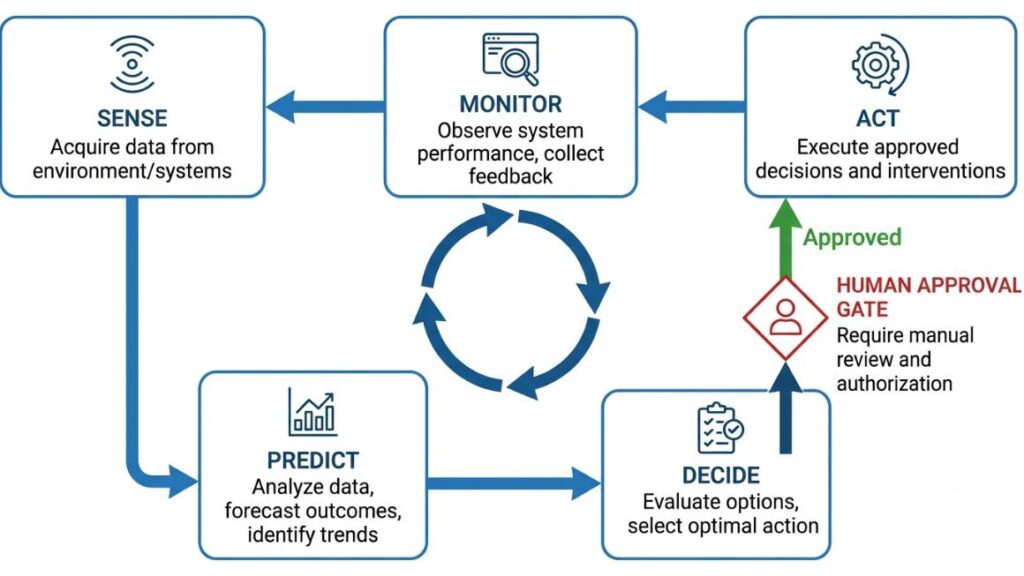
Sense: Connect to Business Data
The agent needs read access to warehouse tables, CRM records, ad platforms and inventory feeds. Most projects stumble here, not in the modelling. Klaviyo’s Helpdesk panel leaves the predicted next-order date empty until a customer has two past orders, while another help page says one-time buyers get an estimate from all customers’ behaviour. Either way, thin history means weak predictions.
Predict: Generate or Retrieve a Forecast
The agent either retrieves a score from a model you already run or generates one on demand. BigQuery’s AI.FORECAST uses a built-in model called TimesFM (version 2.5 by default), and Google’s documentation says results are comparable to conventional methods such as ARIMA. Newer isn’t automatically better.
Most of this still runs on classic machine learning models. The value of an AI agent for predictive analytics is that it keeps the output as a probability or range instead of rounding it away.
Decide: Interpret the Prediction in Context
A score alone isn’t a decision. Two customers with the same 80% churn risk, one who pays full price and one who only buys on sale, deserve different responses. The agent weighs margin, stock, budget caps and contact history. Hard-coded guardrails still decide how much discount you can afford.
Act: Trigger the Next Step
The agent calls other systems through APIs: adding a customer to a flow, changing an ad budget, drafting a purchase order. Klaviyo advises against counting down to a customer’s expected next-order date, because repeat buyers would get the same sequence every cycle and may unsubscribe. An agent that doesn’t know that rule will annoy your best customers.
Monitor: Measure Outcomes and Detect Drift
Model drift is the gradual drop in a model’s accuracy as real behaviour moves away from its training data. The agent compares predictions with outcomes and pauses actions when the gap widens. Klaviyo retrains its lifetime-value model at least weekly, and in India a Diwali sale can make last quarter’s patterns useless.
Why Shared Business Definitions Matter
If “active customer” means different things in the CRM and the warehouse, the agent picks one and sounds confident. A semantic layer stores agreed definitions in one place the agent reads from. Futurum projects the segment growing 19% in 2026 and toward 30% by 2031. PointFive’s summit recap says both Snowflake and Databricks shipped a context layer for agents. It reports a Snowflake benchmark rising from 24% to 86% on structured-context tasks. That’s a vendor number, so treat it as direction.
Where Humans Approve Agent Actions
An approval gate is a point where a person must confirm before the agent proceeds. Let the agent act alone on cheap, reversible steps. Require approval for spend above a cap, mass customer messaging and anything irreversible. McKinsey found high performers much more likely to work on preventing unauthorized or unintended agent actions.
Predictive vs Generative vs Agentic: What Each Type of AI Does
Predictive AI estimates what’s likely to happen, generative AI creates content, and agents pursue goals using tools. Each covers gaps in the others.
Predictive AI
Predictive AI uses historical patterns to estimate an outcome, such as churn or next month’s sales. It’s strong on numbers, weak at explaining itself and it can’t act.
Generative AI
Generative AI creates text, images or code from learned patterns. It summarises and explains well, but it doesn’t know a contact’s churn risk unless someone feeds the score into the prompt, as Hello Retail notes.
Agents That Take Action
Agentic AI describes systems given a goal, tools and limited freedom to plan the steps. Follow-through is the strength. Cost and the need for guardrails are the weaknesses.
How They Work Together
Inside an AI agent for predictive analytics, the chain is: Predict, then Generate or Explain, then Decide, then Act. The model scores lapsing customers, a language model explains why the riskiest group is leaving. The agent picks an offer within margin rules, and a marketer approves the first batch.
Forecast, Recommend, Act: Where Does an AI Agent Fit?
Predictive analytics tells you what will probably happen. A second layer recommends what to do about it. An AI agent for predictive analytics sits on top of both and, within limits, does it. Prescriptive analytics recommends the best action given a forecast plus limits such as budget, stock or policy.
Predict → Prescribe → Act
A research paper on enterprise agent architectures gives a clean example: forecast an inventory shortage, prescribe a procurement plan with optimisation methods, then place the order. Not every problem needs all three layers. A weekly sales forecast may need only prediction, a budget split needs prescription, and a festive-weekend stock-out benefits from action too.
Why Does This Matter Now? What the 2026 Data Says
Interest in an AI agent for predictive analytics is rising fast, especially at large companies, but financial returns haven’t caught up.
AI Agent Adoption
McKinsey’s 2026 survey (1,719 respondents, 97 countries) found 44% of organisations scaling AI across the enterprise, up from 38%. Among companies over $1 billion in revenue, 40% scale agents, up from 27%. Smaller firms stayed flat at 22%. Consumer goods and retail respondents most often use agents in marketing and sales, where respondents also most often report revenue gains.
Returns lag. Only 37% report any EBIT impact and about 6% are high performers. Nearly three-quarters of those redesigned workflows, against about a quarter of others. One in five say operating costs, including token costs, limit their AI use.
Predictive Analytics Is Moving Toward Agentic Workflows
PointFive’s June recap says agents headlined both Snowflake’s and Databricks’ 2026 keynotes. Databricks reported over 100,000 agents built, and Snowflake renamed Snowflake Intelligence to CoWork. Google Cloud showed an agent running BigQuery forecasts through MCP (Model Context Protocol, a standard way for agents to call tools). Gartner expects 33% of enterprise software apps to include agent capabilities by 2028. That is up from under 1% in 2024.
What Is Happening in India?
The Press Information Bureau, citing NASSCOM’s AI Adoption Index, said 87% of Indian enterprises were actively using AI as of December 2025. Depth is the harder question. EY’s 2025 survey of 200 enterprises found 24% of leaders already deploying agents, integration and data readiness as the biggest roadblock, and 64.5% rating data governance and security concerns “very severe.”
Predictive Analytics Market Size
| Research firm | 2026 estimate | Forecast |
| Coherent Market Insights (May 2026) | $12.5 billion | $27.8 billion by 2033, 11.6% CAGR |
| Fortune Business Insights | $27.56 billion | $116.65 billion by 2034, 19.8% CAGR |
| Grand View Research (July 2026) | $30.1 billion | $82.3 billion by 2030, 28.3% CAGR |
The 2026 estimates differ by more than double because firms define the market differently (software only versus software plus services) and use different base years and forecast windows. Treat them as a range. Fortune Business Insights expects Asia Pacific to grow fastest, which is good news if you’re planning an AI agent for predictive analytics in India.
Agent adoption is rising, but returns are not. McKinsey’s 2026 survey shows 40% of large organisations scaling AI agents. Yet only 37% of respondents report any EBIT impact from AI. Gartner expects over 40% of agent projects to be canceled by the end of 2027. So the gap is mostly a workflow and data problem, not a model problem.
What Can These Agents Actually Do? Eight Core Capabilities
A capable AI agent for predictive analytics combines eight abilities. Missing two or three usually signals a repackaged chatbot.
- Autonomous data analysis. It queries data and runs forecasts without scripted steps.
- Multi-step workflows. It chains score, filter, offer, send and check.
- Context-aware decisions. It weighs margin, stock and contact history, not just the score.
- Real-time monitoring. It reacts to live signals within minutes.
- Model drift detection. It notices when predictions stop matching outcomes.
- Human approval. It pauses at gates on risky or irreversible steps.
- Business-system integration. It reads from and writes to your CRM, ad platforms and warehouse.
- Multi-agent collaboration. One agent plans, another pulls history, a third checks policy.
Also Read: AI Agent for Marketing Campaigns: How to Plan, Launch, and Scale Campaigns Autonomously
Where Do These Agents Actually Pay Off? Six Use Cases
An AI agent for predictive analytics pays off where a forecast triggers a repeatable decision and a slow response has a visible cost. Start with one narrow decision.
Customer Retention and Churn
Klaviyo defines churn risk as the predicted probability that a customer won’t buy again in 90 days: low under 33%, medium 33% to 66%, high above 66%. That’s churn prediction in its simplest useful form. The agent adds the missing steps: read the score, check margin and recent offers, pick the flow, report who returned. Klaviyo itself notes predicted lifetime value isn’t exact, so rank customers rather than promise revenue.
Lead Prioritisation and Sales
HubSpot’s predictive scoring (Enterprise tier) returns a likelihood to close within 90 days and a priority tier. Agency guides cite a few hundred closed contacts as the minimum, and it only sees data inside HubSpot. Below that, plain lead scoring built on your ideal customer profile often beats an underfed model, and a hybrid of rules plus model works well. Salesforce is pushing Agentforce above Einstein, with agent-led lead qualification as a headline use, per ZoomInfo’s 2026 roundup.
Also Read: AI Agents for B2B Marketing: Strategies to Boost Leads, Sales & ROI
Marketing Budget Allocation
The agent watches predicted returns by channel and proposes shifts within caps you set. One agency guide to Klaviyo suggests seeding lookalike audiences with high predicted-value cohorts and excluding people about to buy anyway. Feeding predicted customer lifetime value into bidding beats optimising for a cheap first purchase. The catch is attribution noise: messy revenue data means confident reallocation in the wrong direction.
Demand and Inventory Forecasting
Retail is where demand forecasting has the clearest money attached. A Walmart executive told Supply Chain Dive in 2025 that its forecasting neural network stores past predictions across planning horizons and draws on demand patterns, planned events and local trends, with agent tools giving a unified inventory view.
Zepto’s 2026 SEBI filing shows the scale: 1,139 dark stores at 31 March 2026, an average 46,623 SKUs listed at dark-store level in FY2026 and over 2.3 million orders a day. The filing summaries don’t describe how Zepto forecasts. They just show why manual planning breaks.
Campaign and Revenue Forecasting
Google Cloud’s 2025 demo had an agent pull Google Analytics 360 data and run a BigQuery forecast with a 95% confidence level. Copy that detail. Plan on a range, not a single number.
Operational and Financial Risk
Predictive maintenance is the classic case outside marketing: sensor data predicts equipment failure and an agent books the service before the line stops. Fortune Business Insights says this application holds the highest market share. In finance, Market Research Future reports SAS launched agent-based decisioning in Viya in Q3 2026 for continuous risk forecasting. Regulated firms should read the governance section below first.
| Industry | Typical prediction | What the agent does | Watch out for |
| Retail | Sales by store and SKU | Suggests transfers and reorders | Festive spikes distort history |
| Ecommerce | Chance of repeat purchase | Triggers win-back flows | Over-discounting loyal buyers |
| Finance | Credit, fraud or default risk | Flags and routes cases for review | RBI oversight expectations |
| Manufacturing | Equipment failure | Raises a maintenance ticket | False alarms erode trust |
| Marketing | Conversion chance and customer value | Shifts budget within caps | Attribution gaps and consent rules |
| Supply chain | Shortages and delays | Drafts purchase orders | Supplier data quality |

Which Tools Should You Use for Predictive Analytics Agents?
Choosing an AI agent for predictive analytics starts with where your data already lives. It also helps to understand how agentic marketing platforms connect goals, tools and workflows. Warehouse-native tools suit teams with data engineers, CRM-native tools suit marketers, and no-code tools suit teams without data scientists. This is a map, not a ranking, and most claims come from vendor pages, so test on your own data.
Warehouse and Data-Platform Native Tools
Snowflake offers Cortex Agents, and its April 2026 notes say agents using semantic views now generate SQL directly for better accuracy and lower latency. Databricks offers Agent Bricks and Genie. Google’s BigQuery and Vertex AI (now branded Gemini Enterprise Agent Platform) cover AI.FORECAST. Microsoft’s Azure Machine Learning adds agent automation, per TechTarget. Expect a data engineer to be involved.
Enterprise Predictive Analytics Platforms
DataRobot built its name on automated modelling, where Autopilot trains hundreds of models and ranks them, and now positions itself as an agent platform. H2O Driverless AI, Dataiku and SAS Viya sit in the same tier. SAS is known for governance and audit controls, Dataiku for collaboration.
No-Code and Low-Code Tools
Pecan describes its product as a predictive AI agent for teams without data scientists. Akkio offers no-code models for churn, lifetime value and scoring. Alteryx suits analysts when data preparation is the bottleneck. You get speed, but less control over what the agent can do outside the tool.
CRM and Marketing-Native Tools
Klaviyo generates per-customer churn risk, lifetime value and expected next-order date. HubSpot offers predictive scoring on Enterprise. Salesforce runs Einstein predictions and Agentforce agents on Data Cloud. The limit is scope: HubSpot’s scoring only sees HubSpot data, and Salesforce’s only Salesforce data.
Custom AI Agent Builds
A custom AI agent for predictive analytics means Python, APIs, an agent framework and your existing models. You get full control, but PointFive warns a poorly bounded agent can loop and burn 10 to 100 times a normal workload. McKinsey found 32% of respondents skipped buying software because they could build it with coding agents. Building is cheaper, but running costs still bite.
Also Read: 9 Best AI Predictive Analytics Tools: Guide to Choosing What Actually Works
Build vs Buy vs Blend
| Approach | Best for | Watch out for | Example tools |
| Buy (CRM or no-code) | Standard questions and small teams | Limited data scope | Klaviyo, HubSpot, Pecan, Akkio |
| Buy (enterprise platform) | Governed modelling at scale | Cost, data science skills | DataRobot, Dataiku, H2O.ai, SAS Viya |
| Build | Unusual actions, strict guardrails | Engineering time, running costs | Python, APIs, agent frameworks |
| Blend | Most mid-sized teams | Integration between pieces | Bought prediction plus custom actions |
Most teams end up blending: buy the prediction, build the action layer.
How Do You Set One Up? A Seven-Step Roadmap
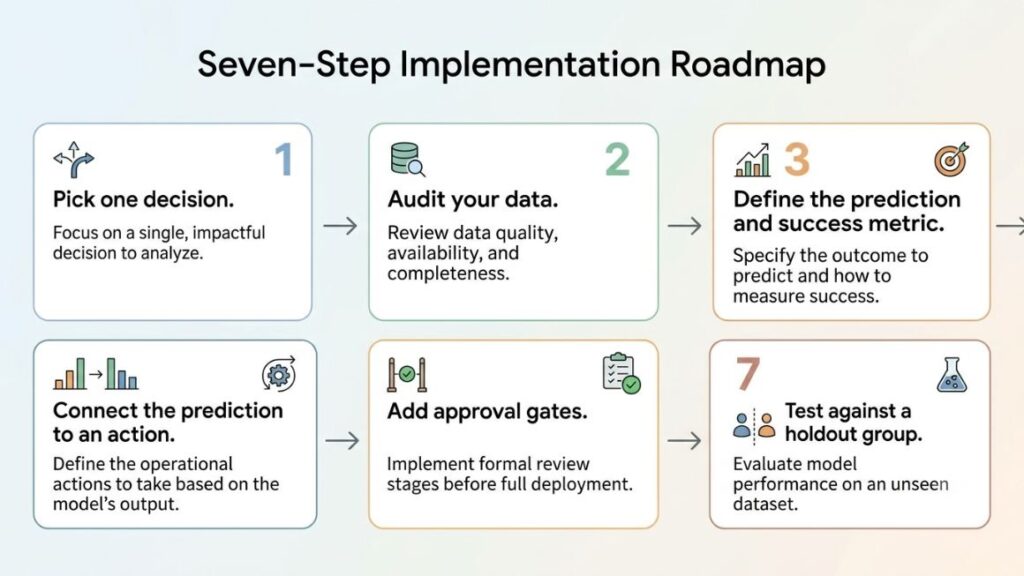
Setting up an AI agent for predictive analytics takes seven steps.
- Pick one decision. Choose a repeatable call, such as which lapsing customers get a win-back offer this week.
- Audit your data. Check that needed fields exist, are recent and mean the same thing across systems.
- Define the prediction and success metric. Write down what you’re predicting and the business number that proves it worked.
- Benchmark against a simple forecast. Compare with something dull, like “no purchase in 60 days means churned.” If the fancy model barely wins, use the dull one.
- Connect the prediction to an action. Wire the score to a permissioned step, with rules on frequency and margin.
- Add approval gates. Start with a person confirming every batch, and loosen only as trust builds.
- Test against a holdout group. Leave a random slice untouched to measure what the agent caused.
An Illustrative Retention Walkthrough
This is illustrative, not a real brand. An online skincare seller wants to win back quiet customers. The prediction is each customer’s chance of not buying in 90 days, the same window Klaviyo uses. Each morning the AI agent for predictive analytics reads the scores, drops anyone who got an offer in the last 30 days, applies a margin cap, picks email or WhatsApp based on recorded consent and queues messages for a marketer to approve. A random slice gets nothing. After 90 days, compare repeat purchases against that holdout.
How Do You Know Whether the Agent Is Working?
Measure an AI agent for predictive analytics at three levels: prediction quality, business impact and agent behaviour. A model can be accurate and still make no money, so the business metric and a holdout group decide.
Prediction Metrics
For yes-or-no predictions like churn, accuracy misleads because most customers don’t churn. Use precision (how many flagged customers really churned), recall (how many churners you caught) and AUC (how well the model ranks risky above safe). For forecasts, track WAPE (weighted absolute percentage error) and calibration: 30% risk should mean roughly 30% churn.
Business Metrics
Track incremental revenue, repeat purchase rate, margin after discounts, cost per retained customer and stock-out rate. McKinsey found high performers twice as likely to have defined processes for measuring AI impact.
Agent and Workflow Metrics
Track how often the agent acts, how often humans override it, time from signal to action, failures and cost per action. A rising override rate means the agent’s judgement doesn’t match your team’s, which is useful information.
Holdout Testing
A holdout test keeps a random group of customers out of the agent’s actions so you can compare them with treated customers. Without one, retention looks brilliant because many “saved” customers were never leaving.
Why Do So Many Agent Projects Fail?
Most failures of an AI agent for predictive analytics aren’t model failures. They’re data, cost, governance and workflow failures. Gartner’s June 2025 prediction that over 40% of agent projects will be canceled by the end of 2027 names escalating costs, unclear business value and inadequate risk controls.
Poor Data Quality and Integration
EY’s India research puts integration and data readiness at the top of the roadblock list. If your CRM, ad platform and warehouse disagree about who a customer is, the agent acts on that confusion faster than a person would.
Rising AI and Infrastructure Costs
About one in five McKinsey respondents limit AI use because of operating costs, including token costs. Set spend caps per agent, track cost per action from day one and watch for loops.
Governance and Compliance
India’s Digital Personal Data Protection Rules were notified in November 2025 and phase in over 18 months, per the Press Information Bureau. Sansa Legal lists 13 May 2027 for the remaining substantive obligations, with penalties up to ₹250 crore per violation. Consently notes verifiable parental consent is required before processing data of anyone under 18. Ask what personal data the agent reads, whether consent covers this use, and whether you can log what it did.
Banks, NBFCs and fintechs face the RBI’s FREE-AI report (13 August 2025), with seven principles and 26 recommendations. It’s advisory, but designed so the RBI can convert it into binding rules, and commentators note it puts accountability on the firm deploying the AI system.
Weak Evaluation
Teams judge agents on demos and a few good examples. Real evaluation tests awkward cases, tracks failures over time and reruns tests when the model, prompt or data changes.
Overtrusting Predictions
A probability isn’t a promise. Cap actions per day, flag sudden score jumps and review a sample weekly.
Automating a Broken Workflow
An agent on a slow, unclear process just makes the mess faster. Gartner says rethinking workflows from the ground up is often the ideal path, and nearly three-quarters of McKinsey’s high performers fundamentally redesigned theirs.
Agent projects usually fail for reasons unrelated to model quality. Gartner names escalating cost, unclear business value and inadequate risk controls, and EY’s India research ranks integration and data readiness as the biggest roadblock. Fixing data, capping spend, defining consent and logging rules, and redesigning the workflow first addresses most of the risk.
What Does This Mean for Your Career?
Working with an AI agent for predictive analytics doesn’t mean becoming a data scientist. McKinsey’s 2026 survey found 80% of respondents say AI improved their individual productivity, and just 13% say it makes them anxious about their careers.
Skills That Matter
Start with business problem framing: turning “we need to grow” into a decision an agent can support. Add data interpretation, KPI definition (if you can’t state success in one number, no agent can chase it) and experimentation, since holdout tests prove anything. You’ll also want working knowledge of predictive analytics, AI marketing analytics, a sense of how agents plan and call tools, the habit of checking outputs and the discipline to supervise a workflow.
Do You Need to Be a Data Scientist?
No. HubSpot and Klaviyo put predictions in front of marketers without code, and Pecan and Akkio target teams without data scientists. What you need is the judgment to question the output.
What Trends Will Shape Predictive Analytics in the Next 12 Months?
For anyone planning an AI agent for predictive analytics, six trends matter most.
Definition layers get serious. Snowflake and Databricks both shipped context layers in 2026 so agents stop guessing what a metric means.
Agent cost tracking. PointFive says agent identity will let teams attribute spend to individual agents and surface runaway ones.
Agent-to-agent communication. MCP and A2A (Agent2Agent) let agents from different vendors pass work along. Techzine reports Snowflake’s Cortex Code connecting through MCP and ACP (Agent Communication Protocol).
Decision intelligence. The term describes linking a decision to its data, prediction and outcome in one traceable loop, a useful mental model whatever vendors call it.
AI inside everyday software. Gartner’s 33%-by-2028 forecast fits Market Research Future’s list of 2026 launches, including Tableau Next Predictive Insights (beta) and SAP’s predictive workforce analytics.
Build versus buy shifts. McKinsey found nearly half of high performers skipped buying at least one software product because coding agents could build it, versus 31% of others.
Conclusion
Predictive analytics tells businesses what may happen. An AI agent for predictive analytics can connect those predictions to decisions and actions, but only when the data is clean, the rules are clear and a person watches the risky steps.
The teams getting value in 2026 picked one decision, measured it against a holdout group and redesigned the workflow before adding autonomy. That’s a small project you can start this month.
To build these skills properly, the YUP AI Marketing course walks through how marketers use AI agents, from framing the question to testing whether the results are real. It’s designed for working professionals who’d rather apply this on Monday than read about it for another quarter.
Frequently Asked Questions
What Is a Predictive Analytics Agent in Plain Terms?
Software that forecasts something, such as which customers will leave, then decides on a response and carries it out through your other tools. A normal model stops at the forecast.
How Do AI Agents Work in Predictive Analytics?
An AI agent for predictive analytics runs a five-stage loop: sense the data, predict, decide, act and monitor. Humans approve risky steps, and monitoring feeds the next cycle.
What Are the Benefits of AI Agents for Predictive Analytics?
Speed from insight to action, more consistent decisions and fewer manual handoffs. Benefits only show up with clean data and a sound workflow, which is why McKinsey finds only about 6% are high performers.
What Are Common Use Cases?
Retention, lead prioritisation, budget allocation, inventory planning, revenue forecasting and risk monitoring. Most teams start with retention because the action, such as an offer, is cheap and reversible.
How Do AI Agents Differ From Traditional Predictive Analytics Tools?
Traditional tools produce a score and leave the response to a person. Agents add decision and action layers and check the result. They cost more to run and need stronger guardrails.
Which AI Tool Is Best for Predictive Analytics?
There’s no single winner. Klaviyo or HubSpot suit marketers, Snowflake, Databricks or BigQuery suit teams with data engineers, DataRobot, Dataiku or SAS Viya suit governed modelling, and Pecan or Akkio suit small teams. Test on your own data.
Which AI Agent Is Best for Data Analysis?
The one closest to your data. If it’s in Snowflake, start with Snowflake’s agents. If it’s in BigQuery, look at Google’s conversational analytics and forecasting. Compare on accuracy, cost per query and ease of oversight.
Do I Need a Data Science Team?
Not to start an AI agent for predictive analytics. CRM-native tools need no code. You do need someone to check data quality and judge whether numbers make sense.
How Accurate Are Predictive Analytics Models?
It varies by problem and data. Rare events like churn are hard to predict precisely. Judge accuracy with precision, recall and calibration. Confirm impact with a holdout test and distrust any single accuracy number.
Can Small Businesses Use AI Agents for Predictive Analytics?
Yes, a small business can run an AI agent for predictive analytics if it has enough history. Klaviyo needs at least two past orders per customer for some predictions, and HubSpot’s scoring is commonly said to need a few hundred closed contacts. India’s DPDP rules apply at any size.