
Last verified: 8th September 2026. Grok Bot’s pricing and access have changed twice since its August 11, 2026 launch, most recently expanding to Cursor Pro at $20/month on August 26. Confirm current terms directly on xAI’s or Cursor’s site before subscribing.
Grok Bot launched in early beta on August 11, 2026, and within two weeks it had already generated the two things every viral AI product launch generates: a flood of “this changes everything” demos, and a much smaller, quieter cluster of people quietly using it for genuinely unglamorous work. This guide is built around the second group and will teach you how to use Grok Bot.
If you’ve heard of “Grok” before, this isn’t quite that. Grok Bot is a distinct product from the Grok chatbot most people are familiar with, and understanding that distinction is the first step to actually using it well.
Here’s what it is, how to set it up, which use cases are real and verified versus which are viral hype, and how it stacks up against both mainstream tools and the open-source agent frameworks, Hermes Agent and OpenClaw, that serious AI practitioners are also experimenting with right now.
Table of Contents
What is Grok Bot?
Grok Bot is xAI’s autonomous AI agent product: named bots that each get their own cloud computer, sign into your actual tools and accounts, run on a schedule without you prompting them, can message other bots, and reach out to you only when they need an approval. It’s a fundamentally different product category from a chatbot, which answers a question in a single session and then stops.
This is easy to confuse with two other things xAI offers. The Grok chatbot, the conversational assistant most people know from X, still exists separately and works the way any chat AI does.
Grok Automations, a lighter feature that runs a scheduled or trigger-based job, like summarizing an inbox on an hourly cron, is closer to a simple scripted task than an autonomous agent with persistent memory and its own environment. Grok Bot sits above both, it’s the product built specifically to act like an employee with its own machine, not just respond to prompts.
Worth being direct about where this stands right now: it’s three weeks old as of this writing, still gated in early beta, and every capability, pricing detail, and reliability claim here should be treated as current but not permanent.
How to Set Up Your First Grok Bot
The setup pattern that’s converged across the most-watched early tutorials starts with what’s being called the “chief-of-staff” bot, a single, general-purpose bot configured first, before spinning off more specialized bots for narrower tasks.
Step 1: Connect the plugins and tools you use daily. Give the bot real access to email, calendar, or a browser, whatever accounts it actually needs to be useful, rather than connecting everything at once.
Step 2: Assign one clear, narrow first task. Choose something with a visible finish line rather than an open-ended mandate, so you can verify whether the bot actually completed it correctly.
Step 3: Watch how it handles that task before expanding scope. Only add more responsibilities or spin off a second, specialized bot once the first task is running reliably.
Step 4: Keep your existing AI tools and workflows running in parallel. Don’t replace an established workflow yet. Grok Bot is still maturing, and treating a three-week-old beta as a full replacement is how people end up disappointed by something still finding its footing.
The Best Use Cases That Are Actually Real
The genuinely useful early pattern is less exciting than the viral demos, and that’s actually the signal worth paying attention to. According to independent tracking of public Grok Bot examples, operations-style work dominates the real, verified use case list, followed by coding tasks and email, while flashier categories like sales, support, and travel remain comparatively small so far. Here’s what’s actually working, in more depth.
Inbox cleanup and triage. This is the single most common real use case reported. A bot audits an inbox, applies rules for what to archive, flag, or draft a reply to, and runs the pass on a recurring schedule rather than requiring a person to sit down and do it manually. The reason this works well as an early use case is the same reason it’s underwhelming as a demo, there’s a clear before-and-after state (inbox count, unread flags) that makes it easy to verify the bot actually did the job.
Browser-based errands. Tasks that involve navigating a website, filling a form, checking a status, or pulling information from a page that doesn’t have a clean API. Early tutorials specifically point to this as one of the more reliable categories, since it plays to what an agent with its own persistent browser environment is actually built to do, rather than asking a chat model to describe steps it can’t take itself.
Meeting prep and follow-up. A bot pulling relevant context ahead of a scheduled meeting, and then handling the follow-up notes or action items afterward, without needing to be re-prompted each time. This pairs naturally with the scheduling capability, the bot can be set to run this pattern automatically around every calendar event matching certain criteria.
Persistent research. Unlike a single chat session that forgets everything once you close the tab, a bot can be assigned an ongoing research thread, monitoring a topic, a competitor, or a market over days or weeks, and surfacing what’s changed rather than requiring you to re-ask the same question repeatedly.
Sales follow-up. Automated, personalized follow-up sequences after an initial contact, timed and tracked without a person manually managing the cadence. One tactic worth noting from early adopters: setting bots to operate specifically during business hours rather than around the clock, both to match how a human recipient would expect contact, and to make monitoring the bot’s output easier during the hours you’re actually watching it.
Customer support. Handling routine, repetitive support queries, including, in a few documented cases, processing refunds directly through connected tools like Stripe. This is one of the categories where the visible finish line matters most, a refund either processed correctly or it didn’t, which makes it easier to trust the bot’s output without extensive manual review.
The repetitive operational work around software development. Not writing entire features from scratch, but the surrounding busywork, reproducing a reported bug, running a QA pass, or handling routine maintenance tasks that eat developer time without requiring deep architectural judgment.
The verified, high-value Grok Bot use cases cluster around unglamorous operational work with a clear finish line, inbox cleanup, browser errands, meeting prep, persistent research, sales follow-up, customer support, and coding busywork, according to independent tracking of public Grok Bot examples. Operations-style tasks dominate this list, while flashier viral demos tend to lack the kind of verifiable outcome that separates genuine usefulness from an impressive-looking but unconfirmed claim.
Worth naming directly: some of the most-shared launch-week claims, including posts describing autonomous crypto-trading desk earnings, have no verifiable receipt behind them. Treat viral, unfalsifiable claims with real skepticism, and weight the categories above, the ones with a visible, checkable outcome, much more heavily when deciding what to actually try first.
Teaching Grok Bot and Managing Its Memory
Grok Bot supports both individual memory, tied to one specific bot, and shared memory, accessible across multiple bots working together. This matters for how you scale beyond a single chief-of-staff bot, a shared memory layer lets a team of specialized bots stay coordinated on the same underlying context rather than each starting from zero.
The practical technique early adopters describe as “teaching” a task involves walking a bot through a process once, correcting it in real time as it works, rather than trying to write a single, perfect instruction upfront. The bot retains that corrected pattern for future runs of the same task, improving accuracy over repeated use rather than making the same mistake every time.
One detail worth knowing before rolling this out to a team: if multiple people are working from a shared computer or shared account setup, memory and task history can blur across users in ways that aren’t always obvious upfront. Worth testing deliberately with a single, isolated setup before assuming it behaves cleanly in a multi-person environment.
How Much Does Grok Bot Cost?
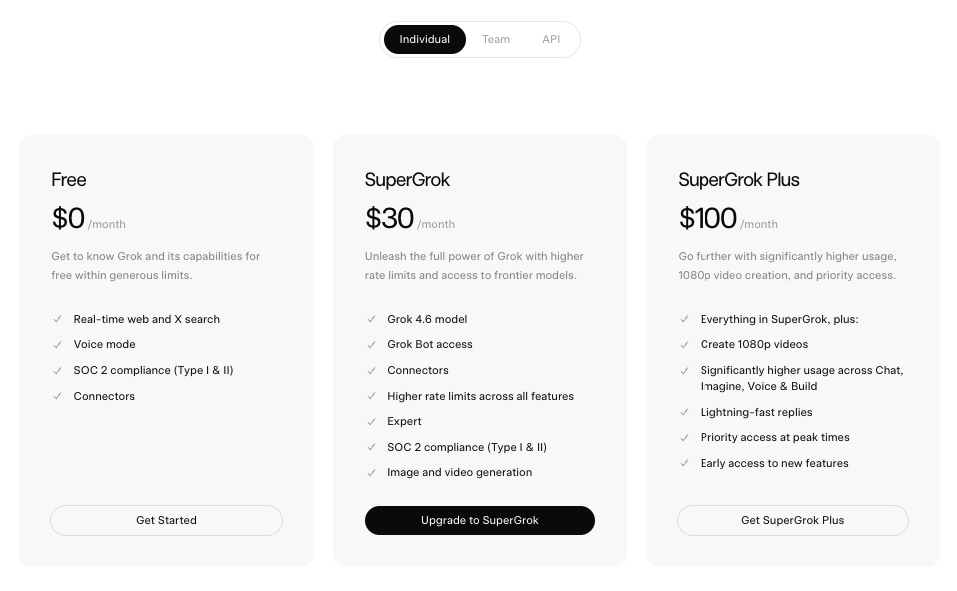
Access to Grok Bot rides on xAI’s existing SuperGrok subscription tiers rather than being a separate standalone product. As of this writing, that’s SuperGrok Lite at $10, SuperGrok at $30, and SuperGrok Heavy at $300, with a separate Grok Business tier at $30 per seat per month for teams, adding collaboration features, data privacy guarantees, and compliance capabilities beyond the individual tiers.
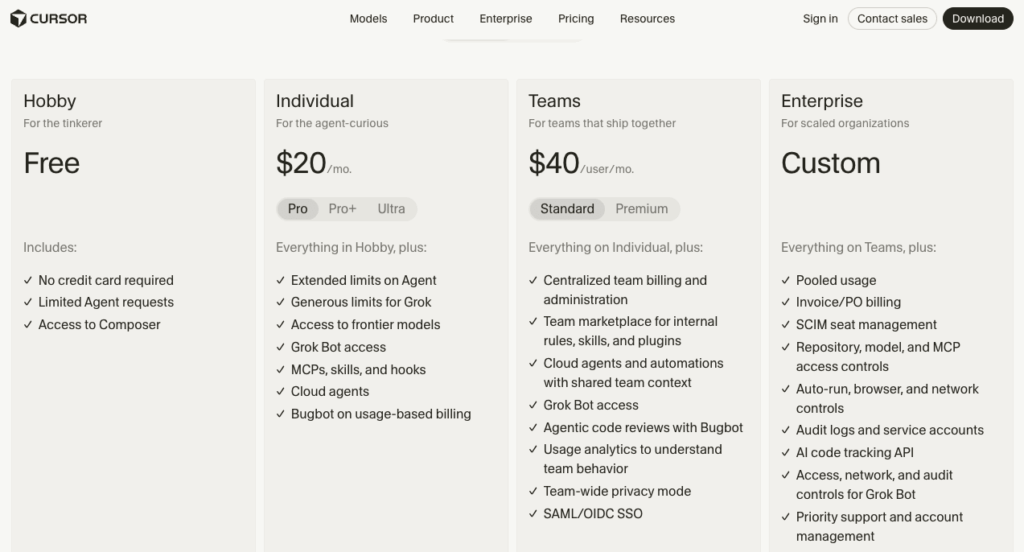
Grok Bot pricing was later reduced after a few weeks as users could access it via a Cursor subscription. It starts at $20.
Given how young this product is, treat any specific number here as a snapshot rather than a stable fact, and confirm current pricing directly on xAI’s site before committing.
The more important, currently live issue: usage limits. xAI’s own team has publicly acknowledged that some users are hitting their bot usage limits faster than expected.
This isn’t a rumor or a workaround-blog exaggeration, it’s an official acknowledgment from inside the company, worth factoring in directly if you’re planning to run multiple bots or schedule frequent recurring tasks.
On the cost-benefit question, the general guidance from early reviewers is that a paid tier tends to pay for itself once a bot reliably saves a person more than an hour or two of work per week, a reasonable bar to test any specific use case against before deciding it’s worth the subscription cost.
There is no standalone Grok Bot subscription. Access is bundled into existing SuperGrok tiers (from $30/month) or Cursor plans (from $20/month via Cursor Pro), with each plan including a separate weekly usage allowance on top of, not drawn from, regular Cursor or SuperGrok usage. Entry pricing has already dropped twice since the August 11, 2026 launch, from $200/month to $60 to $20, so current terms should always be confirmed directly on xAI’s or Cursor’s site before subscribing.
Grok Bot vs. Hermes Agent and OpenClaw
Grok Bot isn’t the only serious autonomous agent getting real attention right now. Two open-source frameworks, Hermes Agent and OpenClaw, represent a genuinely different approach, and understanding the difference matters if you’re deciding where to actually invest your time.
OpenClaw (formerly known as Moltbot) emerged in late 2025 and grew explosively, becoming, by April 2026, the most-starred AI project on GitHub with over 345,000 stars and an ecosystem of thousands of community-built skills.
It’s a Node.js-based personal assistant gateway, architected as a single control-plane process that fans out to the messaging channels people already use, WhatsApp, Telegram, Slack, Discord, iMessage, Signal, and more. According to comparison research published by Turing Post, OpenClaw is best understood as a control-plane-first personal agent built around file-backed identity and explicit, human-authored skills, closer to an always-on personal assistant than a self-directed autonomous worker.
Hermes Agent, built by Nous Research and launched in February 2026, takes a different architectural bet entirely. Rather than a single control-plane process, Hermes centers on what its own documentation calls a learning loop, an agent that becomes more capable the longer it runs, through self-generated skills, procedural memory that captures methods rather than just facts, and a deepening model of the user over time.
According to a comparison published by HackerNoon, Hermes converts successful workflows into reusable skills automatically, rather than relying on a marketplace of skills built by other people.
The most important practical difference, and the one worth taking most seriously, is security. OpenClaw’s ClawHub marketplace grew to over 13,000 community-built skills, but a security audit by Koi Security examining nearly 2,900 of those skills found 341 that were malicious, a roughly 12% malware rate.
Hermes Agent sidesteps that specific risk by generating its own skills rather than pulling from a community marketplace, and according to a detailed comparison from innfactory, Hermes was built with a proactive, seven-layer security model designed specifically to address the class of attacks that had already emerged in the OpenClaw ecosystem, rather than retrofitting security after the fact.
That said, Hermes is younger and had its own disclosed vulnerabilities, including a path traversal issue and an authentication flaw reported in April 2026, and its ecosystem, ten releases at time of comparison versus OpenClaw’s 82, is considerably smaller and less battle-tested.
Where Grok Bot differs from both of these fundamentally is hosting and audience. Grok Bot is a closed, proprietary product, hosted entirely by xAI on their own infrastructure, designed for a mainstream user who wants to sign up and start delegating tasks without touching a server or a command line. Hermes Agent and OpenClaw are both open-source and self-hosted, run on your own machine, VPS, or containerized environment, aimed squarely at developers and technically comfortable users willing to manage their own deployment, security posture, and skill curation.
According to a comparison from Syntalith, the simplest way to frame the open-source choice specifically: Hermes fits when you want a learning agent assigned to background process work, OpenClaw fits when you want a personal assistant that’s always reachable across the messaging apps you already use.
For most marketers, founders, and non-technical operators, Grok Bot’s managed, no-setup approach is the far more realistic starting point. For a technical team specifically evaluating self-hosted, fully controllable agent infrastructure, and willing to accept either OpenClaw’s documented marketplace security risk or Hermes’s smaller, newer ecosystem, the open-source frameworks offer a level of control and customization Grok Bot, as a closed product, simply doesn’t provide.
Grok Bot is a closed, cloud-hosted agent product built for mainstream, no-setup use, while Hermes Agent and OpenClaw are open-source, self-hosted alternatives aimed at technical users. A Koi Security audit found a roughly 12% malware rate among community skills in OpenClaw’s marketplace, a real risk that Hermes Agent’s self-generated skill system and proactive security design were specifically built to avoid, though Hermes remains the younger, less battle-tested project of the two.
Grok Bot vs. ChatGPT, Zapier, and n8n
Beyond the open-source agent comparison, it’s worth placing Grok Bot against the more familiar mainstream tools people already reach for.
ChatGPT, in its standard form, remains fundamentally a single-session assistant, it answers within a conversation and doesn’t independently run tasks on a schedule or maintain its own persistent environment across sessions the way Grok Bot does. Zapier and n8n are workflow automation platforms, genuinely good at connecting triggers to actions across apps, but they execute pre-defined logic rather than exercising judgment, they don’t reason through an ambiguous task the way an agent with an actual model behind it can. Grok Bot’s real differentiator against both is autonomy paired with judgment, it can handle a task where the exact steps weren’t fully specified in advance, rather than only executing a rigid, pre-built workflow.
The practical implication: Zapier or n8n remain the better choice for a purely mechanical, well-defined trigger-to-action pipeline. Grok Bot becomes the better fit once a task requires some real interpretation or decision-making along the way, exactly the kind of ambiguous, judgment-requiring work the verified use cases above tend to involve.
What to Watch Out For Before You Rely on It
A few honest caveats matter more than any single feature claim right now.
This is a three-week-old beta product. Treat every capability and pricing detail in this guide, and in any other guide you read, as a snapshot rather than a permanent fact, and confirm directly with xAI before making a decision that depends on a specific number holding steady.
Usage limits are a live, officially acknowledged issue, not a rumor. If your planned use case involves multiple bots running frequent, recurring tasks, budget real testing time to understand where those limits actually bite before committing a workflow to it.
And treat viral, unverifiable use-case claims with real skepticism specifically. The strongest, most trustworthy demos have a visible finish line, a processed refund, a reproduced bug, a cleaned inbox, something you could independently check. Claims without that kind of verifiable outcome, particularly ones involving financial trading results, deserve real doubt until confirmed by an independent source.
YUP Take on How to Use Grok Bot
Grok Bot is genuinely useful right now for real, unglamorous operational work, inbox management, browser errands, meeting prep, research monitoring, routine support and sales follow-up, precisely because those tasks have a clear, checkable outcome. It’s a fundamentally different tool from a chatbot or a workflow automation platform, closer to a persistent digital employee than either. If you’re technically inclined and want more control, Hermes Agent and OpenClaw offer serious open-source alternatives, each with real tradeoffs around security and ecosystem maturity worth weighing carefully. For most people, though, testing Grok Bot on one narrow, verifiable task, without abandoning your existing workflow yet, is the sensible way to actually evaluate a three-week-old beta product.
If you want to learn how to setup agents and AI employees with Grok Bot (and 50+ AI use cases), check out our 4-week AI for Marketers Course. It has live and self-paced classes taken by expert mentors. People from 20+ countries have benefitted from it.
FAQs about Grok Bot
What is Grok Bot?
Grok Bot is xAI’s autonomous AI agent product, launched in beta on August 11, 2026. Each bot gets its own cloud computer, signs into your actual tools and accounts, runs tasks on a schedule, and pings you only when it needs approval, distinct from the standard Grok chatbot, which only responds within a single conversation.
How is Grok Bot different from the regular Grok chatbot?
The Grok chatbot answers questions within a single session and stops once that conversation ends. Grok Bot maintains a persistent environment, its own cloud computer, and can run tasks autonomously on a schedule, message other bots, and act across multiple sessions without needing to be re-prompted each time.
How much does Grok Bot cost?
There’s no standalone Grok Bot subscription, access is bundled into existing plans on either side, and which plans qualify has already changed twice since the August 11 launch. On xAI’s side, it comes included with SuperGrok ($30/month), SuperGrok Plus ($100/month), or SuperGrok Heavy ($300/month). On Cursor’s side, and worth knowing that Cursor is now part of the same company as xAI following SpaceX’s acquisition of Cursor on August 14, 2026, it’s bundled into Cursor Pro ($20/month), Cursor Pro+ ($60/month), Cursor Ultra ($200/month), or Cursor Teams (Standard at $40/seat or Premium at $120/seat). As of August 26, 2026, Cursor Pro at $20/month is the cheapest entry point into Grok Bot on either side. Each plan includes a separate weekly Grok Bot usage allowance, on top of, not drawn from, your regular Cursor or SuperGrok usage, with on-demand billing from model and token costs once that allowance runs out on eligible accounts. Given how fast this has moved, twice in the first sixteen days, confirm current pricing and access directly on xAI’s or Cursor’s site before subscribing.
What are the best real use cases for Grok Bot right now?
Verified, high-value use cases include inbox cleanup, browser-based errands, meeting prep and follow-up, persistent research monitoring, sales follow-up, customer support including refund processing, and repetitive software development busywork like bug reproduction and QA. These are favored specifically because each has a clear, checkable outcome.
Is Grok Bot safe to connect to real accounts and tools?
It’s a closed, proprietary product hosted by xAI rather than an open-source tool you self-host, so its security posture is managed internally rather than independently auditable the way an open-source project’s code would be. Given it’s an early beta product, it’s reasonable to start with lower-stakes accounts and tasks before connecting anything highly sensitive.
How does Grok Bot compare to Hermes Agent and OpenClaw?
Grok Bot is a closed, cloud-hosted product built for easy, no-setup use, while Hermes Agent and OpenClaw are open-source, self-hosted frameworks aimed at technical users who want full control over their agent infrastructure. OpenClaw has a large but security-flagged skill marketplace, while Hermes Agent was built with a proactive security model but has a smaller, newer ecosystem.
Should I use Grok Bot or a workflow tool like Zapier?
Zapier and n8n are better suited to purely mechanical, well-defined trigger-to-action workflows where the steps are fully specified in advance. Grok Bot is the better fit when a task requires real judgment or interpretation along the way, since it reasons through ambiguity rather than only executing a rigid, pre-built automation.
Can multiple Grok Bots work together?
Yes. Grok Bot supports shared memory across multiple bots, allowing a team of specialized bots to stay coordinated on the same underlying context, in addition to individual memory tied to a single bot working on its own tasks.
What are Grok Bot’s current usage limits?
Each plan includes a weekly Grok Bot usage allowance, but xAI doesn’t publish the actual size of that allowance in any concrete unit, so there’s no published number to point to directly. What is documented: this allowance draws from a separate usage pool, distinct from your regular Cursor or SuperGrok usage, and once it runs out, eligible accounts move to on-demand billing charged from underlying model and token costs. According to pricing analysis from eesel AI, there is currently no Grok Bot-specific spend cap, and there’s no model picker either, so once you’re on the on-demand meter, you can’t steer tasks to a cheaper model to control costs. Public reports from early users during the first few weeks consistently describe the weekly allowance running out faster than expected under real, active agent workloads. The practical takeaway from early adopters: set an on-demand spending limit on your account proactively, before you need it, since the on-demand ceiling is currently the only real cost control available.