

Your best salesperson probably spends more time reading LinkedIn profiles than talking to buyers. Ask any rep to track a week honestly and the pattern shows up fast: open tabs, half-finished spreadsheets, drafts that never get sent, and a few real conversations squeezed in around the edges.
An AI agent for prospecting goes after exactly that grind. It finds companies that fit your target, researches the people inside them, writes a first message and, in some setups, sends it and handles the replies too. That’s the pitch. The 2026 data says the reality is messier.
Adoption is climbing fast, yet reports now put yearly cancellation of autonomous tools at 50 to 70 percent. Both things are true at once. The gap comes down to setup, deliverability, and how much you let the agent do while nobody’s watching. Below you’ll find how these agents work, what the numbers say, what the main tools cost, and how to run one without wrecking your sending domain. Outbound sales teams in India get their own section near the end.
Table of Contents
What Is an AI Prospecting Agent, and How Is It Different From Automation?
An AI agent for prospecting is software that finds, researches and contacts potential customers on its own, working from your CRM, company databases and public web data. Unlike a fixed sequence, it decides who to target, what to say and when to follow up, then adjusts based on what happens next.
That’s the textbook version. The practical version is simpler: an AI agent for prospecting does the first hour of a rep’s day so the rep can start with a conversation instead of a spreadsheet. Salesforce says its Agentforce prospecting agent gives sellers a prioritised list of accounts every morning, with research and draft messaging already attached. Perk, one of Salesforce’s customers, says the agent now builds 60% of its North America pipeline generated by SDRs. That’s a vendor-published customer claim, so read it as a case study, not an audit.
Agent vs. assistant vs. rule-based automation
People mix these three up constantly, and the difference decides what you’re buying.
Older sales prospecting automation follows rules you wrote in advance. If a lead opens email two, send email three on Thursday. It never questions the rule and never notices that the prospect just changed jobs. An assistant, like a chatbot in a browser tab, writes or summarises when you ask and then waits. An agent has a goal, say “book meetings with finance heads at mid-sized logistics firms,” and picks its own steps toward it.
monday.com gives a tidy example. Its guide describes an agent spotting that a target account just announced Series B funding and is hiring heavily in customer success, then treating that as the right moment to reach out. No rule list covers that case.
Also Read: AI Agent for Lead Generation: Benefits, Use Cases & Best Practices
Prospecting agent vs. AI sales rep: sorting out the labels
Vendors use a pile of names. “AI SDR” (short for AI sales development representative) is the most common, and it usually means an agent that also sends messages and books meetings. “Prospecting agent” often describes only the research and list-building half. The labels overlap, so a vendor’s actual feature list matters more than the name on the pricing page.
The real draw is personalization at scale. HubSpot says its Prospecting Agent saves reps up to 95% of the time they used to spend digging for context on each prospect. That’s HubSpot’s own figure, but the direction is believable. Research is the slow part, and research is exactly what software does well.
The catch? Scale is also what inbox filters punish. We’ll get to that.
An AI agent for prospecting automates the early pipeline: it finds accounts that match your target, researches them, drafts outreach and, depending on settings, sends it. It differs from rule-based automation because it chooses its own steps toward a goal, such as booking qualified meetings, instead of following a fixed sequence.
How an AI Agent for Prospecting Works, Step by Step
An AI agent for prospecting works in five stages: it picks targets from your ICP and buying signals, researches and enriches each account, scores them, writes and sends outreach, then hands real replies to a human. Each stage can run alone or wait for your approval.
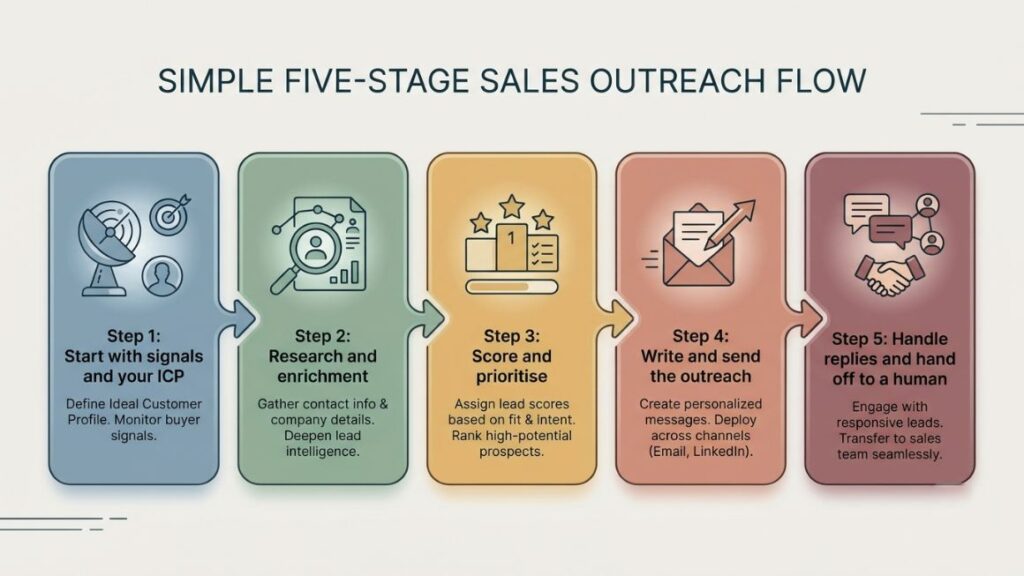
Step 1: Start with signals and your ICP
Everything begins with your ideal customer profile (ICP), a written description of the companies and roles most likely to buy from you. Industry, size, tools they use, titles that matter.
On top of that sit intent signals, which are behaviours suggesting a company might buy soon: a funding round, a new executive, a cluster of relevant job posts, a spike in visits to your pricing page. A weak ICP means the agent works hard on the wrong people. Nothing downstream fixes that.
Step 2: Research and enrichment
Now the agent builds context. It pulls from company websites, recent news, CRM history and databases, then fills gaps in each record. That gap-filling is lead enrichment: finding the missing email, phone number, headcount or tech stack so the record is usable.
Clay shows the idea well. Its waterfall approach checks one data provider, then the next, across more than 150 sources, and its Claygent agent can read a prospect’s site for custom details. Dupple’s June 2026 review notes the catch: credits are charged per attempt, not per success.
Step 3: Score and prioritise
Not every match deserves a message. The agent ranks accounts using fit and timing, and lead scoring is the usual name for that ranking. Fit comes from your ICP. Timing comes from the signals.
Good setups send the top slice and park the rest. That’s boring, and it’s where most of the quality comes from.
Step 4: Write and send the outreach
Next comes the first message and the follow-ups. HubSpot’s Prospecting Agent writes emails based on the research it already did, and Salesforce’s version drafts messaging tied to each account’s trigger event.
For cold email outreach, the agent also decides timing and channel: email first, LinkedIn later, maybe a call task for a human. You choose how much freedom it gets. Many teams start with an AI agent for prospecting that only drafts, while a person approves each message before anything goes out.
Step 5: Handle replies and hand off to a human
This is where autonomy gets risky. Replies about pricing, security or competitors need judgement. A separate Laxis analysis of human-plus-agent teams suggests human review on any first reply that mentions those topics, and a handoff within 30 minutes for replies that run long or ask questions.
The agent should book the easy meetings. A human should own the conversations that could cost you the deal.
Also Read: AI Agent for Sales Outreach: Complete Guide for Modern Sales Teams (2026)
What Do the 2026 Numbers Actually Say?
Use of an AI agent for prospecting is high, results are uneven, and the best-performing setups keep a human in the loop. Most public data comes from vendors that sell these tools, so treat every figure below as directional, not gospel.
On adoption, Laxis’s June 2026 benchmark report says 41% of enterprise B2B teams had an autonomous prospecting agent running in production by the first quarter of 2026, up from roughly 12% a year earlier. The exact number matters less than the speed.
Results are where it gets interesting. The same report puts fully autonomous agents at 1 to 3% reply rates and $250 to $400 per qualified meeting. Signal-driven outreach with human supervision reached 15 to 25% reply rates at $80 to $180 per meeting. Laxis sells in this category, so that gap may flatter its own pitch. Other vendor analyses point the same way, though. Kwanzoo’s July 2026 analysis found outbound touches rose 6.4 times while positive reply rates fell to 1.3%, below a 2.1% human baseline. And Belkins’ 2025 study, cited by Abmatic, measured an average reply rate of just 0.45% for strictly net-new cold outreach.
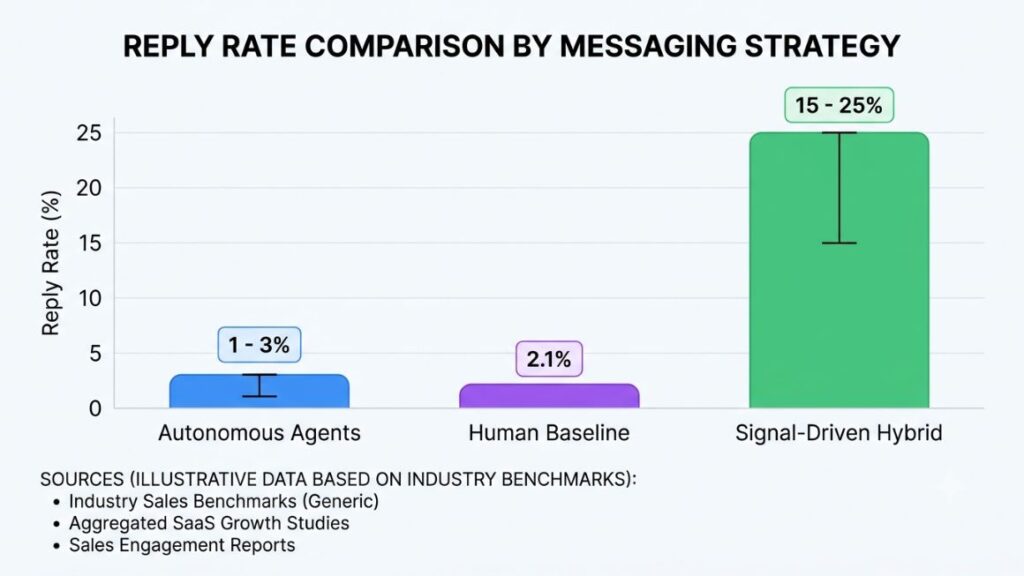
Volume isn’t the same as value. In a controlled test Laxis describes, an AI-only setup booked 847 meetings that converted at 11%. A hybrid setup booked 312 that converted at 38% and produced about 2.3 times the revenue. The autonomous version won on meetings and lost on money, which is a bad trade for your sales pipeline.
Cost per qualified opportunity tells the same story: roughly $487 for human-only pods against $224 for hybrid pods, per Laxis.
Then there’s churn. UserGems, as reported by Autobound in 2026, puts annual churn on autonomous prospecting tools at 50 to 70%, about double typical human SDR turnover. That figure gets repeated a lot and traces back to a small number of sources, so use it as a ballpark. Still, honestly, the churn number tells you more than the adoption number.
In 2026, vendor benchmarks show autonomous prospecting agents widely adopted but frequently cancelled, with 50 to 70% annual churn reported by UserGems via Autobound. Hybrid setups that pair agents with human review show lower cost per qualified opportunity ($224 versus $487 for human-only pods, per Laxis), though most data comes from vendors.
Which AI Prospecting Tools Are Worth Comparing?
Seven tools cover most of what buyers shortlist when they price an AI agent for prospecting in 2026: Apollo, Clay, HubSpot’s Prospecting Agent, Salesforce Agentforce, Artisan, 11x and AiSDR. They split into data tools, CRM-native agents and fully autonomous agents, and prices vary wildly. Check vendor pages before you commit.
| Tool | Type | Reported pricing (2026) | Best for | Watch out for |
| Apollo | Database plus sequencing | Free tier; paid from $49 per user a month, billed annually | Small teams starting out | Data accuracy is fine, not elite; phone numbers cost 8 credits |
| Clay | Enrichment and workflow builder | Free plan; paid from about $167 to $185 a month | Custom signals and lists | Real learning curve; credits charged per attempt |
| HubSpot Breeze Prospecting Agent | CRM-native agent | $1 per lead recommended for outreach, plus seats | Teams already on HubSpot | Costs climb if it recommends low-intent leads |
| Salesforce Agentforce | CRM-native agent | $2 per conversation, or Flex Credits at about $0.10 per action | Salesforce-heavy enterprises | Consumption pricing is hard to forecast |
| Artisan (Ava) | End-to-end outbound agent | No public price; reviews range from about $750 a seat to roughly $2,400 a month | Teams with real volume | Personalization can feel templated |
| 11x (Alice) | Managed autonomous agent | Custom; reported at $5,000 to $15,000 a month | Large outbound teams | Price and opacity |
| AiSDR | Autonomous agent | Published tiers: $250, $900 and $2,500 a month | Small teams wanting flat pricing | Quarterly contracts on higher tiers |
Two things stand out. First, HubSpot’s April 14, 2026 switch to outcome-based billing means you pay when the agent recommends a lead, not for a monthly seat. At 100 credits per lead and $10 per 1,000 credits, that works out to $1. It’s an appealing model, but a loose ICP will run up the bill fast.
Second, these tools stack more than they compete. Clay or Apollo builds the list, and an agent works it. Dupple’s advice is blunt: below real sending volume, a $29 writing coach plus Apollo will often outperform a $750-a-seat agent. We think that’s right. Start with the cheapest thing that proves the motion.
How to Set Up Your First Prospecting Agent in 7 Steps?
You can set up your first AI agent for prospecting in seven steps: define your ICP, pick one data source, choose a few signals, set guardrails, pilot on one segment, route output through a review queue, and record baseline metrics before you scale anything.
- Write down your ICP. One paragraph on who you sell to, plus three clear disqualifiers. If two people on your team describe the ICP differently, fix that first.
- Pick one data source. Apollo, Clay or your CRM. Clean it before the agent touches it, because bounces hurt your domain faster than bad copy does.
- Choose three to five signals. Funding, hiring, leadership change, tech adoption, product launches. More than five and the agent starts chasing noise.
- Set guardrails. List the claims the agent can’t make, topics it must pass to a human (pricing, security, competitors), and a hard cap on daily sends per mailbox.
- Pilot on one segment. Pick a single industry and role, a few hundred accounts at most. A narrow pilot tells you what’s broken. A broad one hides it.
- Add a review queue. Approve the first batch of messages by hand. Keep reviewing until you stop finding things to fix, then loosen the leash gradually.
- Record a baseline. Capture reply rate, positive reply rate, meetings actually held, spam complaint rate and cost per qualified opportunity before the pilot starts. Without a baseline, you can’t tell a win from noise three months on.
Benchmarks help here. Analysts quoted by Kwanzoo flag positive reply rates under 1.5% as unable to support quality pipeline, and under 2.5% as a sign of relevance or deliverability trouble. The human-only baseline in that analysis was 2.1%. If your agent can’t beat your reps after a clean pilot, that’s information, not failure.
What Should You Fix Before the Agent Sends Anything?
Deliverability and consent come first. If your domain reputation collapses or your data practices are sloppy, even a good AI agent for prospecting only gets you into trouble faster. Fix authentication, warm your sending domains, and know which privacy rules apply to the people you contact.
Gmail and Yahoo sender rules
Google’s sender guidelines treat anyone sending 5,000 or more messages a day to Gmail addresses as a bulk sender. Bulk senders need SPF, DKIM and DMARC authentication and one-click unsubscribe on marketing mail. Google tells senders to keep the spam rate reported in Google Postmaster Tools under 0.10% and never let it reach 0.30%. Yahoo enforces similar standards.
Below the 5,000 line, you aren’t exempt in practice, because filters watch behaviour too. Laxis reports that domains warmed for under 30 days land around 51% inbox placement, against 86% at 60 to 90 days and 91% after 90 days. The same report says experienced teams cap cold sends near 25 per mailbox per day, and that 47% of attempted deployments hit a wall from domain-reputation collapse within 90 days.
A sensible habit: send from a separate domain so one bad month doesn’t take down your company email.
Consent and data rules: GDPR and India’s DPDP Rules
If you contact people in the EU or UK, GDPR applies, and details vary by country, so get legal advice before running a campaign there.
India is the newer one. The government notified the Digital Personal Data Protection (DPDP) Rules, 2025 on 14 November 2025, with an 18-month phased rollout. Consent manager registration begins after one year, and the heavier obligations arrive around May 2027. Consent has to come with a clear notice and be easy to withdraw, and the organisation must be able to prove it gave that notice. PIB notes the law carries substantial financial penalties.
How far these rules reach into B2B prospecting is still being worked out in practice. Treat that as a reason to keep clean records of where each contact came from, not as a loophole.
Why Do Most Rollouts Fail, and What Fixes Them?
Most rollouts of an AI agent for prospecting fail because teams give it volume without context, ignore deliverability, and remove human judgement from the steps that carry deal risk. The fix is a hybrid setup: agents handle research and drafting, people handle replies and high-value accounts.
Three failure modes show up repeatedly in 2026 analyses.
Volume without context. The agent blasts a loose list with templated messages. Reply rates sink, spam complaints rise, and the domain pays.
Deliverability debt. Nobody monitors inbox placement or complaint rates. The dashboard says “98% delivered” while real inbox placement slides.
The generic landing. A meeting gets booked, but the human who takes it has no idea what the agent said or why the prospect agreed. Show rates drop and conversion drops further. Laxis puts show rates for agent-booked meetings at 60 to 70%, against 75 to 85% for human-booked ones.
Full autonomy isn’t useless. Autobound’s 2026 analysis says it works in bounded cases: low-priority signal follow-ups and high-volume, low-value motions where a weaker meeting-to-opportunity rate still pays. For your top accounts, use the agent for research and let a person write the message.
Kwanzoo’s analysis adds a hopeful detail: adding human review to a broken deployment recovered reply rates within 45 days. That’s a vendor claim, but it matches what the rest of the data says. Most failed rollouts were fixable. Teams just stopped paying attention.
Also Read: AI Agent for Lead Nurturing: How to Set One Up and Turn Cold Leads into Pipeline
Autonomous prospecting rollouts fail mainly through templated volume, neglected deliverability and missing human review on high-risk replies. Hybrid setups, where an agent researches and drafts while a person handles replies and top accounts, outperform both fully autonomous and human-only configurations on cost per qualified opportunity.
What Changes for Indian B2B Teams?
Indian teams usually need more channels than email, more patience with larger buying groups, and cleaner consent records. The AI agent for prospecting itself works the same way. The environment around it doesn’t.
Abmatic’s 2026 guide to account-based marketing in India says buying committees tend to be larger and more hierarchical than in North America, and that generic outreach gets discarded quickly by sophisticated buyers. It also notes LinkedIn works well for reaching decision-makers in technology and financial services, and that professional phone outreach is generally well received. So an agent tuned only for email is playing with one hand.
Deal size matters too. MarketBetter’s 2026 breakdown suggests that at around $300 per meeting on AiSDR’s entry plan, teams with deals under $10,000 struggle to make the math work. Many Indian SaaS products sit below that line, so run the cost-per-meeting math before you sign a contract.
Finally, most of these tools bill in dollars, so currency swings hit your budget. And because the DPDP Rules are phasing in, the sensible move is to build consent and source records into the agent’s workflow now, not in May 2027.
Conclusion
Pick one segment, one AI agent for prospecting and one human reviewer, and run the pilot for a few weeks before you spend real money. The data is clear enough on the main lesson: the agent does the research, and you keep the judgement.
If you want to build an AI agent for prospecting workflow yourself, including the prompts, guardrails and measurement that make them work, the YUP AI Marketing course walks through hands-on AI marketing systems step by step. It’s a good next step if you’d rather build a reliable setup than gamble on a vendor demo.
FAQs
What is an AI prospecting agent?
It’s software that finds potential customers, researches them, writes outreach and, depending on settings, sends it and handles early replies. An AI agent for prospecting works toward a goal like booked meetings, choosing its own steps, unlike a fixed email sequence that only follows rules.
Is a prospecting agent the same thing as an autonomous sales rep?
Not quite. Prospecting agent usually means the research and list-building half. Autonomous sales rep, or similar labels, usually adds sending, follow-ups and meeting booking. Vendors use the names loosely, so check what each product actually does before you compare prices.
How much does an AI prospecting agent cost?
It ranges from free tiers to about $15,000 a month. Apollo starts at $49 per user, HubSpot charges $1 per recommended lead, AiSDR publishes tiers from $250 to $2,500, and 11x is reported at $5,000 or more. Always add data and email infrastructure costs.
Will AI replace my SDRs?
Probably not in the near term. Data from Laxis and Autobound shows hybrid teams beating fully autonomous ones on cost per qualified opportunity. An AI agent for prospecting takes research and first drafts, while people handle replies, objections and key accounts. Expect the job to shift, not vanish.
What reply rate should I expect?
Plan for low single digits from any AI agent for prospecting. Laxis puts fully autonomous agents at 1 to 3%, while analysts cited by Kwanzoo say a positive reply rate under 1.5% can’t support quality pipeline. The human baseline in that analysis was 2.1%, so use your own reps as the benchmark.
Is AI cold outreach legal in India?
There’s no simple yes or no. The DPDP Rules, 2025 phase in until about May 2027 and require clear notice and withdrawable consent. How they apply to B2B prospecting is still being clarified, so keep source records and get legal advice.
Why are my AI emails going to spam?
Usually it’s volume, a cold domain or templated copy. Check SPF, DKIM and DMARC, keep spam complaints under 0.10%, cut daily sends per mailbox, and warm new domains for 60 to 90 days. Also rewrite messages that sound identical across prospects.
How do I start with a small budget?
Use Apollo’s free or $49 tier for data and sending, write your own ICP, and run one narrow pilot with a human reviewing every message. Add a dedicated AI agent for prospecting only after the pilot beats your baseline reply rate.