
Most brands don’t fail because they built a bad product. They fail because they put that product in front of the wrong people, through the wrong channels, at the wrong time. A weak channel strategy doesn’t just cost you sales – it costs you market position, customer trust, and the kind of momentum that takes years to rebuild.
A solid channel strategy tells you exactly where to show up, how to sell, and which paths between your brand and your buyer actually produce results. Whether you’re building a go-to-market plan from scratch or trying to fix a distribution model that’s leaking, this article covers everything you need to know – from the core types and frameworks to real-world examples and the common pitfalls that most brands don’t catch until it’s too late.
Table of Contents
What Is a Channel Strategy?
A channel strategy is a plan that defines which paths a brand will use to reach its customers, deliver its product or service, and generate revenue – and how each of those paths will be managed and measured.
That definition sounds simple. But the reason so many brands get this wrong is that they treat “channels” as a checklist. They pick Instagram because a competitor is on Instagram. They add a retail presence because someone in a meeting suggested it. They signed a reseller deal because an inbound inquiry came in. None of that is a strategy.
A real channel strategy connects your product type, your buyer’s behaviour, your margins, and your growth goals into a single coherent plan. It tells you which channels to prioritize, which to deprioritize, and – just as importantly – which to ignore entirely.
Nykaa is a good example of this done right. When they launched, they didn’t try to be everywhere. They built a direct-to-consumer digital channel first, used content to drive awareness, and expanded into offline retail only after they had built enough brand pull to make the retail investment worthwhile. That sequencing was deliberate. It was a channel strategy, not just channel selection.
Why a Strong Channel Strategy Changes How You Grow
Here’s the problem most marketers don’t want to admit: being present on more channels does not automatically mean more growth. Without a clear channel strategy, more channels mean more complexity, more budget dilution, and more inconsistency in how your brand shows up.
The brands that scale well aren’t the ones with the most channels. They’re the ones with the right channels, managed well.
A strong channel strategy does a few things that are genuinely hard to replicate without one:
It focuses your resources. Budget and attention are finite. A defined channel strategy tells you where to put both. Without it, you’re spreading resources across too many bets and winning none of them.
It creates a consistent customer experience. When every channel is managed with the same brand standards, the same messaging, and the same service expectations, customers trust you more. That trust compounds over time. Without coordination, channels create friction – a customer sees one price online and another in-store, or gets a different answer from a distributor than from your website.
It gives you a growth lever you can actually pull. When you know a specific channel is working – when you have data showing that customers acquired through a particular channel have better retention, higher order values, or lower acquisition costs – you can double down. That’s only possible if you built the channel with measurement in mind from the start.
It protects your margins. Each channel has a different cost structure. A wholesale channel might bring volume but compress margins significantly. A direct channel might be lower volume initially but far more profitable per unit. A channel strategy forces you to do this math before you commit.
According to a 2023 Forrester Research report, companies with a defined channel strategy see 30% higher revenue growth compared to those managing channels ad hoc. That’s not because the strategy itself is magic – it’s because having one forces the kind of clarity and prioritization that actually produces results.
A channel strategy defines which paths a brand uses to reach customers and how those paths are managed. Brands with a documented channel strategy see measurably higher revenue growth than those choosing channels reactively, because the strategy forces resource allocation decisions that ad hoc channel selection never does.
The 8 Types of Channel Strategies (and When to Use Each)
There’s no single channel strategy that works for every business. The right type depends on your product, your market, your margins, and where your buyers actually spend their time. Here are the eight main types, with a clear signal for when each one makes sense.
Marketing Channel Strategy
A marketing channel strategy focuses on how you build awareness and generate demand – not just how you sell. It covers the combination of paid, organic, content, and referral approaches your brand uses to get in front of buyers at different stages of their journey.
This is foundational. Every business needs some version of a marketing channel strategy, even if the other types below don’t all apply.
Retail Channel Strategy
A retail channel strategy puts your product in physical stores – your own stores, third-party retailers, or a mix of both. This works best when your product benefits from being seen, touched, or tried before purchase, and when your target buyer shops in physical environments.
Mamaearth’s expansion into offline retail is a clean example. After building a strong D2C base online, they moved into modern trade and general trade retail to reach buyers in Tier 2 and Tier 3 cities who were less likely to buy personal care products online. The retail channel gave them the reach that the D2C model couldn’t match alone.
Wholesale Channel Strategy
In a wholesale channel strategy, you sell in bulk to distributors or retailers who then sell to end customers. Your margins per unit are lower, but your volume can be significantly higher, and your operational complexity is reduced – someone else handles last-mile distribution.
This works well for FMCG brands, commodity products, and categories where shelf presence drives purchase decisions. The trade-off is that you give up some control over how your product is presented and priced.
Consumer Direct (D2C) Channel Strategy
A direct-to-consumer channel strategy means selling straight to your end customer, cutting out intermediaries entirely. You control the experience, the data, and the margin.
This is the model that boAt built its early growth on. By selling directly through its own website and Amazon India, boAt kept margins intact while building a direct relationship with buyers – something traditional electronics distributors couldn’t offer. That buyer data became one of their most valuable assets over time.
The trade-off with D2C is that you own the entire acquisition cost. Without brand pull or organic traffic, customer acquisition in a pure D2C model can get expensive quickly.
A direct-to-consumer channel strategy removes intermediaries between brand and buyer, giving companies full control over pricing, experience, and customer data. Brands like boAt built an early competitive advantage through D2C by accumulating buyer insights that traditional retail distribution channels cannot provide.
Franchising Channel Strategy
Franchising is a channel strategy where you let third parties sell and operate under your brand in exchange for fees and royalty payments. It’s how brands like McDonald’s or VLCC scale physical presence without owning every location.
This works when your model is replicable, your brand has strong recognition, and you can maintain quality standards across a distributed operator network. The biggest risk is brand inconsistency – a poor franchise operator damages your brand, not just their own revenue.
B2B Partnership Strategy
A B2B partnership strategy involves partnering with other businesses to reach your target customer through their existing relationships. This is common in SaaS, professional services, and enterprise products.
Think of a marketing consultancy that recommends a specific analytics or creative vendor to every client they onboard. The vendor doesn’t pay for that recommendation directly – they’ve built a partnership where the referral is mutual or the recommendation is built into the consultancy’s workflow.
This channel is underused by mid-size brands. When you identify partners whose customers match your ideal buyer profile, a B2B partnership can deliver qualified leads at a fraction of what paid acquisition would cost.
Network Channel Strategy
A network channel strategy relies on a distributed network of independent sellers, often compensated on commission or a tiered structure. Multi-level marketing companies use an extreme version of this, but the model also applies to affiliate networks, influencer partnerships, and broker networks.
The key challenge is consistency. A large network of independent sellers is hard to align around brand messaging, pricing standards, and customer experience.
Reseller Channel Strategy
In a reseller channel strategy, you sell your product or service to a third party who then resells it – often bundled with their own offering or under a white-label arrangement. This is common in B2B and tech markets.
A digital marketing agency reselling a third-party reporting dashboard to their clients under their own brand is a simple example of the reseller model in practice.
How to Build a Channel Strategy That Actually Works
Most channel strategy mistakes happen before anyone picks a channel. They happen in the thinking stage – or more accurately, the skipping-the-thinking stage.
Here’s a four-step process that actually holds up.
Step 1: Understand what you sell
Before you pick a channel, you need to be clear on what your product or service actually requires from a channel. Does it need to be demonstrated? Does it require trust-building before purchase? Is it an impulse buy or a considered decision?
A ₹499 phone case can be sold through Instagram ads with a two-tap checkout. A ₹15 lakh B2B software subscription cannot. The channel has to match the buying process, not just the target audience.
Also, map your margins honestly. Some channels are structurally incompatible with your economics. A product with 20% gross margins cannot afford the kind of retail distribution fees or affiliate commissions that a product with 60% margins can absorb.
Step 2: Define your target audience with precision
Not “young urban professionals.” Not “women aged 25-40.” You need to know where your buyer actually discovers products like yours, what influences their purchase decision, and which channels they trust.
This is research, not an assumption. Look at where your existing customers came from. Talk to them about how they found you. Look at where your best competitors are investing, because that tells you something about where the category’s buyers actually are.
Step 3: Prioritize the customer experience
Every channel you add is a new touchpoint in the customer experience. And every touchpoint that’s inconsistent, slow, or confusing costs you conversions and trust.
Before adding a new channel, ask: Can we staff it properly? Can we maintain consistent brand standards? Can we respond to customers quickly enough? A badly managed channel is worse than no channel at all. Customers who have a bad experience on one touchpoint don’t compartmentalize – they form an opinion about your brand.
Step 4: Set goals and measure your channels
Every channel needs its own success metrics before you launch it, not after. What does good look like for this channel in three months? In six months? What’s the minimum performance threshold below which you’ll either fix the channel or cut it?
Common channel metrics include cost per acquisition (CPA), customer lifetime value by channel, conversion rate, and channel-attributed revenue. Track them from day one. Channels that can’t be measured can’t be improved – and can’t be defended when budget decisions come around.
Omnichannel vs. Multi-Channel vs. Through-Channel: What’s the Real Difference?
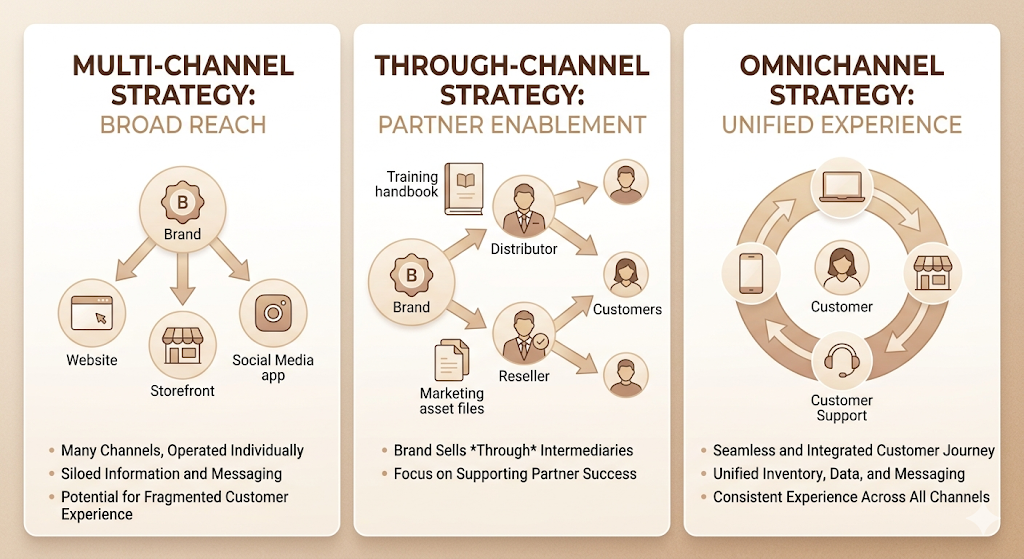
These three terms get used interchangeably in most marketing conversations. They’re not the same thing, and the difference matters when you’re building a channel strategy.
What Is a Multi-Channel Strategy?
A multi-channel strategy means being present on multiple channels – your own website, a retail partner, social media, and a marketplace like Amazon. Each channel operates somewhat independently, with its own messaging and sometimes its own pricing.
The goal is to reach. You’re meeting buyers wherever they happen to be.
The limitation is that the experience is fragmented. A customer might see a different price on your website than on Amazon. They might get a different level of service through a retail partner than through your direct channel. Multi-channel gives you coverage; it doesn’t give you coherence.
What Is a Through-Channel Strategy?
A through-channel strategy is specifically about enabling your channel partners – distributors, resellers, franchisees, retailers – to sell on your behalf effectively. The focus is less on reaching the end customer directly and more on giving your partners the assets, training, and support they need to do it well.
This is common in B2B and wholesale models where the brand is selling through intermediaries rather than to the end buyer.
What Is an Omnichannel Distribution Strategy?
An omnichannel distribution strategy goes one step further than multi-channel. It’s not just about being on multiple channels – it’s about making those channels work together seamlessly from the customer’s perspective.
A customer browses on Instagram, saves a product, checks it out on the brand’s website, buys it, picks it up in-store, and returns it through WhatsApp. Each step happens on a different channel, but the experience feels continuous because the brand’s inventory, messaging, and customer data are unified across all of them.
Swiggy’s cross-channel experience is a strong example of omnichannel thinking in India. Whether you order through the app, access a restaurant through Dineout, or use Swiggy Instamart, the experience, branding, and service quality are consistent – because they’re built on unified infrastructure, not separate siloed operations.
Omnichannel is harder to build. It requires integrated data systems, consistent brand standards, and real coordination across teams. But when it works, it creates a customer experience that’s genuinely hard to replicate.
An omnichannel distribution strategy connects all customer-facing channels – online, offline, and partner – into a single, seamless experience. Unlike multi-channel, which focuses on presence, omnichannel focuses on continuity: a customer can move between channels without losing context, history, or consistency in brand experience.
The 4 Types of Marketing Channels You Need to Know
A marketing channel is how you create awareness and demand – it’s distinct from a distribution channel, which is how you sell. Both matter, and your channel strategy needs to account for both.
Paid Channels
Paid channels are any channel where you pay for placement or reach – search ads, social ads, display advertising, sponsored content, or paid influencer partnerships. You control exactly who sees your message and when, but you pay for every impression or click.
Paid channels are powerful for speed and targeting precision. They’re also expensive to sustain at scale, and performance drops the moment you stop spending. Most brands treat paid as a primary acquisition channel early on and work to reduce dependency on it as organic and direct channels mature.
Free (Organic) Channels
Organic channels – search engine optimization (SEO), organic social media, public relations, and word-of-mouth – don’t require direct payment per impression. But they’re not actually free. They require investment in content, community, relationships, and time.
The trade-off versus paid is that organic channels take longer to produce results but tend to be more durable. A well-ranked article or a loyal community doesn’t disappear the moment you cut the budget.
Digital Channels
Digital channels include email, social media, content marketing, and your own website. These are channels you own or operate directly, which means you have more control over the experience – but also more responsibility for building and maintaining the audience.
Email is still one of the highest-ROI digital channels for most businesses. According to Litmus’s 2023 Email Marketing Report, email delivers an average return of $36 for every $1 spent. That’s not a channel to neglect.
Traditional Channels
Traditional channels – television, print, out-of-home advertising, and radio – still reach massive audiences, especially in Tier 2 and Tier 3 India. Many D2C brands that have scaled primarily on digital have found that adding traditional media at a certain stage drives significant brand awareness uplift that digital alone couldn’t achieve.
Mamaearth’s shift to television advertising as it scaled is a good example. Digital built the brand; TV broadened it to a market that digital wasn’t penetrating efficiently.
The Biggest Challenges in Channel Marketing (And How to Handle Them)
Channel marketing sounds straightforward until you actually try to execute it across multiple partners or touchpoints. Here’s where most brands hit a wall.
Inconsistent Brand Messaging
When multiple partners are communicating your brand – resellers, distributors, retail staff, affiliates – maintaining message consistency becomes genuinely hard. Each partner tends to emphasize what they think will sell, which may or may not align with how you want the brand positioned.
The fix is not tighter control – you can’t micromanage a distributed partner network. The fix is better enablement: clear brand guidelines, ready-to-use approved messaging, and regular touchpoints to reinforce the standards. Partners who understand the brand deeply are far more likely to represent it well.
Limited Access to Analytics
One of the most frustrating parts of selling through third-party channels is that you often can’t see what’s happening. Your retail partner doesn’t share granular sell-through data. Your distributor doesn’t report back on what’s moving. You’re making strategic decisions with incomplete information.
The best workaround is to build direct data touchpoints wherever possible – QR codes on packaging, registration prompts, or incentivized customer surveys – that give you some signal about what’s happening at the end of the chain. It’s not perfect, but it’s better than flying blind.
Outdated or Ineffective Marketing Materials
Partners often end up using outdated creatives, old pricing sheets, or off-brand visuals – not because they want to, but because accessing the right materials is inconvenient. If your approved assets are buried in an email thread from six months ago, partners will use whatever they can find.
Keep brand assets centralized, clearly labelled, and easy to access. Make updating them when products change a non-negotiable part of your channel management process.
Lack of Marketing Expertise Among Partners
Not every reseller, distributor, or retail partner has a trained marketing team. Many are operators, not marketers. Expecting them to execute campaigns or build brand presence without support is unrealistic.
The solution is co-marketing programmes – where you provide the strategy, the assets, and sometimes the funding, and the partner provides the local reach and relationships. Both sides bring something to the table.
Minimal Control Over Partner Messaging
Especially in reseller and wholesale models, partners will adapt your messaging to suit their audience. Sometimes that’s fine. Sometimes it undermines your positioning.
The way to handle this is contractual clarity at the start of the partner relationship – not after something goes wrong. Define what partners can and cannot say about your brand, your pricing, and your positioning. Include brand compliance as part of your partner review process.
How to Choose the Right Channel Marketing Partners
Not every potential partner is worth the complexity of managing a channel relationship. Choosing poorly here is one of the fastest ways to damage brand equity and waste distribution budget.
Key Partner Traits to Look For
The basics matter: financial stability, an established customer base, and operational capacity to handle your product. But beyond the basics, the partners who actually drive results tend to share a few traits.
They’re motivated to sell your product specifically – not just to fill shelf space or hit a quota. They have a genuine audience overlap with your target buyer. And they’re willing to invest in the relationship, which usually means they see long-term value in it, not just a short-term transaction.
A partner who’s excited about your product because it solves a real problem for their existing customers is worth ten partners who signed up because your margins looked attractive on paper.
Strategic Alignment Signals
Before formalizing any channel partnership, look for alignment on three things: target customer, brand standards, and growth ambition.
If your partner is focused on price-sensitive buyers and you’re a premium brand, that’s a misalignment that will show up in how they position your product. If their service standards are inconsistent and your brand promise is built on reliability, that’s a problem you’ll inherit.
The best partnerships feel like a natural extension of your brand, not a compromise.
Best Practices for Channel Marketing That Actually Scales
Most channel programmes start strong and gradually lose momentum. Partners become less engaged, performance drifts, and the brand starts treating the channel as a set-and-forget arrangement. Here’s what the brands that sustain channel performance do differently.
Provide Consistent Brand Assets
Every partner interaction with your brand – every piece of collateral, every product image, every tagline – should come from a single approved source. Inconsistency compounds fast at scale.
Build a centralized brand asset library and make it part of your onboarding process for every new partner. And update it every time your creative, messaging, or product information changes.
Enable Partners With the Right Support
Training and enablement aren’t one-time events. A partner who received a product briefing eighteen months ago and hasn’t heard from you since isn’t an enabled partner – they’re a liability.
Set up a cadence of regular communication: product updates, sales enablement sessions, and quarterly performance reviews. Partners who feel supported perform better. It’s not more complicated than that.
Offer Training, Support, and Resources
This applies especially to through-channel models where your partners are the ones talking to your end customers. They need to understand your product deeply, know how to handle objections, and be clear on what your brand stands for.
Build a partner training programme that covers your product, your brand positioning, and your customer experience standards. Make it easy to complete and keep it up to date.
Monitor Performance and ROI
Every channel partner should have agreed-upon performance metrics – sell-through rates, customer acquisition numbers, revenue targets, or NPS scores, depending on the type of partner.
Review these regularly and act on what you see. Partners who are underperforming need support or a conversation about fit. Partners who are overperforming deserve recognition and investment.
Maintain Alignment and Motivation
Partner motivation declines when they don’t feel valued or when the economics stop making sense for them. Build partner incentive structures that reward the behaviours you actually want – not just volume, but quality metrics, brand compliance, and customer experience outcomes.
Build Loyalty Through Strategic Relationships
The best channel partners aren’t vendors you manage. They’re relationships you invest in. The brands that build genuinely loyal partner networks do it by treating partners as stakeholders, not just sales outlets.
That means sharing information, involving partners in feedback loops, and making sure the relationship feels genuinely mutual – not just transactional.
Effective channel marketing at scale requires more than partner sign-up and commission structures. Sustained channel performance comes from consistent brand enablement, regular performance review, and partner relationships built on mutual benefit – not one-sided transactional arrangements. Brands that treat partners as stakeholders rather than vendors consistently see stronger long-term channel ROI.
A Real-World Channel Strategy Example
Let’s walk through how Mamaearth built and evolved its channel strategy – because it illustrates almost every principle in this article.
Mamaearth launched in 2016 as a pure D2C brand, selling primarily through its own website and Amazon India. Their product category – toxin-free personal care – required trust-building before purchase, and digital content (particularly parenting communities and influencer partnerships) was the right environment for that kind of education. Their marketing channel strategy leaned hard on organic social, influencer content, and search.
That direct channel gave them something invaluable: customer data. They could see exactly who was buying, what they were buying in combination, and how often they were returning. That data-informed product development and helped them refine their messaging.
As revenue scaled and brand awareness grew, Mamaearth expanded into a retail channel strategy. They entered modern trade retail chains and eventually general trade, targeting the Tier 2 and Tier 3 markets where D2C penetration was lower. But they didn’t abandon D2C when they went into retail – they ran both simultaneously, with different assortments and pricing strategies calibrated to each channel’s cost structure and buyer behaviour.
By the time they listed publicly in 2023, Mamaearth had a genuinely multi-channel distribution model with D2C, marketplace, and offline retail all contributing meaningfully to revenue.
What’s worth noting is the sequencing. They didn’t try to be everywhere from day one. They built conviction in one channel, extracted value from it, then used that foundation to expand into adjacent ones. That’s channel strategy in practice.
Conclusion
Channel strategy isn’t a one-time decision. It’s an ongoing discipline. The brands that grow consistently aren’t the ones that picked the most channels – they’re the ones that picked the right ones, managed them well, and kept refining based on what the data was telling them.
The three things worth carrying forward from everything above: start with your buyer’s behaviour, not the channel you find most familiar. Be honest about your margins, because they determine which channels are even viable. And treat every channel you add as a commitment, not an experiment you can forget about.
Your channel strategy is the infrastructure on which your brand grows. Build it as it matters – because it does.
Frequently Asked Questions
What is a channel strategy in simple terms?
A channel strategy is a plan for how your brand reaches and sells to customers. It defines which paths – direct sales, retail, resellers, digital, or any combination – you’ll use, and how you’ll manage each one. It’s not just about picking channels; it’s about deciding which ones fit your product, your buyer, and your margins, and then managing them intentionally.
What’s the difference between a channel strategy and a marketing strategy?
A marketing strategy covers how you build awareness, generate demand, and position your brand. A channel strategy covers how you distribute your product and reach buyers. They’re related but distinct. Your marketing strategy drives people toward your channels; your channel strategy determines where they end up and what experience they have when they get there.
Which channel strategy works best for a D2C brand?
Most D2C brands start with a direct digital channel and expand from there. The direct model gives you control over the customer experience and access to buyer data, both of which are hard to get through intermediaries. As brand awareness grows and margins allow, expanding into marketplaces and eventually retail tends to be the natural progression. The right sequence depends on your category and your capital position.
How do I know if my channel strategy is working?
Set channel-specific metrics before you launch each channel, not after. Track cost per acquisition, revenue attributed to each channel, customer retention by channel, and channel contribution to overall revenue. If a channel isn’t hitting its targets after a reasonable ramp period, either investigate the execution or make a deliberate decision to cut it. A channel that can’t be measured can’t be managed.
What is through-channel marketing?
Through-channel marketing is the practice of enabling your distribution partners – resellers, distributors, franchisees – to market and sell your product on your behalf. Instead of reaching the end customer directly, you’re equipping intermediaries with the brand assets, messaging, training, and support they need to do it. It’s common in wholesale, B2B, and franchise models.
What is an omnichannel distribution strategy?
An omnichannel distribution strategy integrates all your channels – digital, physical, and partner – into a single, unified customer experience. A customer can start their journey on one channel and complete it on another without losing context. It’s different from multi-channel, which focuses on presence across multiple channels, because omnichannel focuses on continuity and coherence across all of them.
Is a reseller strategy the same as a wholesale strategy?
Not exactly. In a wholesale strategy, you sell in bulk to a buyer who then sells to end customers, typically with your brand identity intact. In a reseller strategy, the third party sells your product – sometimes bundled with their own services, sometimes under a white-label arrangement. Wholesale is primarily about volume and distribution reach; reselling often involves some degree of value-add by the reseller.
What are the biggest mistakes brands make with channel marketing partners?
The most common mistake is selecting partners based on size or reach alone, without checking for strategic alignment. A large distributor whose core customer base doesn’t match your target buyer creates more problems than a smaller, better-aligned one. The second most common mistake is under-investing in partner enablement – signing partners and then leaving them to figure it out on their own.
How many channels should a small brand focus on?
Fewer than you think. Most small brands are better served by doing one or two channels extremely well than by spreading thinly across five. Pick the channel where your target buyer is most active and where your product type is best suited to be discovered and purchased. Build momentum there before expanding.
When should a startup think about channel strategy?
Before you launch, not after. Your channel strategy should be part of your go-to-market plan from the beginning, because it affects your pricing, your margins, your brand positioning, and your operational requirements. Building a product for retail distribution requires very different decisions from building one for direct online sales. The earlier you define your channel approach, the fewer expensive pivots you’ll need to make later.