
Most SaaS companies don’t have a product problem. They have a distribution problem.
You can build something genuinely useful, price it fairly, and still watch your pipeline stagnate because you put your budget into channels that look busy but don’t convert. Picking the wrong B2B SaaS marketing channels early doesn’t just waste money -it burns six months of runway and makes your team question whether the product is the problem when it isn’t.
This guide covers every major channel SaaS companies use to acquire, retain, and expand customers. You’ll learn what each channel actually delivers, when to use it, how to measure it honestly, and how to build a channel mix that keeps working as you scale.
Table of Contents
What Are B2B SaaS Marketing Channels?
B2B SaaS marketing channels are the specific paths a software company uses to reach, attract, and convert business buyers -from first-touch awareness all the way through to a paying customer. They include everything from search engine rankings and LinkedIn posts to outbound email sequences and in-product referral flows.
The reason this definition matters is that a lot of SaaS teams conflate “channel” with “tactic.” A channel is the medium -SEO, paid search, email, and community. A tactic is what you do inside that channel -writing a comparison article, bidding on competitor keywords, running a 5-email drip, hosting an AMA. You need to get the channel right before obsessing over the tactics.
How Marketing Channels Fit Into the SaaS Customer Journey
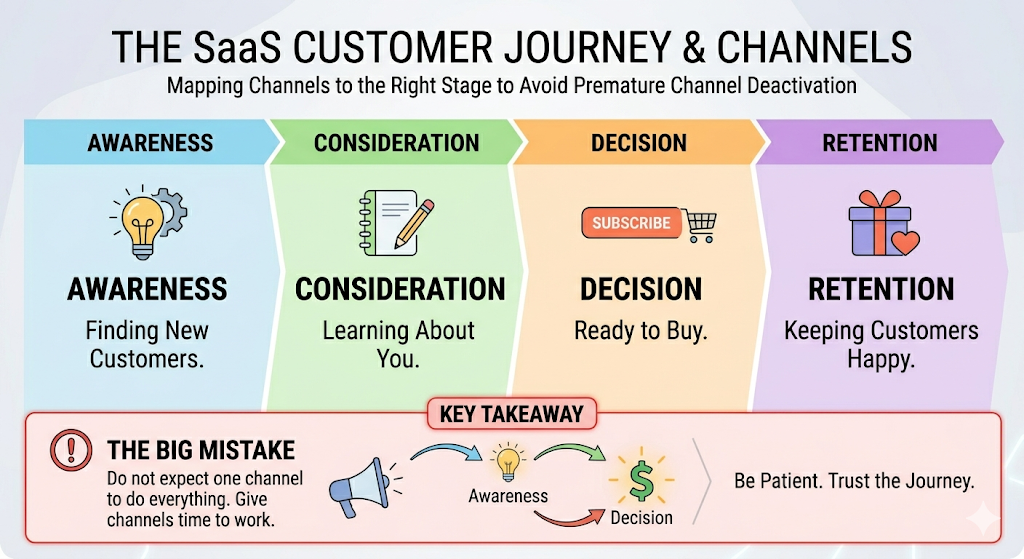
Different channels serve different stages. SEO and content typically fuel awareness and early consideration. Email nurturing and demos work better at the decision stage. Product-led channels, like in-app onboarding and referral prompts, kick in post-signup. The mistake most SaaS marketers make is expecting every channel to perform at every stage -and then killing channels prematurely because they’re not generating immediate revenue.
The Difference Between Inbound and Outbound Channels
Inbound channels pull buyers toward you. Someone searches for “project management software for agencies,” finds your SEO article, reads your case study, and books a demo. The buyer initiated contact.
Outbound channels push your message toward a targeted list. Your SDR finds a shortlist of Head of Marketing roles at Series B SaaS companies and sends a personalised cold email. You initiated contact.
Neither is better universally. The right answer depends on your average contract value, sales cycle, and team size. A $200/month self-serve product can’t sustain outbound’s cost. A $50,000 annual contract almost always needs it.
Owned, Earned, and Paid Media Explained
Owned media is what you control -your blog, email list, product, podcast, and social profiles. You build it once, and it compounds.
Earned media is what others say about you -press mentions, review site ratings, word-of-mouth, and backlinks. You can’t buy it, but you can create the conditions for it.
Paid media is what you rent –Google Ads, LinkedIn Ads, sponsored content. It works while you’re paying and stops the moment you don’t.
The healthiest B2B SaaS marketing channels strategies combine all three: paid for fast signal, owned for compounding returns, and earned for trust and reach you couldn’t buy.
Why B2B SaaS Marketing Channels Matter
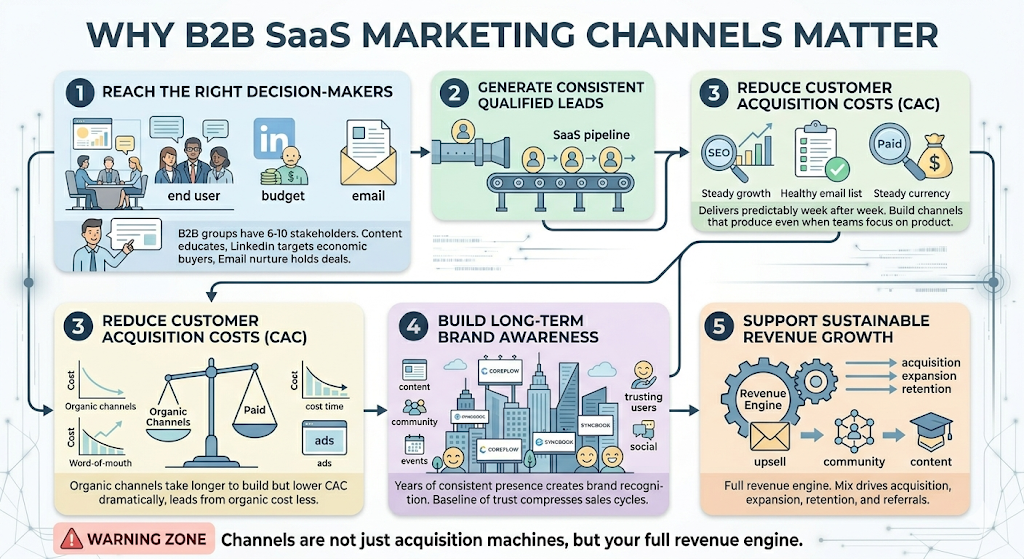
They Help You Reach the Right Decision-Makers
B2B buying decisions rarely come from one person. According to Gartner’s 2023 B2B Buyer research, the average enterprise buying group involves 6 to 10 stakeholders. Your channels need to reach not just the end user, but also the economic buyer, the technical evaluator, and sometimes legal or finance. Content marketing can educate the user. LinkedIn can reach the economic buyer. Email nurture can hold a deal together through a three-month procurement process. Each does a different job.
They Generate Consistent Qualified Leads
The word “consistent” does a lot of work here. Posting on LinkedIn three times in January and then going quiet isn’t a channel -it’s a one-time effort. Real saas pipeline generation requires channels that deliver predictably, week after week. SEO does this if you maintain it. Email does this if your list is healthy. Paid search does this as long as your budget holds. Build channels that produce even when the team is heads-down on product.
They Reduce Customer Acquisition Costs (CAC)
Organic channels take longer to build but dramatically lower your CAC over time. Zoho, for example, has been famously frugal on paid acquisition and still built a $1B+ revenue business, largely on the back of organic content, word-of-mouth, and product utility. That’s an extreme case, but the principle holds: every lead that finds you through organic search costs a fraction of what a paid lead costs once your SEO is working.
They Build Long-Term Brand Awareness
Buyers who have never visited your site still know HubSpot, Salesforce, and Canva. That brand recognition doesn’t come from a single campaign. It comes from years of consistent presence across B2B SaaS marketing channels -content, community, events, social. Brand awareness compresses sales cycles because buyers arrive with a baseline of trust already built.
They Support Sustainable Revenue Growth
A pipeline is vanity if it doesn’t convert to revenue and stick. The right channel mix drives not just acquisition but also expansion and retention. Email channels support upselling. Community channels build switching costs. Content channels educate customers who stay longer and refer more. Think about channels not as acquisition machines but as the full revenue engine.
How B2B SaaS Buyers Discover Software Today
This section is worth your full attention because the answer has changed substantially in the past two years.
Search Engines and AI Search Platforms
Buyers still use Google -but they’re doing different things with it. According to Similarweb’s 2024 Digital Report, over 65% of Google searches now end without a click, because AI Overviews answer the query directly on the results page. That means ranking on page one is no longer enough. You need to be the source that AI systems cite in those overviews. That’s what Generative Engine Optimisation (GEO) is about, and it’s quickly becoming one of the most important skills in B2B content marketing.
ChatGPT and Perplexity have also entered the discovery mix. A significant portion of technical buyers now ask AI tools, “What’s the best CRM for early-stage SaaS?” before they even open a browser. If your content isn’t structured for AI extraction, you’re invisible in this growing discovery channel.
Social Media and Professional Networks
LinkedIn is where most B2B SaaS buying conversations are actually happening. Not the corporate page posts -those almost never perform. The real action is on individual accounts: founders sharing product journeys, practitioners posting real campaign breakdowns, and community managers running engaged groups around specific problems. This shift toward founder-led marketing and individual-driven content is probably the biggest organic distribution opportunity in B2B right now.
Review and Comparison Websites
G2, Capterra, and Trustpilot remain essential. According to G2’s 2024 Software Buyer Behaviour report, 86% of software buyers read at least six reviews before making a purchase decision. Your G2 profile is part of your marketing -not the product team’s responsibility. Reviews need to be actively solicited, and your positioning on comparison pages should be managed as deliberately as your homepage copy.
Communities and Peer Recommendations
Slack communities, WhatsApp groups, Reddit threads, and Discord servers are where real recommendations happen. A recommendation from a trusted peer in a Slack community of 2,000 marketing ops professionals is worth more than any LinkedIn ad you’ll ever run. These environments can’t be gamed easily, but they can be cultivated. Show up consistently, add value, and you’ll become the brand people recommend.
Direct Outreach and Referrals
Old-fashioned? Maybe. Effective? Still yes. For high-ACV products, a well-researched cold email from a real human who understands the buyer’s specific problem still converts. And a referral from an existing happy customer converts at rates no other saas customer acquisition channel touches -sometimes 4x better than paid, according to research from Extole in 2023.
Types of B2B SaaS Marketing Channels
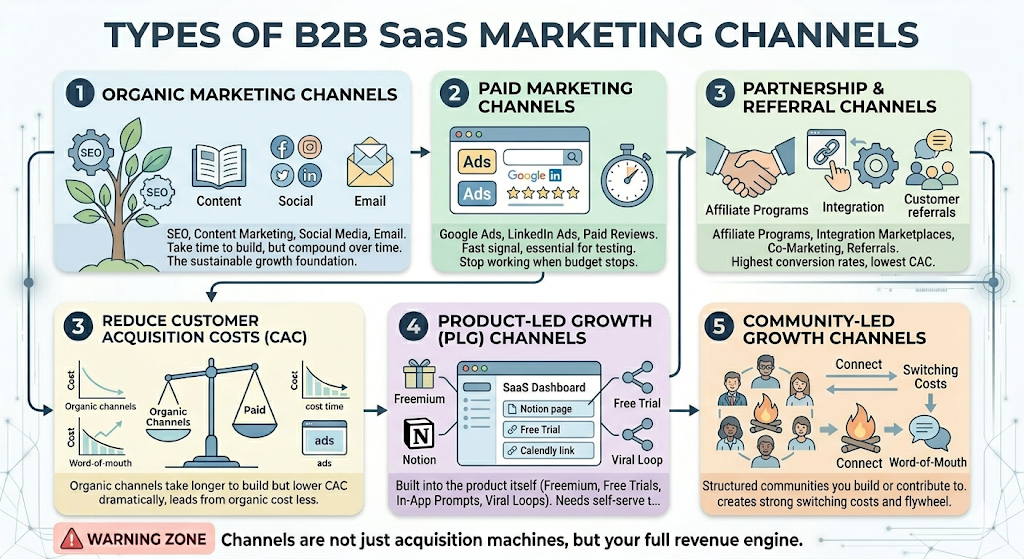
Before we go deep on specific channels, here’s how they group:
Organic marketing channels include SEO, content marketing, social media, and email. These take time to build but compound over time. They’re the foundation of a sustainable growth engine.
Paid marketing channels include Google Ads, LinkedIn Ads, and paid review placements. These give you a fast signal and are essential for testing positioning and targeting, but they stop working the moment the signal stops.
Partnership and referral channels include affiliate programs, integration marketplaces, co-marketing with complementary tools, and customer referral programs. These often have the highest conversion rates and lowest CAC of any channel.
Product-led growth (PLG) channels are built into the product itself -freemium tiers, free trials, in-app upgrade prompts, viral loops (like sharing a Calendly booking link or a Notion page). These are only available if your product has network effects or genuine self-serve utility.
Community-led growth channels are structured communities you build or contribute to. These take the longest to develop but create the strongest switching costs and word-of-mouth flywheel.
B2B SaaS marketing channels can be grouped into five broad types: organic, paid, partnership/referral, product-led, and community-led. Organic and community channels compound over time but take longer to build. Paid channels deliver a fast signal but require ongoing spend. The healthiest SaaS growth engines combine all five in proportions that reflect the product’s ACV, sales cycle, and stage of growth.
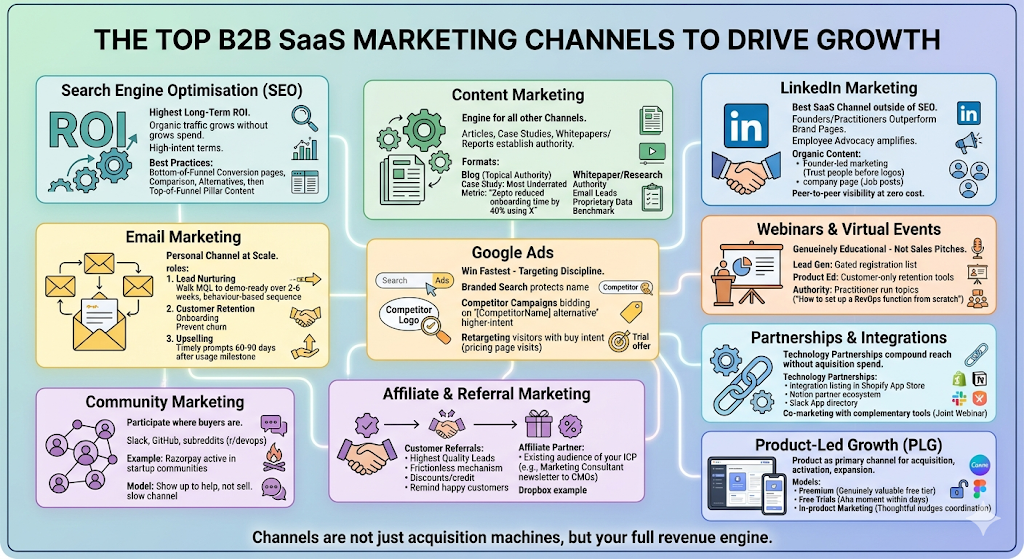
The Top B2B SaaS Marketing Channels to Drive Growth
Search Engine Optimisation (SEO)
SEO is still the highest long-term ROI channel in B2B SaaS. Full stop.
The reason is compounding. An article you write today can rank for years, pulling in a steady stream of qualified buyers without any additional spend. Compare that to Google Ads, where you pay for every click forever.
The benefits: Organic traffic grows without growing spend. High-intent search terms (like “best project management tool for agencies”) attract buyers who are already looking for a solution. SEO also feeds your GEO strategy -well-structured content is exactly what AI answer engines extract and cite.
Best practices: Focus on bottom-of-funnel terms first -comparison pages, alternative pages, use case pages. These convert faster than awareness-stage content. Then build up to top-of-funnel pillar content as domain authority grows. HubSpot built a significant portion of its $2B+ revenue on this exact model.
The honest challenge: SEO takes 4-12 months to show meaningful results. It requires consistent investment in quality content, technical site health, and link building. If you need a pipeline in the next 90 days, SEO alone won’t deliver it. That’s why pairing it with paid search from the start makes sense.
Content Marketing
Content is the engine that makes most other B2B SaaS marketing channels work better. Your SEO articles need content. Your email campaigns need content. Your LinkedIn posts need content. Your sales team needs content to share in follow-up sequences.
The forms that work in B2B SaaS specifically:
Blog articles drive organic traffic and establish topical authority. Freshworks built an entire organic acquisition strategy through deep how-to content targeting SMB buyers in India and globally.
Case studies are the most underrated content format in B2B. A well-written case study with specific metrics (“Zepto reduced onboarding time by 40% using X”) answers the buyer’s unspoken question: “Has anyone like me actually used this and did it work?”
Whitepapers and research reports build authority and generate email leads. If you have access to proprietary data (even from your customer base), turning it into an annual benchmark report is one of the most effective B2B content plays available.
So why do most companies still publish generic blog content that ranks for nothing and converts no one? Because content is easy to measure in vanity metrics (pageviews) and hard to measure in real revenue contribution. Fix the attribution, and the content becomes impossible to defund.
LinkedIn Marketing
For most B2B SaaS companies selling to SMBs and mid-market, LinkedIn is the single best saas channel mix addition outside of SEO.
But here’s what most marketing teams get wrong: they invest in the company page and neglect the founder’s personal account. Company page content gets 3-5x lower organic reach than individual posts. The founder -or any senior practitioner with genuine expertise -almost always outperforms the brand page.
Organic content from the company page works best for product announcements and job posts. For awareness and lead gen, individual accounts are far more effective.
Employee advocacy amplifies everything. If your 10-person marketing team each reshares a post from the founder, that post reaches 10 different first-degree networks. Peer-to-peer visibility at zero cost.
Founder-led marketing is not a trend. It’s a structural shift in how B2B buyers build trust. Buyers trust people before they trust logos. A founder who posts consistent, specific, useful content on LinkedIn will outperform most company-level paid campaigns on a fraction of the budget.
Email Marketing
Email is the most personal channel at scale. And in B2B SaaS, it plays three completely distinct roles:
Lead nurturing takes a Marketing Qualified Lead (MQL) who downloaded a whitepaper and walks them to a demo-ready state over 2-6 weeks. The key is progressive email sequences that respond to behaviour -clicked the pricing page? Send the ROI calculator. Didn’t open email 3? Try a different subject line before removing from the sequence.
Customer retention is where email delivers outsized value. A well-timed onboarding sequence dramatically improves activation rates. A proactive “you haven’t used Feature X yet” email can prevent churn before the customer even realises they’re disengaged.
Upselling works particularly well in the 60-90 day window after a customer reaches a meaningful usage milestone. “You’ve sent 500 emails this month -here’s what the Pro plan unlocks” is a concrete, timely upgrade prompt that converts without feeling pushy.
Google Ads
Paid search is where SaaS companies often waste the most money and also where they can win fastest -the difference is targeting discipline.
Branded search campaigns protect you from competitors who are bidding on your name. If you’re not bidding on your own brand, someone else is capturing your buyers at the moment of highest intent.
Competitor campaigns -bidding on “[CompetitorName] alternative” or “[CompetitorName] pricing” -are one of the highest-intent targeting approaches in B2B SaaS. The buyer is already in evaluation mode. Clearbit ran these aggressively before their acquisition and credited competitor targeting with meaningful pipeline contribution.
Retargeting campaigns bring back visitors who showed buying intent but didn’t convert. Someone who visited your pricing page twice is not a casual visitor. A well-crafted retargeting ad with a free trial offer or a customer proof point can re-engage them effectively.
Webinars and Virtual Events
Webinars remain one of the most underused channels in B2B SaaS for one reason: most teams treat them as sales pitches dressed up as education. Buyers have learned to smell this from the subject line.
The ones that work are genuinely educational. A 45-minute webinar on “How to set up a RevOps function from scratch” run by a practitioner with real experience, will outperform any product demo webinar by a significant margin. You build authority. You attract the right audience. And then you nurture them with product-relevant follow-up.
For lead generation: Gated webinar registration gives you a qualified email list of people who care about your topic.
For product education: Customer-only webinars are underrated retention tools. Customers who understand your product deeply are far less likely to churn.
Community Marketing
Community is a slow channel. And it’s one of the most powerful ones for long-term saas pipeline generation.
The model is straightforward: participate in the communities where your buyers already spend time. For marketing ops software, that’s communities like the MO Pros Slack group (25,000+ members). For developer tools, it’s GitHub discussions, Hacker News, and subreddits like r/devops. You don’t show up to sell. You show up to help.
Razorpay, the Indian payments SaaS platform, has been particularly active in startup and developer communities since its early days. That community presence built trust with exactly the kind of technical founders who would go on to become their largest accounts.
Affiliate and Referral Marketing
Customer referrals consistently produce the highest-quality leads of any B2B SaaS marketing channel. Referred customers close faster, have lower CAC, higher lifetime value, and better retention.
A structured customer referral program doesn’t need to be complex. Dropbox’s early referral program gave both parties extra storage. In B2B, the incentive is often a credit, a discount, or early access to a new feature. What matters is making the referral mechanism frictionless and reminding happy customers that it exists.
Partner affiliate programs work best when the affiliate has an existing audience of your ICP. A marketing consultant with a newsletter of 15,000 CMOs recommending your analytics tool is worth more than any banner ad you could buy.
Partnerships and Integrations
Technology partnerships compound your reach without compounding your acquisition spend. Being listed as an integration in HubSpot’s App Marketplace puts your product in front of every HubSpot customer who’s solving the problem you address. Notion’s partner ecosystem, Slack’s app directory, and Shopify’s App Store all operate on this logic.
Co-marketing with complementary tools is another underused play. If you’re a video testimonial tool, co-marketing with a CRM that doesn’t do video creates mutual distribution. One joint webinar can generate leads neither company would have reached alone.
Product-Led Growth (PLG)
Product-led growth is a distribution strategy, not just a product philosophy. The product itself becomes the primary channel for acquisition, activation, and expansion.
Freemium models let buyers experience value before committing to a purchase. Notion, Canva, and Figma all grew explosively on the back of freemium. The key is that the free tier must be genuinely valuable -not a crippled trial. It has to demonstrate the core value proposition so clearly that upgrading feels like a natural next step.
Free trials work especially well for products with a clear “aha moment” that can be reached within days. If your tool saves someone two hours in the first week, they’ll convert. If the trial ends and they haven’t reached the aha moment yet, they’ll churn -and you’ll never know why.
In-product marketing -upgrade nudges, feature discovery prompts, and usage-based alerts -turns your existing user base into an expansion revenue channel. This requires thoughtful product design and coordination between marketing and product teams.
Product-led growth (PLG) treats the product itself as the primary B2B SaaS marketing channel. Free trials, freemium tiers, and in-product upgrade flows drive acquisition, activation, and expansion without requiring a traditional sales motion. PLG works best when the product has a fast time-to-value -ideally within the first session or first week of use.
How to Choose the Right B2B SaaS Marketing Channels
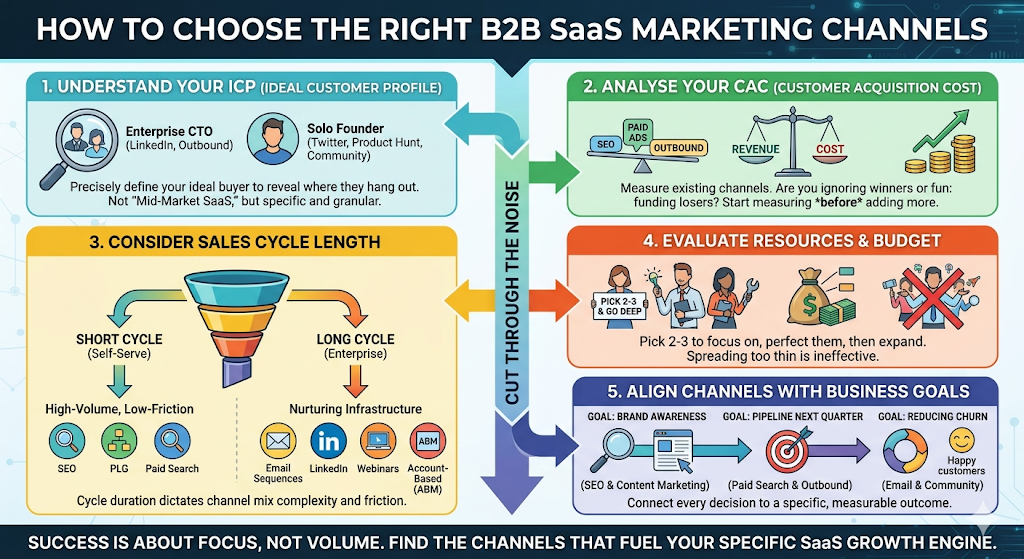
Not every channel works for every company. Here’s how to cut through the noise.
Understand Your Ideal Customer Profile (ICP)
Your ICP defines where you should market before it defines what you should say. If you’re selling to CTOs at enterprise companies, LinkedIn and targeted outbound work better than social media advertising. If you’re selling to indie makers and solo founders, Twitter, Product Hunt, and community marketing may outperform everything else.
Get specific: not “mid-market SaaS companies” but “Series A SaaS companies with 50-200 employees, using Salesforce CRM, with a Head of Marketing who is actively building the team.” The more precisely you define your ICP, the clearer the channel becomes.
Analyse Your Customer Acquisition Costs
Which channels are you already using? What’s the CAC from each one? If you don’t know, start measuring before adding new channels. Most SaaS teams have 2-3 channels they’ve tried but never properly measured, and one or two that are clearly working but underfunded.
Consider Your Sales Cycle Length
A 2-week self-serve sales cycle and a 6-month enterprise sales cycle require completely different channel mixes. Short cycles need high-volume, low-friction channels -SEO, PLG, paid search. Long cycles need nurturing infrastructure -email sequences, LinkedIn presence, webinars, and account-based marketing.
Evaluate Available Resources and Budget
A 3-person marketing team cannot run 8 channels well. They’ll run them all badly. Pick 2-3, go deep, get them working, then expand. Spreading thin across every B2B SaaS marketing channel is how teams look busy and produce nothing.
Align Channels With Business Goals
If the goal is brand awareness, SEO and content marketing are your best long-term tools. If the goal is pipeline next quarter, paid search and outbound will move faster. If the goal is reducing churn, email and community are where you should invest. Every channel decision should connect to a specific business outcome.
Choosing B2B SaaS marketing channels should start with ICP clarity, not channel enthusiasm. The right channel is determined by where your buyer spends time, what your sales cycle requires, and what your team can execute consistently. A SaaS startup with a 3-person marketing team and a short self-serve cycle should pick 2-3 channels and go deep before expanding.
Building a Multi-Channel B2B SaaS Marketing Strategy
Combining Organic and Paid Channels
The smartest SaaS companies use paid to accelerate organic. Run Google Ads on the keywords you’re trying to rank for organically -you get traffic and conversion data immediately, which informs how you write and position the organic content. Once the organic article ranks and converts, you can reduce ad spend on that term and redirect it to a new keyword you’re trying to crack.
Creating a Full-Funnel Marketing Approach
Each stage of the funnel needs coverage. Awareness without conversion infrastructure is expensive and demoralising. Conversion infrastructure without awareness traffic is an empty pipeline. Map your channels to the funnel explicitly:
- Awareness: SEO, LinkedIn, content marketing, community
- Consideration: Webinars, case studies, email nurture, review sites
- Decision: Free trial, demo, competitor comparison pages, retargeting
- Retention/Expansion: Email, in-product marketing, customer community
Aligning Marketing and Sales Teams
B2B SaaS pipeline generation breaks down most often at the marketing-to-sales handoff. Marketing generates MQLs that sales never works properly. Sales generates opportunities that marketing doesn’t know how to support. The fix is shared definitions (what is an MQL exactly), shared data (marketing and sales on the same CRM view), and shared goals (marketing owns pipeline contribution, not just lead volume).
Using Data to Optimise Performance
Set up attribution modelling from day one. Last-click attribution will tell you paid search is your best channel even when the buyer actually found you through an organic article eight months ago. Multi-touch attribution gives a more honest picture. Tools like Dreamdata, Triple Whale, or even a well-maintained UTM structure in a basic CRM can start giving you real channel performance data quickly.
Measuring the Performance of B2B SaaS Marketing Channels
The metrics that matter are simpler than most SaaS marketers make them. Here’s what to track:
Customer Acquisition Cost (CAC) is the total marketing and sales spend divided by new customers acquired. Break this down by channel. Channel-level CAC tells you where you’re getting the best return.
Customer Lifetime Value (LTV) determines how much CAC you can afford. A customer worth $10,000 over their lifetime can support a $2,000 CAC. A $500 customer cannot.
Marketing Qualified Leads (MQLs) measure top-of-funnel output. But don’t stop here. An MQL target with no conversion-to-revenue tracking creates perverse incentives.
Sales Qualified Leads (SQLs) measure how many MQLs your sales team actually wants to work. A high MQL-to-SQL drop-off usually means channel and ICP misalignment -you’re attracting the wrong people.
Conversion Rates at each stage reveal where leads are getting stuck. A 2% trial-to-paid rate isn’t necessarily a product problem. It might be a channel quality problem -the wrong buyers are entering the trial.
Pipeline Contribution by channel is the metric that finally justifies the marketing budget to the finance team. When marketing can show that “our SEO programme contributed 35% of pipeline this quarter,” it becomes a real business asset, not a cost centre.
Revenue Attribution is the endpoint. Every channel should ultimately be traceable to closed-won revenue, even with a multi-touch model. If you can’t connect your marketing activity to revenue, you can’t defend or grow your budget.
Common B2B SaaS Marketing Channel Mistakes to Avoid
Trying Too Many Channels at Once
This is the most common and most expensive mistake. A team that’s managing SEO, LinkedIn, email, webinars, paid search, podcasts, and partnerships simultaneously is doing all of them at 10% capacity. Better to pick three and do them at 100%.
Ignoring Customer Intent
Not all traffic is equal. Getting 10,000 visitors to a generic “what is project management” article is nearly worthless if you sell to enterprise operations teams. Fifty visitors on a “project management software for large construction firms” search are worth 100x more. Always optimise for intent, not volume.
Focusing on Traffic Instead of Revenue
Traffic is a means to an end. Pageviews, impressions, and email opens are signals, not results. The result is pipeline and revenue. Build your reporting around revenue contribution from the start, even if the early data is messy. It forces the right decisions.
Neglecting Retention Marketing
SaaS revenue is recurring. That means a customer you keep for 3 years is worth 3x a customer you keep for 1. Yet most SaaS marketing teams spend 90% of their effort on acquisition. Email, community, and in-product marketing for existing customers are significantly underfunded in most SaaS businesses.
Quitting Channels Too Early
SEO takes 6-12 months. Community takes longer. If you start a channel and abandon it at 6 weeks because “it’s not working,” you’re quitting exactly when compounding is about to start. Give organic channels a genuine runway before drawing conclusions.
Emerging Trends in B2B SaaS Marketing Channels
AI-Powered Search and Generative Engine Optimisation (GEO)
Generative Engine Optimisation (GEO) is the practice of structuring content so that AI answer engines -ChatGPT, Perplexity, Google AI Overviews, Bing Copilot -extract and cite it in responses. This is distinct from traditional SEO. GEO-optimised content has standalone definition sentences, direct answer blocks at the top of each section, specific statistics with named sources, and citation capsules that summarise key claims in quotable form.
SaaS companies that are early to GEO are already seeing brand mentions appear in AI-generated answers when buyers ask for tool recommendations. This is a distribution channel that didn’t exist three years ago.
Founder-Led Marketing
The biggest shift in B2B distribution in the past three years isn’t a new platform. It’s the movement of trust from brands to individuals. Buyers trust practitioners more than companies. A founder with 20,000 LinkedIn followers who posts specific, useful content about their problem space will generate more qualified pipeline than most company marketing teams with ten times the budget.
This is why founder-led marketing is showing up in the growth strategies of companies like Gong, Lavender, and dozens of India-based SaaS companies, including Salesken and Leadsquared.
Community-Led Growth
Community-led growth as a channel model is gaining traction because it creates network effects that paid channels never can. When your users help each other, share use cases, and advocate in peer communities, your product becomes stickier and your CAC drops. Companies like Notion, Figma, and Airtable have built community-led growth channels that compound without compounding spend.
Video-First Content Strategies
Text-based content is competing with AI-generated content at a scale that was unimaginable two years ago. Video is harder to fake and harder to commoditise. YouTube, LinkedIn video, and short-form video on Instagram Reels are growing as B2B discovery channels, particularly for reaching younger buyers and practitioners who prefer watching to reading.
Personalisation Through First-Party Data
As third-party cookies continue to disappear, first-party data -the signals your own product and website generate -becomes the foundation of personalised marketing. SaaS companies with strong onboarding flows, usage tracking, and behavioural email triggers are already using first-party data to run personalised campaigns that outperform any cookie-based targeting approach.
The Only Channel Framework You Actually Need
Forget the pressure to be everywhere. The SaaS companies that build predictable growth engines usually do three things consistently:
They pick channels based on where their buyers actually are, not where marketing trends say they should be. If your buyers are on LinkedIn and read long-form comparison content before buying, build SEO and LinkedIn. Don’t start a podcast because everyone else is.
They measure channels by revenue contribution, not activity metrics. If a channel isn’t contributing to the pipeline or revenue within a reasonable timeframe, it either gets fixed or cut. The signal matters more than the effort.
They treat owned channels as assets and paid channels as tests. Paid is for learning. Organic and owned are for compounding. The goal is always to use paid signals to speed up organic investment, not to substitute for it.
If you’re building or rebuilding your B2B SaaS marketing channels stack, start with one or two channels where your ICP is most concentrated, get them working with honest measurement, and then expand from there.
If you want sharper frameworks, real campaign examples, and a weekly breakdown of what’s actually moving in B2B marketing -not generic advice, but the kind that’s useful to practitioners -the YUP Crystal Clear Newsletter covers exactly that.
Frequently Asked Questions
What are B2B SaaS marketing channels?
B2B SaaS marketing channels are the specific paths a SaaS company uses to reach, attract, and convert business buyers. They include both inbound channels like SEO, content marketing, and LinkedIn, and outbound channels like cold email and paid advertising. The right channel mix depends on your product, your buyers, and your stage of growth.
Which marketing channel works best for B2B SaaS companies?
There’s no single best channel -it depends on your ACV, sales cycle, and ICP. That said, SEO and content marketing consistently deliver the best long-term ROI for SaaS companies with a self-serve or low-touch motion. For high-ACV enterprise products, outbound email and LinkedIn tend to outperform organic in the short run. Most successful SaaS companies eventually combine both.
How many marketing channels should a SaaS startup use?
Two to three, done well. Most early-stage SaaS teams overextend across 6-8 channels and get poor results from all of them. Pick the two channels most aligned with your ICP’s behaviour, invest properly, measure rigorously, and only add a third when you have the first two producing consistently.
What is the difference between inbound and outbound SaaS marketing?
Inbound marketing attracts buyers who are already looking for a solution -through search, content, or community. The buyer initiates contact. Outbound marketing pushes your message to a targeted list through cold email, LinkedIn outreach, or paid ads. The buyer is contacted before expressing intent. Inbound tends to have lower CAC at scale. Outbound produces faster results but at a higher cost per acquisition.
Is SEO still effective for B2B SaaS companies?
Yes -and it’s evolving. Traditional SEO (ranking in Google’s blue links) still drives significant traffic. But the emerging priority is Generative Engine Optimisation (GEO): structuring your content so AI answer engines like ChatGPT and Google AI Overviews extract and cite it. SaaS companies that invest in both will capture buyers regardless of how search behaviour continues to shift.
How do you measure the success of a SaaS marketing channel?
Start with pipeline contribution and customer acquisition cost (CAC) broken down by channel. These two metrics tell you which channels are producing real business results. Vanity metrics like pageviews, impressions, and social reach are signals to monitor but should never be the primary KPI for a marketing channel.
What is the most cost-effective B2B SaaS marketing channel?
Customer referrals consistently produce the lowest CAC and highest conversion rates of any B2B SaaS marketing channel. Referred customers also retain better and expand more. After referrals, organic SEO tends to be the most cost-effective at scale -it requires upfront investment in content but delivers compounding returns over years without ongoing spend per click.
How does AI search affect SaaS marketing channels?
AI search tools like ChatGPT, Perplexity, and Google AI Overviews are changing how buyers discover software. A growing percentage of early-stage research happens through AI prompts rather than traditional Google searches. This makes it important to optimise content for AI citation (GEO) alongside traditional search rankings. SaaS companies that structure their content for AI extractability will appear in discovery channels that competitors relying only on SEO will miss.
What role does LinkedIn play in B2B SaaS marketing?
LinkedIn is the highest-reach organic channel for reaching business buyers at the awareness and consideration stages. But company pages consistently underperform. The real opportunity is through individual accounts -founders, executives, and practitioners who post consistently on topics their ICP cares about. A founder with genuine expertise and a consistent posting habit can generate a meaningful pipeline without any ad spend.
How can SaaS companies build a multi-channel marketing strategy?
Start by mapping your buyer’s journey and identifying which channels serve which stage. Use paid channels for fast signal and testing. Use organic and owned channels for compounding returns. Align marketing and sales on shared definitions for MQLs and SQLs. Track pipeline contribution by channel from the start. Add new channels only after the existing ones are producing consistently.