

Here’s something no one likes to say out loud: most products don’t fail because they’re bad. They fail because people never really understood what the product was trying to do for them.
That’s a messaging problem. And it happens way more often than you’d think.
Think about the last time you landed on a website, scrolled for a few seconds, and left because you couldn’t figure out what they were selling. Or you read a headline that said something like “end-to-end solutions for modern enterprises” and had no idea what that meant. That’s exactly what bad messaging looks like from the outside.
Your product messaging strategy is the set of decisions that shapes how people understand, talk about, and buy your product. Get it right, and your website does most of the selling before anyone picks up the phone. Get it wrong, and even an incredible product quietly loses to a weaker competitor that just explains itself better.
This guide walks you through everything: what product messaging actually is, why it matters,
Table of Contents
What Is Product Messaging?
Product messaging is the language you use to explain what your product does, who it helps, and why it matters. It’s not just your tagline or your homepage headline. It’s every word a potential customer reads or hears from you, whether that’s an ad, an email, a sales pitch, or a post on Instagram.
Here’s a simple definition worth holding onto: Product messaging is how you communicate your product’s value in a way that speaks to the right people and gives them a reason to act.
The part most teams get wrong is consistency. They write one thing on the homepage, say something slightly different in the email, and the sales team explains it completely differently on a call. Individually, none of those things is wrong. But when a customer experiences all three, they feel confused. Confused people don’t buy.
Good messaging feels the same everywhere. Not word-for-word identical, but same idea, same tone, same promise.
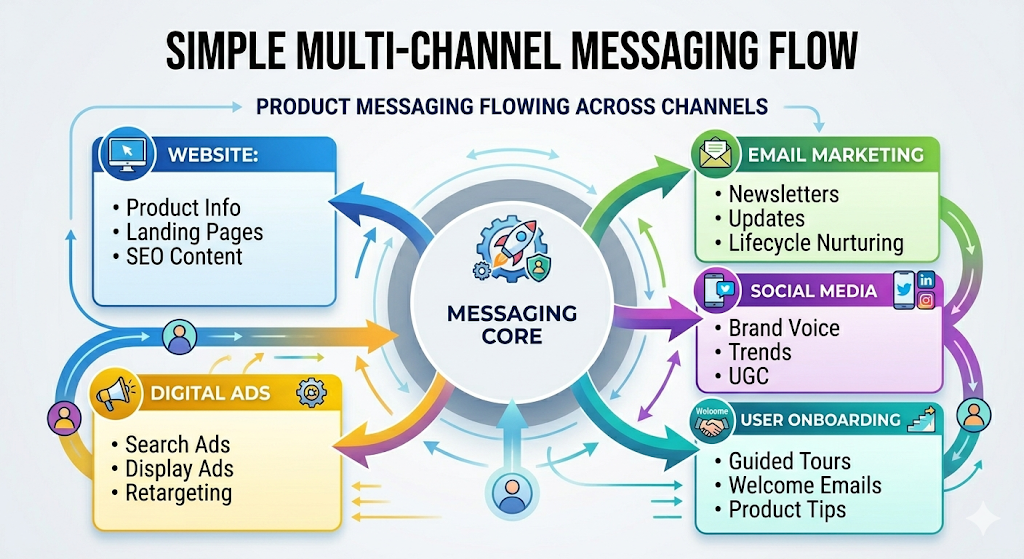
Product messaging is how a brand communicates its product’s value consistently across every touchpoint – website, ads, emails, onboarding flows, and sales conversations. When that language is inconsistent, customers feel uncertain, and uncertainty kills conversions. The goal of product messaging is not to sound clever but to make it obvious, in seconds, what the product does and who it’s for.
What Is In-Product Messaging?
In-product messaging is the communication that happens inside the app or product itself, after someone has already signed up. Things like little pop-ups that guide you through a new feature, a banner reminding you to complete your setup, a notification saying “You’ve almost unlocked your first milestone.” All of that is in-product messaging.
It’s different from the messaging that brings people in. By this point, the person is already a user. So the goal shifts. You’re no longer trying to convince them to sign up. You’re trying to help them actually use the product, stick around, and ideally expand.
Tools like Intercom, Appcues, and Pendo make this easy to manage. Say someone creates an account but never finishes setting up their profile. A well-timed in-product message nudges them back. It’s simple, but it works.
Mamaearth does this well on their app. If you browse their skincare section and leave without buying, you’ll likely get a personalized reminder about exactly what you were looking at. That’s in-product messaging working at the moment of highest intent, right when you were already interested. It reduces the kind of drop-off that costs brands a lot of revenue.
What Is Dynamic Product Messaging?
Dynamic product messaging means showing different versions of your message to different people, in real time, based on who they are.
Instead of one homepage headline for everyone, you serve a version that’s relevant to each visitor. Someone in Mumbai might see “Free delivery across Mumbai.” Someone in Delhi sees “Next-day delivery to your door.” Same product. Same page. Different words for different people.
That’s a basic version of it. At a more advanced level, B2B SaaS companies use tools like Mutiny or VWO to personalize website copy based on the industry or company size of the visitor. A hospital visiting the site might see “Simplify your compliance documentation.” A retail chain sees “Manage your vendor workflows in one place.” Two completely different pain points, one product.
According to a 2023 Epsilon research report, personalized experiences drive purchase intent for 80% of consumers. Dynamic messaging is one of the most practical ways to deliver that at scale without rebuilding your website for every audience.
Product Messaging vs Positioning: What’s the Difference?
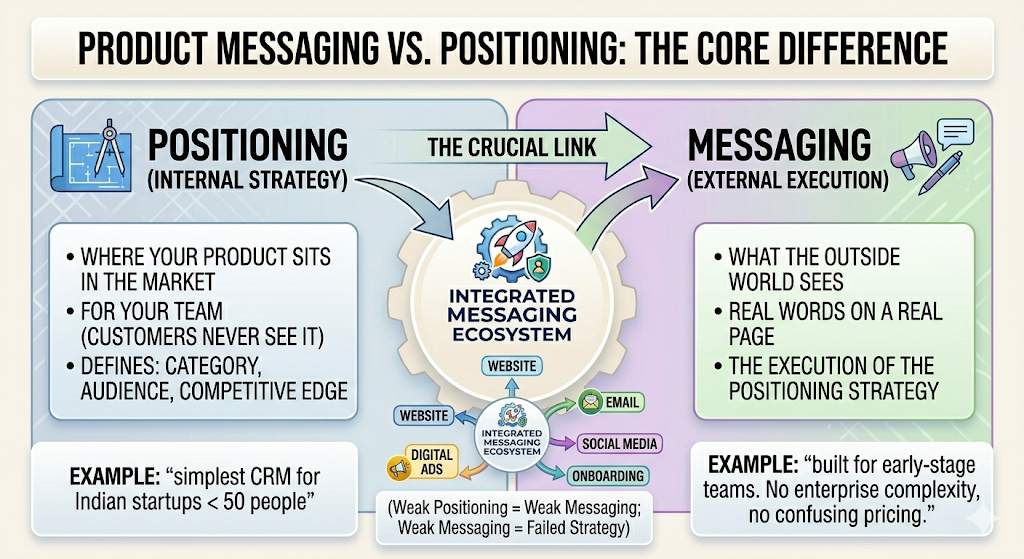
People mix these up all the time. They’re related, but they’re not the same thing.
Positioning is a decision you make internally. It’s about where your product sits in the market: who it’s for, what category it’s in, and what makes it a better choice than the alternatives. Your customers never see your positioning document. It’s for your team.
Messaging is what the outside world sees. It’s how you take that internal decision and turn it into real words on a real page.
Think of it this way: positioning is the strategy, messaging is the execution.
Here’s an example. If your positioning says “we’re the simplest CRM for Indian startups with fewer than 50 people,” your messaging might be “A CRM built for early-stage teams. No enterprise complexity, no confusing pricing.” Same thought, expressed in a way a real customer would read and actually understand.
If you get the positioning wrong, no amount of good writing will save your messaging. And if you nail the positioning but write weak messaging, the strategy never reaches the people it was built for.
Why Product Messaging Matters More Than You Think
Let’s talk numbers for a second. According to Nielsen’s 2023 Global Marketing Report, brands that keep their messaging consistent across channels bring in 23% more revenue on average than brands that don’t. That’s not a small difference.
And yet, most product teams spend months building the product and a few days writing about it. The imbalance is backwards. Because here’s the reality: from a customer’s point of view, your product doesn’t exist until they understand what it does. They can’t want something they can’t make sense of.
There’s also the trust angle. When your messaging is clear and consistent, it sends a quiet signal that your company knows what it’s doing. When it’s messy or contradictory, people pick up on that too, even if they can’t name why they feel uncertain.
Honest messaging, done consistently, is one of the cheapest trust-building tools you have. Most brands just don’t treat it that way.
According to Nielsen’s 2023 Global Marketing Report, brands with consistent messaging across channels generate 23% more revenue on average than those with fragmented communication. Product messaging is not a creative exercise – it is a revenue lever. When customers can’t quickly understand what a product does and why it matters to them specifically, they leave without converting.
Key Elements of an Effective Product Messaging Framework
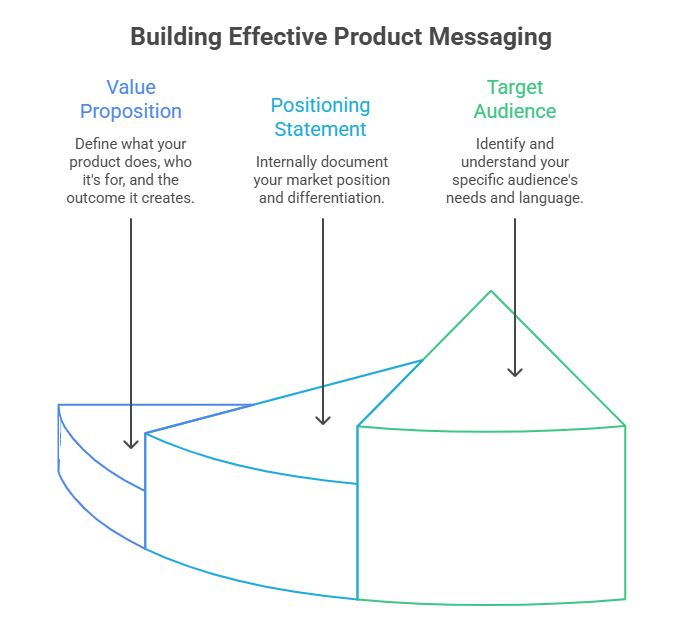
Value Proposition
Your value proposition is probably the single most important thing you’ll ever write about your product. It’s the answer to one very simple question: why should this specific person choose your product instead of everything else available to them?
A good value proposition covers three things: what the product does, who it’s for, and what outcome it creates. Slack’s early value prop was basically “team communication that replaces email.” Short, clear, and covers all three. You knew exactly what it did, who it was for, and what life would look like after using it.
A bad value prop sounds like “a comprehensive solution for modern teams.” That’s so vague it could describe an accounting firm, a food delivery app, or a dog grooming service.
Positioning Statement
A positioning statement is an internal document that nails down your market position in one structured paragraph. The classic format goes like this:
For those whose audience is who (have this specific problem), (your product name) is a (product category) that (delivers this result). Unlike the main alternative, our product is the key thing that makes you different.
It sounds formulaic, and honestly, it is. But getting your whole team to agree on every word in that formula is harder than it sounds, and worth every minute. Once you have it, every piece of copy you write becomes easier to check: Does this reflect what we agreed on?
Target Audience
You can’t write messaging that works if you don’t know who you’re writing for. Not in a vague way, like “marketers” or “small business owners.” In a specific way: what’s their job title, what problem are they stuck on, what have they already tried, and what words do they use to describe that frustration?
Nykaa is a great example. Their messaging doesn’t try to talk to “everyone who buys beauty products.” It speaks directly to beauty-conscious Indian women who want discovery and access. That focus shows up in everything they write. It’s why their messaging feels personal to their audience instead of generic.
Real-World Examples of Product Messaging Done Right
The best product messaging isn’t trying to sound smart. It’s trying to be understood quickly. The taglines that have lasted are the ones that say something true, in the simplest possible words.
Slack: “Be Less Busy”
Slack could have written “real-time team communication platform.” That’s accurate and completely forgettable. Instead, they said what their users actually wanted to feel: less overwhelmed, less buried in email threads. The whole product experience was built to back up that promise. For enterprises looking for a Secure Slack alternative for enterprises, this focus on streamlined communication and a better user experience is especially important.
Trello: “Organize Anything, Together”
Just four words, but they work hard. “Anything” tells you it’s flexible. “Together” tells you it’s built for teams. Their audience is anyone who has ever tried to run a project from a shared spreadsheet and ended up more confused than when they started. Trello doesn’t explain that pain. They just say the opposite of it.
Dropbox: “Simplify Your Life”
When cloud storage was new, most people found the concept confusing and a little scary. Dropbox didn’t try to explain the technology. They described the feeling after using it. That’s a smart move: don’t sell the product, sell the outcome.
Mailchimp: “Send Better Email”
Three words. Completely clear. You know exactly what you’ll be able to do after using it. That’s the whole job of product messaging, done in three words.
Asana: “Work on Big Ideas, Without the Busywork”
Asana is talking to people who already know what project management software is. So they don’t explain the category. They speak to the frustration inside the category. “Busywork” is a word their users actually use when they complain about other tools. That’s why it lands.
Why Is Product Messaging Important for Conversions?
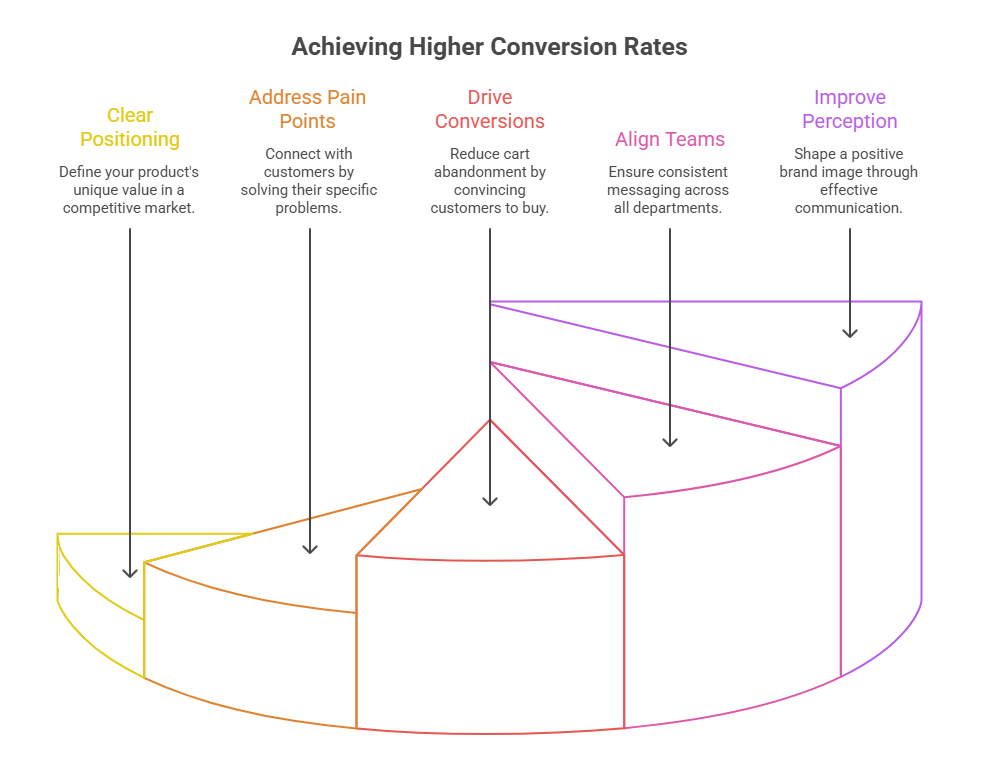
It Positions Your Product Clearly in a Crowded Market
When messaging is vague, customers fall back on what they know: price and brand name. Neither of those helps a growing product that isn’t the cheapest or the most famous. Clear messaging gives people a real reason to choose you that has nothing to do with those two things.
It Speaks Directly to Customer Pain Points
People don’t buy products. They buy solutions to specific problems they’re dealing with right now. Messaging that starts with the pain point connects much faster than messaging that leads with a list of features. A feature list tells people what your product does. Pain-point messaging tells them what their life looks like after they use it.
It Drives Conversion Rates
Here’s a number that should concern anyone working on a product. According to a 2024 study by the Baymard Institute, 69.8% of online shopping carts are abandoned before purchase. A big chunk of that is due to unclear messaging at the decision-making moment: people who almost bought but weren’t convinced.
Fixing your value proposition, clarifying what makes you different, and removing ambiguity from your calls to action are all messaging changes that directly chip away at that number.
It Aligns Teams for Consistency
When sales, marketing, and customer success all say roughly the same thing about your product, the customer gets a consistent experience from the first ad they see to the first renewal conversation. That consistency builds trust in a way that any single great touchpoint alone can’t.
It Improves Customer Perception Over Time
How you talk about your product shapes how people think about it. Zepto doesn’t call itself “a grocery delivery app.” They talk about getting groceries in ten minutes, about never having to plan a shopping trip, about the relief that comes from that. That framing makes the product feel more valuable than the underlying service would suggest.
Product messaging directly affects conversions by removing confusion at the moment customers decide whether to buy. According to the Baymard Institute’s 2024 research, 69.8% of shopping carts are abandoned before purchase, with unclear messaging being a major contributing factor. Brands that lead with customer pain points rather than product features consistently see stronger conversion outcomes.
Common Mistakes in Product Messaging (And How to Fix Them)
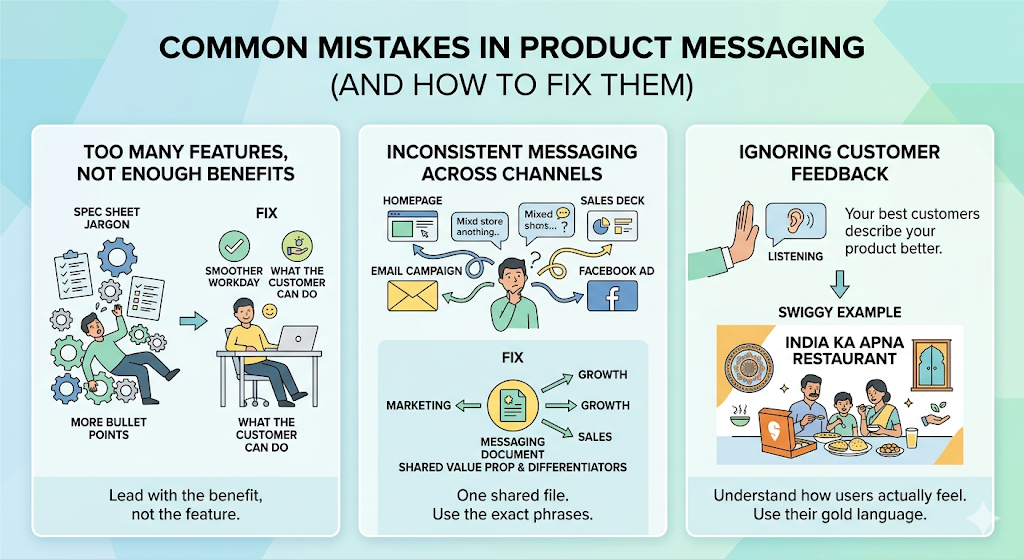
Too Many Features, Not Enough Benefits
This is the most common mistake, especially in B2B products. As the product grows, the website starts looking like a spec sheet. More features, more bullet points, more jargon. But customers don’t care what your product does. They care what their workday looks like after using it.
The fix takes discipline, but it’s simple: for every feature you want to mention, ask “what does this actually let the customer do that they couldn’t do before?” Write that answer first. Lead with the benefit, not the feature.
Inconsistent Messaging Across Channels
Picture this. Your marketing team writes a great homepage. Your growth team runs email campaigns with slightly different language. Your sales team builds their own deck. Six months later, a customer who came through a Facebook ad, got four emails, and sat through a demo, has heard three different versions of what you do.
None of them was wrong, exactly. But none of them matched.
The fix is a messaging document: one shared file with your approved value proposition, key differentiators, and the exact phrases your team should be using. It doesn’t need to be long. It needs to be shared and actually used.
Ignoring Customer Feedback
Here’s a useful truth: your best customers almost always describe your product better than your marketing team does. The exact words they use when they explain why they bought, what they were struggling with before, or what they’d lose if you disappeared, that language is gold.
Swiggy’s “India ka apna restaurant” framing didn’t come from a brainstorm. It came from understanding how their Indian users actually felt about food delivery: not as a convenience app but as something culturally familiar. That came from listening.
Overcoming Common Challenges in Product Messaging
Dealing with Market Saturation
In crowded categories, every brand starts to sound the same. The usual response is to shout louder. That rarely works. The smarter move is to get more specific.
Find the part of your audience that competitors are ignoring or underserving. Write directly to them. Yes, it feels like narrowing your reach. But when the right people read your messaging and feel like you’re talking directly to them, that specificity converts much better than something written for everyone.
boAt is a perfect example. The Indian audio market already had Sony, Bose, and a dozen other established players. boAt didn’t try to out-quality them. Instead, they went straight to younger, style-conscious Indian buyers who wanted decent sound at a price they could actually afford. Their messaging was unapologetically Indian and youth-first. In a saturated category, they carved out a lane no one else was in.
Evolving Consumer Expectations
What your audience responded to two years ago might not land the same way today. People’s expectations shift, especially in fast-moving categories like fintech, D2C, and SaaS. The fix isn’t a constant rebrand. It’s building a quarterly check-in into your process where you look at whether your messaging still reflects how your best customers talk and what they care about.
Razorpay is a good example of doing this well. They started as a payment gateway, and their early messaging reflected that clearly. As they expanded into a full financial platform for businesses, their messaging expanded too, without losing the credibility they’d built. They didn’t pretend to be something new overnight. The shift was gradual, and it tracked the actual product evolution.
What Is a Product Marketing Messaging Framework?
A product marketing messaging framework is basically a document that puts all your messaging decisions in one place. It’s the source of truth. When someone on your team needs to write an ad, build a deck, or update the homepage, this is what they refer to.
It’s not a brand guidelines doc. Brand guidelines tell you about fonts, colours, and how to use the logo. A messaging framework tells you what to actually say about the product.
Components of a Strong Product Messaging Framework
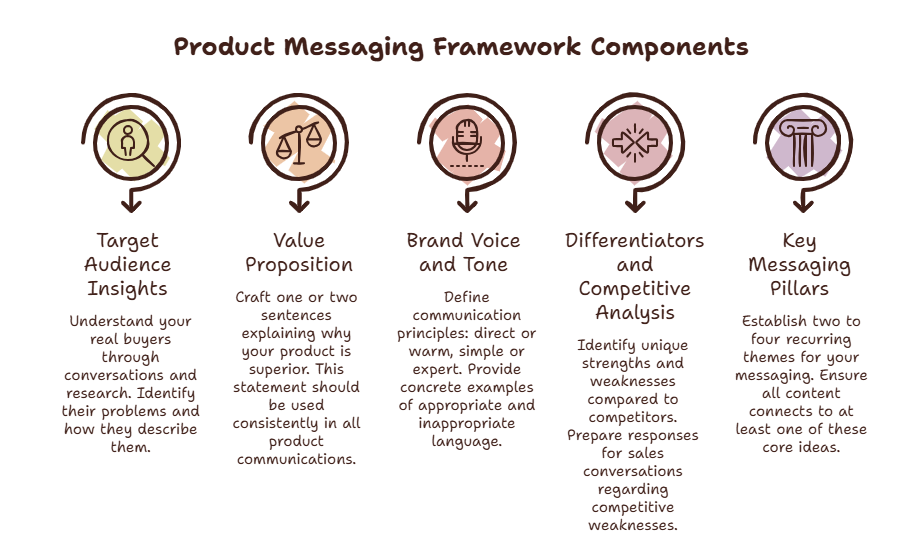
Target Audience Insights. Who are your real buyers? Not guesses, actual insights based on conversations and research. What keeps them up at night? How do they describe their problem? This section grounds everything else.
Value Proposition. The one or two sentences that explain why someone should choose your product over everything else. This gets used every time someone writes anything about the product.
Brand Voice and Tone. A short set of principles that describes how you communicate: are you direct or warm, simple or expert-level, casual or professional? Give real examples of what sounds right and what doesn’t, so writers have something concrete to work from.
Differentiators and Competitive Analysis. What do you do that your competitors don’t? Where are you stronger? And where are you weaker, and how does your team handle those questions when they come up in sales conversations? This section is missing from most frameworks, which is exactly why sales teams improvise.
Key Messaging Pillars. Two to four big themes that your messaging always comes back to. Not slogans, but recurring ideas: speed, simplicity, affordability, trust. Every blog post, every ad, every email should connect to at least one of them.
How to Create a Product Messaging Strategy: Step by Step
Step 1: Define Your Product’s Core Value
Start with this honest question: if your product disappeared tomorrow, what would your best customers actually miss? Not the features. The outcome. What would go wrong for them?
That’s your core value. Write it in one clear sentence, with no jargon. If it takes more than twenty words, cut until it doesn’t.
Step 2: Research and Develop Buyer Personas
Talk to your existing customers. Actual conversations, not just surveys. Ask them why they chose you, what they were using before, and what they’d do if your product went away. Take notes on the words they use, because their language will almost always be sharper than anything your team invents.
Build two or three customer personas from what you learn. Each one should have a job title, a specific problem they’re dealing with, a number they care about (like a conversion rate or a cost target), and the exact words they use when they talk about their pain.
Step 3: Identify Your Differentiation
Write down everything you do differently from your top three competitors. Then go through the list and ask: Does this difference actually matter to our customers? Because a differentiator that customers don’t care about is just a feature, not a reason to choose you.
What you’re looking for is the overlap between what’s true about your product and what your buyers genuinely value. That’s where your best messaging lives.
Step 4: Build Your Messaging Framework
Take everything from the first three steps and put it in one document. Your value proposition, your positioning statement, your top differentiators, your messaging pillars, and your voice guidelines.
Keep it short. A ten-page document that sits in a folder no one opens is worse than a two-page one that your team actually uses. The point is shared alignment, not a lengthy report.
Step 5: Test and Validate with Real Customers
Before anything goes live, test it. Run two versions of your homepage headline and see which one gets more clicks. Read your new value proposition to a few customers and watch their faces. Ask your sales team if the updated positioning makes their conversations easier or harder.
Messaging that feels great internally but confuses real people isn’t good messaging yet. The testing step is where most teams stop short, and it’s the step that makes the biggest difference.
A product messaging strategy is built in five steps: defining the core value your product delivers, learning your buyers’ own language through real conversations, identifying the differentiators that customers actually care about, organizing everything into a shared framework document, and validating the messaging with real customers before publishing. The step most teams skip – validation – is also the one that most often determines whether messaging converts or confuses.
How to Measure Whether Your Messaging Is Actually Working
Good messaging should show up in your numbers. If it doesn’t, something’s off and it’s worth looking into.
Key Performance Indicators for Product Messaging
Landing page conversion rate is the most direct signal. Clear messaging should lift this. Track it before and after any meaningful messaging change, so you know whether the update helped.
Time on page and scroll depth tell you whether people are actually reading or bouncing right away. If the average visitor spends eight seconds on your homepage and barely scrolls past the first section, your opening message isn’t doing its job.
Sales cycle length is a less obvious one, but worth tracking. When messaging is clear, people come into sales conversations already partly convinced. They’ve read your website and understood the value. Shorter sales cycles are often a side effect of tighter messaging upstream.
Churn rate and customer success metrics show you the long-term health. If your messaging promises something the product doesn’t deliver, customers leave. If it sets honest expectations, they stay.
Continuous Improvement and Adaptation
Messaging isn’t something you do once and leave alone. It’s a system that needs maintenance. A good rhythm: review performance every quarter, check it against competitor positioning every six months, and revisit your buyer personas whenever your customer base meaningfully shifts.
Brands that convert and retain well don’t treat messaging as a launch deliverable. They treat it like any other part of the product: something that needs care, regular attention, and iteration.
Future Trends Shaping Product Messaging
The Impact of Technology on Product Messaging
AI is making it faster to test and refine messaging. Tools like Persado use machine learning to generate and test copy variations at a pace no human team can match. That doesn’t replace the thinking that goes into what you’re trying to say. But it does make it cheaper and faster to figure out how to say it.
There’s another shift worth paying attention to. When someone asks ChatGPT or Perplexity which CRM to use for a ten-person team, AI systems pull from existing content to generate that answer. Brands that have structured their messaging in a clear, well-organized way are more likely to get cited. The ones that haven’t are harder for AI to reference. That’s a new kind of visibility problem, and it’s already here.
The Growing Importance of Personalization
Generic, one-size-fits-all messaging is becoming less effective. Customers expect brands to speak to them like they know who they are, what they’re dealing with, and what matters to them. According to McKinsey’s 2023 Personalization Pulse Check, 71% of consumers expect personalized interactions, and 76% feel frustrated when brands don’t deliver.
For your product messaging strategy, this means one message for one audience is probably not enough. Your framework needs to account for the fact that different segments have different pain points, and your messaging needs to reflect that, especially at key moments like landing pages, onboarding emails, and sales outreach.
Cross-Team Alignment: The Underrated Benefit of Clear Messaging
Most conversations about product messaging are about what it does for customers. But strong messaging has an internal benefit that doesn’t get talked about enough.
When your sales team, your marketing team, and your customer success team all work from the same messaging document, three real things happen.
First, the customer experience becomes consistent. Someone who reads your ad, attends a webinar, and then sits through a demo hears the same core story each time, told in slightly different ways depending on the context. That consistency builds confidence. People trust brands that know what they are.
Second, new team members get up to speed faster. A new sales hire doesn’t spend their first month figuring out how to explain the product. They start from a framework that the whole team agrees on. They can adapt it, but they’re not starting from nothing.
Third, product decisions improve. When the product team understands what promises the messaging is making and how the product is positioned, they make smarter calls about what to build next, what to prioritize, and what to deprioritize.
This is one of the main reasons product marketers at fast-growing companies often get pulled into leadership conversations. Messaging isn’t just copy. It’s a shared understanding, made visible.
Conclusion
When conversions stall, most teams immediately look at the product or the pricing. Half the time, it’s actually the messaging.
Your product messaging strategy sits between what your product does and what your customers believe it can do for them. When that gap is small, everything works better: ads perform, sales conversations get easier, and customers stick around longer. When that gap is wide, everything costs more: more budget to get the same clicks, more time to close the same deals, more support conversations because people didn’t quite understand what they signed up for.
The steps in this guide aren’t complicated. Define your core value clearly. Build your messaging from real customer language. Put it in one shared document. And test it before it goes live.
Good messaging doesn’t happen by accident. But it also doesn’t require a massive team or a hundred-page brand document. It just requires honesty about what your product actually does, and care about how you explain it.
If you want to go deeper on product marketing, from messaging and positioning to go-to-market planning and launch strategy, the YUP Product Marketing course covers everything you need to build this skill.
Frequently Asked Questions About Product Messaging Strategy
What is a product messaging strategy?
A product messaging strategy is a clear plan for how you describe your product, communicate its value, and talk about it consistently across every channel. It covers what you say (your value proposition, differentiators, key themes) and ensures every team that talks to customers is saying roughly the same thing.
How is product messaging different from product positioning?
Positioning is an internal strategic decision: who your product is for, what category it belongs to, and how it’s different from competitors. Messaging is what customers actually read and hear. Positioning tells your team where to stand. Messaging tells customers why they should care.
What are the key elements of a product messaging framework?
The five core elements are: audience insights based on real buyer research, a clear value proposition, brand voice and tone guidelines, a competitive differentiators analysis, and two to four key messaging pillars that all your content should tie back to.
How do I know if my product messaging is working?
Look at landing page conversion rates, time on page, scroll depth, sales cycle length, and churn rate. Run A/B tests when you update headlines or value propositions. And talk to customers: ask them how you describe the product sounds like the way they’d describe it. Their answer is usually very revealing.
What is in-product messaging, and how is it different from marketing messaging?
Marketing messaging talks to people before they become customers: ads, landing pages, social content. In-product messaging talks to people after they sign up, inside the app itself. Things like onboarding guides, feature tips, and behavioural nudges. Both should feel like they come from the same brand, but they have different goals. Marketing messaging gets people in. In-product messaging helps them succeed once they’re there.
What is dynamic product messaging?
Dynamic product messaging shows different versions of your copy to different visitors in real time, based on who they are or where they’re coming from. A person in Chennai might see different messaging than someone in Bengaluru. A startup founder sees different headlines than an enterprise buyer. Same product, message adjusted to fit who’s reading it.
How often should I update my product messaging?
Check performance every quarter. Do a full review any time your product launches a significant new feature, your audience shifts, or a major competitor changes how they position themselves. Messaging isn’t a one-time thing. It needs to grow with the product and the market.
What is the biggest mistake brands make with product messaging?
Leading with features instead of benefits. Customers don’t buy a product because of what it does. They buy it because of what their life, work, or business looks like after using it. Every piece of messaging should answer “what’s in it for me?” before it explains “here’s what the product does.”
Do I need different messaging for different customer segments?
Usually yes. If your product serves more than one type of buyer with different goals, the same value proposition will feel slightly off-target for everyone. Segment your messaging for the biggest buyer groups, and you’ll see better results across the board, even if it takes more effort to maintain.
How does product messaging affect SEO?
Quite a bit. Your value proposition and key differentiators often map directly to the words people type into search engines. Clear, plain-language messaging naturally includes the terms your audience searches for, without any stuffing or keyword tricks. It also tends to keep people on the page longer, which sends positive signals to Google.