

Most value propositions sound fine in a meeting room. Then they go live and suddenly nobody remembers them. That’s usually the issue. The messaging feels broad, polished, maybe even “professional” but customers still don’t understand why the product matters to them specifically. This blog goes deep into what makes a strong value proposition example actually connect with real people. Not just sound impressive on a homepage. It covers clear frameworks, industry-specific examples, common positioning mistakes, and the small messaging shifts that often make a bigger difference than expected. Some brands overcomplicate value. Others hide it behind jargon. The businesses growing fastest tend to communicate things much more simply than competitors expect.
Table of Contents
Introduction
Most businesses don’t struggle because they have a bad product. They struggle because people don’t immediately understand why the product matters.
That gap between “what you sell” and “why someone should care” is where a value proposition comes in.
And honestly, the stakes are much higher than they were even a few years ago.
People skim faster. Search engines summarize brands before users even visit websites. AI-generated answers pull snippets from landing pages, reviews, and product descriptions instantly. Buyers compare five alternatives in minutes. Sometimes seconds.
If your messaging is vague, feature-heavy, or overloaded with generic claims like “innovative solutions” or “customer-centric approach,” you disappear into the background almost immediately.
A strong value proposition fixes that.
It tells people:
- Who your product is for
- What problem it solves
- Why it’s different
- Why they should trust you
- And what outcome they can realistically expect
The best value propositions feel obvious once you read them. Clear. Specific. Easy to repeat.
But getting there is harder than most companies expect.
A lot of brands accidentally write for themselves instead of customers. They talk about internal capabilities, company vision, or technical features when buyers actually care about simpler questions:
“Will this save me time?”
“Will this make me money?”
“Will this reduce risk?”
“Will this make my life easier?”
That shift matters even more now because AI-driven search experiences are changing how consumers discover businesses.
What a value proposition is and why it matters
A value proposition is no longer just homepage copy.
It influences:
- Search visibility
- Ad performance
- Landing page conversions
- Email click-through rates
- Social positioning
- Brand recall
- Even how AI systems categorize and summarize your business
When someone searches for a solution today, they often see AI-generated summaries before clicking anything. Google AI Overviews, conversational search engines, and recommendation systems extract messaging patterns directly from websites.
Which means unclear positioning creates problems everywhere.
If your value proposition sounds generic, AI systems summarize you generically too.
And users? They move on.
The brands growing fastest right now usually communicate value with extreme clarity. Not necessarily fancy copywriting. Just sharp positioning.
A sentence like:
“Automate repetitive workflows in minutes without writing code.”
…works because people instantly understand the benefit.
No decoding required.
Why most businesses struggle to communicate value clearly
One of the biggest reasons businesses struggle with messaging is proximity.
Teams are too close to the product.
They know every feature, every workflow, every technical detail. So naturally, they try to explain everything at once. The result is messaging packed with jargon, vague promises, and unnecessary complexity.
Another issue is that many businesses focus on features before outcomes.
Customers rarely buy software because it has “advanced integrations.”
They buy because they want fewer manual tasks.
They don’t buy consulting because of “strategic alignment frameworks.”
They buy because they want growth, clarity, or better results.
There’s a subtle difference there, but it changes everything.
And honestly, modern consumers have become much less patient with unclear communication.
Attention spans aren’t necessarily “shorter” in the simplistic way people say online. People will absolutely spend hours researching products they care about. But they decide very quickly whether something deserves deeper attention.
That first impression matters a lot.
How AI-driven search, Google AI Overviews, and zero-click behavior changed messaging
Search behavior looks very different from traditional SEO playbooks.
Users increasingly get partial answers without clicking through to websites. AI-generated summaries often pull key information directly into search interfaces.
That means your messaging has to stand alone.
If your homepage headline says:
“Transforming digital experiences through innovative solutions.”
…nobody really knows what you do.
But if it says:
“Reduce customer support tickets with AI-powered onboarding workflows.”
…the positioning becomes instantly understandable.
Specificity wins because AI systems and human readers both prefer clarity.
There’s also another shift happening: comparison-heavy behavior.
Consumers rarely evaluate brands in isolation anymore.
They compare:
- Pricing
- Outcomes
- Trust signals
- Speed
- Simplicity
- Use cases
- Reviews
- Differentiators
Your value proposition becomes the shortcut that helps people decide whether you belong in the consideration set at all.
Weak messaging creates friction.
Strong messaging reduces cognitive load.
And that difference directly impacts conversions.
What readers will learn
In this guide, we’ll break down:
- How to write a strong value proposition from scratch
- The anatomy of high-converting messaging
- Real value proposition examples across industries
- Frameworks and templates you can adapt
- Common mistakes that weaken positioning
- Why modern value propositions need more clarity than ever before
Whether you’re building a SaaS product, ecommerce brand, agency, startup, personal brand, or AI business, the core principle stays surprisingly consistent:
Clear value beats clever wording almost every time.
What Is a Value Proposition?
A value proposition is a clear statement that explains why someone should choose your product, service, or brand over alternatives.
At its core, it answers four simple questions:
- Who is this for?
- What problem does it solve?
- What outcome does it create?
- Why is it better or different?
That’s it.
A good value proposition doesn’t try to sound impressive. It tries to become instantly understandable.
And that distinction matters because many businesses confuse positioning with branding language.
A value proposition is practical communication. It’s not poetry.
The strongest ones are usually very direct.
For example:
“Create professional designs in minutes without design experience.”
That works because the audience, outcome, and benefit are obvious immediately.
People shouldn’t need to “figure out” what you mean.
Value proposition vs slogan
A slogan is primarily about memorability.
A value proposition is about clarity.
For example, Nike’s “Just Do It” is iconic branding, but it doesn’t explain what Nike actually offers. The slogan creates emotion and identity.
A value proposition explains the practical value behind the brand.
The two can support each other, but they serve different purposes.
Value proposition vs USP
A USP, or Unique Selling Proposition, focuses specifically on differentiation.
It answers:
“What makes you different from competitors?”
A value proposition is broader.
It includes:
- Audience
- Problem
- Outcome
- Differentiation
- Benefits
Think of the USP as one component inside the overall value proposition.
For instance:
“24-hour delivery” could be a USP.
But the full value proposition might explain how that speed helps businesses reduce downtime and improve customer satisfaction.
Value proposition vs mission statement
Mission statements describe a company’s broader purpose or vision.
They’re internally meaningful and culturally important, but they’re often too abstract for buyers making decisions.
A mission statement might say:
“To empower businesses through innovation.”
A value proposition would say:
“Automate accounting workflows and reduce manual reporting time by 70%.”
One expresses aspiration.
The other communicates practical value.
Why a value proposition is the foundation of modern marketing
Almost every successful marketing campaign starts with strong positioning.
Ads work better when the value proposition is clear.
Landing pages convert better when the outcome is obvious.
Emails perform better when the benefit feels relevant.
Sales conversations become easier when messaging is focused.
Without a strong value proposition, businesses usually compensate by increasing ad spend, adding more content, or layering complexity onto campaigns.
But unclear messaging creates friction at every stage.
This becomes especially visible in crowded markets.
When ten competitors offer similar products, customers naturally gravitate toward the brand that communicates value most clearly.
Not necessarily the brand with the most features.
Not even always the cheapest.
Just the easiest to understand.
And honestly, that’s why some relatively simple products outperform technically superior competitors. Clear communication changes perceived value.
What Makes a Strong Value Proposition?
Key Elements of a Good Value Proposition
A strong value proposition usually includes five core elements working together.
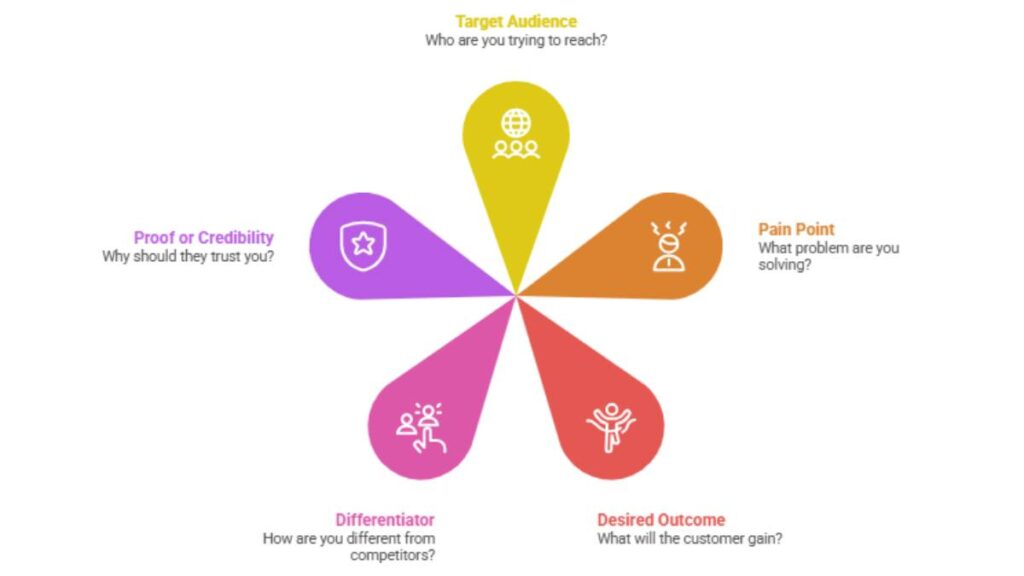
Target audience
Specificity matters.
“Businesses” is too broad.
“Independent ecommerce brands scaling paid ads” is much stronger because it immediately narrows relevance.
The clearer the audience definition, the more personal the messaging feels.
Pain point
People buy solutions to problems.
That problem might be:
- Wasted time
- Low revenue
- High costs
- Complexity
- Risk
- Frustration
- Poor productivity
- Lack of visibility
Good value propositions identify the pain clearly without overexplaining it.
Desired outcome
Outcomes matter more than features.
Customers don’t necessarily want “AI-powered automation.”
They want:
- Faster execution
- Lower costs
- Better decisions
- More growth
- Simpler workflows
- Higher conversions
The transformation should feel concrete.
Differentiator
Why choose you instead of alternatives?
This could be:
- Speed
- Simplicity
- Better support
- Lower cost
- Better results
- Industry specialization
- AI capabilities
- Proprietary systems
Differentiation doesn’t always need to be dramatic. Sometimes even a simpler onboarding experience becomes a major competitive advantage.
Proof or credibility
Claims become stronger when supported by evidence.
That proof can come from:
- Testimonials
- Case studies
- Statistics
- Customer counts
- Reviews
- Industry recognition
- Demonstrated expertise
Trust is increasingly important because consumers have become more skeptical of exaggerated marketing language.
Why Value Propositions Matter More in 2026
The Rise of AI Search and AI Overviews
Search engines are evolving into answer engines.
Instead of simply ranking pages, platforms now summarize information directly for users. AI-generated search experiences pull key positioning statements from websites and synthesize them into quick overviews.
That changes how businesses need to communicate.
Generic messaging creates weak summaries.
Specific messaging creates stronger interpretation.
For example, there’s a huge difference between:
“We help businesses grow digitally.”
…and:
“Reduce customer acquisition costs with SEO content designed for AI search visibility.”
The second statement communicates:
- Audience
- Problem
- Outcome
- Context
- Differentiation
Much easier for both users and AI systems to understand.
Another important shift is semantic relevance.
Brands that clearly explain:
- Use cases
- Outcomes
- Audience types
- Industry context
- Specific benefits
…tend to perform better in AI-driven discovery systems because their messaging contains stronger contextual signals.
Vague copy loses visibility.
Clear positioning gains it.
How Consumers Evaluate Brands Today
Consumer behavior has changed quite a bit over the last few years.
People make decisions faster, but they also research more deeply before committing.
It sounds contradictory, but both are true.
Users quickly eliminate irrelevant options, then spend time comparing the strongest candidates.
This creates a few important realities:
Faster decision-making
Visitors often decide within seconds whether your product feels relevant.
Your value proposition becomes the first filtering mechanism.
If the messaging feels confusing, generic, or overly broad, people leave.
Trust-first buying behavior
Consumers are more skeptical now.
They look for:
- Specificity
- Social proof
- Transparency
- Real outcomes
- Credibility indicators
Overhyped messaging tends to create resistance instead of excitement.
Comparison-heavy searches
Buyers compare multiple solutions simultaneously.
That means differentiation becomes critical.
If your messaging sounds interchangeable with competitors, price often becomes the deciding factor.
And competing primarily on price is rarely sustainable.
Outcome-focused messaging
Customers care less about what products “have” and more about what products “do.”
Features matter, but outcomes drive decisions.
That’s why some of the best value propositions focus almost entirely on transformation.
How to Write a Value Proposition
Step 1: Identify Your Target Audience
One of the biggest messaging mistakes businesses make is trying to appeal to everyone.
Broad messaging feels safe internally, but externally it usually becomes forgettable.
Strong value propositions start with specificity.
You need to know exactly who the message is for before you write anything else.
Not just demographics either.
You need context.
A startup founder and an enterprise marketing executive may both want “growth,” but their problems, priorities, and buying triggers are completely different.
The more precisely you understand the audience, the easier it becomes to communicate value naturally.
Questions to Ask Before Writing
Who is the ideal customer?
Try to define the audience beyond surface-level categories.
Instead of:
“Small businesses”
Think:
“DTC ecommerce founders struggling with rising acquisition costs.”
That immediately creates more useful messaging territory.
Specific audiences create specific language.
What stage are they in?
A beginner customer needs reassurance and simplicity.
An advanced customer usually cares more about efficiency, scalability, or performance gains.
The same product may require different value propositions depending on buyer awareness.
That’s why many successful SaaS companies create separate landing pages for different user segments.
What are they struggling with?
Pain points create urgency.
Sometimes the pain is obvious:
- Losing revenue
- Wasting time
- Low productivity
Sometimes it’s emotional:
- Overwhelm
- Uncertainty
- Frustration
- Fear of falling behind
The best messaging often combines functional and emotional understanding together.
Step 2: Define the Main Problem You Solve
A value proposition becomes weak when it tries to solve too many things at once.
Focus matters.
Your messaging should identify the primary problem customers associate with your product or service.
Not every possible capability.
That clarity helps customers categorize your business faster.
And honestly, buyers usually remember one strong idea better than ten average ones.
Customer Pain Points Examples
Time-saving
“Automate repetitive reporting tasks in minutes.”
Time-saving value propositions work because efficiency is universally valuable.
Especially in overloaded teams.
Revenue growth
“Increase qualified inbound leads through intent-driven SEO content.”
Growth-focused messaging tends to perform well when tied to measurable outcomes.
Specificity strengthens credibility.
Cost reduction
“Reduce customer support costs with AI-powered self-service workflows.”
Financial impact messaging becomes stronger when tied to operational improvement rather than generic savings claims.
Ease of use
“Build landing pages without coding or design experience.”
Simplicity reduces friction.
That’s why ease-of-use positioning remains incredibly effective across software categories.
Productivity
“Centralize tasks, meetings, and documentation in one workspace.”
Productivity messaging works best when it removes fragmentation or cognitive overload.
Risk reduction
“Monitor compliance issues before they become expensive problems.”
Risk-reduction messaging is especially effective in finance, healthcare, cybersecurity, and enterprise services.
Step 3: Explain the Desired Outcome
This is where many businesses accidentally become feature-heavy.
Features explain what the product does.
Outcomes explain why customers care.
And customers almost always prioritize outcomes.
Focus on Transformation, Not Features
People don’t buy project management software because it has dashboards.
They buy because they want:
- Better organization
- Faster collaboration
- Fewer missed deadlines
- Less chaos
The transformation matters more than the functionality itself.
That doesn’t mean features are unimportant. They support the outcome.
But the value proposition should lead with the result.
Before vs after messaging
One useful framework is comparing the customer’s current state with their desired future state.
Before:
- Disorganized workflows
- Manual tasks
- Slow execution
- Confusing processes
After:
- Streamlined operations
- Faster output
- Better visibility
- Reduced stress
Transformation creates emotional momentum.
It helps customers imagine improvement instead of simply evaluating software specifications.
Emotional outcomes
Not every outcome is measurable.
Sometimes customers want:
- Confidence
- Clarity
- Peace of mind
- Control
- Simplicity
Emotional outcomes often influence buying decisions more than businesses realize.
Especially in crowded markets where products feel technically similar.
Business outcomes
In B2B markets particularly, business outcomes become critical.
Examples include:
- Lower acquisition costs
- Higher retention
- Increased productivity
- Faster onboarding
- Better reporting accuracy
- Improved ROI
The clearer the outcome, the stronger the value proposition tends to become.
Step 4: Highlight What Makes You Different
Differentiation is where positioning becomes competitive.
Without it, your messaging risks sounding interchangeable with everyone else in the market.
And honestly, this is where many companies default to clichés.
“Innovative.”
“Cutting-edge.”
“World-class.”
Those words rarely communicate anything meaningful anymore.
Real differentiation is specific.
Unique Value Proposition Framework
Speed
“Launch campaigns in hours instead of weeks.”
Speed-based positioning works well when customers feel operational pressure.
Simplicity
“Manage finances from one dashboard.”
Simple messaging reduces perceived complexity immediately.
Cost advantage
“Enterprise analytics without enterprise pricing.”
Cost positioning works best when paired with quality reassurance.
AI capabilities
“Automatically generate optimized ad variations based on performance trends.”
AI positioning works when tied to practical outcomes rather than hype.
Customer support
“Get strategic onboarding support from real specialists.”
Human support remains a strong differentiator in automation-heavy markets.
Specialization
“SEO software designed specifically for ecommerce brands.”
Niche positioning often outperforms broad positioning because it feels more relevant.
Step 5: Add Proof and Credibility
A value proposition becomes much stronger when customers believe the claims.
That’s where proof matters.
Without credibility signals, even good messaging can feel exaggerated.
Ways to Build Trust in Your Value Proposition
Testimonials
Customer quotes validate outcomes through third-party experience.
Especially when the testimonial includes measurable impact.
Case studies
Detailed success stories create deeper credibility because they demonstrate real implementation and results.
Statistics
Metrics help make benefits tangible.
Examples:
- “Reduce onboarding time by 45%”
- “Trusted by 50,000+ businesses”
Specific numbers usually feel more believable than vague superlatives.
User numbers
Large customer counts create perceived trust and adoption momentum.
Especially in SaaS and consumer products.
Social proof
Reviews, ratings, creator endorsements, and community recognition all reinforce legitimacy.
Industry recognition
Awards, certifications, partnerships, and media mentions can strengthen authority when used naturally.
The key is balance.
Too much proof clutter can overwhelm messaging.
Too little can weaken trust.
The best value propositions combine clarity, differentiation, and credibility in a way that feels immediate and believable.

Enroll Now: Product Marketing Course
Value Proposition Formula Templates
Writing a strong value proposition from scratch can feel surprisingly difficult.
Not because the concept is complicated, but because clarity is hard. Most businesses know their product too well, which makes it easy to overexplain features and under-communicate value.
That’s where frameworks help.
A good value proposition formula gives structure to your thinking. It forces you to simplify the message down to what customers actually care about:
- The problem
- The outcome
- The differentiator
- The reason to believe
Now, formulas are not magic. You still need strong customer understanding behind them. But they’re incredibly useful for sharpening positioning, especially when messaging feels vague or scattered.
Some of the best-performing value propositions today are surprisingly simple.
Simple Value Proposition Formula
“We help [audience] achieve [result] without [pain point].”
This formula works because it strips messaging down to the essentials.
You identify:
- Who the product is for
- What outcome it creates
- What obstacle it removes
That combination is naturally persuasive because customers evaluate solutions through both desire and friction.
For example:
“We help ecommerce brands increase repeat purchases without relying on constant discounting.”
Or:
“We help freelancers manage client projects without complicated software.”
The reason this framework works so well is that it focuses on transformation instead of product features.
It also forces specificity.
A lot of weak messaging happens because companies skip audience clarity entirely. They say things like:
“We help businesses grow.”
But what kind of businesses?
What type of growth?
What problem is being solved?
Specificity creates relevance.
And relevance creates attention.
Another advantage of this formula is adaptability. It works across:
- SaaS
- Agencies
- Ecommerce
- Consulting
- Personal brands
- Coaching
- Service businesses
Simple frameworks tend to scale because customers fundamentally make decisions in similar ways across industries.
Steve Blank Value Proposition Framework
“We help X do Y by doing Z.”
This framework is widely used in startup positioning because it connects outcomes directly to mechanisms.
The structure is straightforward:
- X = target audience
- Y = desired result
- Z = how the result happens
For example:
“We help remote teams collaborate faster by centralizing communication and documentation.”
Or:
“We help creators monetize audiences by simplifying digital product sales.”
The “by doing Z” section matters more than people sometimes realize.
Without it, value propositions can sound too abstract.
Customers want outcomes, yes. But they also want a believable explanation for how those outcomes happen.
That’s especially important in competitive markets where multiple businesses promise similar results.
The mechanism creates differentiation.
Sometimes that differentiation comes from:
- Proprietary systems
- Better workflows
- Faster execution
- Simpler onboarding
- Specialized expertise
- Automation
- Personalization
And honestly, customers don’t always need deep technical detail. They just need enough clarity to understand why your approach is different.
Customer-Centric Value Proposition Template
Problem – Solution – Outcome – Differentiator
This framework works particularly well for homepage messaging, landing pages, and sales positioning because it mirrors how buyers naturally process information.
First:
“What problem do I have?”
Then:
“How does this solve it?”
Then:
“What outcome will I get?”
And finally:
“Why choose this instead of alternatives?”
For example:
“Managing multiple marketing tools slows down campaign execution. Our platform centralizes analytics, reporting, and automation so teams can launch campaigns faster with fewer manual tasks than traditional systems.”
This approach works because it creates logical flow.
The customer immediately understands:
- The pain point
- The proposed solution
- The business benefit
- The competitive edge
Another reason this framework performs well is emotional validation.
When customers see their frustration clearly articulated, they feel understood.
That emotional recognition builds trust surprisingly fast.
One thing worth mentioning though: this framework works best when kept concise.
Some businesses overload every section with too much explanation and the messaging becomes heavy. The goal is clarity, not completeness.
You’re opening a conversation, not writing product documentation.
AI-Era Value Proposition Formula for 2026
Audience + Pain Point + AI Advantage + Measurable Outcome
Modern value propositions increasingly need to communicate operational advantages created through automation, personalization, or intelligent systems.
But there’s a nuance here.
Simply adding “AI-powered” to messaging is not enough anymore.
Customers have become desensitized to generic AI claims because nearly every product now markets itself that way.
The strongest messaging explains:
- What the AI actually improves
- Why that improvement matters
- What measurable outcome customers can expect
For example:
“Help sales teams reduce manual prospecting time with AI-driven lead prioritization that improves conversion efficiency.”
Or:
“Enable ecommerce brands to personalize product recommendations at scale and increase average order value.”
Notice how the AI capability supports a business outcome instead of acting as the headline itself.
That’s important.
Technology alone is rarely the value proposition.
The result created by the technology is the value proposition.
And, buyers increasingly expect:
- Faster execution
- Personalization
- Reduced complexity
- Better decision-making
- Lower operational effort
Value propositions that clearly connect intelligent systems to practical business outcomes tend to resonate much more strongly than vague innovation messaging.
10 Best Value Proposition Examples in 2026
A good value proposition usually feels simple when you read it.
That’s part of what makes writing one so frustrating sometimes. The final version may only be one sentence, but getting to that sentence takes real clarity about the customer, the problem, and the outcome.
The strongest examples don’t try to sound clever. They sound useful.
They make the customer think:
“That’s exactly what I need.”
And in 2026, that instant relevance matters more than ever because customers compare products faster, skim harder, and expect immediate clarity from brands.
What’s interesting is that high-converting value propositions across industries tend to follow similar patterns:
- Clear outcomes
- Specific audiences
- Obvious differentiation
- Simplicity
- Credibility
- Reduced friction
Let’s break down some of the best value proposition examples across different industries and why they work.
AI Marketing Agency Value Proposition Example
Example
“Scale paid ads faster with AI-assisted creative testing and performance optimization.”
Why It Works
This value proposition works because it immediately communicates business impact.
The phrase “scale paid ads faster” focuses on the outcome first, which is important. Most businesses running paid campaigns care about growth efficiency more than the mechanics behind it.
Then the second half introduces differentiation:
“AI-assisted creative testing and performance optimization.”
That adds a modern operational advantage without becoming overly technical.
There’s also a subtle psychological effect happening here. The messaging implies:
- Faster experimentation
- Better optimization
- Reduced manual work
- Improved campaign performance
All without explicitly overexplaining it.
Another reason this works well is specificity. It doesn’t say:
“We help businesses grow.”
It narrows the context to paid advertising performance, which makes the positioning more believable.
Broad claims often weaken trust.
Specific claims strengthen it.
SaaS Value Proposition Example
Example
“Automate repetitive workflows in minutes without writing code.”
Why It Works
This is one of those classic SaaS positioning structures that continues to perform well because it removes friction immediately.
The customer problem is obvious:
Repetitive workflows waste time.
The desired outcome is equally obvious:
Automation.
But the most important part may actually be:
“without writing code.”
That phrase eliminates a major objection instantly.
A lot of users want automation but assume they need technical expertise to implement it. This messaging lowers perceived complexity.
And honestly, reducing perceived effort is one of the most underrated parts of strong positioning.
People don’t just evaluate value anymore. They evaluate difficulty.
The simpler something feels, the more likely users are to explore it further.
This value proposition also avoids unnecessary buzzwords. It doesn’t mention infrastructure, integrations, or digital transformation language.
Just a practical outcome.
That’s usually enough.
Ecommerce Brand Value Proposition Example
Example
“Premium skincare backed by dermatologist-approved ingredients and personalized AI recommendations.”
Why It Works
Modern ecommerce positioning has become heavily trust-driven.
Customers are overwhelmed with choices, especially in categories like skincare, supplements, wellness, and beauty. Generic “high-quality products” messaging doesn’t really move people anymore.
This example works because it combines three powerful conversion triggers:
- Authority
- Personalization
- Product quality
“Dermatologist-approved ingredients” creates immediate credibility.
That phrase reduces uncertainty because it signals expertise and validation.
Then the personalization angle strengthens the customer experience:
“personalized AI recommendations.”
Consumers increasingly expect tailored experiences instead of one-size-fits-all products. Especially in skincare, where buyers want solutions that feel customized to their specific concerns.
What’s also effective here is the balance between emotional and rational appeal.
Emotionally:
People want confidence in what they’re putting on their skin.
Rationally:
They want trusted ingredients and recommendations that feel relevant.
This value proposition addresses both.
Personal Brand Value Proposition Example
Example
“Helping founders turn expertise into high-converting content systems powered by AI.”
Why It Works
Personal brand positioning works best when it clearly defines:
- The audience
- The transformation
- The mechanism
This example does all three cleanly.
The audience:
“Founders.”
The transformation:
“Turn expertise into high-converting content systems.”
The differentiator:
“Powered by AI.”
What makes this effective is that it focuses on business outcomes instead of vague creator language.
A lot of personal brands accidentally position themselves around identity instead of value.
They talk about passion, mindset, or creativity without explaining what practical result customers actually receive.
This example avoids that trap.
It also subtly communicates scalability. The phrase “content systems” implies repeatability and operational structure rather than random content creation.
That distinction matters because founders increasingly care about efficiency, leverage, and sustainable visibility.
B2B Service Value Proposition Example
Example
“Reduce customer acquisition costs with performance-driven SEO content designed for AI search visibility.”
Why It Works
B2B messaging performs best when tied directly to measurable business outcomes.
In this case, the outcome is extremely clear:
“Reduce customer acquisition costs.”
That immediately positions the service around financial efficiency instead of generic marketing support.
The second half adds context and differentiation:
“performance-driven SEO content designed for AI search visibility.”
This works because the messaging aligns with current shifts in how businesses think about discoverability and search behavior.
It also feels more strategic than traditional “content marketing services” positioning.
Another smart element here is specificity.
The phrase “performance-driven” signals accountability and measurable results, while “AI search visibility” reflects evolving market concerns around search traffic and discoverability.
Strong B2B positioning often works because it sounds commercially relevant rather than creatively impressive.
Decision-makers usually care about:
- Cost reduction
- Revenue growth
- Efficiency
- Competitive advantage
- Operational clarity
This value proposition speaks directly to those priorities.
Fitness Brand Value Proposition Example
Example
“Personalized fitness coaching that adapts to your schedule, recovery, and goals in real time.”
Why It Works
Fitness marketing has shifted heavily toward personalization over the last few years.
Generic “get fit fast” messaging feels outdated because consumers now expect flexibility and customization.
This example works because it acknowledges modern lifestyle realities.
People don’t just want fitness plans.
They want plans that fit unpredictable schedules, energy levels, stress, and recovery patterns.
The phrase:
“adapts to your schedule, recovery, and goals”
…makes the coaching feel dynamic instead of rigid.
That’s important because one of the biggest barriers in fitness is sustainability. Customers worry about whether a system will realistically fit their lives.
This messaging reduces that friction.
There’s also a subtle emotional layer underneath it:
The brand feels supportive rather than demanding.
That emotional positioning matters more than many fitness companies realize.
EdTech Value Proposition Example
Example
“Learn job-ready AI and marketing skills through real-world projects and live mentorship.”
Why It Works
Education marketing has become much more outcome-focused.
People are increasingly skeptical of courses that promise vague “knowledge” without practical application.
This example works because it centers employability and execution.
“Job-ready skills” immediately communicates career relevance.
Then the phrase:
“real-world projects and live mentorship”
…adds practical credibility.
It suggests hands-on learning instead of passive video consumption.
That distinction matters because modern learners want:
- Portfolio-building opportunities
- Practical experience
- Guidance
- Accountability
- Career outcomes
The mentorship angle also creates perceived support, which can become a major differentiator in crowded education markets.
A lot of EdTech brands compete on content volume.
But support, implementation, and outcomes often matter more than sheer information access.
FinTech Value Proposition Example
Example
“Manage business finances, invoicing, and forecasting from one AI-powered dashboard.”
Why It Works
Financial workflows are often fragmented and stressful.
Businesses juggle multiple platforms for accounting, invoicing, reporting, forecasting, and budgeting. That operational complexity creates a strong opportunity for consolidation-focused messaging.
This value proposition works because it promises simplification.
The phrase:
“from one dashboard”
…communicates centralization immediately.
That’s a strong efficiency signal.
The messaging also balances breadth and clarity well. It mentions multiple use cases:
- Finances
- Invoicing
- Forecasting
…but still feels concise.
Another reason this works is that financial software buyers often prioritize visibility and control.
This positioning implies both.
It tells users:
“You can manage critical financial workflows from one place.”
Simple idea. Strong value.
Healthcare Startup Value Proposition Example
Example
“Virtual healthcare consultations with faster diagnosis support and personalized treatment tracking.”
Why It Works
Healthcare messaging requires a careful balance between convenience and trust.
Too much emphasis on speed can feel risky.
Too much emphasis on technology can feel impersonal.
This example works because it balances efficiency with patient support.
“Virtual healthcare consultations” establishes accessibility and convenience.
Then:
“faster diagnosis support”
…addresses a major frustration in healthcare experiences: delays.
Finally:
“personalized treatment tracking”
…adds continuity and care management.
The wording feels supportive rather than transactional, which is important in healthcare positioning.
Another subtle strength here is that the value proposition doesn’t overpromise outcomes. It avoids unrealistic medical claims while still communicating meaningful improvement.
That restraint actually increases credibility.
Productivity App Value Proposition Example
Example
“Turn meetings into actionable summaries, tasks, and follow-ups automatically.”
Why It Works
This is a very strong example of pain-point-driven positioning.
Meetings are widely associated with:
- Lost productivity
- Poor documentation
- Missed action items
- Communication gaps
The value proposition directly addresses those frustrations.
What makes it effective is the transformation from passive conversation to structured execution.
“Actionable summaries, tasks, and follow-ups” communicates operational value immediately.
Then the word:
“automatically”
…removes effort.
That combination is powerful because users increasingly value tools that reduce cognitive load and administrative work.
Another reason this messaging works is that it feels tangible.
People can instantly imagine the benefit in their day-to-day workflow.
Strong value propositions often create that immediate mental picture:
“This would make my life easier.”
And honestly, if a customer can visualize the improvement quickly, conversions usually become much easier too.
Real Brand Value Proposition Examples
Studying real brand value proposition examples is useful because it shows how successful companies communicate value without overcomplicating their messaging.
Most major brands aren’t trying to sound impressive.
They’re trying to sound instantly understandable.
And when you look closely, the strongest positioning usually revolves around very clear themes:
- Simplicity
- Empowerment
- Accessibility
- Efficiency
- Creativity
- Growth
- Collaboration
The messaging itself often feels deceptively simple because these companies have already done the hard strategic work underneath.
Let’s break down some of the best-known examples and why they work.
Slack
Slack’s positioning became successful because it reframed workplace communication around speed and simplicity.
Instead of focusing on software infrastructure or enterprise collaboration systems, Slack emphasized smoother communication and reduced workplace friction.
Its messaging consistently centered around ideas like:
- Faster communication
- Organized collaboration
- Reduced email overload
- Better team alignment
That simplicity mattered.
A lot of workplace software historically felt complicated and corporate. Slack positioned itself as approachable and intuitive instead.
Even the product design reinforced the value proposition. The experience matched the messaging.
That alignment is something many businesses overlook. A value proposition becomes much stronger when the actual customer experience supports the promise naturally.
Notion
Notion built an incredibly strong value proposition around flexibility and productivity.
The core appeal wasn’t just note-taking or project management.
It was customization.
Users could build systems that adapted to their workflows instead of forcing rigid structures onto teams.
That’s why Notion resonated across:
- Startups
- Creators
- Students
- Product teams
- Agencies
- Knowledge workers
Its messaging often emphasized ideas like:
- One workspace
- Flexible organization
- Connected workflows
- Custom productivity systems
The brilliance of Notion’s positioning is that it balances structure with creativity.
Many productivity tools focus heavily on operational efficiency. Notion also positioned itself as empowering and adaptable, which gave the product broader emotional appeal.
Shopify
Shopify’s value proposition has always been closely tied to entrepreneurship enablement.
The company didn’t simply market ecommerce software.
It marketed the ability to start and grow an online business.
That distinction is important.
People don’t buy ecommerce platforms because they love backend systems. They buy because they want independence, revenue, flexibility, and business ownership.
Shopify’s messaging consistently focused on reducing barriers to entrepreneurship:
- Easy store setup
- Scalable selling tools
- Multi-channel commerce
- Business growth support
Another reason Shopify’s positioning works so well is accessibility.
The messaging makes ecommerce feel achievable even for non-technical users.
That emotional accessibility became a huge competitive advantage.
Canva
Canva is probably one of the best examples of accessibility-focused positioning in modern software.
Before Canva, professional design often felt intimidating to non-designers.
Canva changed the framing entirely.
Its value proposition centered around:
- Easy design creation
- Drag-and-drop simplicity
- Accessibility for everyone
- Professional-looking outputs without complexity
That “without complexity” part is really the key.
Canva succeeded because it removed intimidation from the design process.
The company didn’t compete directly with advanced professional tools on technical depth. Instead, it expanded the market by making design approachable for millions of everyday users.
That’s a powerful positioning lesson:
Sometimes the strongest differentiator is simplicity.
Not more features.
Just less friction.
HubSpot
HubSpot built its positioning around inbound growth and customer-centric marketing.
At a time when aggressive outbound marketing dominated many industries, HubSpot popularized the idea that businesses could attract customers through helpful content and relationship-building.
Its value proposition evolved over time, but the core themes remained consistent:
- Business growth
- Better customer relationships
- Centralized marketing and sales tools
- Simpler CRM workflows
One reason HubSpot’s messaging works well is that it connects tactical tools to strategic business outcomes.
The company rarely positions itself as “just software.”
Instead, it frames its platform as a growth system.
That broader strategic positioning increases perceived value significantly.
Why Most Value Propositions Fail
Most value propositions fail for the same reason most marketing fails:
They focus on the business instead of the customer.
Not intentionally, of course.
But companies naturally drift toward talking about:
- Features
- Capabilities
- Technology
- Internal terminology
- Company achievements
Meanwhile, customers are trying to answer much simpler questions:
- Will this help me?
- Will this save time?
- Will this make money?
- Will this reduce stress?
- Why should I trust it?
- Why is it better than alternatives?
When messaging doesn’t answer those questions quickly, people lose interest.
And in competitive markets, confusion is expensive.
Businesses focus too much on features instead of outcomes
One of the most common mistakes is feature-first messaging.
Businesses describe what the product does technically instead of explaining why customers should care.
For example:
“Advanced workflow automation platform with integrated analytics capabilities.”
That sounds functional, but it’s emotionally flat.
Compare it to:
“Reduce repetitive work and launch campaigns faster from one dashboard.”
Same category.
Completely different clarity level.
Customers buy outcomes.
Features support those outcomes, but they rarely create emotional momentum on their own.
This becomes especially important in software and service businesses where products can start sounding interchangeable very quickly.
Outcome-focused messaging creates distinction because it connects directly to customer goals.
Generic messaging blends into competitors
A huge amount of modern business messaging sounds almost identical.
“Innovative solutions.”
“Customer-first approach.”
“Next-generation platform.”
“Transforming businesses digitally.”
None of these phrases communicate concrete value anymore because they’re too broad.
Generic messaging weakens positioning because customers can’t immediately understand:
- What makes the business unique
- Who it’s for
- What practical result it creates
And honestly, vague messaging often signals weak strategic clarity internally too.
The strongest brands tend to communicate in highly specific language because they deeply understand their audience and market positioning.
Specificity creates memorability.
Generic language disappears.
Lack of audience clarity weakens positioning
Trying to appeal to everyone usually results in messaging that resonates with nobody deeply.
Strong value propositions require audience focus.
That doesn’t mean excluding growth opportunities. It means prioritizing relevance.
For example:
“Marketing software for businesses”
…is far weaker than:
“Marketing automation software for ecommerce brands scaling paid acquisition.”
Specific audiences create sharper positioning because:
- Pain points become clearer
- Outcomes become more relevant
- Messaging becomes easier to personalize
- Differentiation becomes stronger
Customers want to feel understood.
Broad messaging rarely creates that feeling.
AI-generated search results now reward specificity and trust
Modern search experiences increasingly summarize businesses automatically.
That means vague messaging creates weak interpretation layers.
When positioning lacks specificity, businesses become harder to categorize clearly.
And users increasingly evaluate brands through summarized impressions before even visiting websites.
That shift makes clarity much more important than cleverness.
Strong value propositions now need:
- Specific outcomes
- Clear audience relevance
- Credibility signals
- Distinct differentiation
- Natural language clarity
Brands that communicate value clearly tend to build trust faster because users immediately understand what they do and why it matters.
And honestly, trust is becoming one of the biggest competitive advantages in modern marketing.
The Future of Value Propositions
Value propositions are evolving from static homepage statements into dynamic positioning systems.
That sounds a little abstract, but the shift is real.
Customers now encounter brands across:
- Search summaries
- Recommendation engines
- Social content
- Reviews
- Landing pages
- Short-form video
- Community discussions
- Conversational interfaces
Which means messaging needs to stay consistent, clear, and instantly understandable across multiple touchpoints.
And attention is becoming increasingly compressed.
Businesses have fewer seconds to communicate relevance.
AI Search Is Changing Brand Messaging
Search behavior is shifting from traditional link-clicking toward direct answer consumption.
Users increasingly see summarized business information before visiting actual websites. Platforms extract key positioning signals automatically and present condensed explanations of products and services.
That changes how value propositions function.
Brands can no longer rely on vague top-of-funnel messaging and expect customers to “figure it out later.”
The positioning itself needs to communicate:
- Audience
- Outcome
- Differentiation
- Credibility
Almost instantly.
Google AI Overviews summarize businesses instantly
This creates an interesting challenge.
If your messaging is generic, summarized interpretations become generic too.
For example:
“We provide innovative business solutions.”
That statement gives almost no contextual understanding.
But:
“Help ecommerce brands reduce return rates through personalized post-purchase experiences.”
…creates much clearer categorization.
The more specific the messaging, the easier it becomes for platforms and users to understand the value quickly.
And that clarity compounds across discovery channels.
Clear positioning improves visibility in AI search
Brands that clearly explain:
- What they do
- Who they serve
- What outcomes they create
- How they’re different
…tend to build stronger discoverability because the messaging contains richer contextual meaning.
This doesn’t mean stuffing messaging with keywords or technical language.
Actually, the opposite usually works better.
Natural, customer-focused language often performs strongest because it mirrors how people search, compare, and evaluate products today.
Conversational, customer-focused messaging performs better
Modern buyers respond better to messaging that feels human and outcome-oriented.
Not corporate.
Not overly polished.
Not overloaded with jargon.
Customers increasingly prefer brands that communicate simply and directly.
That doesn’t mean sounding casual for the sake of it.
It means reducing unnecessary friction in communication.
Clear beats complicated.
Almost every time.
Customers Expect Faster Clarity
Customer expectations are evolving quickly.
People now assume businesses should explain value immediately.
If they can’t understand the offer within seconds, they move on.
That sounds harsh, but it’s mostly a reflection of information overload. Consumers evaluate enormous amounts of content every day.
Simple positioning reduces cognitive effort.
And lower cognitive effort usually improves conversion behavior.
Users decide within seconds if a product is relevant
This is why homepage messaging matters so much now.
Users often scan:
- Headlines
- Subheadings
- Product descriptions
- Social proof
- Category positioning
…before deciding whether to continue exploring.
A weak value proposition increases bounce behavior because relevance feels uncertain.
A strong value proposition creates immediate orientation.
Customers know:
- What the product does
- Why it matters
- Whether it’s meant for them
That clarity reduces hesitation.
Strong value propositions reduce friction
Good positioning simplifies decision-making.
It removes confusion, lowers uncertainty and increases perceived relevance.
And honestly, friction reduction is one of the most underrated drivers of conversion performance.
Businesses often focus heavily on acquisition tactics while ignoring messaging clarity. But even strong traffic performs poorly when positioning feels unclear or generic.
The best value propositions make decisions feel easier.
Not more complicated.
Simplicity and measurable outcomes drive conversions
The future of value proposition messaging is probably less about sounding impressive and more about sounding immediately useful.
Customers increasingly respond to:
- Clear outcomes
- Specific benefits
- Simple language
- Practical differentiation
- Credible proof
Not inflated promises.
Not abstract innovation language.
Just clear communication around meaningful results.
And in a market filled with noise, that kind of clarity becomes a serious competitive advantage.
Key Takeaways From These Value Proposition Examples
After looking at dozens of value proposition examples across industries, a few patterns become very obvious.
The businesses that communicate value clearly tend to grow faster, convert better, and build stronger brand recall over time. Not because they necessarily have the best product in the market, but because customers instantly understand why the product matters.
That clarity creates momentum.
And honestly, a lot of modern marketing problems are really positioning problems underneath.
Weak messaging forces businesses to overcompensate everywhere else:
- More ad spend
- More content
- More sales calls
- More explanation
- More friction
Strong value propositions simplify everything downstream.
Focus on transformation, not features
One of the biggest lessons across all high-converting examples is this:
Customers care more about outcomes than capabilities.
They don’t buy automation software because automation sounds exciting.
They buy because they want:
- Less manual work
- Faster execution
- Better efficiency
- Fewer mistakes
- More time
The transformation is what creates emotional relevance.
Features still matter, of course. But they should support the larger story instead of becoming the story itself.
A good test is simple:
If you remove the feature from the sentence, does the customer still understand the outcome?
If yes, the positioning is probably stronger.
Use customer language instead of internal jargon
A lot of companies accidentally write like industry insiders instead of actual customers.
That usually creates messaging filled with:
- Technical terms
- Abstract phrases
- Corporate language
- Overcomplicated explanations
The problem is that customers rarely describe their problems using internal business terminology.
People search and think in practical language.
They say:
“I need more leads.”
“I want faster reporting.”
“I’m overwhelmed.”
“I waste too much time on this.”
“I need something simpler.”
The strongest value propositions sound natural because they mirror customer thinking patterns.
Not because they sound sophisticated.
In fact, overly polished messaging often performs worse because it creates emotional distance.
Clear and conversational usually wins.
Make the value proposition specific and outcome-driven
Specificity builds credibility.
Compare:
“Helping businesses grow online.”
Versus:
“Helping ecommerce brands increase repeat purchases through personalized email flows.”
The second version feels more believable because it’s more precise.
Specificity tells customers:
- Who this is for
- What problem gets solved
- What result to expect
It also makes differentiation easier.
Generic messaging blends into competitors because everyone uses the same vague claims. Specific messaging creates sharper positioning naturally.
And honestly, modern buyers are becoming increasingly skeptical of broad promises.
Concrete outcomes feel safer and more trustworthy.
Highlight what makes your business different
A value proposition without differentiation becomes forgettable very quickly.
If your messaging could describe five competitors equally well, the positioning probably isn’t strong enough yet.
Differentiation doesn’t always need to be dramatic though.
Sometimes the advantage is:
- Simplicity
- Faster onboarding
- Better support
- Specialized expertise
- Lower costs
- Better personalization
- Industry focus
- Speed of execution
The important thing is clarity.
Customers should immediately understand why your solution feels meaningfully different from alternatives.
Not necessarily “better for everyone.”
Just better for the right audience.
That nuance matters.
Continuously test and optimize messaging
Value propositions are not permanent.
Markets change.
Customer expectations shift.
Competitors evolve.
Buyer behavior adapts.
Messaging that worked two years ago may suddenly feel outdated or generic.
That’s why strong brands consistently refine positioning over time.
Sometimes even small wording changes create meaningful conversion improvements.
For example:
- Simplifying language
- Clarifying outcomes
- Reducing jargon
- Adding proof points
- Narrowing audience focus
- Improving specificity
The goal is not to create the “perfect” value proposition once.
The goal is ongoing clarity.
And honestly, the businesses that stay closest to customer language usually maintain the strongest positioning over time.
Final Checklist Before Publishing Your Value Proposition
Writing a value proposition feels deceptively easy until you actually try condensing everything into one clear statement.
Most businesses either:
- Say too much
- Say too little
- Sound too generic
- Focus too heavily on features
- Or forget differentiation entirely
Before publishing your messaging on a homepage, landing page, ad campaign, or product page, it helps to pressure-test the positioning properly.
A strong value proposition should feel obvious to customers almost immediately.
Not confusing.
Not clever.
Not overloaded.
Just clear.
Is the audience clearly defined?
Customers should instantly understand whether the message is relevant to them.
Broad audience definitions weaken clarity.
For example:
“For businesses”
…doesn’t communicate enough.
But:
“For ecommerce brands struggling with rising acquisition costs”
…creates much stronger audience alignment.
Specificity increases relevance because people naturally pay more attention to messaging that feels personally applicable.
Is the pain point obvious?
Strong positioning usually addresses a recognizable frustration, challenge, or goal.
If customers cannot quickly identify:
“What problem does this solve?”
…the messaging becomes weaker.
Pain points don’t always need dramatic wording either.
Sometimes practical friction is enough:
- Too many manual tasks
- Slow workflows
- Poor visibility
- Rising costs
- Complex systems
- Time inefficiency
Clear pain points create urgency.
And urgency creates attention.
Does the message explain the outcome?
Customers evaluate products based on future improvement.
The value proposition should communicate what changes after using the product or service.
That outcome could be:
- Faster growth
- Better organization
- Reduced costs
- Simpler workflows
- Higher productivity
- Better customer retention
- More efficiency
The clearer the transformation, the easier the value becomes to understand.
One useful question here is:
“Can customers visualize the result?”
If yes, the messaging is usually moving in the right direction.
Is the differentiation clear?
A lot of businesses accidentally sound interchangeable because they never explain why their approach is different.
Differentiation is what prevents your positioning from becoming generic.
That difference could come from:
- Technology
- Speed
- Specialization
- Customer support
- Pricing structure
- Simplicity
- Methodology
- Personalization
The key is communicating it naturally instead of forcing buzzwords into the messaging.
Customers don’t necessarily need revolutionary innovation.
They just need a reason to choose you instead of alternatives.
Can the statement be understood in under 10 seconds?
This is one of the simplest but most useful tests.
Modern users scan quickly.
If the value proposition requires too much interpretation, people move on.
Clarity should happen almost instantly.
A good value proposition usually answers:
- What is this?
- Who is it for?
- Why should I care?
…within a few seconds.
Not through complicated explanations. Just through direct communication.
Does it sound credible and believable?
Overpromising weakens trust.
Statements like:
“Guaranteed explosive growth”
“Revolutionary industry-changing innovation”
“Unlimited results instantly”
…often create skepticism instead of excitement.
Specific and realistic claims usually perform better because they feel grounded.
Credibility increases when messaging includes:
- Measurable outcomes
- Clear use cases
- Social proof
- Practical language
- Realistic expectations
Trust matters more than hype.
Especially in crowded markets where customers are constantly evaluating alternatives.
Action Steps to Create a Better Value Proposition
Most businesses don’t need a completely new product to improve conversions.
They often just need clearer messaging.
And the process of improving a value proposition usually starts with listening more carefully to customers instead of brainstorming clever headlines internally.
The strongest positioning rarely comes from creativity alone.
It comes from understanding.
Research customer pain points
Good messaging starts with customer insight.
You need to understand:
- What frustrates customers
- What outcomes they want
- What language they naturally use
- What objections they have
- What alternatives they compare against
One of the best ways to improve positioning is analyzing:
- Customer reviews
- Sales calls
- Support tickets
- Community discussions
- Survey responses
- Testimonials
Patterns start appearing very quickly.
You’ll notice recurring phrases around:
- Frustration
- Goals
- Desired outcomes
- Emotional triggers
That language becomes incredibly valuable because customers often write your best messaging for you without realizing it.
Analyze competitor messaging
Competitor analysis helps identify two things:
- Industry positioning patterns
- Opportunities for differentiation
When every competitor says:
“Fast, innovative solutions”
…there’s probably room for clearer positioning.
The goal is not copying competitors.
It’s understanding where messaging feels repetitive, vague, or overcrowded.
Strong differentiation often comes from saying something more specific instead of louder.
Sometimes even narrowing the audience creates a major positioning advantage.
Identify your strongest differentiator
Most businesses have multiple strengths.
But effective value propositions usually emphasize one primary differentiator clearly.
Trying to communicate ten advantages at once often weakens the message.
The differentiator could be:
- Speed
- Simplicity
- Specialized expertise
- Better support
- Better results
- Lower cost
- Personalization
- Workflow efficiency
- Ease of implementation
What matters is choosing the differentiator customers actually value most.
Not necessarily the one the business internally prefers talking about.
That distinction matters more than people think.
Write multiple versions
The first version of a value proposition is rarely the strongest one.
Good messaging usually comes through iteration.
Try writing:
- Short versions
- Long versions
- Outcome-first versions
- Problem-first versions
- Audience-specific variations
- Emotion-driven versions
- Simplicity-focused versions
Different formats reveal different strengths.
Sometimes one small wording adjustment suddenly makes the positioning much clearer.
And honestly, strong messaging often feels simpler after several revisions, not more complicated.
Test on landing pages and ads
Messaging should be validated against real customer behavior whenever possible.
A value proposition that sounds impressive internally may not resonate externally at all.
Testing helps identify:
- Which outcomes attract attention
- Which headlines improve engagement
- Which wording creates clarity
- Which differentiators actually matter to buyers
Even small changes in:
- Headline structure
- Specificity
- Audience framing
- Proof placement
…can meaningfully impact conversions.
Customer response is ultimately the best positioning feedback.
Optimize based on conversion data
Positioning should evolve alongside customer behavior.
If certain messaging consistently performs better:
- Lean into it
- Clarify it further
- Expand it across channels
And if messaging creates confusion, weak engagement, or low conversion rates, simplify it.
Strong value propositions usually become more focused over time, not broader.
That’s because clarity compounds.
The more precisely a business communicates value, the easier it becomes for customers to understand why the product matters.
Conclusion
A strong value proposition is really about reducing confusion.
That’s the core job.
Customers are overloaded with choices, messaging, ads, recommendations, and competing products every single day. Most businesses don’t lose attention because their offer is bad. They lose attention because the value isn’t communicated clearly enough.
And, clarity has become a competitive advantage.
The brands growing fastest are usually the ones that explain:
- Who they help
- What problem they solve
- What outcome they create
- Why they’re different
…in the simplest possible way.
Not the most clever way or technical way.
Just the clearest way.
Throughout these value proposition examples, one theme keeps repeating:
Specificity builds trust.
Customers respond to messaging that feels:
- Relevant
- Outcome-focused
- Credible
- Easy to understand
That applies whether you’re building:
- A SaaS company
- An ecommerce brand
- A startup
- A personal brand
- An agency
- A consulting business
- A productivity app
- A healthcare platform
The fundamentals stay surprisingly consistent.
Focus on customer outcomes.
Reduce friction.
Communicate value quickly.
Differentiate clearly.
Support claims with credibility.
And maybe most importantly, keep refining the message over time.
Because strong positioning is rarely static.
Markets evolve.
Customer expectations change and Competitors adapt.
The businesses that continue listening carefully to customers usually build the strongest messaging eventually.
And when the value proposition becomes clear, almost every other part of marketing starts working better too.
FAQs:
What is a value proposition?
A value proposition is basically the clearest explanation of why someone should choose a product, service, or brand over everything else available. It tells people what problem gets solved, what outcome they can expect, and why this option feels different. Good ones sound simple. Almost obvious. That’s usually the point. Clarity tends to outperform cleverness now.
What is a good value proposition example?
A strong value proposition example could be: “Automate repetitive workflows in minutes without writing code.” It works because the benefit is immediate and easy to picture. No vague promises. No inflated language. Just a clear outcome tied to a real frustration people already feel. The best examples usually reduce mental effort instead of adding more explanation.
How do you write a value proposition?
Start with the customer, not the product. That’s where most businesses get stuck, honestly. A strong value proposition usually identifies a specific audience, a painful problem, the result customers actually want, and one meaningful differentiator. Then it strips away unnecessary language. If the message sounds too corporate or overly polished, it probably needs simplifying further.
What are the key elements of a value proposition?
Most effective value propositions contain a few consistent elements: audience clarity, customer pain point, desired outcome, differentiation, and some form of credibility. The order can vary a little depending on the industry. But without those pieces, the message often feels incomplete. Customers need to quickly understand who it’s for, what improves, and why they should believe it.
What is the difference between a value proposition and USP?
A USP focuses mainly on uniqueness. It answers the question: “What makes this different?” A value proposition goes wider than that. It explains the customer problem, the outcome, and the reason the solution matters in the first place. Think of the USP as one part of the overall positioning, not the entire message on its own.
What are some unique value proposition examples?
Unique value proposition examples usually feel specific instead of broad. Something like, “Helping ecommerce brands reduce returns through personalized sizing recommendations,” sounds stronger than generic growth messaging. Same with: “Turn meetings into organized action items automatically.” Clear use case. Clear outcome. The specificity is what makes these examples memorable. Otherwise everything starts sounding interchangeable after a while.
What makes a value proposition effective?
Customers move fast now. Really fast. Effective value propositions communicate relevance almost immediately because people compare options constantly and lose patience quickly. Messages that focus on outcomes, simplicity, trust, and specificity tend to perform better. Generic branding language gets ignored more often. Customers want practical value explained clearly without having to decode complicated positioning statements.
How long should a value proposition be?
Short enough to understand quickly, but detailed enough to feel meaningful. That balance matters. Most strong value propositions are one headline supported by a short sentence underneath. Sometimes even shorter. If customers need to reread the statement multiple times, the messaging probably became too complex somewhere during the writing process. Simplicity usually creates stronger first impressions.
Where should a value proposition appear on a website?
The homepage is the obvious starting point because it shapes first impressions almost instantly. But value propositions should also appear on landing pages, product pages, signup flows, ads, and even email campaigns. Consistency matters more than many businesses realize. When messaging changes too much across channels, customers start feeling uncertain about what the business actually offers.
What is a customer value proposition?
A customer value proposition focuses entirely on the value customers receive, not what the company wants to say about itself. That distinction matters more than people think. It explains how a product improves someone’s situation, removes friction, saves time, increases revenue, or creates convenience. Strong customer-focused messaging always centers around outcomes instead of internal business language.
What is a personal value proposition?
A personal value proposition explains the unique value an individual brings professionally. Common for consultants, freelancers, creators, executives, and job seekers. The strongest ones avoid generic skill lists and focus more on results, expertise, and transformation. Something like “Helping SaaS founders simplify onboarding experiences” feels clearer and more believable than broad self-promotional descriptions that say very little.
Can AI help write a value proposition?
AI can help generate ideas or organize messaging directions, sure. But strong value propositions still depend heavily on customer understanding, positioning clarity, and real market insight. Generic automated copy tends to sound polished but emotionally flat. That’s usually the problem. Effective messaging needs specificity, nuance, and natural customer language. Otherwise it starts sounding like everyone else online.
What are common value proposition mistakes?
One of the biggest mistakes is focusing too much on product features instead of customer outcomes. Another is using vague language that could describe almost any competitor. Some businesses also try sounding overly innovative or disruptive without explaining practical value. Customers usually respond better to clarity. Simple messaging often feels more trustworthy than exaggerated marketing claims packed with jargon.
How do startups create a strong value proposition?
Startups usually build strong value propositions by narrowing focus instead of broadening it. That part gets overlooked constantly. The best startup messaging identifies a specific audience, a painful problem, and a clear outcome. Then it communicates the value in straightforward language. Early-stage companies often gain traction faster when the positioning feels sharp, practical, and easy to repeat.
What is a unique value proposition in marketing?
A unique value proposition explains why a business feels meaningfully different in a crowded market. Not just different for the sake of sounding original, though. The difference has to matter to customers. It could be speed, simplicity, specialization, pricing, personalization, or expertise. Strong positioning connects that differentiator directly to a practical customer outcome people actually care about.
How do you test a value proposition?
Testing usually happens through landing pages, ad campaigns, customer interviews, and conversion data. But sometimes the simplest signals matter too. Are customers understanding the offer quickly? Are sales conversations becoming easier? Strong messaging reduces confusion. Weak messaging creates more questions. Small wording adjustments can create surprisingly large differences in engagement once the positioning starts becoming clearer and sharper.
What industries benefit most from strong value propositions?
Almost every industry benefits from strong positioning, but it becomes especially important in crowded markets like SaaS, ecommerce, consulting, agencies, finance, healthcare, and AI businesses. Customers compare options aggressively in those spaces. A clear value proposition helps reduce decision fatigue. It gives people a fast reason to care before competitors pull attention somewhere else entirely.
What is the best value proposition formula?
One commonly used formula is: “We help [audience] achieve [result] without [pain point].” It works because the structure naturally forces clarity. Another popular version is: “We help X do Y by doing Z.” The exact framework matters less than the thinking behind it, honestly. Good value propositions feel customer-centered, specific, outcome-driven, and easy to understand quickly.
How does Google AI Overview affect value propositions?
Search experiences have changed a lot. Businesses are now summarized instantly in many cases, which means unclear positioning becomes a bigger problem than before. Generic messaging often gets lost because it lacks specificity. Clear value propositions help customers understand relevance faster. And when messaging is easy to interpret, brands usually become easier to trust and compare as well.
How often should you update your value proposition?
Probably more often than most businesses do. Markets shift, customer expectations evolve, competitors change positioning, and buyer behavior adapts constantly. A value proposition that worked two years ago can suddenly feel outdated or too generic. Reviewing messaging regularly helps maintain clarity. Usually the strongest brands keep refining positioning gradually instead of rewriting everything all at once.