

Type “best running shoes for flat feet” into Google today and watch what happens. Now you won’t see ten blue links waiting for you to guess which one has the answer. You’ll see a synthesized response pulled from multiple pages. They already know you mean overpronation, arch support, and stability shoes, even though you never typed those words. That’s not keyword matching. That’s meaning matching, and it’s the entire game now.
For years, ranking meant stuffing a page with a target phrase and its exact variants. That approach is actually dead weight in 2026. Search engines and AI answer engines read content the way a person does. Grasping concepts, relationships, and intent is the new way, not by counting how many times “digital marketing course” appears on a page. Semantic keywords are how you write for that reality.
This guide breaks down what semantic keywords actually are and how they differ from the LSI keywords and entities everyone confuses them with. Knowing how to find and use them without turning your content into a keyword-stuffed mess matters. You’ll also see how this applies to real Indian brands and where most marketers get semantic SEO wrong.
Let’s start with the definition. Half the confusion in this space comes from people skipping it.
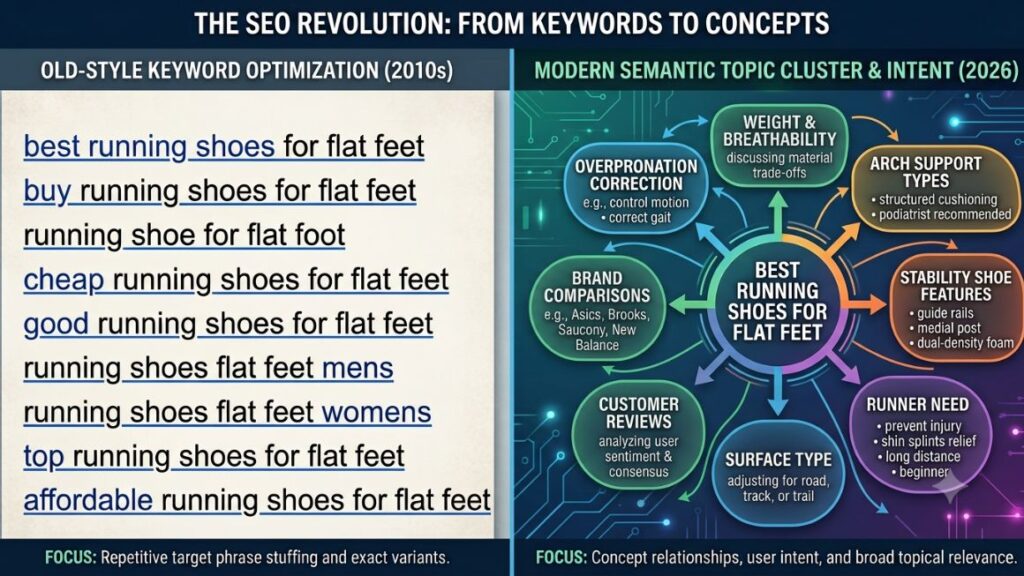
Table of Contents
What Are Semantic Keywords?
Semantic keywords are words and phrases that are conceptually related to a primary topic. These are used by search engines to understand the full context and meaning of content instead of just matching exact phrases.
That’s the whole idea in one sentence. A traditional keyword list gives you “digital marketing course,” “digital marketing course online,” and “best digital marketing course”. But semantic keywords give you the surrounding universe of meaning. These include curriculum, placement assistance, certification, instructor-led, live projects, Google Ads, SEO. You see dozens of related concepts a real learner would care about.
Search engines have stopped rewarding exact match density a long time ago, so the difference matters. A page can look thin to Google’s systems if it mentions “digital marketing course” fifteen times but never touches curriculum, outcomes or certification. This is the reality no matter how perfectly it matches the target phrase. A page that naturally covers the surrounding concepts looks complete, even if the exact phrase appears fewer times.
Think of it this way. A plain keyword list tells you what words to include. A semantic keyword map tells you what the topic actually is. One is a checklist. The other is a mental model of what a knowledgeable person would say if you asked them to explain the subject properly.
Semantic keywords are conceptually related terms. They help search engines understand the full context of a topic instead of matching exact phrases. They shift SEO from keyword density toward topical completeness. That is why modern content briefs are built around clusters of related concepts rather than a single target phrase that is repeated throughout the page.
Read More: Competitor Brand Keyword Bidding in Google Ads
Why Semantic Keywords Matter More Than Ever in 2026
Search stopped being a single product a while back. It’s now a layer of interfaces: Google’s classic results, AI Overviews, ChatGPT, Perplexity, that all draw from the same underlying content but process it differently. Semantic keywords are the thread connecting all of them.
From Hummingbird to AI Overviews – How Google’s Understanding Evolved
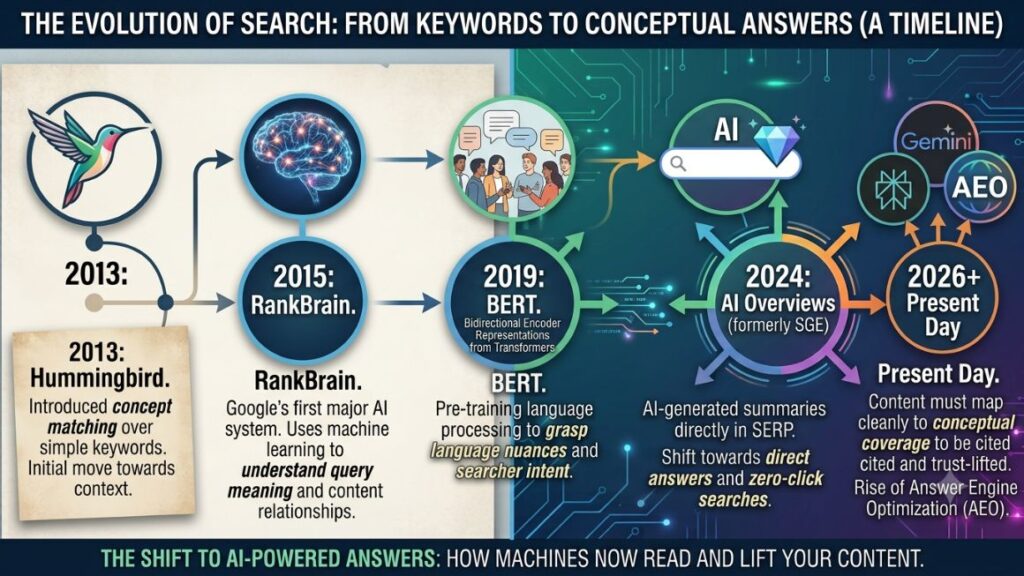
The Hummingbird update of Google in 2013 was the real starting point here. It shifted ranking from matching individual keywords to understanding the intent and contextual meaning behind a full search query. Before Hummingbird, “where can I get a decent slice of pizza near me” was parsed almost word by word. But after it, Google understood this as a local and intent driven query about nearby pizza restaurants.
RankBrain followed in 2015. It applied machine learning to interpret queries Google had never seen before. Then came BERT in 2019. This let Google understand the relationship between words in a sentence. These include prepositions that completely change meaning (“to Brazil from the US” versus “from Brazil to the US”).
AI Overviews are the current chapter of that same story instead of a separate one. They don’t crawl the web differently. They synthesize an answer from pages Google’s existing systems already understand semantically, then cite the ones that provide the clearest, most extractable passages. If your content was never built with concepts and relationships in mind, in the way BERT and RankBrain read them, it’s simply harder to get pulled into that synthesized answer.
What Changes When AI Answer Engines Read Your Content
Here’s the shift that catches a lot of marketers off guard. Google’s classic algorithm ranks pages. ChatGPT, Perplexity, and Gemini generate answers, and they pull from whichever sources give them the cleanest, most complete conceptual coverage of a topic, regardless of that page’s Google ranking position.
According to Similarweb’s 2025 AI search report, zero-click Google searches rose from 56% to 69% within a year of AI Overviews launching in May 2024. That’s not a small shift. It means a growing share of searchers get their answer without ever visiting a website. The sites that do get cited inside that answer are the ones whose content maps cleanly to the underlying concepts of the query.
This is why Answer Engine Optimization (AEO) has now become its own discipline. AEO targets the specific passages AI engines lift and quote directly, featured snippets, AI Overview citations, voice assistant answers. A page can rank on page two organically and still get cited in an AI Overview, because one paragraph on that page answers the implicit question cleanly and completely. Semantic keywords are basically the raw material for that kind of passage. So without them, you’re just writing content that only makes sense to someone who already knows the topic. With them, you’re writing content a machine can lift and trust.
Semantic Keywords vs. LSI Keywords vs. Entities – What’s the Real Difference?
This is where most SEO content gets sloppy. People use “semantic keywords,” “LSI keywords,” and “entities” interchangeably. Honestly, that’s part of why so many marketers feel lost here. They’re related but they’re also not the same thing.
LSI stands for Latent Semantic Indexing. That is a mathematical technique from the 1980s used in information retrieval. It’s not something Google actually uses to rank pages today. The term stuck around in SEO circles because it sounded technical and authoritative. But Google has repeatedly clarified there’s no “LSI keyword” database it consults. What people usually mean by LSI keywords today is really just semantic keywords under an outdated label.
Entities are different again. An entity is a specific and discrete thing, a person, place, brand or concept. Google’s Knowledge Graph can identify and connect these to other entities. “Sundar Pichai” is an entity. “CEO” is not; it’s a semantic concept related to that entity. “Nykaa” is an entity. “beauty e-commerce” is the semantic territory around it.
Comparison of Semantic Keywords vs LSI Keywords vs Entities
| Term | What It Actually Is | Example |
| Semantic keywords | Conceptually related words and phrases that build topical context | curriculum, certification, placement, live projects (for “digital marketing course”) |
| LSI keywords | An outdated 1980s statistical term, mostly a rebrand of semantic keywords in SEO usage | Same as above: wrong technical label |
| Entities | Specific, named things Google’s Knowledge Graph recognizes and links | Nykaa, Sundar Pichai and IIT Bombay |
Here’s the practical takeaway. Stop hunting for “LSI keyword tools.” Focus on two things instead: the semantic concepts that build out your topic, and the named entities, tools, people, brands, that give your content specificity and credibility. Both matter. They’re just not the same lever.
Read More: Types of Keywords in SEO: 10 Types Of Keywords To Skyrocket Your Rankings

How Search Engines Actually Process Semantic Meaning
None of this works by magic. There’s an actual technical process behind how a search engine decides your content is “about” something. Understanding it changes how you write.
NLP, Embeddings and Why Exact-Match Stopped Working
Natural language processing (NLP) is the branch of AI that lets machines interpret human language. This includes grammar, context and intent instead of just matching strings of text. Google’s ranking systems use NLP models to convert words and sentences into embeddings. These are numerical representations that capture meaning, so that “affordable” and “budget-friendly” land close together mathematically even though they share no letters.
This is exactly why exact-match keyword stuffing has stopped working. A page that’s repeating “cheap SEO course” fifteen times isn’t offering more information to an embedding-based system than a page that says it once and then naturally discusses pricing, payment plans, EMI options and value for money. The second page covers more conceptual ground even with fewer repetitions of the literal phrase.
TF-IDF, short for Term Frequency-Inverse Document Frequency, is an older statistical method. It scored how important a word was to a document that is relative to a larger collection of documents. It’s still used as one signal among many in some ranking systems. But it’s a blunt instrument compared to embeddings. TF-IDF can tell you a word appears frequently and isn’t common elsewhere. It can’t tell you whether two differently worded sentences mean the same thing. Embeddings can.
The Knowledge Graph and Entity Resolution
The Knowledge Graph in Google is a database of billions of facts about people, places, and things and how they connect to each other. When you search “Ratan Tata,” the panel that appears with his companies, education and history isn’t all pulled from a single web page. It’s actually assembled from the Knowledge Graph’s understanding of that entity and its relationships.
Entity resolution is the process by which Google figures out that “TCS,” “Tata Consultancy Services,” and “TCS Ltd” all refer to the same entity. That is so even when your content uses different phrasing across a page. This is why named entity clarity matters so much for GEO (Generative Engine Optimization). Does your article mention “the platform” instead of naming Meta Ads Manager specifically? Then you’re not giving Google’s entity resolution system anything to connect. Name your tools, brands and frameworks explicitly every time. That is how you make it trivially easy for the Knowledge Graph to link your content to the right entities.
Google’s ranking systems convert content into embeddings and numerical representations of meaning built through NLP. This happens so that conceptually related phrases are recognized as equivalent even without shared words. This is why modern content needs topical completeness through semantic keywords and named entities rather than exact-match keyword repetition
How to Find Semantic Keywords for Any Topic?
This is the part marketers actually need on a Tuesday afternoon with a content calendar to fill. Here’s how to build a semantic keyword map without expensive tools, though the tools help once you’ve got the fundamentals down.
SERP and “People Also Ask” Analysis
Start by searching your target keyword and reading the top five to ten ranking pages. The goal is not to copy them but to note the concepts that show up across all of them. If every top-ranking page for “email marketing strategy” mentions segmentation, open rates and A/B testing, then that’s your semantic signal. Those concepts are load bearing for the topic.
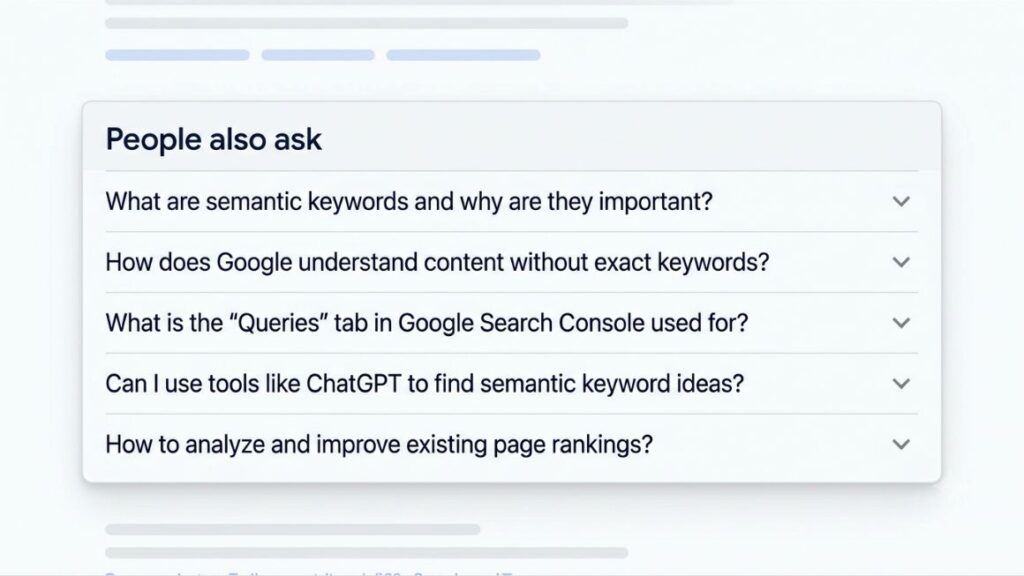
The “People Also Ask” box is underused for this. Every question in it represents a real and common query pattern Google has already validated as related to your topic. So expand three or four of them. You’ll usually surface five to ten semantic angles you hadn’t considered. These are often phrased exactly the way people search, which is gold for your FAQ section later.
Competitor Content Gap Analysis
Pull the top three to five ranking articles for your target keyword and lay their subheadings side by side. Look for concepts that appear in two out of three competitors but not the third. That gap is either an opportunity, cover it and win completeness, or a signal the missing competitor made a deliberate choice you should understand before copying it.
This is also where topical authority gets built. A single article covering semantic keywords well helps that page. A cluster of interlinked articles where each covers a related subtopic in depth is the right move. This signals to Google that your entire site has topical authority on the subject, not just one lucky page.
Using Google Search Console and AI Chat Tools
Google Search Console’s Performance report is a goldmine most marketers check only for rankings. Look at the “Queries” tab for a page that’s already ranking, and you’ll see the actual search terms triggering impressions, many of which you never explicitly targeted. Those are real semantic keywords Google already associates with your content.
AI chat tools deserve a mention here too, somewhat counterintuitively. Asking ChatGPT or Claude to list the subtopics, related questions and adjacent concepts a reader researching your topic wants covered is a fast way to generate a first-draft semantic map. It won’t replace SERP analysis. But it’s a solid starting point before you validate against real search data.
The Best Tools for Semantic Keyword Research in 2026
Manual research gets you far. But purpose-built tools speed up the process significantly. That is especially for content teams producing at volume.
| Tool | Best For | What It Does |
| MarketMuse | MarketMuse | Scores topical completeness against top-ranking competitors and flags content gaps automatically |
| Surfer SEO | Individual article optimization | Generates a real-time content score based on semantic terms found in top-ranking pages for your target keyword |
| Google Cloud Natural Language API | Technical teams and developers | Runs entity extraction and sentiment analysis on any text, useful for auditing whether your content contains the entities Google would expect |
| WordLift | Structured data and entity SEO | Builds knowledge graphs from your own content and connects it to schema markup for better entity recognition |
Surfer SEO and MarketMuse are the two most commonly used inside Indian content teams because they integrate directly into the writing process rather than requiring a separate audit step. Neither replaces editorial judgment. A content score of 90 on Surfer doesn’t mean the writing is good. It means the terms are present. You still need a human editor checking that those terms are used naturally but not crammed in to satisfy a score.
Read More: 30 Keyword Research Tools for Every Use Case in 2026
How to Use Semantic Keywords Without Keyword Stuffing?
Here’s the trap. Marketers learn about semantic keywords, get a list of forty related terms from a tool and then try to cram all of them into one 1,500 word article. That reads exactly as badly as old school keyword stuffing did, just with fancier words.
The fix is placement discipline. Semantic keywords should appear where they’d naturally occur if a knowledgeable person were writing about the topic from memory, not forced into every paragraph.
A few practical rules:
- Let subheadings carry semantic weight naturally. An H2 titled “How to Calculate Customer Acquisition Cost” already contains several related concepts without forcing them into the body copy.
- Cover one semantic cluster per section. Don’t scatter it across the whole article. If a section is about email segmentation, keep segmentation-related terms there instead of sprinkling them randomly throughout.
- Use topic clustering across your site, not just within one article. A pillar page on “content marketing” doesn’t need to cover every semantic angle itself. That is the case if it links out to dedicated articles on content calendars, distribution and repurposing.
- Read the finished draft out loud. If a sentence exists only to fit in a semantic term the tool flagged, cut it or rewrite it. Naturalness beats coverage every time you have to make a choice between them.
Keyword density as a metric matters far less than it used to. But it hasn’t disappeared entirely. Aim for your primary keyword to show up naturally three to five times across a long article and once in a heading. Let the semantic field do the work beyond that.
Read More: Dynamic Keyword Insertion (DKI): The Complete 2026 SEO + Google Ads Guide
A Semantic Keyword Strategy for Indian D2C and SaaS Brands
Indian brands offer a genuinely useful lens here. That is because the market has some specific quirks that pure global SEO advice tends to miss.
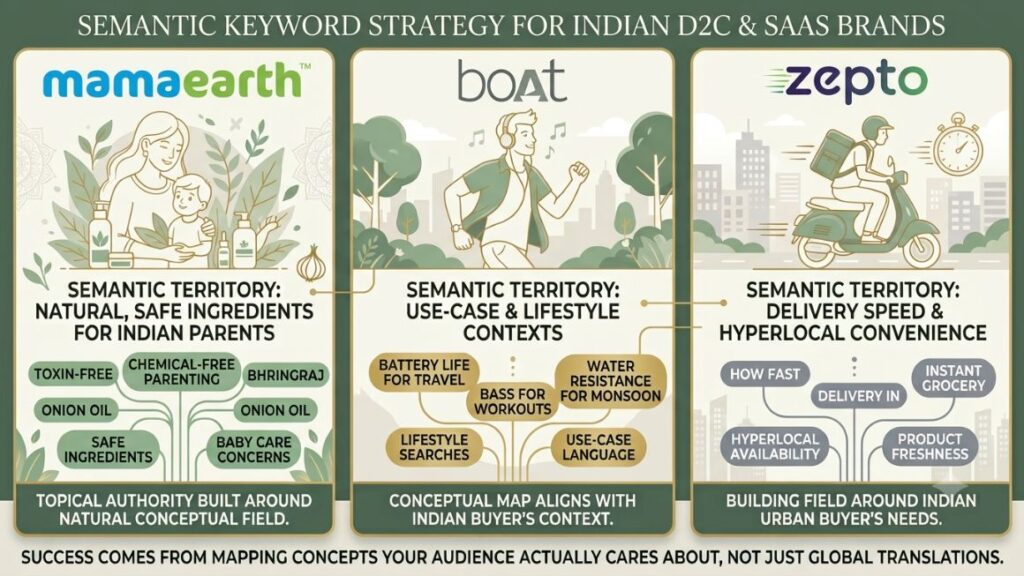
Take Mamaearth. Their content strategy leans heavily on semantic clusters around “toxin-free,” “chemical-free parenting,” and specific ingredient names like bhringraj and onion oil. That’s not accidental. It builds topical authority around a specific conceptual territory (natural, safe ingredients for Indian parents). They don’t just chase “baby care products” as a single keyword. Their blog content maps almost entirely to that semantic field. That likely explains why they show up for a wide range of long-tail queries around ingredient safety and parenting concerns without targeting each one individually.
boAt takes a different semantic approach. It is built around use-case language rather than ingredient language: “battery life for travel,” “bass for workouts,” “water resistance for monsoon.” Those phrases cluster around lifestyle contexts an Indian buyer actually searches in instead of just pure spec sheets. It’s a strong example of how semantic keyword strategy shifts depending on category. A D2C beauty brand and a D2C electronics brand build entirely different conceptual maps, even when both are optimizing for similar-sounding “best products” queries.
Zepto is the SaaS-adjacent example worth studying, since quick commerce content increasingly competes on “how fast,” “delivery in,” and “instant” language clusters, alongside more traditional grocery and convenience terms. From what we’ve seen with YUP learners running SEO for quick commerce and D2C clients, the brands that win long-tail visibility are rarely chasing the most obvious head keyword. They’re building out the semantic field around delivery speed, hyperlocal availability, and product freshness, concepts that matter enormously to an Indian urban buyer but rarely show up in a basic keyword list pulled from a generic tool.
The lesson for any Indian marketer building a semantic strategy: don’t just translate a global keyword list. Map the concepts your specific audience actually cares about, in the language and context they search in, and build content around that field.
Read More: Search Engine Marketing Strategy: A Practical Guide
Common Semantic SEO Mistakes Marketers Make
A few patterns show up repeatedly in content audits, and they’re worth naming directly.
Over-reliance on LSI tools is the first. Plenty of marketers still run a page through an “LSI keyword generator” and then get a list of forty related words. They treat that list as gospel. Some of those tools are just synonym generators with a technical sounding name attached. So cross-check any generated list against actual top-ranking content before trusting it.
Ignoring intent is second, and it’s the more damaging mistake. A page can have perfect semantic coverage for “CRM software” and still fail to rank if it’s written as a comparison piece when Google’s understanding of that query, based on what’s currently ranking, is informational (“what is CRM software and how does it work”). Semantic keywords support intent. They don’t override it. Always check what type of content is actually ranking before building your semantic map.
Third, treating entities as keywords is a subtler error. Some marketers see “Zomato” appearing frequently in top ranking content for a food delivery query and try to insert “Zomato” as a keyword throughout an unrelated article. This hopes it borrows some entity authority. That’s not how entity resolution works. Naming an entity only helps when it’s genuinely relevant to the content. Forcing brand names into irrelevant context can confuse the topical signal instead of strengthening it.
Conclusion
Semantic SEO isn’t a checklist you complete once and forget. Search engines and AI answer engines keep getting better at understanding meaning. This means the bar for “topically complete” content keeps rising too. Mamaearth and boAt are the brands winning long-tail visibility right now. There are also plenty of smaller players nobody’s written case studies about yet. They all got there by mapping what their specific audience actually cares about, not by running a generic keyword list through a tool.
Start small if this feels overwhelming. Pick one existing article and run it through the SERP and PAA analysis in this guide. Then rebuild its semantic map before touching anything else. That single exercise can teach you more about how your audience actually searches than any tool subscription will.
If you want to go deeper into building a full SEO strategy around semantic keywords, topical authority, and AEO, from keyword research through to content briefs your writers can actually use, YUP’s SEO course walks through the entire process with real Indian brand examples like the ones covered here.
Frequently Asked Questions About Semantic Keywords
What are semantic keywords in simple terms?
Semantic keywords are words and phrases related in meaning to your main topic. They are used by search engines to understand context rather than just matching an exact phrase. If your main keyword is “content calendar,” then semantic keywords can include posting schedule, content pillars, editorial workflow and publishing frequency.
Are semantic keywords the same as LSI keywords?
Not technically. LSI (Latent Semantic Indexing) is an outdated 1980s statistical method that Google doesn’t actually use for ranking. The term stuck in SEO circles as an informal label for what’s really just semantic keywords. When someone mentions “LSI keywords” today, they almost always mean semantic keywords.
Semantic keywords vs entities, what’s the difference?
Semantic keywords are concepts and related terms that build context around a topic. Entities are specific and named things Google’s Knowledge Graph can identify, like a person, brand or place. “Certification” is a semantic keyword for a course topic. “Google” is an entity if you’re referencing Google Ads certification specifically.
How do I find semantic keywords for my content?
Analyze the top five to ten ranking pages for your target keyword and note recurring concepts. Then expand the “People Also Ask” box for related questions. Check Google Search Console’s Queries report on similar existing content. Use tools like Surfer SEO or MarketMuse to validate your list against real ranking data.
Do semantic keywords actually help you rank higher?
Yes, but not as a direct ranking factor you can point to in isolation. They help by making your content more topically complete. This correlates strongly with ranking well and, increasingly, with getting cited in AI Overviews and answer engines that reward conceptually thorough passages over keyword-dense ones.
Is keyword density still important if I’m using semantic keywords?
It is somewhat, but far less than it used to be. Aim for your primary keyword to appear naturally three to five times in a long article and once in a heading. Focus on topical completeness through semantic keywords instead of repeating the exact phrase.
Do I really need semantic keyword tools or can I do this manually?
You can build a solid semantic map manually through SERP analysis and Google Search Console data. That is especially for a handful of articles a month. Tools like Surfer SEO or MarketMuse become worth the cost when you’re producing content at volume. They need to standardize the process across multiple writers.
Why isn’t my content ranking even though I covered all the semantic keywords a tool suggested?
The most common reason is intent mismatch. Full semantic coverage doesn’t compensate for the wrong content format, publishing a listicle when Google’s current results for that query are all in-depth guides, for example. Check what’s actually ranking before assuming the semantic map is the problem.
Do semantic keywords matter for local or India-specific SEO?
Yes and arguably more so. Local and India specific searches often use context heavy phrasing. These include monsoon-proof, EMI available and COD option, that a generic global keyword list entirely misses. Building your semantic map around how your specific audience actually searches, not a translated global list, matters more here than in broader international SEO.
How is AEO different from regular semantic SEO?
Semantic SEO focuses on topical completeness to help search engines understand your content. AEO (Answer Engine Optimization) goes a step further. It structures specific passages so AI systems like AI Overviews, ChatGPT and Perplexity can extract and quote them directly as answers. AEO builds on semantic SEO but it doesn’t replace it.