

Most marketers think they need a bigger budget to get better results. They’re wrong.
The brands that grew fastest in the last decade – Dropbox, Dollar Shave Club, Hotmail, Airbnb – didn’t start with big media spends. They started with a single marketing experiment. One idea, one test, one channel. And when it worked, they scaled it.
A marketing experiment is a structured test where you run a specific idea against a measurable goal to find out what actually moves the needle. No guesswork. No “let’s try this and see.” Just a clear hypothesis, a controlled test, and data you can act on.
The good news? You don’t need a rupee of budget to run one. You need a goal, a channel, and two hours.
This guide walks you through everything: why experiments matter more than budgets, what the fastest-growing brands did differently, and exactly how to run your first marketing experiment starting today.
Table of Contents
Why Marketing Experiments Matter More Than Big Budgets
Big budgets amplify what already works. They don’t create the insight. And if you don’t know what works yet – which most early-stage marketers don’t – spending more money just burns it faster.
Experiments create that insight.
The Myth That Marketing Success Requires Money
There’s a common belief that the brands with the best marketing have the most money behind them. Look closer, and that story falls apart.
Hotmail acquired 12 million users in 18 months with no paid acquisition budget. They added a single line of text to the bottom of every email: “Get your free email at Hotmail.” That was the experiment. Mamaearth, one of India’s most recognizable D2C skincare brands, built its early customer base almost entirely through micro-influencers and referral mechanics not performance ad spend.
The pattern isn’t a coincidence. Constrained resources force creative thinking. When you can’t buy your way to growth, you have to find it.
Read More: D2C brand growth strategies
How Small Experiments Create Outsized Results
A single marketing experiment rarely transforms a business on its own. What it does is give you directional information – which channel, which message, which offer resonates with your audience. That directional data compounds fast.
Run one experiment a week for three months, and you’ve got 12 data points on what works. That’s 12 decisions made on evidence instead of intuition. Over time, this is the competitive edge that separates brands that grow from brands that stall.
Think of it this way: every decision you make without testing is a guess. Every decision you make after a test is a bet with better odds.
H3: What the World’s Fastest-Growing Brands Did Differently
Dropbox, Airbnb, and PayPal didn’t run campaigns – they ran experiments. They identified a friction point in their growth, hypothesized a fix, tested it cheaply, and then scaled what stuck.
Dropbox’s famous referral loop – give storage, get storage – started as a test. PayPal’s cash-for-referral mechanic was a test. Airbnb’s Craigslist cross-posting was a test. None of these were guaranteed wins. They were educated guesses that got validated.
That’s the discipline. Not a genius marketing strategy. Systematic testing.
The fastest-growing consumer brands of the last decade – Dropbox, Hotmail, Airbnb, PayPal — built their early growth through cheap, repeatable marketing experiments rather than large ad budgets. Each brand identified a single friction point, created a testable hypothesis, and scaled the mechanic that worked. The pattern holds across industries and markets: experiments compound, budgets don’t.
What Is a Marketing Experiment?
A marketing experiment is a controlled test designed to answer one specific question about your audience, your channel, or your offer. You form a hypothesis, you test it against a measurable outcome, and you learn from the result – whether or not it works.
This isn’t the same as “trying things.” The difference is in structure. Without structure, a failed test just feels like a failure. With structure, a failed test tells you exactly what not to do next – which is just as valuable.
The Basic Formula: Hypothesis, Test, Measure, Learn
Every solid marketing experiment follows the same four-step loop.
Hypothesis: A specific, falsifiable prediction. “If we change the email subject line from a generic announcement to a question, open rates will increase by at least 10%.”
Test: Run the controlled change on a defined audience for a defined period. One variable at a time.
Measure: Track the metric you defined before you started. Not the metrics that happened to look good after.
Learn: Document the result. Was the hypothesis right? What does this tell you about your audience? What do you test next?
The keyword in that loop is “specific.” Vague hypotheses produce vague learnings. “Let’s try posting more on LinkedIn” is not a hypothesis. “Posting LinkedIn content with a hook question in the first line will increase comment rate by 15%” is.
Read More: A/B testing
Why Experiments Reduce Marketing Risk
Every rupee you spend without testing is a risk. You’re betting that the campaign you built, the message you wrote, the channel you chose – all of it – will work. And you’re betting without evidence.
Experiments reduce that risk by making your bets smaller and smarter. Instead of running a full campaign on an untested message, you test the message on a small sample first. If it doesn’t work, you’ve lost two hours of effort, not two lakhs of budget.
For early-career marketers especially, this is the most important habit to build. Companies don’t reward risk – they reward results. And the fastest path to results is a fast feedback loop.
Common Types of Marketing Experiments
Not all experiments look the same. Here are the formats you’ll encounter most:
A/B tests compare two versions of one element – a subject line, a headline, a call-to-action – to see which performs better.
Channel tests compare the same message across two or more channels to find where your audience actually responds.
Offer tests change the incentive or value proposition to see which version drives more action.
Timing tests change when content goes out – day of week, time of day, frequency – to optimize reach and engagement.
Format tests compare content types: carousel vs. single image, long-form vs. short-form, video vs. static copy.
You don’t need to run all of these at once. Start with one. Master the loop, then expand.
Lessons From Marketing Experiments That Generated Millions
The best way to understand what a marketing experiment actually looks like in practice is to study the brands that got it right. These case studies aren’t just inspiring – they’re replicable.
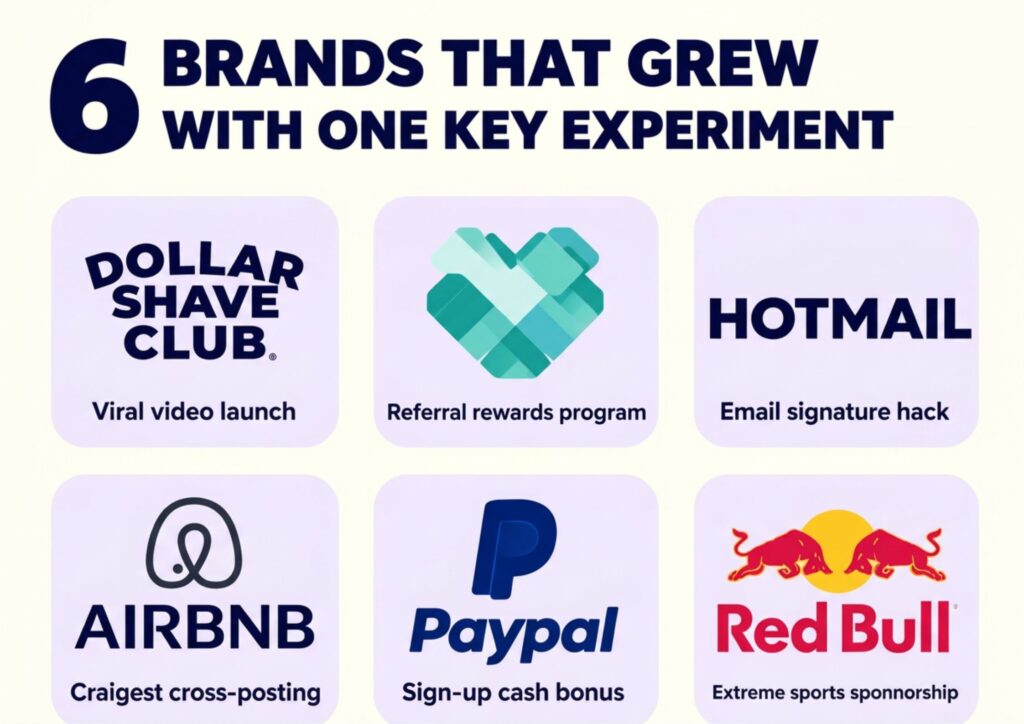
Dollar Shave Club’s Viral Video Strategy
In 2012, Dollar Shave Club had no brand recognition and no paid media budget. The founder, Michael Dubin, made one unscripted YouTube video in a warehouse for about $4,500. The experiment was this: could a direct, funny, irreverent video do the job that expensive TV advertising did for established razor brands?
Within 48 hours of posting, the video had generated 12,000 orders. The site crashed twice. That single video drove $9 million in revenue and ultimately led to a $1 billion acquisition by Unilever.
The learning wasn’t just “video works.” It was that a specific type of video – one with personality, a clear offer, and no corporate polish – could outperform traditional advertising at a fraction of the cost.
The experiment cost $4,500. The outcome was irreplaceable.
Dropbox’s Referral Program Growth Loop
Before Dropbox ran its referral programme, the team tested whether users actually wanted more storage badly enough to share the product with friends. They introduced a double-sided mechanic: refer a friend, and both of you get 500MB extra.
The result was immediate. Dropbox grew from 100,000 users to 4 million in just 15 months – a 3,900% increase in signups. No paid ads. The experiment confirmed that storage scarcity was the lever and that users were willing to do word-of-mouth work in exchange for it.
What makes this a great experiment is that it tested a specific human motivation – the desire for more of a valued resource – not just a marketing channel.
Hotmail’s Signature-Based User Acquisition
This one is almost absurdly simple. Hotmail’s investors suggested adding the line “PS: I love you. Get your free email at Hotmail” (later shortened) to the bottom of every outgoing email. The hypothesis: every email sent by a Hotmail user is also an ad impression for Hotmail.
The experiment worked beyond expectations. Hotmail grew from 500,000 to 12 million users in 18 months without a conventional marketing budget. Microsoft acquired them for $400 million.
The insight? Distribution already existed inside the product. The experiment revealed it.
Obama’s Data-Driven Email Testing
During the 2008 US presidential campaign, Barack Obama’s digital team ran systematic marketing experiments on email variants every single day. 24 writers tested subject lines, donation button copy, and landing page combinations – sometimes running multiple variants simultaneously across millions of recipients.
The winning subject line from all that testing? “Hey.” Not “The time has come.” Not “I will be outspent.” Just “Hey.” Conversational, human, low-effort in appearance – and dramatically more effective than anything polished.
The email programme raised $500 million out of the campaign’s total $690 million in donations. That’s the scale of what disciplined, systematic A/B testing for beginners – or anyone – can produce when it’s taken seriously. None of the individual tests required additional budget. Just time, writers, and a commitment to measuring what worked.
Airbnb’s Marketplace Growth Hack
In Airbnb’s early days, listings weren’t getting enough visibility to drive bookings. The team ran an experiment: what if hosts could cross-post their Airbnb listings to Craigslist, which had a massive existing real estate audience?
They built the integration without Craigslist’s knowledge or support – which was technically complex but required no media spend. Airbnb listings with Craigslist cross-posting got significantly more views and bookings than those without it. The experiment validated that the platform’s biggest problem wasn’t product quality – it was distribution.
They scaled the mechanic until Craigslist shut it down. By then, Airbnb had the data to justify paid distribution.
PayPal’s Referral Incentive Experiment
PayPal’s early growth was built on a deceptively simple experiment: pay people to sign up. They offered $20 to new users and $20 to the person who referred them. The hypothesis was that the cost of acquisition through direct incentive would be lower than traditional advertising, and that paid referrals would attract users who actually transacted.
At peak, PayPal was adding 7 to 10% new users per day through this mechanism. Yes, it was the most expensive experiment on this list – they spent $60 million on cash referral bonuses. But that $60 million built the user base that powered a $300 billion-plus company. Once network effects kicked in, they dialled back the incentive without losing momentum.
The experiment didn’t just drive signups. It revealed that PayPal’s core user was someone who cared about cash rewards, which shaped their product roadmap for years.
Red Bull’s Attention-First Marketing Approach
Red Bull didn’t experiment with advertising. They experimented with stunts. The most famous: they sent Felix Baumgartner to the edge of space – the Red Bull Stratos jump – and live-streamed the freefall. No traditional media buy. Just an idea so extreme it was impossible to ignore.
The Stratos jump earned billions in media coverage. Not millions. Billions. And it was built on the same principle Red Bull had been testing since their earliest local event sponsorships: put the product in environments where the target customer’s adrenaline is already high.
Today, Red Bull runs a $7.5 billion brand with almost no traditional advertising. That entire marketing philosophy – attention first, media spend second – started as a zero-budget experiment at small extreme sports events long before anyone called it content marketing.
Dollar Shave Club’s $4,500 video generated $9M in revenue and a $1 billion Unilever acquisition. Dropbox grew from 100,000 to 4 million users in 15 months with a double-sided referral programme and zero paid ads. Obama’s email team of 24 writers raised $500 million of a $690 million campaign through daily A/B testing. Red Bull’s Stratos jump earned billions in media coverage and anchored a $7.5 billion brand that runs almost no traditional advertising. Every one of these outcomes started with a single hypothesis, not a campaign brief.
How to Run Your First Marketing Experiment With Zero Budget
You don’t need special tools, a testing budget, or a data science team. You need a clear process. Here’s exactly how to run your first marketing experiment in five steps.
Step 1: Identify a Single Growth Goal
Before anything else, you need to know what you’re trying to move. Not “improve our marketing” – that’s not a goal. Pick one number that matters right now.
Examples: email open rate, LinkedIn post engagement rate, website click-through rate from Instagram bio, and new leads from organic content this month.
The more specific the goal, the more focused the experiment. If you’re unclear about your growth goal, that’s the first problem to solve – not the experiment itself.
Step 2: Create a Clear Hypothesis
A good hypothesis has three parts: the change you’re making, the expected outcome, and the metric you’ll use to verify it.
Structure it like this: “If we [do X], then [metric Y] will [increase/decrease] by [amount Z] because [reason].”
For example: “If we add a personal story to the first paragraph of our weekly email newsletter, open-to-click rate will increase by 15% because readers respond better to content that feels human rather than promotional.”
Notice that the “because” matters. It forces you to think about the mechanism behind the change, not just the tactic. That’s what turns a test into a learning.
Step 3: Choose One Channel to Test
Pick the channel where your target audience is most active and where you have enough reach to get meaningful data. You don’t need thousands of data points for a first experiment – but you need enough to spot a pattern.
If you’re running an email test, you need at least 200-300 subscribers for results to be worth analyzing. If you’re testing LinkedIn content formats, you need enough consistent posting history to compare. If you have a very small audience, that’s fine – your experiment will take longer to gather data, but it will still tell you something real.
Don’t test on two channels simultaneously. You won’t know which variable caused the result.
Step 4: Define Success Metrics
This step happens before you launch – not after. If you wait until you see the results to decide what counts as success, you’ll unconsciously pick the metric that makes your idea look good.
Define the primary metric (the one that determines if the experiment worked) and a secondary metric (any positive or negative side effects you want to watch). Write both down before you start.
Primary metric: email open rate. Secondary metric: unsubscribe rate (because aggressive subject line tactics might hurt long-term list health).
That secondary metric is often where the real insight hides.
Step 5: Launch Fast and Gather Data
The biggest mistake most first-time experimenters make is over-preparing. The experiment doesn’t need to be perfect. It needs to run.
Set a clear time window – two weeks is usually enough for content and email experiments, four weeks for slower channels like SEO or community. When the window closes, pull the data, compare against your hypothesis, and document the result.
Even if the experiment fails, write down what you learned. That documentation is your actual competitive advantage. Over time, your library of tested ideas becomes a playbook no competitor can copy because it’s built on your specific audience’s behaviour.
Running a zero-budget marketing experiment requires five steps: identifying one growth goal, writing a specific hypothesis, choosing one channel, defining success metrics before launching, and documenting results regardless of outcome. The structure matters more than the tactics. A well-run experiment that fails produces more value than an unstructured campaign that accidentally succeeds.
Five Zero-Budget Marketing Experiments You Can Start Today
These are practical, low-effort experiments that any marketer can run without spending a single rupee. Each one tests something real and produces data you can act on.
Test Different Content Formats
Take your best-performing blog post or newsletter topic and produce it in two formats: a long-form written version and a short visual carousel. Post both for over two weeks and compare engagement rate, saves, and click-throughs.
This tests whether your audience prefers depth or digestibility — and the answer is almost always more nuanced than you’d expect. Swiggy’s social media team famously tests content formats weekly, which is a big part of why their Instagram engagement rates are consistently above industry averages for the food delivery space.
Experiment With Email Subject Lines
Split your email list into two halves and send the same content with different subject lines. Version A uses a factual, descriptive subject line. Version B uses a curiosity-driven or question-based one.
This is one of the fastest feedback loops available to any marketer. You’ll get data within 24 hours of sending. Run this five times across five campaigns, and you’ll have a clear picture of which subject line style your specific list responds to.
One important note: don’t conclude from one test. The signal only becomes reliable after three or more consistent results in the same direction.
Create a Referral Incentive
Design a simple referral mechanism for your existing audience. It doesn’t have to be cash. For early-stage brands and marketing teams, a content upgrade works well: “Refer a colleague to this newsletter and get our 30-day content calendar template.”
Test whether the incentive moves the needle on new signups or forwards. This directly replicates what Dropbox and PayPal tested at scale, but at a size you can manage manually. The learning – whether your audience is willing to advocate for you in exchange for something – is worth knowing before you invest in building formal referral infrastructure.
Read More: referral marketing
Repurpose Existing Content Across Channels
Take your three highest-performing pieces of content – measured by whichever metric matters most to you – and repurpose each one for a channel you haven’t been active on. A blog post becomes a LinkedIn thread. A LinkedIn thread becomes an email. An email becomes a carousel.
Track which repurposed version performs best relative to the original, and on which channel. This experiment often reveals that content that works on one platform has untapped potential on another, with zero additional content investment.
This is a classic content repurposing strategy that Indian creator brands like Zepto and boAt have used to maintain high content output without proportional team growth.
Optimize Calls-to-Action
Take one piece of content – an email, a landing page, a social post – and rewrite only the call-to-action. Version A is your current CTA. Version B changes either the action word, the specificity, or the placement.
For example: “Download the guide” vs. “Get the free 10-step guide” vs. “I want the free guide.” Three CTAs, same content, same channel. Track click-through rate for each.
CTA testing is one of the highest-leverage experiments available because the copy change is minimal, but the impact on conversion can be significant. According to data published by HubSpot in 2023, personalized CTAs convert 202% better than generic ones. Testing your own version costs nothing but time.
Common Mistakes That Kill Marketing Experiments
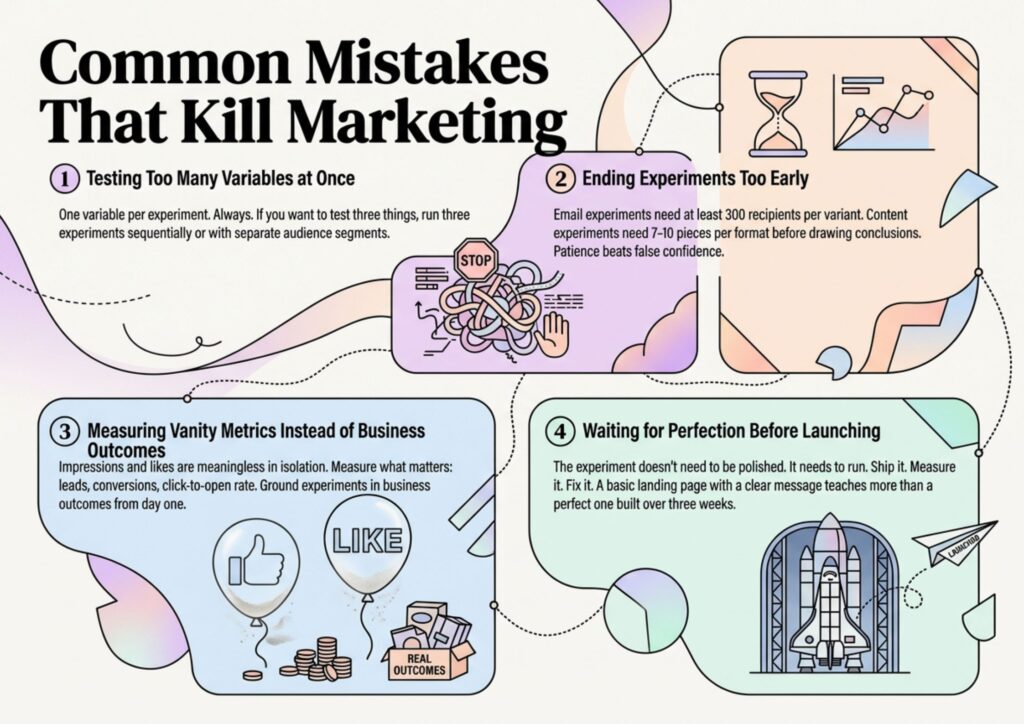
Running an experiment badly is almost worse than not running one at all. Bad experiments produce false confidence – you think you learned something, but the data is actually misleading.
Testing Too Many Variables at Once
This is the most common mistake. You change the subject line AND the send time AND the email design in the same test – and then you wonder why open rates went up. You don’t know which change caused the lift. You can’t scale it. You can’t replicate it.
One variable per experiment. Always. If you want to test three things, run three experiments sequentially or with separate audience segments.
Ending Experiments Too Early
You post twice on LinkedIn with a new content format, get low engagement, and conclude that the format doesn’t work. But maybe the first two posts just weren’t compelling. Maybe your audience needs time to adjust to a new style. Maybe the timing was off.
Statistical significance requires a minimum sample size that most marketers don’t wait for. A rule of thumb: email experiments need at least 300 recipients per variant and a full send cycle. Content experiments need at least seven to ten pieces of content per format before you draw any conclusions.
Patience isn’t exciting. But calling an experiment early is one of the most common ways marketers build a false understanding of their audience.
Measuring Vanity Metrics Instead of Business Outcomes
Impressions, followers, and likes are easy to measure and meaningless in isolation. A post with 10,000 impressions that generates zero clicks or enquiries tells you nothing useful about your marketing.
The right metric depends on your growth goal. If you’re trying to generate leads, measure leads. If you’re trying to convert free users to paid, measure conversions. If you’re testing email engagement, measure click-to-open rate, not just opens.
This is where the growth hacking examples from Dropbox and PayPal are instructive: they measured signups and referral conversion, not brand awareness metrics. Their experiments were grounded in business outcomes from day one.
Waiting for Perfection Before Launching
The experiment doesn’t need to be polished. It needs to run.
Marketers who wait until every element is perfect before testing aren’t running experiments – they’re running campaigns. The whole point of an experiment is to learn from something imperfect. A landing page with a single clear message and a basic design will tell you more about your audience than a beautifully designed page you spent three weeks building.
Ship it. Measure it. Fix it.

Enroll Now: AI-Powered Performance Marketing Course
How to Measure the Success of a Marketing Experiment
Measurement is where most experiments break down. Not because the tools are complicated – most aren’t – but because marketers don’t set up the measurement framework before they start.
Metrics That Actually Matter
The right metric is the one that connects most directly to your growth goal. Here’s a quick map:
Goal: grow email list → Track new subscribers per week, cost per subscriber (even if the “cost” is just time).
Goal: improve content engagement → Track engagement rate (comments + shares + saves divided by reach), not likes alone.
Goal: drive traffic to a specific page → Track clicks from the source you’re testing, not total site traffic.
Goal: convert leads to customers → Track conversion rate from the specific experiment audience, not overall conversion rate.
Whatever you choose, define it as a ratio or rate, not a raw number. Raw numbers don’t account for audience size, and they make it easy to confuse growth in audience with growth in performance.
Tracking Results Without Paid Tools
You don’t need any paid analytics tools to run meaningful experiments. Here’s what’s available for free:
Google Analytics 4 tracks website traffic, source attribution, and conversion events at no cost. Mailchimp’s free plan (up to 500 contacts) shows open rates, click rates, and unsubscribes per campaign. LinkedIn and Instagram analytics are built into every account and show post-level performance data. Google Sheets is all you need to log, compare, and trend your results over time.
Build a simple experiment log in Google Sheets: date, hypothesis, channel, variable changed, primary metric before, primary metric after, result (win/loss/inconclusive), and key learning. That’s your entire measurement system. No subscription required.
Turning Insights Into Your Next Experiment
Every experiment – win or loss – should produce the next question. That’s how you build a testing culture rather than a testing habit.
If your experiment worked: why did it work? Is the insight generalizable to other content, channels, or offers? What would happen if you applied the same principle at a higher volume?
If your experiment failed, what assumption turned out to be wrong? Was it the channel, the message, the timing, or the offer? What’s the minimum change you’d need to make to test the same hypothesis again under different conditions?
The best marketers don’t just run experiments. They run experiments in a sequence, where each one builds on the last. That compound learning is what separates marketers with three years of experience from marketers with one year of experience repeated three times.
Measuring a marketing experiment doesn’t require paid tools. Google Analytics 4, Mailchimp’s free plan, and native social analytics on LinkedIn and Instagram are sufficient for most zero-budget experiments. The critical discipline is setting success metrics before launch, not after, and tracking ratios (engagement rate, conversion rate) rather than raw numbers that can be distorted by audience size.
Conclusion:
The biggest takeaway from every brand story in this article is not the tactic. It’s the behaviour.
Dropbox ran a test. Hotmail ran a test. Obama’s team ran hundreds of tests. Red Bull sent a man to the edge of space as a test. None of them knew what would work before they started. Every brand on that list started with a hypothesis, not a guarantee. And that willingness to act without certainty is exactly what made the difference.
Start Small, Learn Fast, Scale What Works
You don’t need a complex programme to start. You need one hypothesis, one channel, and two weeks. Write down what you’re testing and why. Track one metric. Document the result.
Then do it again.
That loop – hypothesis, test, measure, learn – is the most valuable marketing skill you can build right now. It doesn’t require seniority. It doesn’t require a budget. It requires discipline and a willingness to be wrong in small ways so you can be right in bigger ones.
Why Action Beats Planning Every Time
Marketers who plan experiments without running them are just procrastinating with extra steps. The only thing a perfectly planned experiment produces is a delay. The imperfect experiment that runs produces data.
Pick the smallest version of the test you can start this week. Not next month. Not after the next campaign cycle. This week.
Your first marketing experiment won’t be your best one. But it’ll be more valuable than anything you planned but never launched.
Frequently Asked Questions
What is a marketing experiment?
A marketing experiment is a structured test where you change one variable in your marketing, measure the impact on a specific metric, and use the result to make better decisions. It follows a four-step loop: form a hypothesis, run the test, measure the outcome, and document the learning. The goal is to replace guesswork with evidence.
Can I run marketing experiments without a budget?
Yes. Most of the most impactful experiments in marketing history cost little to nothing. Email subject line tests, content format tests, referral mechanics, CTA copy variations, and channel repurposing all require time, not money. You need access to a channel, a small audience, and a clear metric to track. That’s it.
How long should a marketing experiment run?
It depends on the channel and the volume of data you can collect. For email experiments, run the test across at least one full send cycle and a minimum of 300 recipients per variant. For content experiments on social media, run at least seven to ten pieces of content in each format before drawing conclusions. For website tests, wait until you’ve collected at least 100 conversions per variant. Ending early is one of the most common reasons experiments produce misleading results.
What are the best channels for beginner marketers to test?
Email is the best starting point for beginners because the feedback loop is fast (24 to 48 hours), the data is clean (open rate, click rate, unsubscribes), and you don’t need a large audience to see patterns. LinkedIn is a close second – posting frequency and format experiments produce clear engagement data within days. Both channels are free and give you native analytics without additional tools.
How do I know if an experiment was successful?
An experiment is successful if it gives you a clear, actionable answer to the question you were testing – even if that answer is “this approach doesn’t work.” Set your success threshold before you launch. If you defined success as a 10% lift in open rate and you got 12%, that’s a win. If you got 4%, that’s a loss – but it’s still a learning. An inconclusive result (where the difference between variants is too small to act on) usually means you need a larger sample size or a more significant change to test.
What should I do if my first experiment fails?
Document it. Write down the hypothesis, the result, and your best explanation for why it didn’t work. Then identify the smallest change to the hypothesis that would make the test worth running again. Most experiments don’t fail because the idea is wrong – they fail because one assumption in the hypothesis was off. Treat a failed experiment as a question answered, not a dead end.
How many marketing experiments should I run at once?
One at a time if you’re just starting out. Two is manageable if they’re on completely separate channels with separate metrics. More than two and you’ll lose the discipline – you’ll either forget to document properly, conflate results across experiments, or spread your attention thin enough that none of them are well-executed. Speed in experimentation comes from running sequential experiments quickly, not from running many simultaneously.