
Most organisations don’t fail because they lack a vision. They fail because their projects don’t connect to it.
You’ve seen it happen. A leadership team spends weeks crafting a three-year growth strategy. Everyone nods in the boardroom. Then the work gets handed down, broken into projects, distributed across teams, and somehow, six months later, the projects are running, but the strategy isn’t moving. The work is happening. The vision isn’t getting closer.
That gap has a name: poor strategic project management. And it’s more common than most people admit.
Strategic project management is what closes that gap. It’s not just about delivering projects on time and on budget. It’s about making sure every project you run is actively pushing your organisation toward its larger goals. This article breaks down what it means in practice, who’s responsible for it, and how to actually put it to work in your organisation.
Table of Contents
What is Strategic Project Management?
Strategic project management is the practice of selecting, planning, and executing projects in a way that directly supports an organisation’s overall strategy and long-term goals.
The standard definition of project management focuses on delivering a specific outcome within constraints like time, cost, and scope. Strategic project management goes a layer deeper. It asks: why does this project exist, and how does completing it bring us closer to where we want to be as an organisation?
Think of it this way. Traditional project management asks, “Are we building this right?” Strategic project management also asks, “Are we building the right thing?”
It’s a discipline that sits at the intersection of strategy and operations. And the reason it matters is simple: organisations that don’t practise it tend to end up with teams that are busy but not productive, projects that are completed but not impactful, and strategies that look great on paper but never quite materialise.
According to the Project Management Institute’s 2023 Pulse of the Profession report, organisations with mature project management practices waste 28 times less money than those with poor ones. That’s not just because they’re more efficient. It’s because they’re working on the right things.
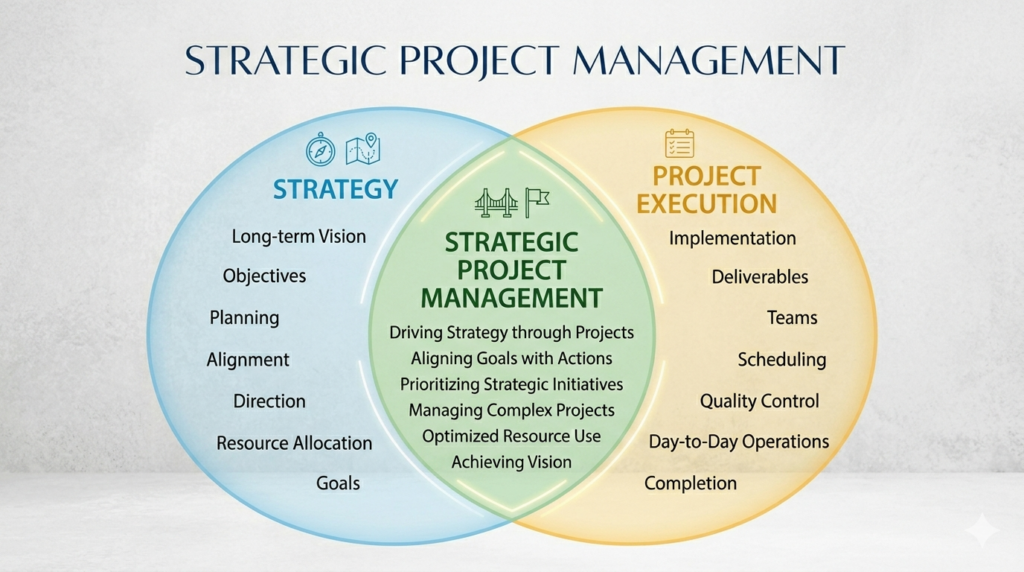
Strategic project management is the practice of aligning project selection and execution with an organisation’s long-term goals. Rather than simply tracking deliverables, it ensures that every project contributes measurable value to the organisation’s broader strategy. According to PMI’s 2023 Pulse of the Profession, organisations with mature project management practices waste 28 times less money than those without.
What is the Role of Strategic Management in a Project?
Strategic management in a project does three things that standard project oversight doesn’t.
First, it provides the “why.” Every project needs a reason to exist that’s tied to a larger purpose. Strategic management ensures that reason is explicit, documented, and regularly revisited. When scope creep hits or priorities shift, the team can come back to the “why” and make decisions grounded in organisational intent rather than just immediate pressure.
Second, it shapes prioritisation. When you have more project ideas than resources (which is almost always the case), strategic management gives you a structured way to decide what to take on and what to park. Projects get evaluated against strategic criteria, not just on whether they’re feasible.
Third, it creates accountability at the right level. Project teams are accountable for delivery. Strategic management holds leadership accountable for direction. Without that upper layer, projects can be perfectly executed while still missing the point.
In practice, this means strategic management touches a project at three points. Before it starts, it determines whether the project should exist. During execution, it monitors whether the project is still aligned with evolving organisational priorities. And after completion, it evaluates whether the project actually delivered the strategic value it promised.
Benefits of Strategic Project Management
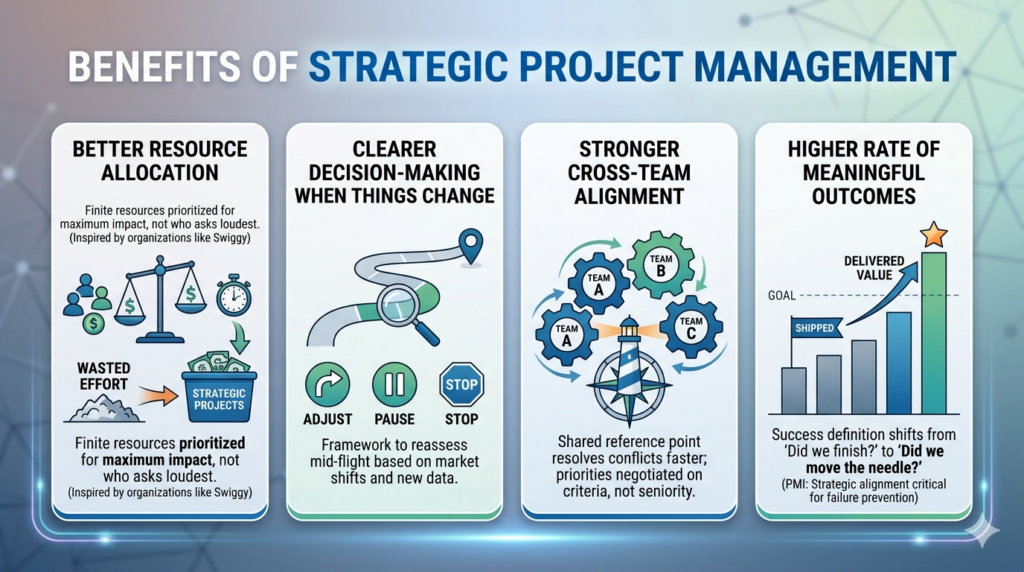
Here’s where most organisations underestimate what they’re missing. Strategic project management isn’t just a management philosophy. It has real, measurable consequences for how an organisation performs.
Better Resource Allocation
Resources, whether that’s people, money, or time, are always finite. Strategic project management ensures those resources flow toward the projects that matter most. Without it, resources tend to get distributed based on who asks loudest or whose project started first, not based on strategic value.
A company like Swiggy, which has had to make hard calls about where to invest as it expanded from food delivery into quick commerce and dining out, doesn’t have the luxury of running every initiative that sounds good. Strategic project management is what helps organisations like theirs decide which bets to place.
Clearer Decision-Making When Things Change
Things change. Markets shift. A competitor launches something new. A regulation comes into force. Strategic project management gives organisations a framework to reassess projects mid-flight and make clear decisions: adjust, pause, or stop. Without that framework, most teams default to continuing regardless of whether the original rationale still holds.
Stronger Cross-Team Alignment
One of the most underrated benefits. When projects are connected to a shared strategic direction, different teams can see how their work fits together. Conflicts get resolved faster because there’s a shared reference point. Priorities get negotiated with actual criteria, not just seniority.
Higher Rate of Meaningful Outcomes
Completing a project isn’t the same as delivering value. Strategic project management shifts the success definition from “did we ship?” to “did we move the needle?” That shift changes how teams plan, measure, and report. According to PMI, only 35% of projects are considered successful by all measures, and strategic misalignment is one of the top reasons for failure.
Strategic project management improves resource allocation, cross-team alignment, and the rate of meaningful outcomes. According to PMI, only 35% of projects meet all success criteria, with strategic misalignment being among the most common causes of failure. Connecting projects to organisational strategy before they begin is the most direct way to change that number.
Strategic Project Management Roles and Responsibilities
Getting this right depends a lot on having the right people doing the right things. Let’s be clear about who’s involved and what each person is responsible for.
Project Management Office (PMO)
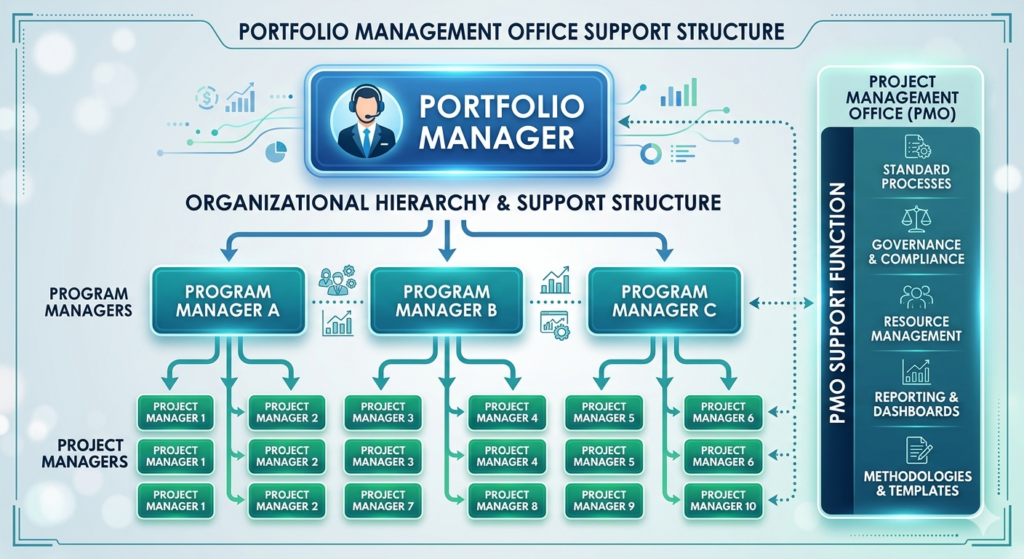
The Project Management Office, or PMO, is the function within an organisation that sets the standards for how projects are run. It doesn’t typically manage individual projects itself. Instead, it creates the governance frameworks, templates, tools, and processes that everyone else uses.
A PMO in a strategically mature organisation does more than enforce process. It maintains visibility across all active projects, tracks how well the project portfolio aligns with strategic goals, and flags when something looks off. Think of it as the control tower.
Not every organisation needs a formal PMO, but once you’re running more than a handful of simultaneous projects, some version of that centralised oversight function becomes necessary.
Project Manager
The project manager is accountable for executing a single project. Their job is to take a defined scope, build a plan, assemble a team, manage risks, and deliver the outcome on time and on budget.
In a strategic project management environment, the project manager’s role extends slightly beyond pure execution. They need to understand the strategic context their project sits in, communicate it to their team, and surface early when the project’s direction starts to drift from its original purpose.
The best project managers aren’t just great organisers. They’re the people who can translate “this sprint deliverable” into “here’s why this matters to what the business is trying to do.”
Program Manager
A program manager oversees a group of related projects that together deliver a larger strategic outcome. Where a project manager is focused on a single initiative, a program manager is thinking about the whole.
For example, if an e-commerce brand like Nykaa is running a program to improve its post-purchase experience, that program might include separate projects for delivery tracking, returns management, loyalty communications, and customer service tooling. Each project has a project manager. The program manager makes sure all those pieces connect and move toward the shared goal.
Portfolio Manager
The portfolio manager sits at the highest level. They oversee the entire portfolio of projects and programs an organisation is running and make sure the distribution reflects strategic priorities.
Portfolio management is where strategy and execution truly meet. The portfolio manager is asking: given our strategic goals, are we investing our project capacity in the right places? Which initiatives should we accelerate? Which should we deprioritise? What are we not doing that we should be?
This role requires both a bird’s-eye view of the organisation’s direction and enough operational understanding to know what’s actually possible.
What’s the Difference Between Strategic Project Management and Traditional Project Management?
The short answer: scope and intent.
Traditional project management is focused on delivering a defined output. Given a specific set of requirements, a deadline, and a budget, a project manager’s job is to make it happen. Success is measured by whether the output was delivered as specified.
Strategic project management adds a layer above and below that. Above, it asks whether the project should exist and how it connects to organisational goals. Below, it looks at outcomes beyond the immediate output, whether the project actually created the value it was supposed to create.
Here’s a simple way to see the difference:
| Traditional Project Management | Strategic Project Management | |
| Focus | Deliver the output | Deliver the right output |
| Success metric | On time, on budget, on scope | Strategic value realised |
| Starts with | A project brief | An organisational goal |
| Ends with | Project closure report | Value assessment |
| Governance level | Project manager | PMO + Portfolio manager |
To be fair, traditional project management isn’t wrong. It’s just incomplete on its own. You need people who can execute a plan with discipline. But discipline without direction is just efficient busyness.
The reason this distinction matters for organisations today is that projects are increasingly the primary vehicle through which strategy gets executed. If your project management practice isn’t strategic, your strategy doesn’t have a reliable delivery mechanism.
Traditional project management focuses on delivering a defined output within time, cost, and scope constraints. Strategic project management expands this to ask whether the right projects are being run and whether they’re producing strategic value. The key difference is that strategic project management begins with organisational goals, not project briefs, and measures success in terms of value realised, not just delivery.
The Components That Drive Strategic Project Management
Three components make strategic project management work. Miss any one of them and the whole thing starts to fall apart.
1. Strategic Choice
Strategic choice is the decision about which projects to pursue. It sounds obvious, but most organisations don’t actually do it well.
Choosing strategically means evaluating potential projects against criteria tied to organisational goals, not just feasibility. A project might be entirely buildable but add little strategic value. Another might be harder to execute, but critical to where the organisation needs to go. Strategic choice makes that distinction explicit.
This is also where prioritisation frameworks come in. Tools like a scoring matrix, a strategic alignment map, or even a simple weighted criteria list help leadership teams make consistent decisions about what to pursue rather than relying on gut or politics.
One important point: strategic choice also means having the discipline to say no. Organisations that try to run everything end up excelling at nothing.
2. Strategic Analysis and Planning
Once you’ve chosen a project, strategic analysis ensures you understand the environment it’s operating in. This includes understanding the competitive landscape, internal capabilities, external risks, and dependencies with other initiatives.
Strategic planning then translates that analysis into a roadmap with specific milestones tied to strategic outcomes, not just delivery phases. A strategic project plan doesn’t just say “launch by Q3.” It says “launch by Q3 in order to capture first-mover positioning in the tier-2 market, aligned with our expansion goal for FY26.”
That additional context shapes how the team makes decisions throughout the project. When they face a trade-off between adding a feature or meeting the deadline, they know which one matters more given the strategic purpose.
3. Strategic Implementation
The third component is where most of the hard work happens. Strategic implementation is the actual execution of the project within the strategic context set by the first two components.
It involves keeping the team aligned on the “why” as the work progresses, actively managing stakeholders who have different views of success, and building in regular check-ins to assess whether the project is still on the right strategic track.
It also means being willing to adjust. Not every project runs exactly as planned. Strategic implementation requires the maturity to distinguish between “we need to solve this problem” and “this problem is telling us the plan needs to change.” This becomes especially relevant when looking across different industries, where execution still depends on the same underlying discipline. The same principles also apply to engineering project management, where strategic direction needs to remain clear throughout execution.
Implementing Strategic Project Management in Your Organisation
Knowing what strategic project management is and actually putting it in place are two different problems. Here’s how to approach the implementation in a way that’s realistic and sustainable.
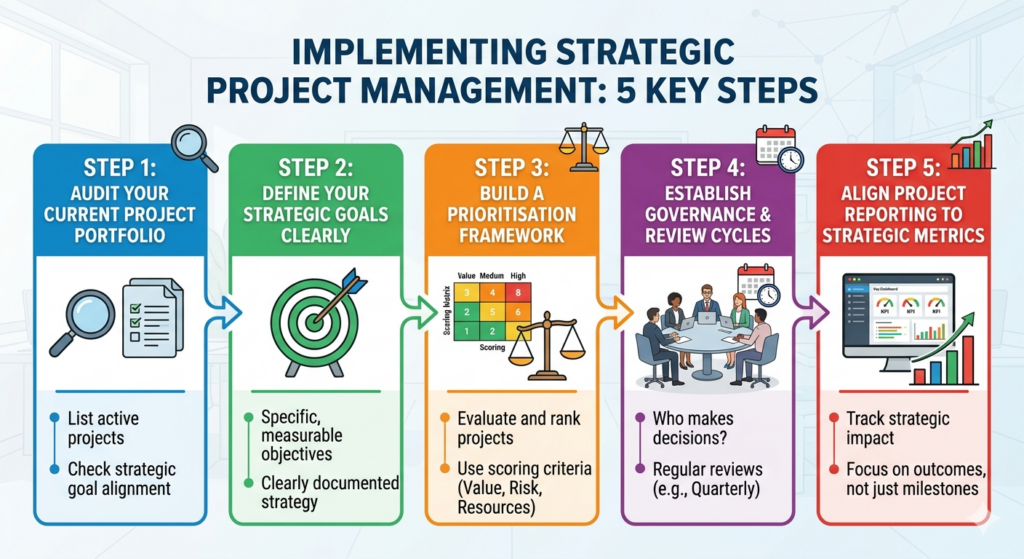
Step 1: Audit Your Current Project Portfolio
Before you change anything, understand what you’re working with. List every active project in the organisation. For each one, ask: what strategic goal does this support? If you can’t answer that clearly, that’s a data point.
This audit often surfaces projects that have been running on momentum rather than purpose, holdovers from a previous strategic cycle, or initiatives that someone started and no one stopped. Getting that clarity is the first step.
Step 2: Define Your Strategic Goals Clearly
Strategic project management only works if the strategy itself is clear. Vague goals like “grow the business” or “improve customer experience” aren’t enough. You need specific, measurable strategic objectives that projects can be evaluated against.
If your organisation doesn’t have those clearly documented, that’s the work that needs to happen before anything else. Projects can’t align to a strategy that hasn’t been articulated.
Step 3: Build a Prioritisation Framework
Create a consistent way to evaluate and rank potential projects. The simplest version is a scoring matrix where projects are scored against criteria like strategic alignment, expected value, resource requirements, and risk level.
This doesn’t have to be complicated. Even a basic spreadsheet that forces structured thinking about trade-offs is better than making decisions informally.
Step 4: Establish Governance and Review Cycles
Decide who makes decisions about which projects to run and how often those decisions get revisited. Quarterly portfolio reviews are common for most organisations. Some fast-moving ones do them monthly.
The governance structure also needs to define escalation paths. When a project hits a strategic-level problem that the project manager can’t resolve, where does it go? Having that clarity prevents decisions from getting stuck.
Step 5: Align Project Reporting to Strategic Metrics
Change what you measure. If your project status reports only track delivery milestones, add a strategic impact section. What strategic outcome is this project moving toward? What’s the current indication that we’re on track to deliver that value?
This sounds like a reporting change. It’s actually a culture change. Teams start thinking differently about what success means when the metrics they’re reporting against are tied to strategy.
Common Pitfalls to Avoid in Strategic Project Management
Even organisations that understand these principles in theory can stumble badly in practice. A few patterns show up repeatedly.
Confusing Activity with Progress
Running a lot of projects doesn’t mean you’re making strategic progress. One of the most common traps is filling the project portfolio with initiatives that are active, measurable, and producing outputs, but not actually moving the strategy forward. More work isn’t the same as more aligned work.
Treating Strategy as a Once-a-Year Event
Strategy gets set in an annual planning cycle and then largely ignored while teams execute. Strategic project management requires an ongoing connection between what’s being built and where the organisation is going. That connection needs to be maintained actively, not just assumed.
Under-investing in the PMO Function
Many organisations either don’t have a PMO or have one that’s been reduced to a process-enforcement function with no strategic authority. A PMO that can only say “follow the template” has very little influence over whether the right projects get run. Giving the PMO a genuine role in portfolio-level decision making is what makes it strategically useful.
Not Involving the Right People Early
Strategic decisions about which projects to pursue often get made without the people who understand operational constraints. That leads to ambitious project portfolios that look great on paper but can’t actually be staffed or funded. The people who will execute need to be in the room when the portfolio is being set.
How Strategic Project Management Applies in India’s Fast-Growing Organisations
This isn’t an abstract global concept. India’s fastest-growing companies are dealing with exactly the problem that strategic project management solves.
Take Zepto, which went from concept to market leader in quick commerce in under three years. That kind of growth involves running dozens of simultaneous projects, from supply chain buildout to dark store expansion to app feature development. Without a strong strategic project management layer, those initiatives don’t stay aligned. Some get over-resourced. Others get neglected. The strategy starts to drift.
Similarly, Razorpay’s expansion from a payment gateway into a full-stack financial services company required carefully sequenced projects, where one initiative’s success depended on another’s. That sequencing is portfolio management in action. It requires someone thinking above the project level at all times.
The specific context for Indian organisations is also worth noting: rapid scaling often means building strategy and execution infrastructure simultaneously. You can’t wait until you have a perfect PMO before running strategic projects. The two have to develop together.
Measuring Success in Strategic Project Management
Delivery metrics tell you if a project was run well. Strategic metrics tell you if it mattered. Both are necessary. But most organisations over-index on the first and underinvest in the second.
Delivery Metrics
These are the traditional ones: was the project completed on time, within budget, and to spec? They still matter. A project that delivers the right outcome late or over budget hasn’t fully succeeded. Delivery metrics are the minimum bar, not the definition of success.
Strategic Contribution Metrics
These measures whether the project moved the organisation toward its goals. They vary by project type but might include things like market share gained, revenue attributed to a new product, cost savings realised, or time-to-market improvement. The key is that they’re defined at the start of the project, not retrofitted at the end.
Portfolio Health Metrics
At the portfolio level, you want to know: what percentage of our projects are actively aligned to our top strategic priorities? What’s our completion rate for high-priority initiatives? How is our project investment distributed across strategic themes? These metrics give leadership a view of whether the organisation’s project capacity is being used strategically.
Organisational Learning Metrics
Often overlooked. Strategic project management should get better over time. That means tracking things like how often project estimates are accurate, how frequently strategic priorities shift mid-project, and what percentage of projects reach their promised strategic value. These retrospective metrics tell you whether the practice itself is maturing.
Success in strategic project management requires measuring beyond delivery. Strategic contribution metrics ask whether the project moved the organisation toward its goals. Portfolio health metrics assess whether project investment is distributed across strategic priorities. Organisations that measure both delivery and strategic impact close the loop between project execution and organisational outcomes.
Tools and Frameworks That Support Strategic Project Management
You don’t need expensive software to make this work, but the right tools do make it significantly easier.
Strategy Mapping Tools
A strategy map, based on the Balanced Scorecard framework developed by Kaplan and Norton, helps organisations visualise how different strategic goals connect and what capabilities are needed to achieve them. It’s a useful starting point for deciding which projects deserve the most investment.
Portfolio Management Software
Tools like Jira Portfolio, Celoxis, Monday.com, Asana, and Smartsheet can all be used to manage project portfolios at a level that traditional project tools don’t support. The key feature to look for is cross-project visibility, the ability to see how all active projects relate to strategic themes.
OKRs (Objectives and Key Results)
OKRs, used by companies like Google and Infosys, provide a framework for setting strategic goals in measurable terms and then connecting team-level and project-level work to them. When projects are tied to specific Key Results, the strategic alignment is explicit rather than assumed.
SWOT and PESTLE Analysis
These aren’t just for annual planning. Used at the project selection stage, SWOT (Strengths, Weaknesses, Opportunities, Threats) and PESTLE (Political, Economic, Social, Technological, Legal, Environmental) analysis help you understand the external context for a potential project before you commit resources to it.
Conclusion
The distance between a strong strategy and real results usually isn’t a lack of ideas. It’s the gap between vision and execution, and most organisations don’t have a formal system to close it.
Strategic project management is that system. It connects what the organisation wants to build in the long run with the day-to-day decisions being made at the project level. It ensures the right work gets prioritised, the right people are accountable, and the right questions are asked before, during, and after every initiative.
Start with what you have. Audit your current portfolio. Get clear on your strategic goals. Build a simple prioritisation framework. And get the right people involved in portfolio-level decisions. You don’t need a perfect system on day one.
What you do need is a commitment to asking, every time a new project gets proposed: “Does this actually get us closer to where we want to go?”
If the answer is yes, build it well. If the answer is unclear, figure that out before you start.
If the answer is no, say no.
FAQs
What is strategic project management in simple terms?
It’s the practice of making sure your projects are connected to your organisation’s bigger goals. Not just running projects well, but running the right projects for the right reasons. When done well, every project your team works on should be pushing the organisation closer to its long-term direction.
How is strategic project management different from regular project management?
Regular project management focuses on delivering a specific output within time, cost, and scope constraints. The strategic version adds the question of whether that output actually contributes to organisational goals. It starts with where the organisation wants to go and works backwards to decide which projects to prioritise.
What is the role of a PMO in strategic project management?
The PMO, or Project Management Office, sets the governance standards and maintains visibility across the full project portfolio. In a strategic context, it also tracks how well active projects align with strategic priorities and flags when the portfolio drifts from the organisation’s goals. It acts as the oversight function that ensures projects stay connected to strategy, not just delivery schedules.
What’s the difference between a project manager and a program manager?
A project manager is responsible for a single project, delivering a specific outcome within defined constraints. A program manager oversees a group of related projects that together contribute to a larger strategic goal. The program manager isn’t doing the delivery work; they’re making sure the individual projects connect and progress toward the shared outcome.
How do you measure success in strategic project management?
Success has two layers. At the delivery level, you measure whether the project was completed on time, on budget, and to spec. At the strategic level, you measure whether the project delivered the value it was supposed to, whether that’s market share, revenue, cost reduction, or some other metric defined before the project started. Both matter. Delivery without strategic value isn’t full success.
Is strategic project management only for large organisations?
No. The scale of the practice should match the scale of the organisation, but the core principles apply regardless of size. A startup with five people and three active projects still benefits from asking “does this project align with what we’re trying to achieve?” The tools and governance structures look different, but the underlying discipline is the same.
What are the biggest mistakes in strategic project management?
The most common ones are: running too many projects without clear strategic rationale, treating strategy as a once-a-year planning exercise rather than an ongoing reference point, under-investing in the PMO’s strategic authority, and only measuring delivery metrics instead of strategic outcomes. Any one of these can break the link between projects and strategy.
How do you start implementing strategic project management?
Start with an audit of your current project portfolio. For every active project, ask what strategic goal it supports. This audit alone often reveals projects running on momentum rather than purpose. From there, clarify your strategic goals, build a simple prioritisation framework, and establish a regular portfolio review cadence. You don’t need a perfect system on day one; you need a consistent habit of asking the right questions.
What frameworks support strategic project management?
Several frameworks work well here. The Balanced Scorecard and its associated strategy maps help organisations connect financial and non-financial goals. OKRs (Objectives and Key Results) make the link between strategic goals and project-level work explicit. Portfolio management frameworks like MoSCoW prioritisation or weighted scoring matrices help with project selection. The right choice depends on your organisation’s size, maturity, and how formal your strategic planning process already is.
How does strategic project management help with resource allocation?
It gives you a structured basis for deciding where to put your resources. Without strategic alignment, resources tend to flow to whoever asks first or has the most influence, not to the projects with the highest strategic value. This practice requires you to score and rank projects before committing resources, which means the most strategically important work gets funded and staffed first.