

Anyone can pass the Google Ads certification exam in a weekend. Very few people get hired because of it. If you’re figuring out how to become a Google Ads expert who actually gets paid, that gap is the problem you need to solve.
It matters more now than it did two years ago. Google is automating keyword matching, ad copy and landing page selection through AI Max for Search and Performance Max, so the button-pushing part of the job keeps shrinking. What clients pay for is judgment. Setting up conversion tracking that reflects real revenue. Feeding the algorithm good signals. Knowing when to override it.
This roadmap has five steps: learn how the auction works, get certified for free, practice with real budgets, build proof, and land and price your first clients. Facts are checked against Google’s own documentation and 2026 sources, and figures are attributed so you can verify them. One caveat up front: earnings vary a lot by market and niche, so read every number as a range, not a promise.
Table of Contents
What Does a Google Ads Expert Actually Do, and What Can You Earn?
A Google Ads expert plans, launches and optimises paid campaigns across Google Search, Shopping, YouTube, Display and Performance Max so a business gets leads or sales at a cost it can afford. They’re paid through a monthly retainer, a percentage of ad spend, or a project fee.
The day-to-day is less glamorous than the LinkedIn posts suggest. You audit accounts, fix tracking, read search term reports, write and test ad assets, adjust budgets and bidding targets, and explain results to someone who mostly cares about one number: what did I get for what I spent?
So what does that pay? Published rates vary widely, and most of them come from agencies and platforms with something to sell, so treat them as market signals. According to Improtics’ July 2026 hiring guide, an India-based Google Ads freelancer typically charges $300 to $800 per month for full account management, while a US or UK freelancer charges roughly $500 to $1,500 a month per account. Within India, Upgrowth’s April 2026 pricing guide, citing a Noir and Blanco benchmark, puts agency retainers anywhere from Rs 20,000 to Rs 3,00,000 a month, or 10 to 20 percent of media spend.
The spread is huge because scope, niche and ad budget change the work. A single-service local business spending Rs 25,000 a month is a different job from a D2C brand spending Rs 10 lakh across Search, Shopping and YouTube. You start at the first and grow into the second.
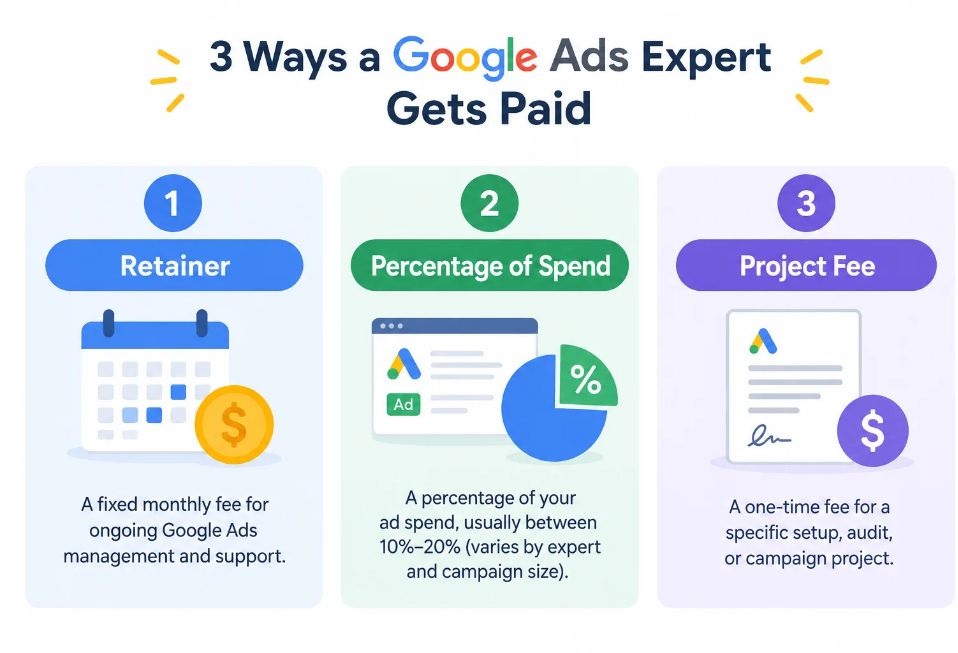
Ads expert plans, launches and optimises paid campaigns so a business gets leads or sales at an affordable cost. According to Improtics’ 2026 guide, India-based freelancers typically charge $300 to $800 per month per account, while US and UK freelancers charge roughly $500 to $1,500. Rates depend heavily on ad spend, niche and scope.
Step 1: Learn How the Google Ads Auction Really Works
Google Ads runs a real-time auction every time someone searches, and where your ad appears depends on Ad Rank, not just your bid. Ad Rank is Google’s auction-time score that combines your bid, the quality of your ad and landing page, expected impact from assets, and the context of the search.
Most beginners skip this and jump straight to building campaigns. It shows. They can click through the interface but can’t explain why a competitor with a lower bid outranks them.
Spend your first two weeks on the mechanics before you touch a budget.
Ad Rank, Quality Score and Match Types
Quality Score is a 1 to 10 diagnostic that Google shows next to keywords, based on expected click-through rate, ad relevance and landing page experience. Google describes it as a diagnostic tool rather than an input to the auction, so don’t optimise the number for its own sake. Use it as a signal for what to fix.
Match types control how closely a search must relate to your keyword before your ad can show. Broad match reaches the widest set of searches, phrase match covers searches that include the meaning of your keyword, and exact match stays close to the keyword’s meaning. Here’s the twist for 2026: Google is pushing broad match and AI Max hard, which means your control moves away from keyword lists and toward negative keywords, brand controls and the quality of your conversion data.
That sounds like a small shift. It changes the job.
Campaign Types and Conversion Tracking
You need a working map of the main campaign types: Search for high-intent queries, Shopping for product listings fed from Google Merchant Center, Performance Max for automated reach across Google’s channels, Demand Gen and Video for YouTube and discovery surfaces, and Display for banner inventory. You won’t master all of them in step one. Know what each one is for.
Then learn tracking properly, because it’s where accounts quietly fail. Conversion tracking is the setup that tells Google Ads which actions (purchases, form fills, calls) count as success. Smart Bidding, Google’s automated bidding, can only optimise toward the signals you feed it. If you count every page view as a conversion, the algorithm will happily find you cheap page views.
Here’s a practical two-week plan:
- Create a free Google Ads account and explore campaign creation up to the final step, without launching anything.
- Read Google’s Skillshop Search learning path end to end.
- Set up a Google Analytics 4 property on a test site and link it to Google Ads.
- Learn the difference between the Google tag, imported GA4 conversions and enhanced conversions.
- Use Google Ads Keyword Planner on three different industries and note how search volume and cost estimates differ.
If you were running ads for a marketplace like Nykaa, this is where you’d learn why product feed quality in Merchant Center and purchase-value tracking decide more than any bid tweak. The principle holds for a ₹20,000 account as much as a large one.
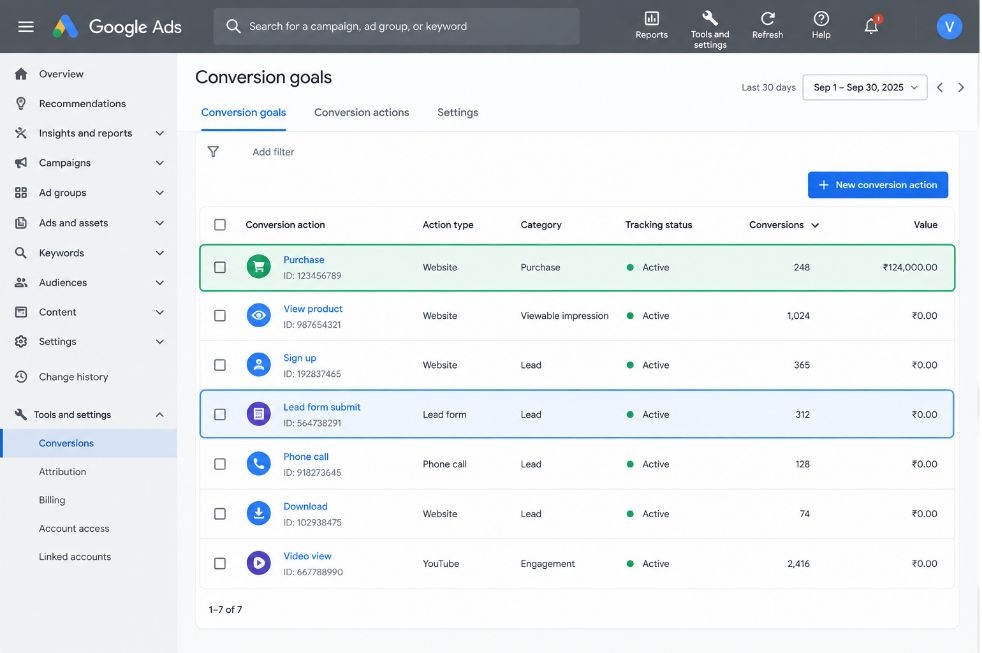
Google Ads decides ad position through Ad Rank, a real-time combination of bid, ad and landing page quality, asset impact and search context. Quality Score is a diagnostic, not a direct auction input. Automated bidding can only optimise toward the conversions you define, so conversion tracking is the first thing to learn.
Step 2: Get Google Ads Certified for Free on Skillshop
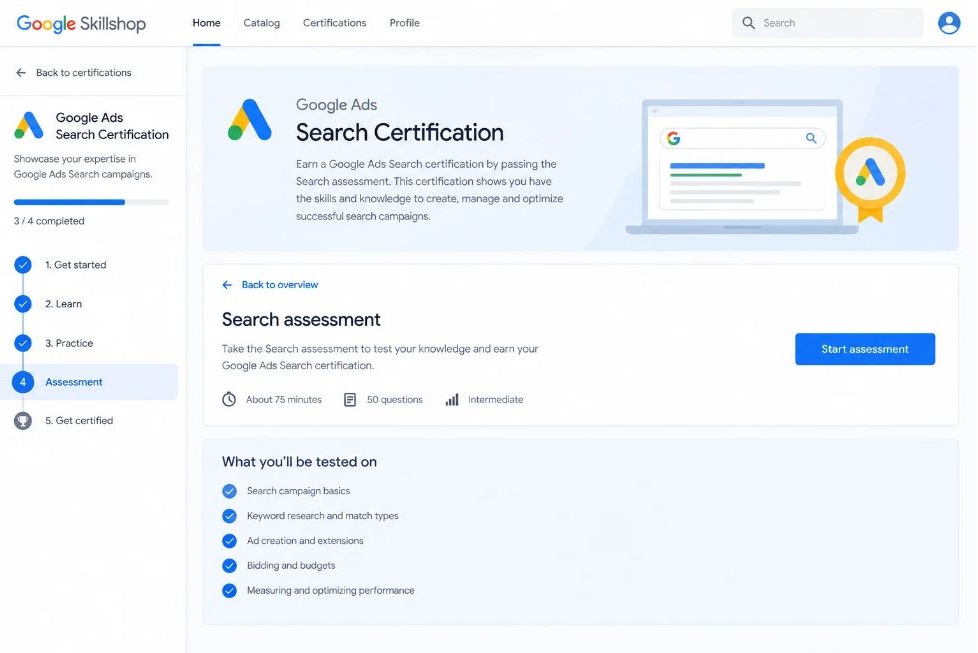
You can get Google Ads certified for free through Skillshop, Google’s official training platform. Each assessment needs a score of 80% or higher within 75 minutes, and a failed attempt can be retaken after one day, according to Google Ads Help.
Certification won’t make you an expert. It does make you look serious to a client who has never met you, and it forces you to cover the whole platform in a structured way.
Which Certifications to Take First
Start with Google Ads Search. It’s the most widely recognised and covers keyword strategy, bidding and ad quality that carry across every other campaign type. Course Careers’ 2026 guide estimates 3 to 5 hours of study for someone starting from scratch, though you’ll want longer if you’ve never seen the interface.
After Search, pick based on the work you want. Measurement if you want to be the person who fixes tracking. Shopping if you’re targeting e-commerce brands. Video or Display if you’re aiming at awareness-heavy clients. Google also lists an AI-powered performance ads certification on Skillshop, which several 2026 guides flag as increasingly relevant, so check the current list on Skillshop before you commit study time.
Sources disagree on how many Google Ads certifications exist right now, because Google adds and retires them. Skillshop itself is the only reliable list.
Google Ads Help names five certifications that count toward a company’s Google Partner or Premier Partner badge: Search, Display, Video, Shopping and Apps. That matters if you plan to join or start an agency. Google Partner status belongs to companies, not individuals.
Here’s how to get certified:
- Go to Skillshop and sign in with your Google account.
- Open the Google Ads certification channel and choose Google Ads Search.
- Work through the learning modules and knowledge checks.
- Start the assessment only when you can finish it in one sitting, because the timer can’t be paused.
- Download your certificate and add it to LinkedIn as a separate entry for each certification.
What Certification Proves and What It Doesn’t
Be honest with yourself here. The exam tests platform knowledge, ad formats and policy. It doesn’t test whether you can turn Rs 50,000 of spend into profitable sales. Course Careers makes the same point: employers increasingly know the difference between a certificate and a track record.
Two practical rules from Google’s own guidelines. You can only call yourself certified if you personally passed the assessments, and your certification expires after one year, so you’ll need to retake it to stay current. And ignore any site charging you for a “Google Ads certificate.” The official exams are free.
Step 3: Practice With Real Budgets, Including AI Max and Performance Max
The fastest way to become good at Google Ads is to spend real money, even a small amount, and learn from the results. Simulations and courses only take you so far because nothing teaches like watching your own budget disappear on the wrong search terms.
You don’t need a client for this. Run ads for your own project, a family business, a friend’s shop or a local service provider who’ll let you try a small budget. Keep the stakes low and the learning high.
Here’s a practice plan you can follow:
- Pick one business with a clear conversion, such as a lead form, a phone call or a purchase.
- Set up conversion tracking first and test it with a real conversion before spending anything.
- Launch one Search campaign with tightly grouped keywords, three to four ad groups at most.
- Check the search terms report every few days and add negative keywords for irrelevant queries.
- Change one variable at a time (ad copy, bid target, landing page) and note the result in a simple log.
- After a few weeks, compare against your starting numbers for cost per acquisition (CPA, the average cost of one conversion) and conversion rate.
AI Max: The Change You Can’t Ignore
AI Max for Search is a set of Google features layered onto standard Search campaigns that includes search term matching, text customization and final URL expansion. Google confirmed on its Ads blog that AI Max is moving out of beta and that Dynamic Search Ads, automatically created assets and campaign-level broad match campaigns are being upgraded to it.
The timeline is specific. According to Google’s June 2026 announcement, campaigns using automatically created assets and campaign-level broad match began auto-upgrading in September 2026, while Dynamic Search Ads move from February 2027. RichClicks recommends taking a snapshot of CPA, ROAS, conversion volume and key landing pages before any migration, so you can judge the before and after fairly. That’s exactly the habit that separates an expert from someone who just clicks “apply.”
Google’s internal data, as reported in a July 2026 Hawky roundup, suggests advertisers already using search term matching saw an average 7% more conversions or conversion value at a similar CPA or ROAS after adding text customization and final URL expansion. It’s vendor-reported, so treat it as an indication, not a guarantee. It may not hold for your account.
Performance Max Is Less of a Black Box Now
Performance Max, Google’s automated campaign type that runs across Search, YouTube, Display, Discover and Maps, spent 2026 addressing its transparency problem. Hawky reports that Google launched a channel performance timeline in April 2026 showing how each channel contributed, plus asset experiments to test which headline, image or video moves results.
Practice reading those reports. An expert who can explain to a client where Performance Max spent the money is worth more than one who says “the algorithm handles it.”
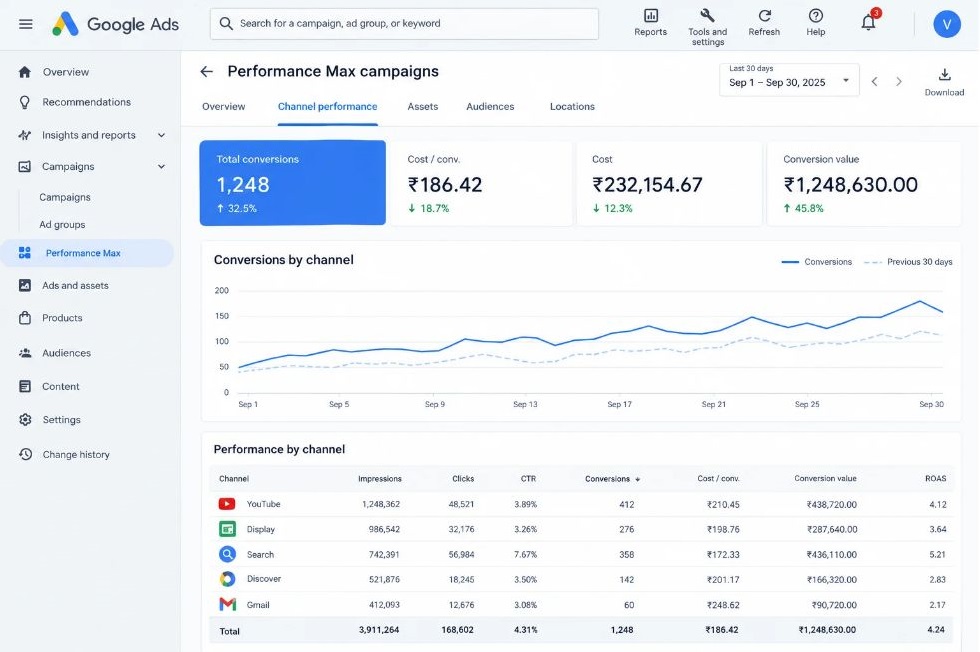
AI Max for Search adds search term matching, text customization and final URL expansion to standard Search campaigns. Google’s June 2026 announcement said automatically created assets and broad match campaigns began upgrading in September 2026, with Dynamic Search Ads following from February 2027. Advertisers should record CPA, ROAS and conversion volume before migrating to compare results fairly.
Step 4: Build Proof With Audits, Case Studies and a Portfolio
Clients hire proof, not potential. Your proof can be a documented audit, a small case study from your practice campaigns, or a clear before-and-after from a friendly business, as long as it shows a decision and its result.
Most beginners have nothing to show because they never wrote anything down. Start logging from day one of Step 3.
A simple audit is your strongest lead magnet. Pick a local business that already runs Google Ads. You can see which ads they’re running in Google’s Ads Transparency Center, which shows ads by advertiser. Then write a short, respectful review of what you’d check first.
Here’s how to structure an audit:
- Check that conversion tracking exists and counts the right actions.
- Review the search terms report for wasted spend and missing negatives.
- Compare ad copy against the landing page and note any mismatch.
- Look at budget distribution across campaigns and campaign types.
- List three prioritised fixes with the reason behind each.
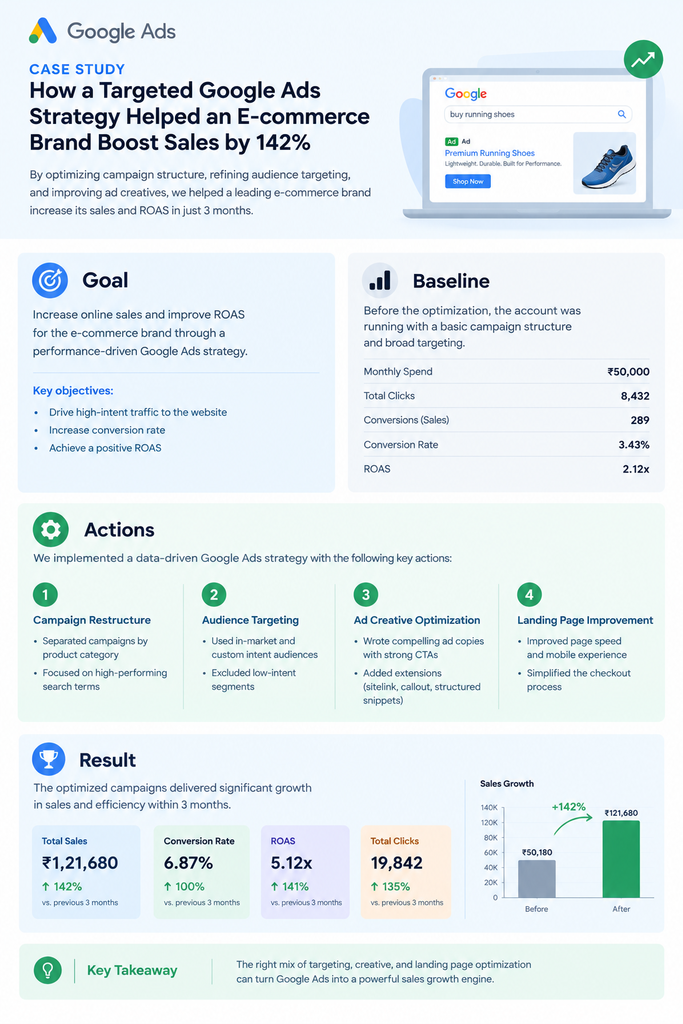
For case studies, use four blocks: the goal, the starting numbers, what you changed, and the result. Use real numbers even when they’re small. A case study showing CPA falling from Rs 900 to Rs 620 on a small account is more credible than vague claims of “massive growth.” Never invent or inflate results. Clients check, and your reputation is all you have at this stage.
Put everything in one place: a simple portfolio page or a Notion document with two or three case studies, your certifications, and a short description of how you work. Add a Looker Studio report template so clients can see what your reporting looks like. Then add your Skillshop certifications to LinkedIn individually. Digital Vidya’s 2026 guide notes this helps each one show up in LinkedIn search.
Step 5: How Do You Find Your First Clients and Price Your Work?
Your first clients will come from people who already trust you: your network, local businesses, and agencies that need extra hands. Price with a setup fee plus a flat monthly fee at first, then move to percentage-based pricing once you have proof and confidence.
Where the First Three Clients Come From
Start warm. Tell everyone you know exactly what you do and who it’s for. “I help local dental clinics get appointment enquiries from Google” lands better than “I do digital marketing.”
After that, three channels work for most beginners. Local businesses that spend on ads but have no one managing them properly. Small agencies that outsource Google Ads work, which Improtics describes as a growing white-label arrangement with India-based specialists. And freelance platforms, where competition is heavy but a strong niche profile still wins jobs.
Budget matters more than most beginners realise. According to VGraple’s April 2026 guide, underinvesting, meaning under Rs 15,000 a month in ad spend, is the most common mistake, because you’ll spend money and see little. Mayank Digital Labs’ August 2026 guide suggests at least Rs 15,000 to Rs 30,000 a month for meaningful results. Filter for clients who can actually fund the test, or you’ll take the blame for a budget that was never big enough.
Retainer vs Percentage of Spend vs Performance Pricing
Here’s how the common models compare, using 2026 figures from the sources above:
| Model | How it works | Typical range | Best for |
| Flat monthly retainer | Fixed fee regardless of spend | Rs 5,000 to Rs 25,000 for small accounts in India (Mayank Digital Labs, 2026); higher for complex accounts | Beginners, small budgets |
| Percentage of spend | Fee scales with ad spend | 10 to 20 percent (Upgrowth, 2026) | Growing accounts with stable budgets |
| Setup fee | One-time account build | Rs 5,000 to Rs 20,000 (VGraple, 2026) | New accounts needing tracking and structure |
| Hourly | Billed per hour | Rs 150 to Rs 250 entry-level; Rs 500 to Rs 1,500 experienced (Contra, 2026) | Audits and one-off projects |
My view: start with a flat fee. Percentage pricing penalises the work that makes an account efficient, because if you cut wasted spend, your fee drops. And don’t offer pure performance pay early on. Attribution disputes and tracking gaps will eat your time.
That said, it depends on your market. In the US and UK, Improtics puts freelancer retainers at $500 to $1,500 a month, so the same skills earn more if you can win overseas clients. Time zones and trust are the trade-off.
Everything in this table comes from vendor and agency sources, not independent audits. Use it as a starting point and test it against what real clients in your niche will pay.
Mistakes That Keep New Google Ads Freelancers Stuck
Most new freelancers stall for the same handful of reasons, and almost none of them are about knowing the platform.
- Promising results. You can promise process, reporting and honest communication. You can’t promise ROAS, and clients who hear guarantees remember them.
- Skipping tracking. Launching before conversions are verified means every optimisation decision rests on bad data.
- Accepting tiny budgets. As covered above, very low spend rarely produces enough data to judge anything.
- Fighting automation blindly. Overriding AI Max or Smart Bidding without evidence usually costs more than it saves. Test with experiments, not opinions.
- Ignoring renewals. Certifications expire after a year, and an expired badge on your profile looks careless.
- Collecting every certification. Three certifications plus real results beat twelve certificates and none.
The pattern behind all of these: they’re about judgment, not tools. Which is why Step 3 matters more than Step 2.
Conclusion
The route to earning from Google Ads is shorter than most courses admit, but it isn’t a shortcut. Certification gets you in the room. Practice with real budgets teaches you how the platform behaves. Proof gets you hired.
If you take one thing from this roadmap, make it this: document everything from your first practice campaign. Starting numbers, changes, results. That log becomes your case study, your portfolio and your pricing confidence all at once.
And keep watching the automation. With AI Max upgrades rolling through Search accounts from September 2026, the experts who win will be the ones who understand what the algorithm is doing and can prove when to step in.
Pick your first practice project this week and set up its conversion tracking before anything else.
Reading about Google Ads only takes you so far. Learning to run campaigns, read the data and explain results to clients is a practical skill, and it’s easier with structure and feedback.
If you want a guided path from fundamentals to managing real campaigns, take a look at YUP’s Performance Marketing course.
FAQ
What is a Google Ads expert?
A Google Ads expert is a professional who plans, launches and optimises paid campaigns across Google’s advertising channels for a business. They’re usually certified through Skillshop, but the title has no official meaning. Clients judge experts by results and experience, not by a badge.
Google Ads certification vs Google Partner badge: what’s the difference?
Individuals earn Google Ads certifications by passing Skillshop assessments. Companies earn the Google Partner or Premier Partner badge by meeting Google’s requirements, which include certified staff. According to Google Ads Help, certifications for Search, Display, Video, Shopping and Apps count toward the certification requirement.
How do I become a Google Ads expert from scratch?
Follow five steps: learn how the auction and conversion tracking work, pass Skillshop certifications, practice with real budgets, build audits and case studies, then pitch and price your first clients. The certification can take a few hours to a few days. Genuine expertise takes months of live account experience, so plan for that.
Is Google Ads certification free?
Yes. Google’s official Skillshop certifications are free, and Google never charges for the exam. You need 80% or higher to pass, you get 75 minutes, and you can retake after one day. Be wary of any website charging for a Google Ads certificate.
Is Google Ads certification worth it?
It’s worth it as a starting credential, not as proof of skill. It helps clients trust you before you have results, and it makes you learn the full platform. It won’t replace a track record. Hiring managers and clients increasingly look for real account results alongside the badge.
How much can a beginner earn as a Google Ads freelancer?
It varies widely by market. Improtics’ 2026 guide reports India-based freelancers charging $300 to $800 per month per account, while Mayank Digital Labs’ guide lists Rs 5,000 to Rs 25,000 a month for freelancers in India handling one or two services. Your income depends on how many clients you manage and how well you retain them.
Who should learn Google Ads?
Marketers moving into performance roles, freelancers wanting a high-demand skill, small business owners who want to run their own ads, and career switchers with analytical habits. It suits anyone comfortable with numbers and testing. It’s a poor fit if you want guaranteed, effortless results
Will AI Max and automation replace Google Ads experts?
Not the good ones, but it will change the work. Google is automating matching, ad text and landing page selection, which means the expert’s role shifts toward conversion data quality, brand controls, experiments and strategy. RichClicks makes this point directly: the advertiser’s role increasingly focuses on the quality of inputs and controls.
Why aren’t my Google Ads campaigns getting conversions?
Check tracking first. Confirm the conversion action fires correctly and counts the right event. Then review search terms for irrelevant traffic, check that your landing page matches the ad’s promise, and make sure the budget is large enough to gather data. Most low-conversion accounts have a tracking or targeting problem, not a bid problem.