
Dropshipping has changed shape quite a bit, and this blog on dropshipping marketing trends tries to make sense of that shift without overcomplicating it. What stands out today isn’t just new tools or platforms, but how marketing itself has become the main driver of whether a store survives or fades out. The focus has moved toward short-form content, creator-led ads, AI-assisted workflows, and more layered customer journeys instead of one-off product wins.
There’s also a clear thread running through everything… branding and consistency now matter just as much as traffic. Paid ads still play a role, sure, but they don’t carry stores the way they used to without content backing them up. The blog walks through these changes and what they actually mean in practice, especially for anyone trying to build something stable in a space that keeps shifting faster every year.
Table of Contents
Introduction:
Why Dropshipping Marketing Trends Matter
Dropshipping marketing trends are not just “nice to know” anymore; they are basically the difference between a store that scales and a store that quietly dies after a few ad tests. The model itself hasn’t disappeared, but the way it works has changed so much that what worked even two years ago already feels outdated.
If you look closely, dropshipping is no longer just about finding a cheap supplier and running ads. That era is pretty much gone. Today, it’s closer to running a media-driven brand where marketing is the actual product. The store is just the checkout layer.
And this shift didn’t happen randomly.
A few things pushed it:
- Paid ads became more expensive and less forgiving
- Customers started trusting content more than “salesy” ads
- Platforms like TikTok and Instagram changed how products get discovered
- AI started speeding up content creation and ad testing cycles
So when people talk about dropshipping marketing trends, they’re really talking about how survival works now in a highly competitive attention economy.
The stores that are doing well usually have one thing in common: they think like content creators first, sellers second. That’s a big mindset shift. It means instead of asking “what product should I sell?”, the better question is often “what kind of content can I consistently create around a product that people actually want to watch?”
That alone changes everything.
Another important angle is how algorithm-driven platforms now decide winners. You don’t really “launch” a product anymore in the traditional sense. You feed content into platforms, and the algorithm decides whether your product gets visibility or not. Sometimes it feels unpredictable, but there is a pattern: content quality and retention matter more than polished branding.
And honestly, this is where most beginners struggle. They still think dropshipping is a product game. In reality, it has become a distribution and attention game.
A few things shaping dropshipping marketing trends right now:
- AI tools are speeding up ad creation, but also increasing competition
- Short-form video is dominating product discovery
- Influencer content is becoming more performance-based than brand-based
- Organic content is often outperforming paid ads in early testing phases
- Customers expect faster shipping and more “real” proof before buying
There’s also something subtle happening in the background: trust is becoming harder to earn but easier to lose. That means marketing is not just about grabbing attention anymore. It’s about maintaining belief long enough for someone to actually convert.
So when we talk about dropshipping marketing trends, we’re really talking about how modern eCommerce is shifting from “buy traffic, convert traffic” to “build content ecosystems that create demand.”
And that’s a very different game.
The next sections break down what dropshipping actually looks like, so the trends make more sense in context.
What is Dropshipping?
Dropshipping is still technically the same business model on paper: you sell products without holding inventory, and suppliers handle fulfillment. But if you stop the definition there, you’ll miss how much the real game has changed.
Because today, dropshipping is less about logistics and more about marketing systems.
A store can have the same supplier, same product, even the same pricing as another store, but the winner is usually decided by who tells the better story and who gets better distribution through content.
That’s the uncomfortable truth that a lot of beginners don’t realize early enough.
If we simplify it, modern dropshipping looks like this:
- Product sourcing still matters, but it’s not the main advantage anymore
- Marketing execution is the core skill
- Content velocity often beats product uniqueness
- Brand perception is built through ads, short-form videos, and creator content
- Stores act more like landing pages for attention, not standalone destinations
And because of that, dropshipping has slowly shifted from a “store-first” model to a “content-first” model.
This is probably the biggest mental shift in the entire space.
Store-first vs content-first thinking
Earlier, people would build a Shopify store, add products, and then “start marketing.” That sequence doesn’t really work the same way now.
In a content-first approach, the flow is almost reversed:
- You test content angles first
- You identify what hooks and messages get attention
- Then you match products to that demand
- Only after that do you scale through ads and influencers
It feels backwards at first, but it aligns much better with how platforms like TikTok, Instagram Reels, and YouTube Shorts actually distribute content.
Another thing shaping dropshipping is how crowded most niches have become. Almost every “easy” product idea has already been tested multiple times. That doesn’t mean you can’t succeed, but it does mean your marketing has to work harder than it used to.
Some of the biggest challenges affecting dropshipping marketing today:
Rising ad costs
Even basic testing campaigns on Meta or Google can get expensive quickly. This forces sellers to rely more on organic content or highly optimized creatives before scaling.
Saturated niches
Winning products don’t stay “hidden” for long anymore. If something is working, it usually gets copied fast, sometimes within days.
Faster customer expectations
People expect quicker delivery, better tracking, and more transparency before buying. Marketing has to reflect that reality instead of ignoring it.
And then there’s the platform side of things, which quietly controls a lot of outcomes.
Algorithms are now doing more of the distribution work than ever before. That means your marketing success depends heavily on how well your content fits platform behavior, not just how good your product is.
For example:
- TikTok prioritizes watch time and retention over anything else
- Instagram favors shareable, relatable content formats
- YouTube Shorts rewards repeatable hooks and consistent posting
- Paid ads perform better when they look like organic content, not ads
So in a way, the line between “content” and “advertising” is fading.
That’s why modern dropshipping marketing trends are leaning so heavily toward UGC-style content, influencer-driven trust building, and short-form video storytelling. Because those formats don’t feel like ads, even when they are.
And maybe that’s the key idea behind everything happening right now:
Dropshipping is not about selling products. It’s about earning attention long enough for a product to feel like a natural choice.
Everything else flows from that.
Core Dropshipping Marketing Trends
This is where things actually get interesting. If you strip away all the noise around dropshipping, what you’re left with is a very clear pattern: marketing has stopped being a support function and has become the main growth engine of the entire dropshipping business model.
Winning stores aren’t necessarily the ones with the “best product” anymore. They’re the ones who understand attention, content systems, and platform behavior better than everyone else.
Let’s break down what’s actually working right now.
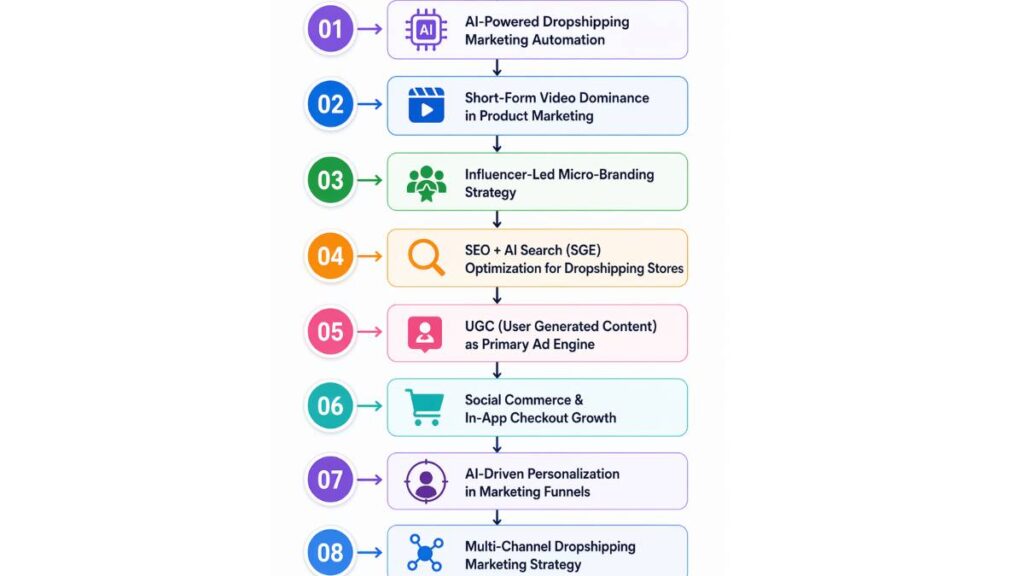
AI-Powered Dropshipping Marketing Automation
AI has quietly changed the speed at which dropshipping marketing operates. Not in a flashy way, but in a practical, day-to-day execution way.
Earlier, testing ads, writing copy, or researching products used to take days. Now it can happen in hours. That doesn’t automatically mean better results, but it definitely means faster cycles of experimentation.
What stands out most:
- Ad creatives are being generated and tested at scale instead of being manually designed one by one
- Copywriting is becoming more variation-driven rather than single-message focused
- Product research is increasingly prediction-based instead of purely trend-hunting
- Email flows and retargeting sequences are becoming behavior-driven rather than static
The real shift is this: decisions are becoming data-reactive instead of intuition-heavy.
Stores that still rely on “gut feeling marketing” tend to lose consistency fast. The ones adapting to automation are able to test more angles, more hooks, and more audience segments without burning out their entire budget in the process.
But there’s also a hidden downside. When everyone can generate ads quickly, the real differentiator is no longer production speed; it’s creative judgment. Knowing what not to run becomes just as important as what to launch.
Short-Form Video Dominance in Product Marketing
Short-form video is no longer just a traffic source for dropshipping. It has basically become the discovery layer of eCommerce itself.
Platforms like TikTok, Instagram Reels, and YouTube Shorts are now where most product awareness starts, even before users search for anything.
The shift is subtle but powerful:
- Users don’t “search” for products first anymore
- They stumble upon them through content feeds
- The algorithm decides what gets attention, not the store owner
And this is why UGC-style ads consistently outperform traditional product ads. They don’t feel like ads. They feel like content that just happens to include a product.
The most effective short-form formats right now usually follow a few patterns:
- Hook-first storytelling (problem – surprise – solution)
- Relatable everyday scenarios where the product naturally fits
- Fast visual demonstration instead of long explanations
- Minimal branding, maximum realism
What’s interesting is that Polish often hurts performance here. Over-edited videos tend to get ignored, while simple, slightly imperfect clips often perform better because they feel more authentic.
And once something hits in this format, it doesn’t just convert once. It can keep driving traffic as long as the platform keeps distributing it.
Influencer-Led Micro-Branding Strategy
Influencer marketing in dropshipping has matured a lot. The old model of paying big influencers for one-off shoutouts doesn’t really hold the same weight anymore.
The direction has clearly shifted toward micro and nano influencers.
Why?
Because trust scales better in smaller communities.
What’s happening now:
- Smaller creators with higher engagement are outperforming big celebrity influencers
- Brands are shifting toward ongoing performance-based collaborations
- Product seeding is becoming a core part of content pipelines
- “Relatable creator content” is replacing scripted brand promotions
The key advantage here is repetition and authenticity. When multiple small creators talk about the same product in different ways, it starts feeling like social proof instead of advertising.
And that’s really the point.
Dropshipping stores that rely on influencers effectively are no longer buying reach. They’re buying distributed trust.
SEO + AI Search (SGE) Optimization for Dropshipping Stores
Search is changing, but it hasn’t disappeared. It has just become more structured and context-driven.
Dropshipping stores that still ignore organic search are missing out on long-term compounding traffic, especially from product research queries.
What’s working now is less about keyword stuffing and more about semantic clarity:
- Product pages that clearly explain use cases and benefits
- Content that answers buyer questions directly
- Structured formatting that helps AI systems interpret relevance
- Supporting blog content that builds topical authority around a niche
A big shift here is that blog content is no longer just “traffic content.” It’s becoming a conversion support system. People often read multiple touchpoints before they trust a store enough to buy.
Another subtle change is how entity-based understanding works. Search systems now try to understand relationships between products, problems, and intent rather than just matching keywords.
So stores that explain things clearly tend to perform better over time.
Even simple improvements like FAQs, comparison sections, and clear product storytelling can significantly change how a page performs in modern search environments.
UGC (User Generated Content) as Primary Ad Engine
UGC is no longer a “nice addition” in dropshipping marketing. It has become the main engine for paid and organic performance.
And the reason is simple: people trust people more than brands.
UGC works because it mirrors how users already consume content:
- Casual tone instead of scripted ads
- Real environments instead of studio setups
- Honest reactions instead of polished sales messaging
- Imperfect delivery that feels believable
Most high-performing dropshipping brands now actively build creator pipelines instead of relying on internal content teams alone.
The interesting part is the psychology behind it. UGC doesn’t just increase clicks, it reduces skepticism. And in eCommerce, reducing skepticism often matters more than increasing curiosity.
Platforms like TikTok, Meta, and Pinterest amplify this effect because their algorithms already prioritize native-feeling content.
So the winning formula is becoming less about “perfect ad creative” and more about “repeatable creator-driven content at scale.”
Social Commerce & In-App Checkout Growth
The checkout journey is slowly disappearing into the platforms themselves.
Instead of sending users to external stores, platforms like TikTok Shop, Instagram Shop, and Pinterest Shopping are creating frictionless buying experiences inside the app.
That changes a lot of assumptions about dropshipping funnels.
Key shifts happening:
- Discovery and purchase are merging into a single flow
- Users are more likely to buy impulsively within content feeds
- Traditional Shopify funnel steps are becoming shorter or sometimes irrelevant
- Checkout behavior is becoming more emotion-driven than research-driven
This doesn’t mean standalone stores are dead, but it does mean they need stronger reasons to exist beyond just checkout.
Speed, trust, and simplicity matter more than ever. If a user has to think too much or leave the platform, conversion probability drops immediately.
So marketing now has to align with “in-the-moment buying behavior” instead of structured funnel logic.
AI-Driven Personalization in Marketing Funnels
Personalization in dropshipping used to be basic segmentation at best. Now it’s becoming behavior-driven and dynamic.
Instead of sending the same message to large audiences, stores are starting to adapt messaging based on real-time user actions.
What this looks like in practice:
- Different product recommendations based on browsing patterns
- Retargeting ads that adjust messaging based on engagement level
- Email flows that change depending on user intent signals
- Dynamic creative variations that shift depending on audience behavior
The interesting part is how subtle this personalization is becoming. It’s not about “Hey John, we saw you liked this product.” It’s more about adjusting tone, urgency, and messaging style based on behavior clusters.
And when done well, it doesn’t feel like personalization at all. It just feels like better timing.
That’s the real goal.
Multi-Channel Dropshipping Marketing Strategy
Relying on a single traffic source is becoming one of the fastest ways to limit growth in dropshipping.
Platform volatility is too high now. Ad costs fluctuate. Algorithms change. And audience behavior shifts quickly.
That’s why multi-channel strategies are becoming the default for serious sellers.
A strong modern approach usually blends:
- TikTok for discovery and viral reach
- Google for intent-based traffic and product validation
- Meta for retargeting and conversion scaling
- Influencers for trust distribution
- Pinterest for evergreen product discovery
The challenge is not just being present everywhere, but understanding how each channel contributes differently to the buyer journey.
Attribution is getting more complex, but also more important. Because without it, scaling becomes guesswork.
The stores that adapt to this reality are usually the ones that stabilize long-term revenue instead of depending on short viral spikes.
And that’s really where dropshipping is heading: less “one winning ad” mentality, more structured ecosystem thinking.
Emerging Dropshipping Marketing Trends
If you zoom out a bit, dropshipping isn’t just evolving in tactics; it’s slowly reshaping what “a dropshipping business” even looks like. The next wave of winners won’t just be better advertisers; they’ll be better at building systems around demand, retention, and identity.
Some of these shifts are already visible, others are just starting to form underneath the surface.
Subscription-based dropshipping models
One of the most interesting directions is the quiet move toward subscriptions. Not every product fits this model, but when it does, it changes everything.
Instead of chasing one-time purchases, brands are trying to build recurring relationships:
- Replenishable products packaged as subscriptions
- “Monthly surprise” style product bundles
- Membership-based perks tied to repeat purchases
The logic is simple. One-time customers are expensive to acquire. Recurring customers stabilize cash flow and reduce pressure on constant ad performance.
Sustainability-focused product branding
This isn’t just a branding trend; it’s a trust signal trend.
Even in dropshipping, where supply chains are often abstracted, customers are asking more questions:
- Where is this coming from?
- Is this ethical or just cheap?
- Will it last, or is it disposable?
Stores that can’t answer those questions clearly often struggle long-term. The interesting part is that even the perception of sustainability, not just actual logistics, influences conversion rates.
Community-driven brand marketing
This is probably one of the most underrated shifts.
Instead of relying only on ads, more dropshipping brands are slowly building micro-communities:
- Private WhatsApp groups for buyers
- Discord communities around product categories
- Post-purchase engagement loops
The goal isn’t just retention. It’s identity formation. When customers feel like they’re part of something, not just buyers, repeat purchase behavior changes naturally.
Fast shipping expectation shaping ad messaging
This one is subtle but powerful. Shipping speed used to be a backend problem. Now it’s a front-end marketing message.
Customers are no longer surprised by fast shipping. They expect it.
So marketing is adapting:
- “Ships in 24–48 hours” is becoming a core hook
- Delivery transparency is used as a conversion trigger
- Delayed shipping without clarity now kills ad performance faster
Saturation-driven niche micro-segmentation
Broad niches are getting harder to dominate. So the shift is toward hyper-specific micro-niches.
Instead of targeting “fitness products,” stores go deeper:
- Posture correction for remote workers
- Recovery tools for runners over 30
- Home workout tools for small apartments
The more specific the niche, the easier it is to create relevant content that actually resonates instead of competing in crowded generic spaces.

Enroll Now: Product Marketing Course Online
Why These Dropshipping Marketing Trends Are Emerging Now
These trends didn’t appear randomly. They’re a direct response to pressure building across the entire dropshipping ecosystem.
If you look at it closely, everything comes back to a few structural changes.
AI disruption in eCommerce marketing
AI didn’t just make content creation faster. It changed the baseline expectation for output.
What used to be “good enough” creative is now average. That forces marketers to either produce more variations or find better angles, not just better designs.
Rising cost of paid ads
Meta and Google ads are still powerful, but they’re no longer easy entry points.
Higher competition means:
- Testing costs go up quickly
- Margins get squeezed earlier in the funnel
- Creative fatigue happens faster than before
So naturally, brands are diversifying into organic content and influencer systems.
Consumer trust shifts toward authenticity
This might be the most important long-term change.
Users are simply more skeptical now. They’ve seen too many ads, too many dropshipping stores, too many identical landing pages.
So what converts is not persuasion-heavy messaging, but trust-heavy content:
- Real demonstrations
- Unfiltered usage
- Relatable creator narratives
Algorithm changes in social platforms
Platforms are no longer just distribution channels. They are behavior-shaping systems.
Content that wins now tends to:
- Hold attention quickly
- Feel native to the platform
- Trigger engagement loops (shares, rewatches, comments)
This changes how marketing is built from the ground up. You’re no longer “posting ads.” You’re creating content that must survive algorithmic filtering.
Global competition and niche saturation
Dropshipping is no longer a “hidden opportunity” space. It’s fully global.
That means:
- Faster replication of winning products
- Shorter product lifecycles
- Higher pressure to differentiate through branding, not just selection
So naturally, strategies are shifting from product discovery to marketing sophistication.
How to Apply Dropshipping Marketing Trends in Your Store
Knowing trends is one thing. Applying them without overcomplicating your entire system is where most people struggle.
The goal here is not perfection. Its direction.
Choose Trend-Aligned Products
The first filter is simple: not every product deserves to be marketed the same way anymore.
Strong modern dropshipping products usually share a few traits:
- They can be shown visually in under 10 seconds
- They solve a very clear, emotional or practical problem
- They don’t require long explanations to understand
- They naturally fit into short-form content formats
What tends to fail now:
- Generic, overly saturated products with no angle
- Items that need heavy explanation before interest
- Products that don’t create any visual curiosity
The product itself still matters, but mostly in how easily it can be framed in content.
Build a Content-First Marketing System
This is where most stores either scale or stall.
Instead of treating content as “marketing support,” it becomes the core operating system.
A practical structure usually looks like this:
- Consistent short-form video output (daily or near-daily rhythm)
- Multiple content angles per product (problem, reaction, demo, comparison)
- Creator-based content integrated into paid ads
- Repurposing across platforms instead of platform-specific creation
The key idea here is repetition with variation.
One product is not one ad. It’s dozens of potential content angles.
And the more angles tested, the higher the chance of finding a winning hook.
Optimize Store for Conversion (CRO Integration)
Even the best marketing can collapse if the store experience doesn’t support it.
Modern conversion optimization is less about design and more about clarity and trust.
What actually matters:
- Product pages that answer objections before they are asked
- Visible trust signals (reviews, real usage content, guarantees)
- Clean, fast checkout without unnecessary friction
- Clear delivery expectations were displayed early
A lot of stores underestimate how quickly users decide. In many cases, the landing page either builds confidence immediately or loses the visitor within seconds.
So CRO is less about persuasion tricks and more about removing doubt.
Use AI Tools for Scaling Marketing
Scaling dropshipping marketing today is not about working harder. It’s about removing repetitive bottlenecks.
AI-driven systems are mostly useful in four areas:
- Generating multiple ad copy variations quickly
- Testing different creative directions without manual overload
- Identifying product demand signals earlier
- Automating email flows and retargeting logic
But the important part is this: AI doesn’t replace decision-making. It increases the volume of decisions you have to make.
So the real advantage comes from:
- Filtering good ideas faster
- Killing weak creatives earlier
- Doubling down on what actually shows traction
When used correctly, it turns marketing from a slow guessing game into a faster feedback loop.
If you connect all of this together, the direction becomes pretty clear. Dropshipping isn’t about finding shortcuts anymore. It’s about building systems that can consistently turn attention into trust, and trust into sales, across multiple channels without depending on a single source of traffic.
Dropshipping Marketing Mistakes to Avoid
Most dropshipping failures don’t come from “bad products” anymore. They come from predictable marketing mistakes that keep repeating, even as the landscape changes.
What’s interesting is that many of these mistakes actually worked in the past. That’s why people still fall into them. But the environment has shifted that old logic enough that it quietly stops working.
Relying only on paid ads without organic content
This is probably the most common trap.
Paid ads still matter, but they don’t work in isolation the way they used to. If there’s no supporting content ecosystem, everything becomes expensive very quickly.
What tends to happen:
- Ads work for a short testing phase
- Costs increase as creatives fatigue
- No organic backup means no compounding traffic
- Scaling becomes unstable and unpredictable
Stores that combine ads with consistent short-form content usually have a much smoother growth curve. Not because ads are weaker, but because content absorbs some of the acquisition pressure.
Ignoring brand identity in favor of “quick wins.”
There’s still a strong temptation in dropshipping to chase fast conversions over everything else.
But here’s the issue: quick wins don’t compound.
Without a recognizable identity, every new campaign feels like starting from zero. And customers don’t build memory around a store; they just see random products.
What this usually leads to:
- High dependency on constant testing
- Low repeat purchase rates
- Weak long-term customer trust
- Difficulty scaling beyond one product cycle
Branding doesn’t have to be complex. Even simple consistency in tone, visuals, and positioning changes performance over time.
Copying saturated product trends too late
This one is subtle, but it kills more stores than people realize.
By the time a product trend becomes obvious on social platforms, it’s usually already in its late stage.
Late entry typically means:
- Higher ad costs due to competition
- Lower engagement because audiences are already saturated
- Reduced profit margins from price wars
- Shorter product lifespan
The better approach is not chasing trends late, but learning to recognize early signals: unusual engagement spikes, emerging creator formats, or niche-specific demand clusters.
Poor supplier and fulfillment alignment is affecting marketing trust
This is often overlooked because it feels like an operational issue, but it directly impacts marketing performance.
If fulfillment doesn’t match the promise made in ads, everything breaks down.
Common issues include:
- Delayed shipping that wasn’t communicated clearly
- Inconsistent product quality between batches
- Lack of tracking transparency
- Refund pressure from unhappy customers
And the impact is immediate:
- Ad accounts get restricted or underperform
- Customer trust drops sharply
- Retargeting becomes less effective
Marketing can only scale what fulfillment can sustain.
Tools That Support Dropshipping Marketing Trends
Tools alone don’t build a dropshipping business, but they do change how fast you can execute and test ideas. The real advantage isn’t having access to tools; it’s knowing how to use them in a structured workflow.
Most successful setups rely on a combination of research, content creation, automation, and optimization tools working together.
AI ad generation tools
These tools are mainly used to speed up creative testing cycles.
They help with:
- Generating multiple ad variations quickly
- Testing different hooks and messaging angles
- Creating baseline creative concepts for short-form content
But the real value isn’t automation. It’s iteration speed. The faster you test, the faster you find winning patterns.
Product research platforms
Product research has become less about guessing and more about interpreting signals.
Modern platforms help identify:
- Rising demand patterns across niches
- Competitor ad activity
- Early-stage product momentum
- Engagement trends across social platforms
Still, the key insight here is that data alone doesn’t decide winners. Interpretation does.
UGC creator marketplaces
UGC has become a core input for ads, not an optional layer.
Creator marketplaces help connect brands with:
- Micro creators for authentic-style content
- Niche-specific influencers with real engagement
- Flexible content production without long contracts
The shift here is from “big influencer campaigns” to distributed content production at scale.
Email automation tools
Email is still one of the most underutilized parts of dropshipping marketing.
Automation tools now focus on:
- Behavioral segmentation based on user actions
- Abandoned cart recovery flows
- Post-purchase engagement sequences
- Personalized product recommendations
The interesting part is how email is no longer just a retention channel. It’s becoming a second conversion engine.
CRO optimization tools
Conversion optimization tools help bridge the gap between traffic and sales.
They typically support:
- A/B testing product pages and layouts
- Tracking user behavior on landing pages
- Identifying drop-off points in the checkout flow
- Improving trust elements and engagement signals
Even small improvements here can significantly change profitability without increasing ad spend.
Future of Dropshipping Marketing
Today is about adaptation, but beyond looking more like consolidation. The space is slowly shifting from fragmented experimentation toward more structured, system-driven brands.
A few clear directions are already visible.
Fully AI-managed ad ecosystems
Advertising is moving toward systems that continuously test, adjust, and optimize campaigns in real time.
Instead of manual campaign management, we’re heading toward:
- Automated creative testing loops
- Self-optimizing ad budgets
- Dynamic audience segmentation
- Real-time performance adjustments
This doesn’t remove human input, but it reduces manual control over repetitive decisions.
Zero-click commerce from social platforms
The buying journey is becoming shorter, sometimes disappearing entirely.
Users now:
- Discover products through content
- View product details within the same platform
- Complete purchase without leaving the app
This reduces friction but also increases dependency on platform ecosystems. Brands that adapt to in-platform selling will likely outperform those relying only on external stores.
Hyper-personalized storefront experiences
Stores are gradually moving away from one-size-fits-all layouts.
Instead, experiences are becoming:
- Behavior-based product displays
- Personalized landing pages depending on the traffic source
- Dynamic recommendations based on browsing history
The store is no longer static. It adapts to the visitor in real time.
Shift toward brand-led dropshipping companies
This is probably the most important long-term shift.
Dropshipping is slowly evolving from a “product arbitrage model” into a brand-driven ecosystem where:
- Content drives discovery
- Community drives retention
- Trust drives conversion
- Systems drive scalability
In other words, the stores that survive long-term won’t feel like temporary setups. They’ll feel like real brands operating in a digital-first environment.
And that changes everything about how marketing is approached, from the very first product test to long-term scaling decisions.
Conclusion:
If there’s one thing that stands out clearly in dropshipping right now, it’s this: marketing has quietly taken over as the actual product. Not the store setup, not even the supplier relationship. It’s how attention is captured, shaped, and turned into intent.
And that shift feels pretty permanent.
The dropshipping business is no longer about finding shortcuts or chasing “winning products” in isolation. That approach still shows up, but it rarely holds up for long. What actually works is more structural. Systems that keep generating demand through content, consistent testing, and signals of trust that build up over time.
A few patterns keep repeating across winning stores:
- AI is speeding things up, but it hasn’t replaced judgment or direction
- Short-form content has become the main entry point for product discovery
- Branding is slowly becoming more important than the product itself
- Paid ads still matter, but only when they’re backed by real content volume
- Depending on a single traffic source is starting to feel risky, almost fragile
It’s less about “what tool to use” and more about how all these pieces connect together. Content feeds attention, ads scale what works, and branding holds everything in place long enough for repeat purchases to happen.
What’s really changing underneath all this isn’t just platforms or formats. It’s behavior. People don’t discover products the way they used to. There’s less searching, more scrolling. Less comparing, more reacting. And marketing has to fit into that reality, not fight against it.
The stores that are doing well in this environment usually aren’t the loudest or the most aggressive. They tend to be the ones that feel consistent. Same tone across content. Same type of messaging across ads. Same promise repeated in slightly different ways until it sticks.
And that’s probably the quiet divide right now.
On one side, short-term stores that depend on spikes. On the other hand, systems that slowly build trust, one piece of content at a time.
That difference is what separates something that runs for a few months from something that actually lasts.
FAQs:
What are the latest dropshipping marketing trends?
Dropshipping is being shaped heavily by short-form video, creator-led content, and faster AI-assisted execution. The direction is pretty clear at this point. Less focus on static product pages, more on content that feels native to the platform. Attention comes first; everything else follows after that.
How does AI impact dropshipping marketing?
AI has mostly changed speed. Ad variations, audience research, even basic product testing, all of it moves faster now. But it doesn’t really decide what works. That part still comes down to positioning and messaging. The better use of AI is simple: test more, waste less time, and iterate quicker.
Is TikTok still effective for dropshipping ads?
TikTok is still one of the strongest discovery channels. Not because of ads in the traditional sense, but because of how content flows inside the feed. Products show up as part of entertainment. UGC-style videos tend to work best since they blend in naturally instead of feeling like promotions.
What is the best marketing strategy for dropshipping?
The strategies that hold up usually combine three layers instead of relying on one. Short-form content brings attention, influencers add credibility, and paid ads scale what’s already working. Separating them tends to create gaps. When they’re connected, performance becomes more stable.
How important is branding in modern dropshipping?
Branding is becoming less of a “nice to have” and more of a stabilizer. It doesn’t always show up in obvious ways. Sometimes it’s just tone consistency or repeated messaging. But over time, that consistency is what makes customers trust a store enough to come back again.
Which platform is best for dropshipping marketing today?
There’s no single winner anymore. TikTok is usually where discovery starts. Meta works better for retargeting and scaling. Google captures intent when people are already searching. The stronger setups don’t rely on one platform; they distribute across all three depending on the stage.
How do UGC ads improve dropshipping sales?
UGC works because it removes the “ad feeling” from marketing. It looks like real people using real products in normal situations. That shift is subtle but important. It lowers resistance, builds familiarity faster, and makes it easier for people to picture themselves using the product.
Is SEO still important for dropshipping stores?
SEO still matters, just not in the same immediate way as ads. It builds slowly, almost quietly, in the background. Well-structured pages and supporting content help search engines understand context better. Over time, that turns into steady traffic that doesn’t fluctuate with ad spend.
What tools help with dropshipping marketing automation?
Automation tools mostly handle repetitive tasks. Things like testing ad variations, sending email flows, segmenting users, and organizing product data. They don’t replace strategy. The real value is simple… they free up time so more focus can go into testing ideas and improving creative direction.
What is the future of dropshipping marketing trends?
The direction is clearly moving toward tighter integration between content, automation, and social platforms. More purchases will happen inside apps instead of websites. At the same time, brands that rely only on isolated products tend to struggle. Systems and consistency are becoming more important.
How are AI tools changing dropshipping marketing strategies?
AI is mostly speeding up the boring parts. Testing ads, analyzing results, generating variations. That creates more room for experimentation, which is good. But results still depend on judgment. The stores that do well don’t rely on AI to decide; they use it to move faster.
What are the most profitable dropshipping marketing channels right now?
Each channel plays a different role. TikTok usually brings discovery. Meta helps scale and retarget. Google captures buyers who already have intent. Influencers build trust. The real performance comes from combining them instead of treating any one channel as the full system.
How do short-form videos increase dropshipping sales conversions?
Short-form video works because it matches how people actually consume content now. Quick hooks, simple demonstrations, no over-explaining. It shows value instead of describing it. That reduces hesitation, because the product feels understood almost instantly without needing extra effort from the viewer.
What role does influencer marketing play in modern dropshipping trends?
Influencer marketing has shifted toward smaller creators. Not always massive reach, but stronger engagement and trust. These creators feel closer to their audience, which makes their recommendations more believable. Multiple smaller collaborations often outperform one big campaign over time.
How can beginners adapt to new dropshipping marketing trends quickly?
The fastest progress usually comes from repetition, not overthinking. Consistent short-form content, simple ad testing, and observing what actually gets traction. Product selection matters, but execution matters more early on. Momentum builds faster through doing than planning endlessly.
Is email marketing still effective for dropshipping stores?
Email still works when it’s used with intent. Automated flows like abandoned cart reminders, post-purchase messages, and personalized recommendations tend to perform better than general blasts. It’s less about sending more emails and more about sending the right ones at the right time.
How does social commerce impact dropshipping marketing performance?
Social commerce shortens everything. Discovery, evaluation, and purchase all happen in one place now. That creates more impulse buying and fewer steps in the funnel. It also changes how stores think about optimization, since conversion doesn’t always happen on the website anymore.
What is the biggest mistake beginners make in dropshipping marketing today
A common mistake is depending too heavily on paid ads without building content or brand presence alongside them. That usually leads to unstable results. Another issue is entering trends late, when competition is already high, and margins start tightening quickly.
How important is branding compared to paid ads in dropshipping success?
Paid ads bring traffic, but branding decides what happens after that traffic arrives. Without branding, every sale has to be earned from scratch. With it, trust builds over time, which makes scaling smoother and less dependent on constant testing.
Will dropshipping marketing become fully automated in the future?
A lot of execution will get automated… ad testing, budget allocation, performance tracking. That part is already moving fast. But strategy, positioning, and creative direction still need human input. So it’s more likely to become assisted automation, not a fully hands-off system.