

This blog walks through how conversion optimization is shifting with AI, not in a flashy way, but in the day-to-day reality most teams are already feeling. The focus is on AI Conversion Rate Optimization Strategies and how they actually show up in practice, from testing and personalization to funnel fixes that happen faster than traditional cycles. It also touches on what works, what often goes wrong, and where things tend to get overcomplicated. Nothing too theoretical here. Just a grounded view of how AI is quietly changing conversion work, and what that means for teams trying to improve results without overengineering the process.
Table of Contents
What is AI Conversion Rate Optimization?
AI conversion rate optimization is essentially what happens when CRO stops being purely reactive and starts becoming more adaptive. The goal is still the same: to improve conversion rates, but the way that goal is achieved has shifted quite a bit in recent years.
Traditional conversion rate optimization used to depend heavily on manual A/B testing cycles, intuition from UX teams, and retrospective analysis. Something would be tested, data would be collected over days or weeks, and then decisions would be made after the fact. That approach still works, but it often feels slow in environments where user behavior changes daily, sometimes even hourly.
AI CRO changes that rhythm.
Instead of waiting for results to accumulate, machine learning models continuously analyze behavioral signals as they happen. Things like scroll depth, click patterns, exit intent, and time between interactions all of that gets processed in real time to identify patterns that humans would likely miss.
A few core ideas sit underneath AI conversion rate optimization:
- Machine learning models that detect behavior patterns across large datasets
- Predictive systems that estimate conversion likelihood before a user actually converts
- Automated experimentation that adjusts traffic allocation dynamically
- Behavioral segmentation that replaces static audience definitions with fluid user groups
The interesting shift here is not just speed. It’s adaptability. CRO is no longer locked into fixed test cycles. It keeps adjusting while traffic is still flowing.
And that alone changes how teams think about optimization. Less about “what worked last month” and more about “what is happening right now and why.”
Why AI Conversion Rate Optimization Strategies Matter
There’s been a quiet shift in digital marketing over the last couple of years. Not dramatic, but steady. User journeys have become less predictable, and attention spans are shorter than most dashboards suggest.
In that kind of environment, traditional CRO starts to feel slightly out of sync.
AI conversion rate optimization strategies are becoming more relevant because they align better with how users actually behave today, not in theory, but in practice.
A few reasons this matters more:
- User expectations have changed without asking for permission
People now expect websites and apps to adjust instantly. If something feels irrelevant, they leave. Simple as that. - Data is too fragmented for manual interpretation alone
A single user journey might span ads, landing pages, email, retargeting, and organic search. Piecing that together manually is possible, but not efficient at scale. - Real-time signals matter more than historical reports
A report from last week doesn’t always explain what’s happening right now on a landing page with fresh traffic. - Competition has become faster, not just better
It’s not always the best product that wins. Often, it’s the one that adapts more quickly to user behavior changes.
There’s also a subtle operational shift happening inside growth teams. CRO is no longer just a testing function sitting at the end of the funnel. It’s starting to sit closer to product, analytics, and paid media, almost like a shared intelligence layer.
And that’s where AI fits in naturally. Not as a replacement for strategy, but as a way to reduce the delay between insight and action.
Key Benefits of AI Conversion Rate Optimization Strategies
The impact of AI in CRO is not always flashy. It’s often incremental. Small improvements that stack up over time. But those small improvements tend to matter more than they first appear.
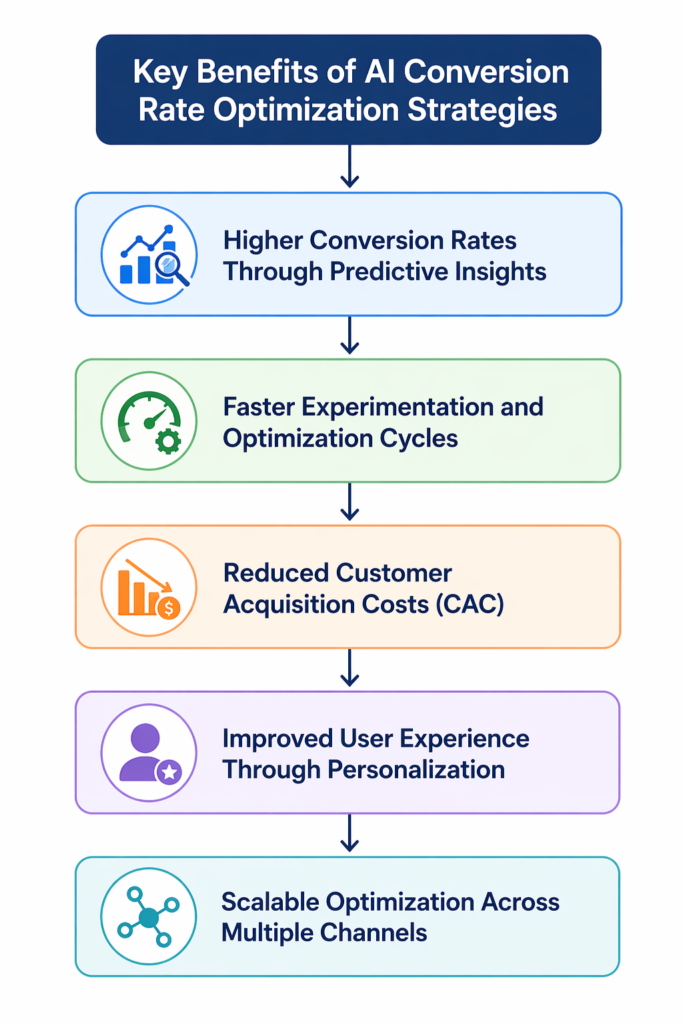
Higher Conversion Rates Through Predictive Insights
One of the most practical advantages is prediction. Instead of reacting after users drop off, AI systems try to anticipate it.
In real terms, this means:
- Identifying high-intent users early in their journey
- Flagging users who are likely to abandon checkout or signup flows
- Adjusting messaging or offers before drop-off actually happens
It’s not perfect, but even partial accuracy can improve conversion rates noticeably over time.
Faster Experimentation and Optimization Cycles
Traditional CRO often slows down because of process overhead. Build a hypothesis, design a test, wait for traffic, and analyze results. Repeat.
AI reduces friction in that loop.
What changes is the pace:
- Variations can be generated and tested more quickly
- Traffic can be shifted toward better-performing versions automatically
- Underperforming ideas get filtered out earlier, sometimes before wasting significant traffic
The result is less waiting and more continuous learning. Not necessarily more chaos, just less delay between steps.
Reduced Customer Acquisition Costs (CAC)
This benefit is easy to underestimate because it doesn’t show up as a single metric inside CRO dashboards.
But it shows up in marketing spend.
When conversion rates improve, the same traffic produces more revenue. That directly lowers acquisition cost, especially in paid channels where every click has a price attached.
Even a small lift in conversion rate can:
- Stretch ad budgets further
- Improve ROAS without increasing spend
- Reduce pressure on scaling campaigns aggressively
It’s one of those compounding effects that becomes more visible over time rather than immediately.
Improved User Experience Through Personalization
Personalization used to feel like a “nice to have.” Now it feels closer to an expectation.
AI helps here by adjusting experiences based on behavior patterns rather than static segments.
That includes:
- Changing landing page messaging depending on referral source or intent signals
- Showing different offers to different user clusters
- Recommending products or content based on live engagement patterns
The key idea is relevance. When users feel like the experience matches what they’re trying to do, friction drops naturally. No need for aggressive persuasion.
Scalable Optimization Across Multiple Channels
One of the biggest constraints in traditional CRO is scale. There’s only so much testing a team can run at once.
AI changes the scale equation.
Instead of optimizing one funnel at a time:
- Website, app, email, and ad experiences can be optimized in parallel
- Insights from one channel can influence others automatically
- Experimentation becomes a system rather than a project
This is where AI CRO starts to feel less like a tool and more like infrastructure. Something running quietly in the background, adjusting things as new data comes in.
At a broader level, AI conversion rate optimization is not replacing traditional CRO thinking. It’s extending it. The fundamentals still matter: understanding users, testing ideas, improving experience.
But the speed and complexity of modern digital behavior mean those fundamentals now need support systems that can keep up.
And that’s really where AI fits in, not as a revolution, more like an upgrade to how optimization work already happens, just faster and a bit more adaptive.
Core AI Conversion Rate Optimization Strategies
This is where AI conversion rate optimization stops being theoretical and starts showing up in day-to-day marketing work. Not always in obvious ways, either. Sometimes it’s a dashboard update, sometimes it’s a subtle shift in how traffic is distributed, and sometimes it’s just fewer “why did this drop?” moments in meetings.
What’s changing underneath is the way decisions get made inside the funnel.
AI-Powered A/B Testing and Multivariate Testing Strategies
A/B testing used to feel structured. Almost rigid. One idea at a time, clean split, wait for statistical confidence, then move on. That still exists, but AI has started bending that structure a bit.
Now the system itself starts participating in the testing loop.
- Hypotheses don’t always come from humans first anymore. Patterns in past behavior often surface ideas worth testing
- Traffic isn’t always split evenly. Better-performing variations quietly start getting more exposure
- Tests don’t really feel like they “end” in the traditional sense. They just evolve or get replaced
There’s a subtle shift here. Instead of treating testing as a project, it starts to behave more like a running system. Always adjusting, sometimes before anyone even notices a pattern fully forming.
Not perfect, though. Sometimes it over-optimizes too early, especially on low-traffic pages. That’s still a limitation worth watching.
Predictive Analytics for Conversion Rate Optimization
This is where things get a bit more interesting, and honestly, a bit more useful in day-to-day decisions.
Predictive analytics tries to answer a simple question: what is likely to happen next?
Not in a vague sense. In actual funnel behavior.
- Users who are likely to convert often show micro-signals early, scroll depth, hesitation pauses, and repeat visits
- Drop-off points can be flagged before they fully show up in reports
- Purchase intent can be estimated even when users haven’t clicked anything meaningful yet
It’s not magic. It’s pattern recognition layered over a lot of historical behavior data.
What changes in practice is timing. Instead of fixing problems after conversion drops, adjustments can be made while users are still inside the funnel. Sometimes that’s enough to shift outcomes in a noticeable way.
Still, there’s a caution here. Predictions are probabilities, not certainties. Treating them like absolute truth usually leads to bad decisions.
AI-Driven Website Personalization Strategies
Personalization used to be fairly shallow. Name tokens, maybe location-based tweaks. That’s about it.
Now it goes deeper, but also feels less obvious to users when done well.
- Content changes based on where a visitor came from and how they interacted before
- Product or content blocks adjust depending on browsing behavior, not just demographics
- Landing pages don’t stay static; different users often see slightly different versions without realizing it
The goal isn’t to overwhelm with personalization. If anything, that tends to backfire. The better implementations feel invisible. The page just feels… more relevant than expected.
There’s also a trade-off here. Too much personalization too early can feel intrusive. So there’s always a balance between relevance and restraint.
Behavioral Analytics and User Journey Optimization Using AI
This is where CRO starts feeling less like “page optimization” and more like trying to understand actual human behavior at scale.
AI helps connect signals that usually get lost in separate reports.
- Session recordings and heatmaps are analyzed not individually, but in patterns across thousands of users
- Users get grouped based on behavior sequences, not just traffic source or device
- Funnel drop-offs get traced back to interaction patterns that aren’t always obvious in raw metrics
One thing that stands out here, it’s often not one big issue causing drop-offs. It’s usually a combination of small friction points stacking up.
A slightly slow load here, a confusing CTA there, a form that feels a bit too long. Individually minor. Together, they matter.
AI doesn’t fix that automatically, but it does make it easier to see the pattern earlier.
AI-Powered Landing Page Optimization Strategies
Landing pages are still one of the highest leverage points in conversion work. That hasn’t changed.
What has changed is how optimization happens.
- Headlines and CTAs can be tested and iterated without waiting for long manual cycles
- Layout decisions are influenced more by engagement data than subjective design preference
- Sections that consistently underperform gradually get deprioritized or reworked
There’s a practical shift here. Instead of debating “what looks better,” decisions start leaning toward “what users actually respond to.”
Not always clean, though. Sometimes data pushes toward odd-looking results that still perform better. That can be uncomfortable for teams used to design-first thinking.
AI Chatbots and Conversational Conversion Optimization
Chatbots used to sit quietly in the corner of websites. Mostly support-focused, rarely strategic.
That’s changed quite a bit.
Now they often sit directly inside the conversion path.
- They qualify leads instead of static forms, doing all the work
- They handle objections in real time, which reduces hesitation at critical moments
- They guide users through decisions instead of leaving them alone with too many choices
When done well, it doesn’t feel like a bot experience. It feels closer to assisted navigation.
But there’s a catch. If the conversation feels scripted or rigid, users drop off quickly. So tone and flexibility matter more than most teams initially expect.
Dynamic Pricing and Offer Optimization Using AI
Pricing strategy used to be relatively fixed in most digital funnels. Now it’s becoming more fluid, sometimes in ways that aren’t immediately visible.
- Offers adjust based on user intent signals
- Discounts are not always uniform; they vary depending on the likelihood to convert
- Different stages of the funnel may see different incentives
This can improve conversions, but it needs careful handling. If users start noticing inconsistent pricing too often, trust can take a hit.
So the real challenge here isn’t just optimization. It’s restraint. Knowing when not to change things is just as important.
AI-Driven Email and Retargeting Optimization Strategies
Email and retargeting haven’t lost importance. If anything, they’ve become more dependent on timing and relevance than volume.
AI helps fine-tune both.
- Segmentation happens based on behavior patterns, not just broad categories
- Retargeting ads respond to deeper engagement signals, not just page visits
- Lifecycle flows adjust depending on how users behave after the first interaction
The biggest shift is timing. Messages tend to reach users closer to the moment of intent, rather than on a fixed schedule.
And that alone can make campaigns feel more natural, less forced. This usually translates into better conversion performance without needing aggressive messaging.
How to Implement AI Conversion Rate Optimization Strategies (Step-by-Step Framework)
Most AI CRO setups don’t fail because of a lack of tools. They fail because everything gets layered too fast, tracking, testing, dashboards, automation, without a clean starting point. Things look advanced on paper, but messy in practice.
A simpler way usually works better.
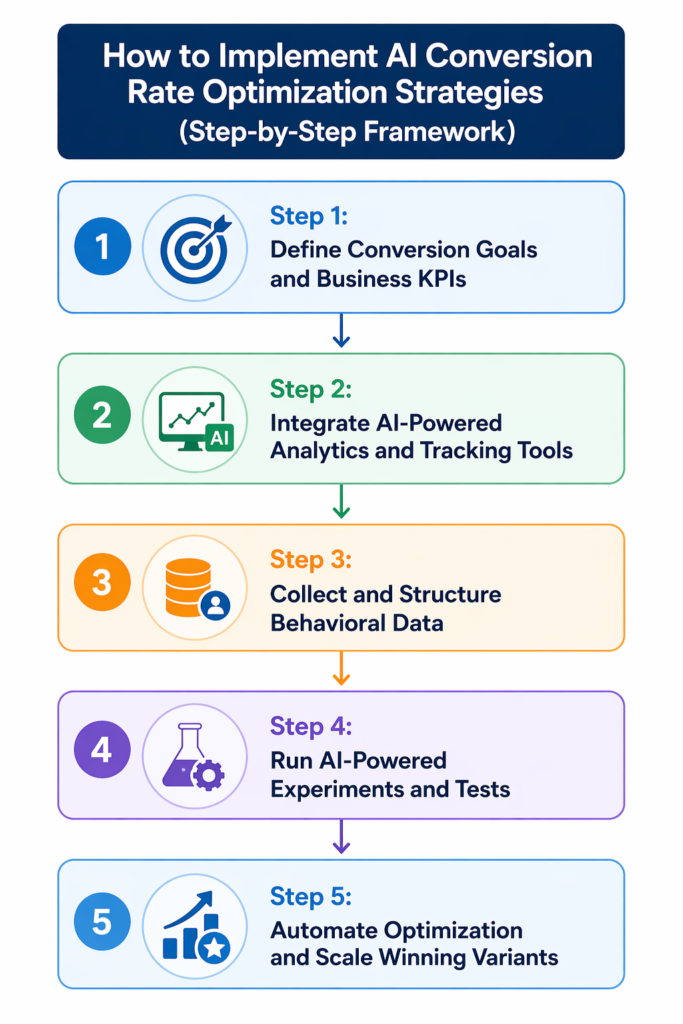
Step 1: Define Conversion Goals and Business KPIs
This sounds obvious, but it’s where a lot of confusion begins.
“Improve conversions” is not a goal. It’s a direction.
What actually helps:
- Be specific about what counts as conversion (purchase, signup, demo request, etc.)
- Separate primary conversions from micro conversions (clicks, form starts, add-to-carts)
- Decide what “good performance” actually looks like for the business stage
Without this clarity, AI ends up optimizing noise. And that happens more often than people admit.
Step 2: Integrate AI-Powered Analytics and Tracking Tools
This part is less about stacking tools and more about capturing real behavior properly.
At a minimum, the system should be able to see:
- Where users enter and exit the funnel
- How they move between pages (not just pageviews, but flow)
- Where hesitation shows up, pauses, scroll stops, repeated clicks
One small issue here can distort everything later. Incomplete tracking leads to confident but wrong conclusions. That’s a common one.
Step 3: Collect and Structure Behavioral Data
Raw data alone doesn’t help much. It just fills storage.
What matters more is structure:
- Group users by behavior patterns instead of just demographics
- Separate high-intent actions from casual browsing early
- Keep event naming consistent across funnels (this is often underestimated)
There’s usually a phase where data exists, dashboards exist, but insights still feel vague. That’s almost always a structure problem, not an AI problem.
Step 4: Run AI-Powered Experiments and Tests
This is where things start to feel more dynamic, sometimes even unpredictable.
Instead of waiting for one test to finish:
- Multiple variations can run at the same time
- Traffic gradually shifts toward better-performing options
- Weak variations fade out earlier, instead of running full cycles
It changes the pace of experimentation quite a bit.
But a small caution, speed can create noise. If everything is tested without a clear hypothesis, results start to blur together. Not every variation needs to exist just because it can.
Step 5: Automate Optimization and Scale Winning Variants
Once patterns are clear, automation starts to make sense.
- Winning versions get pushed to more traffic segments
- Similar pages can inherit successful patterns automatically
- Underperforming variants get reduced without manual intervention
At this point, CRO stops feeling like a series of experiments and starts behaving more like a system that quietly adjusts itself.
Still, full automation is rarely safe to trust blindly. Especially in high-revenue funnels. A quick human check here and there usually prevents unnecessary surprises.
AI Tools for Conversion Rate Optimization Strategies
Tools don’t solve CRO by themselves, but they do shape how fast insights appear. The key is not using too many, but using the right layer for the right job.
AI CRO Platforms for Testing and Optimization
These handle the experimentation backbone.
- Optimizely is often used for structured experimentation and large-scale testing setups
- VWO covers testing, heatmaps, and conversion tracking in one place
- Convert.com, simpler experimentation tool, usually preferred when teams want less complexity
These platforms tend to sit at the center of CRO workflows. Everything else usually connects to them in some way.
AI Personalization and Experience Tools
This layer decides what users actually see.
- Dynamic Yield, strong focus on real-time personalization across web experiences
- Mutiny is often used in B2B funnels, where messaging needs to shift by audience type
Personalization tools are powerful, but only when used carefully. Too much variation can confuse more than it helps.
Behavioral Analytics Tools Powered by AI
This is where user behavior becomes readable instead of just stored.
- UXCam, commonly used for mobile app behavior tracking
- Hotjar, heatmaps, recordings, and behavior patterns that show where users struggle
- FullStory, deeper session-level analysis across journeys
Most CRO insights actually start here. Before any testing, before any optimization.
AI Marketing and Funnel Optimization Tools
These connect CRO improvements back to revenue and performance.
- HubSpot, CRM and automation platform that ties marketing behavior to pipeline outcomes
- Triple Whale, especially common in eCommerce for attribution and performance tracking
This layer often decides whether CRO wins actually translate into business decisions.
Enroll Now: AI-Powered Performance Marketing Course
Use Cases of AI Conversion Rate Optimization in Real Businesses
AI CRO shows up differently depending on the business model. But the underlying idea stays similar: reduce friction in the funnel using behavior signals.
Some practical applications:
AI-powered landing page experiments in eCommerce
Product pages adapt depending on how users arrived. Ad traffic, organic traffic, and returning users all see slightly different experiences. Sometimes, small changes, but they add up.
SaaS funnel optimization using predictive analytics
Free trial users are scored based on actions inside the product. Not all users are treated equally, and that changes onboarding flows quite a bit.
AI-driven product recommendation engines
Recommendations evolve based on browsing behavior instead of staying static or generic.
Lead scoring and qualification using machine learning
Instead of fixed scoring rules, behavior patterns decide lead quality in real time. It removes a lot of manual guesswork.
Checkout optimization for reducing cart abandonment
Drop-offs are analyzed more closely; sometimes it’s form friction, sometimes pricing hesitation, sometimes just timing. AI helps separate these signals.
Across all of these, the pattern is the same. Better timing leads to better conversions, even when the changes themselves are small.
Integrating AI with Traditional CRO Strategies
There’s a tendency to frame this as “old vs new,” but in practice, it’s usually a mix. Pure AI-driven CRO without structure tends to drift. Pure traditional CRO without adaptability tends to move slowly.
The balance sits somewhere in between.
Combining Human Hypotheses with Machine Learning
Human input still matters, especially for understanding context that data doesn’t fully capture.
- Humans usually define the direction of testing
- AI helps validate patterns at scale
- Both loops feed into each other over time
It’s less about replacing judgment and more about reducing blind spots.
Turning Historical CRO Data into Predictive Models
Most teams already have years of experiments sitting in spreadsheets or dashboards. Not always used properly.
When structured well, that history can:
- Reveal patterns that repeat across different funnels
- Highlight what actually works consistently (not just once)
- Feed models that predict future user behavior more accurately
There’s a lot of untapped value here, honestly. It just takes cleanup before it becomes useful.
AI-Assisted Experiment Design vs Manual Testing
Experiment design is slowly changing shape.
Instead of purely manual ideas:
- AI suggests variations based on past performance gaps
- Low-impact ideas get filtered earlier
- Stronger hypotheses surface faster
Still, not everything should be automated. Some of the best CRO ideas still come from observing users directly, not just analyzing them.
Scaling CRO Programs Across Teams Using AI Automation
As teams grow, CRO often becomes fragmented. Different teams test different things, and insights don’t always flow cleanly.
AI helps reduce that friction:
- Learnings from one funnel can influence another automatically
- Testing patterns become more standardized
- Optimization stops being isolated work and becomes a shared infrastructure
It doesn’t remove coordination needs, but it reduces the chaos that usually comes with scaling.
Overall, this phase of AI CRO isn’t about replacing what already works. It’s more about smoothing out the gaps between insight and action, between testing and learning, between data and decisions. And those gaps, even if small, are often where most conversion losses happen.
AI Conversion Rate Optimization vs Traditional CRO
This comparison isn’t really about one replacing the other. It’s more about how the rhythm of optimization has changed. Traditional CRO still has value, especially in structured environments, but the speed and adaptability gap is becoming harder to ignore.
Rule-based testing vs AI-driven optimization
Traditional CRO usually follows fixed rules. You set hypotheses, run controlled tests, and wait for clean results. It’s methodical, sometimes slow, but predictable.
AI CRO works differently:
- Rules are not fully fixed; they adapt based on incoming data
- Variations evolve during the test instead of staying static
- Decisions can shift mid-experiment based on early signals
The trade-off is control vs speed. One feels stable, the other feels more fluid.
Static insights vs real-time insights
Traditional CRO insights often come after the fact. Reports, summaries, and post-test analysis are useful, but delayed.
AI-based systems lean toward real-time interpretation:
- User behavior is analyzed as it happens
- Early signals influence optimization before full cycles end
- Patterns are spotted while traffic is still active
It’s a subtle shift, but it changes how fast teams can react to issues in a funnel.
Manual segmentation vs behavioral clustering
Segmentation used to be fairly straightforward: age, location, device type. That still has use, but it’s limited.
AI CRO moves toward behavioral clustering:
- Users grouped by how they behave, not just who they are
- Patterns based on interaction depth, hesitation, and navigation paths
- Clusters that shift dynamically instead of staying fixed
This often reveals groups that weren’t obvious before. Sometimes surprising ones too.
Slow iteration vs continuous optimization
Traditional CRO runs in cycles. Test – wait – analyze – repeat. It works, but it’s naturally limited by time.
AI CRO feels more continuous:
- Multiple tests running in parallel
- Underperforming variants removed early
- Winning patterns applied across other parts of the funnel quickly
Not everything is faster for the sake of speed, though. The real change is that optimization doesn’t fully stop anymore. It just keeps adjusting.
Common Mistakes in AI Conversion Rate Optimization Strategies
Even with better tools, mistakes don’t disappear. They just change shape a bit. Most issues in AI CRO come from how it’s used, not the technology itself.
Over-relying on automation without human validation
One of the most common pitfalls. Automation can process patterns, but it doesn’t always understand context.
What usually goes wrong:
- Accepting AI suggestions without questioning them
- Letting automated changes run without review on key pages
- Ignoring brand or user experience implications
AI helps decision-making, but it shouldn’t replace judgment completely. Especially in high-impact funnels.
Ignoring data quality and tracking issues
This one is less visible, but it breaks everything quietly.
If tracking is incomplete or inconsistent:
- Behavioral signals become unreliable
- Predictions lose accuracy
- Optimization starts by improving the wrong things
Even small tracking gaps can distort outcomes more than expected. It’s not a glamorous issue, but it’s a foundational one.
Running too many tests without clear hypotheses
AI makes testing easier, which sometimes leads to over-testing.
Common pattern:
- Too many variations running at once
- Weak or unclear hypotheses behind experiments
- Results that are hard to interpret or act on
More tests don’t always mean better insights. Sometimes it just creates noise that slows decision-making.
Poor segmentation leading to inaccurate AI insights
AI systems depend heavily on how users are grouped and labeled.
When segmentation is weak:
- High-intent users get mixed with low-intent traffic
- Predictive models become less reliable
- Personalization starts feeling inconsistent
It’s one of those issues that quietly reduces performance without obvious warning signs.
KPIs to Measure AI Conversion Rate Optimization Success
AI CRO only matters if it improves measurable outcomes. But not every metric tells the full story on its own. It’s usually a combination that gives clarity
Conversion rate improvement
The most direct signal. Still important, but not always enough alone. Sometimes conversion rates go up while quality drops slightly, so context matters.
Revenue per visitor (RPV)
This is often a more balanced metric. It captures both conversion rate and order value in one view.
- Helps understand real business impact
- Reduces over-focus on vanity conversion gains
- Works well across eCommerce and SaaS funnels
Customer acquisition cost (CAC)
When AI CRO works well, CAC usually trends down over time.
- Better conversion efficiency means less wasted traffic
- Paid campaigns become more effective without increasing spend
- Funnel leaks get reduced at multiple stages
Bounce rate reduction
Not always the main focus, but still useful as a supporting signal.
- Indicates better landing page relevance
- Helps identify early-stage friction
- Often improves alongside personalization efforts
Average order value (AOV)
Especially relevant in eCommerce environments.
- Influenced by recommendation systems
- Affected by pricing and offer optimization
- Reflects how well upsells and cross-sells are working
No single KPI tells the full story. The real picture usually comes from how these metrics move together over time.
Future of AI Conversion Rate Optimization Strategies
AI CRO is already changing workflows, but the next phase looks less like “tools assisting optimization” and more like systems handling large parts of it continuously.
Fully autonomous CRO systems
There’s a clear direction toward systems that:
- Run experiments automatically
- Adjust variations in real time
- Learn from past performance without manually setting up each time
Not fully hands-off in practice yet, but moving closer in that direction.
Real-time adaptive websites
Websites are gradually becoming less static.
- Layouts shift based on user intent signals
- Messaging adapts during the session itself
- Content reorganizes depending on engagement patterns
It’s subtle, but users already experience early versions of this without always noticing.
Hyper-personalized user journeys at scale
Personalization is moving beyond basic segmentation.
- Entire journeys adjust based on behavior history
- Different users experience different flows even within the same funnel
- Messaging, timing, and offers align more closely with intent signals
The challenge here is balance; too much personalization can feel inconsistent if not handled carefully.
AI replacing manual experimentation workflows
This doesn’t mean CRO teams disappear. It means the workflow changes.
- Less manual setup of tests
- Less time spent analyzing basic patterns
- More focus on strategy, interpretation, and direction
In many cases, CRO becomes less about running experiments and more about guiding systems that already run them.
Across all these shifts, the direction is fairly clear. Optimization is becoming continuous instead of cyclical, and decision-making is moving closer to real-time behavior rather than delayed reports. The structure of CRO doesn’t disappear; it just becomes more fluid underneath.
FAQs: AI Conversion Rate Optimization Strategies
What is AI conversion rate optimization?
AI conversion rate optimization is basically using machine learning and predictive systems to improve how people move through a website or funnel. Instead of running isolated tests and waiting for results, the system keeps learning from live behavior. It quietly tweaks experiences so users find it easier to convert, without needing constant manual adjustments.
How does AI improve conversion rates?
AI improves conversion rates by picking up patterns that usually slip through manual analysis. Small things like hesitation before clicking, repeated scrolling, or sudden exits start forming signals. When those signals are understood properly, pages can adjust in ways that reduce friction. Not dramatic changes, more like small, timely nudges that add up.
Is AI CRO better than traditional A/B testing?
Not exactly better, more like a different pace and style. Traditional A/B testing is still useful when clean comparisons are needed. It’s structured, predictable. AI CRO, though, doesn’t really wait around for full test cycles. It keeps adjusting as data comes in. Sometimes that speed helps, sometimes it feels a bit less controlled.
What tools are best for AI CRO?
There’s no single “best” stack here, which is honestly where most teams get stuck at first. Tools like Optimizely, VWO, and Convert.com handle experimentation quite well. On the behavior side, platforms like FullStory or Hotjar give deeper context. And personalization layers like Dynamic Yield or Mutiny sit on top of it all.
Can small businesses use AI conversion rate optimization strategies?
Yes, and this is becoming more realistic than it used to be. A few years ago, this felt like enterprise-only territory, but not anymore. Even smaller setups can use basic AI-driven tools to track behavior and personalize simple parts of the experience. Nothing too complex is needed at the start, just clean tracking and focus.
How does AI personalization increase conversions?
Personalization works because people respond better when things feel relevant. AI looks at behavior patterns, what someone clicks, skips, or returns to, and adjusts what they see next. It might be content, it might be timing, or sometimes just the way an offer is presented. That small relevance shift often improves conversion rates quietly
What industries benefit most from AI CRO?
Any industry with a structured funnel sees impact, but some feel it more strongly. eCommerce is the obvious one, SaaS too, and finance tends to benefit a lot because decisions are more considered. Even education platforms are using it now. The common factor is simple: lots of user steps where drop-offs happen.
Does AI CRO require coding skills?
Not really in most cases. Modern tools are designed so marketers can run experiments and changes without touching code. There’s usually a visual interface for testing and personalization. That said, when setups get more advanced, like custom tracking or deeper integrations, some technical help becomes useful
How does AI CRO use machine learning to improve website conversions?
Machine learning in CRO is mostly about pattern recognition at scale. It looks at thousands of user actions and tries to connect them to outcomes like conversions or drop-offs. Once those patterns are clear, the system starts predicting behavior and adjusting experiences while users are still active on the site.
What is the difference between AI CRO and predictive analytics in marketing?
Predictive analytics is more about forecasting. It answers questions like who might convert or who might drop off. AI CRO goes one step further. It doesn’t just predict, it acts on those predictions by changing the actual experience in real time. So one is observation, the other is action layered on top.
How long does it take to see results from AI conversion rate optimization strategies?
It really depends on traffic and how clean the data is. High-traffic sites can see early movement within days, but that doesn’t always mean stable results. In lower traffic environments, it takes longer for patterns to settle. Over time, though, improvements tend to compound instead of appearing all at once.
Can AI CRO tools automatically run A/B tests without human input?
They can automate a lot of the process, setting variations, shifting traffic, and even pausing weak performers. But leaving it completely unattended is risky. There’s still a need for direction. Otherwise, the system optimizes small things without understanding bigger business goals or brand context, which can drift off track.
What data is required to implement AI-powered conversion rate optimization?
At the core, it’s behavioral data, clicks, scroll depth, page views, session duration, and funnel actions. On top of that, actual conversion events like purchases or sign-ups give the model something to anchor to. The real issue usually isn’t quantity; it’s consistency in how that data is tracked.
Is AI CRO effective for B2B lead generation websites?
Yes, often even more than expected. B2B funnels are longer and involve multiple decision layers. AI helps by spotting high-intent behavior early and adjusting messaging or lead capture accordingly. It also helps filter leads better, so sales teams spend time on prospects that actually matter.
How does AI improve landing page performance compared to manual optimization?
Manual optimization usually relies on assumptions or test results that take time to validate. AI works differently; it watches real user behavior continuously. If something feels off, like a confusing section or weak CTA, it picks that up faster and adjusts layout or messaging based on actual interaction signals.
What are the risks or limitations of using AI in conversion rate optimization?
The biggest issue usually starts with data quality. If tracking is incomplete or inconsistent, the system learns the wrong patterns. Another risk is over-automation, where changes happen too fast without enough review. And with smaller datasets, results can feel unstable or less reliable than expected.
How does AI CRO help reduce cart abandonment in eCommerce stores?
AI CRO looks closely at checkout behavior and tries to understand where hesitation happens. Sometimes it’s too many steps, sometimes unclear pricing, sometimes the timing of prompts. Once those points are identified, small adjustments like simplifying the flow or adjusting the messaging can help users complete the purchase instead of dropping off.
Can AI conversion rate optimization strategies work without large datasets?
They can, but with limits. Smaller datasets still allow basic optimization and simple personalization, and that alone can improve performance. The challenge is accuracy; with less data, predictions are less stable. As traffic grows, the system becomes more confident and starts spotting patterns more reliably.