
Most marketing failures aren’t creative failures. They’re conceptual ones. Someone builds a campaign around a product feature nobody cares about. A brand runs aggressive promotions instead of building trust. A company optimises for reach when it should be optimising for retention.
Table of Contents
The core concepts of marketing exist to prevent exactly this. These aren’t abstract theories. They’re the operating principles that separate campaigns that actually move the needle from ones that just make noise. If you’ve ever wondered why some brands seem to effortlessly earn loyalty while others spend heavily and get little back, the answer almost always comes back to how well they understand these foundations.
This post breaks down the essential marketing concepts — not as textbook definitions, but as working frameworks you can use right now.
What is Marketing?
Marketing is how businesses connect with people who need their products or services. It’s not just about selling—it’s about understanding customer needs and offering the right solutions.
It starts with identifying a problem or desire. Businesses then create products, services, or experiences to fulfill those needs. Marketing helps communicate these solutions to the right audience through advertising, promotions, social media, and more. It also includes pricing, packaging, and product placement to attract and retain customers.
Marketing happens both online and offline. Digital marketing uses websites, emails, and social media, while traditional marketing includes TV ads, billboards, and print media.
In short, marketing is the art of making people say, “I need that!” And when done right, it doesn’t just drive sales—it builds trust, loyalty, and a lasting connection with your target market.
Also read: Scope of Marketing: Nature, Importance and Career Opportunities
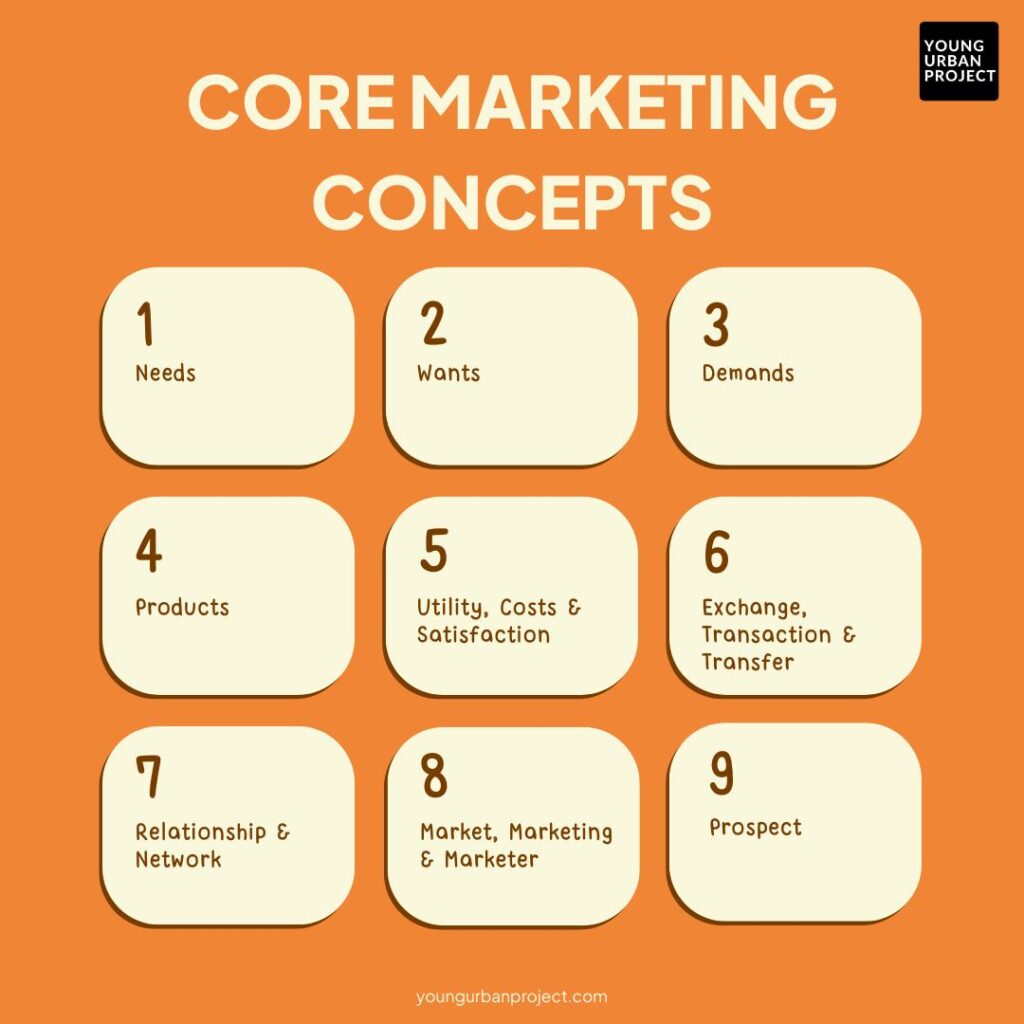
Core Marketing Concepts
1. Needs
Needs are basic human requirements. They include things like food, water, shelter, and safety. These are essential for survival. Without needs, life would be difficult. Needs are not created by marketers. They exist naturally. Marketers identify these needs. They then try to offer solutions. Needs are universal. Everyone has them. They are the starting point for all marketing activities.
For example: A person needs food, water, and shelter to live. Without these, survival is hard. Businesses study basic needs to create products, like bottled water or energy bars, that fulfill them.
2. Wants
Wants are desires for specific things. They are shaped by culture and personality. To give an example, one person may want a burger, another a salad. Wants go beyond basic needs. They are not necessary for survival. Marketers influence wants. They create products that appeal to these desires. Wants can change over time. They vary from person to person. Wants drive consumer choices.
For example: A person needs food but may want a pizza. Wants depend on culture, trends, and lifestyle. Companies create products that match people’s wants, like different pizza flavors or diet-friendly options.
3. Demands
Demands are wants backed by buying power. People may want many things. But they only demand what they can afford. Like, someone may want a luxury car. But they demand a budget car. Demands depend on income and resources. Marketers focus on turning wants into demands. They offer affordable options. Demands reflect what people are willing to pay for.
For example: A person may want a luxury car, but only those who can afford it create demand. Demand exists when a want is backed by the ability and willingness to pay.

Enroll Now: Advanced Digital Marketing Course
4. Products
Products are items that satisfy needs or wants. They can be physical goods, services, or ideas. To give an example, a phone is a product. So is a haircut. Products solve problems. They make life easier or better. Marketers create and promote products. They ensure products meet customer needs. Products must offer value. They should be better than competitors. Products are the core of marketing.
For example: A smartphone is a product designed to meet communication and entertainment needs. It has features like cameras, apps, and internet access, making it valuable for both work and personal use.
5. Utility, Costs & Satisfaction
Utility is the value a product offers. It includes form, time, place, and ownership. Costs are what customers give up to get the product. Satisfaction is how happy customers are with the product. Marketers aim to maximize utility. They try to reduce costs. High satisfaction leads to repeat purchases. Balancing these three is key to success.
For example: A customer buys a coffee for convenience and taste (utility). The price is the cost. If the coffee meets expectations, the customer feels satisfied and may buy again in the future.
6. Exchange, Transaction & Transfer
Exchange is getting something by offering something else. Like, money for a product. A transaction is a completed exchange. It involves a deal between two parties. Transfer is giving something without expecting anything in return. Marketing focuses on exchanges and transactions. These are the basis of business. Transfers are less common in marketing.
For example: A customer gives money to buy a book (exchange). The bookstore gives the book in return (transaction). If the book is gifted later, ownership changes without payment (transfer).
7. Relationship & Network
Relationship marketing builds strong connections with customers. It focuses on long-term satisfaction. Networks are groups of people or businesses connected for mutual benefit. Good relationships lead to loyalty. Networks help in reaching more customers. Both are important for growth. They create trust and repeat business. Marketers invest in both to succeed.
For example: A business builds relationships by offering discounts to loyal customers. A network forms when satisfied customers recommend the brand to friends, creating trust and expanding the company’s reach.
8. Market, Marketing & Marketer
A market refers to a location, either physical or digital, where buyers and sellers interact. Marketing involves promoting and selling goods or services. A marketer is someone who does this work. They identify customer needs. They create strategies to meet those needs. Markets are competitive so marketing must be effective. Therefore marketers must understand their audience.
For example: The market includes all buyers and sellers of smartphones. Marketing involves promoting phones through ads. A marketer studies customer needs and creates campaigns to attract buyers and boost sales.
Enroll Now: Performance Marketing Training
9. Prospect
A prospect is a potential customer. They show interest in a product, but they haven’t bought it yet. Marketers identify prospects. They try to convert them into buyers. Prospects are valuable. They represent future sales. Marketers use various tools to attract prospects. These include ads, emails, and social media. Converting prospects is a key goal in marketing.
For example: A person interested in buying a gym membership is a prospect. If convinced, they become a customer. Businesses target prospects with offers, like free trials, to turn them into buyers.
What Are Needs, Wants, and Demands in Marketing?
Needs are states of deprivation. Wants are the specific forms needs take. Demands are wants backed by the ability and willingness to pay.
That three-part distinction sounds simple, but most marketers blur it, and that’s where strategies go wrong.
A person needs nutrition. They want a burger from McDonald’s. They demand it when they have money and are ready to buy. Marketing that treats all three as the same ends up either building products nobody values or pitching to people who can’t or won’t buy.
Philip Kotler, whose work at the Kellogg School of Management has shaped modern marketing education, put it plainly: understanding the gap between what people need and what they’re willing to pay for is where the real marketing opportunity lives. Swiggy didn’t invent hunger. It identified that people needed food, wanted convenience, and were willing to pay a delivery premium for it. That’s the gap it filled.
The practical consequence here is that your product or service needs to be built around genuine needs, not just wants. Wants can be manufactured through advertising. But marketing a product that serves no real need is an uphill battle from day one.
Needs are fundamental states of deprivation, wants are culturally shaped expressions of those needs, and demands are wants backed by purchasing power. Every effective marketing strategy starts by identifying which of these three it is actually addressing. Marketing that confuses needs with wants tends to build products that feel relevant but don’t convert.
What Is Customer Value and Why Does It Drive Every Decision?
Customer value is the difference between what a buyer receives and what they give up to get it.
That sounds like a simple equation. In practice, it’s the most contested number in any marketing team’s spreadsheet.
What a customer receives includes the product itself, but also the experience of buying it, the service they get after, and how owning or using it makes them feel. What they give up includes money, yes, but also time, mental effort, and opportunity cost. A product can be cheaper than a competitor’s and still feel like poor value if it takes three steps to purchase and two support calls to actually work.
Nykaa understood this early. The value wasn’t just the products on the platform. It was the editorial content, the beauty tutorials, the product filters, the curated brand selection. Customers weren’t giving up money; they were getting a buying experience that felt expert and personalised. That’s why Nykaa built loyalty in a category where switching costs are near zero.
Value also shifts. What felt like excellent value in 2020 might feel ordinary in 2026. Marketers who stop monitoring perceived value eventually find themselves defending market share they don’t understand losing.
What Is the Exchange Process in Marketing?
Marketing is, at its core, about facilitating exchanges. An exchange happens when two parties each give something to receive something they value more.
You spend money. You get a product. The brand gets revenue. Both parties are better off than they were before the exchange. That’s the condition marketing is designed to create.
But exchange isn’t just transactional. A brand that creates one successful transaction and never sees the customer again has facilitated an exchange. A brand that creates an ongoing relationship has built something far more valuable. The distinction between transaction and relationship is one of the oldest debates in marketing, and it still matters.
D2C brands like boAt have built their entire model around making the first exchange easy (affordable, accessible products, aggressive pricing) and the ongoing relationship sticky (community, co-creation, social identity). A single sale isn’t the goal. A customer who buys three, four, five times across a product lifetime is.
What Is a Market, and Who Does It Actually Include?
A market is a set of actual and potential buyers for a product or service.
Not everyone is your market. Honestly, most people aren’t. And one of the most common early mistakes in marketing strategy is defining the market too broadly in the hope of capturing more people.
Your market is made up of people who have the need, the purchasing power, and the willingness to buy. All three conditions have to be met. A teenager who wants a luxury watch but has no money is not in the market for a luxury watch. A wealthy person who genuinely doesn’t want a car isn’t in the market for one either, regardless of how good your car ad is.
This matters practically because it determines where you spend. If your market is urban professionals aged 25-35 who care about sustainability, you’re not buying outdoor billboard space in tier-3 cities. You’re showing up on LinkedIn, running YouTube pre-rolls on finance channels, and creating content that speaks to people who already think about the trade-offs they make when they buy.
Zepto’s entire market definition was specific: urban customers in top-tier Indian cities who wanted grocery delivery in under 10 minutes and were willing to pay a premium for it. Not all grocery shoppers. A very specific slice of them. That specificity is what let them build product, logistics, and marketing around one coherent promise.
What Is the Marketing Concept?
The marketing concept holds that achieving organizational goals depends on identifying the needs and wants of target markets and delivering satisfaction better than competitors.
It sounds obvious. It wasn’t always the default. For most of the 20th century, the dominant logic was the selling concept: make the product first, then find ways to convince people to buy it. The marketing concept flips that. Find out what people want, then build for it.
The shift from selling concept to marketing concept is why customer research became central to business strategy. Companies that operate on the selling concept push what they have. Companies that operate on the marketing concept build what the market wants, then communicate it clearly.
There’s a version of this failure that shows up in every industry. A tech company builds a product full of features its engineers love and its customers never asked for. A fashion brand launches a collection based on what the design team wanted to create, not what buyers were looking for. These aren’t execution failures. They’re conceptual failures.
The marketing concept also comes with a caveat: consumer wants aren’t always in consumers’ long-term best interests. That’s where the societal marketing concept comes in, which we’ll cover below.
The marketing concept states that business success depends on understanding and satisfying target market needs better than competitors do. It’s the foundational shift from product-first to customer-first thinking. Brands that operate on the selling concept push products. Brands operating on the marketing concept build for demand that already exists.
What Are the 4Ps of Marketing (The Marketing Mix)?
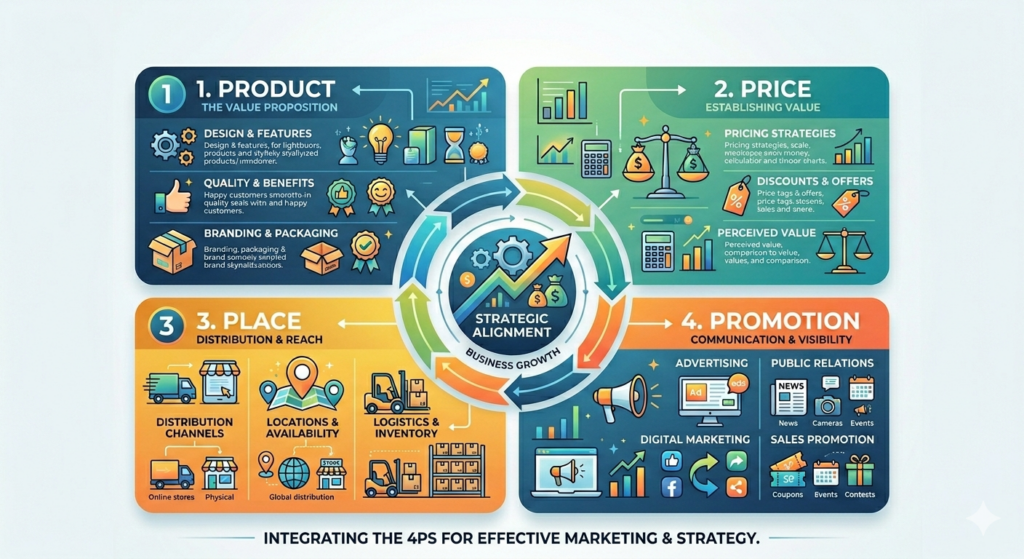
The 4Ps of marketing, also called the marketing mix, are Product, Price, Place, and Promotion. Together they describe every decision a marketer makes about how to bring an offering to market.
Product
Product is what you’re selling, including the tangible item, the packaging, the brand identity, the warranties, and the overall experience. Product decisions include what features to include, what quality level to deliver, and what category the product belongs to in the customer’s mind.
Apple’s iPhone isn’t just a phone. It’s an aesthetic object, a status signal, a productivity tool, and a gateway to an integrated software environment. All of those are product decisions, not just engineering ones.
Price
Price is what customers pay, but it’s also what it signals. A premium price communicates quality. A low price communicates accessibility or, in some contexts, low quality. Pricing strategy includes decisions around list price, discounts, credit terms, and bundling.
The right price isn’t the lowest price. It’s the price that best reflects the value delivered and positions the product correctly relative to competitors. Mamaearth priced its products to undercut international clean beauty brands while signalling quality through ingredient transparency. That pricing was a positioning decision, not just a financial one.
Place
Place covers distribution: how and where the customer accesses the product. Online, offline, direct, through a retailer, through an aggregator. Every channel decision is a tradeoff between reach, margin, and control.
D2C brands choose direct channels to own the customer relationship and protect margins. Mass market brands choose broad retail distribution to maximise accessibility. Neither is wrong. Both are deliberate.
Promotion
Promotion is how you communicate the product’s value to the target market. Advertising, PR, social media, content marketing, sales promotions, direct marketing, events. The promotional mix determines how often, where, and in what form customers encounter your brand message.
A common mistake here is treating promotion as the only lever. It’s one of four. A promotion campaign cannot fix a product that’s priced wrong for its market, or placed in channels where the target customer doesn’t shop.
The 4Ps of marketing — Product, Price, Place, and Promotion — form the marketing mix. Every decision about how to bring a product to market falls into one of these four categories. Strong marketing strategy requires all four to be aligned. A great product at the wrong price, in the wrong channel, with weak communication will underperform.
How Segmentation, Targeting, and Positioning Shape Your Strategy
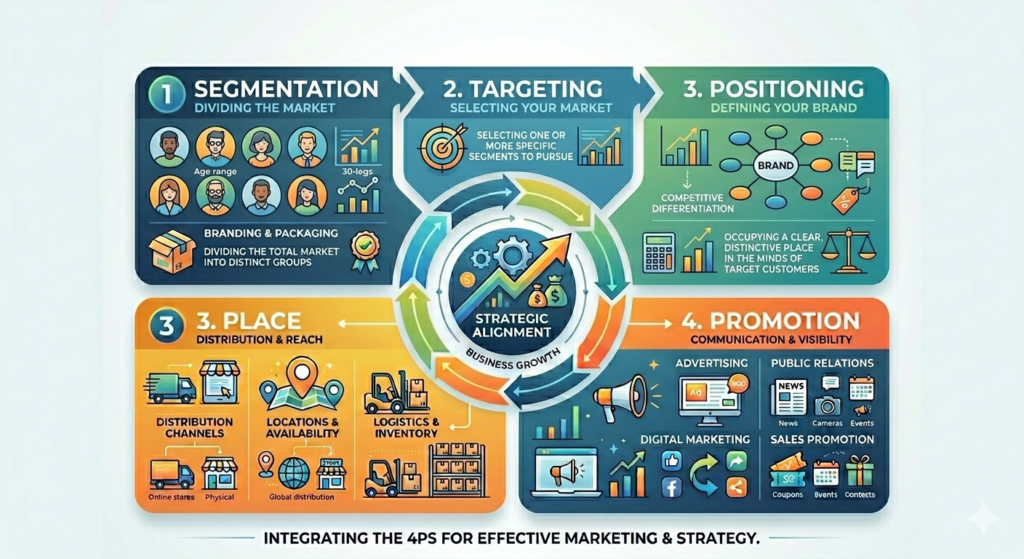
Segmentation, targeting, and positioning — usually called STP — is how marketers decide who they’re for and what they stand for.
Segmentation divides the total market into distinct groups with different needs, characteristics, or behaviors. Geographic, demographic, psychographic, and behavioral segmentation are the standard lenses.
Targeting decides which segment (or segments) to focus on. Not everyone, even if “everyone” technically needs your product. Targeting means making the deliberate choice to go deep with a specific group rather than shallow with everyone.
Positioning defines how you want your brand to live in the mind of your target customer relative to alternatives. Volvo owns safety. BMW owns performance. Mercedes owns prestige. These are positioning choices that every campaign, product design, and pricing decision has to reinforce.
The STP process is where abstract market knowledge becomes a strategy. Without it, you end up running campaigns that speak to no one in particular and spending budgets that could have built genuine loyalty in a specific community.
From what we’ve seen with YUP learners, the segmentation step is where most early mistakes happen. People either segment too broadly (millennials who like fitness) or too narrowly (women aged 27 in Mumbai who do yoga on weekdays). Good segmentation finds the natural seams in demand that align with what you can actually serve.
What Is Customer Relationship Management in Marketing?
Customer Relationship Management (CRM) in marketing refers to the strategies, practices, and tools used to manage and strengthen a company’s interactions with existing and potential customers throughout the customer lifecycle.
CRM isn’t just a software category. It’s a philosophy. The underlying idea is that acquiring a customer is a starting point, not the goal. The goal is to build a relationship that keeps them buying, reduces your cost to serve them, and turns them into advocates who bring others in.
The economics of CRM make the case without much debate. According to research published by Bain & Company, increasing customer retention rates by 5% can increase profits by 25% to 95%, depending on the industry. Retaining customers is consistently cheaper than acquiring new ones. Brands that invest heavily in acquisition while neglecting existing customers are running a leaky bucket strategy.
CRM in practice looks like:
- Personalised email sequences triggered by customer behaviour
- Post-purchase follow-up that helps customers get more value from the product
- Loyalty programmes that reward repeat behaviour without training customers to only buy on discount
- Customer service that resolves issues quickly and humanly
Swiggy One, Zomato Gold, and Amazon Prime are all CRM mechanisms. They’re not just loyalty programmes. They’re tools that change customer behaviour, increase purchase frequency, and raise the cost of switching to a competitor.
The Societal Marketing Concept: Does Purpose Still Matter?
The societal marketing concept extends the marketing concept by adding a third consideration: the long-term wellbeing of society.
In plain terms, it argues that brands shouldn’t just satisfy individual consumers. They should do so in a way that doesn’t harm the broader community or the environment.
This used to feel like a nice-to-have. In 2026, it’s a positioning decision with real commercial consequences. A 2023 report by NielsenIQ found that 78% of global consumers say a sustainable lifestyle is important to them. Brands that operate with no environmental or ethical accountability are increasingly visible to customers who care about these things, and they pay for it in trust.
That said, purpose-washing is real. Brands that claim social values but don’t operationalise them tend to face faster backlash than brands that never claimed them at all. The societal marketing concept isn’t a communications strategy. It’s a business model constraint. It means building products that don’t exploit customers, using supply chains that don’t cause harm, and communicating honestly about what you do and don’t do.
Tata as a conglomerate has built 150 years of brand equity partly on this principle. It’s not a coincidence. Long-term brand value and long-term social accountability tend to move together.
Conclusion
Marketing is more than just promoting a product or service—it’s about understanding people, their needs, and how to provide value. The core concept of marketing helps businesses build strong relationships with customers and create effective marketing strategies. By recognizing the difference between needs, wants, and demands, businesses can offer the right solutions. Understanding exchange, transactions, and networks helps in building customer trust. A good marketer knows how to position a product, communicate its value, and keep customers engaged.
In today’s digital world, marketing is constantly evolving. Businesses must adapt to new trends, technologies, and customer behaviors to stay ahead. Whether through traditional methods or digital marketing, applying these core marketing concepts is key to success. Mastering marketing basics gives you a strong foundation to grow a brand, attract the right audience, and build lasting connections. When done right, marketing is not just about selling—it’s about creating value and trust.
FAQs: Core Concepts of Marketing
1. What are the core concepts of marketing?
The core concepts of marketing include needs, wants, and demands; products and services; utility, costs, and satisfaction; exchange, transactions, and transfer; relationships and networks; markets, marketing, and marketers; and prospects. These marketing concepts help businesses understand customer behavior and create effective marketing strategies.
2. Why is understanding customer needs important in marketing?
Understanding customer needs helps businesses create products or services that solve real problems. When a company knows what customers want, it can offer better solutions, improve customer satisfaction, and build long-term relationships.
3. How do “needs,” “wants,” and “demands” differ in marketing?
Needs are basic human requirements essential for survival (e.g., food, water). Wants are desires shaped by culture and personal preferences (e.g., pizza, smartphone). Demands are wants backed by purchasing power—people desire something and can afford it. Marketers aim to fulfill needs, influence wants, and create demand by offering products consumers can afford and desire.
4. What is the role of exchange in marketing?
Exchange is the process where a customer gives something valuable (like money) in return for a product or service. It’s a key part of marketing that ensures businesses provide solutions customers are willing to pay for.
5. How does digital marketing fit into core marketing concepts?
Digital marketing uses online platforms like social media, search engines, and email to apply core marketing concepts. It helps businesses connect with their target audience, understand their needs, and create personalized marketing strategies.
6. Why is relationship marketing important?
Relationship marketing focuses on building strong, long-term customer relationships rather than just making one-time sales. It increases customer loyalty, improves brand reputation, and boosts repeat business.