
Most brands that struggle with growth aren’t failing at tactics. They’re failing at something more fundamental: they’re using the wrong marketing concept for their business stage, their customer, and their market.
Table of Contents
The five marketing concepts aren’t just academic theory. They explain why Apple doesn’t compete on price, why Mamaearth built an audience before it built a distribution network, and why some businesses keep pouring money into ads that convert once but never build anything lasting.
Understanding these marketing concepts gives you a mental model for diagnosing what’s broken and what to fix. Whether you’re setting strategy for a D2C brand or running campaigns for a product with a six-month sales cycle, the concept you operate from determines almost everything downstream.
What is a Marketing Concept?
A marketing concept is a business philosophy that determines how a company creates, delivers, and communicates value to its customers.
That definition sounds clean. But in practice, your marketing concept is the answer to a much blunter question: does your business exist to sell what it makes, or does it make what customers actually want?
Every strategy, channel decision, and campaign ultimately traces back to one of five positions on that spectrum. Companies that are clear on their position move faster and waste less. Companies that are fuzzy, or that accidentally operate on the wrong concept for their context, tend to fix symptoms without ever fixing the root.
A marketing concept is a guiding business philosophy that shapes how a company approaches creating value and reaching its customers. There are five main marketing concepts: the production concept, the product concept, the selling concept, the marketing concept, and the societal marketing concept. Each reflects a different set of assumptions about what drives customer decisions and what businesses should optimise for.
Also Read: Modern Marketing Concepts
The 5 Types of Marketing Concepts
1. Production Concept: Efficiency and Mass Production
The production concept holds that customers prefer products that are widely available and affordable, so the best strategy is to maximise production efficiency and lower costs.
It’s the oldest of the five marketing concepts, and it still applies in specific contexts. Think commodity markets, price-sensitive buyers, and high-volume, low-margin categories.
Hindustan Unilever runs parts of its business on the production concept. For products like Lifebuoy soap or Wheel detergent, the goal is scale, distribution reach, and cost per unit. Whether a customer in rural Bihar can find the product and afford it matters more than the brand story behind it.
Where the production concept breaks down: the moment a competitor can replicate your scale, you have no differentiation left. In any market where customers have meaningful choices, optimising production alone won’t protect your position.
The production concept works when: your category is commoditised, price is the primary decision factor, or you’re entering a market where access is genuinely the barrier.
2. Product Concept: Quality and Innovation First

The product concept assumes that customers buy the best product. So if you build a superior product, buyers will find you.
This is the “build it and they will come” philosophy. And it produces some genuinely great products that fail commercially, because the people who built them confused product quality with market demand.
The classic example is Kodak. Kodak’s engineers actually invented one of the first digital cameras in 1975. The product concept made Kodak brilliant at making film. It also made leadership reluctant to cannibalise a business that was working. The product was great. The marketing thinking was a trap.
Where the product concept goes wrong: it creates what Theodore Levitt called “marketing myopia.” You become so focused on improving your product that you stop asking whether the market still wants what you’re improving.
The product concept works when: you’re operating in a high-involvement category where buyers actively evaluate product specifications, or when genuine technical differentiation is your real competitive advantage.
[INTERNAL LINK: competitive positioning → article on brand positioning strategy]
The product concept is a marketing philosophy that prioritises building the highest-quality product, assuming superior performance will drive customer preference and sales. While this approach encourages innovation, it carries the risk of marketing myopia: focusing so intensely on product improvement that a business fails to notice shifts in customer needs or market alternatives.
3. Selling Concept: Sales-Driven Growth

The selling concept operates from a different assumption: customers won’t buy enough on their own, so you need to push hard with aggressive promotion and sales activity.
This is the default mode for many businesses. High-pressure sales teams, constant discount campaigns, retargeting ads that follow users across every platform for three weeks after they looked at a product once. All of this is the selling concept in action.
It works in certain situations. B2B companies with long sales cycles often need proactive outreach because no one is Googling for enterprise infrastructure software at 11pm. Products with low awareness need to be pushed into the customer’s consideration set.
The problem: the selling concept treats every potential customer as someone who needs to be convinced, rather than someone whose actual needs you’ve tried to understand. When the sale ends, the relationship usually ends with it.
Brands that operate purely on the selling concept tend to have high acquisition costs, low retention, and poor lifetime value. The transaction is the relationship.
The selling concept works when: you have a genuinely undersold product, when you need to clear inventory, or when you’re competing in categories where salesforce activity is the norm.
4. Marketing Concept: Customer-Centric Approach
The marketing principle itself implies a customer-oriented approach to business activities. Whereas the selling concept tends to talk the customer into purchasing a good or service, the marketing concept begins by specifying what customers require and desire, creating goods or services that best fulfill these wants and needs, and, thereby, building long-term relationships, ensuring customer satisfaction and profit generation.
The marketing concept presumes that customers want personalized service and seamless interactions and expect that businesses will enhance and improve their offerings continuously. Companies applying the marketing concept would then use such marketing approaches as
- Digital marketing to engage customers across online platforms.
- Email marketing ensures their continued engagement through personalized offers.
- Social media marketing to communicate directly with audiences and promote brand allegiance.
- Market research is used to scrutinize customer feedback and accordingly improve products and services.
While traditional marketing practice restricts itself to the product or service, modern marketing seeks to align marketing objectives with customer expectations on an actual basis. Under this concept, companies emphasize long-term relationships, not short-term sales, fostering customer loyalty for competitive advantage.
5. Societal Marketing Concept: Ethics and Social Responsibility

The societal marketing concept extends the marketing concept by adding a third obligation alongside customer satisfaction and company profit: the long-term wellbeing of society.
Businesses operating on the societal marketing concept ask: does serving this customer’s immediate want create problems for them, other customers, or the world later?
It sounds idealistic. But look at where consumer preferences are moving. According to NielsenIQ’s 2024 Global Sustainability Report, 62% of consumers say sustainability claims influence their purchase decisions. In India, a 2024 Kantar study found that 58% of urban consumers between 25-40 actively choose brands they perceive as ethically responsible.
Patagonia is the most cited global example. The outdoor apparel brand has built one of the most loyal customer bases in retail by consistently putting environmental commitments ahead of short-term sales. Patagonia’s “Don’t Buy This Jacket” campaign, which asked customers to buy less and repair more, generated more brand goodwill than any discount campaign could have.
In India, Fabindia operates on a version of this concept, building its identity around supporting traditional artisans and sustainable production, which gives customers a purchase they feel good about long after the transaction.
The societal marketing concept works when: your target customer has strong ethical or environmental values, your product category has meaningful sustainability implications, or you’re building a brand for long-term customer relationships rather than volume.
Which Marketing Concept Should Your Business Use?
Honestly, most businesses don’t pick one and stay with it forever. The right marketing concept depends on your category, customer, and stage.
Here’s a practical frame:
Early-stage businesses with limited distribution often start with the selling concept out of necessity. You need customers, and you need them now. That’s fine as a starting point, as long as you don’t build your entire system around it.
Commodity or price-sensitive categories suit the production concept. If you’re selling cement, edible oil, or basic textiles, access and affordability are the real value drivers.
High-involvement or technical products can lean on the product concept, but only if genuine technical superiority exists and customers care enough to evaluate it.
Any brand competing on loyalty, repeat purchase, or word-of-mouth needs the marketing concept at its core. If lifetime value matters to your unit economics, understanding your customer isn’t optional.
Brands building for a decade or more in categories with growing consumer awareness around ethics, environment, or health should be thinking about the societal marketing concept now, not when it becomes a crisis.
From what we’ve seen with YUP course learners working at D2C brands, the biggest gap isn’t knowing which concept exists. It’s that teams run marketing-concept-level campaigns (audience insight, community, retention) while leadership makes decisions using the selling concept (acquisition volume, discount depth, quarterly numbers). That misalignment is expensive.
Also Read: 20 Digital Marketing Examples to Learn From
How the 5 Marketing Concepts Apply in the Digital Age
Digital didn’t create new marketing concepts. It made the costs of using the wrong one much more visible, much faster.
The selling concept online looks like retargeting fatigue, ad frequency burnout, and rising CPMs with falling conversion rates. When you push hard enough that customers associate your brand with being followed around the internet, you’re paying for the privilege of making them trust you less.
The marketing concept online looks like content that actually answers customer questions, communities that form around shared identity, and products that improve based on feedback loops from real users. Zepto built a category-leading quick commerce brand not by outspending competitors but by obsessing over the 10-minute delivery promise that customers actually cared about.
The societal marketing concept is showing up in how brands handle data privacy, sustainability certifications, and supply chain transparency. Customers increasingly check what’s behind the product, not just what the product claims.
Three shifts that matter in 2026:
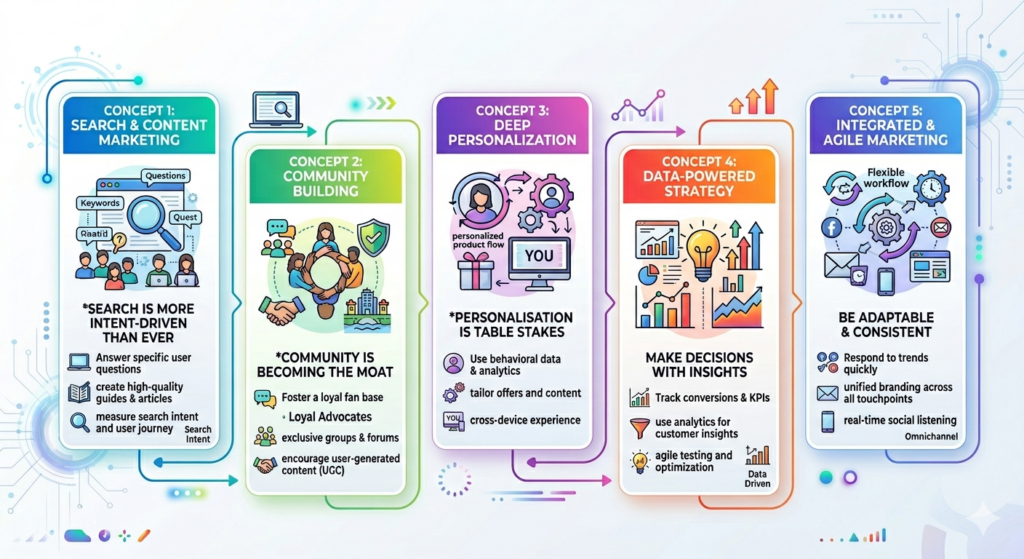
Search is more intent-driven than ever. Google’s AI Overviews now surface answers directly on the results page, which means content built purely on the selling concept (buy now, click here) performs worse than content that genuinely addresses customer questions. The marketing concept and the societal concept create content worth citing.
Community is becoming the moat. Platforms are saturated. Organic reach on most social platforms is structurally declining. Brands operating on the marketing concept, who built genuine communities rather than just follower counts, have distribution others can’t replicate.
Personalisation is table stakes. According to McKinsey’s 2023 Personalisation in Marketing report, brands that get personalisation right generate 40% more revenue from those activities. That level of personalisation requires the customer-first thinking that only the marketing concept delivers at scale.
In 2026, the marketing concept is the most defensible orientation for digital-first brands because it builds retention, community, and lifetime value rather than relying on constant acquisition. Google’s shift toward AI-surfaced answers in search further rewards content built around genuine customer value rather than promotional messaging.
Common Mistakes Marketers Make with Marketing Concepts
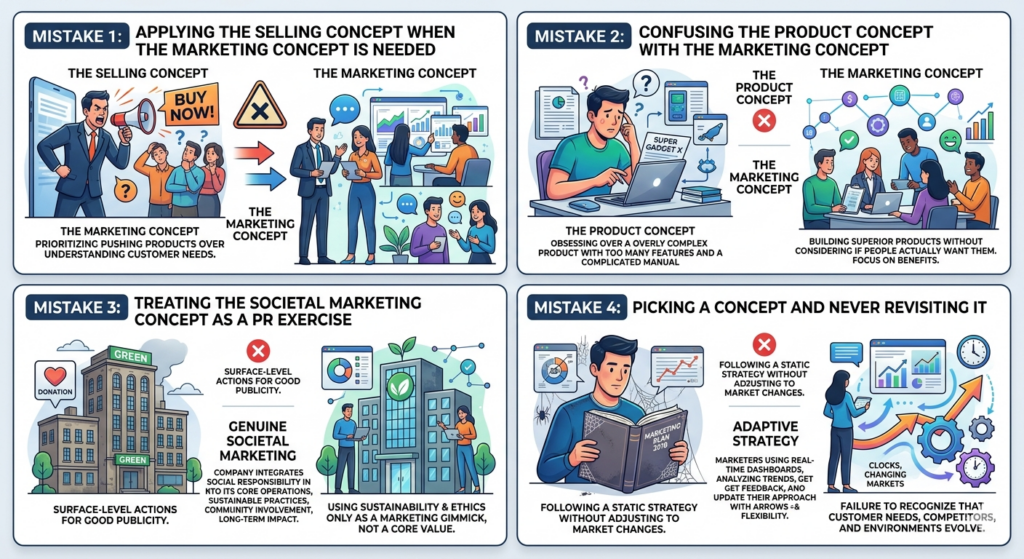
Most marketers know these five concepts in theory. The mistakes show up in how they’re applied.
Mistake 1: Applying the selling concept when the marketing concept is needed. This shows up as CAC that keeps rising, LTV that stays flat, and repeat purchase rates that never improve. The fix isn’t better ads. It’s better customer understanding.
Mistake 2: Confusing the product concept with the marketing concept. Building a great product is not the same as being customer-focused. A great product that solves the wrong problem at the wrong price for the wrong audience fails. Customer focus comes before product development, not after.
Mistake 3: Treating the societal marketing concept as a PR exercise. Greenwashing and purpose-washing are real. Customers in 2026 are better at detecting inauthenticity than they’ve ever been. If your societal commitment doesn’t connect to your actual product or operations, it costs more than it earns.
Mistake 4: Picking a concept and never revisiting it. Markets change. A production-concept business in a commoditised category may need to shift to the marketing concept as the category matures and differentiation becomes the primary competition axis. Relentless execution of the wrong concept is still a loss.
The Role of Digital Transformation in Marketing Concepts
Modern marketing reflects a world transformed by technology, therefore it is different from traditional marketing with principles that encourage data-backed initiatives to remain competitive. The shift from traditional marketing and selling techniques to digital marketing followed by email marketing and social media marketing has completely changed how businesses interact with customers.
Thanks to AI-powered tools and big-data analytics, now businesses can fine-tune their marketing mix, optimize marketing campaigns, and improve customer satisfaction through highly personalized experiences. AI-led insights also help in anticipating customer needs and wants, segmenting the customer base, and developing marketing strategies tailored to individual preferences.
For example, by relying on an AI algorithm, brands like Flipkart and Amazon get high conversion rates and long-term relationships by analyzing browsing history, past purchases, and engagement patterns to recommend products and services that fit the interests of their customers. Email marketing platforms driven by AI, on the other hand, personalize subject lines, content, and send times for maximum open rates and engagement.
Conclusion
The five concepts of marketing serve as the basics for business expansion by focusing on separate aspects related to customer interaction, such as costs and efficiencies, quality, persuasion, customer orientation, and social responsibility. Each marketing type has distinct pros. Companies combining marketing approaches maximize value creation for customers and remain competitive.
Marketing has changed tremendously with ever-evolving technologies therefore, businesses should adopt digital tools and data-driven decision-making while keeping the customer in mind. An alignment between marketing activities and ethical principles and social responsibility can greatly enhance brand image and create long-term loyalty. In dynamic market environments, it thus becomes imperative for sustainable success and further increasing their growth.
Enroll Now: Advanced Digital Marketing Course
FAQs: Marketing Concepts
1. What is the most effective marketing concept?
The marketing concepts emphasizes customer satisfaction and long-term success, making it the most effective approach for modern businesses.
2. How do businesses decide which marketing concept to use?
Managers analyze market research, consumer behavior, and industry trends to determine which concept best aligns with their product or service and overall business objectives.
3. What are the 7Ps of marketing?
The marketing mix includes Product, Price, Place, Promotion, People, Process, and Physical Evidence, each playing a crucial role in shaping successful marketing strategies.
Each element plays a crucial role in shaping successful marketing strategies by ensuring that every aspect of the customer experience is aligned with the overall brand promise. This comprehensive approach not only helps in meeting customer needs but also builds long-term competitive advantage in an ever-evolving marketplace.
4. Can a business adopt more than one marketing concept simultaneously?
Yes, many successful companies integrate elements from multiple marketing concepts. By combining approaches—such as blending product innovation with customer-centric strategies—they can create a balanced and adaptable marketing plan.
5. How do digital marketing tools influence marketing concepts?
Digital marketing tools like AI, social media analytics, and CRM systems provide businesses with deeper insights into customer needs. These tools help in personalizing experiences, optimizing the marketing mix, and enhancing customer engagement, thereby reinforcing the core principles of the marketing concept.
6. What role does market research play in the marketing concept?
Market research is essential for identifying customer needs, preferences, and trends. This information guides product development, promotional efforts, and long-term relationship building, ensuring that marketing strategies remain aligned with evolving consumer demands.
7. How does the societal marketing concept differ from the traditional marketing concept?
While the traditional marketing concepts focuses on satisfying customer needs, the societal marketing concept extends this approach by incorporating ethical practices and social responsibility. It ensures that marketing strategies benefit both consumers and the broader community without compromising environmental or ethical standards.
8. What challenges do businesses face when implementing the selling concept?
The selling concept is based much on high-pressure selling that creates short-run sales increases. This usually involves ignoring long-term relationship-building with customers and may even cause customer dissatisfaction and a reduced reputation in the long run.