

A recruiter at a mid-size tech company once told us she was spending eleven hours a week just scheduling first-round calls. Not conducting them. Scheduling them. Multiply that across a hiring team of six, and you get a department that spends more time on logistics than on actually judging talent.
That’s the gap AI interview agents are built to close. These tools handle the early, repetitive parts of hiring, structured screening, scheduling, note-taking, even full conversational interviews, so human recruiters can spend their time where it actually matters: final decisions.
This guide breaks down the tools worth knowing, what each one actually does well, and how to figure out which one fits your hiring process. No fluff, no vendor talking points repeated verbatim. Just what these platforms do and where they fall short.
Table of Contents
What Are AI Interview Agents and How Do They Work?
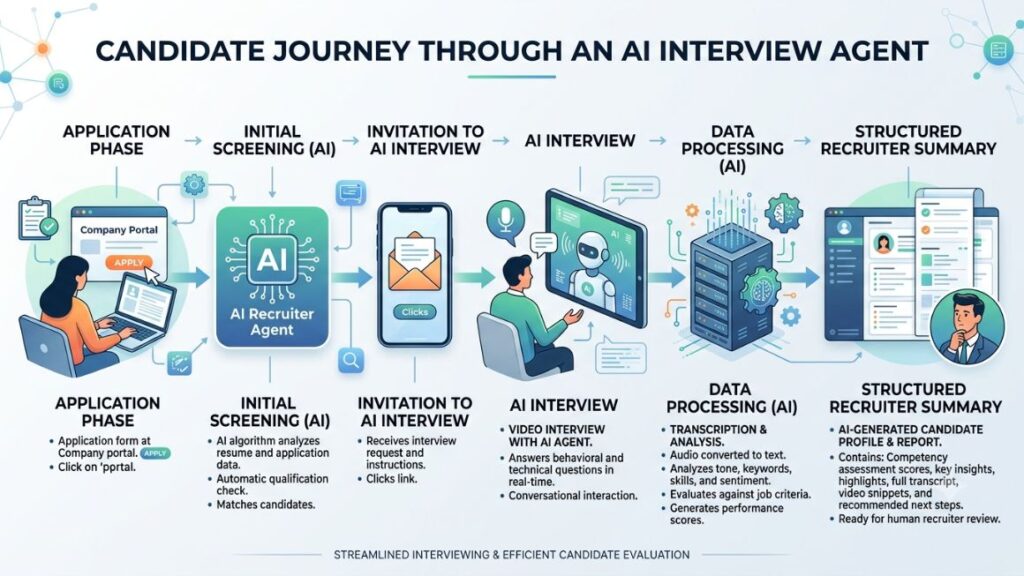
An AI interview agent is software that conducts, records, or analyzes candidate interviews using natural language processing and machine learning, instead of requiring a human recruiter to run every conversation manually.
Some tools run the entire interview themselves, asking questions through chat or voice and scoring responses in real time. Others sit alongside a human interviewer, listening in, taking notes, and flagging key moments after the call ends. The common thread is automation applied to a part of hiring that used to eat up enormous amounts of recruiter time.
Most platforms follow a similar sequence. A candidate applies, gets invited to a screening step, completes it on their own schedule (or live, depending on the tool), and the system generates a structured summary or score. Recruiters then review that output instead of sitting through every raw interview themselves.
That’s a meaningful shift from how screening worked even five years ago, when a recruiter might manually review 200 resumes and phone-screen 40 candidates just to find eight worth passing to a hiring manager.
Why Recruiting Teams Are Turning to Automated Candidate Screening
Volume is the honest answer. A single posting on LinkedIn or Indeed can pull in hundreds of applicants within days, and most recruiting teams haven’t grown headcount to match that inflow.
Automated candidate screening lets a small team apply consistent evaluation criteria across every applicant, not just the ones who happened to get a live phone screen. That consistency matters more than people give it credit for. Two candidates answering the identical question, scored against the identical rubric, is a fairer starting point than one candidate getting a sharp interviewer on a good day and another getting a distracted one on a Friday afternoon.
There’s also a speed argument. Async video and chat-based screening let candidates respond on their own time, which cuts the scheduling back-and-forth that used to add days or weeks to time-to-hire. According to LinkedIn’s 2024 Future of Recruiting report, talent teams increasingly cite speed of process as a top factor in whether strong candidates accept offers, since top performers rarely stay on the market long.
Automated candidate screening tools reduce time-to-first-interview by removing scheduling friction and applying a consistent scoring rubric across every applicant. This matters most for high-volume roles, where recruiters can’t realistically phone-screen every applicant manually. The tradeoff is that automation works best for structured, comparable roles, not highly nuanced senior hires.]
That said, this isn’t a fit for every hiring scenario. A structured entry-level or high-volume role is a great candidate for automation. A niche executive search with three finalists doesn’t need a screening bot; it needs a recruiter who can read the room.
HireVue — Structured Video Interviews at Enterprise Scale
HireVue is one of the oldest and most widely deployed platforms in this space, and it’s built for companies hiring at real volume, think retail chains, banks, and large consumer brands filling thousands of roles a year.
The platform runs one-way video interviews where candidates record responses to pre-set questions on their own time. HireVue’s assessment engine then scores responses against role-specific competency models, and recruiters get a ranked shortlist instead of a folder of unwatched videos.
Key features:
- Structured, competency-based interview scoring
- Game-based and skills assessments alongside video interviews
- Scheduling automation for live interviews
- Integrations with major ATS platforms like Workday and SAP SuccessFactors
HireVue has faced scrutiny over algorithmic scoring in the past, and in response the company shifted away from facial-analysis scoring toward structured, human-reviewed rubrics. That history is worth knowing if you’re evaluating the tool for a regulated industry.
Best for: large enterprises with high-volume, repeatable hiring needs like retail, call centers, or campus recruiting.
Limitations: pricing is enterprise-tier and generally not accessible to small teams, and the platform can feel heavy for companies hiring under a few hundred roles a year.
Paradox (Olivia) — Conversational AI for High-Volume Hiring
Paradox built its reputation on Olivia, a conversational AI assistant that texts and chats with candidates the way a person would, answering questions, scheduling interviews, and screening for basic qualifications before a human ever gets involved.
What sets Paradox apart is the channel. Instead of pushing candidates to a portal, Olivia meets them in text messages, which dramatically boosts response rates for frontline and hourly roles where candidates are less likely to sit down at a laptop to fill out a form.
Key features:
- SMS and chat-based candidate screening and scheduling
- Automated FAQ handling (pay, shift times, location) without recruiter involvement
- Instant interview scheduling with real-time calendar sync
- Career-site chatbot for top-of-funnel engagement
Companies like McDonald’s and CVS Health have used Paradox for high-volume hourly hiring, where speed and mobile-first candidate experience matter more than deep behavioral assessment.
Best for: high-volume, hourly, and frontline hiring where candidates expect a fast, mobile-native process.
Limitations: the depth of screening is lighter than platforms built for structured competency scoring; it’s optimized for speed and volume, not nuanced evaluation.
Metaview — AI Notetaking and Interview Intelligence
Metaview takes a different approach. Instead of running the interview, it sits alongside a live human conversation, transcribes it, and generates structured notes and summaries automatically.
For recruiting teams that still believe in live human interviews but are drowning in note-taking and inconsistent debrief quality, this is the tool. Metaview listens to the call, tags key answers against your interview scorecard, and produces a clean summary within minutes of the call ending.
Key features:
- Real-time transcription and AI-generated interview summaries
- Automatic mapping of candidate answers to scorecard criteria
- Searchable interview archive across the whole hiring team
- Coaching insights on interviewer question quality and talk-time ratio
This is less about replacing the interview and more about making the humans running it faster and more consistent. That’s a meaningfully different value proposition than the fully automated tools on this list.
Best for: teams that want to keep live human interviews but eliminate manual note-taking and inconsistent debriefs.
Limitations: it doesn’t reduce interview volume the way async screening tools do, since a human still has to conduct every conversation.
Sapia.ai — Chat-Based Screening Built for Fairness
Sapia.ai runs asynchronous, text-based interviews, no video, no audio, just a structured chat conversation candidates complete on their own schedule. The company built its scoring model specifically around minimizing bias tied to appearance, accent, or background.
Sapia’s platform, called Smart Interviewer, asks open-ended behavioral questions and scores responses using natural language processing trained to focus on the content of an answer rather than demographic signals that video interviews can inadvertently pick up.
Key features:
- Text-only chat interviews (no video or audio bias signals)
- Bias-audited AI scoring, independently tested for adverse impact
- Candidate-facing feedback after every interview, even for rejections
- Strong fit for high-volume hourly and graduate hiring
Sapia.ai has published third-party bias audits of its scoring model, which is worth calling out specifically because so few vendors in this category do that publicly.
Best for: organizations prioritizing fairness and adverse-impact reduction in high-volume screening.
Limitations: the text-only format won’t suit roles where communication style or presentation genuinely matters to the job, like client-facing sales positions.
myInterview — Async Video Screening for SMBs
myInterview brings one-way video screening to small and mid-sized businesses at a price point HireVue’s enterprise clients wouldn’t recognize. Candidates record video responses to preset questions, and the platform’s Predict feature adds personality insights based on response patterns.
Key features:
- One-way async video interviews with custom question sets
- Predict personality scoring layered onto video responses
- Simple ATS integrations (Workable, BambooHR, Greenhouse)
- Mobile-first candidate experience
The pitch here is accessibility. A hiring manager at a 30-person company can set this up in an afternoon without a recruiting ops team or enterprise procurement process.
Best for: small and mid-sized businesses that want async video screening without enterprise pricing or complexity.
Limitations: the personality-scoring layer is a nice-to-have, not a rigorous psychometric assessment, and shouldn’t be treated as a sole hiring signal.
Humanly — AI Screening With Bias-Reduction Controls
Humanly combines chat-based screening with structured scorecards, positioning itself as a middle ground between fully automated interviews and pure notetaking assistants. It screens candidates through conversational chat, then routes qualified applicants directly into scheduling.
Key features:
- Chat-based initial screening against job-specific criteria
- Built-in bias-reduction settings recruiters can configure
- Automated scheduling once a candidate clears screening
- Interview intelligence for live human interviews, similar to Metaview’s approach
Humanly’s dual focus, both automated first-round screening and live interview intelligence, makes it a broader platform than some single-purpose tools on this list.
Best for: mid-market companies that want one platform covering both early screening and live interview support.
Limitations: because it does two jobs, teams that only need one function (say, just live interview notes) may find dedicated single-purpose tools like Metaview more refined for that specific use case.
BrightHire — Interview Coaching and Decision Support
BrightHire focuses on the quality of the interview itself rather than replacing it. The platform records and transcribes live interviews, then surfaces coaching feedback to help interviewers ask better questions and avoid leading or biased phrasing.
Key features:
- Interview recording, transcription, and searchable playback
- Real-time and post-interview coaching prompts for interviewers
- Collaborative debrief tools so hiring panels can compare notes against the same transcript
- Analytics on interviewer performance and question consistency across a hiring team
This is squarely aimed at companies that see interview quality, not just interview volume, as their biggest hiring bottleneck. If your team’s problem is that different interviewers ask wildly different questions and reach inconsistent verdicts, BrightHire targets that specific pain point.
Best for: organizations focused on interviewer training and decision consistency rather than reducing interview volume.
Limitations: it doesn’t automate screening or reduce recruiter workload the way async tools do; it makes human interviews better, not fewer.
Talview — End-to-End Remote Hiring and Proctoring
Talview positions itself as a full remote hiring suite rather than a single-purpose screening tool. Alongside AI interview agents, it offers skills assessments, video proctoring for exams, and credential verification, aimed largely at high-volume campus and graduate hiring plus regulated industries like BFSI (banking, financial services, and insurance).
Key features:
- AI-powered video and chat interviews with automated scoring
- Remote proctoring for technical and aptitude assessments
- Credential and background verification tools
- Strong presence in campus recruiting and BFSI hiring in India and APAC
For companies running large graduate hiring drives, especially in markets like India where campus recruiting volumes can run into tens of thousands of applicants, Talview’s combination of proctored testing and interview screening in one platform cuts down significantly on vendor sprawl.
Best for: large-scale campus recruiting and regulated industries needing proctoring alongside interview screening.
Limitations: the breadth of features means some individual modules feel less specialized than best-in-class single-purpose tools.
Willo — Simple Async Video Interviewing for Lean Teams
Willo keeps things intentionally simple: async video interviewing, clean candidate experience, and straightforward pricing without the assessment layers or AI scoring complexity of larger platforms.
Key features:
- One-way video interview recording and review
- Custom branded candidate interview pages
- Team collaboration and rating tools for reviewing responses together
- Straightforward per-seat pricing suited to small recruiting teams
Willo doesn’t try to be an AI scoring engine. It’s closer to a well-designed video collection tool that happens to save recruiters from scheduling live calls for first-round screens. For teams that don’t want an algorithm making judgment calls, that restraint is a feature, not a gap.
Best for: small teams or agencies that want async video screening without heavy AI scoring layered on top.
Limitations: minimal AI-driven scoring means recruiters still do the manual work of reviewing every response themselves.
Apriora (Alex) — A Fully Autonomous AI Interviewer
Apriora represents the newest and most ambitious end of this category. Its AI interviewer, Alex, conducts live, adaptive voice conversations with candidates, asking follow-up questions in real time based on what the candidate just said, rather than sticking to a fixed script.
Key features:
- Live, voice-based AI interviews with adaptive follow-up questions
- Automatic scoring and structured summaries after each interview
- Available around the clock, letting candidates interview outside business hours
- Designed to replace, not just support, first-round human screening calls
This is the tool that most directly tests how comfortable a hiring team is with full automation. It’s not augmenting a recruiter’s note-taking or handling scheduling logistics; it’s running the actual conversation.
Best for: high-growth companies willing to fully automate first-round technical or behavioral screens to save recruiter hours at scale.
Limitations: candidate comfort with talking to an AI voice agent varies widely by role and seniority, and this approach demands more trust in AI judgment than any other tool on this list.
How to Choose the Right Tool for Your Team
Start with your bottleneck, not the tool’s feature list. If scheduling is what’s killing your team, Paradox solves a different problem than BrightHire does. If interview quality and consistency across your panel is the issue, Metaview or BrightHire matter more than a fully autonomous interviewer like Apriora.
Company size matters more than most vendors admit. HireVue and Talview are built for volume that most companies under 500 employees will never hit, while Willo and myInterview are designed for teams that don’t have a recruiting operations function at all.
Bias and fairness deserve a real look, not a checkbox. Sapia.ai’s public bias audits set a bar that most competitors haven’t matched, and that’s worth weighing seriously if your company operates in a jurisdiction with strict adverse-impact regulations, like the EEOC guidelines in the US or the EU AI Act’s provisions on employment-related AI systems.
And be honest about candidate experience. AI interview agents work best for structured, high-volume roles. For a senior or highly specialized hire, an over-automated process can actually cost you the candidate, since strong senior talent tends to expect a human conversation early in the process, not a chatbot.
Choosing an AI interview agent depends on which bottleneck you’re solving, scheduling, screening volume, interview consistency, or bias reduction, not on picking the highest-rated tool overall. Enterprise-scale platforms like HireVue and Talview suit high-volume hiring, while lighter tools like Willo and myInterview fit lean teams. Fairness-focused platforms like Sapia.ai matter most in regulated hiring environments.
Run a pilot before committing. Most of these vendors offer a trial period or limited pilot program, and testing against one real requisition tells you more than any demo call will.
Final Thoughts
The right AI interview agent isn’t the one with the longest feature list. It’s the one that solves the specific bottleneck slowing your hiring team down, whether that’s scheduling friction, inconsistent interview quality, or simply too many applicants and not enough recruiter hours in the day.
Start with a pilot on one real requisition before rolling anything out company-wide. And whichever tool you land on, keep a human reviewing the edge cases; automation handles volume well, but judgment calls still belong to people.
If you’re building out an AI-driven hiring or recruiting workflow and want to go deeper on prompting these tools effectively, integrating them with your existing stack, or using AI more broadly across your marketing and operations, Hotskill’s AI tools training walks through exactly that, hands-on, tool by tool.
Frequently Asked Questions
What is an AI interview agent?
An AI interview agent is software that automates part or all of the candidate interview process using natural language processing, either by conducting the interview directly through chat or video, or by transcribing and analyzing a live human interview. Most platforms generate a structured score or summary that recruiters review instead of watching or conducting every interview manually.
How is automated candidate screening different from a regular ATS?
An applicant tracking system (ATS) manages job postings, applications, and candidate pipelines, but it doesn’t conduct or evaluate interviews on its own. Automated candidate screening tools plug into or alongside an ATS to handle the actual interview or conversation, adding a layer the ATS by itself doesn’t cover.
Do candidates actually respond well to AI interviews?
It depends heavily on the role and the format. High-volume, entry-level, and hourly candidates generally respond well to async video or chat screening because it’s fast and fits their schedule. Senior candidates and specialized roles tend to expect a human conversation earlier in the process, so heavy automation there can hurt candidate experience.
Are AI interview agents legal to use for hiring decisions?
Yes, but with compliance requirements that vary by jurisdiction. New York City’s Local Law 144, for example, requires bias audits for automated employment decision tools used on NYC-based candidates. Companies should check local regulations and favor vendors, like Sapia.ai, that publish independent bias audit results.
Which AI interview agent is best for small businesses?
myInterview and Willo are generally the best fit for small businesses, since both offer async video screening at accessible pricing without the enterprise complexity or cost of platforms like HireVue or Talview.
Can AI interview agents replace human recruiters entirely?
No, and none of the credible vendors in this space claim otherwise. These tools automate the repetitive, high-volume parts of early-stage screening, but final hiring decisions, offer negotiations, and nuanced judgment calls still require a human recruiter or hiring manager.
How do these tools handle bias in scoring?
Approaches vary widely. Sapia.ai uses text-only interviews specifically to remove visual and vocal bias signals, and publishes third-party audits. HireVue moved away from facial-analysis scoring toward structured, human-reviewed rubrics after past scrutiny. Always ask a vendor directly whether their scoring model has been independently bias-audited.
What does an AI interview agent typically cost?
Pricing varies enormously by tool and company size. Small-business-focused platforms like Willo and myInterview often run a few hundred dollars a month for smaller teams, while enterprise platforms like HireVue and Talview typically require custom quotes based on hiring volume and can run into tens of thousands annually.
Is a fully autonomous AI interviewer, like Apriora’s Alex, actually reliable?
It’s reliable for structured, role-specific screening questions where the goal is filtering candidates against clear criteria. It’s less proven for nuanced, senior-level evaluation where judgment calls matter more than checking defined competencies, which is why most companies pair it with a human final round rather than a fully automated pipeline.
What should I look for in a demo before buying an AI interview agent?
Ask to see the tool run against a real requisition from your own hiring pipeline, not a generic demo script. Check how it handles edge cases like unclear or short candidate answers, ask directly about bias-audit history, and confirm integration compatibility with your existing ATS before signing anything.