

Most ads describe the product. The ones that convert describe the person the buyer wants to become. That gap, between listing a feature and naming the reason someone actually reaches for their card, is where most marketing budgets quietly leak away.
Buying triggers are the psychological reasons behind a purchase, and they rarely show up in the copy at all. A running shoe ad talks about cushioning and grip. The buyer is thinking about confidence, or the version of themselves that finally sticks to a routine. Get the trigger wrong and no amount of clever wordplay saves the ad.
This guide breaks down 50 buying triggers across ten categories, each with a real brand example and a copy angle you can adapt today. By the end, you’ll also know how the highest-converting brands stack multiple triggers into a single offer, and where most marketers get psychological persuasion wrong.
Table of Contents
What Are Buying Triggers in Marketing?
A buying trigger is the underlying psychological need or emotion that drives a purchase decision, separate from the product’s functional features. Someone doesn’t buy a treadmill for its motor specs. They buy the discipline they think owning it will force on them.
This isn’t a new idea. Behavioural economist Daniel Kahneman and psychologist Amos Tversky spent decades studying how people actually make decisions under uncertainty, work that eventually won Kahneman a Nobel Prize. Their 1979 paper on prospect theory, published in Econometrica, found that people don’t evaluate outcomes rationally. They evaluate them relative to a reference point, and losses hurt roughly twice as much as equivalent gains feel good.
That single finding underpins half the triggers in this article. It’s also why “don’t miss out” consistently outperforms “don’t miss this opportunity” in headline testing. One implies loss. The other implies a shrug.
Robert Cialdini’s 1984 book Influence: The Psychology of Persuasion organised similar findings into principles marketers still lean on today: scarcity, social proof, authority, reciprocity, commitment, and liking. Buying triggers are, in a sense, the applied, product-specific version of those same principles.
A buying trigger is the psychological reason behind a purchase, distinct from a product’s functional features. Prospect theory, developed by Kahneman and Tversky in 1979, showed that losses are felt roughly twice as intensely as equivalent gains, which is why loss-framed copy usually outperforms gain-framed copy in advertising.
Identity and Self-Image: Why Features Don’t Sell
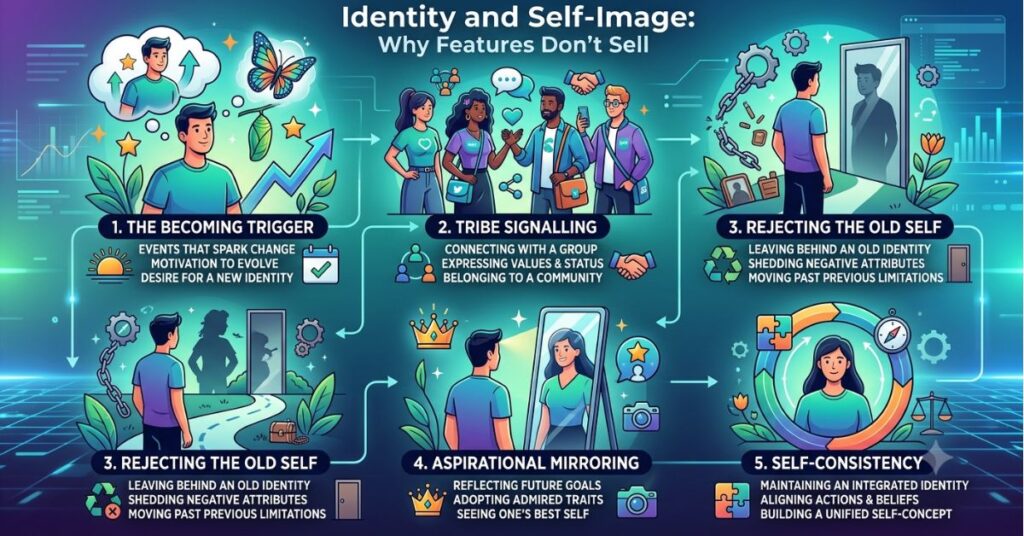
Nobody buys the item. They buy who it lets them become. A pair of running shoes sells confidence, better health, or the feeling of looking put-together, not rubber and mesh.
1. The becoming trigger. People buy the version of themselves the product implies. A treadmill sells discipline, not cardio. Copy angle: “This isn’t a planner. It’s proof you followed through for 90 days straight.”
2. Tribe signalling. People buy what tells the world which group they belong to, before the product does anything functional. Nike’s “Just Do It” campaigns rarely mention shoe technology in the first three seconds. They sell belonging to a mindset.
3. Rejecting the old self. A purchase can be a public break from a past identity the buyer wants to leave behind. Copy angle: “The last course you’ll need to stop calling yourself a beginner.”
4. Aspirational mirroring. Show the buyer someone slightly ahead of them using the product. They buy the trajectory, not the person profiled. This is why case studies of “someone like you, six months ahead” convert better than testimonials from people who feel unreachable.
5. Self-consistency. People act to stay consistent with how they already see themselves. Remind them who they claim to be, and the purchase becomes an act of alignment rather than a decision. Copy angle: “You said you’d take your business seriously this year. This is that decision.”
How to Sell Time Back to Your Customer
Time is the one resource nobody can buy back, which means the more of it your product returns, the higher the price it can command without resistance.
6. The before/after clock. A concrete time comparison beats a vague efficiency claim every time. “What used to take you 2 hours now takes 10 minutes” is a specific, testable promise a reader can picture immediately.
7. Reclaimed hours reframed as life. Saved time means nothing until it’s spent on something the buyer values. Zepto’s entire pitch rests on this: groceries in 10 minutes isn’t about logistics, it’s about the evening you get back.
8. Speed-to-first-result. Buyers don’t just want the end result faster, they want proof of progress faster. “See your first result in 24 hours, not 24 days” removes the anxiety of a long wait with no signal.
9. Automation replaces admin. People will pay to never do a repetitive task again, even a small one. “Set it up once, never touch it again” is a promise that compounds in value the longer someone imagines using the product.
10. Skip-the-line positioning. Frame your offer as the shortcut past a process everyone assumes takes a long time. “Everyone else is still figuring this out from scratch. You won’t have to.”
Using Pain and Loss Aversion Without Sounding Manipulative
Humans move away from pain faster than they move toward pleasure, and naming that pain precisely does more persuasive work than describing the solution ever will.
11. The cost of inaction. People consistently underestimate what standing still is already costing them. Make that cost visible instead of assuming they’ve already calculated it. “What happens if you don’t fix this in the next six months?”
12. Naming the specific pain. Vague pain doesn’t land. “Struggling with marketing” means nothing. “Re-explaining the same campaign results to your manager every Monday because nobody trusts your numbers” means everything to the right reader.
13. Loss aversion, applied directly. Since losses are felt roughly twice as strongly as gains, frame the offer as preventing a loss rather than promising a gain. “Don’t let another quarter pass without a system that actually works” hits harder than “Get a system that works this quarter.”
14. Future regret. People act harder to avoid regret they haven’t felt yet than to chase a gain they haven’t experienced yet. “A year from now, you’ll wish you’d started today, not next Monday” borrows urgency from an imagined future self.
15. Fixing the visible symptom first. Lead with the pain the buyer can already feel, not the root cause they haven’t diagnosed. “If your ads are getting clicks but no sales, the problem isn’t your budget” earns attention before it earns the explanation.
This is also where marketers most often cross a line. Naming a real pain is honest persuasion. Manufacturing anxiety about a problem that barely exists is not, and readers can usually tell the difference within a sentence.
Money Triggers That Justify a Higher Price
Money sits underneath almost every other trigger on this list, and used directly, it still converts better than most copywriters give it credit for.
16. The payback frame. A price feels smaller the moment it’s reframed with a return date attached. “Pays for itself in the first client you land” turns a cost into an investment with a visible finish line.
17. Cost of the alternative. Compare your price to what the buyer is already losing by not having the solution, not to a competitor’s price. “Less than what you’re already losing to late fees every month” reframes the decision entirely.
18. Passive upside. Money earned without ongoing effort is more attractive than the same amount earned actively. “Set it up in a weekend, get paid every month after” is a stronger hook than “earn extra income.”
19. The discount deadline. Saving money feels more urgent when the window to save it is visibly closing. “Price goes up at midnight, lock in today’s rate now” works because it converts a soft discount into loss aversion.
20. Stacked value math. Breaking a bundle into individual dollar values makes the total feel like a steal, even if the buyer never touches every piece. “Worth ₹25,000 separately, you get all of it for ₹4,999” is a well-worn tactic precisely because it still works.
Why Comfort Sometimes Outsells Performance
Sometimes comfort outsells performance. People buy relief, connection, and a better mood more often than marketers give emotional triggers credit for.
21. Instant mood shift. Products that promise an emotional change within minutes get bought on impulse rather than deliberation. “Five minutes in, and your shoulders will actually drop” sells a felt outcome, not a feature.
22. Feeling understood. Brands that describe the reader’s exact feeling before pitching a fix build trust before the sales pitch even starts. “You’re not lazy, you’re just tired of systems that were never built for how you actually work” does more than any bullet-point feature list.
23. Belonging over isolation. A community attached to a product sells the feeling of not struggling alone. “Join 3,000 people figuring this out together, not alone at 1am” works because isolation is the actual pain, not the lack of a tool.
24. Comfort as permission. Give buyers permission to choose the gentler option instead of the harder one they feel they “should” pick. “You don’t have to grind through this alone. There’s an easier way.”
25. Nostalgia. Reminding someone of a simpler, happier version of an experience creates warmth that transfers to the brand asking for the sale. Netflix’s “remember when Sunday nights meant something” style messaging leans on exactly this.
Selling Health Outcomes People Can Actually Picture
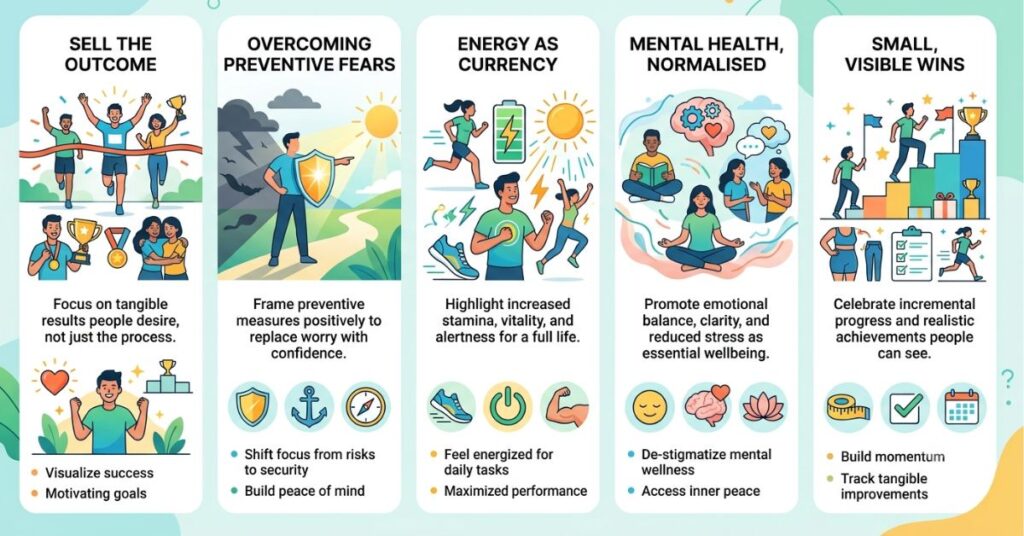
Health isn’t sold as longevity. It’s sold as the outcome people already picture for themselves: more energy, better sleep, a body that doesn’t hold them back.
26. Sell the outcome, not the mechanism. Nobody wakes up wanting “better gut health.” They want to stop feeling bloated after lunch. Naming the mechanism is for the ingredients page, not the headline.
27. Preventive fear, gently framed. People respond to early warning signs more than distant, abstract risk. “The habit that’s quietly wrecking your sleep, and how to reverse it in a week” is specific enough to feel personal.
28. Energy as currency. Energy is the health outcome people value most because it unlocks everything else in their day. “More energy by 10am than you had all of last week” sells the knock-on effect, not the supplement itself.
29. Mental health, normalised. Framing wellbeing as maintenance rather than crisis management removes the stigma that stops people from buying in the first place. “You don’t need to be in crisis to deserve 20 minutes for yourself” widens who feels the offer is for them.
30. Small, visible wins. Health products convert better when the first result is something the buyer can feel or see within days, not months. “You’ll feel the difference by day 3, see it by day 21” sets an expectation the product can actually meet.
Removing Friction as a Buying Trigger
Given two paths to the same result, people take the one that asks less of them. Convenience isn’t a nice-to-have. It’s a reason to buy on its own.
31. One-click framing. Naming the exact number of steps removes the buyer’s fear of a long, confusing process. “Three clicks, that’s the whole setup” is more persuasive than “easy setup.”
32. Done-for-you positioning. Some buyers will pay a premium specifically to remove their own involvement. “You don’t build it, we hand it to you finished” targets a buyer who has already decided their time is worth more than the markup.
33. Decision fatigue relief. Reducing the number of choices a buyer has to make functions as its own form of effort reduction. “No more guessing which plan to pick, there’s just one, and it’s the right one” removes an entire decision, not just a step.
34. Templates over blank pages. A blank page is the single biggest barrier to starting anything. Removing it removes the excuse to delay. “Fill in the blanks, don’t start from zero” is a promise about momentum, not just structure.
35. No-learning-curve promise. People overestimate how hard something new will be to learn. Naming a short learning curve removes a hidden objection before it’s raised. “If you can use WhatsApp, you can use this.”
When Buyers Want to Be Seen
Even the most private-sounding purchase is often about being seen. Recognition doesn’t need a public audience to be a real motivator.
36. Public proof of effort. Certificates, badges, and shareable milestones let a buyer show their work, not just complete it. “Get a certificate you’ll actually want to post” acknowledges that the outcome matters less than the proof of it.
37. Validation from peers. People chase approval from people whose opinion they respect more than from strangers online. “The kind of work your manager actually notices” narrows the audience the buyer is really trying to impress.
38. Being first. Early adopters buy partly for the bragging rights of finding something before everyone else does. “Before your competitors even hear about this” sells timing as much as the product itself.
39. Named achievement. A specific title or milestone gives the buyer something concrete to call themselves, which they’ll repeat to others without being asked. “Graduate as a certified performance marketer, not just someone who did a course” is a stronger close than a generic completion certificate.
40. Featured or spotlighted. Being highlighted by a brand or community satisfies the need for recognition even without a large public audience watching. “Best case studies get featured on our page every month” gives buyers a reason to perform well, not just participate.
Status Signalling and Why People Don’t Always Buy the Best Product
People don’t always buy the best product. They buy the one that signals they’ve made it, or that they’re about to.
41. Exclusivity by design. Limiting who can access something makes the people who have it feel like they’ve earned an upgrade in status. “Applications open to 50 people, not everyone gets in” works because the limit is the value proposition.
42. Premium as the default choice. Positioning the higher tier as what “serious” people choose makes the lower tier feel like settling. “The plan people upgrade to once they stop treating this as a side project” nudges without pressuring.
43. Association with success. Buyers borrow status from the people already associated with a brand. “Used by the same teams behind the country’s fastest-growing D2C brands” transfers credibility from named, recognisable companies.
44. Visible craftsmanship. Details that signal quality, even ones most buyers can’t fully evaluate, do the work of communicating status on their own. Apple’s packaging is a well-documented example of this: the unboxing experience sells before the product is even turned on.
45. The upgrade narrative. Framing a purchase as the next natural step appeals to people already invested in their own growth story. “You’ve outgrown the free version, this is what comes next” works because it flatters the buyer’s trajectory rather than questioning their current choice.
Curiosity, FOMO, and the Psychology of the Open Loop
An open loop in someone’s head is uncomfortable enough that they’ll click, read, or buy just to close it.
46. The open loop. Withholding one specific piece of information creates a mental itch the reader wants resolved. “There’s one line in your bio that’s costing you followers, here’s what it is” works because curiosity resolution feels almost involuntary.
47. Social proof at scale. Large, specific numbers of other buyers reduce the perceived risk of being the only one trying something new. “12,000 marketers have already made the switch” does more work than any feature list.
48. Scarcity that’s real. In a well-cited 1975 study, researchers Worchel, Lee, and Adewole gave one group of participants a jar with ten biscuits and another group an identical jar with only two. Despite the biscuits being the same, participants who received the near-empty jar rated them as more desirable. Genuine limits on time or spots create urgency the same way. Manufactured scarcity gets noticed and quietly destroys trust, so this only works when the limit is real.
49. What everyone else already knows. The fear of being the last person to figure something out is a stronger motivator than the desire to be first. “Every agency you’re competing with already uses this, you’re the only one who doesn’t” reframes inaction as a competitive risk.
50. The specific number hook. A precise, slightly unusual number is more believable and more clickable than a round one. “37 buying triggers most marketers never learn” outperforms “a bunch of tips” because specificity reads as evidence.
Scarcity increases perceived value even when the underlying product is identical. In a classic 1975 experiment by Worchel, Lee, and Adewole, participants rated biscuits from a nearly empty jar as more desirable than the same biscuits from a full jar. This is the mechanism behind limited-spot offers and countdown timers, and it only holds up ethically when the scarcity is genuine.
How the Best-Converting Brands Stack Multiple Triggers
Here’s the thing: the highest-converting brands rarely rely on just one reason to buy. They activate two or three triggers at once, without making the copy feel crowded.
Apple stacks time savings, status, and reduced effort into nearly every product launch. The pitch is never just “faster chip.” It’s faster, and it signals you’re the kind of person who owns the newest one, and you didn’t have to learn anything new to use it.
Nike combines health, recognition, and identity. A shoe ad rarely mentions cushioning technology first. It sells the runner you become and the version of yourself that gets noticed for finishing the race at all.
Amazon stacks time, money, and effort reduction almost entirely on operational promises: faster delivery, lower prices, and one-click checkout, with almost no emotional appeal required because the functional stack does the work.
So why do most marketers still lead with just one trigger? Usually because they’ve only identified one. Stacking isn’t about cramming every trigger from this list into a single headline. It’s about picking one to lead, letting a second support it in the body, and reserving a third for the CTA if there’s room.
A working example: “Do it in 10 minutes, not 2 hours (time). No design skills needed (effort). Join before the price goes up Friday (scarcity).” Three triggers, no trigger doing more than its share of the sentence.
Common Mistakes Marketers Make With Psychological Triggers
The gap between marketers who use these triggers well and marketers who burn trust with them usually comes down to a handful of repeatable mistakes.
Faking scarcity. A countdown timer that resets every time the page reloads gets noticed within a single visit, and once a buyer catches one fake urgency cue, they stop trusting every urgency cue that follows.
Naming a pain that isn’t real. Manufacturing anxiety about a problem the reader doesn’t actually have reads as manipulation, not persuasion. The strongest pain-based copy names something the reader was already feeling before they clicked.
Stacking too many triggers into one line. A headline trying to sell time, money, status, and health simultaneously sells nothing, because the reader can’t tell which promise to believe.
Ignoring the product-trigger mismatch. Not every product fits every trigger. Forcing a status angle onto a genuinely budget-friendly product confuses the positioning instead of strengthening it.
Skipping the proof. A trigger without evidence is just a claim. “Do it in 10 minutes” needs a demonstration, screenshot, or testimonial nearby, or it reads as an empty promise the reader has heard a hundred times before.
From what we’ve seen with YUP learners building their first ad campaigns, the single biggest jump in conversion rate usually comes not from a cleverer trigger, but from finally matching the right trigger to the specific audience segment being targeted. A performance marketer targeting CFOs and one targeting first-time founders should almost never use the same trigger for the same product.
Conclusion
Every purchase, no matter how small or considered, is solving an emotional or practical problem for the person making it. The 50 triggers in this guide aren’t a checklist to run through on every ad. They’re a way of asking a sharper question before you write a single word of copy: what is this customer actually trying to fix, become, avoid, or feel, and does my headline say that plainly enough?
Pick one trigger that genuinely fits your product, test it in isolation, and only stack in a second or third once you know the first one is pulling its weight. The brands that win long-term aren’t the ones with the cleverest copy. They’re the ones whose triggers were true the whole time.
If you want to go beyond individual triggers and build full campaigns, sales pages, and email sequences around this kind of consumer psychology, YUP’s Content Marketing course walks through the frameworks professional copywriters and content teams actually use, taught by people running these campaigns, not just teaching them.
Frequently Asked Questions
What is a buying trigger in marketing?
A buying trigger is the underlying psychological need, emotion, or motivation that drives someone to purchase, separate from the product’s functional features. Examples include saving time, avoiding loss, gaining status, or feeling understood.
Are buying triggers the same as Cialdini’s principles of persuasion?
They overlap but aren’t identical. Cialdini’s principles, like scarcity, social proof, and reciprocity, describe general mechanisms of influence. Buying triggers apply those mechanisms specifically to purchase decisions and product positioning.
How do I figure out which buying trigger fits my product?
Start with what the customer actually gets from using it, not what the product does technically. A time-tracking app might genuinely trigger “save time,” but for a freelancer trying to look professional to a new client, “gain recognition” or “increase status” might convert better.
Is it manipulative to use psychological triggers in ads?
Not inherently. Naming a real pain, saving real time, or highlighting genuine scarcity is honest persuasion. It becomes manipulative when the trigger describes something that isn’t true, like fake urgency or an exaggerated pain point the customer doesn’t actually have.
Can I use more than one buying trigger in a single ad?
Yes, and the highest-converting brands usually do. The key is to lead with one trigger in the headline, support it with a second in the body copy, and save a third for the call to action, rather than trying to activate all of them in the same sentence.
Why does loss-framed copy usually outperform gain-framed copy?
Because of loss aversion. Prospect theory research by Kahneman and Tversky found that people feel the pain of a loss roughly twice as intensely as the pleasure of an equivalent gain, which is why “don’t miss out” tends to outperform “here’s an opportunity” in headline testing.
Do buying triggers work the same way in B2B as they do in B2C?
Mostly, though the emphasis shifts. B2B buyers respond strongly to risk reduction, status within their organisation, and time saved, while emotional triggers like nostalgia or comfort are far less relevant. Recognition and status still matter, but they’re usually about looking good to a manager rather than to a peer group.
What’s the most overused buying trigger in advertising right now?
Scarcity, by a wide margin, mostly because it’s the easiest to fake with a countdown timer or a “limited stock” label. It’s also the trigger most likely to backfire once a buyer suspects it isn’t real, so it needs to be used only when the limit genuinely exists.