

Most businesses that fail at marketing don’t fail because they ran out of ideas. They fail because they ran out of money before their ideas had time to work. But here’s the thing: the best-performing marketing assets on the internet right now cost nothing to create. A YouTube video. A Reddit thread. A well-written article. A referral loop baked into a product. None of these requires a budget. They require time, clarity, and the willingness to be consistent.
Zero-budget marketing strategies are not a backup plan for when the money runs dry. For many fast-growing startups and independent businesses, they are the primary strategy. Dropbox built a multi-billion-dollar company on a referral loop. Hotmail added 12 million users in 18 months with a single line of text in every outgoing email. Mamaearth, before it became a household name in India, grew largely through earned media, community trust, and founder visibility.
This article covers every major zero-budget marketing strategy that actually works: what to do first, how to build each channel, and what the first 90 days should look like if you’re starting from scratch. No fluff. No “post consistently” advice that means nothing in practice.
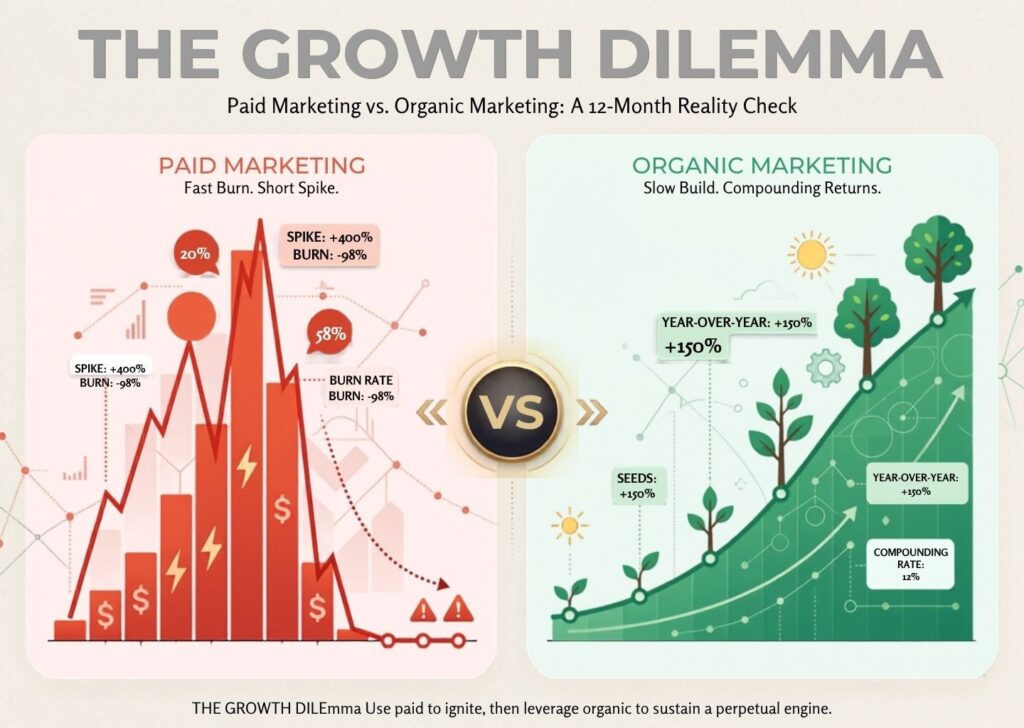
Table of Contents
Why Zero-Budget Marketing Is a Competitive Advantage
Zero-budget marketing is not a handicap. In many industries, it’s a structural advantage -and the brands that understand this early tend to build audiences that paid advertisers can’t replicate with cash alone.
The Myth That Marketing Requires Money
There’s a version of marketing advice that only makes sense if you’re already profitable. “Spend on ads.” “Hire an agency.” “Boost your posts.” This advice treats marketing as a line item, not a skill. And it assumes the unit economics work out before you’ve earned the right to spend.
The myth is that money equals results. But the most durable marketing results come from trust, reputation, and relevance -none of which can be bought directly. You can accelerate trust with money. You cannot manufacture it.
Why Constraints Force Better Marketing Decisions
When you can’t spend, you’re forced to think harder about what actually matters. You can’t buy your way out of a weak value proposition. You can’t run ads to an audience you don’t understand. Budget constraints remove the option of laziness.
Brands that grow without marketing budgets are, almost by definition, saying something worth hearing. They’ve had to earn attention through relevance rather than repetition. That’s not a consolation prize -it’s a stronger foundation.
Trading Budget for Creativity, Consistency, and Distribution
The currency of zero-budget marketing is not money. It’s time, consistency, and smart distribution. A founder who publishes one useful LinkedIn post per day for six months builds an audience that no paid campaign could replicate for the same cost. A startup that answers questions in three relevant Reddit communities every week builds search visibility and brand recall simultaneously.
The trade is real. Zero-budget marketing takes longer. But what it builds is owned and compound, meaning the effort you put in on day one keeps delivering returns on day 300.
Zero-budget marketing strategies work because they build owned, compounding assets -content, reputation, community trust, and referral loops -that deliver returns long after the initial effort. Unlike paid advertising, which stops when spending stops, these channels grow stronger over time with consistent use.
Build a Strong Foundation Before You Promote Anything
Before running a single zero-budget marketing strategy, you need three things locked in. Skip any one of them, and the tactics that follow will produce noise, not growth.
Define Your Ideal Customer Profile
Your ideal customer profile (ICP) is a specific description of the person most likely to buy from you, benefit from your product, and tell others about it. Not a demographic range. A specific person with a specific problem in a specific context.
If you sell a project management tool, “small business owners” is not an ICP. “A freelance graphic designer managing five or more client projects simultaneously, who is currently using sticky notes and WhatsApp to track deliverables,” is an ICP. The level of specificity determines how useful it is.
Every zero-budget channel works better when you know exactly who you’re talking to. SEO keywords become sharper. Community choices become obvious. Referral triggers become predictable.
Create a Clear Value Proposition
Your value proposition answers one question: why should someone choose you over every other available option, including doing nothing? It should be one sentence. If it takes a paragraph, it’s not clear yet.
A useful test: read your value proposition to someone outside your industry. If they can repeat back what you do and why it’s different in their own words, it’s working. If they’re confused, you have a copy problem, not a marketing problem.
Focus on One Marketing Channel First
The single biggest mistake early-stage businesses make with zero-budget marketing strategies is spreading across too many channels at once. They post on Instagram, write occasional blog posts, try LinkedIn, experiment with YouTube, and wonder why nothing is working.
Pick one channel. Go deep on it for 90 days. Understand it well enough to see compounding results before you add a second. The brands that grow fastest on zero budget are almost always the ones that dominate one channel before touching the next.
Founder-Led Content: The Highest ROI Marketing Asset
Hotstar’s early Indian audience built on the founder’s visibility. Zepto’s founders actively used social media to explain their quick commerce thesis before the category even had a name. Founder-led content isn’t a trend. It’s the most efficient trust-building mechanism available to early-stage companies.
Why People Trust People More Than Brands
This is not a philosophical claim. It’s a measurable pattern. According to the Edelman Trust Barometer 2024, 63% of people say they trust information from individual experts more than information from brands or institutions. Founder content works because it has a face, a point of view, and an accountable voice behind it.
A brand saying “our product is excellent” carries zero weight. The same founder saying, “here’s exactly what we got wrong in our first product launch and how we fixed it,” builds genuine credibility. The vulnerability is the signal.
Building Authority Through Educational Content
You don’t need to talk about your product to build authority. You need to talk about the problem your product solves. If you sell accounting software to freelancers, write about tax filing mistakes freelancers commonly make. If you sell a fitness app, document what 90 days of consistent training actually looks like in practice.
Educational content has two properties that make it ideal for zero-budget distribution. First, it’s searchable, which means it earns organic traffic over time. Second, it’s shareable, which means your readers become distribution partners every time they send your post to someone facing the same problem.
Turning Everyday Work Into Content Opportunities
The most common objection to founder-led content is time. “I don’t have time to create content.” But the insight isn’t about creating more work. It’s about documenting the work you’re already doing.
The difficult customer conversation you had this week is a content opportunity. The mistake you made on a campaign and corrected is a content opportunity. The question a prospect asked during a demo that nobody else has ever asked you is a content opportunity. You’re already doing the work. The only additional step is writing it down.
Read More: “Content Marketing for Startups.”
SEO Without Spending a Single Dollar
SEO is the closest thing to permanent free advertising that exists. An article that ranks on page one for a high-intent keyword can drive qualified traffic for years with zero ongoing cost. The barrier is not money. It’s patience and strategic thinking.
Finding Low-Competition Keywords Using Free Tools
Google Search Console, Google Trends, and Ahrefs’ free tier are enough to do meaningful keyword research. The goal for any new website or blog is not to compete for high-volume, high-competition keywords. It’s to find the questions your target audience is asking that bigger competitors haven’t answered well yet.
A practical starting point: type your primary topic into Google and look at the “People also ask” box. Each question is a keyword opportunity. Filter for questions with conversational, specific phrasing -these are typically low-competition and high-intent.
Another free approach is using AnswerThePublic (free tier) to see every preposition-based and question-based variation of a keyword. A search for “email marketing” returns hundreds of real questions people are typing into search engines every month.
Creating Problem-Solving Content That Ranks
Google’s ranking algorithm has become increasingly good at identifying whether content actually answers the searcher’s question. Generic, shallow articles that technically include the keyword but don’t solve the problem are getting pushed down.
Problem-solving content has a specific structure: it names the problem clearly, explains why it happens, shows the solution step by step, and gives the reader a way to verify it worked. Every section should answer a question the reader is likely to have at that point in the article. If a section can be skipped without losing anything, cut it or rewrite it.
Building Topical Authority Through Content Clusters
Topical authority is the concept that Google rewards sites that cover a subject deeply and completely, not just sites that publish one article on a topic. The way to build it without spending money is through content clusters: a central pillar article covering a broad topic, surrounded by supporting articles on each specific subtopic.
For example, if your central pillar is “email marketing for D2C brands,” your supporting articles might cover subject line best practices, abandoned cart sequences, post-purchase email flows, list segmentation, and re-engagement campaigns. Each supporting article links back to the pillar. The pillar links out to each supporting article. Google reads this as genuine expertise.
SEO-based zero-budget marketing builds compound traffic assets. A single well-researched article targeting a low-competition keyword can generate consistent organic traffic for years without any additional spend. Building topical authority through content clusters accelerates this effect by signaling subject matter expertise to search engines.
Read More: “topical authority.”
Community Marketing That Generates Trust at Scale
Reddit has over 1.5 billion monthly active users. Quora has 300 million. LinkedIn Groups and Facebook Groups have hundreds of millions of members between them. Every one of these platforms contains communities of people actively asking for advice, looking for product recommendations, and searching for solutions to specific problems. And every one of them can be reached for free.
How to Win Customers Through Reddit, Quora, and Facebook Groups
The key to community marketing is understanding that you are a guest, not an advertiser. Communities exist for their members, not for you. The fastest way to be ignored or banned is to join a community and immediately pitch your product.
The approach that works is simple: spend the first two to four weeks only giving value. Answer questions thoroughly. Genuinely useful share resources, even if they’re not yours. Offer specific, detailed advice rather than generic responses. Build a reputation as someone worth listening to. Then, when it’s natural and appropriate, mention what you do or what you’ve built.
This approach works on every major platform. Zepto’s early team reportedly used hyperlocal WhatsApp and Facebook groups to understand consumer behaviour before and during their launch in Bengaluru. The intelligence they gathered shaped everything from inventory decisions to messaging.
The Give-Value-Before-You-Pitch Framework
A practical rule for community marketing: give ten times before you ask once. For every mention of your product, leave ten genuinely helpful contributions that have nothing to do with self-promotion. This ratio keeps you credible in the community and makes the one time you do mention your product feel like a recommendation, not an advertisement.
The “give value” part has a specific structure that works best. The most effective community contributions answer a specific question in detail, then optionally link to a longer resource for those who want more. The answer should be complete enough to be useful on its own. If the only value is in the link, the community will flag it as spam.
Common Community Marketing Mistakes to Avoid
The most common mistake is joining too many communities at once and contributing nothing of substance to any of them. Pick two or three communities where your ideal customers are actually active. Go deep on those. Consistent, valuable presence in three communities beats surface-level participation in thirty.
The second mistake is treating every community like it has the same culture. Reddit’s r/entrepreneur has norms very different from those of a private Facebook group for SaaS founders. Read the rules. Observe for a few days before posting. Match the tone and format of well-received contributions. What gets upvoted on one platform gets removed on another.
Read More: “community-led growth.”
The Power of Strategic Partnerships
Two brands with overlapping audiences and no competing products can do more for each other than either could do independently. This is the logic behind strategic partnerships, and it costs nothing but a well-crafted email to start.
Finding Non-Competing Brands With Similar Audiences
The starting point is mapping out who your customer is buying from before they buy from you, and what else they’re buying at the same time. If you sell productivity tools to freelance designers, your natural partners include project management tools, payment processing platforms, font libraries, stock image platforms, and online course providers for creatives.
None of these competes with you. All of them have your exact audience. A joint newsletter feature, a co-promoted webinar, or a shared resource guide puts your brand in front of a qualified audience that already trusts the brand introducing you.
Cross-Promotion Tactics That Cost Nothing
The simplest partnership tactic is the newsletter swap: you promote a partner’s product or content to your audience, and they do the same for you. No money changes hands. Both audiences get introduced to a relevant brand they didn’t know about.
Other zero-cost cross-promotion tactics include co-authoring a blog post published on both sites (which also builds backlinks for both), hosting a joint Instagram or LinkedIn Live, creating a shared resource page, and building a combined toolkit or checklist that both brands distribute.
The success of a partnership comes down to audience alignment. A poorly matched partnership with a large brand is less valuable than a well-matched partnership with a small one.
Co-Created Content and Guest Contributions
Guest writing on established publications in your space is one of the most underused zero-budget marketing strategies. A well-placed article on a respected industry site delivers three things simultaneously: reach, backlinks for SEO, and a credibility signal that you can reference in future outreach.
The key is matching pitch quality to the publication’s standards. A generic, un-researched pitch to a major marketing publication gets ignored. A specific, well-argued pitch with a unique angle and a clear reader benefit gets accepted. Research the publication, read its recent content, identify the gap, and pitch it.
Social Proof and User-Generated Content as a Growth Engine
One honest review from a real customer is worth more than ten pieces of polished branded content. Social proof is the mechanism behind almost every successful word-of-mouth growth story, and collecting it costs nothing.
How to Collect Social Proof Without Spending a Rupee
The most effective approach is simply to ask. After a customer has a positive experience, send a direct, personal message asking if they’d be willing to share a quick review or testimonial. The timing matters: ask within 24 to 48 hours of the positive moment, while the experience is fresh.
The ask should be specific. “Would you be willing to share a quick two or three-sentence review of what you found most useful?” converts better than “Could you leave us a review?” Specific requests lower the effort required and produce more detailed, useful responses.
Turning Customer Stories Into Marketing Content
A good testimonial is not just a quote you put on a landing page. It’s a content asset. A customer who went from a specific problem to a specific result using your product has a story. That story, told with their permission, becomes a case study for your blog, a carousel for LinkedIn, a short video for Instagram, and a social post for Twitter.
The brands that get the most mileage from customer stories are the ones that treat every success as a content opportunity. Nykaa built significant trust in its early growth phase by featuring real customer transformation stories, which resonated strongly with an audience that had historically been suspicious of beauty product claims.
User-Generated Content That Spreads Organically
User-generated content (UGC) is any content created by your customers, not by your brand. It spreads more easily than branded content because it carries the implicit endorsement of a real person. The challenge is creating the conditions for it to happen naturally.
Brands that generate consistent UGC typically have one or more of the following: a visually striking product experience worth sharing, a community or identity their customers want to signal membership in, or a direct prompt built into the product experience itself. boAt, the Indian audio brand, built substantial UGC momentum by making product unboxing genuinely shareable, which drove organic content creation across Instagram and YouTube without any paid incentives.
User-generated content and social proof are among the most cost-effective marketing assets available to any business. Because they come from real customers rather than brand channels, they carry higher credibility and spread more organically. The key is making the customer experience worth sharing, then making it easy to share it.
Build a Referral Engine Without Offering Discounts
Referral marketing is often confused with discount-driven affiliate programs. But the most powerful referral systems work without any financial incentive. They work because sharing the product is itself the mechanism of value delivery.
Creating Word-of-Mouth Triggers
A word-of-mouth trigger is a specific moment in the product or customer experience where sharing happens naturally. Hotmail’s trigger was the email signature: every message sent via Hotmail automatically included a line inviting the recipient to sign up for a free account. There was no incentive. The trigger was embedded in the usage.
Other triggers include an experience worth talking about (positive surprise, unexpected quality, exceptional service), a visible product that signals something about the user’s identity or taste, and a result that makes the customer look good when they share it.
Turning Customers Into Advocates
There’s a difference between a satisfied customer and an advocate. A satisfied customer will use your product and not complain. An advocate will actively recommend you to others. The gap between the two is the customer experience above and beyond the core product.
The fastest way to create advocates is to over-deliver at one specific, memorable moment. A handwritten note in an order. A direct response from the founder to a customer complaint. An unexpected upgrade. A piece of advice that has nothing to do with selling them anything. These moments are cheap to create and disproportionately powerful in how they’re remembered and shared.
Making Referrals Feel Natural
The most common reason customers don’t refer is not that they don’t like the product. It’s that they’ve never been given a natural reason to bring it up. Make referring easy and contextual.
Build referral asks into the moments when value is highest. If you’re a B2B tool, ask for a referral right after a customer tells you they’ve had a good result. If you’re a consumer product, ask right after a repeat purchase. If you’re a service provider, ask at the end of a successful project. The ask should feel like a natural next step, not an interruption.
Read More: “referral marketing.”
Product-Led Marketing on a Zero Budget
Product-led growth (PLG) is a go-to-market strategy where the product itself is the primary driver of customer acquisition and expansion. When done well, every person who uses your product becomes a passive distribution channel.
Building Shareability Into Your Product
Canva’s early growth was almost entirely product-led. Every design created in Canva included “Made with Canva” as a default label, visible to everyone who saw the design. The product created millions of branded impressions without any marketing spend.
The key question for building shareability into your product is: when does using my product create something a user would naturally show or share? If your product outputs something visible, add your brand to it. If your product creates a result the user is proud of, build in an easy way to share that result.
Free Tools, Templates, and Resources as Growth Loops
Free tools are one of the most effective zero-budget marketing strategies for B2B companies and SaaS products. The logic is simple: build a free tool that solves a real problem for your target audience, make it genuinely useful, and let it rank in search results.
HubSpot’s free website grader has driven millions of organic visits and countless product sign-ups. Clearbit’s free email enrichment tool introduced the Clearbit brand to thousands of B2B marketers. In both cases, the tool solved a real problem, required no ongoing ad spend, and created a natural bridge to the paid product.
For Indian founders, the equivalent approach might look like a free GST calculator for small business owners, a free social media audit tool for D2C brands, or a free resume template for early-career marketing professionals. These assets earn backlinks, drive search traffic, and introduce the brand to exactly the right audience.
How Successful Startups Used Product-Led Growth
Dropbox’s referral program is the canonical product-led growth example: refer a friend, and both of you get additional storage. The mechanic worked because the reward was more of the core product value. It cost Dropbox virtually nothing (storage is cheap at scale) and drove 3,900% growth over 15 months, according to Dropbox’s own published growth data.
Notion’s early growth followed a similar pattern. The product was free for individuals, and every document shared or published publicly carried Notion branding. Every collaboration link sent to a non-Notion user was a product-led acquisition touch.
Email Marketing Without Paid Software
Email has the highest return on investment of any digital marketing channel, and the free tiers of tools like Mailchimp (up to 500 contacts), Brevo, and ConvertKit make it genuinely accessible at zero cost for early-stage businesses.
Building an Email List Organically
The most reliable way to build an email list without paid acquisition is to offer something worth signing up for. Not a newsletter. A specific, valuable resource: a free checklist, a template, a mini-course, an industry report, a tool.
A lead magnet that solves a single specific problem converts better than a generic “subscribe for updates” prompt. If you’re a marketing educator, a free “30-day content calendar template” will outperform “subscribe to our newsletter” by a factor of five or more, because the value is clear and immediate.
Once the list is built, the second organic growth lever is referrals from within the list itself. Newsletters like The Hustle and Morning Brew built large chunks of their early subscriber base through reader referral programs that cost nothing -just a mention within the newsletter itself.
Creating Newsletters People Want to Read
The biggest difference between newsletters people open and newsletters people ignore is specificity. A newsletter that tries to be everything to everyone ends up being useful to no one. The best newsletters have a clear point of view, cover a defined topic for a defined audience, and consistently deliver one thing their readers can’t get elsewhere.
Practical formats that retain subscribers include weekly roundups of the best resources in a niche, a personal analysis or take on one industry development each week, or a “what we’re learning” series where the founder shares real decisions and their outcomes. What doesn’t work is a newsletter that reads like a content marketing calendar: promotional, generic, and written for search rankings rather than humans.
Nurturing Leads Until They Are Ready to Buy
Most email subscribers are not ready to buy when they first sign up. They’re curious. They’re evaluating. They’re comparing options. The job of an email nurture sequence is to be useful enough in the months between sign-up and purchase that when they’re finally ready to buy, you’re the obvious choice.
A basic organic growth nurture sequence for a new subscriber might look like: welcome email with the promised lead magnet, followed by an email that addresses the most common problem your product solves, followed by a case study or customer story, followed by a soft introduction to your product, followed by an FAQ email addressing common objections. Five emails. No paid tools required beyond the free tier. And if done well, a conversion rate that justifies the entire effort.
Read More: email marketing strategy
Repurpose One Piece of Content Into Ten
Creating content from scratch for every channel is the fastest path to burnout. The smarter approach is to produce one high-quality anchor piece and distribute it across every channel in a format native to that channel.
Blog to LinkedIn Post
A 3,000-word blog article contains somewhere between ten and twenty standalone ideas. Each one of those ideas is a LinkedIn post. Not a link to the article -an actual post that delivers the idea in full within the platform.
LinkedIn rewards posts that keep users on LinkedIn, not posts that send them away. So the repurposed LinkedIn post should be complete and valuable on its own. Then, optionally, mention the full article at the end for those who want to go deeper.
Blog to Carousel
The same 3,000-word article can become an Instagram or LinkedIn carousel covering one key framework or step-by-step process from within the article. You can also repurpose key ideas into promotional graphics using an online banner maker, making it easier to create platform-specific visuals while keeping your branding consistent. The carousel format suits any content that has a sequential structure or a comparison.
The cover slide needs to give a specific benefit or make a specific claim. “5 reasons your email subject lines aren’t working” converts better than “Email subject line tips.” The final slide should include a clear next action: visit the full article, follow for more, or save this post for later.
Blog to Video Script and Newsletter
The introduction and conclusion of a strong blog article translate directly into a video script. The problem framing and core insight from the intro become the hook. The practical section in the middle becomes the body of the video. The conclusion becomes the call to action.
For a newsletter, pull the single most counterintuitive or actionable insight from the article and build a short email around that one idea. Don’t summarise the whole article. Give the reader the best part, then link to the rest if they want more. This approach drives much higher click-through rates than “here’s what we published this week.”
How to Build Your Personal Brand to Drive Business Growth
A strong personal brand doesn’t just benefit the individual. It directly drives revenue for the business behind the person. Kunal Shah’s personal brand built significant credibility for CRED before the platform’s product had a chance to prove itself. Harsh Agrawal’s personal brand on ShoutMeLoud has driven hundreds of thousands of visits and countless affiliate conversions for years.
Choosing the Right Platform for Your Personal Brand
Not every platform is right for every type of business or every type of person. LinkedIn works for B2B founders, consultants, and educators targeting professionals. Instagram works for consumer brands, lifestyle products, and visual industries. Twitter (now X) works for opinion-forward takes in tech, finance, and media. YouTube works for anyone with a depth of knowledge worth teaching.
Pick the platform where your target customer spends time. A SaaS founder targeting enterprise procurement teams should be on LinkedIn. A food brand founder targeting Gen Z should be on Instagram and YouTube Shorts. The platform is not about where you’re comfortable -it’s about where your customer is already paying attention.
Building a Consistent Presence Without Burning Out
The most common reason personal brand building fails is inconsistency caused by burnout. Someone commits to daily posting, does it for two weeks, then disappears for a month. This pattern is worse than posting twice a week consistently, because audiences notice the absence.
A sustainable cadence is better than an ambitious one that doesn’t last. If you can genuinely maintain three LinkedIn posts per week and one newsletter for twelve months, that will outperform anyone who posts daily for six weeks and then stops. Consistency is not just a discipline. It’s a compounding mechanism.
Converting Personal Brand Attention Into Business Results
Personal brand attention converts when there is a clear, low-friction path from following your content to engaging with your business. A link in bio. A free resource is mentioned in the post. A direct invitation to join a waiting list or newsletter. The content earns the attention. The call to action converts it.
The mistake most founders make is building a large audience with no clear next step. An audience without a conversion mechanism is a vanity metric. Make sure every channel that drives personal brand attention has a corresponding path into the business.
Personal brand-led marketing is one of the most powerful organic growth marketing strategies available, particularly for founders and solo operators. By consistently publishing useful, specific content on one or two platforms, a founder can build an audience that drives qualified leads, partnership opportunities, and media coverage at zero direct cost.
The 90-Day Zero-Budget Marketing Roadmap
This roadmap is designed for a business starting with no audience, no email list, and no marketing budget. It’s a sequence, not a menu. Do it in order.
Days 1–30: Build Visibility
The first 30 days are about getting visible to the right people. Pick your one primary channel and commit to it. If it’s SEO: publish your first three keyword-targeted articles. If it’s LinkedIn: post three times a week using the founder-led content framework. If it’s community marketing, join three relevant communities and contribute value every day without pitching.
In the same period, set up your email list with a lead magnet. Even if it’s just 50 subscribers by day 30, the list is the most important long-term asset you’re building. Every other channel should funnel people toward it.
Days 1–30 output: 3 published articles or 12 LinkedIn posts, 1 lead magnet live, email list started, active presence in 2-3 communities.
Days 31–60: Build Authority
The second 30-day shift from visibility to credibility. This is when you start going deeper: more specific content, first partnership outreach, first guest contribution pitch, and the beginning of your content repurposing system.
In this period, take your two or three best-performing pieces of content and repurpose them across a second channel. If you’ve been writing, turn your best articles into LinkedIn posts. If you’ve been posting on LinkedIn, compile the best posts into a long-form article.
Days 31–60 output: 2-3 repurposed content pieces live on a second channel, 1 partnership outreach initiated, 1 guest post pitched or published, email list growing through referrals from first 50 subscribers.
Days 61–90: Build a Growth Engine
The third 30 days are about turning individual actions into repeatable systems. Document your content creation process. Build a simple referral mechanism if the product allows it. Set up a basic email nurture sequence for new subscribers.
By day 90, you should have: one primary channel with a consistent publishing cadence, one secondary channel being fed through repurposing, an email list with a nurture sequence, at least one partnership or guest contribution live, and a referral mechanism in place.
This isn’t a finished marketing engine. But it’s a working one, and it costs nothing to maintain.
Zero-Budget Marketing Mistakes That Kill Growth
The strategies above work. But there are specific patterns of misuse that consistently produce zero results, and it’s worth naming them directly.
Trying Too Many Channels at Once
There is an inverse relationship between the number of channels you’re active on and the results you see on any individual channel. Spreading effort across six channels means no channel gets enough consistent attention to compound.
The rule is simple: one channel until you see results, then add a second. “Results” doesn’t mean millions of impressions. It means a consistent upward trend in the metric that matters: traffic, subscribers, and engagement from your target audience.
Chasing Virality Instead of Consistency
Viral content is not a strategy. It’s an outcome, and an unpredictable one. Most viral moments are the result of years of consistent publishing, not a single brilliant idea. Trying to engineer virality without a content foundation is like trying to win the lottery instead of building a savings account.
The consistent practitioner who publishes three times a week for two years will always outperform the person who spent two years trying to create something that goes viral.
Measuring Vanity Metrics Instead of Business Outcomes
Likes, impressions, and follower counts are easy to track and largely meaningless on their own. The metrics that matter in zero-budget marketing are: email subscribers gained, inbound leads generated, qualified website traffic, and actual conversions.
A business with 500 highly engaged email subscribers and 10 inbound leads per week is in better shape than a business with 50,000 Instagram followers and no measurable conversion path. Build the metrics dashboard around business outcomes, not platform metrics.
Real Examples of Brands That Grew Without Large Marketing Budgets
Dropbox’s Referral Loop
Dropbox launched in 2008 with a referral program that gave both the referrer and the new user additional free storage. There was no cash incentive. The reward was more of the core product value. Within 15 months, Dropbox went from 100,000 to 4,000,000 users, according to the company’s published growth data. The insight is that the best referral incentive is more value from the product people already love, not money.
Hotmail’s Viral Email Signature
In 1996, Hotmail added the line “Get your free email at Hotmail.com” to the bottom of every outgoing email. There was no user opt-in required and no budget spent. Every email sent by a Hotmail user became an advertisement. Within six months, Hotmail had over one million users. Within 18 months, 12 million -making it the fastest-growing media company in history at that point, according to data published in the Harvard Business Review.
Dollar Shave Club’s Low-Cost Content Strategy
Dollar Shave Club launched in 2012 with a single YouTube video that cost approximately $4,500 to produce. The video, which went viral within 48 hours, drove 12,000 new subscribers in the first two days. The content worked not because of production quality but because it had a clear point of view, a specific audience, and a genuinely funny script that made the product value obvious. It’s proof that creative clarity matters more than creative budget.
Conclusion
The Real Secret of Zero-Budget Marketing
The secret isn’t a tactic. It’s a mindset shift. Most businesses treat marketing as something they do when they have a budget or when growth slows down. The businesses that build durable, compounding growth treat marketing as a core operating function that happens every day, regardless of what’s in the account.
Zero-budget marketing strategies work because they force you to earn attention rather than buy it. Earned attention compounds. Bought attention doesn’t. The article you write today, the community relationship you build this week, the referral mechanism you set up this month -these assets keep delivering years from now. Paid ads stop the moment you stop paying.
Start with one channel. Be specific about who you’re trying to reach. Produce content that solves real problems. Build an email list. Repurpose everything. And do all of it consistently, not perfectly.
If you’re serious about building the marketing skills that turn zero-budget strategies into real revenue, Young Urban Project’s Digital Marketing course covers everything from organic growth and SEO to content strategy and email marketing. Join the Crystal Clear Newsletter for weekly marketing strategy insights written specifically for Indian marketers and founders.
Frequently Asked Questions (FAQs)
Can a business grow without spending money on advertising?
Yes. Many successful companies grew to a significant scale through zero-budget marketing strategies before spending a rupee on advertising. Dropbox, Hotmail, and Dollar Shave Club are global examples. In India, Mamaearth’s early growth was largely earned through community trust, content, and word-of-mouth before it began scaling paid campaigns. The key is consistency and a genuine focus on solving real problems for your target audience.
What is the most effective zero-budget marketing strategy?
It depends on your product and audience, but for most early-stage businesses, the combination of founder-led content and email list building delivers the highest return. Founder content builds trust and reaches new audiences. An email list converts that attention into owned, long-term relationships that no platform algorithm can take away.
How long does zero-budget marketing take to show results?
Realistically, three to six months before organic channels show consistent, measurable results. SEO typically takes four to eight months to begin driving significant traffic. Social channels and community marketing can show results faster, often within four to eight weeks, but only with consistent daily effort. The trade-off of zero-budget marketing is always time versus money.
Which free marketing channels generate the highest ROI?
Email marketing consistently delivers the highest ROI of any digital channel, with an average return of $36 for every $1 spent, according to Litmus’ State of Email Marketing 2024 report. Among traffic-generating channels, SEO-driven blog content delivers the most durable ROI because it compounds over time. Community marketing (Reddit, LinkedIn Groups, niche forums) delivers high-quality leads when done well because the trust context is already established.
How do startups compete against larger competitors without a budget?
By going narrower and deeper. Large brands cannot serve every micro-niche with specific, relevant content. A startup can. By focusing on a specific audience segment, a specific geographic market, or a specific use case that larger competitors ignore, small businesses can earn dominant positions in niches that don’t appear large enough to attract funded competition.
Is founder-led content a long-term strategy or just for early-stage companies?
It’s both. Founder-led content is particularly powerful in early stages because the founder is the most credible voice for why the product exists. But it scales well too. Some of the most successful B2B companies in the world, including Basecamp (through Jason Fried and David Heinemeier Hansson’s publishing), maintain founder-led content as a primary growth channel even at a mature scale.
What is the biggest mistake people make with zero-budget marketing?
Inconsistency. Most businesses try a zero-budget channel for four to six weeks, see limited results, and abandon it before the compounding effect has had time to activate. Zero-budget strategies work on a longer timeline than paid advertising. The brands that succeed are the ones that commit to a channel for at least three to six months before evaluating it.
Do I need to be on every social media platform for zero-budget marketing to work?
No. Being on every platform is one of the fastest ways to ensure zero-budget marketing fails. The best results come from deep, consistent presence on one or two platforms where your target customer already spends time. Spread thin across six platforms, and you’ll produce mediocre content everywhere. Focus on two, and you can produce genuinely useful content that builds a real audience.
Can B2B companies use zero-budget marketing strategies?
Absolutely. B2B companies often benefit more from zero-budget strategies than consumer brands because trust and relationship-building matter more in B2B sales cycles. Founder-led LinkedIn content, thought leadership articles, community participation in industry forums, and strategic partnerships with non-competing vendors are all highly effective organic growth tactics for B2B businesses.