
Most lead magnets still fail the same way they failed in 2022. A brand builds a 15-page PDF, drops a “link in bio” under a carousel, and waits. Out of a thousand people who see the post, maybe thirty tap through to the bio, and out of those thirty, ten actually land on the opt-in page. The other 970 saw the offer, felt a flicker of interest, and lost it the second they had to leave the app to act on it.
That gap between interest and action is where most lead magnets die. It’s not that the content is bad. It’s that the delivery system adds too much friction between “I want this” and “I have this.”
What’s changed in 2026 isn’t the idea of a lead magnet. It’s the format and the delivery. The highest-converting lead magnets right now are interactive, automated, and delivered inside the same conversation where the interest was expressed. We tested a batch of these formats across YUP’s own Instagram account, and the pattern held every time: magnets that live inside a DM outperform magnets that require a click to an external page, almost regardless of how good the actual content is.
This article breaks down the 10 lead magnet formats converting best right now, how to build each one, and the distribution system underneath all of them that most brands still get wrong.
Table of Contents
What Makes a Lead Magnet Convert in 2026
A lead magnet in 2026 converts when it removes every step between “I saw this” and “I have this.” That means no link-in-bio, no landing page redirect, and ideally no waiting. The winning formats deliver value inside the same app, often inside the same conversation thread, within seconds of the request.
This is a genuine shift, not a trend label. For years, the standard lead magnet playbook was: post content, tease a freebie, send people to a landing page, capture the email, deliver the PDF. Every one of those steps is a place someone drops off. Google’s own search behavior tells a version of the same story. According to SparkToro, in 2026, 68.01% of Google searches now end without a single click to any website – people increasingly want the answer, not the destination. Social platforms are following the same logic. The destination is friction. The answer, delivered in place, is what converts.
The highest-converting lead magnets in 2026 share one trait – they remove the click to an external landing page and deliver value inside the same conversation or app session. Interactive formats like custom GPTs and calculators now consistently outperform static PDF guides because they demonstrate value in seconds rather than requiring a download first.
The other shift is what counts as “value” has moved up a notch. Generic PDF guides that repeat what’s already free on YouTube don’t convert the way they did three years ago. People have seen a thousand “Ultimate Guide to X” freebies. What converts now is something narrow, specific, and immediately usable – a tool, a template, or a real example they can act on inside the next ten minutes.
None of this works without the right distribution mechanism, which we’ll get to. But first, the formats.
The 10 Lead Magnet Formats Converting Right Now
Each of these is currently working, tested against real audiences, not theorised from a whiteboard. We’ll go through what it is, why it converts, how to build it, and where it tends to fall apart.
1. Notion Resource Library
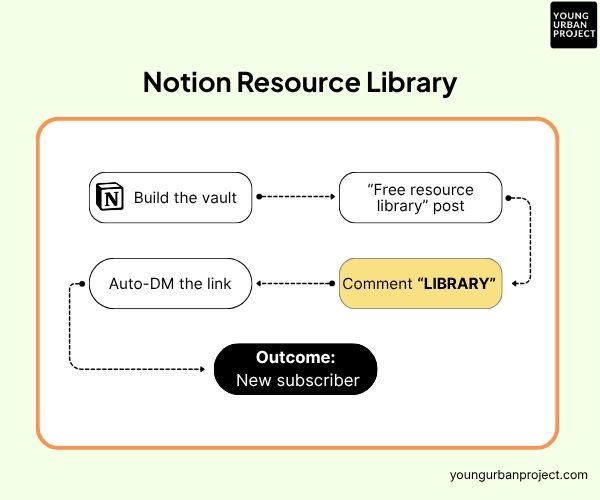
A Notion resource library is a single, organised vault containing every free asset you’ve ever created, templates, swipe files, checklists, all in one place, sitting behind one link.
It converts because it solves the “I know they have good stuff somewhere, I just can’t find it” problem. Most brands scatter their freebies across old posts, old emails, and old Google Drive links nobody can locate. A resource library packages all of it into one destination that feels disproportionately valuable for something free.
To build one: create a Notion page, organise it into clear categories, and add a short description under each asset so people know what they’re getting before they click. Keep it visually clean. A cluttered Notion page undercuts the “vault of value” feeling you’re going for.
The failure point here is neglect. A resource library that hasn’t been updated in eight months starts feeling like a graveyard instead of a vault. Treat it like a living asset, not a one-time build.
2. Custom GPT
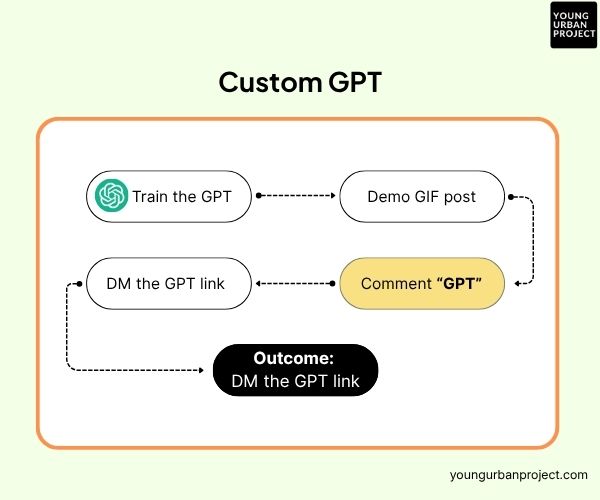
A custom GPT is a branded AI tool, built on top of a foundation model, trained on your frameworks and knowledge, that someone can use directly in their browser the moment they get the link.
This is currently one of the strongest-converting formats because it’s not a promise of value, it’s an experience of value. The person doesn’t have to trust that your framework works. They type a question and watch it work, live, in front of them.
Building one takes an afternoon, not a dev team. Feed it your best frameworks, your tone of voice, and real examples from your work, then test it with edge-case questions before you ship it. From what we’ve seen with YUP learners who build custom GPTs for their own niches, the ones that convert best are narrow and specific – a GPT that does one job extremely well beats one that tries to be a general assistant.
The trap is scope creep. A GPT that tries to answer everything ends up answering nothing particularly well, and that undermines the authority it was meant to build.
3. Prompt Library
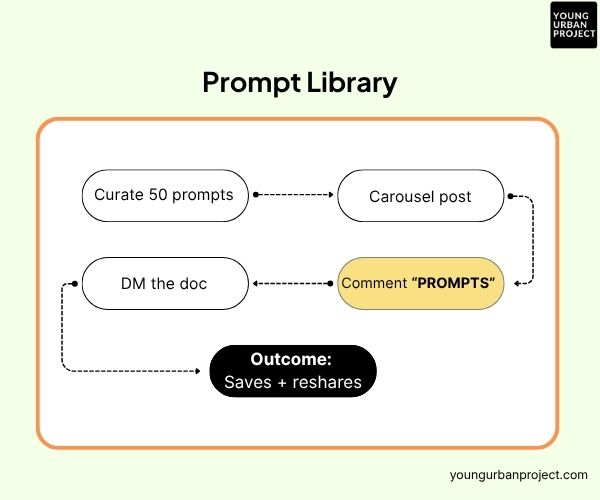
A prompt library is a curated set of ready-to-use prompts, usually 30 to 50, built around a specific job to be done, copy-paste and go.
It converts because it’s an instant win with almost zero setup cost for the person receiving it. There’s no learning curve. They paste a prompt into ChatGPT or Claude and get a usable result in the next thirty seconds. That immediacy is rare, and rare things get saved and shared.
To build one, pick a single job, writing LinkedIn posts, building marketing calendars, drafting cold emails, and write prompts specific enough to produce a genuinely useful output on the first try. Vague prompts that need heavy editing kill the “instant win” feeling that makes this format work.
Prompt libraries convert well because they deliver a usable result with no setup cost, which drives the save and reshare behaviour that most static PDFs never earn. The format works best when narrowed to one specific job, not a general-purpose list.
4. Swipe File
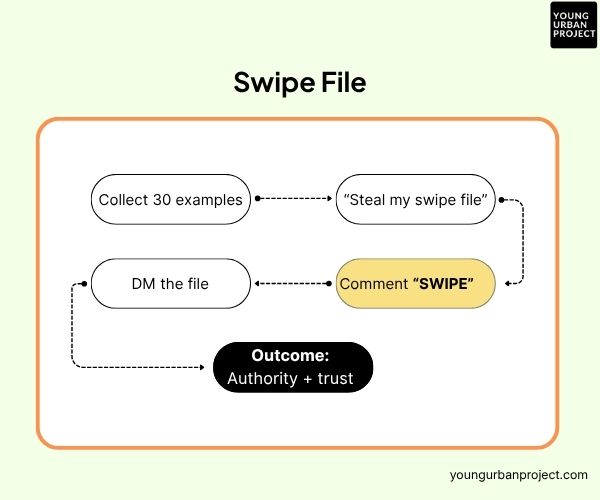
A swipe file is a curated collection of real, working examples, ad copy, email subject lines, landing pages, that people can study or copy directly for their own use.
This one converts on a mix of trust and utility. You’re not telling people what good work looks like. You’re showing them, with receipts. That builds authority faster than most explainer content, because the reader is essentially watching you do the work you claim you can do.
Building it means collecting 20 to 30 real examples, ideally with a one-line note on why each one works. Screenshots of actual campaigns beat recreated mockups every time. Authenticity is the entire point.
Where this fails is copyright and attribution carelessness. Always give credit where the example comes from a named brand or campaign, and avoid presenting someone else’s proprietary work as your own template.
5. Plug-and-Play Templates
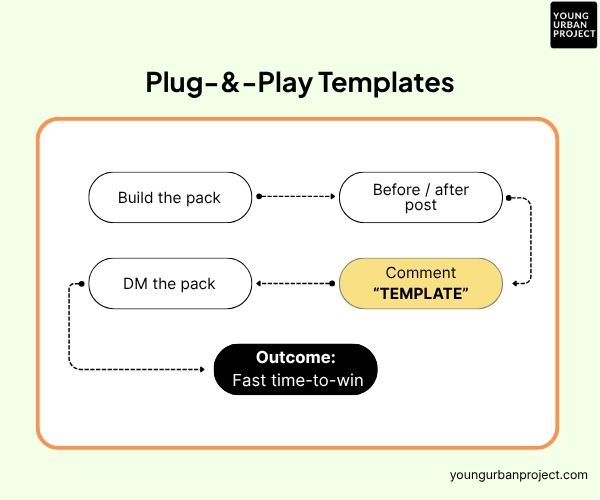
These are ready-made assets, spreadsheets, decks, docs, that someone can drop their own information into and use immediately, no building required.
They convert because they solve for speed. The person requesting this isn’t looking to learn a framework. They want to ship something tomorrow. A well-built template does the thinking for them and leaves only the filling-in.
To build one, take a process you’ve run successfully multiple times and structure it as a reusable document. A content calendar template, a campaign brief format, a hiring scorecard. Keep formatting simple enough that it works whether someone opens it in Google Sheets, Excel, or Notion.
The mistake most people make here is over-designing. A beautifully designed template that’s confusing to actually use loses to a plain one that’s obvious at a glance.
6. Tactical Playbook
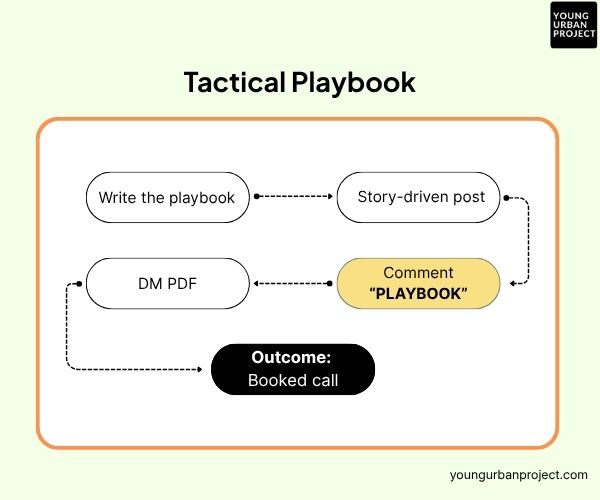
A tactical playbook is a step-by-step system, usually built around a specific outcome, packaged as a downloadable guide.
This converts on specificity and story. Unlike a generic guide, a playbook implies “this is the exact system, in order, that produced a result.” That framing pulls harder than a general how-to because it promises a repeatable outcome, not just information.
Build it by documenting a process you’ve actually run, in the order you ran it, including the parts that didn’t work the first time. That honesty is what separates a real playbook from a repackaged blog post. Story-driven framing in the promotional post, “here’s exactly what I did,” tends to outperform a feature-list framing.
The weak version of this format reads like a table of contents with extra words. The strong version reads like you’re looking over someone’s shoulder while they work.
7. Calculator or Interactive Tool
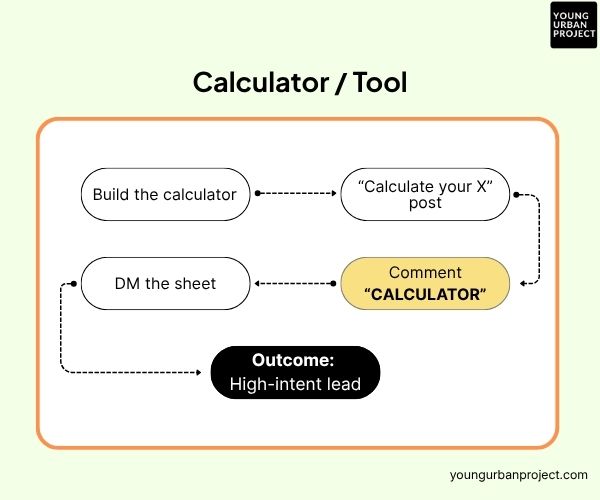
A calculator does one specific piece of math for the user, ROI, budget allocation, pricing, based on their own numbers, and gives them a personalised output.
This is one of the highest-intent formats on this list. Someone who plugs their real numbers into a calculator has already moved past casual curiosity. They’re evaluating something concrete, which makes them a materially warmer lead than someone who just downloaded a PDF.
To build one, identify a decision your audience makes repeatedly, how much to spend on ads, what to charge for a service, and build a simple interactive sheet or lightweight web tool around it. It doesn’t need to be technically sophisticated. It needs to produce a number that means something to the person using it.
Calculators and interactive tools convert into higher-intent leads than static content because the act of entering real numbers signals active decision-making, not passive curiosity. This makes them one of the strongest formats for sales-adjacent follow-up, not just list growth.
The failure mode is a calculator that’s too generic to feel personal. If the output could apply to almost anyone, it doesn’t feel like it was built for the person using it.
8. Checklist or SOP
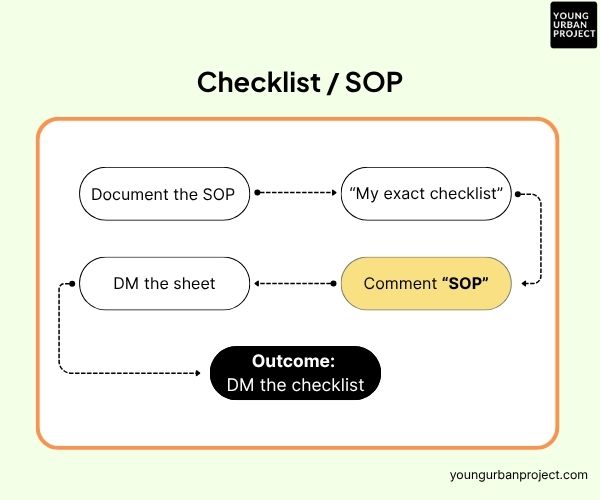
A checklist or standard operating procedure documents your exact process for a specific task, in order, with nothing left implied.
It converts because it removes ambiguity. Most people don’t lack information, they lack a clear, ordered sequence of what to actually do. A tight checklist gives them that in a format that takes two minutes to skim and immediately apply.
Build it from a task you do so often it’s second nature to you. Write down every step, including the ones that feel obvious. What’s obvious to you is often the exact step someone else is missing.
Where this format falls apart is length. A checklist with 40 items stops being a checklist and becomes a document nobody finishes. Keep it tight enough to be genuinely actionable in one sitting.
9. Email Mini-Course
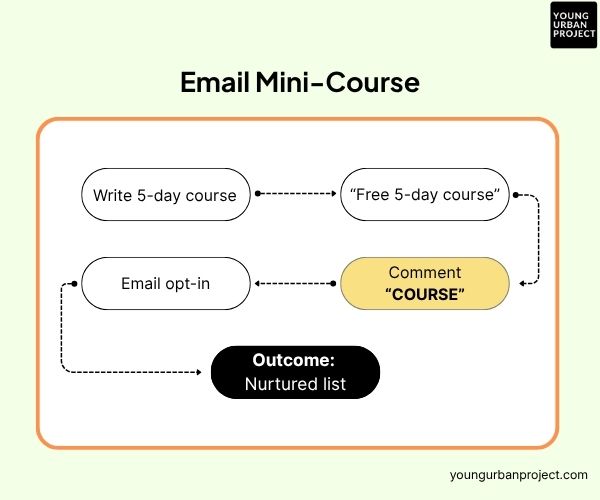
A mini-course delivers value across a sequence, typically five days, one useful lesson per email, building toward a complete skill or outcome.
This converts differently than the other formats. It’s not about a single instant win. It’s about building a real relationship over several days, which produces a warmer, more nurtured subscriber by the end than a one-off download ever does.
To build one, break a skill into five logical steps and write one focused email per step. Each email should stand on its own value, not just tease the next one. If someone only reads day one and never opens another email, they should still walk away having learned something real.
The mistake here is treating each email as a teaser for the next, rather than genuinely valuable on its own. That approach reads as manipulative and tanks open rates by day three.
10. Teardown or Audit
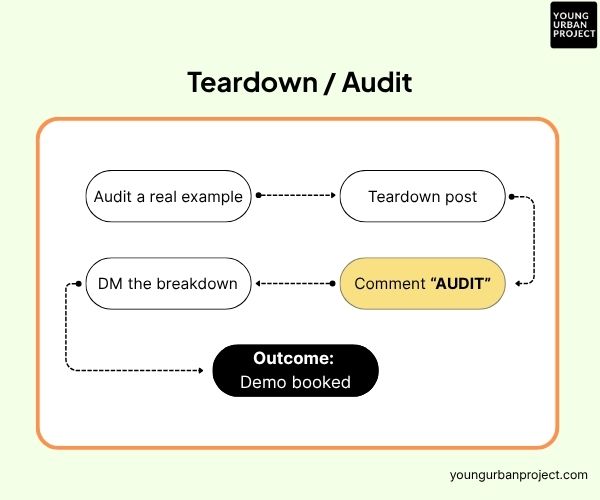
A teardown breaks down a real, named example, a landing page, an ad, a funnel, showing exactly what works, what doesn’t, and why.
This converts because it demonstrates expertise instead of claiming it. Anyone can say “I know how to fix your funnel.” A teardown proves it in public, on a real example, which makes the leap to “will you fix mine” feel natural rather than salesy.
Build it by choosing a well-known example in your space and analysing it section by section, calling out specific decisions and their likely impact. Specificity matters enormously here. “The headline is weak” is forgettable. “The headline leads with a feature instead of the outcome, which is why the bounce rate is probably high” is memorable and credible.
The format’s biggest risk is coming across as a takedown rather than an analysis. Critique the work, not the brand or the person behind it.
How to Match the Lead Magnet to Your Funnel Stage
Not every format belongs at the top of the funnel. Some of these are built to capture a cold audience cheaply. Others are built to filter for intent.
For cold, top-of-funnel audiences who don’t know you yet, lean on formats with low commitment and instant gratification: prompt libraries, checklists, and resource libraries. These ask almost nothing of the person and deliver value fast, which is exactly what builds initial trust.
For warm audiences who already follow you and engage with your content, custom GPTs and swipe files work harder. These formats assume a baseline of trust in your expertise, and they reward that trust with something more substantial.
For audiences close to a buying decision, calculators, playbooks, and teardowns are the strongest picks. Someone plugging real numbers into a calculator or requesting an audit of their own funnel isn’t casually browsing. That’s a qualified lead, and your follow-up sequence should treat it as one.
The Comment-to-DM Distribution System
None of these formats matter without the delivery mechanism underneath them. The system that’s currently outperforming every alternative on Instagram is comment-to-DM automation, and it’s worth understanding why it works before you build on top of it.
Here’s the sequence. Someone sees a post with a clear call to action, “comment LIBRARY and I’ll send you the link.” They comment the keyword. An automation tool detects the comment and instantly sends them a DM with the resource, often within seconds. If the flow is built well, it also asks for their email inside the DM before or after delivering the freebie, so the lead lands in your list, not just your inbox.
This works because it collapses the distance between interest and delivery to almost nothing. Comment-triggered DMs open at rates far above email, typically in the 70 to 90% range within the first hour, compared with roughly 21 to 25% for a cold email send, according to 2026 benchmark data compiled by Communipass’s auto DM research. The person is still looking at your content when the resource lands in their inbox. Compare that to a link-in-bio flow, where the person has to remember to check their bio, tap through, and land on a page that may or may not load quickly on their connection.
- Step 1: Post content with a single, clear keyword CTA in the caption or on-screen text.
- Step 2: Set up an automation tool, most Instagram-native options run through Meta’s official Graph API, so they don’t violate platform rules. There are also tools like Manychat that help with
- Step 3: Configure the trigger to fire an instant DM the moment someone comments the keyword.
- Step 4: Ask for an email inside the DM conversation before or immediately after delivering the resource.
- Step 5: Route non-responders into a short follow-up sequence instead of letting them go cold.
The common mistake is skipping step 4. Sending the resource without capturing an email means you got engagement, not a lead. You gave away the value and walked away with nothing to nurture.
Comment-to-DM automation converts better than link-in-bio delivery because it removes the multi-step navigation, profile, bio, external page, that causes most drop-off. The email capture has to happen inside the DM conversation itself, not after, or the lead magnet becomes a one-time engagement boost instead of a list-building asset.
Common Mistakes That Kill Lead Magnet Conversion
A few patterns show up across almost every underperforming lead magnet we’ve reviewed.
The first is genericism. A lead magnet titled “The Ultimate Marketing Guide” tells the reader nothing about what specific problem it solves. Specificity is what makes someone stop scrolling and comment.
The second is delivery friction. Any lead magnet that requires more than one click, or a page load, or a form with more than two fields, loses a meaningful share of interested people before they ever see the content.
The third is staleness. A lead magnet that’s circulated unchanged for a year sees its conversion rate slide, even if the content itself is still accurate. Refreshing the framing, the format, or the promotional post, without necessarily rebuilding the asset, is often enough to bring the numbers back up.
The fourth is treating the lead magnet as the finish line instead of the start. The best-performing brands don’t stop at delivery. They follow the DM or email capture with a short, relevant nurture sequence that moves the new lead toward an actual offer, rather than letting them sit untouched on a list.
Building a System, Not a One-Off Asset
The formats that convert best in 2026 share a common thread: they deliver real value with almost no friction between interest and access. A Notion library, a custom GPT, a calculator, none of them work in isolation from the distribution system underneath them.
Pick one format that matches where your audience actually sits in the funnel, build the comment-to-DM flow around it properly, capturing the email inside the conversation, and treat the whole thing as a system you maintain, not a one-time asset you publish and forget.
If you want a structured, hands-on way to build funnels like this, from the lead magnet itself to the automation and the follow-up sequence, Young Urban Project’s Advanced Digital Marketing course walks through the full system with live cohort support.
FAQs about Lead Magnets
What is a lead magnet?
A lead magnet is a piece of free value, a resource, tool, or asset, offered in exchange for a person’s contact information, usually an email address or a DM opt-in. Its job is to convert an anonymous audience member into a known, contactable lead.
What’s the highest-converting lead magnet type in 2026?
Interactive formats that deliver value instantly, custom GPTs and calculators in particular, are converting best right now because they demonstrate value in real time rather than requiring a download first. That said, the delivery mechanism, comment-to-DM versus link-in-bio, often matters as much as the format itself.
Do PDF lead magnets still work?
Yes, but they work less well than they used to on their own. A PDF checklist or playbook still converts if it’s specific and genuinely actionable, but it needs to be delivered with minimal friction, ideally inside a DM, to compete with more interactive formats.
How do I set up comment-to-DM automation?
You need an Instagram automation tool that runs through Meta’s official Graph API, a defined keyword trigger, and a DM flow that delivers your resource and asks for an email. Most tools (like Manychat) let you build this without any code, usually configured in under an hour.
Is a lead magnet worth building if I have a small following?
Yes. A calculator, checklist, or template can convert well even on a small account because the format, not the follower count, is what drives conversion once someone sees the post. Smaller accounts often see higher engagement rates on comment CTAs precisely because their audience is more niche and more invested.
Which lead magnet is best for a cold, top-of-funnel audience?
Low-commitment, instant-gratification formats work best here: prompt libraries, checklists, and resource libraries. They ask little of a stranger and deliver value fast, which builds initial trust without requiring existing brand affinity.
Why isn’t my lead magnet converting even though the content is good?
The most common cause isn’t the content quality, it’s the delivery friction. If your funnel requires a click to a bio link, a page load, and a multi-field form, you’re losing people at every step regardless of how strong the actual resource is. Audit the path from “sees the post” to “has the resource” and remove every unnecessary step.
Do I need to capture an email if I’m already delivering the lead magnet by DM?
Yes. DM delivery without email capture means you gained engagement, not a lead you can nurture outside the platform. Build the email ask into the DM conversation itself, ideally before or immediately after the resource is delivered.
How often should I refresh a lead magnet?
Watch the click and opt-in rate on a given resource. When it starts sliding, even without any change to the content itself, it’s usually a sign the format has gone stale for your audience. Refreshing the promotional angle or updating the resource every few months tends to restore performance.