
This piece unpacks what is direct marketing without overcomplicating it. It starts with the basics, then slowly moves into how direct marketing actually plays out in campaigns, the kind that either work… or don’t. There’s a look at different types, where each fits, and why some channels still hold up despite all the newer options. It also touches on the advantages, a few drawbacks that tend to get ignored, and what’s changing right now. Some sections go a bit deeper than expected, but that’s where things usually click. By the end, the idea becomes clearer: direct marketing isn’t just about sending messages, it’s about sending the right ones to people who are likely to respond.
Table of Contents
What Is Direct Marketing?
Direct marketing gets talked about a lot, but the idea itself is pretty straightforward.
At a basic level, direct marketing is when a brand reaches out to a specific person (or a tightly defined group) and asks them to take a clear action. Not someday. Not vaguely. Now, or at least soon.
It could be an email, a message, a call, or even a physical mailer. The format changes, but the intent stays the same.
A slightly more formal definition would be something like:
Direct marketing is a strategy where businesses communicate directly with a targeted audience using specific channels to drive measurable responses related to a product or service.
That sounds neat on paper. In reality, it’s a bit messier, and honestly, that’s where it gets interesting.
Because direct marketing isn’t just about sending messages. It’s about who gets the message, what they see, and why they care enough to act.
Direct Marketing vs Traditional Advertising
This is where things usually click.
Traditional advertising plays the volume game. Put your message in front of as many people as possible and hope a small percentage responds. Billboards, TV ads, print; all built for reach.
Direct marketing doesn’t work like that.
Instead of casting a wide net, it’s more like:
- Picking a specific group
- Saying something relevant to them
- Giving them a reason to respond immediately
A simple comparison helps:
- A TV ad says: “Check out our new collection.”
- A direct marketing email says: “Your size is back. 20% off ends tonight.”
One builds awareness. The other pushes action.
Neither is “better” in isolation, but they serve very different roles. Direct marketing leans heavily toward response and conversion, not just visibility.
The Core Idea Behind Direct Marketing
Strip away all the tactics and tools, and the idea becomes surprisingly clean:
Send a relevant message to the right person and make it easy for them to act.
That’s it.
Of course, doing that consistently is harder than it sounds. Targeting can be off. Messaging can miss the mark. Timing… often overlooked.
But when all three line up, direct marketing tends to outperform broader campaigns, especially in terms of ROI.
What Is the Purpose of Direct Marketing?
It’s tempting to say the purpose is just “to drive sales.” That’s partly true, but it undersells what direct marketing actually does over time.
There are a few layers to it.
Generate Immediate Response
This is the obvious one.
A good direct marketing campaign is built to trigger something specific:
- A purchase
- A signup
- A reply
- A download
There’s always a next step. No ambiguity.
Compared to indirect marketing, which builds interest gradually, direct marketing is more… decisive. It asks for action upfront.
Build Direct Customer Relationships
This part gets less attention, but it matters more in the long run.
When a brand collects emails, phone numbers, or any form of direct contact, it’s essentially building its own communication channel.
No algorithm in between. No platform dependency (at least, not entirely).
Over time, repeated interactions through these direct channels create familiarity. And familiarity, in marketing, often turns into trust… or at least comfort.
Improve Customer Lifetime Value (CLV)
Acquiring a customer is expensive. Keeping one is usually cheaper.
Direct marketing makes it easier to:
- Re-engage past buyers
- Introduce new products
- Offer upgrades or bundles
That’s how businesses increase customer lifetime value without constantly chasing new leads.
It’s not always dramatic. Sometimes it’s just a well-timed message that nudges someone back.
Reduce Dependency on Intermediaries
Relying entirely on third-party platforms can feel unstable. Costs fluctuate. Reach drops without warning.
Direct marketing offers a bit more control.
Owning a list, whether it’s email or SMS, means:
- Communication isn’t filtered the same way
- Messaging can be tested more freely
- Campaigns are less vulnerable to sudden changes
It’s not a complete escape from platforms, but it does balance things out.
Collect Data and Customer Insights
Every interaction leaves a trace.
Who opened. Who clicked. Who ignored. Who converted.
Over time, this data becomes incredibly useful:
- Better segmentation
- More relevant offers
- Smarter timing
And slowly, campaigns start feeling less like guesses and more like informed decisions.
Key Characteristics of Direct Marketing
Not every campaign labeled as “direct marketing” actually follows through. But the ones that work well tend to share a few consistent traits.
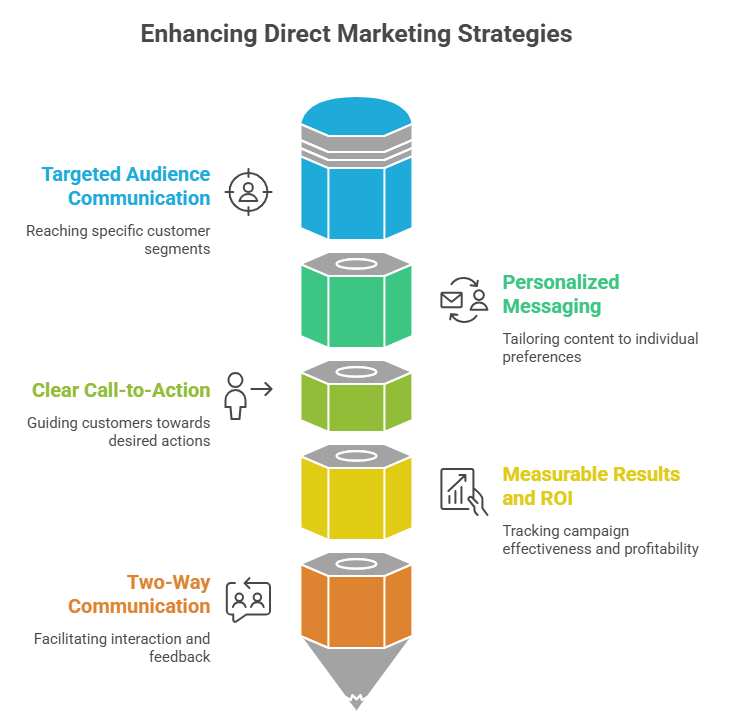
Targeted Audience Communication
Broad messaging doesn’t hold up here.
Direct marketing depends on clearly defined segments:
- Past customers
- High-intent users
- Specific demographics or behaviors
The tighter the targeting, the better the chances of relevance. And relevance is doing most of the heavy lifting.
Personalized Messaging
This goes beyond adding a first name to an email. That’s… the bare minimum.
Real personalization looks more like:
- Different offers for different segments
- Timing based on user behavior
- Content that reflects past interactions
It’s subtle sometimes. But noticeable.
Clear Call-to-Action (CTA)
Every direct marketing campaign needs a direction.
Without a clear CTA, the message drifts. People read it, maybe nod, then move on.
Strong CTAs tend to be:
- Specific
- Time-bound (when possible)
- Easy to act on
Even small tweaks here can shift results quite a bit.
Measurable Results and ROI
This is where direct marketing stands out.
Almost everything can be tracked:
- Opens
- Clicks
- Conversions
- Revenue per campaign
That level of visibility makes it easier to justify spending, but also harder to hide weak campaigns. The data tends to be… honest.
Two-Way Communication
Not always, but often.
Customers can reply, click, engage, or even ignore in a way that sends a signal.
That feedback loop is valuable. It tells you what’s working without needing long feedback cycles or surveys.
How Direct Marketing Works (Step-by-Step Process)
On the surface, it looks simple: send a message, get a response.
But the effectiveness comes from what happens before and after that message is sent.
Step 1: Identify Target Audience
Everything starts here.
A vague audience usually leads to vague results.
Strong campaigns define:
- Who the message is for
- What they care about
- Where they are in the buying journey
Skipping this step or rushing through it tends to show up later in poor performance.
Step 2: Build or Acquire a Customer List
This is the backbone of any direct marketing campaign.
Lists can be built through:
- Website signups
- Lead magnets
- Previous customer data
Buying lists is still a thing, but it comes with risks: low engagement, compliance issues, sometimes both.
Quality matters more than size. Always.
Step 3: Segment the Audience
Not all contacts should receive the same message. That’s where segmentation comes in.
Common segments include:
- New vs repeat customers
- Active vs inactive users
- High-value vs occasional buyers
Even basic segmentation can improve performance noticeably.
Step 4: Craft Personalized Messaging
Now the message takes shape.
This includes:
- The offer
- The tone
- The structure
Some campaigns lean heavily on urgency. Others focus on value or relevance. There’s no single formula, but generic messaging rarely performs well here.
Step 5: Choose a Direct Marketing Channel
Different audiences respond differently depending on the channel.
Options include:
- SMS
- Social media messages
- Direct mail
- Calls
Choosing the wrong channel can quietly reduce effectiveness, even if everything else is solid.
Step 6: Launch the Campaign
Execution phase.
Messages go out. Offers are live. The campaign is in motion.
At this point, there’s usually a bit of waiting… watching early signals, checking if things are landing as expected.
Step 7: Track Response and Optimize
This is where many campaigns either improve or stall.
Key metrics get reviewed:
- Open rates
- Click-through rates
- Conversions
Based on that, adjustments are made:
- Tweaking subject lines
- Refining segments
- Adjusting timing
Then it runs again.
That loop: test, learn, adjust, is what gradually turns an average direct marketing plan into something consistently effective.
Types of Direct Marketing
Direct marketing isn’t a single channel or tactic. It’s more like a collection of approaches that all follow the same principle: reach the right person directly and get a response.
Some of these channels feel very modern. Others have been around for decades and still quietly work.
Let’s break down the main types of direct marketing, along with where they actually make sense.
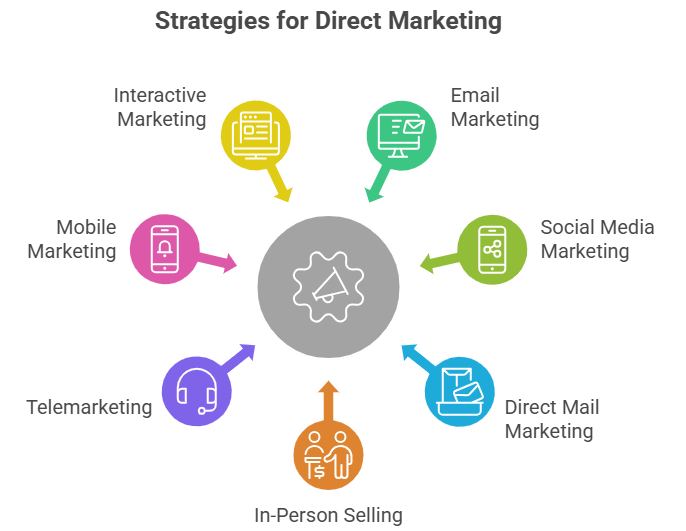
Email Direct Marketing
Email is probably the most widely used form of direct marketing. And despite all the “email is dead” noise over the years… it hasn’t really gone anywhere.
At its simplest, email direct marketing involves sending targeted messages to a list of subscribers to promote a product or service.
Common formats include:
- Promotional campaigns (discounts, launches)
- Lifecycle emails (welcome, onboarding)
- Re-engagement emails
- Abandoned cart reminders
What makes email effective isn’t just reach; it’s control. Brands own the list, control the messaging, and can test endlessly.
A simple example:
- An eCommerce brand sends a reminder: “Still thinking about this? Here’s 10% off.”
That small nudge often converts users who were already close to buying.
Best use cases:
- E-commerce and D2C brands
- SaaS onboarding and retention
- Content-driven businesses building long-term engagement
Social Media Direct Marketing
This one’s a bit broader than people expect.
Social media direct marketing includes both:
- Direct response ads (on platforms like Facebook, Instagram, LinkedIn)
- One-to-one communication (DMs, comments turned into conversations)
Unlike traditional social media marketing (which often focuses on content and engagement), this approach is built for action.
Examples:
- A Facebook ad offering a free webinar with a “Sign Up Now” CTA
- A LinkedIn message sent to a targeted decision-maker
- Instagram DMs used to close high-intent leads
The strength here is precision targeting combined with scale. But it can also get noisy fast if overused.
Best use cases:
- Lead generation campaigns
- B2B outreach
- High-ticket sales where conversations matter
Direct Mail Marketing
Physical mail. Yes, still relevant.
Direct mail marketing involves sending printed materials like:
- Postcards
- Catalogs
- Brochures
- Personalized letters
It might seem outdated, but in some industries, it performs surprisingly well. Less competition in the mailbox compared to inboxes plays a role.
A classic example:
- A real estate company sends personalized postcards to homeowners in a specific area.
It feels more tangible, sometimes more credible. But costs are higher, and targeting needs to be sharp.
Best use cases:
- Real estate
- Luxury products
- Local businesses targeting specific neighborhoods
For hyper-local reach, USPS’s Every Door Direct Mail (EDDM) lets you target entire carrier routes without a purchased list, keep postage low, and deliver oversized postcards that stand out. If you’re a service-area business—think home services, restaurants, or clinics—consider an EDDM postcard mailing for local marketing to blanket the neighborhoods around your location, promote an offer, and drive walk-ins or calls. Pair with QR codes and a trackable URL to tie offline responses back to your CRM.
In-Person Direct Selling
This is one of the oldest forms of direct marketing.
In-person direct selling happens when a salesperson interacts face-to-face with a potential customer to promote and sell a product or service.
Examples include:
- Door-to-door sales
- Retail product demonstrations
- Field sales teams
It’s high effort, no doubt. But it also has a high impact when done right.
There’s something about real human interaction that digital channels can’t fully replicate, especially for complex or high-value products.
Best use cases:
- Insurance and financial services
- High-ticket consumer goods
- Retail environments with experiential selling
Telemarketing
Telemarketing has a bit of a reputation problem. Mostly because of overuse and poor execution.
But at its core, it’s still a direct marketing channel.
It involves reaching out to prospects via phone calls:
- Cold calling (no prior interaction)
- Warm calling (based on some level of interest or data)
In B2B, especially, telemarketing still plays a role in:
- Lead qualification
- Appointment setting
- Follow-ups
The difference between effective and ineffective telemarketing usually comes down to targeting and timing.
A random call feels intrusive. A relevant one, at the right moment, can move deals forward.
Best use cases:
- B2B sales pipelines
- High-value service offerings
- Follow-ups after inbound interest
Mobile Marketing (SMS & Push Notifications)
Mobile marketing is more direct than most channels; it literally sits in someone’s pocket.
This includes:
- SMS campaigns
- App push notifications
These messages tend to have very high open rates. But that also means expectations are higher. Poorly timed or irrelevant messages can backfire quickly.
Examples:
- “Flash sale starts now. Ends in 2 hours.”
- “Your order has been shipped.”
Short, urgent, and action-driven. That’s what works here.
Best use cases:
- Time-sensitive offers
- Transactional updates
- Re-engagement campaigns for apps
Interactive / Digital Direct Marketing
This is where things start blending together a bit.
Interactive direct marketing includes digital experiences designed to respond to user behavior in real time.
Examples include:
- Personalized landing pages
- Chatbots guiding users through decisions
- Dynamic website content based on user data
It’s still direct marketing; just more adaptive.
Instead of sending a fixed message, the experience changes based on who the user is and what they do.
A simple example:
- A returning visitor sees a different homepage offer than a first-time visitor.
Subtle, but effective.
Best use cases:
- SaaS and tech platforms
- E-commerce personalization
- Lead qualification through conversational flows
A Quick Takeaway on Types of Direct Marketing
No single channel works best in every situation.
Most effective direct marketing strategies combine multiple direct marketing channels:
- Email for nurturing
- Social for acquisition
- SMS for urgency
- Landing pages for conversion
That mix tends to outperform any single-channel approach.
And honestly, that’s where many campaigns fall short; not in the execution of one channel, but in the lack of coordination across them.
Real-World Direct Marketing Examples
Reading definitions only gets you so far. Direct marketing really starts to click when you see how brands actually use it; what they send, who they target, and why it works (or doesn’t).
A couple of examples worth unpacking.
B2C Direct Marketing Example: Nike – Stadium Shoebox Campaign
Nike did something interesting with its “Stadium Shoebox” concept. Instead of pushing another digital campaign into already crowded feeds, they went physical.
Here’s the rough idea:
- They identified runners in specific cities
- Sent them a custom-designed shoebox that opened like a stadium
- Included messaging tied to running culture and local events
On paper, it’s just direct mail. But the execution is where it stands out.
The packaging didn’t feel like advertising. It felt like something built for the recipient. Subtle difference, but important.
Also, the targeting was tight. This wasn’t sent to “everyone who buys shoes.” It was aimed at people already engaged in running. That reduces friction immediately.
What made it work:
- Clear audience definition; not broad, not vague
- Personalization that went beyond inserting a name
- A physical experience in a mostly digital landscape
- Strong alignment between the message and the product
There’s a lesson here. Direct mail isn’t outdated; it’s just misused most of the time.
B2B Direct Marketing Example: ZoomInfo – Personalized Video Outreach
B2B direct marketing plays a different game. Fewer prospects, higher stakes, longer timelines.
ZoomInfo leaned into personalized video outreach instead of standard email pitches:
- Short videos recorded for individual prospects
- Messaging tailored to the company’s specific context
- Delivered through email or LinkedIn
Now, this doesn’t scale neatly. And that’s kind of the point.
Most B2B inboxes are filled with copy-paste outreach. Same structure, same tone, same vague promises. A personalized video breaks that pattern.
It signals effort. And relevance.
Why this approach worked:
- The message felt specific, not templated
- It addressed actual business problems, not generic benefits
- It created a small moment of attention in a crowded channel
- Follow-ups were structured, not random
In B2B, that extra layer of effort often makes the difference. Not always scalable, but effective where it counts.

Enroll Now: Advanced Digital Marketing Course
Advantages of Direct Marketing
There’s a reason direct marketing keeps showing up across industries. Even with all the new channels and formats, the fundamentals still hold.
But the benefits only show up when the basics are done right. Otherwise, it just turns into noise.
High ROI Compared to Traditional Marketing
Because the targeting is tighter, spend tends to be more efficient.
Instead of paying for visibility across a broad audience, budgets are directed toward people who are already somewhat relevant. That usually improves conversion rates.
Not guaranteed, but more predictable.
Cost-Effective for Small Businesses
This one gets misunderstood.
Direct marketing doesn’t require massive budgets to start. A small, well-maintained list can outperform a large, poorly targeted one.
For smaller businesses, that matters:
- Less wasted spend
- More control over messaging
- Easier to test and adjust
It’s not “cheap,” exactly. But it’s efficient when handled properly.
Measurable Performance
One of the biggest advantages of direct marketing; everything leaves a trace.
- Opens
- Clicks
- Replies
- Conversions
That visibility changes how decisions are made. Campaigns aren’t based on guesswork as much as they used to be.
And when something underperforms, it shows quickly.
Personal Touch and Customization
Direct marketing allows for a level of relevance that broader campaigns struggle to match.
Messages can shift based on:
- Past behavior
- Purchase history
- Engagement patterns
Sometimes it’s subtle. A slightly different offer, a better-timed message. But those small adjustments compound.
Faster Feedback Loop
Results don’t take long to show up.
Within a short window, there’s usually enough data to understand:
- Is the message landing?
- Are people engaging?
- Where are they dropping off?
That speed makes it easier to iterate. And iteration is where most gains come from.
Disadvantages of Direct Marketing
Now, the other side. Direct marketing isn’t automatically effective. It comes with its own set of challenges, and they show up quickly when things are off.
High Upfront Costs (Data + Setup)
Running a campaign might not be expensive, but building the foundation often is.
Costs can include:
- Acquiring or cleaning a customer list
- Setting up systems for segmentation and delivery
- Creating multiple versions of messaging
If the data isn’t solid, everything built on top of it weakens. That’s usually where things go wrong first.
Limited Reach Compared to Mass Marketing
Direct marketing is focused by design.
That’s great for conversions, not so great for awareness at scale.
If the goal is to reach as many people as possible, other marketing strategies tend to do that better. Direct marketing works best when there’s already some level of intent or familiarity.
Risk of Being Perceived as Spam
This one’s hard to recover from once it happens.
Poor targeting or excessive frequency leads to:
- Ignored messages
- Unsubscribes
- Negative brand perception
And it doesn’t take much. A few irrelevant messages in a row can shift how a brand is perceived.
Permission-based approaches help, but they’re not always followed.
Requires Precise Targeting
There’s less margin for error here.
If the targeting is off:
- The message feels irrelevant
- Engagement drops
- Costs go up without returns
Direct marketing rewards precision. Without it, campaigns feel forced… or worse, intrusive.
A quick observation that comes up often: most disadvantages of direct marketing aren’t inherent to the channel. There are execution problems.
Poor data, rushed segmentation, and generic messaging; those tend to cause more damage than the channel itself. Fix those, and many of the issues become manageable. Not perfect, but manageable.
Common Challenges in Direct Marketing
Direct marketing looks clean in frameworks. In reality, it’s a bit uneven. Some campaigns click instantly. Others… just sit there. No clear reason at first glance.
Most of the time, the issue isn’t the channel. It’s something underneath: data quality, targeting logic, message timing. Small things, but they compound fast.
Lower Reach
This comes up early, especially when teams shift from broad indirect marketing to more focused direct channels.
Reach drops. Naturally.
A tightly defined target audience means fewer people see the message. That’s expected. But it can feel like underperformance if the goal is still “more visibility.”
The fix isn’t to loosen targeting too much. That usually backfires.
Instead, layering channels tends to work better. Email plus retargeting. SMS for high-intent users. Maybe even direct mail in specific segments. The idea is to stay targeted, but show up in more than one place.
People don’t always respond the first time. Or the second.
Higher Costs
Direct marketing gets labeled as cost-effective. It can be. But there’s a front-loaded cost that’s easy to underestimate.
Good data isn’t free. Maintaining it isn’t either.
Segmentation takes effort. Personalization takes time. And when campaigns scale, those costs become more visible.
What usually helps is tightening the focus:
- Fewer, better segments
- More relevant messaging
- Less “send to all” behavior
Sending fewer messages but getting higher responses often balances things out. Not immediately, but over a few cycles.
Negative Customer Responses
This one shows up quietly at first.
Open rates dip. Unsubscribes creep up. Replies get… colder.
It’s rarely dramatic, but it signals something’s off.
Usually, it’s one of three things:
- Messaging feels repetitive
- Offers aren’t relevant
- Frequency is too high
Permission-based marketing helps, but it’s not a safety net. Just because someone opted in doesn’t mean they’ll tolerate poor communication.
Relevance carries more weight than permission over time.
Poor Targeting
If there’s one root cause behind most challenges of direct marketing, it’s this.
When targeting is off, everything downstream weakens:
- The copy feels generic
- The offer misses
- Timing feels random
And the campaign ends up looking worse than it actually is.
Improving targeting isn’t always about adding more data. Sometimes it’s about removing noise. Cleaning lists. Re-segmenting based on behavior instead of assumptions.
It’s not glamorous work. But it’s where most performance gains come from.
Legal & Data Privacy Issues
This part has shifted a lot over the past few years.
Users are more aware. Regulations are stricter. Expectations are clearer.
Consent isn’t optional anymore. Neither is transparency.
People want to know:
- Why are they being contacted
- What data is being used
- How to opt out without friction
Ignoring this doesn’t just affect compliance. It affects trust. And once trust drops, direct marketing becomes much harder to sustain.
Direct Marketing Best Practices
There’s no single playbook that works everywhere. But certain patterns show up again and again in effective direct marketing.
Not hacks. Not shortcuts. More like consistent habits that compound over time.
Build a high-quality targeted list
List quality shapes everything.
A smaller list with clear intent often outperforms a large, loosely defined one. It’s tempting to chase scale early, but relevance matters more here.
Contacts should exist on the list for a reason. Not just because they were available.
Personalize beyond first name
Basic personalization, adding a name, doesn’t do much anymore.
What works better is adjusting the message itself:
- Different offers for different segments
- Timing based on behavior
- Content that reflects past actions
It doesn’t have to be complex. Just… accurate.
Write compelling, benefit-driven copy
Direct marketing copy doesn’t need to be clever. It needs to be clear.
What’s being offered?
Why does it matter?
What should happen next?
When those three are obvious, performance tends to improve. When they’re buried under vague language, it drops.
Use strong CTAs
A weak CTA doesn’t fail loudly. It just underperforms.
“Learn more” or “Check this out” rarely drives action.
More specific CTAs, tied to a clear outcome, usually work better. Not always dramatic changes, but noticeable over time.
A/B test campaigns
Assumptions can be misleading.
Subject lines, timing, and offers; small variations can produce different outcomes. Testing helps uncover those differences.
Not every test gives a clear answer. Some are inconclusive. That’s fine. Over time, patterns start to show.
Optimize timing and frequency
This part is often guessed rather than tested.
Too many messages feel intrusive. Too few, and the brand fades out.
There’s no fixed rule. It depends on:
- The audience
- The channel
- The product or service
Gradual adjustments usually work better than big changes.
Use segmentation and behavioral triggers
Segmentation improves relevance. Behavioral triggers improve timing.
Together, they make communication feel less forced.
Instead of pushing messages on a schedule, they respond to actions: signups, clicks, and inactivity. That shift alone can improve engagement.
Combine multiple channels (omnichannel)
Single-channel campaigns have limits.
Combining channels, email, mobile marketing, and social media creates more touchpoints. Not overwhelming, just… present in the right places.
Consistency across these channels matters more than volume.
Maintain brand consistency
Even in direct campaigns, tone and identity matter.
If messaging feels disconnected from the broader brand, trust takes a hit. Not immediately, but gradually.
Consistency builds familiarity. And familiarity tends to improve response over time.
Track and improve continuously
Direct marketing isn’t something that gets “set.”
Performance needs regular review:
- What’s improving
- What’s declining
- What’s stable
Small adjustments, better segmentation, and sharper messaging tend to add up. Slowly, but steadily.
Steps to Create a Direct Marketing Strategy
A solid direct marketing plan rarely starts with channels or tactics. It starts with clarity. Who the audience is, what they care about, and what outcome actually matters.
Everything else builds from there.
Understand your market and audience
This step gets rushed more often than it should.
Basic demographics aren’t enough. What matters more is:
- Why people buy
- What stops them
- What triggers action
Without that, messaging becomes generic. And generic messaging struggles in direct channels.
Analyze competitors
Competitor analysis isn’t about copying campaigns.
It’s more about spotting patterns:
- What kind of offers are common
- How frequently does communication happen
- Which channels show consistent use
Gaps usually appear when looking closely. Those gaps are often more valuable than the patterns themselves.
Choose the right channels
Not every audience responds the same way.
Some prefer email. Others engage more with SMS or social outreach. In B2B, direct conversations often matter more than broadcast messages.
Choosing channels based on audience behavior, not convenience, tends to produce better results.
Create high-converting messaging
This is where most of the impact happens.
Messaging needs to connect quickly. Not over-explained, not overly polished. Just clear and relevant.
The offer matters. The timing matters. Even small phrasing choices can shift how a message is received.
It’s rarely perfect on the first attempt. That’s expected.
Launch, test, and optimize
Once the campaign is live, patterns start to emerge.
Some segments respond better. Some messages fall flat. Timing might be slightly off.
Adjustments follow:
- Tweaking segments
- Refining copy
- Changing send times
Then it runs again.
Over time, the strategy sharpens. Not through big changes, but through steady iteration. That’s usually how effective direct marketing takes shape.
Current Trends in Direct Marketing
Direct marketing hasn’t stood still. The core idea is the same; reach people directly and get a response, but how it’s executed has shifted quite a bit.
Some of these changes are subtle. Others are changing how entire direct marketing campaigns are built.
AI-powered personalization at scale
Personalization used to mean adding a name or maybe referencing a past purchase.
That’s no longer enough.
Now, personalization is expected to reflect:
- Behavior in real time
- Browsing patterns
- Purchase intent signals
Messages are becoming more dynamic. Two users on the same list might receive completely different emails, offers, and even timing, all based on what they’ve done recently.
It sounds complex, and sometimes it is. But the result is simpler: messages feel more relevant. Less generic, less forced.
Marketing automation tools
Automation isn’t new, but it’s become more central to how direct marketing work actually happens.
Instead of scheduling one-off campaigns, marketers are building flows:
- Welcome sequences
- Re-engagement loops
- Post-purchase follow-ups
These run continuously in the background.
The shift here is from “send campaigns” to “build systems.” Once set up properly, they handle a large part of the communication without constant manual input.
Still needs monitoring, though. Automation without oversight tends to drift.
Omnichannel integration
Channels used to operate separately. Email was one thing, SMS another, social something else entirely.
That separation is fading.
Now, stronger strategies connect these direct marketing channels:
- A user clicks an email – gets retargeted on social
- Abandons a cart – receives an SMS reminder
- Engages with a message – sees a personalized landing page
It’s less about adding more channels and more about making them work together.
When done well, it doesn’t feel like multiple campaigns. It feels like one continuous interaction.
First-party data strategies
With privacy changes and reduced reliance on third-party data, first-party data has become more valuable.
That includes:
- Email lists
- Customer purchase data
- Website behavior
Brands are focusing more on collecting and using their own data rather than depending on external sources.
It’s slower to build, but more reliable. And usually more accurate.
Privacy-first marketing
This isn’t just a legal requirement anymore. It’s shaping how campaigns are designed.
Users are more cautious about how their data is used. Consent, transparency, and control are becoming part of the experience.
That means:
- Clear opt-ins
- Easy opt-outs
- Honest communication about data use
Ignoring this doesn’t just create compliance risks. It affects how people respond to messaging.
Trust has become part of performance.
Direct Marketing vs Indirect Marketing
This comparison comes up a lot, and it’s easy to oversimplify.
Direct and indirect marketing aren’t opposites. They serve different roles.
Key differences explained
Direct marketing focuses on action.
It targets a specific audience and asks for a clear response; buy, sign up, click, reply. It’s measurable, immediate, and often personalized.
Indirect marketing, on the other hand, plays a longer game.
It includes things like:
- Content marketing
- Brand campaigns
- Social media content without direct CTAs
The goal here isn’t immediate conversion. It’s awareness, trust, and familiarity.
So the difference isn’t just in channels. It’s in intent.
Direct marketing asks.
Indirect marketing builds.
When to use each approach
Direct marketing works best when:
- There’s existing demand
- The audience is defined
- A clear action is needed
Indirect marketing works better when:
- Awareness needs to grow
- The market is unfamiliar with the brand
- Long-term positioning matters
Trying to use one in place of the other usually leads to weak results.
For example, pushing hard CTAs to a cold audience rarely works. At the same time, relying only on brand awareness without direct response limits conversions.
Hybrid marketing strategies
Most effective marketing strategies don’t choose one over the other. They combine both.
A typical flow looks like this:
- Indirect marketing builds awareness and interest
- Direct marketing captures and converts that interest
Content attracts. Direct campaigns convert.
When both are aligned, the system becomes more stable:
- Awareness feeds the pipeline
- Direct channels turn that into revenue
It’s not always perfectly structured, but the principle holds.
Conclusion:
Why Direct Marketing Still Works in 2026
Despite all the changes in platforms, algorithms, and consumer behavior, direct marketing hasn’t lost relevance.
If anything, it’s become more important.
The reason is fairly simple.
Attention is fragmented. People are exposed to more content than ever. Broad messaging gets ignored more easily.
Direct marketing cuts through that by focusing on:
- Specific audiences
- Relevant messaging
- Clear actions
It doesn’t rely on being seen by everyone. It relies on being seen by the right people.
That said, it’s not effortless.
Effective direct marketing still depends on:
- Clean data
- Thoughtful segmentation
- Consistent testing and refinement
Without those, campaigns feel generic. And generic messages don’t perform well in direct channels.
Looking ahead, a few things seem clear:
- Personalization will keep getting deeper
- First-party data will become more valuable
- Privacy expectations will continue to rise
None of this changes the core idea. It just raises the standard.
The takeaway isn’t complicated.
Direct marketing works when it respects the audience: their time, their attention, and their intent.
Get that right, and the results tend to follow. Not instantly every time, but consistently enough to matter.
FAQs: About Direct Marketing
What are the 4 main types of direct marketing?
Usually, it comes down to four core types: email, direct mail, telemarketing, and mobile marketing, like SMS. These aren’t new, and maybe that’s exactly why they still work. They’re tested. Reliable in a way. New channels keep popping up, sure, but most direct marketing campaigns still circle back to these because they’re easier to control and measure.
What is the most common direct marketing method?
Email marketing, by a fair margin. Not because it’s exciting, it isn’t, but because it’s practical. Almost every business can build a list and start communicating. The catch is attention. Inboxes are crowded now, so emails that don’t feel relevant get ignored quickly. Sometimes instantly.
What is the main aim of direct marketing?
At its core, direct marketing is about action. A response you can actually see, a click, a signup, a purchase. Not just visibility. Over time, it also builds a direct connection with customers, which quietly reduces reliance on external platforms. That part tends to matter more in the long run.
How does direct marketing work?
It’s a bit of a loop, really. Identify a target audience, send something that feels relevant, watch how people respond, then adjust. And repeat. Rarely works the first time perfectly. The gains usually come from small tweaks, subject lines, timing, messaging, things like that.
What are examples of direct marketing channels?
Email, SMS, phone calls, direct mail, even DMs on social platforms, all fall under direct marketing channels. What ties them together is the direct line to the audience. No middle layer. Each channel feels different, though. Some are more immediate, others more personal. That balance matters more than people expect.
How can I effectively implement direct marketing?
It tends to start with the basics: a clean list, a clear audience, and messaging that doesn’t feel generic. From there, consistency takes over. Campaigns don’t usually hit right away. They improve as patterns become clearer. Small adjustments, over time, that’s where most of the progress comes from.
What are the best B2B direct marketing strategies?
B2B is less forgiving when it comes to relevance. Broad outreach doesn’t land well. More targeted approaches, email, LinkedIn, and account-based strategies tend to perform better. Decision-makers expect context. If the message feels templated or off-point, it’s usually dismissed without much thought.
How much do direct marketers make?
It varies more than people expect. Entry roles are fairly standard, nothing unusual. But once someone moves into performance-focused roles, where results can be tied to revenue, the upside grows. Direct marketing has that advantage. Output is visible, which tends to influence how compensation evolves.
What is direct marketing with an example?
Direct marketing is simply reaching out to a defined group with a clear message. For example, sending a discount offer to customers who haven’t purchased in a while. It’s targeted, intentional, and designed to trigger a response, not just sit there and be seen.
What is the difference between direct marketing and digital marketing?
Digital marketing covers everything online, content, ads, social, the whole mix. Direct marketing is narrower. It focuses on direct communication with a specific audience. Some overlap exists, of course, but not all digital efforts are direct. The intent behind the message is what separates them.
Is direct marketing still effective?
It is, but expectations have shifted. People filter messages faster now. If something feels off or irrelevant, it’s ignored almost immediately. When it’s done well, though, targeted, timely, and clear, it still performs strongly. Maybe even better than broad campaigns in some cases.
Which industries benefit the most from direct marketing?
Industries with repeat interactions tend to benefit more. E-commerce, SaaS, finance, real estate, education, they all rely on ongoing communication. Direct marketing fits naturally there. It helps maintain engagement over time rather than relying on one-off interactions.
What are the best tools for direct marketing campaigns?
There are plenty of tools, email platforms, CRMs, and messaging systems. But tools don’t fix a weak strategy. That’s the thing. A simple setup can outperform a complex one if the data is clean and the messaging is sharp. The fundamentals tend to matter more than the stack.
How do you measure the success of a direct marketing campaign?
Metrics like opens, clicks, and conversions are the obvious starting point. But they don’t tell the full story on their own. Sometimes high engagement doesn’t translate into action, which usually signals a disconnect somewhere. It’s more about reading the pattern than focusing on one number.
What is a direct marketing list?
It’s essentially a database of contacts, people who can be reached through direct channels. Could be leads, customers, subscribers. What matters isn’t just size. Relevance plays a bigger role. A smaller, well-maintained list often performs better than a large, outdated one.
What is permission-based direct marketing?
Permission-based direct marketing means contacting people who have agreed to hear from the brand. It sounds basic, but it changes how messages are received. Expected communication tends to perform better. Unsolicited outreach, on the other hand, usually leads to low engagement or negative reactions.
What is the role of CRM in direct marketing?
A CRM helps organize customer data and track interactions over time. In direct marketing, this becomes useful for segmentation and personalization. Instead of sending one message to everyone, communication can be shaped around behavior and history. That shift alone can improve results quite a bit.
How does personalization improve direct marketing results?
Personalization makes messages feel more relevant, and that’s really the point. When communication reflects what someone has done or shown interest in, it stands out a little more. Doesn’t have to be overly complex either. Even small contextual tweaks can make a noticeable difference.
What is multichannel direct marketing?
Multichannel direct marketing involves using more than one direct channel together, such as email, SMS, social media, and sometimes even direct mail. The idea isn’t to flood the audience, but to stay present across touchpoints. When done right, it feels connected rather than repetitive.
Can small businesses use direct marketing effectively?
They can, and often do. Smaller audiences make it easier to stay relevant. Messaging can feel more personal, less forced. Even simple campaigns can perform well if the targeting is clear and the communication is consistent. It’s not about scale as much as it is about precision.