

You ordered something from an Indian e-commerce platform last month. You got a confirmation email, then radio silence for four days. Then a text saying your package was “out for delivery.” Then nothing. Then it arrived.
That frustrating experience from the customer side? That’s what your supply chain looks like from the inside, except multiplied across hundreds of shipments, dozens of suppliers, and multiple warehouses at once.
Supply chain visibility software exists to fix that. Not just for the customer-facing tracking page, but for every node in the chain: the supplier shipping components from Surat, the 3PL warehouse in Bhiwandi, the last-mile delivery partner in Bengaluru, and every handoff in between.
This guide covers everything: what supply chain visibility software actually does, which features matter, how to choose a platform, and what KPIs tell you whether it’s working. If you’re evaluating tools or trying to understand the category, you’re in the right place.
Table of Contents
What Is Supply Chain Visibility Software?
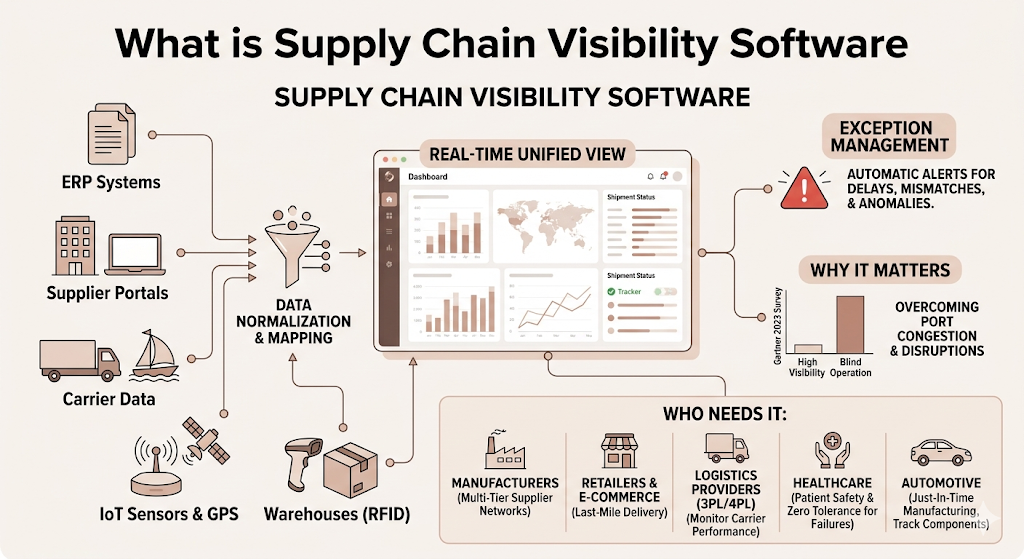
Supply chain visibility software is a platform that gives you a real-time, unified view of every movement, status, and exception across your supply chain, from raw material procurement to customer delivery.
The definition sounds clean. The reality is messier. Most businesses run their supply chains across a mix of ERP systems, spreadsheets, carrier portals, and WhatsApp threads. Supply chain visibility software connects all of that into one view, so you’re not chasing status updates across five different tabs.
How Supply Chain Visibility Software Works
At its core, the software pulls data from multiple sources: your ERP, your carriers, IoT sensors on shipments, GPS devices on trucks, RFID readers at warehouses, and supplier portals. It normalizes that data, maps it to specific orders or shipments, and surfaces it as a live dashboard.
When something goes wrong, it doesn’t wait for you to find out. Exception management logic flags delays, mismatches, and anomalies automatically and sends alerts to the relevant team.
Why Supply Chain Visibility Matters
Here’s an uncomfortable fact: according to a 2023 survey by Gartner, only 21% of supply chain leaders said they had high visibility across their extended supply chain. The other 79% were, in some form, operating blind.
That was before the disruptions of the past few years accelerated the need for better data. Port congestion, unpredictable demand spikes, and geopolitical supplier risks have made real-time visibility a baseline requirement, not a premium feature.
Who Needs Supply Chain Visibility Software?
Manufacturers dealing with multi-tier supplier networks need to know exactly where components are before production schedules fall apart. A delayed shipment from one supplier can halt an entire assembly line.
Retailers and e-commerce brands need visibility from the purchase order all the way to last-mile delivery. Meesho, for instance, operates across tens of thousands of seller-supplier-logistics combinations. Real-time tracking at that scale requires a visibility layer, not just a TMS.
Logistics providers (3PL and 4PL) use visibility software to manage client commitments, monitor carrier performance, and prove SLA adherence. It’s also how they justify their technology fees.
Healthcare organizations have zero tolerance for supply chain failures. A missing shipment of surgical consumables is a patient safety issue, not just an ops problem.
Automotive companies like Tata Motors or Maruti Suzuki run just-in-time manufacturing, where a delayed sub-assembly from a Tier 2 supplier can stop the production line. Visibility at that depth requires software that can track components, not just shipments.
Understanding End-to-End Supply Chain Visibility
“End-to-end” is one of the most overused terms in supply chain software marketing. Here’s what it actually means.
End-to-end supply chain visibility means you have accurate, real-time data at every stage where your goods move, change hands, or sit idle. That includes stages most businesses don’t think to track.
Supplier Visibility
This is where visibility usually breaks down first. Most businesses know what’s in their own warehouse. Far fewer know whether their supplier has actually dispatched the goods, whether the production run is on schedule, or whether there’s a raw material shortage three tiers back.
Supplier visibility means tracking purchase orders, confirmed ship dates, and supplier performance data. Without it, you’re doing a lot of assumption-based planning.
Procurement Visibility
You need to know where every PO stands: raised, acknowledged, confirmed, partially shipped, or fully shipped. Procurement visibility connects purchase orders to actual shipments, so there’s no guessing whether a supplier has acted on a PO.
Inventory Visibility
This covers stock levels across every location: owned warehouses, 3PL facilities, fulfilment centres, and goods in transit. Real inventory visibility tells you not just how much stock you have, but where it is, when it’s moving, and when it’ll be depleted.
Warehouse Visibility
Inside the warehouse: inbound receipts, put-away, pick-pack-ship, returns. Warehouse visibility connects directly to your WMS (Warehouse Management System) and makes inbound shipment status visible to warehouse teams before trucks arrive.
Transportation Visibility
Where is the shipment right now? Which carrier has it? What’s the current ETA? Is there a delay? Transportation visibility is what most people mean when they say “track and trace,” but it’s only one slice of the full picture.
Order Visibility
Order visibility bridges the gap between what the customer ordered and what’s happening in fulfilment. It connects OMS (Order Management System) data with warehouse and carrier data so you can see order status at every stage, not just “picked” or “shipped.”
Last-Mile Delivery Visibility
In India, this is where visibility data is most patchy. Last-mile carriers like Shadowfax, Delhivery, and Xpressbees all have their own portals. Supply chain visibility software that aggregates last-mile carrier data gives you a unified view instead of forcing you to log in to three portals to check delivery status.
Customer Delivery Visibility
This is the customer-facing end: delivery confirmation, proof of delivery, and failed delivery tracking. For D2C brands, this feeds directly into customer service workflows and NPS.
End-to-end supply chain visibility covers eight distinct stages: supplier, procurement, inventory, warehouse, transportation, order, last-mile delivery, and customer delivery. Most businesses only have partial visibility across two or three of these stages, which creates blind spots that lead to delays, excess inventory, and poor customer experience.
Why Businesses Actually Need This (Beyond the Obvious Reasons)
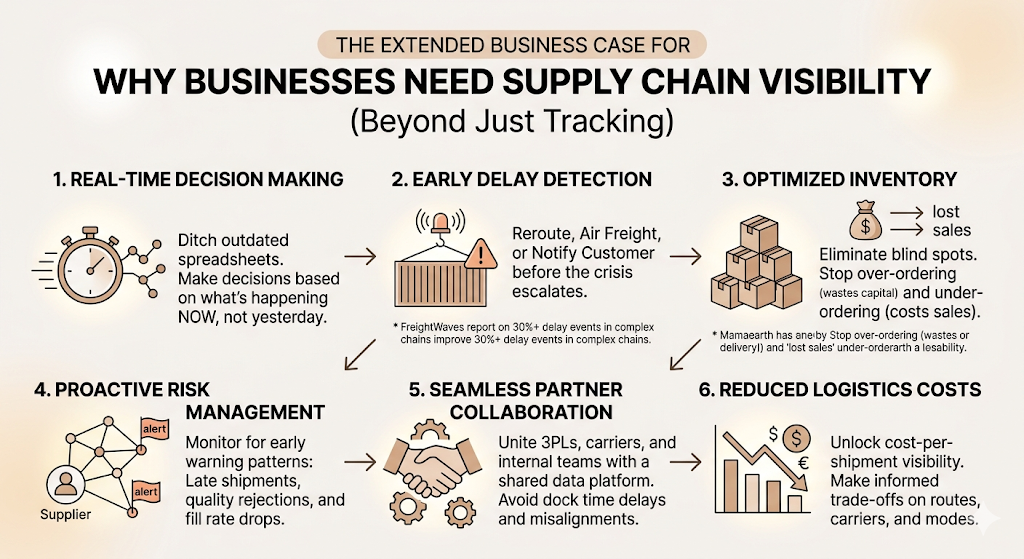
The pitch for supply chain visibility software is usually “track your shipments better.” But the real business case runs deeper.
Limited Real-Time Visibility
Spreadsheets and email threads age out immediately. By the time your ops team has consolidated status across three carrier portals and two supplier emails, the data is already stale. Real-time visibility means your decisions are based on what’s actually happening right now.
Shipment Delays
According to FreightWaves’ 2024 State of Freight report, over 30% of shipments in complex international supply chains experience at least one delay event. The cost isn’t just the delay itself. It’s the cascading effect on production, fulfilment, and customer experience.
Supply chain visibility software can surface delay signals early: a shipment stuck in customs, a carrier running behind schedule, a supplier who hasn’t confirmed dispatch. That early warning gives you time to reroute, air freight, or notify the customer before the problem escalates.
Inventory Blind Spots
If you don’t know exactly where your inventory is and when it’s arriving, you’re either over-ordering (which costs working capital) or under-ordering (which costs sales). Mamaearth, which operates across its own D2C website, Amazon, Nykaa, Flipkart, and thousands of offline stores, cannot afford inventory blind spots. Every out-of-stock event on a marketplace has a direct revenue and ranking cost.
Supplier Risks
A single-source supplier with no backup, shipping from a high-risk region, is a business continuity risk. Supply chain visibility software helps you monitor supplier performance over time and flag patterns: late shipments, quality rejections, and fill rate drops. Those patterns are early warning signs before a supplier relationship becomes a crisis.
Poor Collaboration Across Partners
When your 3PL, your carrier, and your internal ops team are all working from different data, small misalignments become big problems. A missed inbound appointment at a warehouse costs you dock time and restocking delays. Shared visibility platforms eliminate those gaps.
Rising Logistics Costs
India’s logistics sector is notoriously fragmented. Cost visibility, meaning knowing which routes, carriers, and shipping modes are costing you the most per unit, is part of operational visibility. The best platforms surface cost-per-shipment data alongside tracking data so you can make informed trade-offs.
Customer Expectations for Real-Time Tracking
Customers who’ve ordered from Zepto, Blinkit, or Swiggy Instamart expect 10-minute updates. That’s an unfair benchmark for most businesses, but it’s the comparison your customers are making. Providing accurate, proactive delivery updates is now a basic expectation, not a premium feature.
How Supply Chain Visibility Software Works
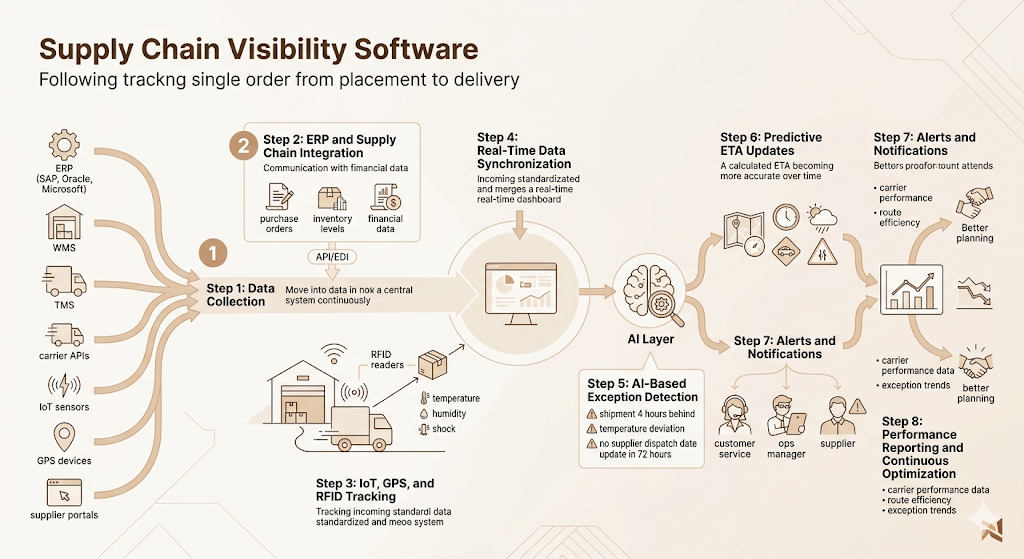
Walk through a single order from placement to delivery, and you can map every point where visibility software adds value.
Step 1: Data Collection. The platform connects to your data sources: ERP (SAP, Oracle, Microsoft Dynamics), WMS, TMS, carrier APIs, IoT sensors, GPS devices, and supplier portals. It ingests data continuously, not in daily batch exports.
Step 2: ERP and Supply Chain Integration. The ERP is usually the system of record for purchase orders, inventory levels, and financial data. The visibility platform reads from it without replacing it. Integration usually happens via API or EDI (Electronic Data Interchange).
Step 3: IoT, GPS, and RFID Tracking. Shipments in transit are tracked via GPS-enabled devices on trucks or containers, RFID readers at warehouses and distribution centres, and IoT sensors that monitor temperature, humidity, or shock for sensitive goods.
Step 4: Real-Time Data Synchronization. Incoming data is normalized, matched to orders and shipments, and updated in the platform continuously. The dashboard reflects the actual current state, not a snapshot from yesterday’s batch upload.
Step 5: AI-Based Exception Detection. This is where modern platforms earn their price. Instead of surfacing all data equally, the AI layer identifies what’s wrong: a shipment running 4 hours behind ETA, a temperature deviation on a cold-chain order, a supplier who hasn’t updated a dispatch date in 72 hours.
Step 6: Predictive ETA Updates. Using historical carrier data, traffic patterns, weather data, and current shipment status, the platform generates a predicted ETA, not just the carrier’s original estimated delivery date. That predictive ETA gets more accurate as the shipment progresses.
Step 7: Alerts and Notifications. Exceptions trigger automated alerts: to the ops team, the account manager, the customer service team, or the supplier, depending on the type of exception and the escalation rules you’ve configured.
Step 8: Performance Reporting and Continuous Optimization. After every delivery cycle, the platform generates carrier performance data, route efficiency data, and exception trends. You use this to negotiate better carrier contracts, identify weak supplier links, and improve planning.
Supply chain visibility software works by ingesting real-time data from ERP systems, carrier APIs, IoT sensors, and supplier portals, then applying AI-based exception detection to surface problems before they escalate. The value is not in tracking what already happened but in predicting and flagging what is about to go wrong.
Key Features That Actually Matter
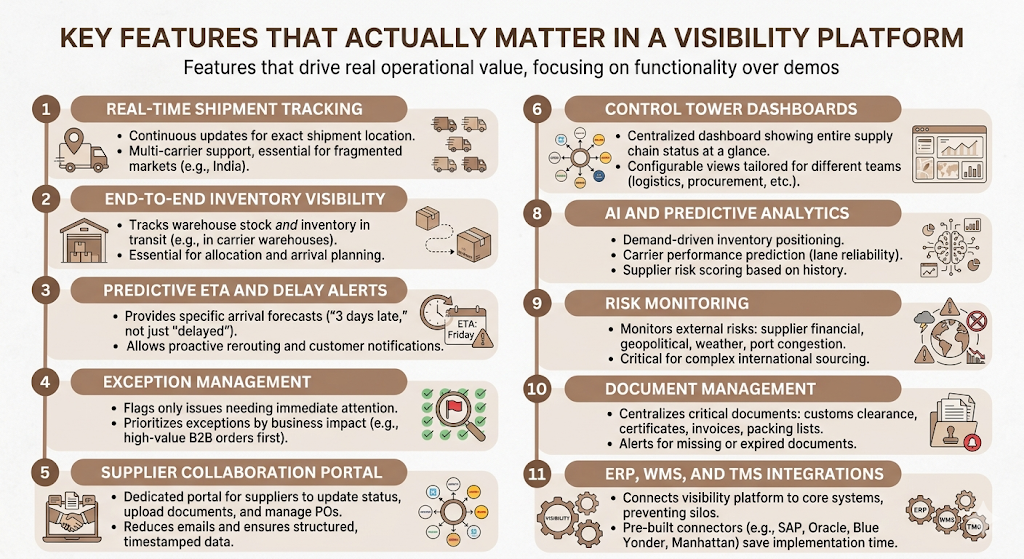
Not every feature on a demo is worth paying for. These are the ones that drive real operational value.
Real-Time Shipment Tracking
This is table stakes. The platform should show you exactly where every shipment is, updated continuously, not in hourly or daily refreshes. Multi-carrier support matters here: if your platform can only track one or two carriers, it’s useless in a fragmented market like India, where you might use Delhivery, BlueDart, FedEx, and Xpressbees across different lanes.
End-to-End Inventory Visibility
Not just warehouse stock levels. Inventory in transit counts too. A shipment of 500 units sitting in a carrier warehouse in Delhi is inventory. You need to see it, allocate against it, and plan for its arrival.
Predictive ETA and Delay Alerts
The difference between “your shipment is delayed” and “your shipment will arrive 3 days late” is enormous for planning. Predictive ETAs let you proactively reroute, notify customers, or adjust production schedules before the delay becomes a crisis.
Exception Management
Exception management is how the platform tells you what needs your attention right now. Good exception management means not just flagging exceptions but prioritizing them by business impact. A delay on a high-value B2B order deserves a different alert than a minor transit update on a low-priority SKU.
Supplier Collaboration Portal
A dedicated portal where suppliers can update shipment status, upload documents, and receive PO changes cuts down on email threads and gives you structured, timestamped data instead of manual input. This is especially valuable when dealing with suppliers who don’t have their own ERP or TMS.
Multi-Carrier Tracking
Your platform needs to connect to your carrier network, not the other way around. Look for platforms with pre-built integrations to Indian carriers (Delhivery, Ecom Express, Shadowfax, BlueDart, DTDC) as well as global ones (DHL, FedEx, UPS, Maersk).
Control Tower Dashboards
A supply chain control tower is a centralized dashboard that shows the status of your entire supply chain at a glance. The best control towers are configurable: you can build views for different teams (logistics ops, procurement, customer service) showing only the data each team needs.
AI and Predictive Analytics
Beyond basic exception detection, AI features in mature platforms include demand-driven inventory positioning (where should stock be, not just how much), carrier performance prediction (which carrier is most likely to meet ETA on a given lane), and risk scoring for suppliers based on historical patterns.
Risk Monitoring
This covers supplier financial risk, geopolitical risk on trade routes, weather-related disruption risk, and port congestion data. Not every business needs this depth, but for companies with complex international sourcing, risk monitoring is the feature that justifies the platform cost.
Document Management
Customs clearance, certificates of origin, invoices, and packing lists. These documents gate shipment movement at every border. A platform that centralizes document management and alerts you to missing or expired documents saves enormous friction, especially on international shipments.
ERP, WMS, and TMS Integrations
A visibility platform that doesn’t connect to your ERP, WMS, and TMS is just another silo. Pre-built connectors to SAP, Oracle NetSuite, Microsoft Dynamics, Manhattan Associates WMS, and Blue Yonder TMS reduce implementation time significantly.
Types of Supply Chain Visibility Platforms
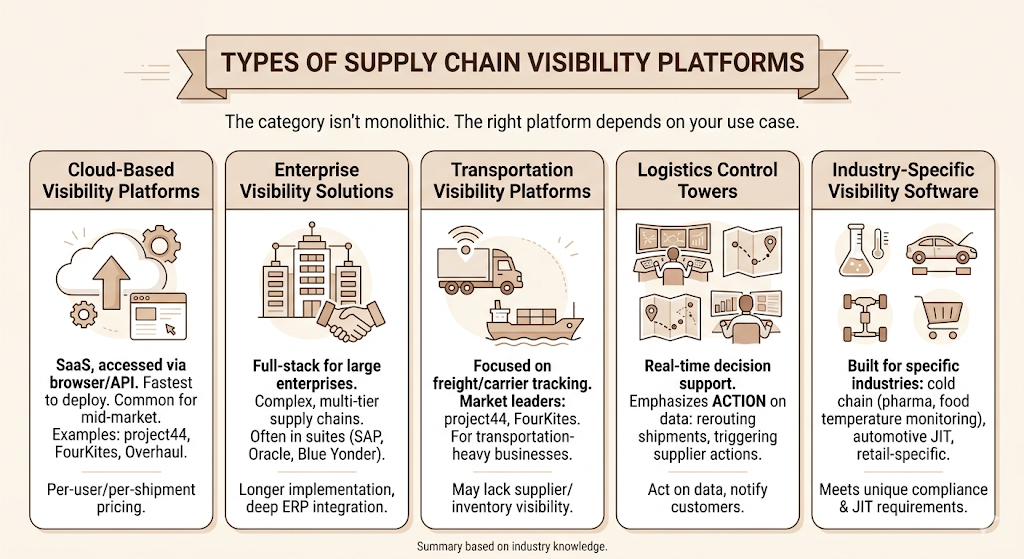
The category isn’t monolithic. There are meaningfully different types of platforms, and the right one depends on your use case.
Cloud-Based Visibility Platforms
SaaS platforms hosted in the cloud, accessed via browser or API. These are the fastest to deploy and the most common for mid-market companies. Pricing is typically per-user or per-shipment. Examples include project44, FourKites, and Overhaul.
Enterprise Visibility Solutions
Full-stack platforms designed for large enterprises with complex, multi-tier supply chains. Often sold alongside broader supply chain management suites from SAP, Oracle, or Blue Yonder. Longer implementation timelines but deeper ERP integration.
Transportation Visibility Platforms
Focused specifically on freight and carrier tracking. project44 and FourKites are the market leaders here. Strong for transportation-heavy businesses but may lack supplier and inventory visibility features.
Logistics Control Towers
Control towers are a specific type of visibility platform that emphasizes real-time decision support across the full supply chain. They’re designed not just to show data but to help you act on it: rerouting shipments, triggering supplier actions, notifying customers.
Industry-Specific Visibility Software
Some platforms are built for specific industries: cold chain visibility for pharma and food (where temperature monitoring is a compliance requirement), automotive supply chain visibility for JIT manufacturing, or retail-specific platforms that connect to marketplace APIs.
Supply Chain Visibility Software vs. SCM Software vs. TMS: What’s the Difference?
These three categories overlap enough to cause real confusion at the buying stage.
| Supply Chain Visibility Software | Supply Chain Management (SCM) Software | Transportation Management System (TMS) | |
| Primary purpose | Real-time monitoring and exception alerting | End-to-end supply chain planning and execution | Managing freight booking, routing, and costs |
| Core capabilities | Tracking, alerts, dashboards, predictive ETA | Demand planning, procurement, inventory, logistics | Rate comparison, carrier booking, freight audit |
| Best for | Ops teams needing live status across the chain | Enterprises managing complex planning cycles | Shippers with high freight volume |
| Integrations | ERP, WMS, TMS, carriers, IoT | ERP, CRM, suppliers, logistics partners | Carriers, brokers, ERP, customs |
| Visibility scope | Entire supply chain, real-time | Supply chain, but often batch-updated | Transportation only |
| Complexity | Low to medium | High | Medium to high |
| Best use case | Monitoring live operations, exception management | Strategic supply chain planning | Optimizing freight spend and carrier performance |
The short version: a TMS helps you book and manage freight. SCM software helps you plan and execute across the full supply chain. Supply chain visibility software tells you what’s actually happening right now, across all of it.
Many enterprises run all three, with the visibility platform as the connective layer between them.
Benefits That Show Up in Real Operations
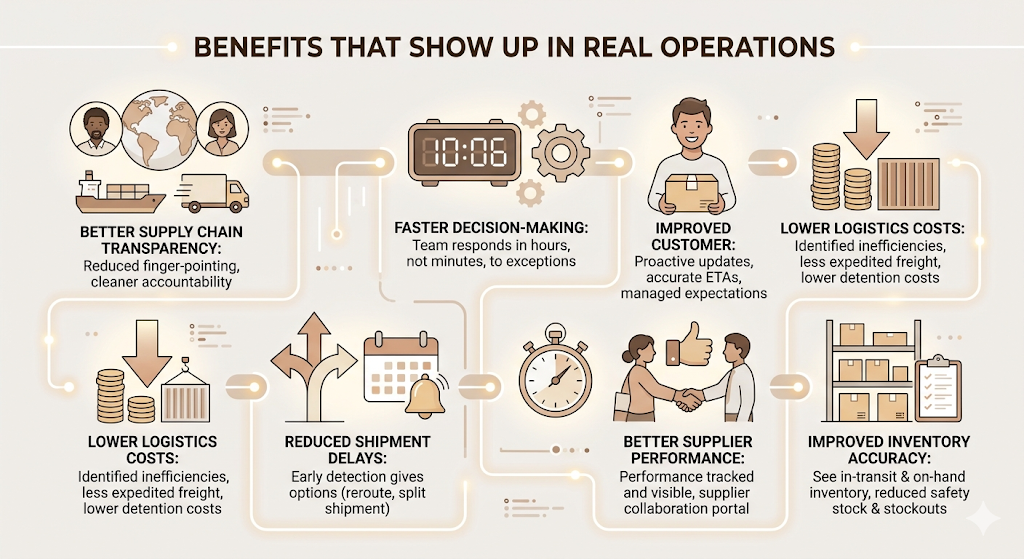
Better Supply Chain Transparency
Transparency across suppliers, carriers, and fulfilment partners reduces the information asymmetry that creates finger-pointing when something goes wrong. When everyone sees the same data, accountability becomes a lot cleaner.
Faster Decision-Making
When an exception surfaces at 8am instead of 5pm (when a customer calls to complain), your team has hours to respond rather than minutes. Speed of decision is directly tied to speed of information.
Improved Customer Experience
Proactive updates, accurate ETAs, and early delivery exception notifications turn a potential complaint into a managed expectation. Brands like Nykaa that operate their own logistics have invested in visibility infrastructure precisely because customer experience depends on it.
Lower Logistics Costs
Visibility data surfaces inefficiencies: carriers consistently underperforming on specific lanes, unnecessary expedited freight spend driven by poor inventory planning, and detention costs from missed warehouse appointments. According to a 2023 McKinsey & Company report, companies with mature supply chain visibility capabilities reported logistics cost reductions of 10-15% within two years of implementation.
Reduced Shipment Delays
Early delay detection means more options. You can reroute. Air freight a critical SKU. Split a shipment. Notify the customer. None of those options are available if you find out about the delay when the shipment misses its delivery window.
Better Supplier Performance
When suppliers know their on-time performance is tracked, scored, and visible to your procurement team, performance improves. The supplier collaboration portal creates accountability without requiring confrontational conversations.
Improved Inventory Accuracy
When you can see in-transit inventory as well as on-hand inventory, your actual available-to-promise quantity is more accurate. That reduces both safety stock buffers and out-of-stock events.
Companies with end-to-end supply chain visibility software reduce logistics costs by 10-15% on average within two years, according to McKinsey & Company’s 2023 supply chain research. The gains come from faster exception response, better carrier performance management, and more accurate inventory positioning, not from a single efficiency lever.
Integrations You Can’t Skip
A visibility platform is only as good as the data it can access. These are the integrations that determine whether the platform actually works.
ERP Systems
Your ERP holds the authoritative data for purchase orders, inventory, and financials. Without ERP integration, the visibility platform is working from incomplete data. Look for pre-built connectors to SAP S/4HANA, Oracle Cloud ERP, Microsoft Dynamics 365, and Tally (for SMB Indian businesses).
Warehouse Management Systems (WMS)
WMS integration gives you inbound and outbound shipment status at the warehouse level. When a truck arrives, the WMS knows. That data should flow automatically into the visibility platform.
Transportation Management Systems (TMS)
TMS integration means shipment bookings, carrier assignments, and tracking events all flow into the visibility layer without manual entry. For businesses already running a TMS, this is the most important integration to get right.
Inventory Management Software
For businesses that run a standalone inventory management tool (like Unicommerce, common in Indian e-commerce), integration keeps inventory counts accurate across the visibility platform and the inventory system.
IoT Devices, GPS Tracking, and RFID
These are the hardware integrations that power real-time location and condition monitoring. Cold chain businesses in pharma and food need IoT sensor integration as a compliance requirement. RFID integration matters for warehouses doing high-volume receiving and put-away.
How to Choose the Right Platform
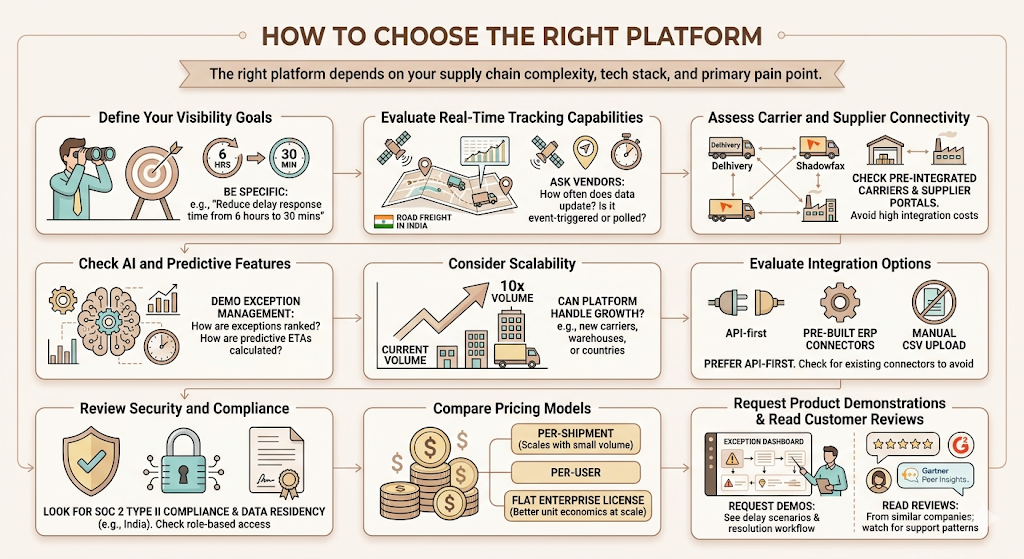
There’s no single right answer here. The right platform depends on your supply chain complexity, your tech stack, and your primary pain point. But here’s how to approach the evaluation.
Define Your Visibility Goals
Be specific. “Better visibility” isn’t a goal. “Reduce the time between a shipment delay event and our team’s response from 6 hours to 30 minutes” is a goal. The more specific your requirements, the easier it is to evaluate whether a platform can actually deliver.
Evaluate Real-Time Tracking Capabilities
Ask vendors directly: how often does tracking data update? Is it event-triggered or polled at intervals? For road freight in India, hourly GPS updates are standard. For air freight, near-real-time updates are achievable. If a vendor can’t give you a clear answer on data latency, that’s a red flag.
Assess Carrier and Supplier Connectivity
Get a list of the platform’s pre-integrated carriers and supplier portal capabilities. If you’re primarily shipping via Delhivery and Shadowfax, and the platform’s Indian carrier coverage is thin, the integration cost will eat into your ROI.
Check AI and Predictive Features
Ask for a demo of exception management specifically. How does the platform rank exceptions by business impact? How are predictive ETAs calculated? What data does the AI model train on? These questions separate genuine AI capability from marketing language.
Consider Scalability
Can the platform handle 10x your current shipment volume without performance degradation? What happens when you add a new carrier, a new warehouse, or a new country? Scalability questions matter more than current-state capability if you’re a growing business.
Evaluate Integration Options
API-first platforms are always preferable to ones that rely on manual CSV uploads or custom middleware. Check whether the platform has pre-built ERP connectors for your specific system. A missing connector is a 3-6 month integration project.
Review Security and Compliance
Supply chain data is sensitive. Look for SOC 2 Type II compliance, data residency options (relevant for Indian businesses post the Digital Personal Data Protection Act, 2023), and role-based access controls.
Compare Pricing Models
Common models: per-shipment, per-user, or flat enterprise license. Per-shipment pricing scales well when you’re small, but gets expensive fast as volume grows. Enterprise licensing has a higher floor but better unit economics at scale.
Request Product Demonstrations
Ask to see the exception management dashboard in action, not just the pretty overview dashboard. Ask the vendor to walk you through a delay scenario: how does the alert get generated, who gets notified, and what does the resolution workflow look like?
Read Customer Reviews
G2 and Gartner Peer Insights have reviews from verified supply chain practitioners. Look for reviews from companies similar to yours in size and industry. Watch for patterns in the negative reviews, particularly around customer support quality during implementation.
Common Mistakes That Slow Down ROI
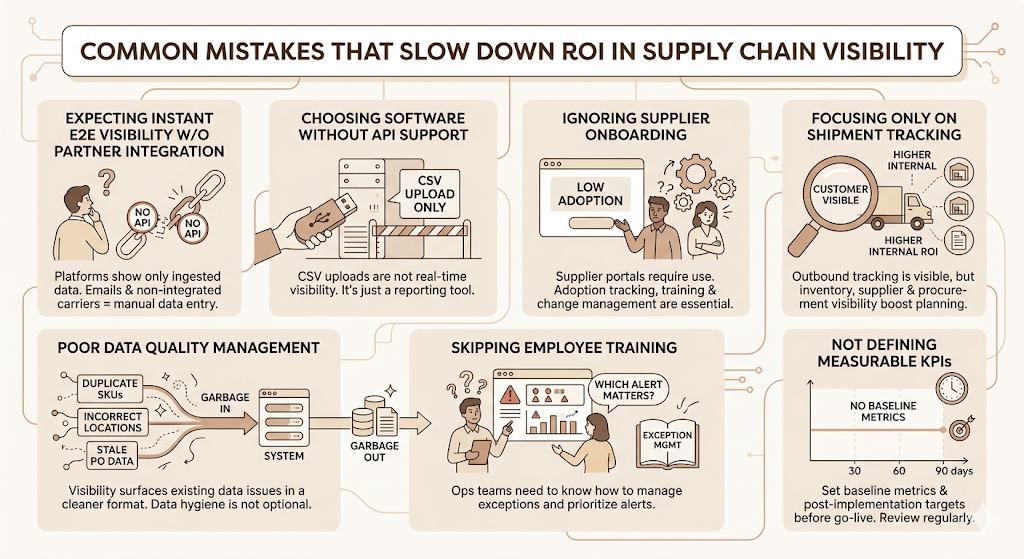
Most supply chain visibility software implementations that underperform have the same few problems.
Expecting instant end-to-end visibility without partner integration. The platform can only show you data that flows into it. If your carriers don’t have API integrations and your suppliers are emailing dispatch confirmations, you haven’t solved the visibility problem. You’ve just built a nicer place to manually enter the same data.
Choosing software without API support. Any platform that requires CSV uploads for data ingestion is not a real-time visibility platform. It’s a reporting tool with a better UI. This distinction matters enormously.
Ignoring supplier onboarding. A supplier collaboration portal is only valuable if suppliers actually use it. Supplier onboarding, including training, change management, and adoption tracking, is often more work than the technical implementation.
Focusing only on shipment tracking. Outbound shipment tracking is the visible, customer-facing use case, so it gets attention. But inventory visibility, supplier visibility, and procurement visibility often have higher internal ROI because they affect planning accuracy and cost.
Poor data quality management. Garbage in, garbage out. If your ERP has duplicate SKUs, incorrect warehouse locations, or stale PO data, the visibility platform will surface that garbage in a cleaner format. Data hygiene before implementation is not optional.
Skipping employee training. Ops teams that don’t understand how exception management works, or which alerts require immediate action versus which can be reviewed in a daily standup, won’t extract the value the platform is capable of delivering.
Not defining measurable KPIs. Without baseline metrics and post-implementation targets, you can’t tell whether the platform is working. Set KPIs before go-live (see the section below) and review them at 30, 60, and 90 days.
Best Practices for a Successful Rollout
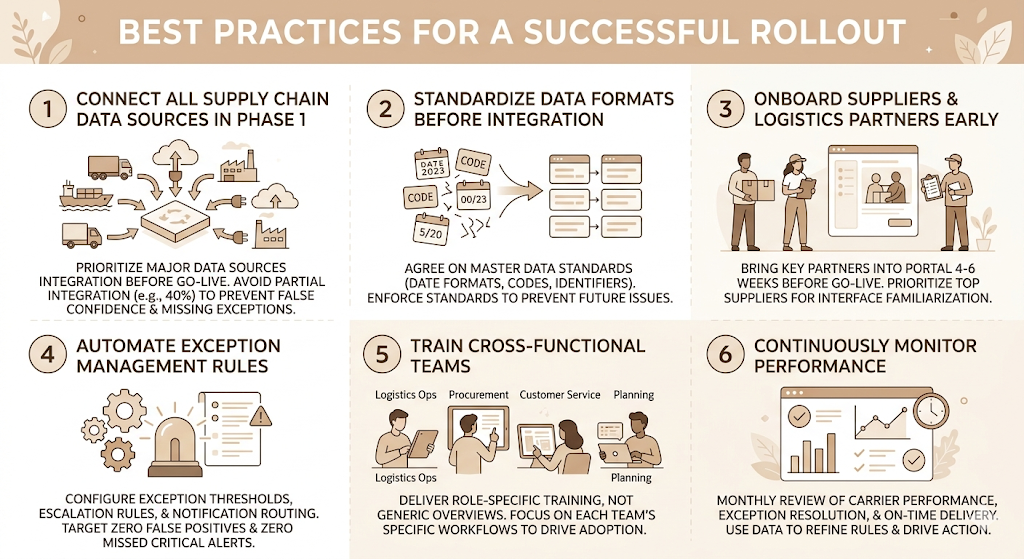
Connect All Supply Chain Data Sources in Phase 1
Don’t go live with a partial integration. A visibility platform showing you 40% of your shipments creates false confidence. You’ll miss exceptions on the 60% that aren’t connected. Prioritize getting all major data sources integrated before going live, even if it delays the launch date.
Standardize Data Formats Before Integration
Different carriers, suppliers, and internal systems use different date formats, location codes, and shipment identifiers. Agree on a master data standard before integration and enforce it. This is boring work. It prevents enormous pain later.
Onboard Suppliers and Logistics Partners Early
Bring key suppliers into the supplier portal 4-6 weeks before go-live. Let them get comfortable with the interface before it’s live. Identify your top 20 suppliers by shipment volume and prioritize their onboarding. The long tail can follow.
Automate Exception Management Rules
The default alert settings in most platforms are too noisy or too quiet. Spend time configuring exception thresholds, escalation rules, and notification routing during implementation. The goal is zero false positives and zero missed critical alerts.
Train Cross-Functional Teams
Logistics ops, procurement, customer service, and planning teams will all interact with the platform differently. Train each team on their specific workflows, not on a generic platform overview. Role-specific training drives adoption.
Continuously Monitor Performance
Review carrier performance, exception resolution time, and on-time delivery rate monthly. Use the data to renegotiate carrier contracts, address supplier performance issues, and refine your exception management rules. A visibility platform that isn’t driving action is an expensive dashboard.
KPIs to Measure Supply Chain Visibility Success
On-Time Delivery Rate: The percentage of shipments delivered within the committed delivery window. Industry benchmark for B2C e-commerce in India is 92-95%. If you’re below 88%, that’s a primary signal of supply chain execution problems.
Perfect Order Rate: Orders delivered complete, on time, with no damage and with accurate documentation. This is the gold standard KPI because it captures quality across every stage of the supply chain. A perfect order rate below 85% usually indicates systemic problems in warehouse operations or supplier reliability.
Shipment Visibility Rate: The percentage of active shipments for which you have real-time location and status data. This is a platform adoption metric. If your visibility rate is 70%, 30% of your shipments are dark, meaning you have no live data on them.
Inventory Accuracy: The variance between system inventory and physical inventory counts. Visibility software should improve this by reducing manual entry errors and improving receipt confirmations. Target is 98%+ for most operations.
Supplier On-Time Performance: The percentage of purchase orders fulfilled by the supplier’s confirmed ship date. Track this by supplier and by product category. Suppliers below 85% on-time performance need a structured conversation.
Order Cycle Time: The total time from order placement to customer delivery. Shorter cycle times are better, but the more actionable question is where in the cycle time is the most variance? That’s where to focus optimization efforts.
Exception Resolution Time: How long does it take, from when an exception is flagged to when it’s resolved? This measures how effectively your team is using the platform. If exceptions are sitting unresolved for 24+ hours, the alert routing or team workflows need adjustment.
Logistics Cost per Shipment: Total logistics spend divided by shipment count. Visibility data should help you reduce this over time by identifying expensive routes, underperforming carriers, and unnecessary expedited freight.
AI and Future Trends Shaping the Category
AI-Powered Predictive Visibility
The next generation of supply chain visibility software doesn’t just tell you what’s happening. It tells you what’s about to happen. Predictive visibility models use historical shipment data, carrier patterns, weather events, and port congestion data to surface expected exceptions before they occur.
Project44’s Intelligence Layer and FourKites’ Predict are both moving in this direction: not just “your shipment is delayed” but “based on current conditions, this shipment has a 78% probability of arriving 2 days late.”
Digital Supply Chain Control Towers
Control towers are evolving from dashboards to decision engines. The next wave of control tower software doesn’t just surface exceptions. It recommends actions: “reroute this shipment via Chennai to avoid the Mumbai port delay,” or “expedite this PO from Supplier B to cover the shortfall from Supplier A.”
IoT and Smart Sensors
IoT sensor costs have dropped dramatically. Temperature, humidity, vibration, and shock sensors that once cost thousands of dollars per unit are now available for tens of dollars. That price drop is making condition monitoring viable for a much broader range of products, not just pharma and high-value electronics.
Digital Twins
A digital twin supply chain is a real-time simulation of your supply chain that mirrors actual operations. You can run scenarios through the digital twin before acting on them in the real supply chain. What happens if this port goes down for 72 hours? Which suppliers are affected? Which customer orders are at risk? Digital twins answer those questions in minutes rather than days.
Blockchain for Supply Chain Transparency
Blockchain’s supply chain use case is provenance and authenticity, not real-time tracking. Where it genuinely adds value is in traceability: proving where a product came from, who handled it, and what certifications apply to it. For food safety, pharma, and luxury goods, blockchain-enabled traceability is becoming a regulatory and brand requirement.
Sustainability and Carbon Tracking
ESG reporting requirements are adding a new visibility layer: carbon emissions per shipment, per lane, and per carrier. The EU’s Carbon Border Adjustment Mechanism and India’s evolving sustainability disclosure requirements are turning emissions tracking from a nice-to-have into a compliance requirement. Supply chain visibility platforms that can surface carbon data alongside cost and performance data will have a significant edge in the next 2-3 years.
The future of supply chain visibility software is predictive and prescriptive, not just descriptive. AI-powered exception detection, digital twin scenario modelling, and sustainability carbon tracking are the three capabilities that will differentiate category leaders from basic tracking platforms over the next three to five years.
Conclusion
Supply chain visibility software doesn’t fix broken supplier relationships, unreliable carriers, or poor inventory planning on its own. But it gives you the data to see those problems clearly and act on them fast.
The businesses that will win on supply chain execution over the next five years aren’t necessarily the ones with the most sophisticated tech stack. They’re the ones who can see what’s happening across their supply chain in real time and respond before problems become crises. That’s what good visibility software enables.
If you’re evaluating platforms, don’t let the demo be all about the dashboard. Ask to see exception management in action. Ask about carrier connectivity for your specific lanes. Ask about implementation timelines and what the post-go-live support looks like. Those questions will tell you more about the platform than any feature comparison spreadsheet.
Supply chains are getting more complex, not less. The tools for managing that complexity are better than they’ve ever been. The question is whether your business is using them.
Frequently Asked Questions
What is supply chain visibility software?
Supply chain visibility software is a platform that gives businesses real-time data across every stage of their supply chain, from supplier shipments through to last-mile delivery. It connects data from ERP systems, carriers, IoT sensors, and supplier portals into a single view, and uses exception management to surface problems that need attention.
Why is supply chain visibility important?
Without visibility, your team makes decisions based on stale data or assumptions. That leads to late deliveries, inventory overstock or shortfalls, and slow responses to supplier and logistics problems. Real-time visibility shortens the time between a problem occurring and your team acting on it.
What’s the difference between supply chain visibility and supply chain management?
Supply chain management (SCM) covers the full planning and execution of your supply chain: demand forecasting, procurement, inventory planning, and logistics. Supply chain visibility software focuses specifically on monitoring and exception management, meaning it tells you what’s happening right now and alerts you to problems. Many enterprises use both, with the visibility platform as a real-time monitoring layer on top of the SCM system.
How does supply chain visibility software improve logistics?
It improves logistics by surfacing carrier performance data (so you can hold carriers accountable and reroute away from underperformers), predicting delays early enough to take action, and reducing the manual work of chasing status updates across multiple carrier portals. Most logistics teams that implement visibility software report significant reductions in the time their team spends on manual tracking.
Which industries benefit the most from supply chain visibility software?
Manufacturers, retailers, e-commerce brands, 3PL providers, pharma companies, and automotive businesses see the highest ROI. Basically any business with a complex supply chain involving multiple suppliers, carriers, and fulfilment points. Single-supplier, single-carrier businesses get less value from a dedicated visibility platform.
Can supply chain visibility software integrate with ERP systems?
Yes, and it should. ERP integration is usually the most important integration in the stack because the ERP holds authoritative data for purchase orders, inventory, and financials. Look for platforms with pre-built connectors to your specific ERP (SAP, Oracle, Microsoft Dynamics) to reduce implementation time.
What technologies enable real-time supply chain visibility?
The main technologies are GPS tracking on vehicles and containers, RFID readers at warehouses and distribution points, IoT sensors for condition monitoring, API integrations with carrier networks, and EDI connections to suppliers. AI sits on top of all of this data to detect exceptions and generate predictive ETAs.
How much does supply chain visibility software cost?
Pricing varies widely. SaaS platforms for mid-market businesses typically range from $2,000 to $15,000 per month, depending on shipment volume and features. Enterprise platforms from SAP, Oracle, or Blue Yonder are project-priced and can run from $100,000 to several million dollars, including implementation. Per-shipment pricing models are common in the transportation visibility segment.
How long does implementation take?
For a mid-market SaaS platform with clean data and API-ready systems, 8-16 weeks is realistic. For enterprise implementations with complex ERP integrations and multi-region carrier networks, 6-12 months is more common. The longest timeline variable is usually supplier onboarding, not technical integration.
What KPIs should businesses monitor after implementing visibility software?
On-time delivery rate, perfect order rate, shipment visibility rate, inventory accuracy, supplier on-time performance, exception resolution time, and logistics cost per shipment. Set baselines before go-live and review them at 30, 60, and 90 days post-implementation.