
Most SEO teams are still doing the same things by hand that they were doing five years ago. Pulling keywords into a spreadsheet. Running a site audit once a quarter, if that. Checking rankings one tool at a time. Meanwhile, the search itself has changed. Google now answers a huge chunk of queries right on the results page. ChatGPT and Perplexity have become places people search instead of clicking through.
That gap, between how teams still work and how search actually behaves now, is exactly what SEO automation tools are meant to close. The right setup doesn’t just save you hours. It tells you whether your content is even being seen by the AI tools your audience now relies on.
This guide covers what SEO automation tools actually do, the best ones to use in 2026, how to pick the right ones for your situation, and where you still need a human in the loop. No fluff, just what you need to build a workflow that actually works.
Table of Contents
What Are SEO Automation Tools?
SEO automation tools are software that handles repetitive SEO work, keyword tracking, site crawling, content scoring, reporting, on a schedule, so nobody has to do it by hand every time. That’s the short answer. The longer answer matters more, because “automation” gets thrown around loosely in this space.
A decade ago, automation meant a scheduled rank check and a basic crawl report. You’d get a spreadsheet, look it over, and decide what to fix yourself. Today’s tools do more. They mix that same automatic data collection with AI that reads the data and suggests a fix, or in some cases, just makes the fix.
Search Atlas’s OTTO agent is a good example. It doesn’t just flag a missing meta description. It writes one and pushes it live. That’s a real jump, from “automation tells you what’s wrong” to “automation fixes what’s wrong.” And it’s where the whole category is heading.
How They’re Different From Manual SEO
Manual SEO means a person checking Search Console, running Screaming Frog by hand, and building keyword lists in a spreadsheet using something like Google Keyword Planner. It works fine. It’s just slow, and it only happens if someone remembers to actually do it.
Automated SEO takes the “remembering” out of it. Crawls run on a schedule. Rankings update daily instead of whenever someone logs in. Reports build themselves and land in an inbox. The thinking part, what to prioritize and why, still needs a person. The data collection mostly doesn’t.
Traditional Automation vs AI-Powered Automation
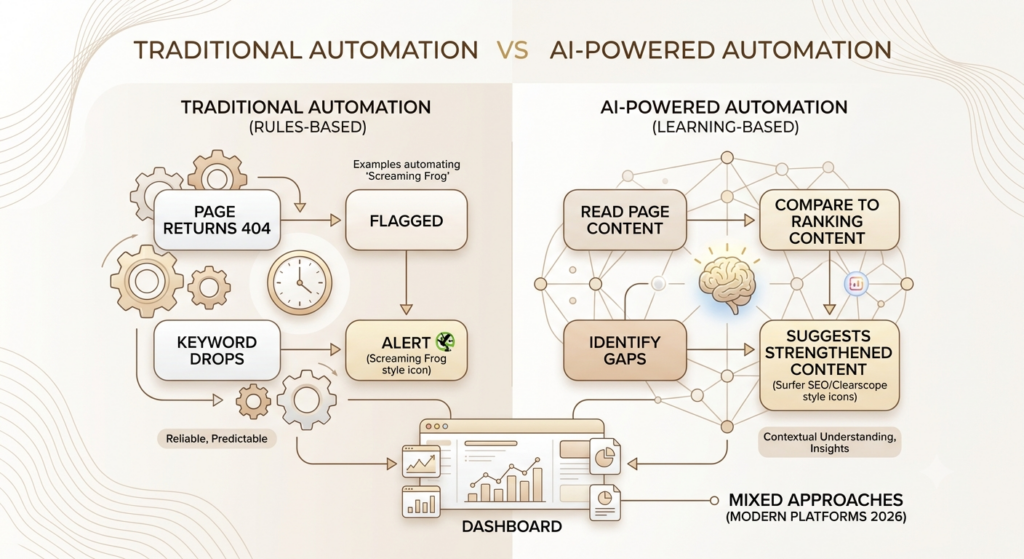
Traditional automation runs on rules. A page returns a 404, it gets flagged. A keyword drops three spots, and someone gets an alert. It’s reliable and predictable, and Screaming Frog has run this way for years.
AI-powered automation goes a step further. It can read a page, compare it to what’s actually ranking, and tell you what’s missing, not just that something’s thin, but what a stronger version should include. Surfer SEO and Clearscope both work like this. Most platforms in 2026 mix both approaches into one dashboard now.
How Does SEO Automation Actually Work?
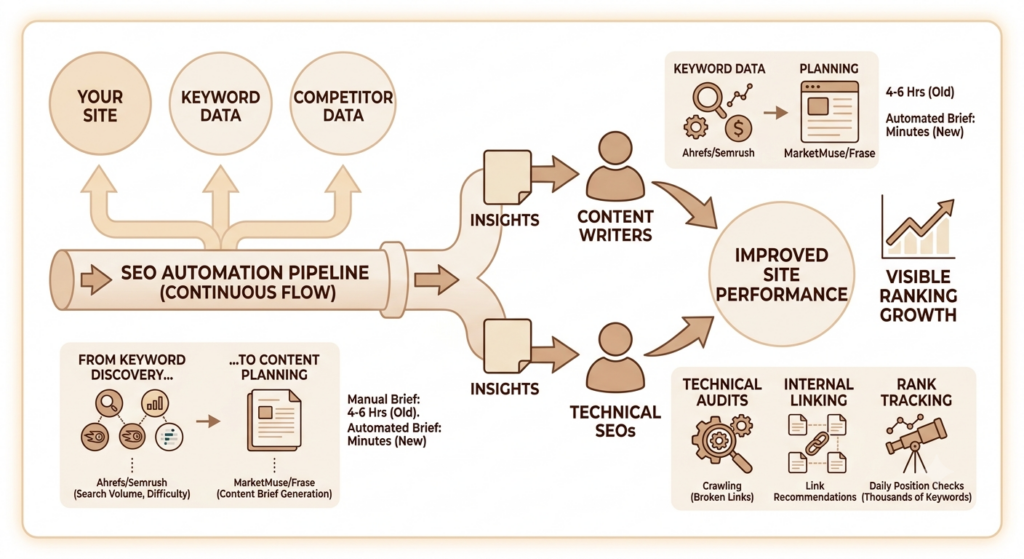
It works by connecting your site, your keyword data, and your competitor data into one pipeline that runs continuously instead of in occasional bursts. Once that pipeline is set up, it feeds insights to whoever needs them, content writers, technical SEOs, or both.
From Keyword Discovery to Content Planning
It usually starts with keyword discovery. A tool like Ahrefs or Semrush pulls search volume, difficulty, and intent, then groups related terms into clusters automatically instead of leaving you to do it by hand. From there, tools like MarketMuse or Frase look at what’s already ranking for a keyword and build a content brief: subtopics to cover, questions to answer, related terms to mention.
This is where a lot of time used to disappear. Marketer Milk’s 2026 review of SEO automation tools notes that building one content brief manually could eat 4 to 6 hours of competitor research. Automated brief generation cuts that to minutes.
Technical Audits, Internal Linking, and Rank Tracking
Once content exists, the technical side takes over. Screaming Frog and Sitebulb crawl your site for broken links, duplicate content, and wasted crawl budget. Some tools now suggest internal links too, scanning your existing pages and recommending where a new article should link out, and where older ones should link back in.
Rank tracking runs alongside all this. Nightwatch and AccuRanker check positions daily across thousands of keywords and locations, which matters if you manage local SEO or sites across multiple markets, where weekly checks miss a lot of movement in between.
AI Search Visibility and Automated Reporting
SEO automation in 2026 covers four connected layers: keyword and content planning, technical site health, rank tracking, and AI search visibility. Tools like Nightwatch and Morningscore now track whether a page gets cited in Google AI Overviews and ChatGPT answers, not just where it ranks in classic blue links. Reporting that once took a full day to put together now runs on a schedule and shows up as a finished dashboard.
This last layer didn’t really exist before 2024. Platforms now track whether your content shows up in AI Overviews, gets cited by ChatGPT, or surfaces in a Perplexity answer. Ahrefs calls this Brand Radar. Semrush built something similar into Semrush One. It’s becoming as standard as rank tracking itself.
Why SEO Teams Are Automating Their Workflows in 2026
The case for automation stopped being theoretical a while back. The numbers make it pretty hard to argue with.
Here’s the bigger picture. According to SparkToro’s June 2026 study with Similarweb, 68% of US Google searches now end without a click. That’s up from about 60% just two years ago, and it’s the steepest two-year jump SparkToro has ever recorded. In plain terms, only around 320 out of every 1,000 Google searches still send someone to a website. The rest get their answer right there on the results page.
That single shift explains why so many teams are rebuilding their SEO process around AI visibility, not just rankings. Ranking on page one used to be the whole game. Now it’s only half of it. Getting quoted inside an AI Overview or a ChatGPT answer is becoming just as important, and you can’t track that by hand.
There’s a real efficiency story here, too. Teams using a connected automation setup save serious time on technical audits, keyword research, and reporting, the stuff that used to eat entire afternoons. A content brief that took half a day now takes ten minutes. A technical issue gets caught the week it shows up instead of the quarter someone finally runs an audit.
There’s also a scale argument that just didn’t exist five years ago. One person managing 500 pages can now realistically keep up with technical monitoring, content planning, and AI visibility tracking that would’ve needed a team of four back in 2020. That’s a big deal. It’s the difference between SEO being a bottleneck and SEO being something one person can actually own.
Key Features to Look for in SEO Automation Software (2026 Checklist)
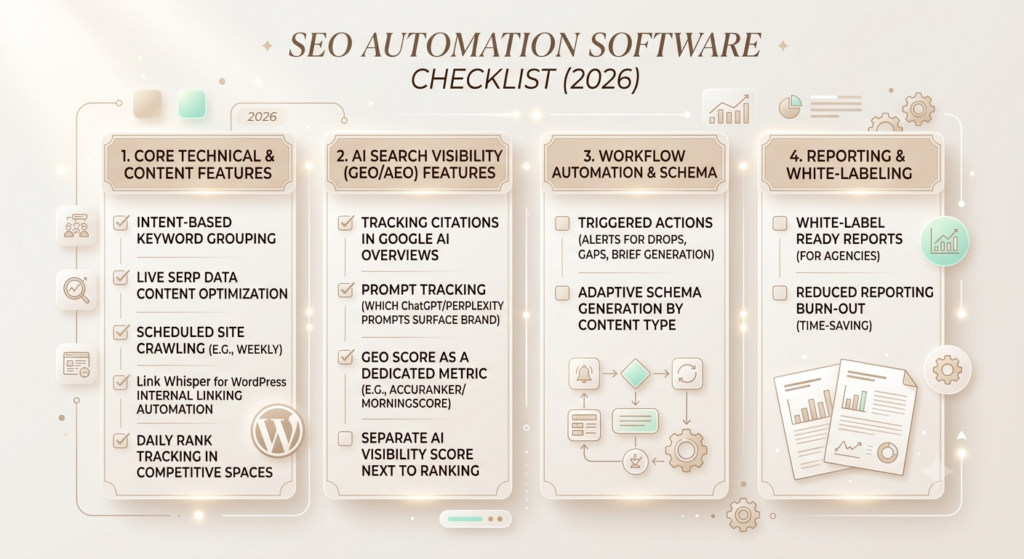
Not every tool does everything well. Most “top tools” roundups skip the part where they tell you what actually separates a good platform from a mediocre one. Here’s what to actually check.
Core Technical and Content Features
Look for keyword research that groups terms by intent, not just volume. Content optimization should compare your draft against live SERP data, not a snapshot from three months back. Site crawling should run on a schedule you set, weekly at a minimum if your site is active. Rank tracking should update daily if you’re in a competitive space.
Internal linking automation is underrated. Few tools do it well, but the ones that do, Link Whisper is a popular WordPress option, saving real time on something most teams skip because it’s tedious.
AI Search Visibility (GEO/AEO) Features
This is the part that barely existed two years ago, and now it decides which tools are worth paying for. You want a platform that tracks citations in Google AI Overviews specifically, not just vague “AI mentions.” You also want prompt tracking, meaning it shows you which actual prompts in ChatGPT or Perplexity are surfacing your brand, or your competitor’s.
AccuRanker’s AccuLLM add-on and Morningscore’s GEO Score both do this. They track AI visibility as its own metric, sitting next to your normal rank position instead of feeling bolted on.
Workflow Automation, Schema, and Reporting
Beyond research and tracking, check if the tool can trigger actions on its own, a ranking drop sends an alert, and a content gap triggers a brief. Schema generation should adapt to your content type, not just spit out one generic template. And reporting should be white-label ready if you run an agency, since rebuilding client reports by hand every single month burns people out fast.
The Best SEO Automation Tools in 2026
No single tool does all of this well. That’s why most serious SEO setups run two or three platforms together instead of betting on one all-in-one suite. Here’s how the major players actually stack up.
Semrush (Semrush One)
Semrush works as a full marketing platform, not just an SEO tool. It covers keyword research, rank tracking, audits, content optimization, and now AI visibility through Brand Radar. The 2026 Semrush One release pulled what used to be scattered AI features into one place, and the platform now tracks 27.3 billion keywords and 43 trillion backlinks across 142 locations.
Best features: Brand Radar for AI search visibility, Position Tracking, and one dashboard for SEO and PPC. Pros: Covers nearly every SEO task without needing five other subscriptions. Cons: The interface is split across roughly 50 sub-sections. It takes a while to learn. Pricing: Plans vary by tier; check current pricing directly since it changes often. Best for: Teams that want one platform instead of a patchwork of tools.
Ahrefs
Ahrefs is still the name most SEOs trust for backlink data. According to a 2026 survey cited in Techsy’s SEO tools roundup, 64% of SEO professionals trust Ahrefs’ link data over any competitor, and its index helps power link strategy for 44% of Fortune 500 companies. Ahrefs also launched a $29-a-month Starter plan in January 2026, which finally made it affordable for solo operators.
Best features: Site Explorer, Keywords Explorer, AI keyword grouping across 40+ languages, Brand Radar for AI visibility. Pros: The most trusted backlink data around, genuinely solid AI search intent breakdown. Cons: Still pricier than most rivals outside the new Starter tier. Pricing: Starts at $29/month (Starter), scales up significantly beyond that. Best for: Link-building work and competitive backlink research.
Surfer SEO
Surfer built its name on scoring content against live SERPs in real time. Surfer AI took that further, letting you go from a keyword to a drafted article, with the platform suggesting (or writing) content based on what’s actually ranking.
Best features: Live SERP-based content scoring, Surfer AI drafting, and an audit tool for old content. Pros: Fast, easy to pick up for solo creators and small teams. Cons: Not great for thought leadership or deeply technical content that needs real expertise, not just pattern-matching against competitors. Pricing: Mid-range, accessible for small teams. Best for: Solo operators and lean content teams optimizing at volume.
Screaming Frog
Screaming Frog is the technical SEO tool that almost every agency reaches for eventually. It crawls sites at scale and catches broken links, redirect chains, duplicate titles, and crawl budget waste. No AI tool has really replaced this yet.
Best features: Deep site crawling, custom data extraction, integration with Search Console and Analytics. Pros: Extremely thorough, and the one-time license keeps costs predictable. Cons: Steep learning curve if you’re not technical. No AI layer. Pricing: Free for crawls under 500 URLs; paid license for bigger sites. Best for: Technical audits, on any size site.
Nightwatch
Nightwatch built its whole 2026 pitch around AI search visibility, tracking whether your content shows up in Google’s AI Mode alongside regular rankings. Its NightOwl AI assistant runs on live Nightwatch data instead of generic training data, so its suggestions are based on actual current search volume, not guesswork.
Best features: Daily rank updates, location tracking across 100,000+ areas, white-label reporting, and the NightOwl assistant. Pros: Genuinely strong if you’re running multiple client sites. Cons: Takes a bit of getting used to if you’re new to rank tracking tools. Pricing: 14-day free trial available. Best for: Agencies and local SEO work that needs daily, granular tracking.
Rank Math
Rank Math is a WordPress plugin that handles on-site SEO right inside the editor, schema markup, meta tags, and keyword suggestions; no separate platform is needed. A WordPress automation update shipped in May 2025, and a Shopify version followed in January 2026.
Best features: Built-in schema generator, content AI suggestions, automated meta handling. Pros: Plugs straight into WordPress, fair pricing. Cons: Schema templates are still fairly basic and need manual tweaking for anything complex. Pricing: Pro plan is around $8/month after a 2026 increase from $5. Best for: WordPress sites that want on-page automation without a separate platform.
MarketMuse
MarketMuse focuses entirely on content strategy, gap analysis, topic authority, and brief generation. It automates the kind of content gap research that usually takes 4 to 6 hours by hand.
Best features: Content gap analysis, topic cluster mapping, and competitive content scoring. Pros: Great for teams building topical authority over time instead of chasing one keyword at a time. Cons: Less useful if you just need quick on-page tweaks rather than long-term planning. Pricing: Starts at $99/month; free version available. Best for: Content marketers building pillar and cluster content systematically.
Frase
Frase builds content briefs by looking at what’s already ranking and showing exactly what a competitive piece needs to cover.
Best features: Automated SERP-based briefs, built-in AI writing assistant, and content scoring against live competitors. Pros: Cuts brief creation from hours to minutes, and it’s budget-friendly. Cons: The AI writing output still needs a real editing pass before it sounds like anything but a tool wrote it. Pricing: Starts at $15/month; free version available. Best for: Teams that need fast, data-backed briefs without spending much.
AirOps
AirOps automates entire content operations using AI combined with your own brand knowledge and live data. Teams can build no-code “AI agents” for repeatable jobs, generating topic ideas or running bulk optimization across hundreds of pages.
Best features: Workflow Builder, AI Copilot for building automations without code, and Power Steps for reusable workflows. Pros: Genuinely useful for scaling editorial work across large content teams. Cons: Overkill if you’re a solo blogger publishing a handful of posts a month. Pricing: Enterprise-leaning; request a quote. Best for: Content teams running high-volume editorial operations.
Google Search Console and ChatGPT/Claude with n8n
Two more things deserve a mention, even though one is free and the other is general-purpose. Google Search Console and AI models connected through a workflow builder like n8n.
GSC is, as Nightwatch’s own 2026 tools review put it, non-negotiable. It’s free, it’s straight from Google, and no third-party tool gives you the exact same insight into how Google actually indexes your pages. Pair it with an AI model like ChatGPT or Claude through n8n, and you can build your own pipeline: pull GSC data, have the AI analyze it, push the findings into a report automatically. Techsy’s content team runs almost exactly this setup, combining the Search Console API, Python, and Claude for daily research and publishing.
The strongest SEO automation stacks in 2026 rarely lean on one platform. Most combine a rank tracker like Nightwatch, an all-in-one research tool like Semrush or Ahrefs, a technical crawler like Screaming Frog, and Google Search Console as the free, non-negotiable baseline. AI models connected through tools like n8n now let teams build their own automation on top of that stack instead of waiting for a vendor to add the feature.
Which SEO Tasks Can You Actually Automate?
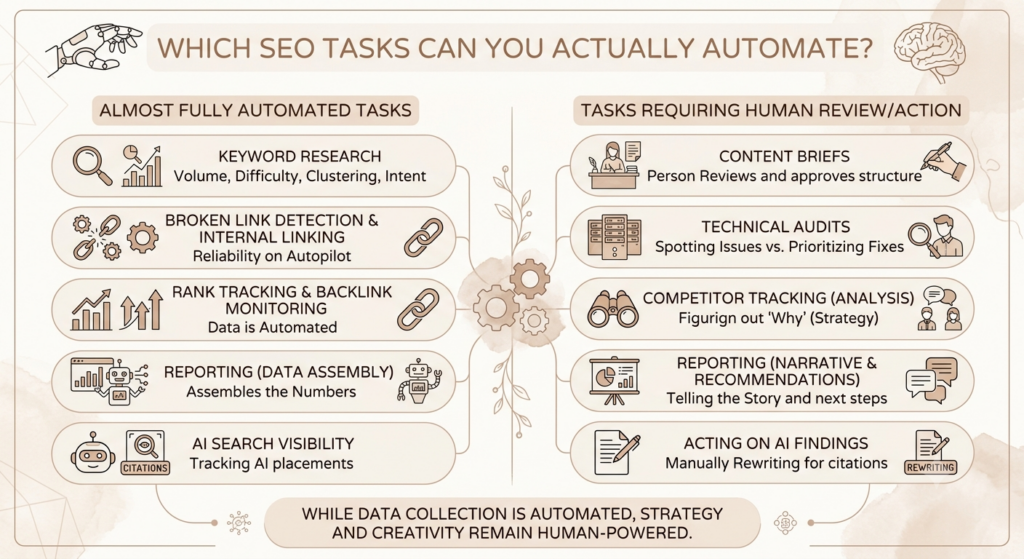
Almost every repetitive SEO task can be automated to some degree now. But how much depends on the task.
Keyword research is nearly fully automated: volume, difficulty, clustering, and intent are all machine-generated today. Content briefs automate well, too, though a person should still review one before a writer touches it. Technical audits automate cleanly for spotting issues, but deciding which fix matters most still benefits from someone who knows the business.
Broken link detection and internal linking suggestions both work reliably on autopilot. Rank tracking and backlink monitoring are basically fully automated; nobody checks rankings by hand anymore. Competitor tracking automates the data collection, but figuring out why a competitor suddenly jumped five spots usually still needs a person to think it through.
Reporting automates almost entirely on the data-assembly side, leaving the narrative and recommendations as the human part. AI search visibility tracking is automated by the tools mentioned above. Acting on what you find, rewriting content to actually earn those AI citations, is still manual work.
SEO Automation vs Manual SEO
Speed clearly favors automation. A manual technical audit on a 10,000-page site could take a specialist a full week. A crawler like Screaming Frog or Sitebulb finishes in hours. Accuracy is close to a tie on data collection; machines don’t get tired and skip pages, but strategic accuracy, knowing which fix actually moves revenue, still leans human.
Scalability is where automation wins outright. A two-person team managing 50 client sites just can’t do that by hand with any consistency. Cost looks steep upfront for subscriptions, but it’s almost always cheaper than hiring enough people to do the same work manually.
Human oversight is where things go wrong if you skip it. The honest case for staying manual is pretty narrow now: small sites, very early-stage businesses, or situations where you’re still learning the basics and want to understand the mechanics before handing them off.
SEO Automation Tools vs AI SEO Tools
People use these two terms interchangeably, and that’s worth fixing. Automation tools execute workflows: crawling, tracking, scheduling, and reporting on a set rhythm. AI SEO tools generate or optimize content using language models, content scoring, AI drafting, and brief generation.
In practice, most 2026 platforms blend both. Surfer SEO automates the workflow of pulling SERP data and also uses AI to suggest content changes. Semrush automates rank tracking on a schedule and uses AI to power Brand Radar’s visibility scoring. The distinction matters most when you’re evaluating a new tool. Ask yourself: is it automating something you already do, or generating something new that still needs a human check before it goes live?
Best SEO Automation Tools by Use Case
Best for beginners: Rank Math, paired with free Google Search Console. Easy to learn, fast on-page wins.
Best for agencies: Nightwatch for white-label reporting and multi-site management, paired with AgencyAnalytics for pulling client dashboards together.
Best for enterprises: Semrush One or Search Atlas, both built to handle thousands of pages across multiple markets.
Best for ecommerce: Surfer SEO for fast content scoring at volume, plus Screaming Frog for catching duplicate product page issues.
Best for SaaS: MarketMuse for building topical authority, since SaaS content lives or dies on depth and coverage.
Best for WordPress: Rank Math, thanks to its native plugin and 2025 automation update.
Best budget tool: Frase, starting at $15/month with a genuinely useful free tier.
Best AI-powered tool: Surfer AI for content, AccuRanker’s AccuLLM for tracking AI search visibility.
Best technical SEO tool: Screaming Frog, still unmatched for crawl control.
Best reporting tool: AgencyAnalytics, for agencies pulling data from 80+ sources into one dashboard.
Best workflow automation tool: n8n combined with an AI model, if you want a fully custom pipeline instead of a fixed feature set from a vendor.
How to Choose the Right SEO Automation Tool
Don’t start with a feature list. Start with whatever’s actually limiting you right now.
If the budget is tight, rule out anything above your ceiling first, then pick from what’s left. Don’t fall for a long feature list and find out the pricing later. If your team isn’t technical, weigh ease of use heavily. A powerful tool that nobody on your team can actually run is dead weight.
Check integrations next. A tool that doesn’t connect to your CMS or analytics setup creates manual work, even while it claims to save you time. Then look closely at AI search visibility features, since this is the part of the category moving fastest, and it’s only going to matter more over the next couple of years, not less.
Reporting needs matter more than people think going in. If you answer to a client or a boss every month, branded or white-label reporting saves real hours. And think about scalability. Pick something that can grow with you, because switching platforms mid-year after outgrowing one is its own expensive headache.
Common SEO Automation Mistakes to Avoid
The biggest one, easily, is automating low-quality content. Tools that generate full articles with barely any human input tend to produce exactly what that sounds like: fine, forgettable, and increasingly easy for both readers and Google to spot.
Ignoring search intent is right behind it. A tool can tell you a keyword has high volume without telling you that the intent behind it doesn’t match what you’re actually selling. Over-optimizing with AI scoring tools causes a different problem: content that hits every suggested keyword target while reading like nobody actually wrote it.
The most common SEO automation mistakes share one root cause: pulling human judgment out of decisions that still need it. Automating content drafting without an editorial pass, chasing volume metrics over search intent, and running three overlapping tools that all do the same job waste exactly the time automation is supposed to save.
Skipping a manual review before publishing is how all of that slips through unnoticed. Running too many overlapping tools, three keyword research platforms doing the same job, is a quieter mistake, but a real cost drain over a year. And ignoring AI search visibility entirely, treating GEO and AEO as someday-later problems, means missing the exact shift that’s already changing where clicks come from.
The Future of SEO Automation (2026 and Beyond)
AI agents are moving from “suggests a fix” to “executes a fix,” and Search Atlas’s OTTO is an early example already doing this. Expect more platforms to follow with workflows that handle routine fixes without waiting on someone to approve every single change.
Generative Engine Optimization and Answer Engine Optimization aren’t fringe ideas anymore. With 68% of US Google searches now ending without a click, according to SparkToro’s June 2026 study, getting cited inside an AI answer matters about as much as ranking on page one used to. AI citation tracking tools like AccuLLM and Brand Radar exist because that shift already happened, not because it’s coming someday.
Predictive SEO, estimating how well something will rank before you even publish it, is getting more reliable as tools collect more data on what actually moves rankings. And treating Google, ChatGPT, Perplexity, and Bing Copilot as one connected visibility problem, instead of separate channels, is becoming the normal way to think about this, not a niche specialty.
None of this replaces strategy. The teams winning in 2026 aren’t the ones who automated everything. They’re the ones who automated the repetitive parts well enough to spend more time on what actually needs a person: judgment, brand voice, and knowing which fight is worth picking.
Getting Your Workflow Right Matters More Than Picking the Perfect Tool
The tools above will keep changing. New AI features will ship, pricing tiers will shift, and a couple of these platforms will probably get bought out before the year ends. What won’t change is the bigger shift underneath all of it: search now happens across Google, AI Overviews, and conversational AI tools at the same time, and automation is what makes tracking all three sustainable for a small team.
Start with one piece. Technical audits or rank tracking are usually the easiest wins. Add layers from there. Don’t try to automate everything in month one.
If you want a structured way to actually build this skill set instead of piecing it together from tool docs, YUP’s SEO course walks through keyword research, technical audits, and AI search visibility as one connected workflow instead of scattered tactics. And if you’d rather get practical SEO breakdowns like this one straight to your inbox, the Crystal Clear Newsletter covers exactly this kind of shift as it happens.
Frequently Asked Questions
What are SEO automation tools?
SEO automation tools are software that handle repetitive SEO tasks, keyword research, technical audits, rank tracking, and reporting on a schedule, instead of someone doing each task by hand every time.
Are SEO automation tools worth it?
For most teams managing more than a handful of pages, yes. The time saved on technical audits, reporting, and keyword research usually pays for the subscription within the first couple of months.
Can SEO be fully automated?
No. Data collection, tracking, and a growing share of execution can run on autopilot, but strategy, brand voice, and judgment calls about what to prioritize still need a person.
Which SEO tasks should not be automated?
Final review before something goes live, deciding which fixes matter most, and brand voice decisions should all stay human. Automating these tends to produce generic, easy-to-spot output.
What is the best SEO automation software in 2026?
There’s no single answer. Semrush One and Ahrefs lead for all-in-one research and tracking, Screaming Frog leads for technical audits, and Nightwatch leads for agency-grade tracking and AI search visibility.
Do SEO automation tools support AI search engines?
Increasingly, yes. Nightwatch, Semrush, Ahrefs, and Morningscore now track citations and visibility inside Google AI Overviews, ChatGPT, and Perplexity, not just regular rankings.
Which SEO automation tool is best for beginners?
Rank Math, paired with the free Google Search Console, gives beginners on-page automation and first-party data without a steep learning curve or a big bill.
Are free SEO automation tools enough?
For a solo blogger publishing occasionally, Google Search Console and GA4 cover the basics fine. Once you’re publishing weekly and competing for visibility, a paid tool usually becomes worth it.
What is the difference between SEO automation and AI SEO?
SEO automation tools run scheduled workflows like crawling and tracking. AI SEO tools generate or optimize content using language models. Most modern platforms now do both.
Which SEO automation tool is best for agencies?
Nightwatch, for white-label reporting and multi-site management, is paired with AgencyAnalytics when an agency needs to pull data from a lot of different platforms into one client-facing dashboard.