

Search isn’t really about links anymore… at least not the way it used to be. People ask questions, and AI systems decide which brands show up in the answer. That’s where AI visibility tools come in.
This guide walks through how that shift actually works, not in theory, but in practice. It looks at why rankings don’t always translate into visibility, how platforms like AI Overviews surface information, and what tends to influence whether a brand gets mentioned at all. There’s also a breakdown of 13 AI visibility tools, how to choose between them, and a simple 30-day plan to get started. Along the way, it covers the trade-offs, costs, and what kind of results are realistically achievable.
Table of Contents
What Are AI Visibility Tools?
AI visibility tools are built for a very specific shift happening right now: people aren’t just searching anymore, they’re asking. And when they ask, large language models decide which brands, products, and sources show up in the answer.
That’s the layer most traditional tools completely miss.
Instead of tracking rankings on a results page, these tools track whether a brand actually shows up inside AI-generated responses. Not just if it exists online, but if it gets mentioned, recommended, or cited when someone asks a question that matters.
It’s less about “where do you rank” and more about “are you even part of the conversation.”
What is AI search visibility vs traditional SEO visibility
Traditional visibility is fairly straightforward. A page ranks, it gets impressions, maybe clicks. There’s a clear line between position and performance.
AI visibility doesn’t follow that logic.
A brand might rank #1 on Google and still never get mentioned in an AI answer. At the same time, a lesser-known brand could show up repeatedly because the model finds it more relevant, clearer, or easier to cite.
The difference comes down to how information is processed:
- Traditional SEO: keyword matching + ranking signals
- AI visibility: context, entities, clarity, and trustworthiness
It’s a shift from “best page” to “best answer.”
How AI tools like ChatGPT, Gemini, and Perplexity surface brands
These systems don’t “rank” pages in the usual sense. They generate answers by pulling from patterns, sources, and structured knowledge they’ve learned or accessed.
When a brand appears, it usually happens because:
- The content is clear and directly answers a question
- The brand is consistently associated with a topic
- The information is easy to extract and summarize
- It appears across multiple trusted sources
It’s subtle, but important. AI doesn’t just look for authority; it looks for usable authority.
That’s why some brands get mentioned over and over, even if they aren’t dominating traditional search.
Why AI visibility tracking matters
Search behavior has already started shifting. Instead of clicking through multiple links, users increasingly rely on summarized answers.
And those summaries don’t just list options; they shape decisions.
If a brand isn’t included in those answers, it’s not just missing traffic. It’s missing consideration entirely.
That’s where AI visibility tracking becomes necessary, not optional. It helps answer questions like:
- Are we being recommended when people ask about our category?
- Which competitors show up more often in AI responses?
- What kind of prompts trigger our visibility (or don’t)?
Without that layer of insight, it’s easy to assume things are working… when in reality, visibility is quietly slipping somewhere else.
What Is AI Visibility Tracking And Why Businesses Need It Now?
How AI visibility tracking works across LLMs
At a basic level, AI visibility tracking works by running large sets of prompts across different models and analyzing the responses.
But the real value comes from patterns, not single answers.
Instead of checking one query, these tools test variations; different phrasings, intents, and contexts; to understand where and how a brand shows up.
Over time, that builds a clearer picture:
- Which topics trigger mentions
- Which competitors appear alongside
- How frequently a brand is included
- What kind of positioning does the AI assign
It’s less like rank tracking and more like mapping presence across conversations.
What gets tracked in AI mentions (brand, product, citations, sentiment)
Not all mentions are equal, and good tracking tools don’t treat them that way.
They usually break visibility down into layers:
- Brand mentions – Is the brand named at all?
- Product mentions – Are specific offerings included?
- Citations or references – Is the brand used as a source?
- Context and sentiment – How is the brand being described?
That last part often gets overlooked.
A mention isn’t always a win. Being included as a weak alternative or in a negative comparison tells a very different story than being recommended as a top option.
Real examples of AI-generated brand mentions
If you look closely at AI-generated answers, patterns start to show up.
Ask for “best tools,” and you’ll often see the same handful of brands repeated. Ask for “alternatives,” and a different set appears. Change the phrasing slightly, and the entire list can shift.
What’s happening underneath is a mix of association and clarity.
Brands that consistently publish focused, structured content around a topic tend to show up more often. Not because they “rank,” but because they’re easier for the model to interpret and reuse.
That’s why visibility can feel inconsistent at first glance, until you start tracking it properly.
Why AI visibility ≠ rankings (key differences explained)
It’s tempting to treat AI visibility as just another extension of rankings. In practice, it behaves very differently.
A few key differences stand out:
- Rankings are position-based; AI visibility is inclusion-based
- Rankings are static snapshots; AI responses vary by prompt
- Rankings reward optimization; AI visibility rewards clarity and relevance
The biggest shift, though, is control.
With rankings, there’s at least a sense of predictability. With AI responses, outcomes depend heavily on how the question is asked.
That’s exactly why tracking matters; without it, there’s no real way to see where visibility is actually coming from.
Why Traditional SEO Tools Can’t Track AI Visibility
Limitations of Google Search Console & keyword trackers
Most traditional tools were built around a very specific model of search: queries, rankings, clicks.
They’re still useful, no doubt. But they operate within a system where results are clearly defined and measurable.
AI-generated answers don’t fit neatly into that structure.
There’s no fixed ranking position inside an AI response. No standard impression data. No straightforward way to measure how often a brand is included across different prompts.
So while tools like Search Console can show traffic trends, they can’t show whether a brand is being surfaced in the first place.
Why SERP rankings don’t reflect AI-generated answers
Ranking well doesn’t guarantee visibility anymore.
A page might sit at the top of search results and still get ignored in an AI summary. At the same time, another source might be pulled in repeatedly because it’s easier to interpret or better aligned with the query.
That disconnect is where many strategies start to break.
Relying only on rankings gives a partial picture; one that increasingly misses how users actually consume information.
The shift from “ranking pages” to “being cited by AI”
There’s a subtle but important shift happening.
Earlier, the goal was simple: get the page to rank.
Now, it’s closer to this: become a source worth referencing.
That changes how content needs to be structured. Information has to be clear, direct, and easy to extract. Authority still matters, but so does usability at a sentence level.
In a way, it’s less about optimizing pages and more about making ideas easier to understand and reuse.
Entity-based search vs keyword-based SEO
Keyword-based SEO focuses on matching phrases. Entity-based systems focus on meaning.
AI models lean heavily toward entities; understanding what a brand represents, what it’s associated with, and how consistently it shows up across contexts.
That’s why simply targeting keywords isn’t enough anymore.
A brand needs to be clearly connected to specific topics. Repeatedly. Across different formats and sources.
When that connection is strong, visibility tends to follow; even in places where rankings don’t.
How AI Search Visibility Works in Google SGE & AI Overviews
How Google AI Overviews selects sources
AI Overviews don’t just pull from the top-ranking pages and call it a day.
They tend to favor sources that are:
- Clear and direct in answering the query
- Structured in a way that’s easy to summarize
- Consistent with information found elsewhere
- Associated with the topic at a broader level
It’s a mix of relevance, clarity, and trust, but filtered through how usable the content is for generating an answer.
Role of authority, entities, and structured content
Authority still matters, but it shows up differently here.
Instead of just backlinks or domain strength, it’s about how strongly a brand is associated with a topic. That association builds over time through consistent coverage, mentions, and clear positioning.
Structured content plays a big role, too.
Well-organized information, headings, concise explanations, and clean formatting make it easier for AI systems to extract and reuse key points. Not complicated, just intentional.
Why do some brands appear in AI answers without ranking #1
This is where things get interesting.
A brand doesn’t need to dominate search results to show up in AI answers. It just needs to be:
- Relevant to the query
- Easy to interpret
- Consistently linked to the topic
In some cases, smaller or newer brands actually have an advantage because their content is more focused and less cluttered.
So while rankings still matter, they’re no longer the only gateway to visibility.
Key ranking signals for AI-generated responses
Even though AI responses don’t “rank” in the traditional sense, there are still underlying signals influencing what gets included.
Some of the stronger ones:
- Topical consistency across content
- Clear, factual, and direct answers
- Strong entity associations
- Presence across multiple trusted sources
- Content that aligns closely with user intent
None of these is entirely new. What’s changed is how they’re being used.
Instead of influencing position on a page, they influence whether a brand becomes part of the answer itself.
13 Best AI Visibility Tools
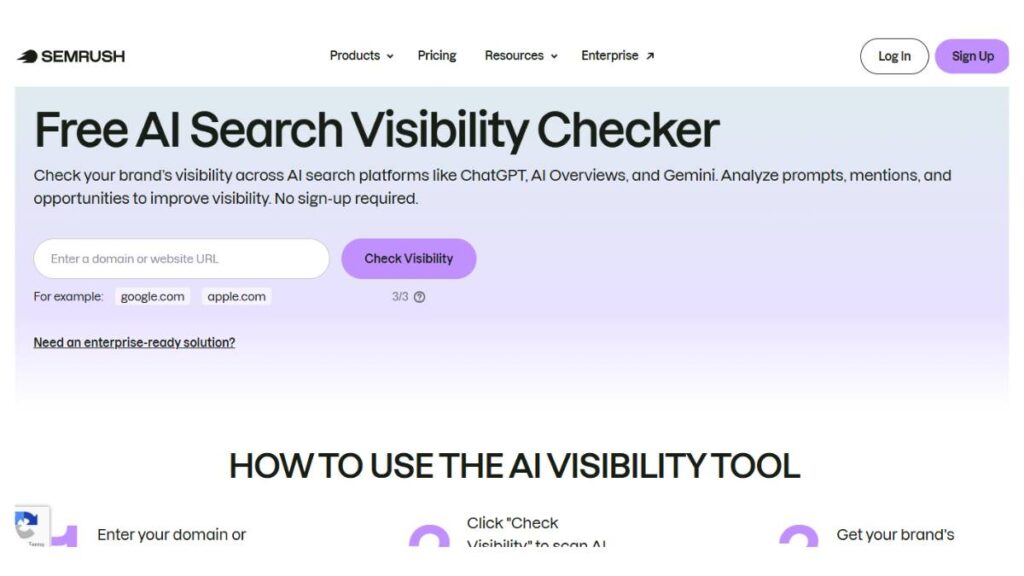
1. Semrush AI Visibility Tracking Tool
What it does:
Semrush approaches AI visibility as an extension of something marketers already understand. Instead of treating it as a completely separate system, it layers AI mention tracking into its broader ecosystem. That means you’re not just looking at visibility in isolation; you’re seeing how it connects to search performance, content, and overall presence.
There’s a certain advantage to that. It reduces guesswork. You don’t have to jump between tools to understand what’s happening.
Key features:
The platform tracks how often a brand appears in AI-generated responses and connects that data with keyword-level insights. It also gives a comparative view of how frequently competitors are showing up in similar contexts. The reporting feels structured, not experimental, which makes it easier to rely on for regular tracking.
Best for:
All-in-one marketers prefer having everything in one place rather than stitching together multiple tools.
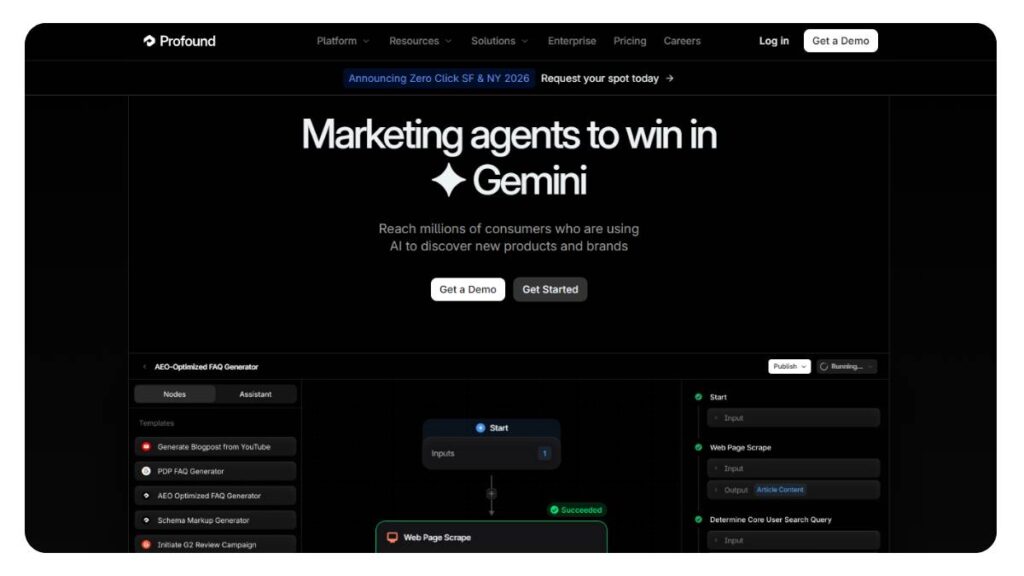
2. Profound AI Visibility Platform
What it does:
Profound is built with scale in mind. It doesn’t just sample a handful of queries; it goes wide, tracking visibility across large sets of prompts and variations. The idea here is consistency. Instead of relying on snapshots, it tries to map patterns over time.
That makes it less reactive and more strategic.
Key features:
Deep prompt tracking is the core strength. It analyzes how visibility shifts depending on phrasing, intent, and context. Reporting is detailed, sometimes dense, but it’s designed for teams that need that level of depth. It also offers structured scoring systems to quantify visibility in a way that’s easier to compare.
Best for:
Large brands that need comprehensive monitoring and can actually make use of detailed reporting.
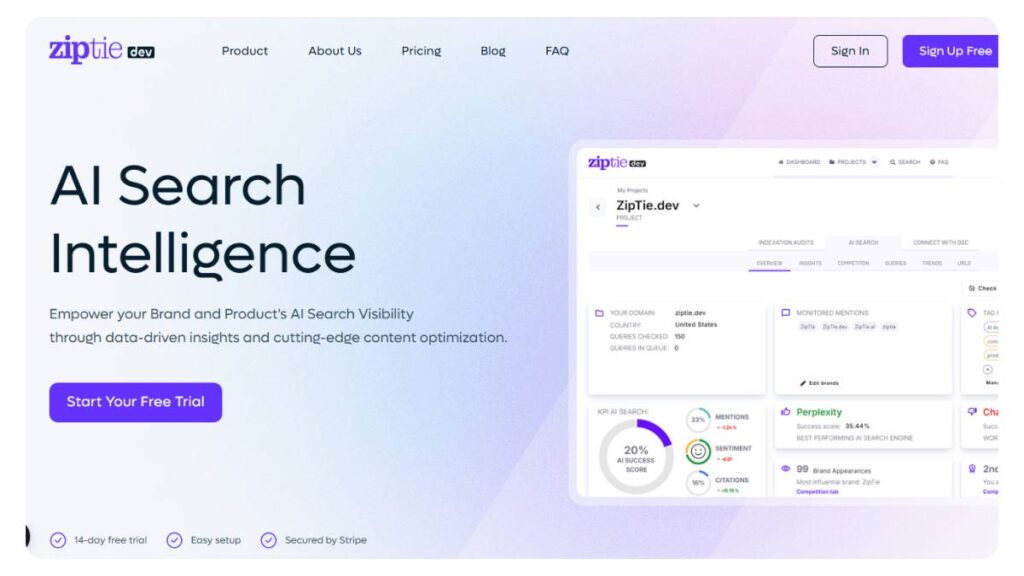
3. ZipTie.dev LLM Monitoring Tool
What it does:
ZipTie.dev feels more like a toolkit than a polished dashboard. It’s designed for teams that want control; people who are comfortable digging into how prompts behave and how outputs change under different conditions.
It doesn’t try to simplify everything. In some ways, that’s the point.
Key features:
Strong focus on prompt-level tracking. You can test variations, monitor outputs, and analyze how visibility shifts with small changes in wording. It also integrates well with technical workflows, which opens up more flexibility but requires a bit more effort to set up and interpret.
Best for:
SaaS teams and technical users who care about precision more than simplicity.
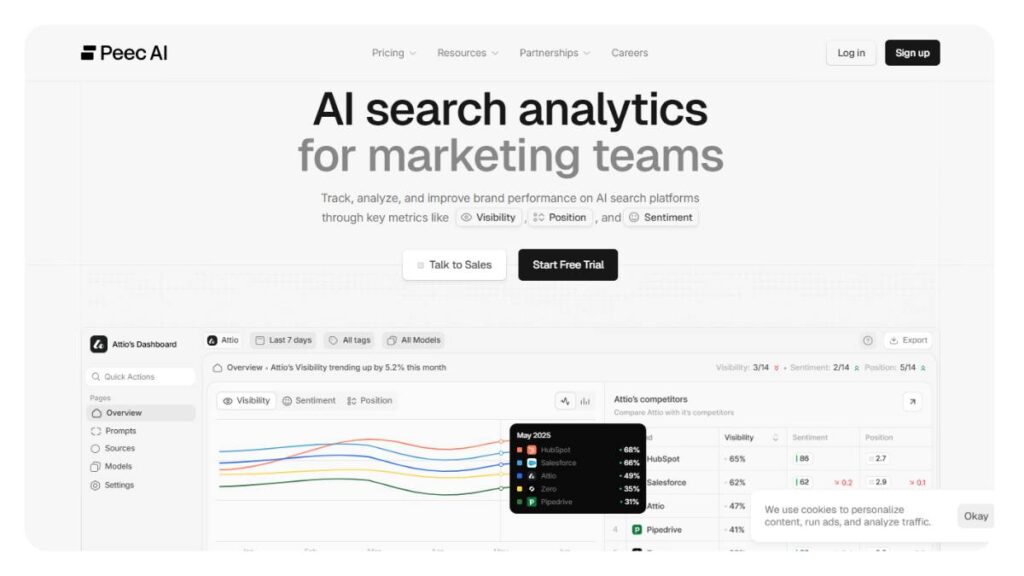
4. Peec AI Visibility Tracker
What it does:
Peec keeps things relatively straightforward. It focuses on answering the core question: are you showing up or not, and builds from there. There’s less emphasis on complexity and more on clarity.
That’s not a limitation. For a lot of teams, it’s exactly what’s needed.
Key features:
It tracks mentions, compares visibility against competitors, and presents the data in a way that’s easy to digest. The scoring systems are simple but useful. You won’t get deep technical breakdowns, but you’ll get enough insight to make decisions without second-guessing.
Best for:
Startups and smaller teams that need actionable insights without heavy analysis.
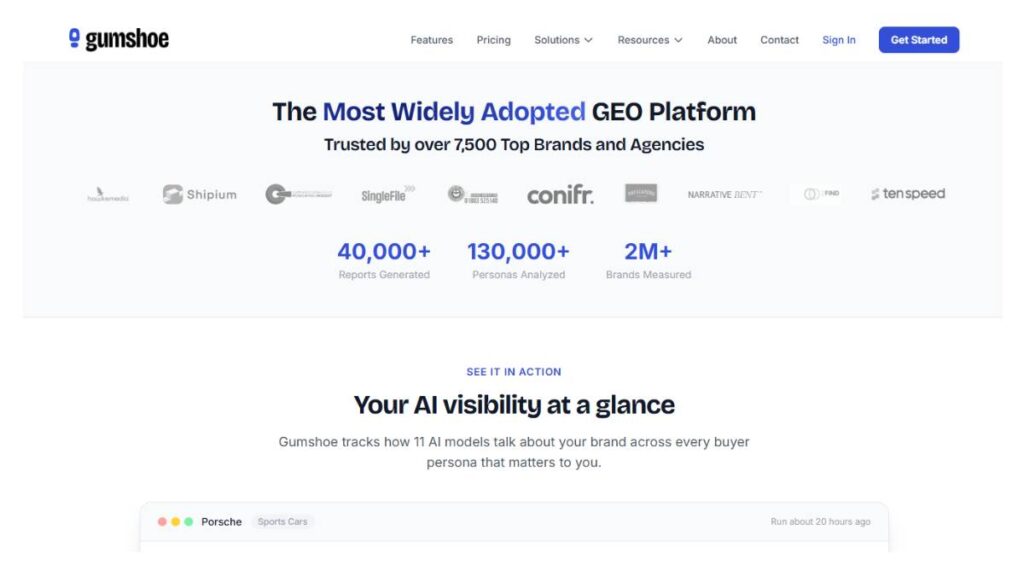
5. Gumshoe AI Brand Monitoring Tool
What it does:
Gumshoe shifts the focus slightly. Instead of just asking whether a brand appears, it looks at how that brand is positioned when it does appear. That distinction matters more than it seems.
Visibility without context can be misleading.
Key features:
The platform tracks sentiment, tone, and positioning within AI-generated responses. It identifies whether a brand is being recommended, compared, or mentioned in passing. Over time, that builds a clearer picture of how the brand is perceived, not just how often it’s included.
Best for:
Brand-focused teams that care about perception, not just presence.
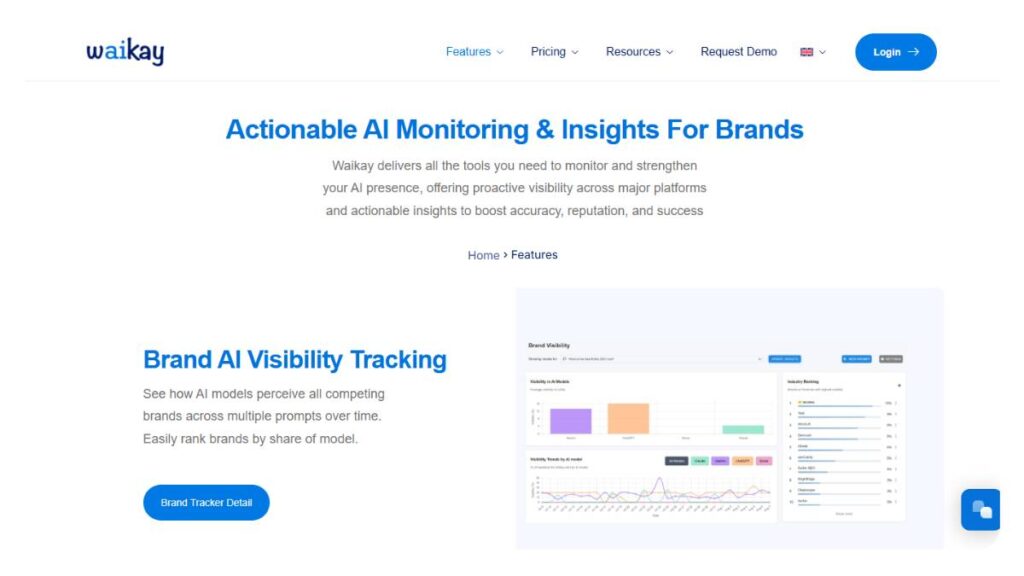
6. Waikay.io Prompt-Level AI Monitoring
What it does:
Waikay.io goes deep into prompts. It treats each query as a variable and tries to understand how different inputs produce different outputs. That level of focus reveals patterns that broader tools often miss.
It’s less about volume and more about nuance.
Key features:
Detailed prompt mapping allows you to see how slight variations in phrasing affect visibility. It also highlights gaps; queries where competitors show up, but you don’t. The insights tend to be very specific, which makes them useful for targeted improvements.
Best for:
Teams are experimenting with positioning and trying to refine how they appear across different queries.
7. Goodie AI (Free AI Visibility Tool)
What it does:
Goodie AI offers a simple entry point. It doesn’t try to compete with full-scale platforms. Instead, it gives you just enough visibility to understand whether you’re present in AI-generated responses at all.
That alone can be eye-opening.
Key features:
Basic mention tracking, limited prompt coverage, and a lightweight interface. It’s easy to set up and doesn’t require much time to interpret. Of course, the trade-off is depth; you won’t get detailed insights or advanced analysis.
Best for:
Beginners or teams testing the waters before investing in more advanced tools.
8. Scrunch AI Content Optimization Platform
What it does:
Scrunch connects visibility with content performance. Instead of treating them as separate layers, it looks at how content structure influences whether it gets picked up in AI-generated answers.
That connection is where a lot of value comes from.
Key features:
It analyzes content and highlights areas that could improve visibility;things like clarity, structure, and completeness. Reporting leans toward content teams, not just analysts, which makes it easier to act on the insights.
Best for:
Large content teams that need to align what they publish with how it gets surfaced.
9. GetAiso AI Content Optimization Tool
What it does:
GetAiso focuses on improving visibility through refinement. It looks at existing content and identifies where it falls short in terms of clarity and alignment.
It’s less about tracking for the sake of tracking and more about fixing what’s missing.
Key features:
Provides suggestions on how to structure content so it’s easier to interpret and reuse. It also highlights gaps where competitors are being cited instead. The recommendations are practical, which makes it easier to implement changes without overthinking.
Best for:
Content marketers and writers who want direct, actionable improvements.
10. SE Ranking AI Visibility Feature
What it does:
SE Ranking blends traditional performance tracking with AI visibility. It doesn’t separate the two; it shows how they interact.
That hybrid view can be surprisingly useful.
Key features:
Tracks keywords and AI mentions side by side, along with competitor comparisons. The reporting is structured in a way that makes it easier to connect visibility with overall performance trends. It’s not as deep as some specialized tools, but it covers more ground.
Best for:
Agencies that need a balanced view across multiple clients.
11. AirOps AI Content & Visibility Platform
What it does:
AirOps sits at the intersection of workflows and visibility. It’s not just about tracking what’s happening; it’s about connecting that data to how content is planned and produced.
That makes it more operational than analytical.
Key features:
Combines tracking with content workflows, allowing teams to adjust processes based on visibility insights. It’s designed for collaboration, so different teams can work from the same data without disconnect.
Best for:
Growth teams that want visibility into insights tied directly to execution.
12. Geneo AI Visibility Intelligence
What it does:
Geneo focuses on turning data into something usable at a strategic level. It aggregates visibility insights and looks for patterns over time rather than isolated results.
That shift in perspective changes how decisions are made.
Key features:
Offers dashboards that track trends, not just snapshots. It highlights shifts in visibility, emerging competitors, and changes in positioning. The insights tend to be broader, which makes them more useful for long-term planning.
Best for:
Data-driven teams that care about direction, not just current status.
13. Nightwatch LLM Tracking Tool
What it does:
Nightwatch extends its tracking capabilities into AI visibility without overcomplicating things. It builds on what it already does well: consistent monitoring and reliable reporting.
It’s steady, which counts for a lot.
Key features:
Tracks visibility across queries and combines it with existing performance data. The reporting is clear and repeatable, making it easier to track changes over time without second-guessing the numbers.
Best for:
SEO professionals who want to integrate AI visibility into their existing workflows without a steep learning curve.
Enroll Now: Advanced Generative AI for Marketing
How to Choose the Right AI Visibility Tool
Choosing the right tool sounds simple until you actually start comparing them. On paper, most of them promise similar outcomes. In practice, they’re built for very different use cases.
The easiest way to approach this isn’t by features first, but by what you actually need from the tool. Depth, accuracy, speed, usability… You rarely get all of them equally.
If accuracy in AI mention tracking is your priority
Accuracy is where things get tricky. Not every tool measures visibility the same way, and small differences in how prompts are tested can lead to very different conclusions.
If accuracy matters most, look for tools that:
- Run large sets of prompt variations, not just a handful
- Show how results change across phrasing, not just a single query
- Offer transparency into how data is collected
Tools that rely on limited sampling tend to look clean, but they miss nuance. And in this space, nuance is everything.
Best AI visibility tools for agencies
Agencies usually need two things: scalability and clarity.
You’re not tracking one brand; you’re tracking multiple clients, often across different industries. That means the tool needs to handle volume without becoming messy.
What tends to work best here:
- Clean dashboards that don’t overwhelm clients
- Easy comparison across brands and competitors
- Reporting that’s quick to generate and easy to explain
Overly technical tools can slow things down. Simpler, structured reporting usually wins in agency environments.
Best enterprise AI visibility platforms
Enterprise teams operate differently. There’s more data, more stakeholders, and a higher expectation of precision.
At that level, the focus shifts to:
- Depth of prompt tracking
- Historical data and trend analysis
- Custom reporting and segmentation
It’s less about quick insights and more about building a system that can support long-term decision-making. The tools tend to be heavier, but that’s part of the trade-off.
Budget-friendly AI visibility tools
Not every team needs a full-scale platform. In fact, early on, simpler tools often do the job just fine.
Budget-friendly options usually offer:
- Basic mention tracking
- Limited prompt coverage
- Simplified reporting
They won’t give a complete picture, but they’ll answer the most important question: Are you showing up or not? That alone is often enough to get started.
Tools for SaaS vs eCommerce vs content brands
Different business models need different kinds of visibility.
- SaaS: More focus on problem-based queries and comparisons. Tools that handle prompt-level tracking tend to work better.
- eCommerce: Visibility often comes from recommendations and “best product” queries. Broad coverage matters more than depth.
- Content brands: Authority and consistency play a bigger role. Tools that track citations and repeated mentions are more useful.
There’s no one-size-fits-all here. The closer the tool aligns with how your audience searches, the more useful the data becomes.
What to Look for in AI Visibility Tracking Software
Accuracy of AI mention detection
This is the foundation. If the tracking isn’t accurate, everything built on top of it becomes unreliable.
Accuracy isn’t just about detecting mentions; it’s about detecting them consistently across different prompts, contexts, and variations. A tool that shows stable patterns over time is usually more trustworthy than one that fluctuates wildly.
It’s worth spending time here. A slightly less feature-rich tool with better accuracy is almost always the better choice.
LLM platform coverage (ChatGPT, Gemini, Claude, Perplexity)
Coverage matters more than it seems.
If a tool only tracks one or two platforms, you’re getting a partial view. Different systems surface different brands, even for the same query. That variation is where useful insights come from.
At the same time, more coverage isn’t always better if it sacrifices depth. The goal is balance; enough breadth to see patterns, enough depth to trust them.
Prompt discovery & tracking capabilities
Most visibility issues don’t come from obvious queries. They come from variations, slightly different ways of asking the same question.
That’s where prompt discovery becomes important.
Good tools don’t just track predefined queries. They help uncover:
- New prompts worth monitoring
- Gaps where competitors are showing up
- Variations that trigger different results
Without that layer, tracking becomes reactive instead of exploratory.
Time to insights & reporting speed
Speed doesn’t get talked about enough, but it matters.
If it takes too long to gather or interpret data, the insights lose relevance. Visibility shifts quickly, and delayed reporting makes it harder to respond effectively.
The best tools strike a balance; fast enough to act on, but detailed enough to trust. Not always easy to get right.
Pricing transparency & scalability
Pricing in this space can be… uneven.
Some tools start out affordable but scale aggressively as usage increases. Others are upfront but require larger commitments from the beginning.
A few things to watch for:
- Hidden limits on prompt tracking
- Extra costs for additional users or reports
- Pricing tied to data volume
Clarity here saves a lot of frustration later. A tool that fits today but doesn’t scale well can become a problem surprisingly quickly.
Critical AI Visibility Tool Capabilities You Shouldn’t Ignore
Segmentation architecture for AI queries
Not all queries are equal, and treating them the same leads to messy insights.
Segmentation brings structure. It allows you to break visibility down by:
- Audience type
- Search intent
- Query complexity
Once you start grouping queries this way, patterns become easier to spot. You’ll see where visibility is strong, where it’s weak, and where it’s inconsistent.
Without segmentation, everything blends together, and that usually hides more than it reveals.
Defining parameters for AI visibility monitoring
Tracking works best when it’s intentional. That means defining what you actually want to measure.
A few parameters make a big difference:
- Branded vs non-branded prompts
- Informational vs transactional queries
- Broad vs niche topics
These distinctions shape how visibility is interpreted. A brand showing up in branded queries is expected. Showing up in non-branded, high-intent queries; that’s where the real value sits.
Getting these parameters right early on makes the data far more useful.
Competitor comparison in AI-generated answers
Visibility on its own doesn’t say much unless it’s compared.
Competitor analysis adds context. It answers questions like:
- Who shows up more often in the same queries?
- Where are competitors being recommended instead?
- Are you part of the same conversations, or completely absent?
This is where concepts like share of voice start to matter. Not as a vanity metric, but as a way to understand positioning.
Over time, these comparisons reveal gaps. And more importantly, they show where effort should actually be focused.
The Core Problem with Most AI Visibility Tools
Inaccurate or inconsistent AI mention detection
This is where things quietly fall apart for a lot of teams. On paper, most platforms claim they “track mentions across AI systems.” In reality, what gets captured is often partial, inconsistent, or just… off.
The issue isn’t just technical limitations. It’s the nature of how these systems generate answers. The same prompt can return different outputs across sessions, regions, or even slight wording changes. So what looks like a clean dataset is usually a snapshot, not a reliable pattern.
Mentions get missed. Brand names get paraphrased. Sometimes the tool records a mention that doesn’t really reflect meaningful visibility at all. And that creates a false sense of progress, or worse, a false sense of absence.
Lack of prompt-level data
Most platforms still operate at a surface level. They tell you what appeared, but not why it appeared.
Without prompt-level tracking, there’s no real context behind the mention. Was it triggered by a branded query? A comparison? A broad informational question? That distinction matters more than it seems.
Because visibility isn’t just about being present. It’s about showing up in the right conversations.
When prompt data is missing, it becomes difficult to connect visibility back to intent. And without intent, it’s hard to make meaningful decisions. Everything starts to feel like guesswork.
Limited LLM coverage
Another common gap, and one that often gets overlooked, is coverage.
Many tools claim multi-platform tracking, but the depth varies a lot. Some focus heavily on one or two systems and treat others as secondary. Others rely on approximations rather than direct monitoring.
The result is a fragmented view.
A brand might appear consistently in one ecosystem but be completely absent in another. Without full coverage, that gap stays hidden. And decisions get made based on incomplete information.
Over-reliance on simulated queries
A lot of tracking is built on predefined prompts. Controlled inputs, repeated at scale.
It sounds logical, but it misses how people actually search.
Real queries are messy. They change tone, phrasing, intent; sometimes all at once. Simulated prompts rarely capture that complexity. So the data ends up reflecting an artificial environment rather than real-world behavior.
This becomes a problem when teams start optimizing based on those patterns. Because what works in a controlled prompt set doesn’t always translate outside of it.
Do AI Visibility Tools Actually Deliver ROI?
When AI visibility tracking is worth it
The short answer: yes, but only under the right conditions.
Tracking visibility starts to make sense when brand discovery depends on being referenced, not just found. When people aren’t just clicking links, but relying on generated answers to make decisions.
In those cases, presence inside responses becomes a real lever. Not the only one, but definitely a meaningful one.
It’s also valuable when content is already performing well externally, but there’s a gap in how it shows up in generated outputs. That disconnect usually signals an opportunity; something isn’t translating, and it can be fixed.
But if the fundamentals aren’t there yet, tracking alone won’t change much. Visibility tools don’t create authority. They just expose where it exists… and where it doesn’t.
Industries that benefit the most (SaaS, agencies, publishers)
Some industries feel the impact more than others.
SaaS brands, for example, are often part of comparison-heavy queries. “Best tools,” “alternatives,” “top platforms”; these are exactly the kinds of prompts where inclusion matters. If a brand isn’t being mentioned there, it’s quietly losing ground.
Agencies operate in a similar space, especially when potential clients are researching services or evaluating expertise. Being referenced in those responses builds credibility in a way traditional placements sometimes don’t.
Publishers and content-heavy platforms benefit differently. For them, it’s about being used as a source. Citations, references, summaries; that’s where visibility translates into authority over time.
Real impact on traffic, brand recall, and conversions
The impact doesn’t always show up immediately in traffic dashboards. That’s important to understand.
Instead, it often starts with brand recall. A name appears repeatedly in answers. It becomes familiar. Trusted, even, without a direct click ever happening.
From there, behavior shifts. People search for the brand directly. They recognize it when they see it elsewhere. Conversion paths shorten, even if they don’t look obviously connected.
It’s subtle, but it compounds.
Over time, visibility in generated responses starts influencing the entire journey, from awareness to decision.
Limitations and expectations to set
That said, there are limits. And ignoring them usually leads to frustration.
Tracking isn’t perfect. Coverage isn’t complete. And attribution is still, in many ways, evolving. Expecting clean, linear ROI can be misleading.
It’s better to treat this as directional insight rather than exact measurement. A way to understand presence, gaps, and movement; not a single source of truth.
Also worth noting: visibility alone doesn’t guarantee influence. Being mentioned matters, but how and where that mention appears matters more.
How Much Do AI Visibility Tools Cost?
Free vs paid AI visibility tools
There’s a noticeable gap between free and paid options, and it shows up quickly once tracking begins.
Free tools tend to offer basic monitoring, limited prompts, restricted coverage, and simplified reporting. They’re useful for getting a sense of how visibility works, maybe spotting a few patterns.
But they hit limits fast.
As soon as deeper analysis is needed, more prompts, broader tracking, better segmentation, the constraints become obvious. Data feels thin. Insights feel surface-level.
Paid platforms, on the other hand, open up that depth. More queries, better coverage, and clearer visibility into how presence changes over time.
Typical SaaS pricing ranges
Pricing varies, but there are some common patterns.
Entry-level plans usually sit in a range that’s accessible for smaller teams. Enough to track a defined set of queries and monitor basic visibility trends.
Mid-tier plans expand on that; more prompts, more frequent tracking, additional reporting layers. This is where most growing teams operate.
At the higher end, pricing scales with usage. More queries, more brands, more complexity. Costs can increase quickly, especially when tracking becomes central to decision-making.
It’s not unusual to see pricing tied directly to the number of prompts or queries being monitored. That’s often the main driver.
Enterprise pricing models
Enterprise setups are a different category altogether.
Here, pricing isn’t just about access; it’s about customization. Dedicated tracking setups, broader coverage, integrations, and more advanced reporting structures.
These plans often include support layers as well. Not just tools, but guidance on how to interpret and act on the data.
Costs reflect that. They’re significantly higher, but so is the scope.
For larger organizations, the value comes from scale and consistency. Being able to monitor visibility across multiple products, markets, and query types without fragmentation.
Hidden costs to watch out for
The obvious price is only part of the equation.
Query limits can become a bottleneck. Expanding coverage often means upgrading plans or purchasing additional capacity. That adds up over time.
There’s also the cost of interpretation. Data without context doesn’t help much. Teams often need to invest time or additional resources to turn insights into action.
And then there’s overlap. Some platforms provide similar data in slightly different ways. Without careful selection, it’s easy to end up paying for redundancy rather than real value.
In the end, the goal isn’t just to find a tool that fits the budget. It’s to find one that delivers clarity, consistently enough to justify the investment.
What’s the Best Free AI Visibility Tool?
Comparison of free tools
Free options exist, and they’re useful; just not in the way most people expect. They’re not built for depth or scale. They’re built to give a rough sense of presence.
At a basic level, most free tools allow limited query tracking, a small set of prompts, and occasional visibility snapshots. Enough to answer simple questions like: Is the brand showing up at all? Or are competitors appearing more frequently?
That alone can be valuable early on. It helps validate whether visibility is even something worth paying attention to.
Where they differ is in how they present that data. Some lean toward simple mention tracking, others try to layer in sentiment or visibility scores. But under the surface, the limitations are similar: restricted coverage, capped queries, and delayed updates.
So the comparison isn’t really about “which free tool is best.” It’s more about understanding what kind of early signal is needed, and choosing the one that delivers that signal without friction.
Limitations of free AI trackers
Free tools tend to look better than they perform over time.
The biggest constraint is volume. A handful of prompts might work for testing, but it doesn’t reflect how people actually search. Once the scope expands, the data starts feeling incomplete.
Then there’s consistency. Tracking isn’t always frequent, and results can vary between runs. That makes it harder to trust trends, especially when trying to measure progress.
Coverage is another issue. Most free tools don’t track across multiple ecosystems in a meaningful way. They focus narrowly, which leaves gaps; sometimes big ones.
And finally, there’s the lack of context. Mentions might be visible, but without deeper breakdowns, it’s difficult to understand why they’re happening or how to improve them.
All of this adds up to one thing: free tools are good for direction, not decisions.
When to upgrade to paid tools
There’s usually a clear moment when upgrading starts to make sense. It’s not about features; it’s about need.
When visibility becomes something that needs to be tracked regularly, across multiple query types, with a level of consistency that supports decisions, free tools stop being enough.
The same goes for competitive analysis. Once the goal shifts from “Are we visible?” to “Where are we winning or losing?” ; that’s when deeper tracking becomes necessary.
Another signal is when patterns start to emerge, but there’s no way to validate them. If the data raises more questions than it answers, it’s probably time to move beyond free limitations.
Upgrading isn’t about getting more data. It’s about getting clearer data and being able to trust it.
30-Day AI Visibility Optimization Plan
Week 1: Establish your AI visibility baseline
The first step is simple, but it’s often rushed: understanding where things stand right now.
That means identifying how often the brand appears, in what context, and against which types of queries. Not just branded ones, but broader, intent-driven prompts that reflect real discovery.
Patterns start to show up quickly. Some areas will have decent visibility. Others will be completely empty. Both are useful.
This stage isn’t about fixing anything yet. It’s about mapping reality. Seeing the gaps clearly, without assumptions.
Week 2: Choose and set up your AI visibility tool
Once the baseline is clear, the next step is setting up proper tracking.
This is where structure matters. Prompts need to be defined carefully; not just obvious ones, but variations that reflect different ways people search. Informational queries, comparisons, problem-based questions… all of it.
Benchmarks should be realistic. Not based on where the brand “should” be, but where it actually is.
A lot of teams overcomplicate this stage. It doesn’t need to be perfect. It just needs to be consistent enough to track movement over time.
Week 3: Optimize content for AI citations
This is where the real work begins.
Visibility improves when content becomes easier to understand, reference, and trust. That usually comes down to clarity. Clear positioning, well-defined topics, and structured information that doesn’t leave room for ambiguity.
Entity signals play a role here as well. When a brand is consistently associated with specific topics, categories, or use cases, it becomes easier for systems to connect the dots.
Content doesn’t need to be longer. It needs to be sharper. More precise. Built in a way that answers questions directly instead of circling around them.
Authority signals matter too. Mentions across credible sources, consistency in messaging, and alignment across different platforms all contribute.
It’s less about adding more content and more about making existing content more usable.
Week 4: Monitor AI visibility growth & refine strategy
By this point, some movement should start to appear.
Not dramatic shifts, but small changes; new mentions, improved positioning, better consistency across queries.
This is where refinement comes in.
Some prompts will perform better than expected. Others won’t move at all. Both are signals.
The goal isn’t to chase every fluctuation. It’s to identify patterns that hold over time and adjust accordingly. That might mean refining prompts, restructuring content, or focusing more on specific areas where traction is building.
Consistency matters more than speed here. Visibility tends to compound slowly, then all at once.
What Is AI Search Visibility And How to Improve It?
Key factors that influence AI visibility
At its core, visibility comes down to whether a brand is recognized as a reliable answer to a given question.
That recognition isn’t random. It’s shaped by a mix of factors that work together over time.
Entity authority is one of the biggest drivers. When a brand is consistently associated with a specific domain or topic, it becomes easier for it to be surfaced in relevant contexts.
Content clarity plays an equally important role. If information is scattered, vague, or overly complex, it’s less likely to be picked up. Clear, structured, and direct content tends to perform better.
Then there’s the broader ecosystem. Mentions across the web, especially from credible sources, reinforce presence. They act as signals that a brand exists beyond its own content.
None of these factors works in isolation. They compound. Slowly, but steadily.
How to increase the chances of being cited by AI
Improving visibility isn’t about shortcuts. It’s about alignment.
Content should answer real questions in a straightforward way. Not layered with unnecessary complexity, not diluted with filler; just clear, usable information.
Structure helps more than most people expect. Headings, logical flow, well-defined sections; these aren’t just formatting choices. They make content easier to interpret and extract from.
Topical depth matters as well. Covering a subject thoroughly, across multiple angles, builds stronger associations than scattered, surface-level coverage.
And then there’s credibility. Being referenced or mentioned across trusted platforms adds weight. It signals that the information isn’t isolated.
Over time, these small improvements stack up. Visibility increases not because of one change, but because everything starts to align.
Conclusion:
The shift is already happening; just not always in obvious ways.
What used to revolve around keywords is moving toward entities. And from there, toward citations within generated responses. It’s a different layer of visibility altogether.
This doesn’t replace traditional approaches. It extends them. Adds another dimension that operates alongside everything else.
Early adoption matters here, but not for the usual reasons. It’s not about chasing trends. It’s about understanding how discovery is changing and adjusting before the gap becomes too wide.
Because once visibility starts shaping perception at scale, catching up becomes harder.
Looking ahead, the role of visibility tracking will likely become more integrated, more precise, and more central to how brands measure presence.
Not as a standalone metric, but as part of a broader system; one that connects visibility, authority, and influence in a way that feels less direct, but far more impactful.
FAQs:
What is an AI visibility tracker?
An AI visibility tracker looks at something most teams didn’t have to think about before: whether a brand actually shows up inside answers, not just search results. It tracks how often a brand gets mentioned, how it’s described, and where it fits in the response. Not just presence, but context… which usually tells the real story.
Why does accuracy matter more than mentions?
More mentions don’t automatically mean better visibility. That’s where people get it wrong. If those mentions show up in weak or irrelevant contexts, they don’t move much. One solid appearance in the right type of query can outweigh dozens of scattered ones. Accuracy keeps the signal clean. Otherwise, it’s just noise.
How is AI visibility different from SEO?
The shift is subtle, but important. Traditional visibility is about ranking pages. This is more about being part of the answer itself. Not linked, not listed; included. That changes the game a bit. It’s less about position and more about whether the brand is considered relevant enough to be mentioned at all.
Which AI visibility tool is best for SaaS companies?
For SaaS, it usually comes down to how well a tool handles comparison-driven queries. Things like “best tools,” “alternatives,” or “top platforms.” If those aren’t being tracked properly, the insights won’t mean much. Depth matters here. Basic tracking won’t cut it once competition starts showing up consistently.
Can Google Analytics track AI visibility?
Not really. It shows what happens after someone lands on a site, but not how they got there in the first place, especially if discovery happened inside a generated response. There’s a missing layer. You might see traffic shifts, sure, but connecting that back to visibility inside answers is where it breaks.
Do you need AI visibility tools if you rank #1 on Google?
Ranking first helps, but it doesn’t guarantee anything here. There are plenty of cases where top-ranking pages don’t get mentioned at all, while others do. It’s a different layer of visibility. So yes, even strong rankings can leave gaps, and those gaps aren’t always obvious without tracking.
Which AI platforms should AI visibility tools track?
Ideally, the ones people actually use to get answers. That sounds obvious, but some tools still focus too narrowly. Coverage matters because each platform behaves a bit differently. A brand might show up consistently in one place and be completely absent somewhere else. Without broader tracking, that difference goes unnoticed.
How do AI visibility tools collect data from LLMs?
Most of them rely on structured prompts; basically controlled queries designed to simulate real searches. The responses get pulled in, analyzed, and broken down into mentions or patterns. It works, but it’s not perfect. Everything depends on how close those prompts are to real user behavior, which is always evolving.
Are AI visibility tools accurate in tracking brand mentions?
They’re improving, but still not flawless. Mentions can slip through, especially when phrasing changes or responses vary slightly. Some tools handle this better than others, but consistency is still a challenge. It’s best to treat the data as directional. Useful, yes. But not something to rely on blindly.
What is prompt-level tracking in AI visibility tools?
Instead of looking at overall visibility, prompt-level tracking zooms in on specific queries. It answers a more useful question: where exactly is the brand showing up? That level of detail changes how decisions get made. You start seeing patterns; what works, what doesn’t, and where the gaps really are.
Can AI visibility tools track competitor mentions?
Yes, and this is where things get interesting. Seeing where competitors show up, and more importantly, where they show up consistently, gives a clearer picture of positioning. It’s not just about whether they’re visible, but the type of queries they dominate. That usually reveals more than raw comparison charts.
How often should you monitor AI visibility?
Daily tracking sounds tempting, but it often creates more confusion than clarity. Results can fluctuate a lot. Weekly tends to strike a better balance, enough to catch trends without overreacting. The key is consistency. Same prompts, same structure, over time. That’s what makes the data actually useful.
Do AI visibility tools help improve rankings on Google?
Not directly. But they do highlight gaps: unclear positioning, weak coverage, and missing associations. Fixing those tends to improve overall performance anyway. So the impact is indirect. You’re not optimizing for rankings, but the improvements often carry over in ways that are hard to ignore.
What industries benefit the most from AI visibility tracking?
Industries where users compare options or look for recommendations tend to benefit more. SaaS is a big one. Agencies too. Publishers, in a different way; they benefit when they get cited. In all these cases, being part of the answer influences decisions early, sometimes before a user even visits a site.
Is AI visibility tracking useful for local businesses?
It depends on the type of queries. Pure location-based searches still lean heavily on traditional visibility. But once queries become more descriptive, like services, recommendations, or comparisons, visibility inside answers starts to matter. That overlap is where local businesses can gain an edge.
What is AI share of voice (AI SOV)?
Think of it as relative visibility. Not just how often a brand appears, but how it stacks up against competitors across the same set of queries. It’s less about total mentions and more about presence in context. Over time, it shows whether a brand is gaining ground… or slowly fading out.
How do you optimize content for AI visibility?
Clarity does most of the heavy lifting here. Content that answers questions directly, without unnecessary fluff, tends to perform better. Structure helps too; clean sections, logical flow. And consistency across topics. It’s not about producing more; it’s about making what’s already there easier to understand and reuse.
Can AI visibility tools track sentiment in AI responses?
Some try, but it’s not always reliable. Tone can shift depending on phrasing, and small variations can change how something is interpreted. Still, it can give a rough sense of how a brand is being positioned: positive, neutral, or otherwise. Just not something to treat as a precise measurement.
What is the difference between AI mentions and AI citations?
Mentions are surface-level; the brand appears, maybe briefly. Citations go deeper. They suggest the brand is being used as a reference point, which carries more weight. Not every mention builds authority, but citations usually do. That distinction matters more than most people initially expect.
Are AI visibility tools worth it for small businesses?
Sometimes yes, sometimes not. It depends on how customers discover the business. If decisions are driven by research or comparisons, tracking visibility makes more sense. If not, the impact may be limited. It’s less about size and more about how the audience searches and evaluates options.
How is AI visibility expected to evolve in the future?
It’s heading toward something more integrated. Less about isolated metrics, more about understanding presence across different touchpoints. Mentions, citations, positioning; all connected. The shift is gradual, but noticeable. And once it becomes standard, not tracking it will feel like missing a piece of the puzzle.