
Programmatic SEO tends to sound complicated at first, but it’s really about scaling content in a structured, repeatable way. This blog walks through how Programmatic SEO actually works in practice: templates, data sources, and all the moving parts behind it. It also digs into where things usually go wrong (thin pages, messy structure… happens more than expected) and how to avoid that. There’s a bit on AI-driven search too, since that’s shaping how these pages get picked up. The focus throughout is simple: grow traffic without cutting corners. Because at scale, quality issues show up fast, and fixing them later isn’t fun.
Table of Contents
Introduction
Search has changed a lot over the past few years. Not just in how people search, but in how websites actually show up in results. Many of the biggest sites online don’t rely on publishing one article at a time anymore. Instead, they build systems that can create hundreds, sometimes thousands, of pages that answer very specific searches.
That approach is known as programmatic SEO.
At its core, programmatic SEO is about scaling content using structured data and repeatable templates. Instead of writing every page manually, websites create a framework that pulls information from datasets and generates pages automatically. When done well, this allows a site to cover huge numbers of search queries without sacrificing usefulness.
You’ve probably seen this in action without realizing it. Pages like:
- “Things to do in Barcelona”
- “Hotels in Paris under $200”
- “Best CRM tools for startups”
- “Slack integrations for project management”
These pages exist because someone built a system that could generate them from data.
Why programmatic SEO is becoming essential
Search demand has become incredibly fragmented. People rarely type broad queries anymore. Instead, they search for very specific combinations of needs, locations, products, or problems.
A few examples:
- “best coffee shops in Brooklyn with wifi”
- “email marketing software for nonprofits”
- “project management tools for remote teams”
Trying to create pages for every variation manually simply doesn’t scale.
Programmatic SEO solves that by letting a site target patterns of search behavior, not just individual keywords.
Instead of writing 100 pages by hand, a website might design a template that can produce 10,000 useful pages using structured data. That’s the difference.
How automation and data-driven SEO strategies are changing search marketing
Marketing used to focus heavily on editorial content. Blog posts, guides, thought leadership. Those still matter, but they’re only part of the picture now.
The sites dominating search results today usually combine two things:
- Editorial authority: guides, explainers, resources
- Programmatic coverage; scalable pages targeting long-tail searches
The second piece is where a lot of growth happens.
A single template connected to the right dataset can unlock huge traffic opportunities. Travel sites do it with destinations. Marketplaces do it with listings. SaaS companies do it with integrations and feature combinations.
It’s less about writing endlessly and more about designing systems that produce useful content at scale.
The rise of AI search, Google AI Overviews, and SGE
Search results are also becoming more structured. Instead of showing ten simple blue links, modern search experiences often pull together answers from multiple sources.
That means content needs to be:
- well organized
- clearly structured
- built around real entities and topics
Programmatic pages naturally fit this environment because they’re often built from structured data. Tables, categories, comparisons, locations, and datasets are much easier for search systems to interpret than long blocks of text.
Websites that organize information this way tend to surface more often in summarized results.
Why large websites dominate search results with programmatic SEO
If you look at industries like travel, local services, or software directories, you’ll notice something interesting. A small group of websites seems to appear everywhere.
That’s rarely an accident.
Those companies usually invest heavily in programmatic content models. Instead of targeting a few hundred keywords, they target entire keyword ecosystems.
For example:
A travel platform might create pages for:
- every city
- every attraction
- every hotel category
- every travel activity
Combine those together, and suddenly the site has millions of relevant pages.
Each page answers a slightly different search, but together they build enormous topical coverage.
Who should use programmatic SEO strategies?
Not every website needs programmatic SEO. It works best when a business has structured information that can be repeated across many combinations.
Common examples include:
- Marketplaces and directories
- businesses by location
- services by category
- Travel websites
- destinations
- hotels
- activities
- SaaS companies
- integrations
- feature comparisons
- use-case pages
- Ecommerce platforms
- product variations
- category combinations
The key requirement is simple: a dataset large enough to support many meaningful pages.
Without that, programmatic SEO becomes forced and usually results in thin pages that add little value.
When the data exists, though, the opportunity can be massive.
What Is Programmatic SEO?
Programmatic SEO is a method of creating large numbers of pages by combining structured data with page templates. Instead of building each page individually, a system automatically generates them using predefined layouts and data sources.
The concept is straightforward.
A website identifies a pattern in how people search. Then it builds a template that can answer that pattern across thousands of variations.
For example:
Search pattern:
“best restaurants in [city]”
Instead of writing separate articles for every city, the website builds a template that includes:
- city name
- restaurant listings
- ratings
- maps
- descriptions
Once the template exists, it can generate pages for:
- best restaurants in Chicago
- best restaurants in Miami
- best restaurants in Austin
- best restaurants in Denver
And so on.
The structure stays the same, but the data changes.
How programmatic SEO works
The typical workflow looks something like this:
- Identify scalable search patterns
- Gather structured data related to those searches
- Design a reusable page template
- Insert dynamic variables into the template
- Generate pages for every relevant combination
For example, a SaaS company might create integration pages.
Template structure:
Connect [Tool A] with [Tool B]
From there, the system can generate pages like:
- Connect Slack with Google Sheets
- Connect Notion with Trello
- Connect HubSpot with Gmail
Each page answers a specific search intent, but they’re all built from the same underlying structure.
Difference between programmatic SEO and traditional SEO
Traditional SEO usually follows a manual publishing model.
A team researches a keyword, writes an article, edits it, and publishes it. Then the process repeats.
That works well for:
- thought leadership
- educational content
- deep guides
Programmatic SEO takes a different approach.
Instead of creating pages one by one, it focuses on building a scalable content engine.
Key differences include:
Traditional SEO
- manual page creation
- editorial content focus
- slower publishing pace
Programmatic SEO
- automated page generation
- structured data-driven
- built for scale
Both approaches often work best together.
Editorial content builds authority and trust. Programmatic pages capture the long tail of search demand.
How automation creates thousands of SEO landing pages
Once a template and a dataset exist, generating pages becomes surprisingly efficient.
Imagine a dataset with:
- 5,000 cities
- 20 categories of businesses
That alone creates 100,000 possible page combinations.
If the template pulls useful information such as:
- listings
- ratings
- descriptions
- location data
Each generated page can still provide meaningful information to users.
The important thing is that the content must remain genuinely helpful. Pages created purely to target keywords without real information rarely perform well.
The role of templates, structured data, and databases
Three pieces usually power programmatic SEO systems.
1. Templates
Templates define the structure of the page:
- headings
- layout
- sections
- formatting
They ensure every generated page follows a consistent structure.
2. Data sources
These provide the content inserted into the template.
Common sources include:
- internal databases
- spreadsheets
- APIs
- product catalogs
- location datasets
3. Variables
Variables allow the template to change dynamically.
Examples:
- city name
- product name
- service category
- company name
When the system combines templates, data, and variables, it can produce a massive number of pages that still remain structured and organized.
That’s the real power of programmatic SEO.
Why Programmatic SEO Works for Search Engines and AI Search
The biggest advantage of programmatic SEO is coverage.
Search behavior today is incredibly specific. People rarely search for a broad term like “project management software.” More often, they search for something closer to their exact situation.
Examples might include:
- project management software for freelancers
- project management software with time tracking
- project management tools for construction teams
Each variation represents a slightly different need.
Trying to write dedicated articles for every variation quickly becomes impossible. But programmatic SEO allows a site to target these combinations systematically.
How long-tail keyword targeting drives programmatic SEO traffic
Individually, many long-tail searches don’t look impressive.
A query might only receive:
- 20 searches per month
- 50 searches per month
- maybe 100 searches
But when a website covers thousands of these variations, the combined traffic becomes substantial.
For example:
If a site ranks for 3,000 long-tail searches averaging 40 searches each, that’s already 120,000 monthly search opportunities.
This is exactly how many marketplaces and directories grow their traffic.
They don’t rely on a handful of huge keywords. Instead, they capture thousands of smaller ones simultaneously.
Why Google rewards extensive topical coverage
Search engines try to understand which websites are truly knowledgeable about a topic.
One strong signal is topic depth.
A website that covers:
- tools
- integrations
- use cases
- comparisons
- categories
It is often seen as more comprehensive than a site with only a few isolated articles.
Programmatic SEO helps build that depth naturally because it expands coverage across related queries.
For instance, a travel platform might have pages for:
- destinations
- hotels
- activities
- neighborhoods
- restaurants
All connected through internal linking.
Over time, that structure reinforces the site’s expertise in the travel space.
The relationship between programmatic SEO and search intent
Another reason programmatic pages work well is that they tend to match very specific search intent.
Consider these searches:
- “best coworking spaces in berlin”
- “Restaurants open late in chicago”
- “crm software for real estate agents”
Each query expects a very particular answer.
Programmatic pages are often designed specifically to satisfy those types of requests by pulling together structured information quickly.
Typical elements include:
- lists
- directories
- comparisons
- tables
- filters
Those formats make it easier for users to scan and find what they need.
How AI search engines process structured content
Modern search systems increasingly rely on understanding relationships between topics, entities, and datasets.
Content that is clearly structured tends to be easier to interpret.
Programmatic pages often include elements such as:
- organized headings
- consistent page layouts
- entity relationships
- structured datasets
All of these help clarify what the page is about and how different pieces of information connect.
That clarity makes it easier for search systems to extract useful insights.
Why data-driven SEO content performs well in AI Overviews
Pages built around real data tend to be more useful than pages that simply repeat generic explanations.
For example, a page listing 50 tools for remote teams provides concrete information that can be summarized, compared, or referenced.
Similarly, a location page showing:
- restaurants
- ratings
- price ranges
- neighborhoods
contains structured information that can easily be organized into answers.
When a site consistently publishes pages that combine clear structure with meaningful data, those pages naturally become strong candidates for being referenced in summarized results.
In other words, programmatic SEO isn’t just about scale.
It’s about organizing large amounts of information in a way that makes it easy to understand and useful to explore.
How Programmatic SEO Works (Step-by-Step Process)
Programmatic SEO isn’t just about generating thousands of pages and hoping they rank. The process actually requires a fair amount of planning upfront. The difference between a site that grows steadily and one that ends up with thousands of useless pages usually comes down to how well the system is designed.
At a high level, the workflow tends to follow a clear structure:
- Identify scalable keyword patterns
- gather structured data that supports those searches
- build page templates that can adapt to different variations
- generate pages using that data
- connect everything with strong internal linking
Each piece matters. Miss one step and the entire system starts to fall apart.
Let’s break it down.
Keyword Research for Programmatic SEO
Everything starts with patterns.
Unlike traditional keyword research, where you might look for individual opportunities, programmatic SEO looks for repeatable combinations. The goal isn’t to find one keyword; it’s to find a structure that can expand into hundreds or thousands of variations.
For example:
- service + location
- plumbers in Chicago
- plumbers in Denver
- plumbers in Miami
- product + feature
- crm with automation
- crm with email marketing
- crm with analytics
- tool + use case
- project management for freelancers
- project management for agencies
- project management for startups
Once you identify a pattern like this, the scale becomes obvious.
A single formula can generate an entire ecosystem of pages.
The next step is building a keyword dataset. This usually involves gathering:
- location lists
- product categories
- industry segments
- use-case variations
- feature combinations
When these datasets combine with search patterns, they form the backbone of the entire system.
A good rule of thumb: if a pattern can produce hundreds of meaningful searches, it’s probably worth exploring.
Building Programmatic SEO Page Templates
Once the keyword patterns are clear, the next step is designing the page structure.
Templates are the engine behind programmatic SEO. They define how every generated page will look, what information it includes, and how it adapts to different variations.
A strong template usually contains several core sections:
- a clear headline targeting the query
- supporting context explaining the topic
- structured data or listings
- helpful subcategories or filters
- internal links to related pages
Think of the template as a flexible framework. The structure stays consistent, but certain elements change depending on the page.
For example, a location-based template might include variables like:
- city name
- nearby areas
- local listings
- maps or geographic context
Meanwhile, a product comparison template might change elements such as:
- product names
- feature descriptions
- pricing ranges
- use cases
Certain page elements are commonly automated within templates:
- title tags
- meta descriptions
- primary headings
- internal link modules
- structured data markup
The challenge is making sure these elements still feel natural. If every generated page reads like a copy-paste job, it becomes obvious very quickly.
Good templates strike a balance. They keep the structure consistent while still allowing each page to feel useful on its own.
Creating Programmatic SEO Data Sources
Templates alone don’t create value. The real substance comes from the data feeding those templates.
Programmatic SEO works best when there’s a reliable dataset behind the content. Without that, pages often end up thin or repetitive.
Common data sources include:
- internal databases
- large spreadsheets
- public datasets
- product catalogs
- location directories
Some sites also pull information from external sources through APIs or other integrations. Others compile their own datasets over time.
The key is structure.
Instead of writing paragraphs manually, the system organizes information into fields such as:
- name
- category
- location
- description
- ratings
- features
Once the information is structured this way, it becomes much easier to insert it dynamically into page templates.
Structured data also makes it possible to create sections like:
- comparison tables
- listings
- filters
- category groupings
These elements not only make pages more useful for visitors, but they also help organize information in a way that’s easy to interpret.
In many cases, the strength of the dataset determines how successful a programmatic strategy becomes.
Automatically Generating SEO Pages at Scale
With templates and data sources in place, the system can begin generating pages.
This is where programmatic SEO starts to look very different from traditional publishing. Instead of creating one page at a time, the site produces pages across entire datasets.
For example:
A template designed for “best restaurants in [city]” might generate pages for:
- chicago
- miami
- san diego
- austin
- denver
Multiply that by hundreds or thousands of cities, and suddenly the site has an enormous footprint.
The generation process usually involves:
- combining template variables with data fields
- creating unique URLs for each variation
- publishing pages into the site structure
Some sites generate pages statically during development. Others build them dynamically as users navigate the site.
Both approaches can work. What matters more is whether the pages contain enough information to be genuinely useful.
Generating thousands of empty pages rarely works. Generating thousands of structured, helpful pages can transform a website’s visibility.
Internal Linking for Programmatic SEO
Internal linking is often overlooked, but it’s one of the most important pieces of the puzzle.
When a site generates hundreds or thousands of pages, it needs a clear structure connecting them together. Otherwise, the pages exist in isolation and become difficult to discover.
Most successful programmatic sites follow a hierarchical structure.
For example:
Parent page
- Restaurants in the United States
Category page
- Restaurants in California
City page
- Restaurants in San Diego
Each layer links naturally to the next. This creates a logical pathway for users exploring the site while also helping search engines understand how the pages relate to one another.
Common internal linking patterns include:
- parent-child page relationships
- category and subcategory pages
- related searches or suggestions
- location hierarchies
- cross-links between similar entities
Strong internal linking does a few important things:
- helps new pages get discovered faster
- distributes authority across the site
- guides visitors toward relevant content
Without it, even the best programmatic pages struggle to gain visibility.
With it, the entire system starts to work together; thousands of pages connected through a clear, logical structure.

Enroll Now: Advanced Digital Marketing Course
Programmatic SEO Examples
Programmatic SEO isn’t just theory; it’s being used successfully across industries that have large datasets or repeatable content structures. Seeing how it works in practice helps make the strategy more tangible.
Marketplace and Directory Websites
Marketplaces and directories are classic examples of programmatic SEO in action. They often have millions of listings, and each listing represents a potential search query.
For instance:
- Yelp generates pages for every combination of location + business category:
- “Italian restaurants in Chicago”
- “Plumbers in Miami”
- “Coffee shops in Brooklyn”
Millions of individual pages are built from a structured dataset of businesses, addresses, and categories. The site doesn’t write unique content for each page manually; templates and data do the heavy lifting. The result is a massive footprint in search, especially for long-tail queries.
SaaS Programmatic SEO
Software platforms often use programmatic SEO to capture traffic around integrations and use cases. A single integration page can serve hundreds of niche search queries.
- Example: Zapier
- Pages like “Connect Slack to Google Sheets”
- “Connect Trello to Gmail”
Each page follows the same template but dynamically pulls in the app names, descriptions, and workflow details. It allows SaaS companies to cover nearly all possible combinations of users they might search for, without writing hundreds of individual guides.
Travel Programmatic SEO
Travel websites thrive on programmatic content because users search for specific locations, activities, and accommodations.
- Example: Tripadvisor
- Pages such as “Things to do in Paris” or “Restaurants in Tokyo.”
- Each page aggregates structured data on locations, attractions, reviews, and categories
By combining location datasets with templates, these platforms cover thousands of unique searches while providing genuinely useful information for visitors.
Design Platform SEO
Even platforms that don’t seem like directories can use programmatic SEO.
- Example: Canva
- Template pages targeting design queries like “Instagram Post Templates for Food Bloggers” or “Presentation Templates for Startups.”
- Pages automatically pull in template examples, categories, and user instructions
Large platforms use this approach to capture niche searches that wouldn’t make sense to target individually but add up to significant traffic when scaled.
The common thread across all these examples: structured data + scalable templates + repeatable patterns = massive reach for long-tail searches.
How to Build a Programmatic SEO Strategy
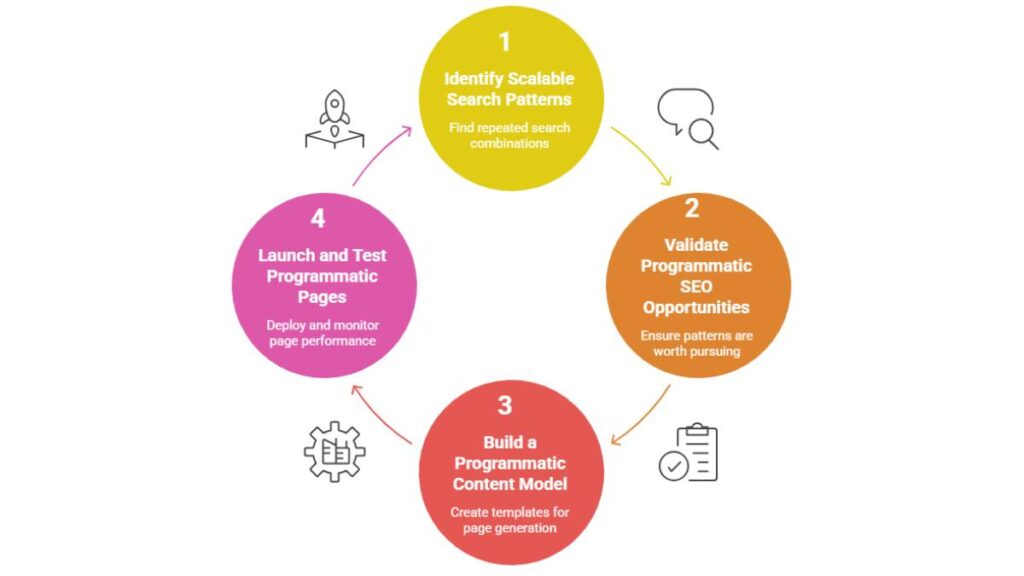
Building a programmatic SEO strategy is like designing a machine. You need the right inputs, a well-thought-out process, and a way to monitor results.
Identify Scalable Search Patterns
The first step is spotting patterns that can generate multiple useful pages. Examples include:
- Location + Service
- “Plumbers in Austin”
- “Yoga studios in Chicago”
- Product + Feature
- “CRM software with automation”
- “Project management tools with time tracking”
- Tool + Use Case
- “Email marketing software for e-commerce”
- “Task management apps for remote teams”
Look for combinations that users search for repeatedly but aren’t well covered yet.
Validate Programmatic SEO Opportunities
Not every pattern is worth pursuing. Validation helps ensure effort is focused where it matters.
Key checks include:
- Keyword volume – Are enough people searching for it?
- Competition – Can the site realistically rank?
- Content intent – Will a generated page actually meet the user’s needs?
This step weeds out patterns that might generate thousands of pages but provide little real value.
Build a Programmatic Content Model
Once patterns are validated, build the model that will generate pages.
Components usually include:
- Template variables – fields that change per page, like city or product name
- Dynamic content blocks – lists, tables, or comparison modules
- Reusable components – sections that appear across multiple pages
A clear model ensures every generated page looks purposeful and helpful rather than repetitive or shallow.
Launch and Test Programmatic Pages
After building templates and linking them to datasets, it’s time to launch. But launch isn’t the end; it’s just the beginning.
Monitor:
- Indexing strategy – Are new pages being discovered and crawled efficiently?
- Crawl monitoring – Make sure the system doesn’t overload search bots or create dead ends
- Ranking analysis – Track which pages perform, which patterns drive traffic, and where adjustments are needed
Continuous testing allows the system to scale safely and ensures the generated pages are genuinely useful.
Programmatic SEO and Google AI Overviews (SGE)
Programmatic SEO isn’t just about scale anymore. Modern search is shifting toward structured, entity-focused results, where AI-generated overviews summarize answers from multiple pages.
How AI Search Changes SEO
Search results now often include:
- Summaries of multiple sources
- Conversational-style answers
- Entity-based results
In this context, programmatic pages have an advantage because they are already structured, making it easier for search systems to extract relevant information.
Structuring Programmatic Pages for AI Answers
To increase the chances of pages being referenced in AI summaries, focus on structure:
- Clear headings – Each section answers a specific user question
- Data tables – Quickly summarize information like comparisons or listings
- FAQs – Provide concise answers to common queries
- Entity coverage – Include relevant names, locations, or categories
A structured layout makes pages both easier for humans to scan and easier for systems to interpret.
Creating Programmatic Content That AI Can Cite
For content to be cited in overviews, it needs more than just structure;it needs substance.
Elements to focus on:
- Semantic coverage – Cover related topics thoroughly so pages feel complete
- Authoritative data sources – Include credible, verifiable information where possible
- Topical clusters – Group related pages together to reinforce authority
When these elements are combined, programmatic pages aren’t just filling space; they become referenceable sources, feeding into modern search experiences and AI-generated summaries.
Best Tools for Programmatic SEO
Getting programmatic SEO to actually work at scale isn’t about having the fanciest software; it’s about having the right mix of tools that can handle data, templates, and some automation without breaking under its own weight. Honestly, a lot of people overcomplicate this part. The basics done well go a long way.
Data and Research Tools
Before doing anything else, it helps to actually know what you’re dealing with. Not every keyword is worth chasing, and patterns can be subtle. Tools that track keyword trends, volumes, and gaps in coverage are really useful. Things like:
- spotting repeatable keyword patterns across categories
- checking what’s already out there, so pages aren’t just copies of others
- finding long-tail queries that actually have some traffic
These aren’t glamorous, but without this step, scaling is just throwing spaghetti at the wall.
Automation and Page Generation
Once you’ve got your data, you need a way to turn it into pages. This can be as simple as a structured database feeding a CMS, or something fancier that pushes hundreds or thousands of pages automatically. The trick is making sure each page still makes sense. Templates are your friend here, but don’t let them turn everything into cookie-cutter fluff.
Monitoring and Optimization
It’s easy to assume that once pages are live, the work is done. Not true. You need to keep an eye on indexing, traffic, and whether certain pages are actually doing anything. Otherwise, the site fills up with pages that nobody visits. A little regular checking saves a lot of wasted effort.
Other useful things include:
- spreadsheets or databases to keep data tidy
- crawling tools to check internal links and structure
- basic analytics to see which page patterns are actually working
Bottom line: tools are just support. They don’t create results on their own, but without them, scaling is a nightmare.
Programmatic SEO Best Practices
Programmatic SEO can be really effective, but it’s also one of those things where small mistakes can snowball quickly. The good news is that a few solid habits go a long way.
Focus on User Value
Generating pages for the sake of numbers doesn’t cut it. Every page should serve a purpose; something a visitor would actually find useful. If the page isn’t helping anyone, it’s probably hurting more than it’s helping.
Avoid Duplicate or Thin Pages
Templates make scaling easy, sure, but repetition is your enemy. Each page needs some uniqueness. Even slight variations in content, data points, or structure make a difference.
Add Useful Data or Insights
It doesn’t have to be huge. Things like ratings, local tidbits, or small stats give pages some personality and credibility. Pages that feel empty get ignored.
Internal Linking Matters
All the pages in the world won’t help if no one, or nothing, can find them. Keep a clear hierarchy, link related pages, and make navigation intuitive.
Watch Crawl Budget
A big site can overwhelm search engines if pages go live all at once. Gradual rollouts and careful sitemap management help avoid headaches.
Programmatic SEO Mistakes to Avoid
There are a few traps that come up over and over. Some of them are obvious in hindsight, but people still fall into them.
Thin Content Pages
Pages that just list names, categories, or locations without meaningful context are dead weight. Don’t generate these.
Doorway Pages
Pages meant purely to catch traffic without adding value usually backfire. They can hurt credibility and make the whole site feel spammy.
Duplicate Templates
If you copy-paste a template without adjusting the content or data, every page starts to blur together. Make sure each variation actually adds something new.
Poor Site Architecture
If pages aren’t organized logically, both visitors and search engines get lost. A flat or messy structure kills the effectiveness of even the best templates.
Publishing Too Fast
It’s tempting to roll out thousands of pages at once. Resist it. Flooding the site can cause indexing delays, technical issues, or just plain chaos.
In short, programmatic SEO works best when it’s done thoughtfully. Quantity alone isn’t the goal. Focus on making lots of pages that genuinely serve users, and the results will follow.
Programmatic SEO vs Traditional SEO
Let’s be honest; traditional SEO and programmatic SEO aren’t just different in size, they’re different animals. Traditional SEO? It’s hands-on. Someone actually writes each page, thinks about headings, sprinkles in keywords here and there, and maybe fiddles with internal links. It’s careful, human, usually reads well, but it’s slow. You can’t crank out hundreds of pages this way without pulling your hair out.
Programmatic SEO flips that script. Templates plus data let you churn out hundreds, even thousands, of pages with the same underlying structure. Nuance is harder to keep, but the reach… oh, it’s massive.
A quick snapshot:
- Manual content: tight control, more personality, slow but steady. Great for cornerstone pages or content that needs a human touch.
- Programmatic content: fast, structured, pattern-driven, but it can feel flat if not overseen. Thin, repetitive pages are a hidden danger.
It’s not about one being “better.” Small blogs and niche sites? Manual works fine. Large marketplaces, SaaS platforms, directories? Without programmatic pages, you’ll never cover all products, locations, or integrations.
The trick? Mix them. Handle the high-value stuff manually, let programmatic pages fill the long-tail gaps. That’s how scale and quality finally shake hands.
Programmatic SEO vs AI-Generated Content
People often lump programmatic content and AI-generated content together, but they aren’t the same. Programmatic content is predictable, structured, and template-driven. AI-generated content is looser, more freeform. It can surprise you with phrasing, tone, even ideas, but it can wander off if left unchecked.
Some ways to think about it:
- Control vs creativity: Programmatic content is precise. AI content can riff, add flair, but sometimes gets sloppy.
- Structured data vs natural flow: Programmatic thrives on numbers, names, locations; stuff that slots neatly into tables or lists. AI is better for storytelling, nuanced explanations, and context that doesn’t fit neatly in a template.
- Mixing them: Some teams let AI fill in paragraphs for programmatic pages; descriptions, tips, extra context. The structure stays intact, but the text reads more human. Works surprisingly well, but only if monitored.
Bottom line: they aren’t mutually exclusive. Know what each brings to the table, and decide when control matters more than a dash of unpredictability.
The Future of Programmatic SEO in the AI Search Era
The game is changing. Search results aren’t just links anymore;they’re answers, snippets, recommendations. That matters a lot. Programmatic pages need to be set up to show up here, or they’re just invisible.
Some trends worth noting:
- AI-driven search: Structured, clean, and easy-to-read pages get noticed. Big, data-heavy pages win, but only if built smartly.
- Data-driven approaches: Templates and datasets need to be solid. Messy or incomplete data? Forget being picked up by complex interfaces.
- Interactive content: Filters, calculators, comparison tables; anything that gives people something to interact with keeps them around. Pages that sit there with just text? Less exciting.
- Dynamic search experiences: Users want fast answers and options. Programmatic pages that anticipate variations and multiple queries will pull ahead.
The takeaway? Programmatic SEO isn’t going anywhere; it’s growing. The sites that do it right combine scale with thoughtful structure and real value. Those are the ones that will dominate both old-school results and the new AI-driven formats.
Conclusion
Programmatic SEO isn’t just about pumping out pages. It’s really about scaling in a way that actually makes sense. When handled right, it lets a site cover a ton of ground without looking like a patchwork of templates. The real trick is balancing structured frameworks, solid data, and a bit of planning. Sites that nail this usually perform well across old-school listings and the newer formats. Bottom line: smarter work, not harder, and users notice.
FAQs: Programmatic SEO
1. What is programmatic SEO?
Think of it as a system that creates lots of pages automatically using templates and structured content. It works best when a site needs to cover different topics, locations, or products without writing each page by hand. It keeps pages consistent while letting the site scale coverage efficiently.
2. How does programmatic SEO work?
It’s a mix of templates and data from spreadsheets, databases, or APIs. Each page follows a set framework but can include unique details for its topic or location. This lets sites churn out hundreds or thousands of pages while keeping structure and formatting intact, without manually creating every page.
3. Is programmatic SEO black hat?
Not really. It only becomes a problem if pages are thin, repetitive, or add no real value. Done thoughtfully, with good structure, reliable data, and useful content; it’s completely legitimate. The goal is scale with substance, not gaming the system, so keeping an eye on quality is key.
4. Can small websites use programmatic SEO?
Yes, but carefully. Smaller sites should focus on specific long-tail variations, like niche products or local services. The challenge is keeping each page meaningful. Throwing too many automated pages onto a small site can backfire if the content doesn’t really help visitors.
5. How many pages should programmatic SEO create?
There isn’t a magic number. It’s about coverage, not sheer volume. Each page should provide unique value, whether that’s a product, location, or feature. Scaling gradually, checking performance, and refining weaker pages is smarter than dumping out thousands at once.
6. What tools are needed for programmatic SEO?
There are basically three kinds: research, automation, and monitoring. Research helps spot scalable keyword patterns. Automation handles templates and page generation. Monitoring keeps tabs on performance, indexing, and structure. A mix of spreadsheets, databases, and CMS features is usually enough to manage things.
7. Does programmatic SEO work with AI search?
Yes, structured pages with solid data are more likely to be noticed in AI-driven search results. Pages that clearly present entities, steps, or data tables are easier to reference. Content needs to be organized and trustworthy, so it’s interpreted correctly and used in summaries or answers.
8. What types of websites benefit the most from programmatic SEO?
Sites with lots of products, multiple locations, or many variations benefit most. Marketplaces, directories, travel platforms, SaaS integrations, and design tools are prime examples. Basically, any site that needs to cover lots of long-tail searches consistently can get a real edge.
9. How many pages can programmatic SEO generate?
Technically, thousands or even millions, depending on templates and data. The real limit isn’t technology; it’s quality. Every page still needs value. Adding pages without oversight usually hurts more than it helps, so careful planning is essential.
10. Does programmatic SEO require coding skills?
Some technical know-how helps, particularly with templates, databases, or CMS automation. But plenty of platforms let non-technical users create pages without deep coding. The more automated and large-scale the setup, the more understanding of how data feeds into templates helps.
11. Is programmatic SEO suitable for small businesses?
Yes, if done cautiously. Small businesses can focus on niche combinations of services or locations. Each page should serve a purpose and align with the brand. Too much automation without oversight can actually be harmful for smaller sites.
12. What is the difference between programmatic SEO and automated content generation?
Programmatic SEO is template-driven and structured, producing predictable pages. Automated content generation creates text dynamically, which can vary in tone or style. They can work together: templates give consistency, and automated text can add extra detail, making pages more readable and useful.
13. How do you find scalable keyword patterns for programmatic SEO?
Look for repeatable combinations like product + feature or service + location. Long-tail variations that match user intent work best. Search trends, competitor insights, and internal analytics all help identify patterns that can be templated and scaled without losing relevance.
14. How do search engines crawl large programmatic SEO websites?
Crawlers treat them like any other site, but structure matters. Clear hierarchies, sitemaps, and parent-child relationships make pages easier to find. Pages buried too deep or poorly linked can be missed, so thoughtful site architecture is crucial.
15. How long does programmatic SEO take to show results?
It depends on competition and volume. Low-competition long-tail pages may appear in weeks, but crowded niches can take months. Regular monitoring, tweaking templates, and iterating content helps speed things up. Patience and gradual scaling usually beat rushing.
16. Can programmatic SEO pages rank without backlinks?
Yes, if they’re relevant, high-quality, and well-structured. Backlinks help, especially in competitive spaces, but unique content that satisfies user intent can rank on its own. Thin or duplicate pages rarely succeed without external signals.
17. What role does structured data play in programmatic SEO?
Structured data makes content easier to understand. It highlights entities, attributes, and relationships. For programmatic pages, it ensures indexing is efficient and increases chances of appearing in rich results or answer boxes.
18. How do you avoid thin content in programmatic SEO?
Make each page feel complete. Include unique details like local info, stats, tips, or explanations. Templates are fine, but pages shouldn’t feel like repeated lists. Regular reviews and updates help keep content substantial and useful.
19. What is a programmatic SEO template?
It’s a framework for a page with placeholders for dynamic content. Templates set layout, headings, meta tags, and content blocks, which are filled with data from spreadsheets, APIs, or databases. They let sites produce many pages quickly while keeping consistency intact.
20. How do you measure the success of a programmatic SEO strategy?
Look at traffic, rankings, engagement, and conversions. Are pages being found, read, and used? Also watch indexing, structure, and content quality. Real success comes from combining scale with meaningful results, not just counting pages.
21. Can programmatic SEO work with AI-generated content?
Yes. AI can fill in descriptions, tips, or extra context within templates. The structure stays intact while the text feels more natural. This hybrid approach scales content while keeping it readable and approachable for visitors.
22. Is programmatic SEO safe according to Google’s guidelines?
Yes, as long as pages provide value, aren’t duplicates, and are structured properly. Following best practices, quality content, internal linking, accurate data, and sensible scaling keep things on the right side. Issues only appear when pages exist solely to chase traffic without helping users.