

Omnichannel eCommerce marketing is basically what happens when brands stop treating every platform like a separate world. The blog walks through how real customer journeys don’t follow a straight line anymore… they jump, pause, come back later, sometimes from a completely different device. One minute it’s Instagram, then a product page, then nothing for a while, and later an email or retargeting ad quietly pulls things back together. That gap between touchpoints is where most brands either lose people or keep them moving.
The sections dig into how this actually works in practice, what changes when systems are connected, and why consistency matters more than constant presence everywhere. It also touches on where things usually fall apart, because honestly, that happens more often than people admit. In the end, omnichannel eCommerce marketing is less about complexity and more about not making the customer restart their journey every single time.
Table of Contents
Introduction
Omnichannel eCommerce marketing isn’t really something brands “try out” anymore. That phase is kind of gone. It’s more like… if a brand isn’t doing it, the gap shows up pretty quickly.
Because shopping behaviour today doesn’t follow a clean path. It never really did, but now it’s almost chaotic in a predictable way, if that makes sense.
A person sees something on Instagram while scrolling. Doesn’t care much. Moves on. A few days later, they search for it on Google, maybe out of curiosity, maybe boredom. They land on the website once, probably on mobile, and leave halfway because something else grabs their attention. Later that night, an email pops up. Or a WhatsApp message. Or they see the same product again in a YouTube ad while watching something completely unrelated.
And somewhere in all that mess, the decision happens.
Not in one place. Not in one clean moment. It’s scattered.
That’s the norm now.
Earlier, marketing teams used to treat each channel like its own little world. Social media had its own plan. Email had its own calendar. Websites were basically separate ecosystems. Offline stores were doing their own thing entirely. And for a while, that worked fine, until customers stopped behaving in neat, predictable ways.
Now they jump around constantly. Without thinking about it.
A few patterns show up again and again:
- People switch devices mid-journey without even noticing
- Discovery happens in one place, and purchase somewhere completely different
- Attention is all over the place, not linear anymore
- Convenience often beats loyalty, even if brands don’t like hearing that
So the real problem isn’t “being everywhere.” Most brands already are.
The real issue is continuity. The feeling that the brand remembers what just happened, even if the customer moved somewhere else.
That’s where omnichannel eCommerce marketing steps in. It tries to connect those scattered moments so the customer doesn’t feel like they’re restarting every time they interact.
When it’s done right, it’s almost invisible. Nothing feels forced. It just flows.
What is Omnichannel eCommerce Marketing?
Omnichannel eCommerce marketing is basically what happens when all customer touchpoints stop acting like separate systems and start behaving like one connected experience.
Website, app, ads, social media, email, even offline stores if they exist… all of it starts feeding into the same loop. Not separately. Not in isolation. Together.
The idea is simple on paper, but a bit messy in execution: the customer should feel recognised no matter where they show up.
No restarting. No repeating the same steps. No “starting over” energy every time they switch devices or platforms.
There’s a clear difference here compared to multichannel setups, even though people often mix them up.
Multichannel is more like different departments doing their own thing. Social media runs campaigns. Email sends updates. Website handles conversions. Stores handle offline sales. Everything functions, but there’s not much coordination between them.
Omnichannel is where those parts start talking to each other. One action influences another. One channel picks up where another left off.
A few things define it in practice:
- Everything is connected, even if it doesn’t look like it on the surface
A cart abandoned on mobile might trigger a reminder email later. A store visit might influence what shows up in ads. - The focus shifts to the full journey
Not just individual campaigns. Not just “what worked on Instagram this week.” It becomes about what the customer actually experiences from start to finish. - Messaging stays aligned
Not copy-paste identical everywhere, but consistent enough that it feels like one brand speaking, not five different voices. - Recognition matters
The system should ideally know it’s the same person across devices. Sounds simple, but this is where a lot of setups struggle in real life.
A more practical way to think about it is this: instead of asking “what do we post today on each channel?”, the better question becomes “what is the customer trying to do right now, and what should they see next?”
That shift sounds small when written down. But in real marketing teams, it changes how decisions get made. Slowly, but noticeably.
Once that mindset sets in, channel-first thinking starts feeling a bit outdated. Almost too narrow.
How Omnichannel eCommerce Marketing Works
At its core, omnichannel eCommerce marketing works by connecting three things that usually don’t sit together properly: customer behaviour, data, and communication channels.
Not in a perfect, clean system. More like a stitched-together flow that tries to behave like one system from the outside.
It usually starts with the customer journey. But not the neat funnel diagrams people show in presentations. The real version is a bit more chaotic.
People don’t move step by step. They jump, pause, come back later, forget, return again, compare, disappear, and then suddenly buy something at 2 AM on a different device.
A typical real-world journey might look like this:
A social media ad shows a product – user clicks out of curiosity – checks the website briefly – leaves without doing anything – later gets an email reminder – still unsure, checks reviews on Google – sees a retargeting ad again on Instagram – finally makes the purchase, maybe on a laptop this time, not even the phone they originally used.
If each of these moments exists separately, the experience feels broken. The brand keeps starting fresh conversations without remembering the last one.
That’s exactly what omnichannel tries to fix.
It usually works through a few building blocks:
Unified Customer View
All customer interactions are pulled into one connected system. Browsing history, clicks, purchases, emails, and even support chats, if they happen.
The idea is simple, even if execution isn’t: the brand should recognise the same person everywhere.
Without that, every interaction feels blind. With it, communication becomes contextual instead of random.
Continuous Data Flow
Timing is where things either feel smooth or completely off.
If someone buys a product and still gets ads for it a few hours later, something clearly broke in the system. It happens more often than brands admit.
So real-time updates matter. Not “end of day sync” or delayed updates. The closer to real time, the better the experience feels.
Journey-Based Communication
Instead of sending messages on a fixed schedule, communication reacts to behaviour.
So the tone and message depend on what the customer is actually doing:
- Browsing casually – educational or comparison content
- Adding to cart – gentle reminders, maybe reassurance
- Post-purchase – onboarding, usage tips, related products
It’s not about how many messages are sent. It’s about whether they make sense in that moment.
Cross-Channel Continuity
This is where things start feeling connected in a real way.
Someone might browse on mobile during the day, come back on desktop later, and maybe even visit a store after that. The experience shouldn’t restart each time.
Even small details matter here. Saved carts. Wishlist syncing. Recently viewed products follow the user across devices. These things don’t feel exciting on their own, but together they shape how “smooth” the experience feels.
When all of this is working together, the brand stops feeling like different teams running different campaigns.
It starts feeling like one system that actually remembers what’s going on.
Not flawless. Rarely perfect. But noticeably closer to how people actually behave when they shop today.
Key Components of an Omnichannel eCommerce Strategy
Building an omnichannel eCommerce strategy is less about adding more channels and more about making sure everything already in place actually talks to each other. Most brands already have the pieces. The gap usually sits in connection, not availability.
At a practical level, the entire system rests on a few core components that quietly decide whether the experience feels smooth or fragmented.
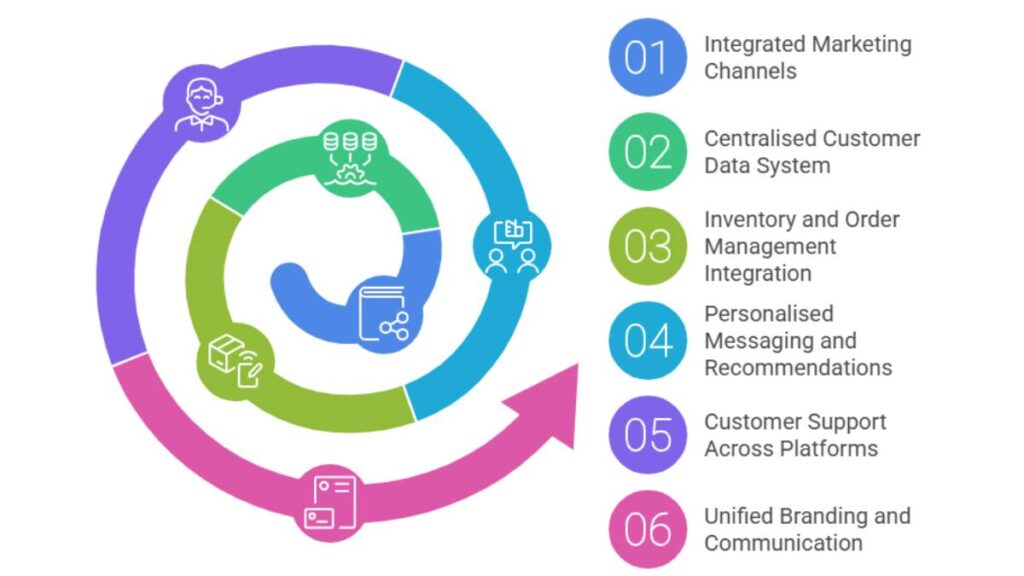
Integrated marketing channels
Website, mobile app, social media, email, even offline stores when they exist… none of these should operate like separate departments. In real setups, they often do. That’s where things start to feel disconnected for the customer.
Integration here doesn’t mean identical messaging everywhere. That would actually feel worse. It means each channel knows what the others are doing and responds accordingly.
A product viewed on Instagram should quietly influence what shows up in email. A purchase in-store should reflect in app recommendations. Nothing dramatic. Just aligned behaviour.
Centralised customer data system
This is usually where things get messy in real businesses.
Data ends up scattered. Website data here, ad platform data there, CRM somewhere else. And suddenly, no one has a complete view of the customer.
A centralised system doesn’t just store data. It creates context. It helps answer simple but critical questions like:
- Has this customer already purchased this product?
- What did they browse but not buy?
- Which channel do they actually respond to?
Without this, every interaction starts feeling like guesswork.
Inventory and order management integration
This part often gets overlooked in marketing discussions, but it matters more than expected.
Imagine promoting a product heavily online, only for it to be out of stock in-store or unavailable in certain regions. That disconnect breaks trust quickly.
When inventory systems are connected across channels, customers get a more realistic experience:
- What’s available online matches what’s available in-store
- Delivery timelines are accurate
- Pickup options actually work without friction
Small detail, but it prevents a lot of silent frustration.
Personalised messaging and recommendations
Personalisation in omnichannel isn’t about inserting a first name into emails. That’s surface-level stuff.
Real personalisation comes from behaviour. What someone viewed, ignored, returned to, or purchased again.
So messaging starts adapting naturally:
- Browsing without buying leads to comparison content
- Repeat visits to a product trigger gentle nudges
- Post-purchase behaviour shapes what shows up next
It’s not about being clever. It’s about being relevant without being intrusive.
Customer support across platforms
Support is often treated as a separate function, but in an omnichannel setup, it becomes part of the experience itself.
A customer might start a query on chat, continue it on WhatsApp, and follow up via email. If each interaction resets, the experience breaks immediately.
The expectation is simple: continuity. The issue should not need to be repeated every time the channel changes.
Unified branding and communication
This is less technical, but equally important.
Even when channels are different, the brand should feel like one voice. Not identical messaging everywhere, but a consistent tone, intent, and personality.
Sometimes brands over-correct here and become too uniform, which makes communication feel flat. The balance sits somewhere in between consistency and flexibility.
When all these components align, the system stops feeling like separate marketing activities. It starts behaving like one connected experience that reacts to customer behaviour instead of just broadcasting messages.
Omnichannel vs Multichannel eCommerce Marketing
This is where a lot of confusion still exists, even among teams actively running campaigns across platforms.
On the surface, multichannel and omnichannel look similar. Both use multiple platforms. Both try to reach customers wherever they are. But the difference lies in how those channels behave behind the scenes.
Multichannel marketing
Multichannel marketing is when a brand uses multiple platforms, but each one runs independently.
Social media has its campaigns. Email has its own calendar. The website runs its own conversion flow. Offline stores operate separately.
Everything works, but in isolation.
The problem is not execution. It’s separation.
A customer might interact with all these channels, but the system doesn’t really connect those interactions. So each channel sees only part of the picture.
Omnichannel marketing
Omnichannel marketing connects those same channels into a shared system.
Now actions in one place influence what happens elsewhere. The customer journey becomes continuous instead of fragmented.
It’s not about doing more. It’s about connecting what already exists.
Key differences that actually matter
A few practical differences stand out when comparing both approaches:
Customer experience
- Multichannel: feels like separate interactions across platforms
- Omnichannel: feels like one continuous experience, even when switching channels
Data integration
- Multichannel: data sits in silos, often disconnected
- Omnichannel: data flows between systems, building a unified view
Personalization
- Multichannel: basic segmentation, often channel-specific
- Omnichannel: behaviour-based personalisation across all touchpoints
Journey continuity
- Multichannel: each channel restarts the conversation
- Omnichannel: channels continue the same conversation from where it left off
Why omnichannel tends to perform better
There’s a simple reason behind this. Customers don’t think in channels. They don’t say “this is my Instagram journey” or “this is my website journey.” It’s all one experience to them.
So when brands treat channels separately, the experience feels slightly off, even if everything technically works.
Omnichannel removes that friction. Not completely, not perfectly, but enough to make the journey feel smoother and more natural.
And that’s usually where better conversion and retention come from. Not from more marketing, but from less disconnect between steps.
Importance of Omnichannel eCommerce Marketing
Omnichannel has become important not because it’s trendy, but because customer behaviour quietly changed faster than most systems could adapt.
People don’t interact with brands in one place anymore. They move constantly. Mobile to desktop. Social to search. Online to offline. Sometimes all within the same decision cycle.
And they expect the experience to follow them.
Changing consumer expectations
Customers today don’t separate “channels” in their mind. They just expect things to work smoothly wherever they show up.
If they abandon a cart on mobile, they expect it to still be there later. If they see a product on social media, they expect it to appear again when they search for it.
Nothing complex. Just continuity.
Increased device and platform usage
One purchase decision can involve multiple devices and platforms now. That wasn’t the case a few years ago at this scale.
A typical path might involve:
- Discovering on social media
- Researching on search
- Comparing on a website
- Buying on mobile or desktop interchangeably
Each switch is normal for the user. The friction happens when systems don’t keep up.
Demand for instant, seamless experiences
There’s very little patience for repeated steps or broken journeys.
If a customer has to re-enter information, re-search a product, or restart a process, even once, the drop-off risk increases.
Not always immediately, but gradually it affects trust.
Competitive advantage in eCommerce
In crowded markets, product differences are often small. Pricing overlaps. Features are similar.
What starts to stand out is experience.
Brands that maintain smoother journeys tend to stay ahead without necessarily competing on aggressive pricing or constant promotions.
Role in customer retention and loyalty
Acquiring customers is one thing. Keeping them is where omnichannel quietly matters more.
When a customer feels remembered across channels, even in small ways, the relationship feels stronger. It reduces friction in return visits, repeat purchases, and ongoing engagement.
Not because of loyalty programs alone, but because the experience feels consistent.
And consistency, in eCommerce, is often underrated. But it’s usually what decides whether a customer comes back or drifts away.
Benefits of Omnichannel eCommerce Marketing
Most brands don’t really feel the “benefits” of omnichannel in a dramatic, overnight way. It’s more subtle than that. Things just start breaking less often. Customers drop off less randomly. Support tickets have reduced a bit. Conversions get a little more stable across channels.
And then over time, it becomes obvious that something is working better, even if it’s hard to pinpoint one single reason.
The biggest shift is usually in how smooth the customer journey feels. Not perfect, just less scattered.
A few real outcomes tend to show up when omnichannel starts working properly:
Better customer experience (without trying too hard)
People stop repeating themselves. They don’t have to re-explain their issue on every channel. Even simple things like remembering a cart or wishlist across devices make the experience feel more “put together.” Small detail, but customers notice it.
Conversion rates stop leaking at every step
It’s not always about getting more traffic. Often, it’s about fewer people dropping out halfway. When reminders, ads, and emails actually align instead of acting independently, more users complete the journey.
Retention improves quietly
Nothing flashy here. Customers just come back more often because the experience feels familiar. They don’t have to “relearn” the brand every time.
Data starts making more sense
Instead of looking at fragmented numbers from different platforms, patterns begin to show up across the full journey. Like seeing where people actually hesitate, not just where they clicked.
Lifetime value grows gradually
Not from one campaign, but from consistent follow-ups and relevant nudges over time. When the brand doesn’t feel forgetful, customers tend to stick around longer.
Brand consistency feels natural, not forced
Same brand, same tone, whether it’s email, Instagram, or a website banner. Not copy-paste messaging, just aligned intent. That consistency builds trust without making a big announcement about it.
Sales spread more evenly across channels
Instead of relying heavily on one source, different touchpoints start contributing in a more balanced way. Ads support discovery, email supports conversion, retargeting supports reminders… everything starts carrying a bit of weight.
Nothing about this is magic. It’s more like removing friction that was always there but ignored for a while.
Core Channels Used in Omnichannel eCommerce Marketing
Omnichannel doesn’t mean being active everywhere just for the sake of it. That usually leads to noise, not results. The real idea is connecting the channels that already matter in the customer journey and making sure they don’t operate like separate systems.
Most eCommerce journeys tend to revolve around a few key touchpoints. These show up repeatedly, no matter the industry.
Website and mobile apps
This is still where most decisions get finalised. Browsing happens here, comparison happens here, checkout happens here. Mobile usually handles discovery and quick browsing, while desktop often handles deeper evaluation. The shift between them is constant.
Social media platforms (Instagram, Facebook, TikTok, etc.)
Social platforms sit at the top of the funnel more often than not. People don’t open Instagram planning to shop, but they end up discovering products anyway. The tricky part is making sure that discovery doesn’t feel disconnected when they move to the website later.
Email and SMS marketing
These channels quietly hold a lot of the journey together. Abandoned carts, reminders, order updates, re-engagement messages… none of it feels exciting on its own, but it’s where continuity is maintained. If this layer is off, everything feels scattered.
Marketplaces like Amazon, Flipkart, etc.
Even when brands have their own websites, marketplaces influence decision-making heavily. Customers compare, check reviews, and sometimes buy there instead. So these platforms are part of the journey, whether brands fully control them or not.
Physical stores (where they exist)
Offline retail still plays a role, especially for categories where touch or experience matters. What’s interesting is how often the journey moves between online research and offline purchase, or the other way around. That loop needs to stay connected.
Customer service channels (WhatsApp, chat, calls, etc.)
Support often gets treated as something separate from marketing, but customers don’t see it that way. For them, it’s all one brand experience. A broken support interaction can undo a lot of good marketing work quickly.
Each of these channels has its own job, but the real difference comes when they start sharing context. When a customer moves from one to another, the experience shouldn’t reset. That’s where omnichannel either works… or quietly falls apart.
Real-World Examples of Omnichannel eCommerce Marketing
Omnichannel sounds theoretical until it shows up in everyday buying behaviour. Most customers don’t even realise they’re moving through multiple systems. It just feels like one long, slightly messy journey.
Here’s what it actually looks like in practice.
Buy Online, Pick Up In Store (BOPIS)
A customer orders online and collects the product offline. Simple idea, but it requires coordination between inventory, website, and store teams. When it works, it feels seamless. When it doesn’t, even small delays feel frustrating.
Cart abandonment follow-ups + retargeting ads
Someone adds a product to the cart, leaves, and forgets about it. Later, they get a reminder email. After that, the same product appears again in social media ads. It feels repetitive from the outside, but internally, it’s one connected recovery path.
Online + in-store loyalty programs
Points earned in-store can be used online. Discounts applied on apps can be redeemed offline. The key detail here is continuity. The customer doesn’t feel like they are switching “systems” just because they changed location.
Social commerce journeys
A product seen on Instagram doesn’t just stay there anymore. It leads directly to product pages, sometimes even checkout flows. The transition from “scrolling” to “shopping” is much shorter now, and that connection between platforms matters more than ever.
Personalised recommendations across devices
A product viewed on mobile shows up later on desktop or in email suggestions. Not in a pushy way, more like a reminder that the interest was never forgotten. That kind of continuity quietly influences decisions.
What ties all these examples together is not technology itself, but coordination. Nothing feels isolated. Each interaction picks up where the last one left off, even if the customer doesn’t consciously notice it.
And maybe that’s the interesting part… when omnichannel is working properly, it stops feeling like marketing altogether.
How to Build an Omnichannel eCommerce Marketing Strategy
Most omnichannel strategies don’t fail because of ideas. They fail because execution gets scattered across teams that are all moving in slightly different directions.
So the real starting point isn’t tools or platforms. It provides clarity on how the customer actually moves.
Step 1: Understand customer journey
Not the neat version that fits into slides. The real one. The messy one where someone discovers a product on Instagram, forgets it, comes back through search two days later, opens the website on mobile, leaves again, then finally converts after a reminder email.
That kind of journey is normal now. Almost predictable in its unpredictability.
Step 2: Identify all customer touchpoints
This is where most brands realise they’ve been underestimating how many interactions actually matter.
It’s not just ads and websites. It includes:
- That first impression on social media that doesn’t convert immediately
- A product page visit that never gets tracked properly
- A WhatsApp query that influences trust more than ads ever do
- Marketplace comparisons are happening in the background
Once all of that is laid out, the fragmentation becomes obvious.
Step 3: Integrate data systems
This is where things usually get messy.
Different systems hold different pieces of the same customer story. Marketing sees one version, support sees another, and sales sees something else entirely.
The goal isn’t perfection. Just enough alignment so the system stops guessing.
Step 4: Align messaging across channels
Alignment doesn’t mean repeating the same line everywhere. That usually feels off anyway.
It’s more about not contradicting yourself.
If a customer is still comparing options, pushing urgency too aggressively everywhere feels out of place. If they’ve already purchased, continuing to show ads for the same product feels broken. Small things like that.
Step 5: Implement automation and personalisation
Once the system starts understanding behaviour, automation becomes less about scheduling and more about reacting.
Some examples:
- Browsing without buying leads to gentle reminders, not pressure
- Repeat visits suggest interest, so content shifts slightly deeper
- Post-purchase behaviour changes what gets shown next
It’s less about “campaigns” and more about responses.
Step 6: Optimise based on performance data
Nothing stays stable for long here. Customer behaviour shifts quietly.
Some journeys shorten. Some channels become more important. Some messaging starts losing relevance.
So optimisation isn’t a final step. It’s just ongoing maintenance, like tuning something that never really sits still.

Enroll Now: Advanced Digital Marketing Course
Challenges in Omnichannel eCommerce Marketing
Omnichannel sounds clean on paper. Everything connected, everything flowing. Reality is a bit more uneven.
Data silos and integration issues
This is the most common friction point. Every team has data, but not always the same version of it.
So what happens is simple:
- Marketing thinks a customer is new
- Support knows they’ve already purchased twice
- CRM has a partial history
Everyone is right, but nobody is seeing the full picture.
High implementation cost
Not just financial cost. There’s time cost, coordination cost, and the slow rebuilding of how teams actually work together.
During transition phases, performance can feel slightly unstable. That’s usually where most hesitation comes in.
Technology complexity
It’s rarely one system causing problems. It’s how multiple systems interact.
Inventory, CRM, analytics, ad platforms… each one works fine individually. But stitching them together without gaps takes more effort than expected.
Maintaining consistent branding
When multiple teams touch different channels, small inconsistencies start creeping in.
A slightly different tone in the email. A different offer structure on ads. A mismatch in timing between channels. Nothing major alone, but it adds up.
Training teams for unified execution
This is more cultural than technical.
Teams naturally think in their own channel logic. Social teams focus on engagement. Email teams think in conversions. Support teams think in terms of resolution speed.
Getting everyone aligned around one customer journey takes time. And repetition. A lot of it.
Best Practices for Omnichannel Success
There’s no perfect formula here, but some patterns consistently make things less chaotic.
Focus on customer-first logic
This gets mentioned a lot, but in real setups, it’s easy to drift away from it.
Channels start competing with each other. Campaigns start chasing their own metrics. And suddenly, the customer journey becomes secondary.
Pulling it back to one question helps: what does the customer actually need at this point?
Use real-time data flow wherever possible
Even small delays create friction.
A purchase not reflected in messaging systems, or outdated recommendations after conversion, breaks the experience in subtle ways. Customers notice it more than teams expect. For dependable real-time sync across channels, choosing scalable business broadband for office connectivity underpins APIs, checkout, and analytics updates so latency doesn’t quietly break continuity.
Keep branding consistent, not identical
Consistency doesn’t mean everything looks or sounds the same everywhere.
It means nothing feels out of place. Tone can shift slightly depending on channel, but the intent should feel aligned.
Invest in automation, but don’t overdo it
Automation helps maintain continuity across channels. But too much of it starts feeling mechanical.
The useful version is behaviour-driven, not time-driven.
Keep checking what’s actually working
Omnichannel systems change over time. What worked six months ago might feel off today.
So performance tracking isn’t just reporting. It’s a way of spotting where the journey starts breaking down.
Prioritise mobile experience
Most journeys begin on mobile now. Even if they end somewhere else.
If the mobile feels slow or incomplete, the rest of the system struggles to recover from that first impression.
Future of Omnichannel eCommerce Marketing
Omnichannel isn’t heading toward a completely new direction. It’s more like becoming deeper, more automatic, and slightly harder to separate from everyday commerce.
AI-driven personalisation
Personalisation is moving away from static segments. Instead of grouping customers into fixed buckets, systems are starting to adjust based on behaviour in real time.
It’s less about labels now, more about context.
Predictive journey mapping
Instead of reacting to what customers did, systems are slowly starting to predict what they might do next.
Not perfectly, not always accurately, but enough to influence timing and messaging in a more proactive way.
Voice and device-based commerce
Search and discovery are expanding beyond screens. Voice assistants, smart devices, and connected systems are becoming part of the journey.
Still early, but the direction is clear enough.
Hyper-personalised experiences
One-size-fits-all campaigns are slowly losing ground in some categories. Journeys are becoming more dynamic, adapting based on ongoing behaviour rather than static profiles.
It’s not about more messaging. It’s about more relevant timing.
Social commerce and live shopping growth
Social platforms are becoming full shopping environments, not just discovery channels.
Live shopping, creator-led product discovery, and in-app purchasing are tightening the gap between seeing something and buying it.
The overall direction is pretty straightforward: fewer steps between interest and purchase, and more connected behaviour across channels.
Omnichannel isn’t a separate strategy anymore. It’s just becoming how eCommerce naturally works when systems stop operating in isolation.
FAQs: Omnichannel eCommerce Marketing
What is omnichannel eCommerce marketing?
It’s basically when all the customer touchpoints stop behaving like separate systems and start acting like one connected flow. Website, social, email, apps, even offline stores if they’re part of the setup… everything carries context forward. So the customer isn’t starting from zero every time they switch screens. That continuity is really the whole point.
How is it different from multichannel marketing?
Multichannel is more like having multiple doors into the same brand, but each door works independently. Social runs its own messaging, email does its own thing, website sits separately. Omnichannel connects those doors. So if someone interacts on Instagram, that behaviour quietly shapes what shows up later on email or ads. Everything is aware of everything else, more or less.
Why is omnichannel important for eCommerce?
Because customers don’t shop in a clean, linear path anymore. They jump between apps, compare across tabs, leave, return later from another device… sometimes more than once before buying. If the experience resets every time, it feels clunky. Omnichannel smooths that out so the journey feels continuous instead of stitched together.
What are examples of omnichannel strategies?
Some are already common in everyday shopping. Buying online and picking up in-store is one. Cart reminders that follow up through email or ads are another. Loyalty programs that work across both app and physical store also fit here. Even product suggestions that stay consistent across devices fall into this category. It’s really about continuity showing up in small ways.
Which tools help implement omnichannel marketing?
Usually, it’s a mix of CRM systems, analytics tools, marketing platforms, and inventory management systems. But the real challenge isn’t the availability of tools, it’s whether they’re actually connected properly. Without integration, data stays scattered, and the experience still feels broken even if everything looks “set up” on paper.
Is omnichannel marketing expensive?
It can be, especially in the beginning when systems need to be aligned or rebuilt. There’s setup effort, sometimes restructuring, too. But over time, it tends to even out. Better retention and fewer lost customers usually offset the cost. It’s less of a short-term expense and more of a structural investment.
How does it improve customer experience?
Mostly by removing small friction points that people don’t always notice individually, but definitely feel overall. Things like having to repeat information, losing cart history, or getting irrelevant messages after purchase. When everything is connected, the experience just feels more aware and less repetitive. A bit more natural, in a way.
What industries benefit most from omnichannel?
Retail, fashion, electronics, and beauty usually see strong results because customers compare heavily before buying. FMCG also benefits due to repeat purchase behaviour across channels. But honestly, any business where customers interact through more than one touchpoint can see improvements. It’s not limited to one sector.
How does data integration work in omnichannel marketing?
It’s basically about pulling customer data from different systems and stitching it into one unified view. Browsing behaviour, purchase history, clicks, support interactions… all of it comes together. Once that happens, the system stops treating each interaction like a fresh start and starts recognising patterns across the journey.
What is the future of omnichannel marketing?
It’s moving toward more predictive behaviour. Instead of reacting to what customers already did, systems will increasingly try to anticipate what comes next. Social commerce, voice search, and faster checkout flows are also shrinking the gap between discovery and purchase. Journeys are getting shorter, but more connected at the same time.
How does omnichannel marketing improve customer retention rates in eCommerce?
Retention improves mainly because the experience feels consistent across all interactions. No repeated steps, no broken context, no “start again” moments. When customers feel recognised, they don’t need convincing every time. They just come back because the process feels familiar and easy.
What role does AI play in omnichannel eCommerce marketing strategies?
AI helps in spotting patterns across large volumes of customer behaviour and turning that into action. Recommendations, timing of messages, basic personalisation… all of that gets easier with it. But it still depends heavily on clean, connected data. Without that foundation, even smart systems can end up making weak assumptions.
How can small businesses implement omnichannel marketing on a limited budget?
No need to overbuild in the beginning. Even connecting just a website, email, and social media can create a simple version of omnichannel. The focus should be consistency, not complexity. When customer data and messaging stay aligned across a few key channels, the experience already feels much more connected.
What are the most common mistakes brands make in omnichannel marketing?
A big one is treating every channel like a separate world, which breaks the customer journey. Inconsistent messaging across platforms is another common issue. Over-automation also shows up often, where communication starts feeling disconnected from real behaviour. And sometimes the focus shifts too much toward tools instead of experience.
How do you measure the success of an omnichannel eCommerce strategy?
It usually shows up in how smooth the customer journey feels across touchpoints. Metrics like conversion rate, retention, lifetime value, and drop-off points help track performance. But beyond numbers, there’s a simpler signal too… fewer broken journeys and less repetition between steps. That usually says enough.
Which tools or platforms are best for managing omnichannel customer data?
Most setups rely on CRM systems combined with analytics and marketing platforms that can integrate properly. The specific tools matter less than the integration between them. If data doesn’t move smoothly across systems, the experience still stays fragmented, no matter how advanced the setup looks.
How does omnichannel marketing impact customer lifetime value (CLV)?
CLV tends to increase because customers stick around longer when the experience feels consistent. They engage more often and drop off less. Better timing, relevant messaging, and fewer friction points all contribute. Over time, that naturally builds higher long-term value without aggressive push tactics.
Can omnichannel marketing work without a physical retail store?
Yes, it absolutely can. Physical stores are not required. Many brands run full omnichannel setups using only digital channels like websites, apps, social media, email, and marketplaces. The key is the connection between those channels, not the presence of offline retail.
How does personalisation differ in omnichannel vs traditional marketing?
Traditional marketing usually works with broader segments and more static messaging. Omnichannel personalisation reacts to actual behaviour across multiple touchpoints. So instead of sending the same message to a group, it adapts based on what each person has done across their journey. More fluid, less fixed.
What KPIs should be tracked in an omnichannel eCommerce campaign?
Key ones usually include conversion rate across channels, retention rate, customer lifetime value, and engagement across touchpoints. Drop-off points matter too, since they show where the journey breaks. In practice, it’s less about tracking everything and more about noticing where the flow stops feeling smooth.