
Timing a campaign wrong can kill it quietly, without ever telling you why. Media scheduling strategies are what separate campaigns that build real momentum from the ones that just drain budget. This guide covers everything: the three core scheduling models (continuity, flighting, and pulsing), the foundational concepts of reach, frequency, and continuity, the six advanced pulse types most marketers have never heard of, and the practical steps to build a media schedule that actually maps to how your audience behaves. There’s also a deep look at social media scheduling benchmarks, what’s actually driving engagement across platforms, the mistakes that bleed budgets silently, and how to think through the right strategy for your product. No filler, no generic advice, just a genuinely useful breakdown of how media scheduling works and how to do it well.
Table of Contents
The Timing Problem Nobody Talks About Enough
There’s a specific kind of campaign failure that nobody really wants to admit. The creative was good. The targeting was decent. The budget wasn’t small. And still, nothing. Flat results, poor recall, ad spend that just sort of… evaporated.
Nine times out of ten, the culprit is scheduling.
Not the creative. Not the channel selection. Not even the audience targeting. It’s the when, and it’s something the industry chronically underinvests in thinking about.
Media scheduling is the strategic planning of when and where to deliver messages across various channels. It covers timing, placement, and frequency, determining the ideal windows in which your target audience is most receptive. At its core, it’s also a tool for media managers to allocate budgets effectively and track expected returns on advertising investments.
But that definition barely scratches what actually happens in practice. The real work is making judgment calls about your product cycle, your audience’s behavior patterns, your competition, and your budget’s limits. Those calls, stacked together, become your media schedule.
Get them right and your campaign punches above its weight. Get them wrong, and you’re running perfectly good creative into a wall.
Reach, Frequency, and Continuity: The Three Concepts That Drive Everything
Before getting into the actual scheduling strategies, there are three concepts worth understanding properly. They sound basic. They’re not.
Reach is the total number of unique people exposed to your ad at least once during a given period. Notice the word “unique”, it’s not total impressions, it’s distinct individuals. When you’re launching a new product into a market that doesn’t know you exist yet, reach is what you’re buying. You need eyeballs, lots of different ones.
Frequency flips that around. It’s how often the same person sees your message. And there’s a tension here that media planners wrestle with constantly: more reach means lower frequency per person (for the same budget), and chasing high frequency means you’re reaching fewer total people. You can’t fully optimize both at once.
Continuity is about the pattern over time. Are you maintaining a steady presence throughout a campaign, or concentrating everything into short, intense bursts? This is the decision that determines which scheduling model you use.
Together, these three form what some planners call the RFC framework, essentially the DNA of your media plan. Every scheduling decision traces back to a trade-off between these three elements.
Here’s a useful way to think about it: reach is the door, frequency is the knock, and continuity is how long you stay at the door. Different products need different combinations of all three.
The Core Media Scheduling Strategies: Continuity, Flighting, and Pulsing
The classical scheduling models are commonly known as continuity, flight, and pulsing. They’ve been around for decades and still hold up. The trick is knowing which one maps to your actual situation, not just picking the one that sounds most sophisticated.
Continuity: The Long-Game Approach
A continuous schedule runs at a consistent, stable level throughout the entire year, think one ad per week for 52 weeks, or one magazine placement per month, every month. No dramatic bursts, no dark periods. Just a steady, predictable presence.
This is ideal for brands whose products people need at any given moment, regardless of the season. Toothpaste. Soap. Mobile banking. Health insurance. The consumer might decide to switch brands on a random Tuesday in March, and if you haven’t been visible recently, you’re not in their consideration set.
Continuous scheduling also builds something harder to measure but genuinely valuable: top-of-mind awareness that compounds over time. The brand that’s always there eventually becomes the one that feels familiar, even safe.
That said, continuous scheduling is expensive. Running a meaningful presence for 12 months requires a real budget commitment. If the numbers don’t work, and for most smaller brands, they don’t, forcing a continuous schedule just means thinly spread spend that never hits the threshold to register.
The upside nobody mentions: consistent long-term advertising contracts often secure better ad slots and lower CPMs. Platforms and publishers reward commitment.
Flighting: Concentrated Firepower for Seasonal Products
Flighting involves alternating periods of heavy advertising with periods of no advertising at all. It’s also called bursting, and the name makes sense. You concentrate all your firepower into specific windows, then go completely dark.
The logic is simple: if your product has a season, advertise in it. Why spend money on woolen sweater ads in May? Why push ski resort campaigns in July? The budget is better saved and concentrated into the months where consumer intent is actually there.
Media campaigns for a specific time period, like raincoats during monsoons, woolens during winters, ACs during summers, these are textbook flight cases.
The risk is real, though. Going dark creates a gap that competitors with continuous schedules can quietly fill. There’s also the question of brand recall; advertising’s effects erode faster than most marketers expect. An intensive burst of ads with high frequency in a short time can often create stronger, more immediate recall than a light, continuous campaign spread thin. But once that burst ends, the clock starts ticking on how long the memory holds.
For brands using flighting, the creative work during active periods has to be strong enough to carry the brand through the silence. There’s no room for mediocre ads when you’re only showing up seasonally.
Pulsing: Probably the Most Practical Strategy for Most Brands
Pulsing combines the first two. A low baseline of advertising runs throughout the year, enough to maintain some presence, and then intensity spikes during peak periods.
Think soft drinks. People buy them in January, sure. But consumption jumps dramatically in summer, during major holidays, and during sporting events. A pulsing strategy runs reminder ads year-round (at modest spend) and then pours serious budget into those peak windows.
Coca-Cola is probably the clearest real-world example. Their advertising never fully disappears, but the Christmas campaign is a whole other level of intensity compared to what runs in April.
Pulsing is versatile. It handles products with year-round demand that still spike seasonally. It works for product launches that need initial bursts followed by sustained awareness. It’s practical for mid-size budgets that can’t sustain true continuous scheduling but also can’t afford to go fully dark during the off-season.
The honest trade-off: planning is resource-intensive to plan well. You’re essentially managing two modes of advertising simultaneously, the background hum and the big push, and they require different creative approaches, different media mixes, and different performance benchmarks.
The Six Pulse Types
Within pulsing, especially, there’s a finer taxonomy that’s worth knowing. Most scheduling guides gloss over this, but these distinctions actually matter when you’re planning a real campaign.
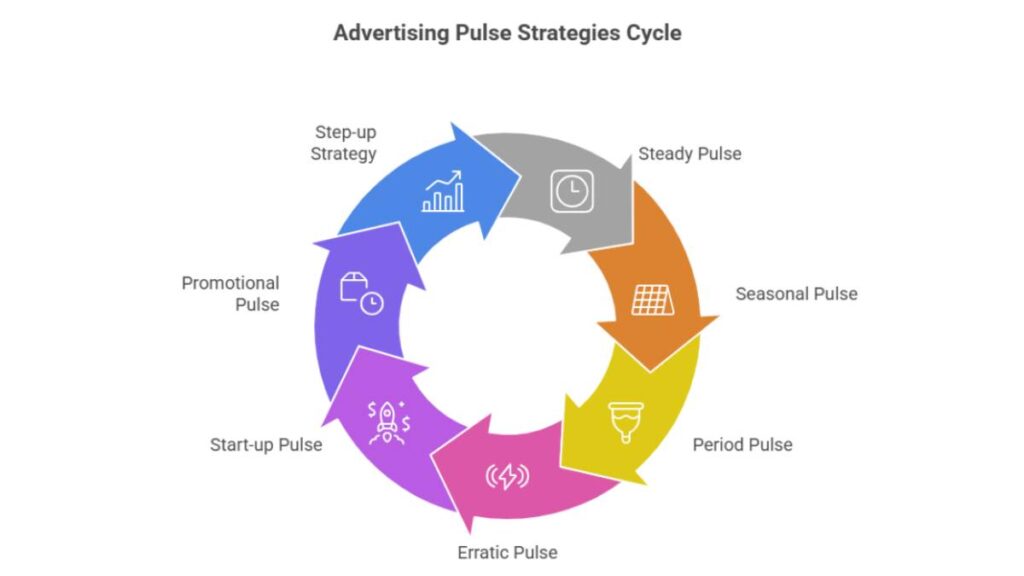
Steady pulse, the most basic form. One ad per week for 52 weeks. Good for mature brands that need low-cost maintenance of existing awareness.
Seasonal pulse, all spend concentrated in key seasons or festivals with nothing in the gaps. High efficiency but demands strong creativity during active windows.
Period pulse, ads appear on a regular, predictable basis. Useful for brands tied to billing cycles, subscription renewals, or monthly purchase triggers.
Erratic pulse, irregular timing, used to disrupt old patterns or react fast to competitors. Harder to plan for, but sometimes the most strategically sharp move.
Start-up pulse, heavy upfront advertising that gradually reduces as awareness builds. Almost always the right call for new product launches. The idea is rapid market penetration followed by a step-down in spend once recall is established.
Promotional pulse, single-use, short-window bursts around specific events, product launches, or seasonal promotions. Limited duration, high intensity.
There’s also a step-up strategy, starting light and peaking as a season arrives, which works particularly well for seasonal products where consumer interest builds gradually before the demand peak.
These aren’t just academic categories. When you’re sitting in a planning meeting arguing about where to put the budget in Q3, knowing the difference between a period pulse and an erratic pulse gives you actual language to work with.
Macro and Micro Scheduling: Planning at Two Levels
Here’s a distinction that surprisingly often gets collapsed into one conversation when it should be two separate ones.
Macro-scheduling is the big picture, allocating advertising spend across the year in relation to seasons and business cycles. Which months are active? Which gets the heavy budget? Which are dark? That’s macro. It’s where the continuity/flight/pulsing decision gets made.
Micro-scheduling is what happens inside those active windows. Which days? Which hours? Which specific placements within the media buy? This is where the granular audience behavior data becomes critical, because knowing that your audience is heaviest on Wednesday evenings versus Sunday mornings changes how you distribute within a flight.
Both have to be planned. A brand might macro-schedule to concentrate on Q4 (classic retail flighting). But within Q4, the micro-schedule might skew spend toward weekday afternoons and pre-weekend windows based on purchase behavior data.
Get the macro right and the micro wrong, and you’re in the right months but the wrong moments. The reverse is equally painful.
Social Media Scheduling in 2025: What the Data Actually Shows
Traditional media scheduling was built for TV, radio, and print. The principles transfer directly, but social media adds a layer of real-time feedback that makes the craft considerably more precise. And more complicated.
A study by the Content Marketing Institute found that 83% of successful marketers use tools for content scheduling and automation. The social media management market is projected to grow from USD 17.5 billion in 2022 to USD 51.8 billion by 2027, at a CAGR of 24.2%. That growth tells you something about how seriously brands are taking the operational side of scheduling.
How Often Should You Actually Be Posting?
Hootsuite’s recommended posting frequencies for optimal engagement: Instagram, 3 to 5 times per week; Instagram Stories, twice daily; Facebook, 1 to 2 times per day; LinkedIn, 1 to 2 times per day; TikTok, 3 to 5 times per week.
Those benchmarks are useful starting points. What’s more useful is what the research shows about the consequences of not meeting them. An analysis of 4.8 million channel-week observations found that accounts that didn’t post in a given week consistently underperformed their own baseline growth rates. Any posting was better than not posting at all, and that held across platforms.
That’s the social media version of the continuity argument. Going dark hurts.
Brands post an average of 5 posts per week on Instagram and TikTok. And notably, brands have reduced posting frequency on Facebook by 48%, pointing to a more intentional approach that moves away from volume toward curated, high-value updates. That’s strategic pulling back applied to social, pulling back from a platform where engagement is structurally declining and concentrating resources where returns are higher.
Platform Engagement Benchmarks Right Now
TikTok leads engagement at 3.70% (up 49% year-over-year), while Instagram sits at 0.48% and Facebook declines to 0.15%.
On LinkedIn, documents (carousel-style posts) pull in a 37% engagement rate, by far the highest single-format performance across any major platform. For marketers, that means carousels disguised as documents are still the king of reach and interaction on LinkedIn.
Interactive content formats, polls, Q&As, and quizzes drive 28% more engagement than static content. Worth building into your scheduling logic when you’re deciding what type of content goes into which slot.
One more data point that reframes the frequency debate: on Instagram, static images (6.2% engagement rate) are outperforming Reels (3.5% ER). Scheduling fewer, higher-quality static posts may outperform a high-volume Reels strategy for certain brands. Format matters in the scheduling calculus.
The Factors That Should Actually Drive Your Scheduling Decision
There’s a temptation to copy what competitors or well-known brands are doing. Understandable, but not always smart. The right scheduling strategy for your brand depends on a handful of specific factors, and they’re worth working through honestly.
Product seasonality. The most obvious one. Is demand genuinely seasonal, or are you just assuming it is? Look at the actual sales data across the year. Some brands are surprised to find their “seasonal” product sells more steadily than they thought. Others confirm the peak is even more pronounced than expected. The data should drive this, not intuition.
What the competitive landscape looks like. If competitors are maintaining a continuous presence, completely disappearing during off-periods is risky. On the other side, if everyone’s piling into the same media channels at the same time, CPMs spike, and your message gets lost in the noise. Sometimes the smarter move is to be loud when competitors are quiet, and quieter when everyone’s fighting for attention.
Budget, honestly assessed. A continuous schedule sounds great in a deck. In practice, spreading a limited budget across 52 weeks often means being present at levels too low to register. Be real about the threshold for meaningful presence. If you can’t hit it year-round, concentrate.
Where your audience is in the buying cycle, awareness campaigns need to reach, be broad, continuous, or pulsing across many touchpoints. Conversion campaigns need frequency, concentrated, high-repetition exposure close to the purchase moment. The scheduling logic should follow from that.
Brand lifecycle. New products almost always need a start-up pulse, heavy initial advertising that establishes awareness and builds recall quickly, followed by a step-down as penetration improves. Mature brands with established recall can coast on a lighter, more consistent presence without losing much ground.
The Mistakes That Quietly Drain Campaigns
Some of these are obvious in hindsight. Less obvious when you’re in the middle of a planning sprint.
Scheduling based on when the team is available, not when the audience is active. It happens more often than anyone admits. Posting at 10 am because that’s when the content team finishes it, not because that’s when the audience is online.
Locking in a schedule too rigidly. Social media and digital media move fast. Real-time events, competitor launches, platform algorithm changes, all of these can make a scheduled post feel tone-deaf or outdated overnight. If you already scheduled a post before an unexpected event that says “Yay! Happy times! Grab your discount!”, you have to edit it in light of the new events. If you don’t, your audience can see your brand as insensitive. A schedule should be a guide, not a contract.
Choosing continuous when flying or pulsing would concentrate the impact better. Thin, stretched continuous presence with a small budget is often worse than a focused burst. The brand that shows up lightly all year and loudly at no point doesn’t build strong recall.
Not revisiting the schedule based on performance data. Digital tools enable marketers to collect data on audience engagement and ad performance, leading to more effective scheduling. Building the schedule is step one. Iterating on it based on what the data shows is where the real optimization happens.
Building a Media Schedule: A Practical Framework
Theory is useful. Here’s how to actually sit down and build one.
Start with your objective. Awareness and brand-building push toward reach and continuity. Conversion and direct response push toward frequency and concentrated timing around purchase moments. Know which game you’re playing before touching a calendar.
Map your product against the year honestly. Pull real sales data across 12 months. Where are the peaks? Where are the valleys? Be specific. “Q4 is strong” is less useful than knowing that demand spikes in weeks 42–49 specifically.
Run the budget math across your options. What does a continuous schedule look like at your budget? Is the weekly spend high enough to register? If not, how does pulsing change the picture? Model it out.
Research audience behavior by channel. Platform analytics, industry benchmark reports, and your own historical engagement data. Where is the audience? When are they most active? What content formats are performing?
Plan macro first, micro second. Lock in which months/quarters get budget, then work out the within-flight timing details. Don’t let micro-level debates (should we post at 8 am or 10 am?) consume macro-level strategic time.
Leave room to adapt. Schedule 60–70% of your content in advance. Keep the rest flexible so you can respond to real-time developments, trending moments, or early campaign data that suggests a pivot.
Measure and iterate. Programmatic buying allows advertisers to dynamically allocate media spend based on real-time bidding, adjusting schedules on the fly based on audience interactions. Even if you’re not running programmatic, the principle applies: let performance data inform your next scheduling decision, not just habit
Conclusion
Honestly, media scheduling is one of those disciplines that looks straightforward until you’re actually doing it under real budget constraints with a real product and a real deadline. Then it gets interesting.
The brands that consistently punch above their weight aren’t always the ones with the biggest spends. They’re the ones who understand their product cycle, who know their audience’s actual behavior, and who make deliberate choices about when to show up loudly, when to maintain quiet presence, and when to go dark entirely.
Continuity, flight, pulsing, these aren’t just textbook categories. They’re strategic postures. Choose the right one for the right situation, pair it with solid micro-scheduling decisions, and the same budget goes further.
The rest is creative execution. But timing? Timing is the foundation.
FAQs
What exactly is media scheduling, and how does it affect a campaign?
Media scheduling is the process of deciding when, how often, and for how long advertisements appear across various media channels. It shapes how a campaign is experienced by audiences, whether they see it consistently, only during certain seasons, or in bursts of intensity. Poor scheduling can waste strong creative work by placing it in front of audiences at the wrong time, while smart scheduling can dramatically improve ad recall and budget efficiency.
What are the three core types of media scheduling strategies?
The three foundational models are continuity, flight, and pulsing. Continuity maintains a steady advertising presence throughout the year, ideal for products with consistent year-round demand. Flighting concentrates all advertising in specific periods with complete breaks in between, suited for seasonal products. Pulsing combines both, maintaining a baseline presence all year and increasing intensity during peak demand periods.
How is flight different from pulsing in practical terms?
Flighting means completely stopping advertising during certain periods and going all-in during others, with no presence in the gaps. Pulsing never fully disappears; it maintains a low baseline of advertising throughout the year and increases spending during peak periods. If a brand can afford to stay present even minimally in the off-season, pulsing is usually the stronger strategic choice.
Which strategy works best for a new product launch?
A start-up pulse is typically the most effective approach for new products. This involves heavy, high-frequency advertising upfront to build rapid awareness and market penetration, followed by a gradual step-down in intensity as recall is established. The goal is to create strong first impressions quickly, then sustain them at a lower cost as the brand earns its place in consumers’ consideration sets.
What is the difference between reach and frequency in media scheduling?
Reach measures how many distinct individuals are exposed to an advertisement at least once during a defined period. Frequency measures how many times the same individual sees that ad. Both matter, but they pull against each other on a fixed budget; spending more to reach new people means showing existing audience members the ad less often, and vice versa. The right balance depends on campaign objectives and where the audience is in their purchase journey.
What does macro-scheduling mean versus micro-scheduling?
Macro-scheduling is the high-level calendar, deciding which months, quarters, or seasons get advertising spend and which don’t, based on demand patterns and business cycles. Micro-scheduling happens inside those windows, determining which specific days, times of day, and individual placements maximize response from the target audience. Both levels of planning need to happen; treating them as one discussion usually leads to weak decisions at both levels.
How often should brands post on social media platforms?
Recommended posting frequencies based on Hootsuite benchmarks: Instagram and TikTok, 3 to 5 times per week; Facebook, 1 to 2 times per day; LinkedIn, 1 to 2 times per day. But the research consistently shows that regularity matters more than volume. Accounts that go quiet for even a week consistently underperform their own historical growth rates, making a consistent presence the single most important scheduling habit for social media.
What is a continuous media scheduling strategy best used for?
Continuous scheduling works best for products and services with no meaningful seasonality, such as daily necessities like personal care items, packaged goods, banking, insurance, or healthcare services. Because consumers could enter the purchase cycle on any day of the year, consistent brand presence ensures the brand is visible whenever that buying moment arrives. It also compounds over time into strong top-of-mind recall that competitors find difficult to displace.
Can smaller businesses with limited budgets use media scheduling strategies effectively?
Yes, and in some ways, they benefit most from strategic scheduling. A small budget spent with continuous scheduling often achieves a presence too light to register with anyone. A well-structured pulsing or flighting approach concentrates that same budget into the windows with the highest purchase intent, dramatically improving impact per dollar. Smaller budgets require more scheduling discipline, not less.
What role does audience behavior data play in building a media schedule?
Audience behavior, when people consume media, which platforms they favor, what times they’re most active, and how their habits shift seasonally, should inform every significant scheduling decision. Scheduling ads when the target audience isn’t active is simply wasted spend. Platform analytics, industry benchmarks, and historical campaign data all help close the gap between where you think your audience is and where they actually are.
What is programmatic advertising’s relationship with media scheduling?
Programmatic advertising automates placement decisions using real-time data algorithms, dynamically adjusting media spend based on audience behavior and bidding environments. It makes micro-scheduling considerably more precise; rather than setting fixed time slots upfront, the system adjusts in real time to maximize efficiency. Even for brands not running programmatic, the principle matters: letting real-time performance data inform scheduling adjustments rather than sticking rigidly to upfront plans.
Why does consistency matter more than posting volume on social media?
Research analyzing 4.8 million channel-week observations found that accounts that went quiet for even a single week consistently underperformed their own baseline growth rates across every major platform. This mirrors the traditional continuity argument: the brand that shows up regularly, even at modest frequency, builds stronger recall and algorithmic favor than the one that posts heavily in bursts and then disappears. Consistency compounds.
What is the erratic pulse scheduling model used for?
The erratic pulse places advertising at irregular, unpredictable intervals rather than any fixed pattern. It’s most useful when a brand needs to disrupt established audience habits, respond quickly to a competitor’s move, or capitalize on an unexpected market opportunity. It’s harder to plan and harder to measure than structured pulse strategies, but in fast-moving categories, the flexibility can be a genuine strategic advantage.
What are the most common mistakes brands make in media scheduling?
The most expensive ones: spreading a limited budget too thin with a continuous schedule that never hits a meaningful intensity threshold; failing to adjust pre-scheduled content when real-world events make it tone-deaf; refusing to revise the schedule based on early performance data; and continuing to invest heavily in platforms where engagement is structurally declining rather than reallocating to where audiences are actually active. All of these are fixable with better planning habits.
How does competitive activity affect media scheduling decisions?
Competitor scheduling directly influences your own strategy. If competitors maintain a continuous presence, going completely dark during off-seasons risks ceding mental space that’s hard to reclaim. Conversely, if all competitors flood the same media channels simultaneously, CPMs increase, and individual brand messages get buried. Smart scheduling sometimes means being present and prominent precisely when competitors pull back, taking share of voice during the gaps they leave open.