
If you’ve spent any time studying modern brand building, the Glossier case study has probably come up. And for good reason. What Emily Weiss pulled off between 2010 and 2021 wasn’t just impressive; it was genuinely strange, in the best way. A beauty blog turned into a billion-dollar company, not through massive ad budgets or celebrity deals, but through listening. Really listening.
This blog breaks down the full Glossier case study, the origin story, the DTC model, the community-led marketing playbook that drove 70% of sales through peer referrals, the Sephora pivot, the failures worth studying, and the lessons that actually hold up. Whether you’re building a brand, working in marketing, or just want to understand how Glossier did it, there’s something concrete here for you.
Introduction:
Why This Case Study Is Still Worth Your Time
Most marketing case studies age badly. You read them, nod along, and then realize the tactics are either outdated or so specific to a particular moment that nothing translates.
The Glossier case study is different. Not because Glossier is perfect, it isn’t, and we’ll get to that, but because the core of what they built is something a lot of brands still haven’t figured out. And it’s not complicated. It’s actually frustratingly simple.
Glossier built a brand by treating customers like people who had something worth saying.
That’s it. That’s the whole thing.
Obviously, the execution matters, and there’s a lot to break down in the execution. But every time you dig into a specific Glossier decision, a product launch, a social media post, the ambassador program, or even the packaging, it traces back to the same instinct. Start with what people actually want. Build for that. And keep asking.
In an industry that had spent decades doing the opposite, telling women what they should want, then selling it to them at a premium, that approach didn’t just feel fresh. It felt almost radical.
So yes, this case study is still worth your time. Let’s get into it.
The Origin Story: Emily Weiss, Into the Gloss, and How a Blog Became a Brand
Into the Gloss and the Community That Built Itself
Emily Weiss started Into the Gloss in September 2010. She was 25, working as a fashion assistant at Vogue, and doing the blog every morning between 4 a.m. and 8 a.m. before her actual job started. She bought a secondhand camera for $750 and paid for the domain name out of her own pocket.
The idea was simple enough: interview women about their beauty routines. Not in a glossy, aspirational way, but actually sit in their bathrooms, photograph whatever was on their shelves, and ask real questions. The feature was called “Top Shelf,” and the subjects ranged from models and editors to completely ordinary women who just had interesting things to say about skincare.
What Weiss didn’t fully anticipate, though she clearly learned to use it, was the comment section.
People didn’t just read. They argued about ingredients, debated skincare philosophies, complained about products that didn’t work, and described in exhausting detail exactly what they wished existed. By early 2012, the site had over 200,000 unique visitors a month. By the time she was ready to launch a product company, it was pulling 2 to 3 million unique monthly visitors.
Eric Liaw, the IVP general partner who led Glossier’s Series B, later called Into the Gloss “a market research goldmine.” That description is accurate, but it undersells something. It wasn’t just research. It was a living, ongoing conversation with the exact customers Weiss was about to sell to. That’s genuinely rare.
The 2014 Launch and Glossier’s First Four Products
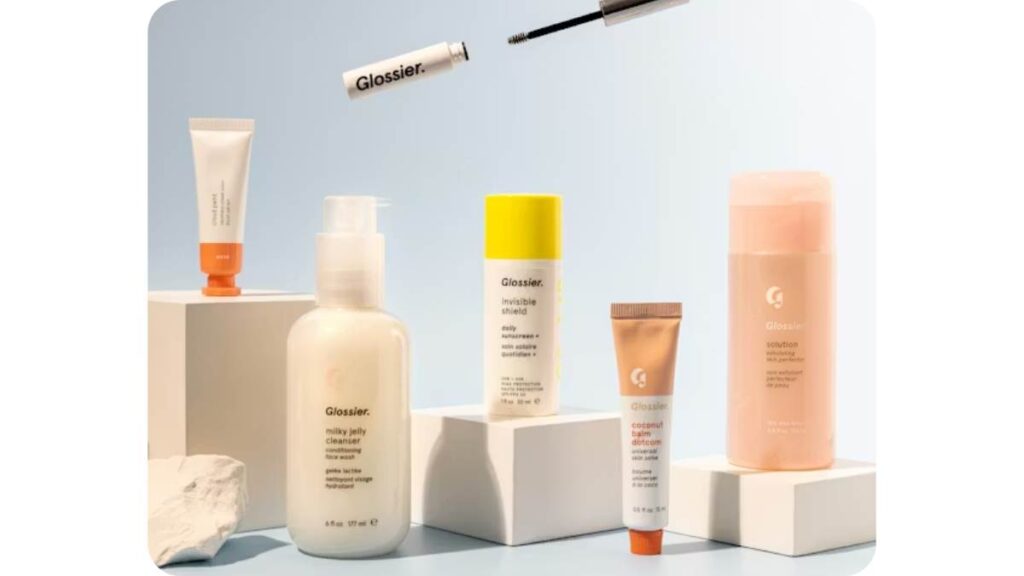
In October 2014, after raising $10.4 million in combined seed and Series A funding, Weiss launched Glossier.com. Four products: a moisturizer, a face mist, a skin tint, and a lip balm. Prices ran from $12 to $26, deliberately positioned above drugstore but below prestige.
The launch was announced in a blog post on Into the Gloss. Not a press release. Not a campaign. A blog post, written in first person, addressed directly to the community that had spent four years building the thing alongside her.
She wrote: “Glossier begins with YOU.”
It read as genuine because it was. The people reading that post had literally contributed to the product decisions being made. Of course it landed.
Fundraising, Rejection, and the Road to Unicorn Status
The fundraising story is worth knowing because it adds context. Weiss pitched 12 firms before getting a single interested investor. Eleven passed. Several told her they’d take the sample products home to their wives to review, a line that tells you everything about how seriously the beauty category was being taken by the VC world at the time.
Kirsten Green at Forerunner Ventures was the one who said yes first, alongside Lerer Hippeau Ventures. The early check was small. From there, the funding rounds moved fast:
- Series A (2014): $8.4 million, led by Thrive Capital
- Series B (2016): $24 million, led by IVP (Source: headwestguide.com)
- Series C (2018): $52 million, the same year Glossier crossed $100 million in annual revenue and added over one million new customers (Source: Emily Weiss Wikipedia)
- Series D (2019): $100 million, led by Sequoia Capital, $1.2 billion valuation, unicorn status
- Series E (2021): $1.8 billion valuation
(Sources: Wikipedia , Glossier; Emily Weiss Wikipedia; headwestguide.com)
The 2018 numbers are worth pausing on. In a single year, the company crossed nine figures in revenue and added a million customers. That’s not organic growth that just happened. That’s the result of a marketing system that was running well.
Glossier’s Business Model: What Actually Made It Work
The DTC Advantage, and What It Really Meant
For most of its first decade, Glossier sold exclusively through its own website. No Sephora. No Ulta. No retail partners of any kind. That was a choice, and it wasn’t just ideological; it had real commercial logic behind it.
When you sell direct, you keep more margin. You also own the customer relationship completely. Every purchase tells you something. Every abandoned cart tells you something. Every email open rate, every repeat order, every product that gets bought alongside something else, all of it feeds back into how you build and market the next thing.
Traditional beauty brands selling through department stores and retailers didn’t have that. They had sales data, eventually, but they didn’t have the customer. Glossier had the customer. In 2024, glossier.com alone generated US$134 million in revenue, even after the brand had moved into wholesale.
That’s how sticky the direct channel stayed.
“Skin First. Makeup Second.” A Philosophy, Not a Tagline
This line showed up in a 2019 Instagram post, but it had been the operating principle since day one. Glossier’s products don’t cover skin. They don’t transform it. They enhance what’s there, dewier, softer, a bit more alive.
It sounds obvious now, but in 2014, it genuinely wasn’t the dominant message in beauty. Most brands were selling transformation. Glossier was selling permission to just look like yourself.
That’s a meaningful difference, and it ran all the way through the product design, the campaign imagery, the models they chose, and the copy they wrote. Nothing was about fixing a flaw. It was all about amplifying what was already there. That coherence is actually hard to maintain as a brand scales. Glossier maintained it for a long time.
How Glossier Built Products from Conversations, Not Labs
This is probably the most instructive part of the business model for anyone trying to build something today.
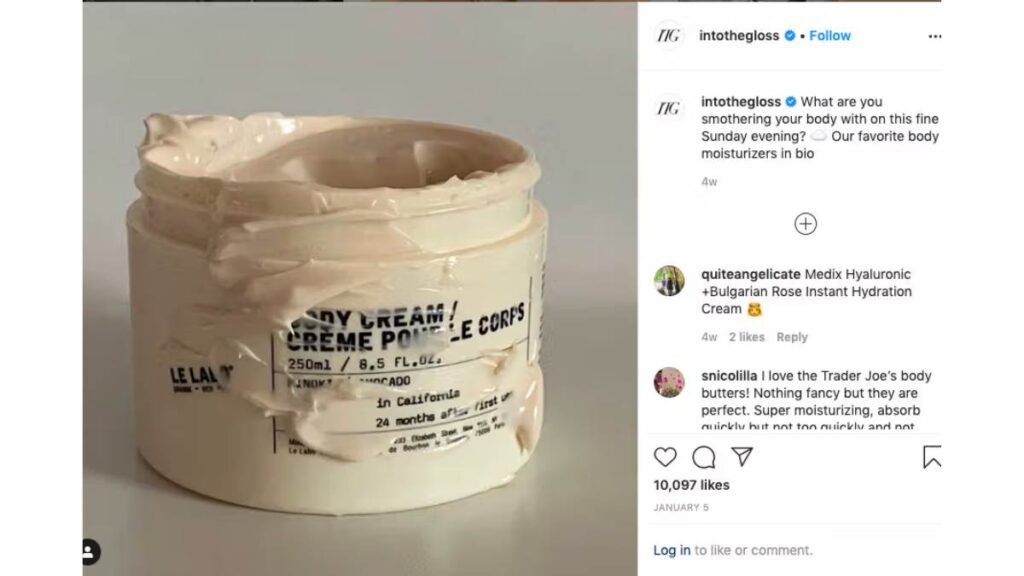
Boy Brow, Glossier’s best-selling eyebrow gel, one of the most talked-about products in modern beauty, came directly from the Into the Gloss comment section. Weiss and her team kept seeing the same request: a product that makes brows look natural and fluffy, not stiff or waxy. They built exactly that. It became a cult product.
The Milky Jelly Cleanser followed the same path. Community members described what they wanted: gentle, effective, something that didn’t strip the skin, in enough detail that the product brief basically wrote itself. Typical sourcing posts on Into the Gloss pulled 300+ substantive comments.
And when Glossier updated its Balm Dotcom in 2023 with a new formula and applicator, customers pushed back hard. They preferred the original. By May 2024, Glossier had re-released the old version.
Most brands would have stayed the course and hoped customers would adapt. Glossier reversed course because the community told them to. That’s either a sign of strong customer orientation or a brand that’s built its identity so thoroughly around listening that ignoring feedback feels like a betrayal. Probably both.

Enroll Now: Advanced Digital Marketing Course
The Glossier Marketing Strategy: Breaking Down the Community Playbook
This is the section that makes people want to start taking notes. Let’s go through it properly.
Word-of-Mouth as the Primary Growth Engine
Here’s the number that tends to stop people mid-sentence: 70% of Glossier’s online sales and traffic come from peer referrals. And approximately 80% of Glossier’s customers were referred by a friend.
For context, most consumer brands would celebrate if word-of-mouth drove 20% of their acquisition. Glossier built an entire company that drove nearly all of it.
This didn’t happen because Glossier asked people to refer friends. It happened because people genuinely wanted to. The brand had made them feel like insiders, like co-creators, like the whole thing was partly theirs. When something feels like yours, you talk about it differently. You’re not recommending a product. You’re sharing something you feel connected to.
That’s the actual engine. Everything else, the UGC, the ambassador program, the Instagram strategy, is infrastructure built on top of that emotional connection.
The UGC Flywheel, How It Actually Runs
A lot of brands talk about UGC like it’s a content strategy. For Glossier, it was closer to a distribution model.
Here’s the loop, as it actually worked:
Glossier shipped products with customizable stickers in every order. Small thing. Enormous impact, because customers immediately had a reason to photograph the package, decorate it, and post about it. The products themselves were designed to be photogenic: the packaging clean and minimal, the colors soft and instantly recognizable.
Customers posted. Glossier reposted, real people, real skin, real routines, on an Instagram account that by this point had over 3 million followers. Those reposts weren’t just gratifying for the person who got featured. They signaled to everyone else that this brand actually sees its customers. That’s paying attention.
The best creators in that loop got invited into the ambassador program. And the cycle ran again, bigger.
Studies put consumer trust in UGC at 79% when making purchase decisions. Glossier didn’t just understand that stat; they built a system around it.
Instagram: Community Channel, Not Broadcast Channel
There’s a way a lot of brands use Instagram that feels like a billboard. Post a product. Add a caption. Repeat. Glossier never really did that.
The feed was built around real people, diverse models, everyday customers, actual skin with freckles and texture, and personality. The visual language stayed consistent: soft pinks, natural light, minimal makeup. But it never felt like a catalog. It felt like scrolling through a friend’s camera roll, if that friend happened to have excellent taste.
Each platform has its own role in the content system. TikTok for discovery, routine demos, first impressions, the kind of content that surfaces a product to someone who’s never heard of the brand. Instagram for community, UGC reposts, ambassador stories, and real feedback loops. Into the Gloss for depth, long-form content, interviews, the stuff that earns trust over time.
That’s not a social media strategy. That’s a media company approach applied to a beauty brand.
Generation Glossier: The Ambassador Program That Scaled Word-of-Mouth
Glossier’s ambassador program, Generation Glossier, is the practical infrastructure behind all those peer referral numbers.
The mechanic is straightforward: existing customers who create good content and have genuine enthusiasm for the brand can apply to become ambassadors. Once accepted, they get a unique promo code and earn commission on every sale it drives. No scripts. No rigid content requirements. Just a code, some product, and the expectation that they’ll talk about it honestly.
8% of Glossier’s online sales link directly to Instagram ambassador activity specifically.
What makes this work, and what separates it from a standard affiliate program, is the selection. Glossier wasn’t recruiting influencers. It was identifying its most genuine fans and formalizing a relationship that already existed. Those people weren’t showing enthusiasm. They already had it.
The brand leaned heavily on micro and nano creators, people with 10,000 to 100,000 followers, because the engagement rates and trust levels in those audiences tend to be significantly higher than with macro influencers. Reach matters less than resonance when your growth model runs on peer referral.
The Olivia Rodrigo Partnership, Why It Worked When Most Celebrity Deals Don’t
In April 2022, Glossier signed Olivia Rodrigo as its first celebrity brand ambassador. For a brand that had built its identity around “real people, not celebrities,” this felt like a risk.
It worked because Rodrigo wasn’t a hired spokesperson. She was already a customer. She’d used Glossier products on red carpets. She’d featured them in her 2022 “Vogue Beauty Secrets” video and said, unprompted: “Less is more with skincare and makeup a lot of the time.” That sentence could have been written by Glossier’s brand team. It wasn’t.
The collaboration pulled over 2 million views across Glossier’s YouTube channel and strengthened the brand’s connection with Gen Z without making it feel like a pivot. The difference between this and a typical celebrity deal is the authenticity that pre-existed the contract. That’s not something you can engineer. It’s something you have to recognize and move on.
Into the Gloss as a Content Engine with Real Compounding Value
Content marketing as a concept gets thrown around a lot. Glossier’s version of it was different in one important way: it started four years before the product did.
Into the Gloss had 2–3 million monthly unique visitors before a single Glossier product existed. That community had been in conversation for years about what they wanted, what wasn’t working, what ingredients they trusted, and what they were willing to pay for. By the time Glossier launched, it already knew its customers better than those customers knew themselves.
That’s a compounding advantage. You can’t buy it. You can only build it, slowly, by creating something people genuinely want to come back to.
Even after Glossier became a billion-dollar company, Into the Gloss kept running, with interviews, tutorials, and long-form beauty content, keeping the brand grounded in the community that built it.
From DTC to Omnichannel: The Retail Expansion
Physical Stores as Brand Experiences
Glossier’s approach to physical retail was never about volume. It was about making the brand feel like a place, not just a product.
The first permanent store opened in New York in December 2016. Millennial pink walls. Selfie rooms. Product testers for everything. Staff who felt more like friendly guides than salespeople. It wasn’t designed to maximize transactions per hour. It was designed to be worth talking about and photographing, which in turn fed directly back into the UGC engine.
Before that flagship, Glossier had used pop-up shops to test markets where their online community was already strong. They’d look at where the web traffic was concentrated and open a temporary space there before committing to anything permanent. Smart use of data. Minimal risk.
The Sephora Partnership in 2023: A Smart Pivot or a Compromise?
When Glossier announced a retail partnership with Sephora in July 2022, the reaction was mixed. For a brand that had defined itself by not selling through retailers, this was a real shift.
The numbers explained it clearly enough. Searches for Glossier’s availability at Sephora grew 200% between 2021 and 2022. Customers were already looking for it there. The brand wasn’t being dragged into retail; it was following demand.
Starting February 2023, Glossier launched across more than 600 Sephora locations in North America, plus the Sephora website and app. The wholesale channel added reach that pure DTC couldn’t replicate, especially for new customer acquisition, sampling, and markets where Glossier had no physical presence. (Sources: Latterly.org)
Was it a compromise? Partly. Part of what made Glossier feel special was that you had to seek it out. That changes when it’s on a Sephora shelf next to 40 other brands. But growth requires trade-offs, and the DTC channel stayed intact for the customers who wanted the original experience.
Where Glossier Stumbled: Failures and Real Criticism
Glossier Play: The Sub-Brand That Missed the Point
In March 2019, literally the same month Glossier hit unicorn status, the company launched Glossier Play. Bold colors. Glitter gel. Graphic liner. Vivid lip gloss. The whole thing was a departure from everything the brand stood for.
Customers rejected it quickly, not with hostility, just with indifference. The products didn’t fit the mental model people had of Glossier. The brand’s entire equity was built on “natural, effortless, barely there.” Play was the opposite. And no amount of branding could bridge that gap. (Source: headwestguide.com)
It was shut down within a year. The lesson is clear: brand equity has a shape. When you try to stretch it into a shape it doesn’t fit, the stretch fails. It doesn’t matter how good the products are.
Layoffs, Leadership Exits, and Store Closures
The years after the 2021 peak were genuinely rough. In early 2022, Glossier laid off over 80 employees, mostly from its tech team, after a push to turn the brand into a social commerce platform didn’t materialize.
Emily Weiss stepped down as CEO in May 2022. Kyle Leahy took over. As of October 2025, Colin Walsh holds the CEO role. (Source: Wikipedia, Glossier)
In February 2026, another round of layoffs cut approximately 54 employees, around a third of the total workforce, as part of a profitability reset. And in March 2026, the company announced that nine of its twelve retail stores would close over the following two and a half years, leaving only New York, Los Angeles, and London. (Source: Wikipedia, Glossier)
None of this erases what the brand built. But it’s a real reminder that even exceptional brand equity doesn’t protect a business from operational problems. Community trust and financial sustainability are different things. Glossier built the first one better than almost anyone. The second one proved harder.
Lessons Worth Stealing from the Glossier Case Study
Five things that actually transfer to other brands and contexts:
1. The community comes before the product. Weiss had four years of ongoing community conversation before she launched a product. Most brands build the product first and then try to find a community. Glossier flipped that order, and it made everything easier downstream.
2. Listening is a business model, not a marketing tactic. Product co-creation through community feedback wasn’t a campaign Glossier ran. It was how the company operated. Boy Brow, Milky Jelly Cleanser, the Balm Dotcom rollback, all of it traces back to taking customer input seriously enough to act on it.
3. UGC scales what ads can’t. 79% of consumers trust UGC more than brand content. 70% of Glossier’s sales came through peer referral. When real people talk about your product because they genuinely like it, that outperforms paid media, in cost efficiency and in credibility.
4. Positioning has a shape. Don’t stretch it past its limits. Glossier Play failed because it lived outside the shape of the Glossier brand. The lesson isn’t “never extend.” It’s “know your limits before you test them.”
5. Platform-specific content isn’t optional. TikTok for discovery, Instagram for community, long-form for depth. Glossier didn’t treat these as the same channel with different aspect ratios. They had genuinely different content strategies for each. That’s the right approach, and most brands still aren’t doing it.
Conclusion
Here’s what the Glossier case study really comes down to: a woman who paid attention.
Emily Weiss spent four years in her subjects’ bathrooms, reading comment sections, and writing down what people actually wanted from beauty, before she ever made a product. That’s not a marketing strategy. That’s a founder who was genuinely curious about the people she was building for.
The company that came out of that is legitimately remarkable. A $1.8 billion valuation. 70% of sales through peer referral. A product development process that turned community comments into cult bestsellers. A brand aesthetic so consistent and recognizable that a single soft pink package is enough to communicate everything the brand stands for.
And yes, there were real failures. Glossier Play was a clear misstep. The 2022 layoffs stung. The store closures in 2026 are a sign of ongoing pressure that hasn’t fully resolved. The brand that reaches this level of love from customers doesn’t always translate that into sustainable financials. That’s a real, honest part of the story.
But for anyone trying to understand how to build a brand that people actually care about, not just buy from, but care about, the Glossier playbook holds up. Start with the customer. Build what they’re actually asking for. Make them feel like the brand is theirs. And then keep asking.
That loop, done well, is what turned a beauty blog into a billion-dollar company. It can work at a lot of different scales, in a lot of different categories. The principles don’t really expire
FAQs: Glossier Case Study
What is the Glossier case study about?
The Glossier case study traces how Emily Weiss took a beauty blog called Into the Gloss and turned it into a $1.8 billion brand. It covers the DTC business model, the community-led marketing strategy that drove nearly 80% of customers through peer referral, the product co-creation process, the Sephora pivot, and the real failures alongside the successes, all with lessons that apply well beyond the beauty industry.
Who founded Glossier, and when was it launched?
Emily Weiss founded Glossier and officially launched it in October 2014. Before that, she spent four years building Into the Gloss, a beauty blog that reached 2–3 million monthly unique visitors and served as both the audience and the research base for the brand. Weiss ran Glossier as CEO until May 2022, when she stepped down to become executive chairwoman.
What was Glossier’s peak valuation?
Glossier peaked at a $1.8 billion valuation following its Series E round in 2021. It had first hit unicorn status two years earlier, in 2019, when a $100 million Series D led by Sequoia Capital put the valuation at $1.2 billion. At the time, it was one of the more striking examples of a consumer brand built almost entirely on community and word-of-mouth reaching that kind of investor confidence.
What is Glossier’s core marketing strategy?
Glossier’s marketing runs on community. Around 70% of its online sales came through peer referrals, and roughly 80% of customers were referred by a friend rather than acquired through paid advertising. The brand built that through user-generated content, a micro-influencer ambassador program called Generation Glossier, consistent social media storytelling, and a product development process that made customers feel like co-creators, not just buyers.
What does “Skin First. Makeup Second.” actually mean for the brand?
It’s the clearest expression of Glossier’s product philosophy: the goal isn’t to transform or cover the face, but to enhance what’s already there. That principle shaped every product decision, including lighter formulas, natural finishes, and skincare-first ingredients. It also positioned the brand against the heavy-coverage, heavily-contoured aesthetic that dominated beauty at the time, which turned out to be a very well-timed counter-positioning.
What is Generation Glossier?
Generation Glossier is the brand’s affiliate and ambassador program. Existing customers and smaller content creators can apply to join, and once accepted, they receive a unique promo code and earn commission on sales they drive. The program is specifically designed around real fans rather than large-scale influencers, which is why it works. 8% of Glossier’s online sales were directly tied to Instagram ambassador activity alone, which is a significant number for what is essentially a formalized word-of-mouth program.
Why did Glossier decide to partner with Sephora in 2023?
Largely because the demand was already there. Searches for Glossier at Sephora grew by 200% between 2021 and 2022. The brand wasn’t pushed into retail; it followed where its customers were already looking. From February 2023, Glossier launched across 600+ Sephora locations in North America, giving it reach into markets and customer segments that the DTC model alone couldn’t access efficiently. The owned DTC channel stayed active alongside it.
What was Glossier Play, and why did it fail?
Glossier Play launched in March 2019 as a separate makeup sub-brand with bold colors, glitter, and graphic looks. Completely different from Glossier’s established identity. Customers didn’t go for it. The brand’s entire equity was built around natural, effortless, “your face but better” aesthetics. Play was the opposite, and it never found its footing. Glossier shut it down within a year. It’s a useful case study in brand extension limits; the product wasn’t necessarily bad; it just didn’t fit the shape of what Glossier meant to people.
How did Into the Gloss actually feed into Glossier’s success?
In the most direct way possible. By the time Glossier launched, Into the Gloss had years of detailed community conversation about what people wanted, what wasn’t working, and what they’d pay for. Product sourcing posts regularly got 300+ substantive comments. Boy Brow, Milky Jelly Cleanser, and several other bestsellers came directly from those discussions. Eric Liaw from IVP called it “a market research goldmine”, but more accurately, it was an ongoing R&D process that happened in public, for free.
Which Glossier products became genuine cult favorites?
Boy Brow is probably the most cited, an eyebrow gel that came directly from community feedback and became one of the most talked-about beauty products of the decade. Balm Dotcom, Cloud Paint blush, Milky Jelly Cleanser, and Futuredew also built strong followings. What these products share is that they all fit the brand philosophy cleanly: simple, effective, enhancing rather than covering. That consistency across the product line reinforced the overall brand identity in a way that’s harder to achieve than it sounds.
How does Glossier’s UGC strategy actually work?
It runs as a loop. Products ship with customizable stickers that make packaging worth photographing. Customers post. Glossier reposts to its 3 million+ Instagram followers, giving real customers a moment of visibility that makes others want the same. The best creators get invited into the ambassador program, and the cycle repeats at higher volume. The brand also runs weekly “Top 5” Instagram Stories specifically highlighting customer content. The whole system reinforces one message consistently: this brand is for real people, not just polished ones.
What were Glossier’s revenue figures?
Glossier crossed $100 million in annual revenue in 2018, the same year it added over a million new customers. Post-2018 figures haven’t been publicly disclosed. Analyst estimates for 2024 place total revenue somewhere between $250 million and $360 million, with glossier.com alone contributing approximately $134 million of that. The range in analyst estimates reflects the fact that the company hasn’t released detailed financials, which is common for privately held brands at this stage.
What made the Olivia Rodrigo partnership different from a typical celebrity deal?
The key difference was that she was already a genuine customer before any contract existed. Rodrigo had used Glossier products on red carpets and mentioned them unprompted in her 2022 Vogue Beauty Secrets video. When she said, “Less is more with skincare and makeup a lot of the time,” she was describing Glossier’s entire brand philosophy without prompting. The collaboration generated 2 million+ views on Glossier’s YouTube channel and landed well with Gen Z specifically because it didn’t feel manufactured, because, largely, it wasn’t.
What happened at Glossier in 2022?
A lot. Early in the year, the brand laid off more than 80 employees, mostly from the tech team, after a push to become a social commerce platform didn’t work out. Emily Weiss stepped down as CEO in May. Kyle Leahy came in as her replacement. And the brand also announced its first-ever wholesale partnership with Sephora, ending its decade-long DTC-only model. It was a year of meaningful strategic reset, not just personnel changes.
What are the most transferable lessons from the Glossier case study?
The ones that hold up across industries: build the community before you build the product if you can; treat customer feedback as R&D, not just customer service; design your UGC system deliberately rather than hoping it happens organically; know the shape of your brand positioning before you try to extend it; and treat each platform as its own thing rather than a copy-paste of your main channel. None of these is complicated. All of them take real discipline to actually execute.