

Timing an ad campaign feels like one of those things you should be able to figure out logically, just run ads when people are buying, right? But in practice, media scheduling is more layered than that, and most brands are winging it more than they’d admit.
This guide is a real breakdown of media scheduling strategies, the three core models, how to pick between them, what changed when everything went digital, and where brands consistently trip up. You’ll find verified data, a proper Coca-Cola case study, and 15 FAQs at the end covering whatever’s still unclear. The keyword holding everything together: media scheduling strategies. Specifically, how to use them so your budget does actual work instead of quietly disappearing into the wrong moments.
Table of Contents
Introduction
Why Campaign Timing Gets Ignored Until It’s Too Late
Most post-campaign debriefs go something like this: the creative was fine, targeting was decent, budget was approved, and the results were still underwhelming. So the team adjusts the creative. Runs A/B tests. Tightens the targeting. Tries again. Same results, roughly.
What almost nobody checks is the schedule.
Not because media planners are lazy. More because timing decisions feel operational, they get made in the logistics layer of a campaign, not the strategy layer. Someone has to pick start and end dates, weight the spend somehow across the calendar, and that’s usually done fast, usually based on habit, usually informed by last quarter’s plan.
In this market, you are guaranteed to be competing against brands that are spending at higher volumes than you. The only way to neutralise a budget gap is through smarter execution, and scheduling is one of the highest-leverage places where execution either compounds or wastes everything else you’ve done. A technically well-made ad delivered in the wrong window, at the wrong frequency, to people who aren’t thinking about that category right now, just disappears. No trace. You paid for the impression and got nothing back.
That’s what this guide is about. Not scheduling in the administrative sense. Scheduling as an actual strategy.
What Media Scheduling Strategies Actually Are
There’s a version of this definition that gets passed around in marketing textbooks: media scheduling is the planned timing and placement of advertisements across various media channels. True. Also not particularly useful.
Here’s a more honest version: a media schedule is the document that answers, specifically and defensibly, when your ads run, how often they appear in front of the same person, and how long the campaign maintains presence before pulling back. Every one of those decisions has budget consequences, awareness consequences, and audience relationship consequences. Getting them right requires more than filling in a calendar.
Before getting into the three main strategies, two frameworks are worth understanding properly because they underpin almost every scheduling choice.
The RFC Framework, Reach, Frequency, Continuity
These three terms are genuinely foundational, though they get reduced to jargon so often that people stop thinking carefully about what they mean.
Reach is the count of unique people exposed to your message at least once during a given period. Wide reach means more new people encountering the brand. It’s the expansion metric, especially important when you’re building initial awareness or entering new markets.
Frequency is how many times the same person sees your ad. This is where memory formation actually happens. A single exposure rarely sticks; research on advertising recall has consistently shown that repetition is necessary. But here’s the problem nobody says out loud: too much repetition creates wearout. The audience that engaged with impression three is actively ignoring you by impression fifteen. The point of diminishing returns is real, and it varies by category, by creative, and by platform.
Continuity is the temporal pattern, whether your campaign runs steadily, in bursts, or in some combination of the two. This is where the three scheduling strategies actually differentiate from each other.
A reasonable way to think about the relationship between all three: reach is the door, frequency is the knock, and continuity is how long you stay on that street. Every scheduling decision you make is, at root, a negotiation between these three. Push reach and frequency drops per person. Sustain continuity across 52 weeks, and the per-week impact might be too diluted to register. There’s no setting where you max out all three simultaneously.
Macro vs. Micro Scheduling, Two Layers That Both Matter
Macro-scheduling is the broad picture. Seasonal budget distribution. Which months carry weight and which go lighter? How the annual campaign calendar maps to business cycles, product demand, and major cultural moments.
Micro-scheduling is the tactical layer inside those periods. Which hours of the day? Which days of the week? Which specific placements or dayparts within a channel?
Here’s why both levels matter: a campaign can be completely right at the macro level, advertising during the correct season, and still underperform because the micro-scheduling is sloppy. Running an ad at 3 AM when your audience is asleep. Front-loading Friday spend when purchase decisions happen Monday through Wednesday. Concentrating the budget in a week when your audience is least active, based on their own platform behaviour data.
The macro gets you in the right months. The micro determines whether you’re in the right moments.
The Three Core Media Scheduling Strategies
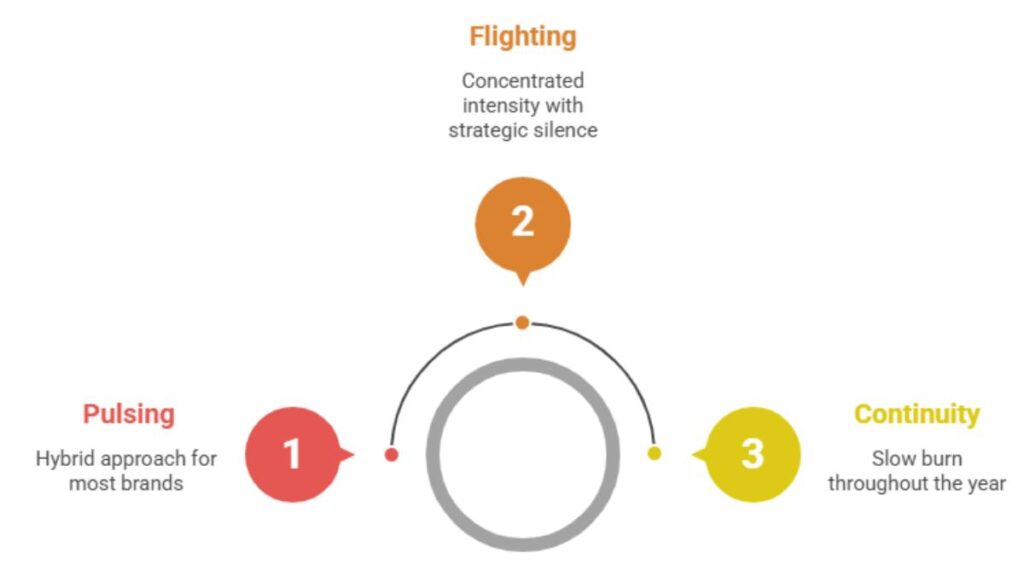
These three models have been in media planning since before digital advertising existed. They were developed for television, radio, and print. They still apply, sometimes without any modification at all, to digital channels. The underlying logic hasn’t aged because the underlying logic is about human behaviour and budget mechanics, not about any particular medium.
Continuity Scheduling, Slow Burn, All Year
A continuous schedule holds advertising at a stable, consistent level across the full year. No dramatic peaks. No dark periods. One ad per week for 52 weeks, or one placement per month, every month. The drumbeat that never stops.
Who actually uses this, and why: continuity scheduling works for products where purchase decisions happen across the calendar with no meaningful seasonal clustering. Toothpaste. Mobile data plans. Packaged foods. Banking apps. Products that someone might buy on any random Tuesday.
For these categories, the risk of going dark, even temporarily, is real. The moment a consumer enters the buying cycle for your category, you want to be the brand they remember. If you went dark last month, you might not be.
There’s also an argument that continuous presence builds a kind of baseline brand salience that compounds over time. Not dramatic top-of-mind awareness, more like the brand being reliably, consistently there whenever the category becomes relevant.
The practical ceiling: continuity is expensive. Genuinely expensive. To maintain meaningful frequency, not just token impressions, but enough exposures per person to actually drive recall, across all 52 weeks, requires a budget that most mid-sized brands don’t have. This is worth saying plainly because it’s where a lot of plans fall apart. A “continuous” schedule on a budget that can’t sustain real frequency is just thinly spread spending that doesn’t land anywhere. In that situation, concentrated alternatives almost always outperform.
Flighting (Bursting), Concentrated Intensity, Strategic Silence
Flighting is the opposite disposition. Instead of spreading across the year, the budget concentrates on specific campaign windows, a few weeks or months, at higher intensity. Between those flights: nothing. Complete dark periods.
The categories where flight makes intuitive sense: seasonal products. Monsoon raincoats. Summer air conditioners. Festive gifting items. Products where the off-season purchase intent is genuinely near zero, so advertising during that period isn’t investing, it’s wasting.
Flighting also works for event-driven campaigns, specific product launch windows, or any situation where purchase consideration is compressed into a predictable calendar window that the brand knows in advance.
What flighting gets right is efficiency. The budget lands when the category is hot. No spend bleeds into periods when the audience isn’t thinking about buying. During the flight period, the brand can punch above its weight, running at a frequency level that continuous scheduling at the same annual budget couldn’t sustain.
There’s an interesting academic angle on this. A study published in Marketing Science (Naik, P.A., Marketing Science Institute Grant 4-1959) found that during media hiatus, the dark periods between flights, audiences partially forget the ads they’ve seen. Which sounds like a problem. But it’s actually an argument for flighting, because when the campaign relaunches, the ad feels fresher to people who’ve seen it before. The wearout gets reset. Pulsing and flighting can, under the right conditions, generate greater total awareness than the same budget spent continuously, precisely because of this forgetting-and-refreshing dynamic.
The real risk: competitors who maintain presence during your dark periods can fill the awareness gap you’ve created. How much that matters depends on competitive intensity and category dynamics. In some categories, going dark for three months means coming back to a slightly colder audience. In others, it means coming back to an audience your main competitor has been talking to the whole time you were absent.
Pulsing, The Hybrid Most Brands Should Default To
Pulsing maintains a low-level continuous baseline throughout the year and layers heavier bursts on top of it during peak periods. It’s the middle path, and for most mid-sized brands with year-round products that still experience seasonal demand spikes, it’s also the most practical and defensible strategy.
Picture any beverage brand. People drink their product in January. Not a lot, but some. Consumption climbs in summer. Spikes around major cricket tournaments, Diwali, and New Year’s Eve. A pulsing approach means a thin but persistent presence through January and February, enough to stay technically visible, then a materially heavier investment starting in March through the peak months and around the key festive windows.
The baseline protects against going completely dark. The bursts deliver the intensity that actually moves purchase intent during high-demand windows. You get the efficiency of flighting (concentrated spend where demand peaks) without the brand-salience risk of going fully dark between peaks.
A Content Marketing Institute study found 83% of successful marketers use scheduling and automation tools, and part of what that number reflects is how seriously brands now take the operational discipline of scheduling, not just the strategic intent. A pulsing strategy requires more planning infrastructure than flighting or continuity because it’s managing two modes simultaneously: the maintenance mode and the burst mode. They often need different creative, different media mix, different performance benchmarks.The honest planning reality: pulsing is harder to execute well than the other two. The complexity is worth it, but it has to be planned for, not just declared.
The Six Pulse Sub-Types, Because Pulsing Isn’t One-Size-Fits-All
Within the broad pulsing framework, media planners work with six more specific scheduling patterns. Knowing which one maps to your actual situation is the difference between a plan that’s generally right and one that’s actually calibrated.
Steady Pulse: The simplest version, one ad per week for 52 weeks, consistent throughout. No seasonal adjustment. Works for products with truly flat year-round demand and no meaningful competitive pressure to spike during specific periods.
Seasonal Pulse: Advertising concentrates on the season where the product is most relevant. Thin or no presence during the off-season. Different from full flight in that some digital touchpoints usually remain live even in the off-season, a social presence, some search coverage, but the main campaign weight arrives with the season.
Period Pulse: Regular campaign intervals that aren’t season-driven. A monthly promotional push. A quarterly brand campaign. Common in subscription businesses, B2B marketing, and financial services, where the purchase cycle follows business schedules rather than consumer seasons.
Erratic Pulse: Intentionally irregular scheduling designed to disrupt audience habituation. When consumers have grown too comfortable predicting when a brand will advertise, and are therefore tuning it out, changing the timing can restore attention. A niche tactic, but a real one.
Start-Up Pulse: The pattern for new product launches. Front-loaded, heavy, concentrated. The first few weeks carry disproportionate spend because there’s no existing awareness to build from, reach is the priority, fast. Once the launch window closes, the schedule typically shifts toward one of the other pulse types based on how demand patterns emerge.
Promotional Pulse: Short, intense campaigns tied to a specific event, offer, or limited release. A flash sale. A product collab. A new collection drop. High frequency in a compressed window, then the campaign closes. No maintenance phase necessary; this is a one-off.
Actually, Choosing the Right Strategy, The Decision Framework
The most common reason brands end up with the wrong scheduling strategy is that nobody explicitly chose one. The schedule was a derivative of when the budget was approved and when the campaign needed to launch, not a deliberate strategic choice. That’s worth naming because it explains why the same average-performing schedule repeats year after year.
Here’s how to actually think through the choice:
Start with demand cycle honesty. Not what the product could sell year-round, but what it actually sells and when. Pull the sales data by month. Look at seasonality. That data should determine the macro-scheduling shape before any other consideration.
Think through the product lifecycle stage. New product in market: start-up pulse almost certainly. Mature product with stable awareness: continuity or light pulsing probably sufficient, heavy bursts around key retail moments. Product facing competitive encroachment: may need to shift from continuity to more concentrated competitive flight during windows where the competitor is aggressive.
Be honest about what the budget can actually sustain. This is the uncomfortable conversation most planning sessions avoid. A “continuous” schedule on an insufficient budget produces impressions that are too thin to register. Say it plainly: if we spread this budget over 12 months, what does weekly frequency actually look like? If the answer is low, the schedule needs to be compressed.
Factor competitive behaviour. Programmatic advertising now represents roughly 90% of display ad transactions, meaning competitor spend is visible in platforms in near real-time. If a competitor consistently goes dark during Q1, maintaining even a modest presence during that window can capture a disproportionate share of mind at a fraction of the cost of competing head-on in Q3 when everyone is spending.
Check audience timing data before locking the micro-schedule. Global internet users spend an average of 141 minutes per day on social media as of 2025. But that’s a global average. Your audience might cluster heavily on weekday evenings, on weekend mornings, or during their commute. The micro-schedule should be built on actual platform analytics for your specific audience, not industry-average benchmarks.
Case Study: Coca-Cola’s Pulsing Strategy
Coca-Cola gets cited in almost every media scheduling article. Usually, it’s a single line: they pulse heavily at Christmas. That’s true, but it misses most of what makes the strategy work.
The brand maintains a genuine year-round presence. It’s never fully absent. Across OOH, digital, and broadcast markets, there’s always some baseline, enough to keep the brand in peripheral awareness for the category buyer who’s not actively thinking about cold drinks right now but might be next week.
On top of that baseline, specific cultural moments trigger concentrated campaign bursts. In India, the IPL season is a significant one, with high cricket viewership, high social occasion frequency, high consumption. Diwali triggers another burst, calibrated to the festive gifting and social gathering context. Globally, the Christmas campaign, a version of which has run since 1931, is probably the most recognisable annual pulse in advertising history.
Here’s the part worth paying attention to: the bursts are not just mechanically heavier than the baseline. They’re calibrated to the context of the moment they’re running in. The IPL campaign doesn’t use Christmas imagery. The Diwali campaign doesn’t reference summer heat. Each burst fits the cultural moment precisely, which is why the intensity of those periods feels natural to audiences rather than intrusive.
The lesson for brands operating at a much smaller scale is that the pulsing model works regardless of budget size. A regional food brand can maintain a thin but consistent digital presence most of the year and go noticeably heavier around Navratri, Eid, harvest season, or the back-to-school period, depending on product and region. The framework scales down. What doesn’t scale down is doing it carelessly: if the burst period creative doesn’t match the cultural moment, the extra spend doesn’t compound, it just costs more.
Digital Changes the Execution, Not the Logic
The three-model framework predates the Internet by several decades. It maps directly to digital environments, though the execution layer looks meaningfully different.
The biggest structural change: traditional media schedules are fixed at the point of booking. A TV flight that runs in October can’t be adjusted in week three because performance data suggested otherwise. Digital campaigns can be adjusted continuously, in real time, based on live performance signals.
Programmatic advertising now represents roughly 90% of all display ad transactions. Those platforms don’t just automate buying; they enable the kind of in-flight schedule adjustment that traditional planning couldn’t support. Underperforming placements lose budget automatically. High-intent windows get weighted more heavily as the algorithm learns. The schedule becomes dynamic in a way that increases efficiency over the campaign’s run.
Dayparting is the micro-scheduling tool most brands underuse. The principle: restrict ad delivery to windows when the audience is most receptive. A B2B platform concentrates LinkedIn spend Tuesday through Thursday during business hours, that’s when decision-makers are desk-adjacent and professionally minded. A food delivery app runs hard from 6 PM to 9 PM, that’s when hunger and indecision peak. A financial services brand might find Sunday evenings outperform everything else because that’s when people reflect on their week and think about their future.
These aren’t assumptions. They come from platform analytics. The data exists; most campaigns just don’t use it.
Frequency capping is now non-negotiable. Traditional media couldn’t limit how many times the same person saw the same ad. Digital can. Running without frequency caps on digital channels means some users will see a campaign 20 or 25 times in a single week. That accumulation drives costs up, and brand sentiment down. The audience that would have converted on impression 5 is now actively irritated by impression 18. Setting sensible caps (typically 3–5 impressions per person per week for awareness campaigns, slightly higher for conversion-focused retargeting) is basic scheduling hygiene.
Retargeting operates on a different scheduling logic. Users who’ve already visited a site, watched a video to completion, or added a product to cart are not in the awareness phase. They’re in the consideration-to-conversion phase. The scheduling approach for this segment should concentrate frequency within a defined post-visit window, usually 7 to 14 days for most categories, then pull back sharply. Retargeting someone three months after they visited the site, with no subsequent interaction, is almost always wasted spend.
The Scheduling Mistakes That Keep Coming Up
These show up across brand sizes and budget levels. Worth naming plainly.
Spreading the budget too thin across too many channels. Running a continuous schedule across five or six channels simultaneously often produces a presence too light to matter on any of them. Concentration beats dispersion, especially when the budget is limited. Strong presence on two channels almost always outperforms a weak presence on six.
Scheduling around internal convenience rather than audience behaviour. Campaigns that launch in January because that’s when the budget is released, or peak in Q3 because that’s when the planning cycle peaks, rather than because that’s when the target audience is in a buying mindset, this is extremely common and extremely costly.
Applying identical scheduling logic across different channels. A television flight strategy and a social media flight strategy for the same campaign should not look the same. Audience interaction patterns differ, platform algorithms differ, and creative consumption differs. The scheduling logic needs to reflect those differences rather than treating all channels as interchangeable.
Never actually reviewing the schedule mid-campaign. A media schedule is not a document that gets filed after launch and reviewed only at post-campaign debrief. Live performance data, which placements are overperforming, where frequency is accumulating faster than conversions are occurring, and which dayparts are wasting budget, should inform adjustments while the campaign is still running.
No frequency management. Campaigns still regularly launch on digital without frequency caps. The audience ends up oversaturated. Costs go up. The engagement data looks worse than it should. And the brand earns a reputation for being the one that follows people around the internet long after they’ve lost interest.
Tools Worth Knowing
Not a comprehensive software list. Just the categories that actually matter for building and managing a media schedule properly.
Audience research, GWI, Nielsen, Comscore. Scheduling decisions should start here, before the calendar is touched. Understanding when your audience is active, what media they’re consuming in that window, and what their purchase behaviour patterns look like turns a generic schedule into one that’s built around how real people actually move through the world.
Social scheduling, Buffer, Hootsuite, SocialBee. For content-driven brands managing large libraries, these platforms support evergreen content recycling, resharing posts that remain useful for months, which adds real efficiency to any pulsing strategy built around content. They also make the operational discipline of a continuous or pulsing schedule actually executable for small teams.
Programmatic platforms, Google DV360, The Trade Desk. For paid digital media at scale, these enable real-time schedule adjustments, dayparting automation, and frequency management that manual buying can’t replicate. The schedule becomes a living document rather than a fixed plan.
Analytics, Google Analytics, platform-native dashboards, mixed-media modelling. Post-campaign analysis feeds back into scheduling decisions for the next cycle. Which dayparts converted? Where did frequency accumulate without lift? Which channels punched above their weight? This loop is what makes schedules improve over time, rather than repeating the same calendar until someone notices it isn’t working.
Conclusion
Media scheduling strategies don’t get talked about enough relative to how much they affect whether a campaign actually works. Creatives get the credit when a campaign performs. Targeting gets the credit when conversions are high. Scheduling is the invisible layer that either amplifies both of those things or quietly undermines them.
Global digital ad spend is projected at $740 billion. Competition for audience attention is not getting easier. The brands that win in that environment are not necessarily spending more; they’re spending in patterns that make sense. Patterns built on understanding when their audience is in-market, what media they’re consuming at that moment, and how much frequency is enough before it becomes noise.
The three models, continuity, flight, and pulsing, have stayed relevant for decades because they reflect durable truths about purchase behaviour and budget mechanics. Digital tools have made the execution sharper, not the underlying logic obsolete.
Pick the model that fits the actual product and the actual budget. Build the micro-schedule from real audience data, not from averages. Adjust while the campaign is live, not just at the debrief. That’s the whole discipline. The rest is execution.
FAQs: Media Scheduling Strategies
What is a media scheduling strategy, in plain terms?
It’s the planned pattern of when your ads run, how often, during which periods, and how intensively. Not just buying media, but buying it in a timing structure that reflects how your audience actually shops and decides. The schedule can make the exact same creative and budget perform very differently depending on whether it lands in the right window or not.
What are the three core media scheduling strategies?
Continuity, flight, and pulsing. Continuity runs at a consistent level year-round. Flighting concentrates spending in specific windows with complete dark periods between them. Pulsing does both, a thin baseline throughout the year with heavier bursts layered over peak periods. Most real-world media plans are a variation of one of these three, even when the planner hasn’t explicitly named which one they’re using.
What’s the actual difference between flight and pulsing?
Flighting goes completely dark between flights , zero advertising between campaign windows. Pulsing maintains a low-level baseline between bursts and never fully disappears. That distinction matters because full dark periods create an awareness gap that competitors can fill, while pulsing keeps the brand technically present even during its lighter periods without spending heavily.
What is the RFC framework?
Reach, Frequency, Continuity are the three dimensions every scheduling decision negotiates between. Reach measures how many unique people see the ad. Frequency measures how often the same person sees it. Continuity describes the timing pattern. All three compete for the same budget, which means every schedule is a set of trade-offs between them, not a setting where you maximise all three simultaneously.
Which strategy works best for a new product launch?
Start-up pulse, which is a subtype within the pulsing model. It means heavy, concentrated spending at launch to build rapid awareness before competitors respond, then a decision about what scheduling model to shift into once the product has established some market presence. Spreading a launch budget evenly across 12 months almost always underperforms because the first-impression window is short and front-loading matters.
When does continuous scheduling actually make sense?
When demand is genuinely flat year-round, and the budget can sustain meaningful frequency, not just token impressions, across all 52 weeks. Daily essentials, financial services, telecom, and packaged foods are the usual candidates. The critical test: if the weekly budget is too thin to drive recall, a continuous schedule is just expensive obscurity. Concentrated alternatives will outperform.
What is dayparting and why does it matter?
Dayparting is restricting ad delivery to specific hours or days when the audience is most receptive. It’s a micro-scheduling tactic that sits inside the broader strategy. A food delivery app running heavier between 6 PM and 9 PM, a B2B brand concentrating LinkedIn mid-week during business hours, an ed-tech brand testing Sunday mornings, these are all dayparting decisions. Done well, dayparting improves cost efficiency without changing the macro-strategy at all.
How does programmatic change media scheduling?
Traditional schedules are fixed once booked. Programmatic platforms allow real-time adjustments, budget can move away from underperforming placements and toward high-performing ones while the campaign is still live. This makes the schedule dynamic rather than static, which is a meaningful efficiency gain over time. It also means a schedule built on static daily assumptions, the same spend every day regardless of performance signals, is leaving money on the table.
What are the six pulse sub-types?
Steady pulse (consistent year-round), seasonal pulse (concentrated in specific seasons), period pulse (regular intervals not season-driven, like monthly or quarterly), erratic pulse (deliberately irregular to break habituation), start-up pulse (heavy front-loading for new products), and promotional pulse (short intense one-off campaigns for specific events or offers). Each maps to a different situation and objective.
What is ad frequency wearout?
The point at which the same person has seen the same ad so many times that they stop engaging with it, or worse, actively develop negative associations with the brand. Research on this suggests that wearout is real, varies by creative and category, and is one of the practical arguments for flight and pulsing over pure continuity. During dark periods, audiences partially forget the ad’s details, which restores some of the freshness when the campaign returns.
How do I choose between flighting and pulsing for a seasonal product?
Ask whether purchase intent genuinely drops to zero during the off-season, or just drops. If it genuinely drops to zero, monsoon gear in January, waterproof boots in summer, full flighting makes sense. If it drops but doesn’t disappear, a beverage that sells less in winter but still sells, pulsing is usually better because maintaining a thin baseline protects against full brand invisibility during a period when some purchase intent still exists.
What’s the difference between macro and micro scheduling?
Macro is the annual or campaign-level calendar, which months are heavy, which are light, and how the budget distributes across seasons. Micro is the tactical layer within each period, which hours, days, placements, and dayparts carry the weight. A campaign can be correct at the macro level and still underperform because the micro-scheduling is generic or based on averages rather than actual audience behaviour data.
Can a small brand with a limited budget benefit from a proper scheduling strategy?
Probably more than a large brand, because the cost of misallocation is proportionally higher when the budget is tight. A small brand that concentrates its limited budget into a well-timed seasonal burst or a disciplined pulsing strategy will consistently outperform one that spreads the same budget evenly and ends up with no meaningful presence anywhere. Scheduling is not a large-budget luxury; it’s how constrained budgets avoid getting wasted.
How do I evaluate whether the current schedule is working?
Look at reach and frequency data by channel and period, then cross-reference with conversion or sales data to identify which scheduling windows are driving results and which are accumulating spend without corresponding lift. Watch frequency accumulation: if the same users are seeing the campaign 15+ times with no conversion, that’s a capping issue. Track what competitors are doing during your dark periods to assess whether going dark is creating an awareness gap you’re not aware of.
How do social media scheduling tools actually support a media scheduling strategy?
They make the operational execution of any scheduling strategy manageable for small and mid-sized teams. A continuous posting calendar, a burst of content around key campaign dates, or a pulsing content structure with evergreen baseline posts between peaks, all of these can be built and managed in advance using tools like Buffer, Hootsuite, or SocialBee rather than scrambling to publish daily. The best of these tools also surfaces timing recommendations based on when your specific audience is active, which feeds directly into micro-scheduling decisions and improves the schedule over time as more data accumulates.