

Pricing is one of those things that looks simple on the surface… until it isn’t. This guide on pricing methods in marketing tries to unpack that a bit. It goes through the core approaches, cost-based, value-based, competitive, demand-driven, and explains where each actually fits in real situations. Not just definitions, but how businesses tend to use them in practice. There’s also a look at common missteps, small but costly ones, and how pricing decisions evolve over time. Because they do. The idea here isn’t to push one “best” method, but to show how different approaches come together depending on context, market pressure, and what customers are really willing to pay.
Table of Contents
What Are Pricing Methods in Marketing?
Pricing methods in marketing are basically the ways businesses figure out what to charge. Not just picking a number that “feels right,” but actually using some kind of logic, structure, or framework behind it.
Sounds simple. It isn’t.
Because pricing sits in a slightly uncomfortable spot. It’s part math, part psychology, part market reality. And if even one of those is off, the final price usually is too.
Why pricing is the only revenue-generating element of the marketing mix
Out of the classic 4Ps, pricing is the only one that brings money in. Everything else drains it.
- Product needs investment
- Promotion needs a budget
- Distribution costs money
Pricing is where the return happens.
And here’s the part that often gets overlooked… small pricing changes can have outsized effects. A slight increase, if customers accept it, can improve profitability far more than chasing additional sales volume. Not always obvious at first glance.
Pricing methods vs pricing strategies
This is where things get mixed up a lot.
- Pricing methods are about calculation
- Pricing strategies are about intention
For example:
- Adding a margin on top of the cost, method
- Positioning the product as premium, a strategy
One decides the number. The other decides what that number means in the market.
They overlap, sure. But treating them as the same thing usually leads to messy decisions.
Role of pricing in business growth and positioning
Pricing quietly shapes perception before a product is even experienced.
- Higher prices tend to signal quality, sometimes exclusivity
- Lower prices suggest accessibility or value
- Mid-range… can work, but often needs strong differentiation
And beyond perception, pricing directly impacts:
- Margins
- Cash flow
- Customer acquisition pace
- Long-term sustainability
There’s a pattern seen often enough. Businesses underprice early to grow faster, then struggle to raise prices later. Customers get used to a number. Changing that expectation isn’t easy.
So pricing isn’t just a number. It’s a positioning tool, whether treated that way or not.
Why Pricing Methods Matter in Marketing Strategy
Pricing decisions tend to look financial on the surface. But underneath, they shape how the entire marketing system behaves.
Change the pricing method, and things shift. Sometimes subtly. Sometimes not.
Impact of pricing on key business areas
Profit margins
Different methods lead to very different margins.
- Cost-based approaches protect baseline profitability
- Value-based approaches can stretch margins… if the perceived value holds up
The gap between those two can be significant.
Brand perception
Pricing sends signals before any ad or copy does.
- Higher pricing can create a sense of trust or aspiration
- Lower pricing leans into practicality, sometimes volume
It’s not always rational, but it’s consistent. People associate price with quality more than they admit.
Customer demand
Price directly influences how many people are willing to buy.
Lower pricing usually increases volume. Higher pricing filters the audience.
The balance isn’t about maximising sales… It’s about maximising revenue and sustainability. That distinction gets missed more often than expected.
Competitive positioning
Pricing answers a silent question in the customer’s mind: Where does this brand sit?
- Cheaper option
- Premium alternative
- Similar to others
Even before marketing messaging kicks in, pricing has already framed the comparison.
How pricing influences consumer behaviour
Customer behaviour around pricing isn’t entirely logical. Patterns repeat, though.
- Prices ending in 9 tend to feel lower, even when the difference is minimal
- Showing a higher “original” price increases perceived value
- Tiered pricing nudges buyers toward the middle option
None of this changes the actual product. But it changes how the product is perceived.
And that’s where many pricing methods fall short. They focus on cost structures, ignore perception, and then wonder why conversion doesn’t match expectations.
Pricing is a key part of the 4Ps of marketing
Pricing doesn’t sit alone. It interacts with everything.
- A premium product with budget pricing creates confusion
- Heavy discounting can weaken brand positioning over time
- Distribution channels influence what customers expect to pay
When pricing, product, and promotion are aligned, things feel natural. When they’re not… something feels off, even if customers can’t explain why.
Factors Affecting Pricing Methods in Marketing
Choosing a pricing method isn’t a clean decision. It’s usually a trade-off between multiple forces pulling in different directions.
Some are internal. Some external. All of them matter.
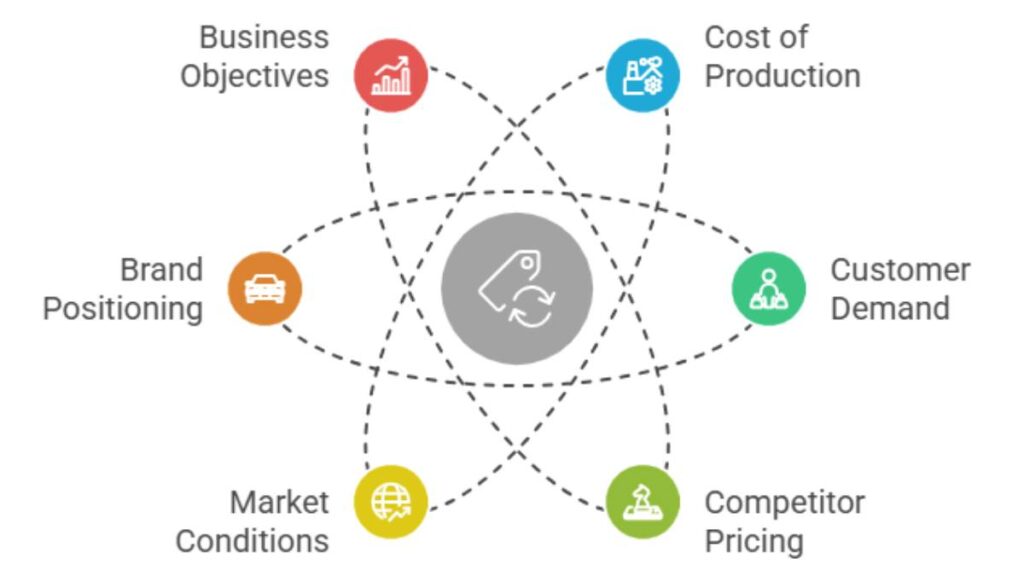
Cost of production (fixed + variable costs)
Everything starts here, whether explicitly or not.
- Fixed costs: rent, salaries, infrastructure
- Variable costs: materials, logistics, packaging
Even businesses that lean into value-based pricing still need cost awareness. Otherwise, pricing becomes risky. Margins shrink without warning.
A surprising number of businesses underestimate this part early on. It shows up later.
Customer demand and price sensitivity
Not all customers respond to pricing the same way.
Some segments react immediately to price changes. Others barely notice, as long as the perceived value stays intact.
This is where price sensitivity comes in.
- High sensitivity, small price changes affect demand heavily
- Low sensitivity, more flexibility in pricing
Understanding this isn’t always straightforward. It often requires testing, adjusting, and observing patterns over time.
Competitor pricing
Competitors set context, whether acknowledged or not.
In crowded markets, pricing tends to cluster within a range. Moving too far outside that range requires strong differentiation.
That said, blindly matching competitors isn’t a great approach either. It leads to price wars, shrinking margins, and very little long-term advantage.
Awareness helps. Dependence doesn’t.
Market conditions and industry trends
External shifts can reshape pricing quickly.
- Economic slowdowns increase price sensitivity
- Inflation pushes costs up, forcing adjustments
- Industry shifts introduce new pricing models
Subscription pricing, for example, became standard in many industries not because it was cheaper, but because customers got used to it.
Ignoring these shifts usually leads to outdated pricing structures.
Brand positioning (premium vs budget)
Pricing needs to match how the brand is positioned.
- Premium positioning allows for higher pricing, but expectations rise, too
- Budget positioning focuses on efficiency and scale
Trying to sit in both spaces at once rarely works. Customers notice the inconsistency.
Pricing either reinforces the brand… or quietly weakens it.
Business objectives (profit, growth, market share)
Finally, pricing depends on what the business is trying to achieve at that moment.
- Profit focus, stronger margins, possibly lower volume
- Growth focus, more competitive or aggressive pricing
- Market share focus, pricing designed to attract quickly
The challenge is that these goals can change. Pricing methods need to adapt alongside them.
Locking into one approach too early can limit flexibility later. And that’s where many businesses get stuck.
Types of Pricing Methods in Marketing
Most businesses don’t sit down and “pick a pricing method” in a clean, textbook way. It’s usually messier than that. A bit of cost thinking, a bit of competitor pressure, some gut feel about customers… and eventually a number lands.
Still, when you step back, pricing decisions tend to fall into a few clear buckets. Understanding these makes it easier to spot what’s actually driving the price. And sometimes, what’s missing.
Cost-Based Pricing Methods (Cost-Oriented Pricing)
Cost-based pricing starts from inside the business. What does it cost to produce, deliver, operate… and then what margin needs to sit on top of that?
That’s the foundation.
The basic formula stays the same:
Price = Cost + Markup
It feels safe. Predictable. For many businesses, especially early on, that’s enough of a reason to stick with it.
But there’s a quiet limitation here. Customers don’t really care about internal costs. They care about what something is worth to them. And those two don’t always line up.
Cost-Plus Pricing Method
Cost-plus pricing is about as straightforward as it gets. Total cost is calculated, then a fixed percentage is added.
No complicated modelling. No deep market assumptions.
If something costs ₹1,000 to produce and the markup is 25%, the selling price becomes ₹1,250. Done.
This works well in industries where cost structures are stable, and demand doesn’t fluctuate wildly. Manufacturing and wholesale environments rely on this quite a bit.
The advantage is clarity. Margins are protected. Planning becomes easier.
But there’s a trade-off. This method doesn’t ask a simple but important question: Would customers have paid more? Or less?
That question gets ignored. And over time, that can either limit growth or hurt sales.
Markup Pricing Method
Markup pricing looks similar on the surface, but the way it’s calculated changes things.
The key difference is whether markup is applied to the cost or to the final selling price. Sounds technical, but in retail, it matters.
A retailer buying a product for ₹500 might apply a 50% markup on cost, pricing it at ₹750. But if the target is a 50% margin on selling price, the final price needs to be higher.
This is where confusion creeps in. Markup and margin get mixed up all the time. They shouldn’t be.
Retail businesses lean heavily on markup pricing because it standardises decisions. Categories get fixed markups, and pricing becomes easier to manage across large inventories.
It works. Until market conditions shift and those fixed markups stop making sense.
Target Return Pricing
Target return pricing takes a more structured approach. Instead of just covering costs and adding margin, it works backwards from a desired return.
The business decides the return it wants… then builds pricing around that.
Price = Cost + (Desired ROI × Investment / Units Sold)
This is common in industries where upfront investment is significant. Large production setups, infrastructure-heavy businesses, and situations where capital is tied up for long periods.
Let’s say a company invests ₹20 lakh into production and expects a 15% return. That target shapes how pricing is set across projected sales volume.
It’s logical. Strategic, even.
But there’s an assumption sitting underneath all this. That projected sales will actually happen. When they don’t, the pricing model starts to feel strained.
Value-Based Pricing Methods (Customer-Oriented Pricing)
Value-based pricing flips the lens outward. Instead of asking “what does it cost?”, the question becomes “what is this worth to the customer?”
Not always easy to answer.
Because value isn’t fixed. It’s shaped by perception. Brand, experience, trust, even small details like packaging or messaging.
Two products with similar costs can end up priced very differently. And still sell.
Perceived Value Pricing
Perceived value pricing leans heavily on how customers feel about a product.
If the perception is strong, pricing power increases. If it’s weak, even a fair price can feel expensive.
Premium brands operate in this space.
A product might cost ₹2,000 to produce but sell for ₹8,000 or more. That gap isn’t accidental. It’s built through positioning, consistency, and sometimes restraint in discounting.
But here’s the thing. Once a brand moves into this space, expectations rise. Every touchpoint has to justify the price. If it slips… customers notice quickly.
Value Pricing
Value pricing takes a slightly different route. Instead of maximising price, the focus is on delivering more perceived value than what’s charged.
Customers feel like they’re getting a good deal. Not necessarily the cheapest option, but worth it.
This approach works well for brands trying to scale quickly while still building trust.
The challenge is operational. Margins are tighter. Efficiency needs to be strong. Otherwise, the model starts to strain.
Some businesses get stuck here. Too expensive to compete with budget players, not premium enough to command higher prices. That middle space can be uncomfortable.
Competition-Based Pricing Methods
Competition-based pricing is shaped by the market more than anything else.
Instead of starting with cost or value, businesses look around. What are others charging? Where does this brand fit within that range?
Simple in theory. Less simple in practice.
Going-Rate Pricing
Going-rate pricing is about staying within the expected price band.
Not too high. Not too low.
This is common in industries where customers already have a clear idea of what something should cost. Fuel, telecom, basic services… pricing tends to cluster.
Deviating too far from that range creates friction. Either suspicion or hesitation.
The benefit here is stability. Less risk of pricing too far off.
The downside… limited differentiation. Price stops being a lever for positioning.
Competitive Pricing Strategy
Competitive pricing can take a more active stance.
Some businesses undercut to gain attention. Others match closely and compete on experience or convenience. Occasionally, a brand prices higher, but only when it can clearly justify why.
This shows up a lot in e-commerce. Prices shift frequently, sometimes even daily.
The advantage is speed. It helps respond quickly to market changes.
But there’s a risk. Constant undercutting leads to price wars. Margins shrink, and over time, it becomes harder to sustain.
It’s easy to win customers on price. Much harder to keep them there.
Demand-Based Pricing Methods
Demand-based pricing moves away from fixed numbers. Prices adjust based on how demand behaves.
Higher demand, higher price. Lower demand, price drops.
Sounds obvious. But applying it consistently requires a good read on customer behaviour.
Differential Pricing (Price Discrimination)
Differential pricing means charging different prices for the same product, depending on the customer or situation.
The variation can come from:
- Timing
- Location
- Customer segment
Airlines do this constantly. The same seat, same flight, different prices depending on when it’s booked or who’s booking.
It allows businesses to capture more value without losing price-sensitive customers.
But it needs to be handled carefully. If customers feel the pricing is unfair, trust drops.
Dynamic Pricing
Dynamic pricing takes flexibility further. Prices change in real time based on demand conditions.
During peak demand, prices rise. During slow periods, they drop.
Ride-sharing platforms, hotels, airlines… this is standard practice now.
From a business perspective, it’s efficient. Revenue gets optimised across different demand levels.
From a customer perspective… it can feel unpredictable. Sometimes even frustrating.
That balance between optimisation and perception is where most of the challenge sits.
Auction-Based Pricing Methods
Auction-based pricing works differently from everything else here. Instead of setting a price, the market determines it.
The seller creates the structure. Buyers compete.
In an English auction, prices move upward as bidders outbid each other.
In a Dutch auction, prices start high and drop until someone accepts.
In a sealed-bid auction, everyone submits privately, and the highest bid wins.
This method is useful when the value isn’t fixed or when items are unique or limited.
It’s not something most everyday businesses rely on. Too unpredictable for that.
But in the right context, it reveals something interesting. What people are actually willing to pay… without any preset anchor.
Pricing Methods vs Pricing Strategies
This part trips people up more than it should.
Pricing methods and pricing strategies sound similar. They’re not. And when they get mixed together, pricing decisions start feeling… off. A bit inconsistent.
At a basic level, pricing methods are about how the number is calculated. Pricing strategies are about how that number is used in the market.
One is internal. The other is external.
A business might calculate its price using cost-plus pricing. That’s the method. Straightforward math, margin added, done. But then it chooses to position that same product as a premium offering. Higher price, tighter discounts, controlled distribution. That’s strategy.
Same number. Different intent behind it.
Sometimes the gap between the two becomes obvious. For instance, a product priced purely on cost might end up looking too cheap for the market it’s trying to enter. Or the opposite… priced high for positioning reasons, but the underlying cost structure doesn’t support it long-term.
That’s where alignment matters.
Methods give structure. They keep things grounded. Strategy adds context. It shapes how customers interpret the price.
Without a method, pricing becomes guesswork. Without a strategy, it becomes disconnected from the market.
Most businesses don’t consciously separate the two, but the ones that do tend to have more control over how pricing evolves. Less reactive. More deliberate.

Enroll Now: Advanced Digital Marketing Course
Advantages and Disadvantages of Different Pricing Methods
No pricing method is clean all the way through. Each one solves a problem, sure, but also creates a few new ones along the way. That trade-off is usually where the real decision sits.
Advantages
One of the biggest advantages of using structured pricing methods is… clarity. Things don’t feel random.
When pricing follows a defined approach, decisions become easier to justify internally. Teams understand why a product costs what it does. That reduces friction, especially when adjustments are needed later.
There’s also a level of consistency that comes in. Instead of pricing every new product from scratch, businesses can apply a framework. It saves time, but more importantly, it avoids erratic pricing.
Another thing that doesn’t get talked about enough is alignment. Good pricing methods tend to reflect business priorities. If the focus is profitability, margins are built in deliberately. If the goal is growth, pricing can be more aggressive.
And over time, structured pricing helps with predictability. Revenue becomes easier to forecast. Not perfectly, but better than operating on instinct alone.
Disadvantages
The problems usually start when a method becomes rigid.
Cost-based pricing is a good example. It protects margins on paper, but it doesn’t check whether customers actually agree with the price. That gap can sit quietly for a while… until sales slow down and no one’s quite sure why.
Competition-based pricing has its own issues. It pulls attention outward constantly. Pricing decisions start reacting to competitors instead of reflecting the brand’s own positioning. Over time, that can lead to a race to the bottom. Margins shrink, and differentiation fades.
Value-based pricing sounds ideal in theory, but it’s not always easy to get right. Misjudging customer perception even slightly can push prices too high. And once customers push back, it’s not easy to reset that expectation.
There’s also the problem of inertia. Markets change, costs shift, customer expectations evolve. But pricing methods sometimes stay the same longer than they should. That lag creates misalignment.
And then there’s oversimplification. Real-world pricing rarely fits into one neat box. Businesses that stick too closely to a single method often miss opportunities to adjust, combine approaches, or experiment a bit.
Real-World Examples of Pricing Methods in Marketing
This is where things start to feel more concrete. Different industries lean toward different pricing methods, not because one is better, but because customer behaviour shapes what works.
Cost-based pricing example (manufacturing)
Manufacturing businesses tend to start with costs. They almost have to.
Take something like small consumer electronics accessories. Chargers, cables, adapters. The cost structure is fairly defined… materials, assembly, packaging, distribution. Once that’s clear, a markup gets added.
It keeps things stable. Predictable.
But here’s where it gets interesting. As soon as branding enters the picture, the model starts shifting. Two similar products, with the same production cost, can end up priced very differently depending on packaging, positioning, and even where they’re sold.
So cost-based pricing works, but only up to a point. After that, other factors creep in.
Value-based pricing example (premium brands)
Premium brands operate in a different space altogether.
Pricing isn’t anchored in cost as much as it is in perception. What does the product represent? How does it feel to own or use?
In categories like skincare or fashion, this becomes very visible. A product might cost relatively little to produce, but sell at a much higher price because of brand equity, design, and experience.
Customers in this segment aren’t comparing line items in a cost sheet. They’re evaluating trust, identity, sometimes even status.
The flip side is pressure. Once a brand sets itself at a higher price point, everything around it has to support that. Packaging, communication, consistency. If any part slips, the price starts to feel unjustified.
Competitive pricing example (telecom, e-commerce)
In highly competitive markets, pricing tends to cluster.
Telecom is a good example. Plans often sit within a narrow range. Move too far above, and customers hesitate. Drop too low, and margins disappear quickly.
E-commerce works in a similar way, just faster. Prices change frequently. Competitors adjust, platforms react, and the cycle continues.
It keeps businesses sharp, but it also creates pressure. Constant comparison means there’s less room to breathe. Differentiation has to come from somewhere else… service, delivery, experience.
Otherwise, it becomes purely a pricing game. And that rarely ends well.
Differential pricing example (cinemas, airlines)
Cinemas and airlines handle pricing differently. They don’t stick to a single price for everyone.
A movie ticket costs less on a weekday morning than on a Saturday evening. Same screen, same film, different demand.
Airlines take this further. Prices shift based on when a ticket is booked, how many seats are left, and even seasonal patterns. Two passengers sitting next to each other might have paid completely different amounts.
It looks inconsistent from the outside, but there’s logic behind it. Different customers have different willingness to pay. Pricing adjusts to capture that.
The tricky part is perception. If customers feel the pricing is unpredictable or unfair, trust takes a hit. So while the method is effective, it needs careful handling.
Not just numbers. Expectations too.
How to Choose the Right Pricing Method for Your Business
Choosing a pricing method isn’t a one-time decision. It tends to evolve as the business grows, the market shifts, and customer expectations change. What works early on often doesn’t hold up later. That’s normal.
Still, there’s a way to approach it without overcomplicating things.
Step 1: Define business goals
Everything starts here. Not with competitors. Not even with customers, at least not yet.
What is the business trying to achieve right now?
Growth-focused businesses usually lean toward more aggressive pricing. Lower margins, faster acquisition, wider reach. Profit-focused businesses do the opposite. They protect margins, sometimes at the cost of volume.
There’s no “correct” goal. But pricing needs to match it. Otherwise, things feel misaligned pretty quickly.
Step 2: Analyse costs
This step gets skipped more often than it should.
Even if the final pricing approach isn’t cost-based, understanding the cost structure is non-negotiable. Fixed costs, variable costs, operational overhead… all of it.
Without that clarity, pricing decisions are built on shaky ground. Margins might look fine at first, but cracks show up later.
And usually at the worst time.
Step 3: Study customer willingness to pay
This is where things get less precise.
Customers don’t always say what they’re willing to pay. And when they do, it’s not always reliable. Actual behaviour matters more than stated preference.
Still, patterns can be observed.
- What price range do similar products sit in?
- How do customers react to small price changes?
- Are they comparing alternatives heavily, or deciding quickly?
These signals help shape the upper and lower boundaries of pricing.
It’s less about finding the exact number… more about understanding the range.
Step 4: Evaluate competitors
Competitors provide context, whether acknowledged or not.
Pricing too far above or below the market range needs justification. Strong justification.
That doesn’t mean copying competitors. It just means being aware of where the business sits relative to them.
Ignoring competitor pricing completely is risky. Over-focusing on it is equally risky.
There’s a middle ground. That’s usually where things work best.
Step 5: Test and optimise pricing
Pricing isn’t static. It shouldn’t be treated that way.
Small adjustments, over time, reveal a lot. How customers respond, where demand shifts, what feels acceptable and what doesn’t.
The key here is patience. Pricing experiments don’t always show results immediately.
But businesses that actively test tend to find a better balance. Between volume and margin. Between growth and sustainability.
Best Practices for Using Pricing Methods Effectively
Using a pricing method is one thing. Using it well… that’s a different conversation.
Most pricing issues don’t come from choosing the wrong method. They come from applying it too rigidly, or without enough context.
Combining multiple pricing methods often leads to better outcomes than relying on just one.
A business might start with cost-based pricing to set a baseline, then adjust based on customer perception and competitor positioning. It’s not about being inconsistent. It’s about being flexible where it matters.
Data plays a role here, but not in an overwhelming way.
Sales patterns, customer behaviour, conversion rates… these signals help refine pricing over time. Not every decision needs deep analysis, but ignoring data entirely makes pricing reactive.
There’s a balance. Observing patterns without overanalysing every fluctuation.
Keeping an eye on competitor pricing helps, especially in dynamic markets.
Prices shift more often than expected. New entrants come in. Existing players adjust their positioning. Staying aware of these changes prevents pricing from drifting too far out of sync.
But again, awareness doesn’t mean imitation.
Alignment with brand positioning matters more than it seems.
A premium brand discounting too frequently starts to lose its edge. A budget brand pricing too high creates friction.
Pricing should feel consistent with the overall experience. When it doesn’t, customers hesitate. Even if they can’t explain why.
Common Mistakes in Pricing Methods
Pricing mistakes rarely look obvious in the beginning. They show up slowly. Lower conversions, shrinking margins, inconsistent sales patterns.
By the time they’re noticed, the impact is already there.
Pricing too low is one of the most common issues, especially for newer businesses.
It feels safer. Easier to attract customers. But it creates problems later.
Margins stay thin. Scaling becomes harder. And increasing prices after customers get used to a lower number… that’s not easy.
On the other hand, pricing too high without a clear justification pushes customers away quietly. No complaints, just fewer conversions.
Finding the right balance takes time. There’s no shortcut around that.
Ignoring perceived value is another big one.
Focusing only on cost leads to pricing that might make sense internally but doesn’t resonate with customers.
People don’t buy based on cost breakdowns. They buy based on what they believe something is worth. That gap between cost and perception needs attention.
Not updating pricing as market conditions change is more common than expected.
Costs increase, competitors adjust, customer expectations shift… but pricing stays the same.
At first, it doesn’t seem like a problem. Over time, it adds up.
Regular reviews help. Not constant changes, but periodic adjustments based on what’s happening in the market.
Over-reliance on cost-based pricing limits flexibility.
It works as a foundation, but rarely as a complete solution.
Businesses that stick too closely to cost-based methods often miss opportunities to capture higher value. Or they struggle to respond when demand shifts.
Pricing works better when it’s treated as a mix of inputs, not a single formula.
At the end of the day, pricing is less about getting it perfect and more about staying aligned. With costs, with customers, with the market.
And being willing to adjust when that alignment starts to slip.
Future Trends in Pricing Methods in Marketing
Pricing isn’t standing still anymore. It used to be something you’d set, review maybe once or twice a year, and move on. That’s changing. Quietly, but quite noticeably if you’re paying attention.
One shift that’s hard to ignore… pricing is becoming more fluid.
Not chaotic. Just less fixed.
There’s a growing move toward systems that adjust pricing more frequently based on patterns. Demand shifts, competitor movements, and seasonal changes. Instead of reacting late, businesses are starting to respond in smaller, ongoing adjustments.
That sounds efficient. It is. But it also introduces a bit of tension.
Too many changes, and customers start noticing. And not always in a good way.
Personalised pricing is another area that’s slowly becoming more common.
Different customers, slightly different prices. Based on behaviour, location, and sometimes even purchase history. It’s rarely obvious on the surface, but it’s there.
From a revenue perspective, it makes sense. From a trust perspective… it needs to be handled carefully. If customers feel like pricing is inconsistent or unfair, that reaction tends to stick.
Dynamic pricing is expanding beyond its usual spaces.
Airlines and hotels have been doing it for years. Now it’s creeping into retail, events, and even digital products. Prices shift depending on timing, availability, and sometimes even browsing patterns.
Customers are getting used to it. Not entirely comfortable, but less surprised than before.
Then there’s the continued rise of subscription and usage-based pricing.
Instead of one-time purchases, customers pay over time. Monthly, yearly, or based on how much they actually use something.
It lowers the entry barrier. Makes products feel more accessible.
But it also changes expectations. If customers are paying regularly, they expect ongoing value. Not just at the start.
Pricing becomes less of a one-time decision and more of an ongoing relationship. That’s a different mindset altogether.
Conclusion:
Which Pricing Method Works Best?
There isn’t a single answer here. And honestly, there probably shouldn’t be.
Different pricing methods solve different problems. That’s the reality.
Cost-based pricing brings stability. Value-based pricing unlocks higher margins when done right. Competitive pricing keeps things relevant. Demand-based pricing adds flexibility when markets shift.
Each one has its place.
The mistake usually happens when a business leans too heavily on just one approach. It starts to feel rigid. Out of sync.
Most businesses that get pricing right… They mix methods. Not in a complicated way, just in a practical one.
A base price might come from cost. Adjustments might reflect demand. Final positioning aligns with how the brand wants to be seen.
It’s layered. Slightly messy at times, but workable.
And over time, pricing becomes less about finding the perfect number and more about staying aligned. With costs, with customers, with the market as it moves.
That alignment shifts. So pricing has to shift with it.
FAQs: on Pricing Methods in Marketing
What are the main pricing methods in marketing?
Most pricing decisions fall into a few familiar patterns. Cost-based, value-based, competition-driven, demand-led, and sometimes auction-style pricing. Each looks at a different angle. Costs, customers, or the market. In practice, though, businesses don’t neatly pick one. They mix them. Quietly. Based on what’s working and what isn’t.
What is cost-based pricing with an example?
Cost-based pricing starts from the inside. Figure out the total cost, then add a margin. So if something costs ₹400 and a 50% markup is applied, it lands at ₹600. Simple enough. The catch? Customers don’t always care about cost. Sometimes they’d pay more. Sometimes… not even that.
What is the difference between pricing methods and strategies?
Pricing methods are about the math behind the numbers. Pricing strategies are about what that number signals in the market. One is calculation. The other is intent. When they don’t line up, things feel off. The price might make sense internally, but still fails to connect outside.
Which pricing method is best for startups?
Early-stage businesses usually keep it simple. Cost-based or competitor-aligned pricing gives them a starting point without overthinking things. Over time, as patterns emerge, pricing evolves. It almost has to. What works in the early days rarely holds once the business starts scaling.
What is value-based pricing in marketing?
Value-based pricing leans on perception more than cost. What customers believe something is worth becomes the anchor. That belief comes from brand, experience, trust… not just the product itself. If that perception is strong, pricing power increases. If not, even a fair price can feel too high.
How do companies decide pricing?
It’s rarely one factor. Costs play a role, obviously. So do competitors, customer behaviour, and business priorities at that moment. Pricing decisions tend to evolve rather than get finalised. Adjustments happen, sometimes small, sometimes not. Over time, a pattern forms.
What is a competitive pricing method?
Competitive pricing looks outward first. It asks where the market sits and positions around that range. Sometimes matching, sometimes undercutting slightly. It works in crowded spaces where comparisons are easy. But over time, it can make brands look similar if nothing else stands out.
What is dynamic pricing with an example?
Dynamic pricing shifts based on demand. Airline tickets are the usual example. Prices rise as seats fill or as departure gets closer. It’s efficient from a revenue standpoint. From the customer side… it can feel a bit unpredictable, especially when prices change quickly.
How do pricing methods affect customer perception in marketing?
Pricing sends signals, whether intended or not. Higher prices often suggest quality or exclusivity. Lower prices lean toward value. Customers don’t always break it down logically, but the impression sticks. That first signal can influence whether they even consider the product further.
What is the difference between cost-plus pricing and markup pricing?
Cost-plus pricing adds a fixed percentage directly to cost. Markup pricing can be calculated differently depending on whether it’s based on cost or the final selling price. It sounds minor, but the difference shows up in the final number more than expected.
When should a business use value-based pricing methods?
Value-based pricing works when there’s clear differentiation. Something that customers recognise and are willing to pay more for. Without that, pricing starts to feel stretched. It’s less about what the product is and more about how it’s perceived in the market.
How does demand-based pricing work in real-world markets?
Demand-based pricing adjusts with customer interest. When demand rises, prices tend to go up. When it drops, prices soften. It’s common in industries where timing matters. Travel, events, things like that. Not fixed pricing, more responsive.
What industries commonly use dynamic pricing methods?
Airlines, hotels, ride-sharing, ticketing platforms… anywhere demand fluctuates regularly. Fixed pricing doesn’t hold up well there. Prices need to adjust quickly. So they do. Sometimes quietly, sometimes very visibly.
Can small businesses use advanced pricing methods effectively?
They can, just in simpler ways. It doesn’t require complex systems. Paying attention to demand, customer feedback, and competitor movement already gets them part of the way there. It’s more about consistency than sophistication.
How often should companies update their pricing methods?
Not too frequently, but not rarely either. Pricing needs to be revisited. Markets shift, costs change, and customer expectations evolve. Leaving pricing untouched for too long usually creates gaps that show up later.
What are the risks of using competition-based pricing methods?
The main risk is becoming reactive. Pricing starts following competitors instead of leading. Over time, that can shrink margins and make differentiation harder. It also creates a cycle where everyone keeps adjusting, but no one really stands out.
How do pricing methods impact profitability and revenue growth?
Pricing influences both how much is earned per sale and how many sales happen. Higher prices can improve margins but may reduce demand. Lower prices can increase volume but compress profits. The balance between those two shapes overall growth.
What role does market research play in selecting pricing methods?
Market research adds context. It helps understand how customers think about price, what competitors are doing, and where expectations sit. Without it, pricing decisions rely too much on assumptions. And those assumptions don’t always hold up in real markets.