
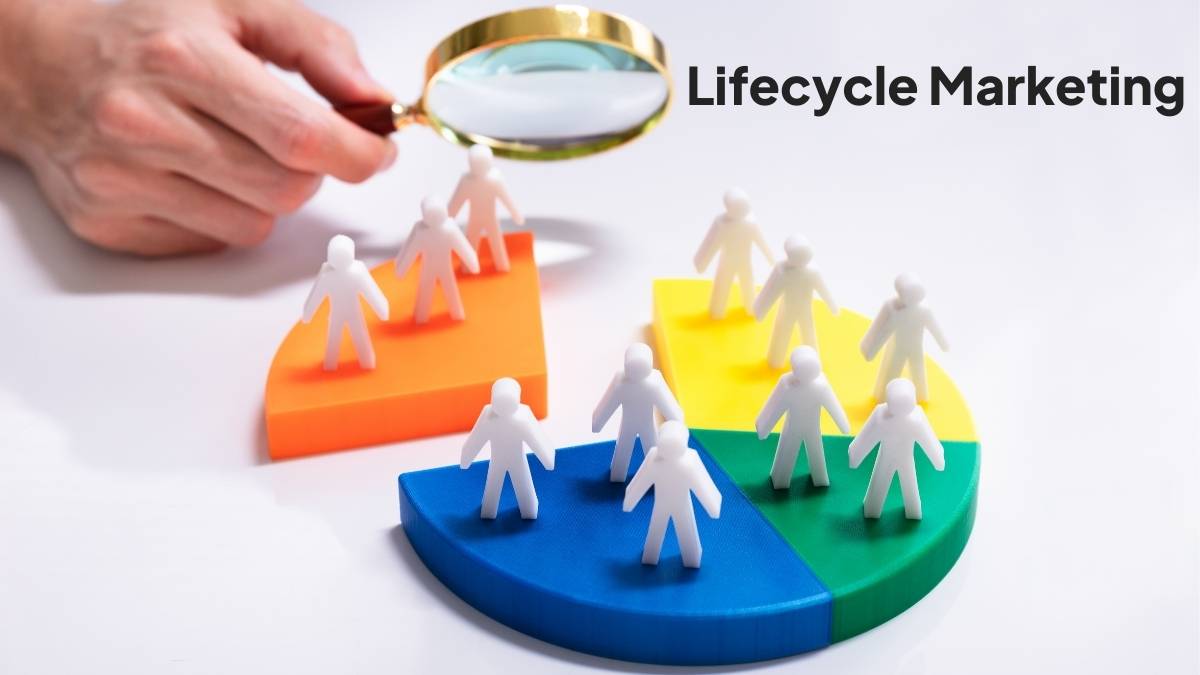
Marketing didn’t always think in terms of “relationships.” For years, most teams focused on campaigns. Launch something. Promote it everywhere. Watch conversions come in. Then move on to the next promotion.
Simple cycle. And for a while, it worked.
But customers don’t behave like neat campaign timelines anymore. Not even close.
People discover brands in messy, unpredictable ways. A blog post here. A product comparison there. Maybe a LinkedIn mention. Sometimes a friend casually drops a recommendation during a conversation that has nothing to do with buying anything.
Then the real pattern begins.
They browse. Leave. Come back days later. Sign up for a newsletter. Ignore a few emails. Click one. Look at pricing. Leave again. Maybe months later, they finally decide to try the product.
That winding path; all those tiny interactions; is exactly where lifecycle marketing lives.
Instead of treating marketing like isolated bursts of activity, lifecycle marketing focuses on the full relationship between a business and its customers. The goal isn’t just to attract attention. It’s to guide people from their first interaction all the way through long-term engagement.
And when done well, it changes how growth actually happens.
Why Lifecycle Marketing Matters in Modern Digital Marketing
A lot of marketing strategies still revolve around acquisition. Get traffic. Capture leads. Close deals. Repeat.
But many teams eventually notice the same frustrating pattern: huge effort goes into attracting customers… and then those customers quietly disappear.
No second purchase. No continued engagement. Just churn.
Replacing them gets expensive. Really expensive.
Lifecycle marketing emerged largely as a response to that problem. Instead of focusing only on bringing new people in, it looks at how the relationship evolves after the first interaction.
A few shifts in the digital landscape pushed this approach forward.
Customer journeys have become longer and more complex.
Very few people buy immediately anymore. Research, comparisons, reviews, and multiple touchpoints are normal.
Retention now drives sustainable growth.
Repeat customers often generate the majority of revenue for mature businesses. Losing them means starting from scratch again and again.
Customer experience shapes brand perception.
The way a brand communicates after a purchase can matter just as much as the product itself.
When those realities sink in, the marketing question changes slightly. Not dramatically. Just enough to shift the strategy.
Instead of asking How do we get the next conversion? The question becomes:
How do we support customers throughout the entire journey?
That’s the heart of lifecycle marketing.
The Shift from Campaign-Based Marketing to Lifecycle Marketing
Traditional marketing tends to revolve around specific moments.
A product launch.
A seasonal sale.
A limited-time promotion.
Each campaign is designed to generate a spike of attention. Traffic increases, sales happen, then everything quiets down again until the next push.
Lifecycle marketing doesn’t ignore campaigns; they still matter. But it connects those moments into something more continuous.
Think about a common path someone might take:
- A visitor finds a helpful article through a search.
- A few days later, they subscribed to the newsletter.
- They start receiving educational emails.
- Eventually they explore the product.
- After signing up, they receive onboarding guidance.
- Weeks later, they get tips on advanced features.
None of those interactions is random. They’re connected.
Each one nudges the relationship forward just a little.
That’s the key difference. Lifecycle marketing isn’t about restarting the conversation with every campaign. It’s about continuing the one that already started.
Why Retention and Customer Lifetime Value Now Drive Growth
Many companies eventually realize something slightly uncomfortable: acquiring customers is only half the job.
The real value often shows up later.
A loyal customer tends to:
- buy more frequently
- spend more time
- Recommend the brand to others
- require less marketing effort to keep engaged
That’s where customer lifetime value (CLV) becomes important. Instead of measuring a single purchase, businesses start looking at the entire revenue relationship.
Lifecycle marketing helps strengthen that relationship.
A few examples show up again and again in successful companies:
- nurturing new leads until they’re ready to buy
- helping customers succeed during onboarding
- encouraging repeat purchases through relevant offers
- re-engaging users who have gone quiet
None of these tactics is particularly flashy. But together, they create momentum.
Over time, that momentum compounds.
How Personalization and Automation Changed Customer Engagement
Another reason lifecycle marketing gained traction is personalization.
Customers have grown used to communication that feels relevant. Generic broadcast marketing; the same message sent to everyone; rarely performs the way it once did.
Instead, brands now tailor communication based on signals such as:
- browsing behavior
- purchase history
- engagement with content
- product usage patterns
These signals reveal where someone might be in their journey.
Automation systems help deliver the right message at the right moment. A welcome email after signup. A reminder after a cart is abandoned. Product tips once someone becomes a customer.
Small adjustments. But they matter.
When communication arrives at the right time, it feels helpful instead of intrusive.
What You’ll Learn in This Lifecycle Marketing Guide
Lifecycle marketing touches almost every corner of modern digital marketing. It’s not just about email automation or retention campaigns; it’s a broader way of thinking about customer relationships.
This guide walks through the topic step by step.
Along the way, we’ll explore:
- What lifecycle marketing actually means in practice
- How the different stages of the customer lifecycle work
- strategies companies use to guide customers through those stages
- The marketing channels that support lifecycle engagement
- metrics used to evaluate long-term customer relationships
The idea isn’t just to explain the concept. The goal is to understand how marketing can move beyond one-time conversions and start building lasting customer connections.
Because ultimately, that’s where the real growth happens.
Table of Contents
What Is Lifecycle Marketing?
Lifecycle marketing sounds complicated at first glance, but the core idea is surprisingly straightforward.
It’s a strategy built around one simple observation: customers move through different stages while interacting with a brand.
Those stages might begin with curiosity. Later comes the evaluation. Eventually, a purchase happens. Then the relationship continues, sometimes for years.
Lifecycle marketing aligns marketing efforts with those stages.
Instead of sending the same message to everyone, communication adapts depending on where someone is in the relationship.
The goal is often education. At times, it’s about encouragement. And sometimes, it’s just about being present. Every interaction has a purpose: helping the customer move naturally to the next step.
Lifecycle Marketing Definition
In practical terms, lifecycle marketing means aligning marketing activities with the phases customers experience while interacting with a business.
Those phases typically include moments like:
- discovering a brand
- exploring possible solutions
- evaluating options
- deciding to purchase
- learning how to use the product
- continuing to engage over time
Lifecycle marketing connects these moments into a cohesive strategy.
A typical lifecycle approach might include:
- educational content designed for early-stage discovery
- nurturing emails for interested prospects
- onboarding guidance for new customers
- loyalty programs that reward repeat buyers
- re-engagement campaigns for inactive users
Each stage receives communication designed for that particular moment.
Not generic messaging. Contextual messaging.
Lifecycle Marketing Explained in Simple Terms
Think about how relationships develop in everyday life.
Nobody jumps straight from meeting someone to a long-term commitment. There’s a gradual process. Conversations build trust. Experiences accumulate.
Marketing works in much the same way.
Customers rarely move from “never heard of this brand” to “loyal customer” in a single step.
More often, the path looks like this:
- A visitor reads a helpful article.
- Later, they subscribe to updates.
- Over time, they receive useful insights.
- Eventually, they explore the product.
- At some point, they decide to try it.
Lifecycle marketing intentionally supports that progression.
Each message builds on the last. The relationship grows naturally rather than being forced.
Lifecycle Marketing vs Funnel Marketing
Lifecycle marketing often gets compared with the traditional marketing funnel.
There’s overlap, but the mindset is slightly different.
The marketing funnel focuses mostly on converting prospects into customers. It usually includes stages such as:
- awareness
- interest
- decision
- action
Once a purchase happens, the funnel technically reaches its end.
Lifecycle marketing continues long after that moment.
After the initial conversion, additional stages become important:
- onboarding new customers
- retaining engaged users
- encouraging loyalty
- turning satisfied customers into advocates
- re-engaging those who drift away
These later stages are where long-term value often emerges.
In simple terms:
The funnel focuses on acquisition.
Lifecycle marketing focuses on the entire relationship.
Customer Lifecycle Marketing Explained
Customer lifecycle marketing applies this thinking to the full customer journey.
Instead of optimizing individual campaigns in isolation, it examines how people interact with a brand over time.
A typical lifecycle might unfold like this:
- Someone discovers the brand.
- They begin exploring content or product information.
- They compare options and evaluate alternatives.
- They eventually make a purchase.
- They learn how to use the product effectively.
- They continue engaging with the brand.
- In some cases, they recommend it to others.
Lifecycle marketing ensures that every step along that path receives thoughtful communication.
That communication might take many forms:
- educational resources
- product tutorials
- personalized recommendations
- loyalty rewards
- re-engagement campaigns
The exact tactics vary, but the principle stays the same: meet customers where they are.
Relationship Between Lifecycle Marketing and Customer Experience
Customer experience has become one of the most powerful differentiators between brands.
Two companies might sell nearly identical products. Yet customers often stay loyal to the one that communicates better.
Lifecycle marketing plays a quiet but important role in shaping that experience.
Consider a few small examples:
- Onboarding instructions arriving immediately after signup
- helpful product tips after the first purchase
- reminders before subscription renewals
None of these messages is dramatic. But they reduce friction. They make the experience feel smoother.
Over time, those small touches add up. Customers start associating the brand with clarity and reliability.
Lifecycle Marketing as a Long-Term Growth Strategy
Many businesses approach marketing as a short-term activity. Launch a campaign, generate leads, and hit quarterly targets.
Lifecycle marketing encourages a longer view.
Customers aren’t just transactions. They’re relationships that evolve over time.
One purchase has value. But a customer who returns repeatedly, engages with content, and recommends the brand to others becomes far more valuable.
Lifecycle marketing helps cultivate those long-term connections.
Instead of constantly chasing new audiences, companies learn to deepen engagement with the customers they already have.
Often, that’s where the most sustainable growth comes from.
Why Lifecycle Marketing Is Important for Businesses
Several practical benefits explain why lifecycle marketing has become central to many growth strategies.
Increasing customer lifetime value
Lifecycle strategies encourage ongoing engagement, which often leads to:
- repeat purchases,
- continued product usage
- upgrades or additional services
Improving retention
Acquiring customers is expensive. Keeping them engaged usually costs far less.
Lifecycle marketing focuses heavily on:
- ongoing communication
- product education
- timely engagement
These efforts help reduce churn.
Lowering acquisition pressure
When retention improves, companies don’t need to rely as heavily on constant acquisition campaigns.
Satisfied customers often:
- Recommend the brand
- leave positive reviews
- attract new users organically
Over time, that dynamic lowers the cost of growth.
How Lifecycle Marketing Works
At a practical level, lifecycle marketing works by responding to customer behavior.
Every interaction someone has with a brand provides a signal.
Reading an article.
Signing up for a newsletter.
Exploring pricing pages.
Starting a trial.
Each action hints at where that person might be in their journey.
Lifecycle marketing uses those signals to guide communication.
The idea isn’t complicated: when someone takes a step, the brand responds with something helpful.
Sometimes that response is an email. Sometimes it’s a product tutorial. Sometimes it’s a reminder or recommendation.
The experience keeps moving forward.
The Customer Journey Behind Lifecycle Marketing
The foundation of lifecycle marketing is the customer journey; the path someone takes from discovering a brand to becoming a loyal customer.
In reality, that journey is rarely linear.
A typical sequence might look something like this:
- discovering a brand through content or social media
- exploring product pages or guides
- subscribing to updates
- leaving without purchasing
- returning later after more research
- eventually making a purchase
Even after the purchase, the journey continues.
Customers often need help learning how to use a product effectively. They might explore advanced features, ask support questions, or look for best practices.
Lifecycle marketing ensures that these moments are supported rather than ignored.
From First Touchpoint to Brand Advocacy
Over time, customers tend to move through several broad phases.
- Discovery – encountering the brand for the first time
- Evaluation – researching options and comparing alternatives
- Purchase – deciding to become a customer
- Adoption – learning how to use the product regularly
- Loyalty – continuing to engage with the brand
- Advocacy – recommending it to others
Each stage brings different expectations.
Someone discovering a brand needs information.
A new customer needs guidance.
A loyal user might appreciate exclusive benefits or community access.
Lifecycle marketing adjusts communication accordingly.
Mapping Marketing Touchpoints Across Channels
Customers rarely interact with a brand through just one channel.
More often, the relationship develops across multiple touchpoints:
- website visits
- blog articles
- email newsletters
- social media engagement
- product trials
- customer support conversations
A lifecycle strategy connects these touchpoints into a coherent experience.
For instance:
- A visitor reads a detailed article.
- They subscribe to the newsletter.
- Later, they receive a guide related to that topic.
- Eventually, they explore a product solution.
Each interaction feels like a continuation of the last.
That continuity is important. It helps the relationship feel intentional rather than random.
Understanding Customer Behavior Signals
One of the most valuable aspects of lifecycle marketing is interpreting behavioral signals.
Customer actions reveal intent.
A few examples illustrate the idea:
- downloading a guide may indicate early curiosity
- Visiting pricing pages often signals evaluation
- Abandoning a cart might suggest hesitation
- Long periods of inactivity could indicate declining engagement
Recognizing these signals allows marketing teams to respond more thoughtfully.
Instead of sending the same message to everyone, communication adapts to the situation.
Someone exploring product features might receive educational material.
Someone who hasn’t engaged for months might receive a re-engagement message.
Timing matters. Context matters even more.
Lifecycle Marketing vs Traditional Marketing Strategies
Traditional marketing often revolves around short-term campaigns designed to generate immediate results.
A new product launch.
A holiday promotion.
A lead-generation campaign.
These efforts can work well, but they tend to focus on short bursts of attention.
Lifecycle marketing approaches things differently.
Campaign-Centric vs Customer-Centric Marketing
Traditional campaigns typically start with marketing objectives.
Lifecycle marketing starts with the customer.
Instead of asking:
What campaign should run next?
The question becomes:
What does the customer likely need right now?
Transactional Marketing vs Relationship Marketing
Transactional marketing focuses on individual purchases.
Lifecycle marketing focuses on relationships.
That shift changes how success is evaluated. Instead of measuring only immediate conversions, businesses start paying closer attention to indicators like:
- retention
- repeat purchases
- customer lifetime value
One-Time Conversions vs Long-Term Engagement
A conversion is important, of course. But it isn’t the finish line.
In many businesses, the majority of value appears after the first purchase.
Lifecycle marketing recognizes this reality and continues supporting customers long after that initial moment, through relevant communication, helpful guidance, and experiences that keep the relationship active.
Over time, those ongoing interactions turn ordinary customers into loyal ones. And occasionally, into advocates.
What Are the Lifecycle Marketing Stages?
Lifecycle marketing only makes sense once the journey itself is clear. Customers don’t simply arrive, buy, and stay loyal forever. The relationship moves through several phases, and each one asks for a different type of communication.
Miss the timing, and the message falls flat.
For example, pushing discounts to someone who has just discovered the brand rarely works. On the other hand, sending basic “what is this product?” content to a long-time customer feels equally off.
That’s why lifecycle marketing is usually broken down into stages. These stages map the natural progression of a customer relationship, from first discovery all the way to advocacy.
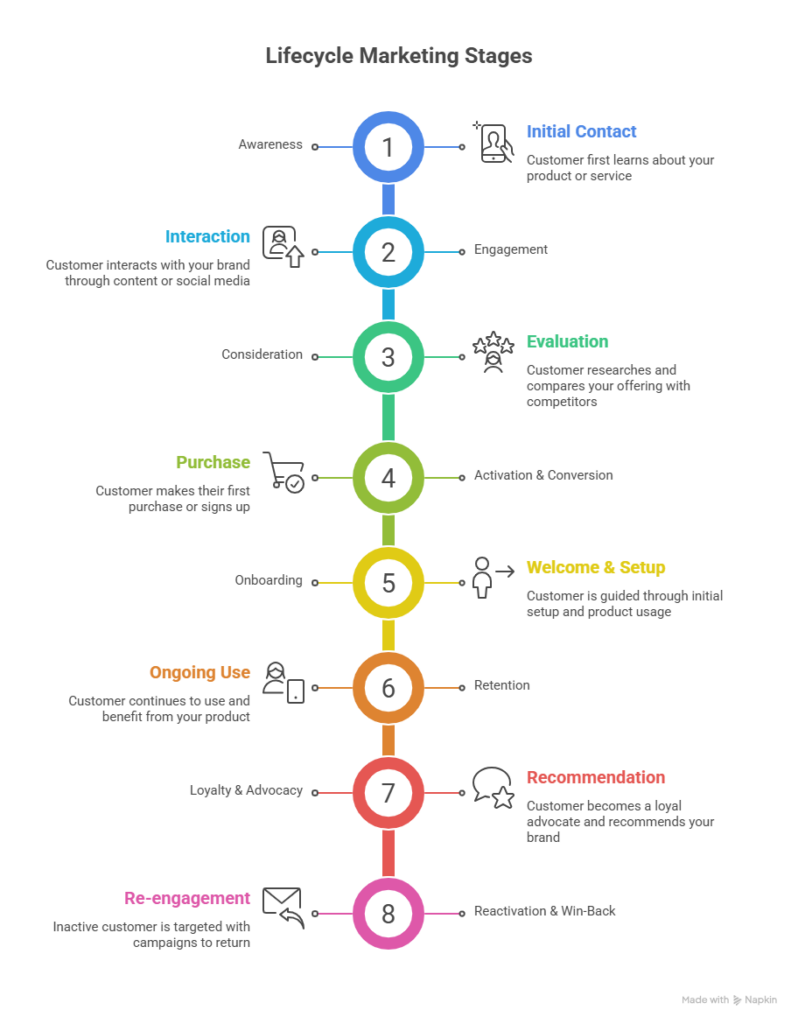
A typical lifecycle looks something like this:
- Awareness
- Engagement
- Consideration
- Conversion
- Onboarding
- Retention
- Loyalty
- Reactivation
Some companies merge or rename stages. That’s fine. The exact labels matter less than the underlying idea: customers move forward step by step, and marketing should support that movement.
Lifecycle marketing strategies guide customers through each stage of the brand relationship, from discovery to advocacy.
Let’s look at how each stage works in practice.
Awareness Stage in Lifecycle Marketing
Goal: Attract potential customers
The awareness stage is where the relationship begins. At this point, people don’t know much about the brand; sometimes, they don’t even know they have a problem yet.
What they’re doing is exploring.
They might search for information, read articles, scroll through social media, or watch industry discussions. The goal here isn’t to sell. It’s to show up with useful ideas when curiosity appears.
Brands that try to jump straight to conversion here usually struggle.
Instead, awareness-stage marketing focuses on education and visibility.
Common awareness strategies include:
- Content marketing and SEO
Helpful articles, guides, and industry insights that answer real questions. - Social media presence
Thought leadership, commentary on trends, and short educational content. - Paid advertising
Especially useful for amplifying content or introducing the brand to new audiences. - Brand awareness campaigns
Messaging designed to build recognition rather than immediate sales.
Typical content formats in this stage:
- Blog posts explaining industry topics
- Educational videos
- Research or industry reports
- Introductory guides
Good awareness content does one simple thing: it makes the brand useful before asking for anything in return.
That early trust matters more than most marketers realize.
Engagement Stage
Goal: Turn visitors into engaged prospects
Awareness brings people in. Engagement gives them a reason to stick around.
This stage starts when someone shows a small signal of interest; maybe they read more than one article, spend time on the website, or interact with content on social media.
At this point, the relationship is still casual. But it’s moving somewhere.
The focus now shifts from pure education to participation.
Typical engagement tactics include:
- Newsletter signups
One of the simplest and still one of the most effective ways to continue the conversation. - Lead magnets
Guides, templates, or reports are offered in exchange for contact details. - Website engagement features
Quizzes, calculators, interactive tools. - Community interaction
Social discussions, comments, or small communities are built around the topic.
Common engagement strategies:
- Email capture forms
- Webinars or live sessions
- Downloadable resources
- Interactive content
This stage is about momentum.
Someone who willingly gives their email or attends a webinar is signaling curiosity. Good lifecycle marketing responds to that signal with thoughtful follow-up, not a sudden flood of sales messages.
Consideration Stage
Goal: Help prospects evaluate your solution
By the time someone reaches the consideration stage, they’re actively exploring solutions.
They’ve likely identified a problem. Now they’re comparing options.
This is where many marketing teams make a mistake: they keep producing general awareness content when prospects actually need clarity.
Consideration-stage content answers practical questions:
- Does this solution work?
- How does it compare to alternatives?
- What results can I expect?
Effective formats at this stage include:
- Product comparisons
Clear explanations of how different solutions differ. - Case studies
Real examples of how customers achieved results. - Customer testimonials
Proof that the product delivers on its promises. - Demos or trials
Letting prospects experience the product firsthand.
Strong consideration content reduces uncertainty.
When prospects can clearly see the value and understand how the product fits their needs, the decision process becomes much easier.
Activation and Conversion Stage
Goal: Turn prospects into customers
Eventually, the evaluation phase reaches a tipping point.
A prospect is close to deciding. But “close” isn’t the same as committed.
Small frictions often appear here: pricing questions, feature confusion, or simple hesitation.
The conversion stage focuses on removing those obstacles.
Common conversion-focused elements include:
- Clear pricing pages
Transparent information about costs and plans. - Conversion optimization
Streamlining forms, checkout flows, and product pages. - Sales enablement content
Detailed explanations for decision-makers. - Purchase incentives
Discounts, limited-time offers, or bonus features.
Typical conversion tactics:
- Product demos
- Free trials
- Retargeting campaigns
- Limited-time offers
The goal isn’t pressure. It’s clarity.
When prospects feel confident about the decision, conversion tends to follow naturally.
Onboarding Stage
Goal: Help new customers succeed quickly
The moment after a purchase is surprisingly fragile.
Customers are excited, but also uncertain. They want reassurance that they made the right decision.
Onboarding plays a crucial role here.
Good onboarding doesn’t overwhelm customers with information. It guides them step by step toward early success.
Common onboarding elements include:
- Welcome email sequences
Friendly introductions that explain what happens next. - Product education
Tutorials that show how to get value quickly. - Setup guidance
Clear instructions for getting started.
Typical onboarding content:
- Product walkthroughs
- Setup guides
- Video tutorials
- Feature introductions
The goal is simple: help customers experience their first “win” as soon as possible.
Once people see tangible value, retention becomes much easier.
Retention Stage
Goal: Keep customers engaged long-term
Retention is where lifecycle marketing quietly does its most important work.
Many companies pour enormous effort into acquisition, then go silent after the first purchase. That’s a missed opportunity.
Customers who stay engaged often generate far more value than new ones.
Retention strategies focus on keeping the relationship active and useful.
Common retention tactics include:
- Regular newsletters
Updates, insights, and helpful tips. - Product updates
Highlighting new features or improvements. - Educational content
Showing customers how to get more value from the product. - Subscription renewal reminders
Retention marketing often feels subtle. It’s less about persuasion and more about continued usefulness.
When customers keep learning and benefiting from the product, they tend to stay.
Loyalty and Advocacy Stage
Goal: Turn customers into brand advocates
Some customers go beyond repeat purchases.
They recommend the brand, share their experiences, and encourage others to try it.
These customers are incredibly valuable, not just for revenue, but for credibility.
Loyalty-stage marketing focuses on strengthening that relationship.
Common approaches include:
- Loyalty programs
Rewards for continued engagement. - Referral programs
Incentives for recommending the product. - User-generated content
Encouraging customers to share experiences. - Community building
Other loyalty strategies may involve:
- VIP rewards
- early access to features
- customer success stories
Advocacy rarely happens by accident. It grows when customers consistently feel valued.
Reactivation and Win-Back Stage
Goal: Re-engage inactive customers
Not every customer stays active forever.
People change jobs, priorities shift, budgets tighten. Even satisfied customers can drift away.
Lifecycle marketing doesn’t ignore those customers. It tries to bring them back.
Reactivation campaigns focus on reconnecting with users who haven’t engaged in a while.
Common strategies include:
- Win-back email campaigns
Simple messages checking back in. - Personalized offers
Discounts or incentives to return. - Product updates
Highlighting improvements made since they left.
Typical campaign examples:
- “We miss you” emails
- reminders about unused accounts
- announcements of new features
Not every inactive user will return. That’s expected.
But thoughtful reactivation efforts often recover a surprising number of customers, especially when the message acknowledges where the relationship left off.
Taken together, these stages form the backbone of lifecycle marketing.
Each phase has a different goal, a different mindset, and different types of communication. When those pieces align, the customer journey stops feeling like a series of random interactions and starts to feel… intentional.
That’s where lifecycle marketing really begins to show its value.

Enroll Now: Advanced Digital Marketing Course
Key Lifecycle Marketing Channels
Customers don’t experience marketing in neat, isolated channels. It’s messy. Someone might discover a brand through an article, forget about it for a week, see a post on social media, and then eventually return after receiving an email. That kind of zigzag journey is pretty normal now.
Because of that, lifecycle marketing rarely depends on just one channel. It works more like a network of touchpoints that support each other. Some channels introduce the brand. Others deepen the relationship. A few quietly bring people back when attention drifts elsewhere.
When those touchpoints feel connected, the experience becomes smoother for the customer. Not perfectly linear; real journeys almost never are, but at least coherent.
Multi-Channel Lifecycle Marketing Strategy
A multi-channel lifecycle strategy simply recognizes that customers move around. They don’t stay inside one marketing channel long enough for a single platform to do all the work.
Someone might start with a piece of educational content. Later, they join an email list. Weeks later, they see the brand mentioned again somewhere else and suddenly remember why they were interested in the first place.
Those moments might feel small individually, but together they create familiarity.
That’s the real value of multi-channel lifecycle marketing. The brand doesn’t vanish after the first interaction. It stays visible, sometimes quietly in the background, while the customer continues exploring.
Consistency matters here. The tone, messaging, and value should feel similar across channels. When the experience changes too abruptly from one platform to another, people notice.
Email Marketing
Email still carries a surprising amount of weight in lifecycle marketing.
Despite the constant stream of new platforms and communication tools, email remains one of the few places where brands can speak directly to their audience without relying on algorithms to distribute the message.
That reliability matters.
Once someone subscribes, email becomes a steady line of communication. It’s where relationships tend to deepen. Brands share useful content, introduce ideas gradually, and guide customers through the next steps when they’re ready.
The rhythm of email is also different from social media. Messages arrive intentionally rather than being discovered while scrolling. That small shift changes how people interact with them.
Over time, email often becomes the thread connecting many lifecycle moments. Welcome messages, onboarding guidance, product updates, re-engagement emails; they all tend to live there.
Not glamorous. Just dependable.
Social Media Marketing
Social media operates more like a public conversation than a traditional marketing channel.
People discover brands here all the time, sometimes almost accidentally. A post gets shared, someone leaves a thoughtful comment, a short explanation catches attention. It’s usually brief, but it’s enough to introduce the brand into someone’s awareness.
Later, social media often becomes a place where prospects quietly evaluate credibility.
They scroll through past posts. Read comments. Notice how the brand responds when someone asks a question. Those small observations shape perception more than most companies realize.
For existing customers, social media tends to function as a lighter touchpoint. Updates appear in the feed. A customer story gets shared. Occasionally, someone tags the brand in a discussion.
The interaction is informal. That’s part of the appeal.
SMS and Push Notifications
SMS and push notifications are different from most lifecycle channels because they interrupt rather than invite attention.
That’s exactly why they need to be used carefully.
When the message is timely and relevant, these notifications feel helpful. A reminder about something important. A quick update about an order. A prompt that saves someone from missing an opportunity they were already considering.
But when the timing is wrong, the experience changes instantly. Too many notifications, or notifications without clear value, can push people away surprisingly fast.
Most lifecycle strategies use these channels sparingly. Usually around moments where speed matters or where the customer expects quick updates.
Handled thoughtfully, they add convenience. Used carelessly, they become noise.
Content Marketing
Content quietly powers many lifecycle strategies, though it doesn’t always get credit for it.
A large portion of customer journeys begin with content. Someone searches for an answer, finds an article, reads for a few minutes, and leaves. At that moment, they’re not thinking about products or purchases. They’re simply looking for clarity.
Still, that interaction plants a small seed of familiarity.
Later, when the same person encounters the brand again, it doesn’t feel completely new. The connection already exists, even if it’s faint.
Content also supports the middle and later stages of the lifecycle. Guides help prospects evaluate solutions. Tutorials help customers get started. Educational resources help experienced users get more value over time.
The best lifecycle strategies treat content less like promotional material and more like an ongoing resource; something customers can return to whenever they need direction.
In-App Messaging
Once someone becomes a customer, communication naturally moves closer to the product itself.
In-app messaging works well because it appears exactly where customers are already interacting with the service. There’s no need to pull them away from what they’re doing.
A short prompt might introduce a useful feature. A small walkthrough might guide someone through the next step. Sometimes it’s just a subtle reminder pointing toward something helpful they haven’t tried yet.
The key is restraint.
When in-app messaging feels like assistance, customers appreciate it. When it feels like marketing inside the product experience, it becomes distracting very quickly.
Paid Retargeting
Most people don’t make decisions during their first visit to a website. They browse, compare options, and leave. That’s simply how modern buying behavior works.
Retargeting exists to reconnect with those visitors.
Instead of disappearing after someone leaves the site, the brand appears again while they continue browsing elsewhere. Sometimes it’s a reminder about something they viewed earlier. Sometimes it’s additional information that helps them continue their research.
The trick with retargeting is moderation.
When ads appear everywhere a person goes, the effect quickly becomes irritating. When they appear occasionally, and with relevant messaging, they feel more like reminders than interruptions.
In lifecycle marketing, that gentle reappearance often nudges people back into the journey.
Lifecycle Email Marketing
Email has survived every major shift in digital marketing for a reason. It still works.
Platforms change constantly. Social networks rise and fall. Algorithms shift without warning. But email continues to operate in a fairly stable way.
That stability makes it particularly useful for lifecycle marketing, where communication needs to evolve gradually over time.
What Is Lifecycle Email Marketing?
Lifecycle email marketing focuses on sending messages that match where someone is in their relationship with the brand.
A person who just subscribed to a newsletter doesn’t need the same information as a customer who has been using the product for months. Their context is different.
Lifecycle email adjusts to that context.
Early messages might introduce the brand and explain what kind of content subscribers can expect. Later messages might help prospects understand how the product works. Once someone becomes a customer, communication shifts toward guidance, tips, and ongoing engagement.
Each stage calls for a slightly different tone.
That’s the core idea behind lifecycle email: the message changes as the relationship grows.
Role of Email in Lifecycle Marketing
Email often becomes the channel where deeper communication happens.
Content might introduce the brand. Social media might reinforce visibility. But email tends to carry the longer explanations, the ideas that require more than a quick post or short update.
It’s where brands help prospects understand a problem more clearly. It’s where new customers receive instructions that make the product easier to use. And it’s where long-time users stay connected through occasional updates and insights.
Because email communication unfolds gradually, it supports the natural pace of decision-making. People rarely move from curiosity to commitment instantly.
Email gives that process space to develop.
Automated Lifecycle Email Campaigns
Automation plays a quiet but important role in lifecycle email.
Without it, many of the right messages would simply arrive too late, or not at all.
When someone subscribes to a mailing list, a welcome email can arrive immediately. When someone creates an account, onboarding guidance can appear shortly afterward. If a customer becomes inactive, a gentle check-in message can surface weeks later.
These messages feel timely because they respond to real actions.
Automation doesn’t replace thoughtful communication. It simply ensures that important moments don’t slip by unnoticed.
Types of Lifecycle Email Campaigns
Several types of emails appear again and again in lifecycle marketing.
Welcome emails are usually the first interaction after someone subscribes. They set expectations and help readers understand what they’ll receive in the future.
Onboarding emails appear once someone becomes a customer. Their purpose is straightforward: help people get value quickly. When customers understand how to use a product early on, the relationship becomes much stronger.
Nurture campaigns typically support prospects who are still exploring options. Instead of pushing for an immediate purchase, these emails share useful insights that help people think through their decisions.
Retention emails arrive later in the relationship. They might highlight product improvements, share tips, or simply remind customers about features they haven’t used recently.
Re-engagement emails appear when activity slows down. A short message acknowledging the gap sometimes brings subscribers back into the conversation.
Not every campaign produces dramatic results. But together they maintain the connection.
Lifecycle Email Marketing Best Practices
Effective lifecycle email programs tend to share a few characteristics.
First, they avoid sending identical messages to everyone. Segmentation keeps communication relevant by grouping subscribers according to behavior, interests, or lifecycle stage.
Second, timing matters. Emails triggered by meaningful actions, such as signing up, downloading something, or completing a purchase, often perform better than generic broadcasts.
Finally, personalization goes beyond adding someone’s name to the subject line. The most effective emails reflect what the recipient actually cares about. Content recommendations, product suggestions, and relevant updates all contribute to that feeling.
When email communication aligns with the reader’s situation, engagement usually follows naturally.
Components of a Successful Lifecycle Marketing Strategy
Lifecycle marketing can easily become scattered if there isn’t a clear structure guiding it. A few campaigns appear here and there, messages go out occasionally, and the overall experience starts to feel disjointed.
Successful lifecycle strategies usually rely on a few foundational components that keep everything aligned.
Customer journey mapping, audience segmentation, and marketing automation tend to form the backbone of that structure.
Customer Journey Mapping
Customer journey mapping begins with a simple observation: customers don’t all follow the same path.
Some discover the brand through content and return weeks later. Others hear about it from colleagues and jump straight into product research. A few sign up quickly but take a long time before becoming active users.
The journey is rarely neat.
Mapping that journey helps marketers see the broader pattern. It highlights the stages people move through: discovery, evaluation, purchase, onboarding, continued use, and reveals where communication can add value.
Without that perspective, marketing often reacts to individual moments without understanding how those moments connect.
Journey mapping doesn’t produce a perfect blueprint of human behavior. But it offers something close enough to guide strategy.
Audience Segmentation
Once the journey becomes clearer, segmentation helps refine communication further.
Different groups of customers experience the lifecycle in different ways. Some explore slowly, gathering information over time. Others move quickly once they recognize the value of a solution.
Segmentation allows marketers to acknowledge those differences.
Some segments are based on behavior; for example, how frequently someone interacts with the product. Others rely on demographics such as industry or location. Lifecycle stage itself can also become a segmentation factor, separating new prospects from experienced customers.
When communication reflects those distinctions, it feels far more relevant.
People respond better when messages match their current situation rather than treating everyone the same.
Marketing Automation
As customer bases grow, manual communication becomes increasingly difficult to maintain.
Automation helps manage that complexity by triggering messages automatically when specific conditions occur. A welcome sequence begins when someone subscribes. Onboarding guidance appears after a new account is created. Renewal reminders arrive when subscriptions approach expiration.
These automated interactions keep the lifecycle moving even when teams are focused on other priorities.
More importantly, they ensure that key moments receive attention. Without automation, many of those moments would simply pass by unnoticed.
When journey mapping, segmentation, and automation work together, lifecycle marketing stops feeling like a collection of isolated campaigns.
It starts to resemble something more deliberate; a structured effort to build relationships that grow gradually over time.
5 Steps to Develop a Customer Lifecycle Marketing Strategy
Lifecycle marketing sounds structured on paper. In practice, it rarely begins that way.
Most companies start with scattered efforts. A nurture sequence for leads. Maybe a retention campaign. Someone launches a loyalty program later. All useful on their own, but not really connected. Customers move through the journey, yet the experience feels… fragmented.
Building a real lifecycle strategy is mostly about connecting those dots. Looking at the full relationship rather than isolated campaigns. When that shift happens, the marketing suddenly starts making more sense.
There isn’t a rigid framework everyone follows, but the process usually settles into a few practical steps.
Step 1: Define Your Target Audience
This step often sounds obvious, which is exactly why teams rush through it.
“Target audience” turns into a slide in a presentation. A few demographic details, maybe a broad persona description. Then everyone moves on. But lifecycle marketing struggles when the audience definition stays that shallow.
Different customers move through the lifecycle in completely different ways.
Some people research for weeks before taking action. Others make decisions quickly once they understand the value. Some customers want detailed product information. Others just want to know the tool will save them time.
Segmentation starts revealing those differences.
Customer personas help clarify motivations behind buying decisions. Behavioral segmentation shows how different groups interact with the website or product. Even small signals; how often someone returns to a page, which resources they download, begin to tell a story.
Once those patterns appear, messaging stops feeling generic. It starts speaking to real situations that customers are actually experiencing.
Step 2: Identify Your “Aha Moment”
Every product has a point where things click for the customer.
Before that moment, they’re still evaluating. Testing. Wondering if the solution really fits their needs.
Then suddenly… it makes sense.
Maybe the customer completes a setup process and sees immediate results. Maybe they use a feature that solves a long-standing problem. Sometimes it’s as simple as realizing how much time something saves.
That turning point, often called the “aha moment,” matters more than most marketing teams initially realize.
When customers reach it quickly, the relationship tends to stick. When they don’t, interest fades surprisingly fast.
Lifecycle strategies work best when they guide people toward that moment deliberately. Onboarding emails, tutorials, product walkthroughs; they all quietly point customers toward the action that reveals the product’s real value.
Once that happens, retention becomes much easier.
Step 3: Create Relevant Lifecycle Content
Not all content serves the same purpose. In lifecycle marketing, timing changes everything.
Someone discovering a brand for the first time usually isn’t looking for product details yet. They’re still trying to understand the broader problem. Educational articles, research reports, and thoughtful guides tend to resonate more at this stage.
Later, when prospects start evaluating solutions, their questions become more specific.
They want proof that the product actually works. This is where deeper resources come in: comparison pages, customer stories, and detailed product demonstrations. The tone shifts slightly; less exploration, more reassurance.
Once someone becomes a customer, the content changes again.
Now the focus moves toward helping them succeed. Tutorials, onboarding guidance, and practical tips that make the product easier to use. These materials rarely feel like marketing. They feel like support.
And that’s exactly what they should feel like.
Step 4: Use Data and Customer Insights
Customer behavior leaves behind a surprising number of signals.
Which pages do people read? How long do they stay on a site? What features do they explore after signing up? Even the point where they stop engaging.
None of these signals tells the whole story on its own. But together, patterns begin to emerge.
Behavioral analytics often highlights where customers get stuck during onboarding. Customer data platforms reveal how people move between marketing channels. Predictive insights sometimes show which users are most likely to convert or churn.
The point isn’t collecting data for its own sake.
It’s about listening to what customer behavior is quietly telling us. Sometimes the signals are subtle. But when teams start paying attention to them, lifecycle strategies become far more grounded in reality.
Step 5: Continuously Optimize Lifecycle Campaigns
Lifecycle marketing isn’t something that gets built once and left alone.
Customer expectations shift. Products evolve. Messaging that once worked beautifully may start feeling stale after a while.
Because of that, optimization becomes part of the routine.
Teams test different messaging approaches. Adjust onboarding sequences. Experiment with the timing of retention campaigns. Occasionally, they discover a small change that produces a surprisingly large improvement.
Other times, adjustments barely move the needle.
Both outcomes are useful.
Over time, these incremental tweaks gradually shape a smoother lifecycle experience. Nothing dramatic. Just steady refinement as the relationship between brand and customer evolves.
Cross-Departmental Collaboration in Lifecycle Marketing
Lifecycle marketing sounds like a marketing responsibility. In reality, it spreads across several teams whether companies plan for it or not.
Marketing may bring customers into the ecosystem. Sales often guides them through the decision stage. Customer success helps them actually get value after the purchase. Support teams step in whenever something breaks or becomes confusing.
From the customer’s perspective, all of those interactions belong to the same company.
Internally, though, those teams sometimes operate in separate lanes. That’s where friction tends to appear.
Aligning Marketing, Sales, and Customer Success
Customers notice when internal alignment breaks down.
Marketing promises a smooth onboarding experience, but the sales team doesn’t mention the setup process. Customer success reaches out without knowing what expectations were set earlier. The journey begins to feel inconsistent.
Alignment fixes most of that.
Marketing, sales, and customer success don’t need identical goals, but they do need shared visibility into the lifecycle. Each team should understand where the customer came from and where they’re likely heading next.
In practice, this often means a few simple things:
- Clear lifecycle ownership across teams
- Shared success metrics focused on long-term customer outcomes
- Regular conversations about customer feedback and behavior
None of this is particularly complex. Still, it requires discipline. Without it, lifecycle strategies drift apart surprisingly fast.
Data Integration Across Platforms
Customer data rarely lives in one place.
Marketing tools track engagement with campaigns and content. CRM systems capture sales conversations. Product analytics shows how customers actually use the service. Support platforms document problems and questions.
Each system holds a fragment of the customer story.
When those fragments stay disconnected, teams make decisions without seeing the full picture. Marketing might celebrate new signups while customer success quietly notices those users struggling to activate the product.
Data integration solves part of that problem.
CRM integration connects sales insights with marketing activity. Customer data platforms unify behavioral signals from multiple channels. Analytics dashboards help visualize how customers move between lifecycle stages.
Once the data begins to connect, patterns become clearer. And when those patterns become visible, improving the lifecycle experience becomes much easier.
Personalization in Lifecycle Marketing
Customers have become remarkably good at spotting generic marketing.
A message that feels obviously mass-produced tends to get ignored. Not because customers dislike the brand, but because the message doesn’t feel relevant to them.
Lifecycle marketing already moves in the right direction by acknowledging different relationship stages. Personalization builds on that idea by making communication feel even more aligned with the individual customer.
When done well, it’s subtle. Almost invisible.
Why Personalization Strengthens Lifecycle Marketing
The simplest form of personalization is timing.
A new subscriber receives a welcome message explaining what to expect. A new customer receives onboarding guidance. Someone who hasn’t engaged in months receives a quiet re-engagement message.
Those adjustments alone make communication feel more thoughtful.
Beyond timing, personalization often reflects customer interests and behavior. Someone who repeatedly explores advanced product features might receive different content than someone who sticks to basic functionality.
These details signal that the brand is paying attention.
Customers don’t necessarily analyze why the communication feels relevant. They just notice that it does.
Advanced Lifecycle Personalization Techniques
As lifecycle programs mature, personalization often becomes more nuanced.
Behavioral personalization responds directly to how customers interact with the product or website. Actions trigger messaging that feels contextually appropriate rather than scheduled.
Predictive targeting looks for patterns across many customers. If certain behaviors tend to signal a future purchase or churn risk, communication can adjust before the outcome actually happens.
Dynamic content adds another layer. Emails or landing pages subtly rearrange themselves depending on who is viewing them, highlighting information most relevant to that individual.
None of this needs to feel complicated to the customer. Ideally, they barely notice the mechanics behind it.
They just experience a brand that seems to understand what they need next.
Scaling Personalization with AI
As customer bases grow, manual personalization becomes difficult to sustain. Hundreds or thousands of behavioral variations appear, far more than most teams can track on their own.
This is where automated systems start playing a role.
AI-driven recommendations can surface content or product features based on previous behavior. Predictive segmentation groups customers who show similar patterns. Automated delivery adjusts messaging timing without requiring constant manual updates.
Used carefully, these systems extend personalization rather than replacing human judgment.
At the end of the day, the goal isn’t technological sophistication. Its relevance. Lifecycle marketing works best when customers feel understood, not studied, not analyzed; simply understood.
Lifecycle Marketing Campaigns
Lifecycle marketing starts to make sense when you look at the actual campaigns behind it. Not the frameworks or diagrams; those help internally, but the real messages customers receive along the way.
Every stage of the customer relationship has its own kind of campaign. Some appear early when someone is still figuring things out. Others show up much later, once a customer already knows the product well. The timing shifts. The tone shifts, too.
And that’s important. Because the way a company talks to someone who just discovered the brand shouldn’t sound anything like the way it communicates with a long-time customer.
Common Lifecycle Marketing Campaign Types
Certain campaign types show up again and again across lifecycle strategies. Not because marketers like repeating the same playbook, but because customer behavior tends to follow similar patterns.
Nurture campaigns
Most customers don’t convert right away. They browse, read a few things, compare options, then disappear for a while. Completely normal behavior.
Nurture campaigns exist for this exact phase. Instead of pushing hard for a purchase, these campaigns stay helpful and patient. They usually include things like:
- educational guides
- deeper explanations of a problem
- Examples of how others solved similar challenges
- occasional product insights that connect the dots
The idea isn’t to rush people. It’s to stay useful while they’re still thinking things through.
Over time, that steady presence builds familiarity. And familiarity matters more than most teams realize.
Onboarding campaigns
Once someone becomes a customer, there’s a short window where the relationship either strengthens… or quietly weakens.
This is the onboarding phase, and it’s surprisingly fragile.
New customers often arrive excited but slightly unsure. They know the product should help them, yet they’re still figuring out how everything works. A good onboarding campaign removes that uncertainty.
Sometimes it’s a sequence of onboarding emails that walk through the first few steps. Sometimes it’s tutorials or short product walkthroughs.
The goal isn’t to overwhelm people with every feature. Quite the opposite. It’s about guiding them toward the first moment where the product clearly proves its value.
When that moment happens early, customers tend to stick around.
Retention campaigns
After onboarding, the relationship settles into a quieter phase.
Customers already know the product. They’ve integrated it into their routine. At this point, marketing doesn’t need to constantly persuade them; it just needs to keep the relationship active.
Retention campaigns often show up as small reminders of value:
- product updates
- tips for using features more effectively
- useful resources connected to the customer’s goals
Sometimes these messages are barely noticeable. That’s usually a good sign. They’re meant to support the relationship, not interrupt it.
Re-engagement campaigns
Even satisfied customers drift away sometimes. It happens more often than companies expect.
Maybe priorities shifted. Maybe the product solved the immediate problem and then faded into the background. Or maybe customers simply forgot the tool existed; yes, that happens.
Re-engagement campaigns attempt to reconnect with those inactive users.
A thoughtful “we haven’t seen you in a while” message can sometimes bring someone back. Other times, a campaign highlights new improvements the customer might not know about yet.
Not every inactive user returns. That’s reality. But when re-engagement works, it can revive relationships that were quietly slipping away.
Examples of Lifecycle Marketing Campaigns
Lifecycle campaigns tend to look a little different depending on the industry.
In SaaS companies, onboarding sequences are a major focus. New users sign up for a trial, and the onboarding campaign guides them through key actions that reveal the product’s value.
In eCommerce, one of the most recognizable lifecycle campaigns is the abandoned cart reminder. A shopper adds items to their cart but leaves before completing the purchase. A simple reminder email, sometimes with a small incentive, often brings them back.
Loyalty campaigns appear across many industries as well. These reward repeat customers with perks, early access, or exclusive offers. Over time, those small rewards build a stronger emotional connection with the brand.
None of these campaigns works in isolation. Together, they form the rhythm of lifecycle marketing; quiet interactions that guide the relationship forward.
Industry-Specific Lifecycle Marketing Strategies
Lifecycle marketing principles stay fairly consistent across industries. Customers still move through discovery, evaluation, purchase, and long-term engagement.
But the details? Those change a lot.
Customer expectations vary depending on the industry. Buying cycles can be short or painfully long. Some products require constant engagement, while others get used occasionally.
Because of that, lifecycle strategies usually adapt to the environment in which they operate.
Retail and eCommerce Lifecycle Marketing
Retail and eCommerce move fast.
Customers often go from discovery to purchase in a single session. Someone sees a product, likes it, and buys it within minutes. That quick decision cycle means lifecycle campaigns tend to focus heavily on repeat engagement.
A few strategies appear constantly in this space.
Abandoned cart recovery campaigns are probably the most familiar. A customer adds items to their cart but leaves before finishing checkout. A gentle reminder, usually within a few hours, often recovers a surprising number of those sales.
Then there are repeat purchase campaigns. After the first order, brands send personalized product suggestions or restock reminders based on previous purchases. These messages encourage customers to come back rather than shop somewhere else.
Over time, loyalty programs reinforce that behavior. Customers earn points, unlock rewards, or gain access to exclusive products. Suddenly, the brand becomes part of their regular shopping routine.
SaaS Lifecycle Marketing Strategy
SaaS lifecycle marketing looks a bit different because the purchase is only the beginning.
Signing up for a tool is easy. Actually using it well… that’s another story.
This is why onboarding plays such a large role in SaaS lifecycle strategies.
Free trial onboarding campaigns usually guide new users through the first meaningful actions inside the product. These messages show people how to set things up, where to start, and which features matter most early on.
Once customers become paying users, the focus shifts to feature adoption campaigns. These highlight capabilities customers may not have discovered yet.
Why does this matter? Because the more value customers see inside the product, the less likely they are to cancel later.
Retention in SaaS almost always comes down to that simple idea: consistent value.
Financial Services Lifecycle Marketing
Financial services operate under a different set of expectations.
Customers aren’t just evaluating convenience; they’re evaluating trust. When someone opens a financial account or explores investment products, confidence becomes incredibly important.
Because of that, lifecycle marketing here often leans heavily on education.
Account onboarding campaigns help new customers understand how their financial tools work. Clear guidance early on reduces confusion and builds trust.
Later in the relationship, cross-sell campaigns introduce additional services that match the customer’s needs. This might include savings tools, credit options, or investment products.
The tone in financial lifecycle campaigns tends to stay calm and informative. Flashy marketing rarely works here. Customers want clarity more than persuasion.
Healthcare Lifecycle Marketing
Healthcare marketing focuses less on transactions and more on ongoing relationships.
Patients often interact with healthcare providers over long periods of time, sometimes years. That makes consistency incredibly important.
Lifecycle campaigns in this space often revolve around patient engagement. Educational messages help individuals understand treatment plans, wellness recommendations, or available services.
Another common campaign type is appointment reminders. These seem simple, but they play a huge role in helping patients stay consistent with care.
In healthcare, lifecycle marketing isn’t really about selling. It’s about supporting patients throughout their care journey.
Benefits of Lifecycle Marketing
Lifecycle marketing usually starts gaining attention when companies realize something uncomfortable.
Acquiring new customers keeps getting more expensive.
Advertising costs rise. Competition increases. Suddenly the old strategy, constantly chasing new leads, doesn’t look as efficient as it once did.
That’s where lifecycle thinking enters the conversation.
Instead of focusing only on the first transaction, lifecycle marketing looks at the entire relationship with the customer. And when companies start doing that well, several things begin to improve.
Business Benefits
One of the first improvements companies notice is higher customer lifetime value.
When customers stay engaged longer, they naturally contribute more revenue over time. Not through aggressive upselling, but through continued use, repeat purchases, and deeper product adoption.
Retention also improves.
This happens partly because customers feel supported throughout their journey. They receive guidance when they need it, updates when something changes, and reminders when engagement starts fading.
Over time, those small interactions add up.
Another benefit shows up in marketing efficiency. Customer acquisition costs don’t disappear, but the pressure on them decreases. When existing customers stay longer and buy again, growth no longer depends entirely on attracting brand-new audiences.
That shift can change the economics of a business quite dramatically.
Customer Experience Benefits
Customers experience the impact of lifecycle marketing in quieter ways.
They notice communication that actually makes sense for where they are in the relationship. A new customer receives onboarding help. A long-time user hears about product improvements. Someone who hasn’t visited in months gets a friendly reminder instead of being forgotten.
It feels more like a conversation than a series of random campaigns.
Over time, this creates something subtle but powerful: familiarity.
Customers begin recognizing the brand as something reliable. The company appears when it’s useful, disappears when it isn’t needed, and generally respects the rhythm of the relationship.
That kind of consistency builds trust. And once trust exists, the customer relationship becomes much easier to maintain.
Lifecycle Marketing Metrics and KPIs
Once lifecycle campaigns are actually running, the conversation shifts pretty quickly from planning to observation. Messages go out. Customers react; sometimes right away, sometimes days later, sometimes not at all. And after a while, if someone is paying attention, patterns begin to surface.
Those patterns are the real signal.
Many teams make the same early mistake: they track everything. Dozens of metrics, charts everywhere, dashboards that look impressive in meetings but don’t really help anyone understand what’s going on. In practice, lifecycle marketing usually benefits from a smaller set of indicators; the ones that say something meaningful about the relationship between the customer and the brand.
The goal isn’t to collect numbers. It’s to understand behavior.
Key Lifecycle Marketing Metrics
A handful of metrics tend to appear again and again when teams evaluate lifecycle performance. Not because they’re trendy, but because they reveal how the relationship is evolving over time.
Customer Lifetime Value (CLV)
CLV tries to answer a simple question: how valuable is a customer across the entire relationship with the company?
Early on, CLV can feel a bit theoretical. One purchase doesn’t reveal much. But once a business has months, or better, years of customer data, CLV becomes far more interesting. It starts showing whether customers return, expand their usage, or slowly fade away.
When lifecycle marketing is working, CLV tends to grow gradually. Customers stick around longer. They buy again. Sometimes they adopt additional services. Nothing dramatic at first, just steady progress.
Customer Acquisition Cost (CAC)
CAC measures how much effort and budget it takes to acquire a new customer. Advertising campaigns, sales outreach, promotional programs; they all feed into this number.
What’s interesting is how CAC interacts with lifecycle performance.
A high acquisition cost doesn’t necessarily mean something is wrong. If customers remain active for years, that cost becomes easier to justify. On the other hand, when customers disappear after a short time, the same CAC suddenly looks uncomfortable.
Retention quietly changes the math.
Retention Rate
Retention rate tracks how many customers continue using a product or service over time. It’s one of the clearest indicators of whether the customer experience is delivering ongoing value.
Customers don’t stay because of clever messaging alone. They stay because the product solves something for them. Lifecycle marketing helps reinforce that value; sometimes through onboarding guidance, sometimes through helpful content, sometimes just by reminding customers of features they may have overlooked.
Often, it’s the small touches that improve retention. A tutorial arriving at the right moment. A tip that solves a common frustration. Nothing flashy. Just useful.
Churn Rate
Churn is the natural counterweight to retention. It measures how many customers stop engaging, cancel, or simply drift away.
Every business experiences churn. That’s unavoidable. But sudden increases in churn usually mean something along the customer journey isn’t working quite as expected.
Maybe onboarding didn’t set expectations properly. Maybe customers never reached the point where the product clearly proved its value. Lifecycle data often reveals those weak spots faster than intuition alone.
Conversion Rate
Conversion metrics track movement between lifecycle stages.
A visitor becomes a subscriber. A subscriber becomes a customer. A customer eventually becomes a repeat buyer or even an advocate. Each of those transitions has its own conversion point.
Small improvements at these stages can compound quickly. A slightly better activation rate, for example, might lead to significantly higher retention months later.
That’s why lifecycle metrics tend to work best when viewed together rather than in isolation.
Measuring Lifecycle Marketing Success
Looking at individual metrics can be misleading if they’re separated from the broader journey. Lifecycle marketing stretches across many touchpoints, so the story usually becomes clearer when different pieces of data are examined together.
Attribution modeling is one approach marketers often rely on. Customers rarely convert after a single interaction. Someone might read an article, attend a webinar weeks later, and finally respond to a targeted email. Attribution attempts to map that path and identify which touchpoints played meaningful roles.
Another useful technique is cohort analysis. Instead of analyzing all customers at once, cohorts group people based on when they joined or how they entered the system. Over time, interesting differences appear. One onboarding process might produce stronger long-term retention than another. Certain acquisition channels may bring customers who remain engaged far longer.
Some teams also maintain lifecycle dashboards; not overly complicated ones, just a clear overview of acquisition, activation, retention, and loyalty trends. Enough visibility to notice when something shifts.
Metrics by themselves won’t fix a lifecycle strategy. But they make it much harder to ignore what customers are actually doing.
Lifecycle Marketing vs Other Marketing Strategies
Lifecycle marketing often shows up in conversations alongside other marketing concepts, which can make the distinctions a little blurry. Terms like funnel marketing, CRM, and email marketing get mentioned in the same breath even though they’re describing different layers of the marketing system.
A helpful way to think about it: lifecycle marketing looks at the entire relationship, while many other strategies focus on a specific stage or channel.
Lifecycle Marketing vs Traditional Marketing
Traditional marketing tends to revolve around campaigns.
A campaign launches with a clear objective: generate leads, promote a product, and drive sign-ups. Teams measure the results, then move on to the next initiative. For a long time, this model worked quite well.
Lifecycle marketing approaches things differently.
Instead of focusing only on the campaign window, it focuses on what happens across the whole relationship. The first conversion matters, of course, but it’s not the end of the story. What happens afterward often matters more.
That shift changes the priorities.
Traditional marketing frequently emphasizes acquisition.
Lifecycle marketing still values acquisition, but it invests just as much attention in retention, engagement, and long-term loyalty.
There’s also a difference in timing. Campaigns run on schedules. Lifecycle interactions respond to behavior. Someone signs up, and they receive a welcome message. Someone stops using the product, and a re-engagement message appears.
It’s less calendar-driven, more behavior-driven.
Lifecycle Marketing vs CRM
CRM systems enter this conversation fairly often, mostly because they hold the same underlying customer data.
A Customer Relationship Management (CRM) platform stores details about customers: contact information, purchase history, support interactions, and other pieces of the relationship. It’s essentially the memory system for the organization.
Lifecycle marketing uses that memory.
Marketers analyze the information stored in the CRM to understand where customers are in their journey. A new customer might trigger an onboarding flow. A loyal customer might receive a referral incentive. An inactive user might get a re-engagement campaign.
So the distinction is fairly simple once it’s clear.
The CRM holds the data.
Lifecycle marketing decides how to respond to it.
Lifecycle Marketing vs Email Marketing
Email marketing often ends up being the most visible component of lifecycle marketing, which is why the two sometimes get mixed together.
But email is just a delivery channel.
Lifecycle marketing is the broader strategy determining when, why, and what type of communication should happen throughout the customer relationship.
A lifecycle interaction might appear in several places depending on the situation:
- in-app notifications
- mobile push alerts
- SMS reminders
- personalized website content
- retargeting ads
Email frequently carries a large portion of the communication simply because it’s flexible and easy to automate. But it’s only one piece of the system.
The strategy defines the moment and message. Channels deliver it.
Conclusion
Marketing has changed quietly over the past several years. The shift wasn’t dramatic at first, but the trend is difficult to miss now.
Customer acquisition keeps getting more expensive. Competition continues to grow. Audiences are fragmented across platforms, and attention is harder to capture than it used to be.
In that environment, relying solely on new customer acquisition becomes risky.
Lifecycle marketing offers a more balanced way of thinking about growth. Instead of treating the first purchase as the finish line, it treats it as the beginning of a longer relationship.
That relationship unfolds gradually.
Customers discover the brand.
They evaluate whether it solves their problem.
They begin using the product.
Over time, if the experience remains positive, they stay.
When companies start paying attention to each stage of that process, the impact becomes noticeable. Customers get value from the product faster. They remain engaged longer. They return when they need the solution again.
Occasionally, something even more valuable happens; they recommend the brand to someone else.
None of this usually comes from a single campaign or one clever piece of messaging. It grows from a series of smaller interactions over time. A helpful onboarding guide. A timely reminder. A useful tip that arrives just when someone needs it.
Individually, those moments might seem minor.
But taken together, they shape how customers experience the company. And eventually, the brand stops feeling like just another option in the market. It becomes familiar. Reliable.
In competitive industries, that kind of relationship often makes the biggest difference.
FAQs:
1. What is lifecycle marketing?
Lifecycle marketing is basically about staying present across the entire customer relationship, not just showing up when it’s time to sell something. The idea is simple enough: attract people, help them understand the product, support them once they become customers, and keep the connection alive afterward. Done well, it feels less like marketing and more like an ongoing conversation.
2. What are the stages of lifecycle marketing?
Most teams break the lifecycle into a few familiar phases: awareness, engagement, consideration, conversion, onboarding, retention, loyalty, and sometimes reactivation. The exact labels can vary a bit from company to company. What matters is recognizing that customers move through different moments, and each one calls for slightly different messaging and support.
3. How does lifecycle marketing improve customer retention?
Retention improves when customers continue seeing value after the purchase. That sounds obvious, but it’s surprisingly easy for companies to go quiet once the sale happens. Lifecycle marketing fills that gap through onboarding guidance, product tips, useful updates, or the occasional check-in. Small touches, really. But over time, those touches remind customers why they signed up in the first place.
4. What channels are best for lifecycle marketing?
There isn’t a single “best” channel. Lifecycle marketing usually spreads across several touchpoints depending on how customers interact with a brand. Email is still a big one, mostly because it’s flexible. But social media, in-app messages, push notifications, SMS, and even personalized website content often play a role too.
5. How do you measure lifecycle marketing success?
The easiest way to judge lifecycle marketing is by looking at long-term relationship metrics. Things like customer lifetime value, retention rate, churn, and stage-to-stage conversion trends. None of them tells the whole story alone, though. Over time, patterns start to appear, and that’s usually where the real insights sit.
6. Do you need special tools for lifecycle marketing?
Not necessarily at the beginning. A clear understanding of the customer journey and consistent communication can go a long way on their own. As things scale, though, tools become helpful, especially for tracking behavior, managing campaigns, and connecting customer data across platforms. Eventually, most teams lean on some form of automation.
7. What is the difference between lifecycle marketing and the customer journey?
The customer journey describes the path customers take while interacting with a brand, from the moment they first hear about it to the point where they become loyal users. Lifecycle marketing is the strategy layered on top of that path. In simple terms, the journey shows what customers do, while lifecycle marketing focuses on how brands respond.
8. How is lifecycle marketing different from the marketing funnel?
The traditional marketing funnel is mostly concerned with getting someone to convert. Awareness, interest, decision, purchase. Lifecycle marketing stretches that thinking further. It pays just as much attention to what happens after the purchase: onboarding, retention, loyalty, and even re-engagement if customers drift away for a while.
9. What role does customer data play in lifecycle marketing?
Customer data is what makes lifecycle marketing actually work. Without it, communication becomes guesswork. Engagement history, browsing behavior, and purchase patterns; those signals help marketers understand timing and context. When used properly, the messages feel more relevant. When ignored, campaigns tend to feel generic. Customers notice the difference.
10. Which industries benefit the most from lifecycle marketing?
Almost any business with repeat customers can benefit from lifecycle thinking. That said, industries like SaaS, eCommerce, financial services, healthcare, and subscription businesses tend to rely on it heavily. In those environments, the real value often comes after the first transaction, once customers continue using the service.
11. What are common lifecycle marketing examples?
A few classic examples show up across industries. Welcome email sequences after someone signs up. Onboarding messages that explain key features. Abandoned cart reminders for online stores. Retention emails sharing updates or helpful tips. And of course, the occasional re-engagement campaign when customers go quiet for a while.
12. What is lifecycle marketing automation?
Lifecycle marketing automation simply means certain messages happen automatically when customers take specific actions. For instance, someone signs up and receives a welcome series. Activity slows down and a re-engagement email appears. Automation handles the timing. The strategy still depends on understanding what customers actually need at that moment.
13. How does lifecycle marketing improve customer retention?
Retention improves when customers continue learning how to get value from a product. Lifecycle campaigns help with that by offering guidance, reminders, and updates over time. Sometimes it’s a tutorial, sometimes a feature announcement, sometimes just a nudge. Individually small things, but together they keep customers connected.
14. What are lifecycle triggers in marketing automation?
Lifecycle triggers are simply actions that start a campaign. A new signup might trigger a welcome email. A completed purchase could activate onboarding messages. Even inactivity can act as a trigger. These signals allow communication to happen at the right moment rather than on a fixed schedule.
15. How can small businesses implement lifecycle marketing?
Small businesses don’t need elaborate systems to start. A welcome message, a short onboarding sequence, and a follow-up after a purchase already cover several lifecycle moments. From there, things can expand gradually. Retention emails, loyalty offers, re-engagement campaigns. Step by step tends to work better than trying to build everything at once.
16. What are the most important lifecycle marketing touchpoints?
Some touchpoints carry more weight than others. The first brand interaction, the moment someone subscribes, the initial purchase, onboarding communication, and later retention messages all shape how customers feel about the brand. If those moments go well, the relationship usually grows stronger. If they don’t, customers drift away.
17. What are the biggest lifecycle marketing challenges?
One challenge is coordination. Different teams often manage different parts of the journey, which can make communication feel scattered. Another issue is data fragmentation. When customer information lives in separate systems, it’s harder to build a clear picture of behavior. Fixing those gaps usually improves lifecycle efforts quickly.
18. How does personalization improve lifecycle marketing performance?
Personalization works because it respects context. Customers don’t all want the same message at the same time. When communication reflects behavior, preferences, or lifecycle stage, it feels more relevant. Engagement usually follows. The difference between a generic email and a well-timed personalized message can be surprisingly large.
19. What tools are commonly used for lifecycle marketing?
Most lifecycle marketing stacks include a mix of marketing automation platforms, CRM systems, analytics tools, and messaging platforms. Each one plays a role. Some store customer data, others deliver campaigns, and others track performance. The exact setup varies, but the goal is always the same: understanding and responding to customer behavior.
20. How often should lifecycle marketing campaigns be optimized?
Lifecycle campaigns rarely stay perfect for long. Customer behavior changes, products evolve, markets shift. Because of that, most teams review performance regularly, often monthly or quarterly. Small adjustments usually work best. A tweak to messaging here, a timing change there. Over time, those incremental improvements add up.
21. How does AI help with lifecycle marketing?
AI can help analyze patterns in customer behavior that would be difficult to spot manually. For instance, predicting when someone might churn or identifying customers likely to convert. Used carefully, those insights help marketers time campaigns better and personalize communication in smarter ways. It’s support, really; not a replacement for strategy.