

Most brands dream about the kind of consistency IKEA has built. Over 80 years in business, 400+ stores across 50+ countries, and somehow the brand still feels current. Still feels relevant. Still gets people queuing for furniture like it’s a sneaker drop.
The IKEA case study isn’t just about flat-pack furniture or Swedish meatballs. It’s about a company that built an entire operational philosophy and stuck to it, relentlessly, while everyone else chased trends. If you work in marketing, eCommerce, or brand strategy, there’s a lot to pull from here.
This breakdown covers IKEA’s business model, marketing strategy, SEO, social media approach, competitive positioning, and the specific lessons that apply to modern brands.
Table of Contents
About IKEA
IKEA (Ingvar Kamprad Elmtaryd Agunnaryd) was founded in 1943 by a 17-year-old Ingvar Kamprad in Älmhult, Sweden. It started as a mail-order catalog business selling pens, wallets, and small household items. Furniture came in 1948. The flat-pack concept arrived in 1956, changing everything.
A few milestones that shaped what IKEA is today:
- 1956: Flat-pack furniture introduced, slashing shipping and storage costs
- 1963: First international store opened in Norway
- 1985: IKEA enters the U.S. market
- 2008: Becomes the world’s largest furniture retailer
- 2023: Annual revenue crosses $47.6 billion (Inter IKEA Group, FY2023)
- 2026: Over 480 stores operating across 63 markets
IKEA’s stated vision is to “create a better everyday life for the many people.” That phrase isn’t marketing copy stuck on a wall. It’s the operating principle behind every pricing decision, product design, and store layout choice they make.
IKEA is the world’s largest furniture retailer, founded in 1943 in Sweden. With over 480 stores across 63 markets and annual revenue exceeding $47.6 billion as of FY2023 (Inter IKEA Group), the brand’s growth is built on a flat-pack business model that reduces costs at every stage of the supply chain while positioning affordable design as IKEA’s core identity.
What Is IKEA’s Business Model?
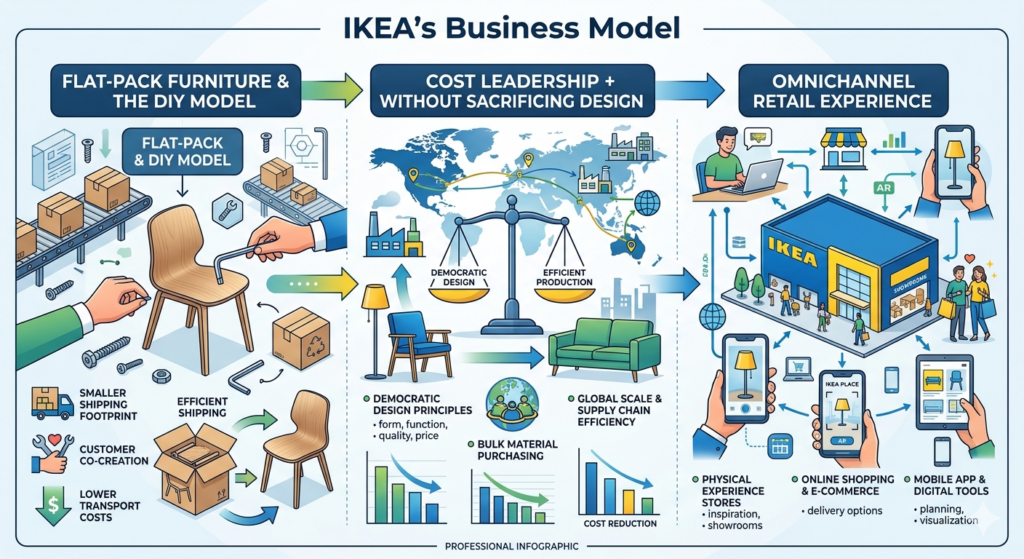
IKEA’s business model is built on cost leadership through design efficiency. Every product decision flows backward from a target price point, not the other way around. That’s unusual, and it’s the core reason the model works.
Flat-Pack Furniture and the DIY Model
The flat-pack concept is IKEA’s most important operational invention. By shipping furniture unassembled, IKEA fits more units into each truck, reduces damage in transit, and cuts the need for dedicated assembly staff at each store. Customers take the product home and assemble it themselves.
That last part sounds like a concession. It isn’t. Research from Harvard Business School found that people value things they’ve built more highly than pre-assembled equivalents, a documented psychological effect now called the “IKEA Effect.” The DIY model isn’t just cost-saving; it creates emotional investment in the product.
Cost Leadership Without Sacrificing Design
IKEA works differently from most furniture brands. Their designers start with a price target, then engineer the product backward to hit it. This is called “Democratic Design”, and IKEA defines it across five dimensions: Form, Function, Quality, Sustainability, and Low Price.
The BILLY bookcase, one of IKEA’s best-selling products with over 110 million units sold globally, has barely changed since 1979. That’s not laziness. It’s the kind of product consistency that comes from designing something right the first time.
Omnichannel Retail
IKEA’s in-store experience is deliberate. The maze-like layout isn’t accidental; it increases time spent in-store and exposes shoppers to more products per visit. The in-store restaurant isn’t a convenience feature; it’s a dwell-time strategy. Studies from retail analytics firm Insider Intelligence have documented that IKEA store visits last an average of 2+ hours, far above typical furniture retail.
Online, IKEA has invested heavily in its app, AR features, and streamlined checkout. The IKEA Place app (available on iOS and Android) lets users preview furniture in their actual rooms using augmented reality before purchase. That’s a real user problem solved, not a tech gimmick.
IKEA’s business model is based on cost leadership through design efficiency. Products are designed backward from a target price, manufactured at high volumes, and shipped flat-packed to cut logistics costs. This, combined with self-assembly, creates both operational savings and documented psychological value through what researchers call the “IKEA Effect” (Harvard Business School).
Also Read: How to create an Omnichannel Marketing Strategy
IKEA Marketing Strategy
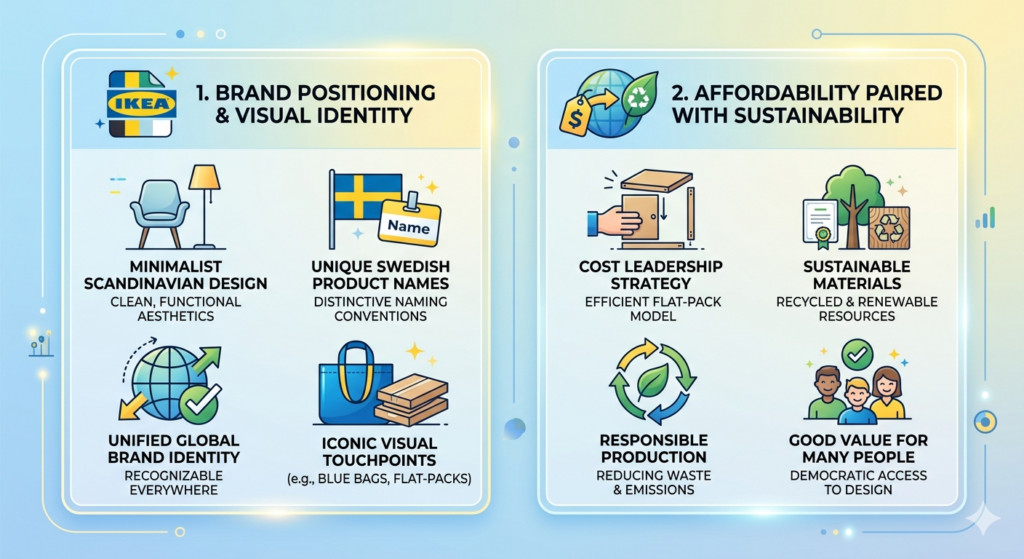
IKEA’s marketing strategy is built around one positioning: affordable Scandinavian design for everyone. Not for design enthusiasts. Not for premium buyers. Everyone.
That clarity makes every marketing decision easier. The brand tone is simple, warm, slightly self-aware, and always grounded in practicality. You don’t see IKEA running aspirational campaigns with unattainable lifestyles. You see real-looking spaces, real messes, and how IKEA fits in.
Brand Positioning and Visual Identity
The blue and yellow palette is one of the most recognizable color combinations in global retail. It mirrors the Swedish flag and travels consistently from store signage to packaging to digital ads. IKEA’s sans-serif typography and clean product photography maintain the same visual register across every channel.
Consistency at this scale isn’t easy. It requires real brand governance, especially across 63 markets with local agency partners managing execution.
Affordability Paired With Sustainability
IKEA’s “Low Price with Meaning” principle has been their answer to the inevitable question: cheap furniture with a conscience? Their buy-back programs, second-life furniture initiatives, and circular design goals are part of their People & Planet Positive strategy, which targets becoming “climate positive” by 2030.
This matters for marketing because sustainability isn’t a bolt-on message for IKEA. It’s built into how products are designed, how stores are operated (many run on renewable energy), and how their supply chain sources raw materials. Brands that bolt sustainability onto existing practices as a PR layer tend to get called out. IKEA, largely, doesn’t face that problem.
A Creative, Consistent Brand Theme
1. Visual Identity: Blue + Yellow, Bold Typography The color palette is unmistakable. IKEA’s bold use of primary colors and simple sans-serif fonts makes it instantly recognizable across the globe.
2. In-store vs. Digital Branding: What’s remarkable is how IKEA keeps its branding cohesive whether it’s in-store signage, catalogs, or social media content. Walk through a store, and you’ll feel the same energy that their Instagram grid delivers.
Also Read: Zara Case Study
Affordability + Sustainability
1. “Low Price with Meaning” Principle IKEA doesn’t just push cheap products, they push smart products at low prices. Each item is designed with intention and efficiency.
2. Circular Design and Second-Life Programs They’ve launched buy-back programs and refurbishing initiatives to encourage a longer product life. It’s not just about profit, it’s about responsibility.
3. Local Sourcing + Efficient Logistics Wherever possible, IKEA sources materials locally and operates regional warehouses. This reduces carbon footprint and ensures quicker delivery times.
Also Read: Advanced Perfromance Marketing Training
Sponsorships and Influencer Collaborations
1. Collaborations with Artists, Local Influencers From working with indie creators to global stars, IKEA keeps its collaborations unexpected. It helps them stay relevant in culture.
2. Strategic Product Drops Limited releases like the MARKERAD collection with Virgil Abloh created hype that you’d expect from streetwear, not furniture.
Other Notable Collaborations:
- IKEA x Sonos (smart speaker integration)
- IKEA x LEGO (creative storage solutions)
Also Read: Myntra Case Study
Exceptional In-Store Experience
1. Maze Layout Design Love it or hate it, IKEA’s maze-like layout increases the chance that shoppers see (and buy) more. It’s a psychological journey of inspiration.
2. Restaurant and Product Immersion The in-store restaurant isn’t just a pit stop, it’s a strategy. It increases dwell time and gives customers a taste of Swedish culture.
3. IKEA Family Loyalty Program Free memberships, member-only discounts, and exclusive previews, the program keeps buyers coming back.
Also Read: Cadbury Case Study
Website and App Marketing
1. Personalization and UX IKEA’s digital platforms prioritize seamless navigation, wishlist features, and personalized recommendations based on browsing behavior.
2. Mobile App + AR (IKEA Place) With AR integration, users can now visualize how furniture will look in their space before they buy. A great example of tech solving real user problems.
3. Streamlined Product Discovery Search filters, lookbooks, and guided navigation help users find exactly what they need, fast.
Also Read: Uniqlo Case Study
SEO Strategy of IKEA
IKEA’s SEO strategy quietly outperforms most eCommerce brands at scale. A brand with 480+ stores and millions of product pages needs a different SEO playbook than a DTC startup, and IKEA has built one that’s worth studying.
Local SEO at Scale
Every IKEA store location has an optimized Google Business Profile with consistent NAP data (Name, Address, Phone number), updated store hours, local photos, and review management. For high-intent searches like “furniture store near me,” IKEA regularly appears in the local 3-pack in cities where it operates.
Managing local SEO at this scale requires standardized processes, not manual effort. IKEA uses a combination of structured data markup, consistent location page architecture, and regularly updated business profiles to maintain local search presence across markets.
Long-Tail Product SEO
Instead of competing for broad terms like “sofa” or “dining table” (which are dominated by aggregators and have high CPCs in paid), IKEA targets long-tail queries tied to specific problems: “space-saving dining table for small apartment,” “children’s loft bed with storage,” “modular shelving for home office.”
These queries have higher purchase intent. The searcher already knows what they need. IKEA’s product page architecture, rich descriptions, and internal linking structure give them strong coverage across thousands of these variations.
Content-Led SEO Through Ideas Hubs
IKEA’s “Ideas” and “Tips & Advice” sections go beyond product catalogs. Content like “How to set up a home office in a small space” or “10 ways to organize a studio apartment” serves the searcher’s informational need while naturally referencing relevant products.
This approach captures traffic at the research phase of the buyer journey, well before someone is ready to search for a specific product name. It’s content marketing and SEO working together, not competing.
IKEA’s SEO strategy operates at three levels: local optimization for store discovery, long-tail product page coverage for high-intent searches, and lifestyle content hubs that capture informational queries at the research stage. This layered approach allows IKEA to compete effectively without relying on broad, high-competition keywords.
Also Read: Amul Case Study
Social Media Marketing of IKEA
IKEA’s social media presence works because the brand doesn’t try to be something it isn’t. It’s not chasing cultural relevance by reacting to every trend. It creates content that reflects how people actually live, and it meets them where they are.
Instagram: Aspirational but Grounded
On Instagram, IKEA posts clean, Scandinavian-styled spaces but intersperses them with real homes, real clutter, and practical transformation content. Carousel posts showing before-and-afters, Reels with home hacks, and Story Highlights organized by room or product range keep their content organized and discoverable.
Their visual consistency (muted palettes, natural light, whitespace) mirrors the offline store experience. That alignment between physical and digital brand feel is harder than it looks.
Follow @youngurbanproject for daily marketing insights, creative ideas, and real-world strategies that you can actually use.
Pinterest: Purpose-Built for Furniture Discovery
Pinterest is one of IKEA’s strongest organic channels. Users on Pinterest are actively searching for room ideas, DIY inspiration, and product combinations. IKEA’s boards segmented by room, budget, and mood create multiple entry points for discovery. Pins link directly to product pages or shoppable lookbooks, keeping the path from inspiration to purchase short.
According to Pinterest’s internal data shared in their 2024 Business Report, furniture and home decor remains one of the platform’s top-performing verticals for purchase intent. IKEA is one of the most-saved brands on the platform.
TikTok: Community-Led Content
IKEA’s TikTok presence is smart precisely because it doesn’t try to control everything. The brand amplifies what the community is already creating: IKEA haul videos, apartment makeovers, flat-pack assembly fails, FRAKTA bag hacks. The user-generated content machine does a lot of the heavy lifting.
When IKEA does create original TikTok content, it tends to follow formats that work natively on the platform rather than repurposing content from other channels. That distinction matters more than most brands realize.
Also Read: Starbucks Case Study
Content Marketing by IKEA
Content marketing at IKEA runs on a simple principle: don’t push products, solve problems. Then show how IKEA fits in.
Their “Life at Home” research series is a good example. It’s actual consumer research on how people globally think about their living spaces, published annually, with data from 37,000+ respondents across multiple countries. It’s genuine editorial content, not a content marketing vehicle dressed up as research. That distinction earns media coverage, backlinks, and brand authority simultaneously.
Their shoppable lookbooks are another well-executed format. Users scroll through styled room setups, and every product in the image is clickable. It merges editorial and commerce without the awkward handoff between “inspiration” and “buy.”
From what we’ve seen with YUP course learners who work in eCommerce, the brands that adopt this kind of content architecture (informational content linked to product pages, not the other way around) tend to see compounding SEO results over 6-12 months.
Also Read: Coca-Cola Case Study
Marketing Channels Overview
Let’s map out IKEA’s key marketing channels and how they balance them:
1. Owned Media
- Website: The core hub, smooth UX, rich content, mobile-first.
- App: IKEA Place, which uses AR to preview furniture in your space, plus standard shopping features.
- Email Marketing: Personalized newsletters with promos, ideas, and order updates.
2. Paid Media
- Google Ads: Heavy investment in Shopping Ads for product-level targeting.
- Meta Ads (Facebook + Instagram): For awareness, retargeting, and carousel-style product ads.
- Local Display: IKEA often geo-targets specific cities or store openings with digital billboards or hyperlocal mobile ads.
3. Earned Media
- PR and Media Coverage: Especially for new store launches or sustainability efforts.
- Influencer Collaborations: IKEA often works with lifestyle creators, interior decorators, and DIYers to create authentic, platform-native content.
- UGC (User-Generated Content): Some of IKEA’s best-performing content has come from its customers. When people share their DIY hacks or room makeovers, IKEA often reposts them, adding credibility and relatability.
Also Read: McDonald’s Case Study
Market Share & Competitive Analysis
IKEA is a market leader in Europe, with strong footholds in Asia and North America. But that doesn’t mean the competition is sleeping.
1. How IKEA Fights Local Players
In markets like India, IKEA faces agile local players who know the terrain better. IKEA’s counter? Hybrid retail models (offline + online), localized catalogs, and affordable pricing tailored to regional economics.
2. Competing With eCommerce Giants
Amazon and Wayfair are huge online furniture sellers, often beating IKEA on delivery speed. But IKEA bets on its in-store experience, product quality, and emotional brand equity, areas where faceless eCommerce platforms often fall short.
They’ve also improved last-mile delivery and integrated click-and-collect options to bridge the gap.
Also Read: Amazon Case Study
Top Competitors
- Wayfair: All-online, fast delivery, competitive pricing.
- Pepperfry (India): Strong in urban furniture + customizations.
- Home Depot: Great for furniture + DIY audience overlap.
- Amazon: The king of speed and convenience, but not emotion or curation.
Also Read: Zara Case Study
IKEA and Technological Innovation
IKEA isn’t flashy with tech. But it’s quietly been using innovation to solve real customer problems.
1. AR/VR Experiences
The IKEA Place app lets users visualize products in their actual rooms using AR. No more guessing if that LACK table will fit your corner.
In select markets, IKEA is also testing VR showrooms, so customers can browse room setups in 3D from home.
2. Smart Home Integration
With its Tradfri line, IKEA offers smart lights, blinds, and speakers that integrate with Apple HomeKit, Google Assistant, and Amazon Alexa. It’s affordable smart home tech for the masses.
3. Logistics Automation
Behind the scenes, IKEA’s supply chain is increasingly automated. From robotic warehouse sorting to AI-powered inventory management, it’s all geared towards keeping costs low and delivery fast.
Also Read: Apple Marketing Case Study
IKEA’s Product Offering Strategy
IKEA’s product strategy might look simple from the outside, minimalist furniture, affordable pricing, Scandinavian names, but under the hood, it’s incredibly layered.
1. Core vs. Experimental SKUs
The core lineup includes bestsellers like the BILLY bookcase, MALM drawers, or the LACK table, items that have stayed consistent for years. These are designed for mass appeal, easy manufacturing, and global scalability.
But IKEA also experiments. Whether it’s modular furniture for tiny homes or bold, artist-led collaborations, they regularly test new ideas without betting the farm.
Also Read: Tata Motors Case Study
2. Country-Specific Catalogs
IKEA doesn’t do one-size-fits-all. Its catalogs are localized, not just in language, but in taste, size preferences, and climate.
For example, in India, they introduced masala boxes and pressure cookers. In Japan, they made smaller furniture tailored to compact urban living. That’s smart adaptation, not compromise.
3. Limited Editions to Spark Urgency
Ever seen a line at IKEA before a collab launch? That’s not by accident.
Drops like IKEA x Virgil Abloh or IKEA x Sonos created hype, scarcity, and desirability. It’s a strategy borrowed from fashion but applied thoughtfully in furniture, and it works.
Also Read: Spotify Case Study
Key Strategies Behind IKEA’s Success
Let’s break this down to the nuts and bolts of what really makes IKEA tick.
1. Cost Efficiency via Flat-Pack Design
This is IKEA’s magic trick. By shipping products disassembled, they drastically cut logistics costs. It’s efficient for them, and oddly empowering for customers.
2. Economies of Scale
IKEA manufactures at insane volumes. That means they can negotiate better prices with suppliers and reinvest savings into affordability or innovation.
3. Strategic Global Sourcing
They source materials close to production hubs. This not only reduces transportation cost and emissions but also ensures flexibility in supply chains.
4. In-Store Psychology
The maze-like layout might seem confusing, but it’s by design. It encourages exploration, cross-category discovery, and impulse purchases. Throw in the restaurant at the midpoint, and you’ve created an experience, not just a shopping trip.
5. Commitment to Sustainability
They’ve pledged to become “climate positive” by 2030. This includes circular furniture programs, resale models, solar investments, and using more renewable/recycled materials.
These aren’t just PR plays, they align with growing consumer demand for responsible brands.
Also Read: Flipkart Case Study
Key Marketing Lessons for Brands and Founders
If you’re building a brand or running marketing for one, here’s what actually transfers from the IKEA playbook.
1. Design from a price constraint, not around one.
IKEA’s “price tag first” product development is unusual. Most brands design a product, cost it out, and then set a price. Working backward from price forces efficiency and creativity simultaneously.
2. The experience IS the marketing.
IKEA spends less on traditional advertising than its revenue would suggest, because the in-store experience generates word-of-mouth at scale. What happens inside the store is the campaign.
3. Consistency is a competitive moat.
IKEA’s visual identity, brand tone, and product philosophy have been consistent for decades. That kind of consistency is hard to replicate and becomes increasingly valuable over time.
4. Build content that serves the pre-purchase moment.
Their ideas hubs, lookbooks, and Life at Home research aren’t selling in the traditional sense. They’re building trust and capturing attention before someone is ready to buy. That’s where modern content marketing actually wins.
5. Localize execution, not positioning.
IKEA’s core positioning doesn’t change between Sweden and India. But the product catalog, store format, and marketing execution adapt for each market. That balance is hard to get right, and IKEA gets it right more often than most.

If you’re looking to upgrade your digital marketing game, or even start a whole new career path, check out the Digital Marketing Course Online by Young Urban Project.
It’s designed for the real world:
✔ Live classes (not boring pre-recorded stuff)
✔ 1-on-1 support when you actually need help
✔ Placement assistance to help you land real opportunities
You’ll learn everything from SEO and Meta Ads to the latest in Generative AI for Marketing, so you’re not just learning outdated theory, but mastering tools and strategies that brands are using right now.
With over 1000 learners, a 5-star Google rating, and a curriculum built to keep up with the fast-changing digital world, it’s definitely worth a look.
Also Read: Digital Marketing Training in Panchkula
Conclusion
At the end of the day, IKEA is more than a place to buy bookshelves and bed frames. It’s a brand that’s managed to turn something as ordinary as furniture shopping into an actual experience. You go there for a table, and somehow you leave with a lamp, meatballs, a house plant, and a hundred new ideas.
What makes IKEA so special isn’t just its low prices, it’s how every piece of the business is so thoughtfully put together. From how products are designed and shipped, to how stores are laid out, to how the website feels, everything works in sync. And behind that simplicity? There’s serious strategy.
For anyone building a brand today, especially if you’re in eCommerce, retail, or digital marketing, IKEA has loads of lessons. Focus on solving real problems. Keep your message clear. Know your audience, but don’t be afraid to surprise them. And when you use tech, make sure it actually helps the customer, not just your pitch deck.
IKEA has stayed relevant for decades because it constantly adapts without losing its core. That’s something a lot of businesses struggle with, and it’s why this case study still holds up in 2026 and likely will for years to come.
FAQs: IKEA Case Study
1. So, what exactly is IKEA’s business model?
It’s basically a cost-driven model built around self-service. IKEA designs affordable furniture that’s flat-packed for customers to take home and assemble themselves. That reduces costs big time, in storage, shipping, and staffing. They pass on those savings to customers while keeping decent margins. It’s all about volume + efficiency.
2. What are some of IKEA’s most popular products?
You’ve probably seen or owned a BILLY bookcase, it’s a classic. The MALM bed, KALLAX shelving unit, POÄNG chair, and LACK side table are also super popular. These products have been around forever because they’re simple, useful, and affordable. That combo works everywhere, from student apartments to family homes.
Q3. Who does IKEA compete with?
It depends on the region. Globally, Wayfair and Amazon are big digital competitors. In physical retail, brands like Home Depot, Target, and local furniture chains pose challenges. In India, it’s names like Pepperfry and Urban Ladder. IKEA holds up by combining the offline experience with solid digital offerings.
Q4. How does IKEA actually use technology?
Quietly, but effectively. Their IKEA Place app lets you see how furniture looks in your room using AR. They also make affordable smart home products like lights and blinds that work with Alexa or Google Assistant. Behind the scenes, they use automation in warehouses to keep logistics fast and efficient. No gimmicks, just practical stuff.
Q5. Who is IKEA really targeting?
Mostly urban folks, think young professionals, students, small families, and anyone looking to furnish a home without blowing their savings. They focus on people who value good design, simplicity, and functionality. And who don’t mind putting together a chair with an Allen key on a Sunday afternoon.