

Selling on Amazon is no longer a side hustle you can manage from a spreadsheet. Amazon now hosts close to 9.7 million registered seller accounts, and while most are dormant, only about 1.9 million are actively selling. That active pool is intensely competitive -and getting smarter every year.
The market has shifted in a way that rewards scale. According to Marketplace Pulse research, fewer than 8,000 sellers now generate half of Amazon’s estimated $300 billion in U.S. third-party GMV, representing just 1.6% of the active seller base. That concentration has nearly doubled in tightness since 2023. The sellers at the top aren’t outworking everyone else. They’re out-tooling them.
Amazon now has more than 100,000 sellers generating over $1 million in annual revenue, up from around 60,000 just a few years ago. What separates them from the rest isn’t always product quality or pricing. It’s data velocity -how fast they can find good products, optimize listings, adjust bids, and react to what competitors are doing.
That’s where Amazon seller tools come in. This guide covers every major category of software, breaks down the best tools in 2026 with real pricing, and gives you a framework to figure out which combination makes sense for your stage of business -without wasting money on overlap.
Table of Contents
What Are Amazon Seller Tools?
Amazon seller tools are third-party software platforms that connect to Amazon’s data via API and give sellers capabilities that Amazon’s native Seller Central does not provide. They cover everything from product research and keyword tracking to automated repricing, PPC bid management, and profit analytics.
Amazon seller tools are defined as software applications that integrate with Amazon’s marketplace data to help sellers make faster, more accurate decisions about product selection, listing quality, advertising performance, inventory levels, and overall business profitability.
They work by pulling data directly from Amazon’s Product Advertising API, Selling Partner API (SP-API), and third-party data aggregators, then presenting it in dashboards that are far more actionable than what Seller Central shows you by default.
Who should use them?
Practically anyone with an active Amazon selling business benefits from at least one dedicated tool. Free tiers on platforms like Keepa work fine at the research stage. By the time you’re managing five or more active SKUs, a paid tool typically pays for itself within weeks.
Why You Actually Need Specialized Tools
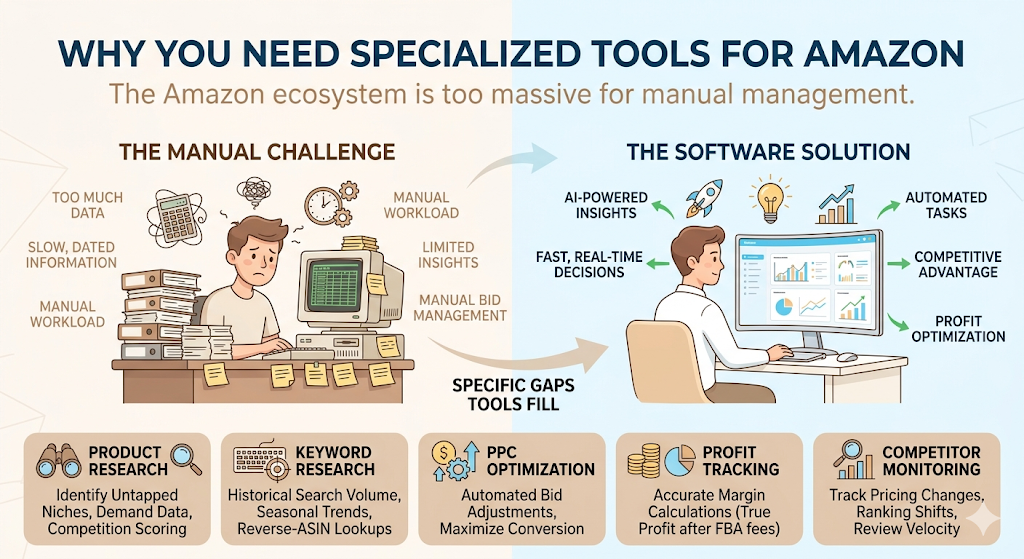
Here’s the honest reason: Amazon has too much data for any seller to process manually, and the pace of change is too fast for spreadsheet-based decisions.
Amazon’s global GMV is projected to exceed $700 billion in 2026, and the number of million-dollar sellers has nearly doubled since 2021, now exceeding 100,000 elite businesses. The sellers reaching those revenue levels aren’t manually checking competitor prices every morning.
Think about what a typical mid-size Amazon seller has to manage on any given day: product opportunity identification, keyword ranking changes, listing A/B tests, inventory reorder points, PPC bid adjustments, review monitoring, Buy Box win rate, and profit margins after FBA fees. That’s not a one-person job without software. Not at any meaningful scale.
A typical Amazon seller spends 15-20 hours per week on tasks that AI tools can reduce to 5-7 hours while delivering better results. That’s time redirected to sourcing, brand-building, and decisions that actually require human judgment.
The specific gaps third-party tools fill:
- Product research: Seller Central has no tool to surface untapped niches with demand data and competition scoring side-by-side.
- Keyword research: Amazon’s native keyword data is limited. Third-party tools show historical search volume, seasonal trends, and reverse-ASIN lookups that competitors don’t want you to see.
- PPC optimization: Manual bid management at scale is nearly impossible. Automation tools adjust bids hundreds of times a day based on real conversion data.
- Profit tracking: Seller Central’s reports mix revenue, fees, and refunds in ways that make true profitability hard to calculate. Dedicated tools show your actual margin per ASIN.
- Competitor monitoring: You can’t watch what your competitors are doing inside Seller Central. Third-party tools track their pricing, ranking changes, and review velocity.
Third-party Amazon seller tools fill the gaps that Seller Central does not address: granular keyword data, actionable profit analytics per ASIN, automated PPC optimization, and competitor intelligence. For sellers managing more than five active SKUs, a dedicated tool stack typically pays for itself within the first month.
The Different Types of Amazon Seller Tools
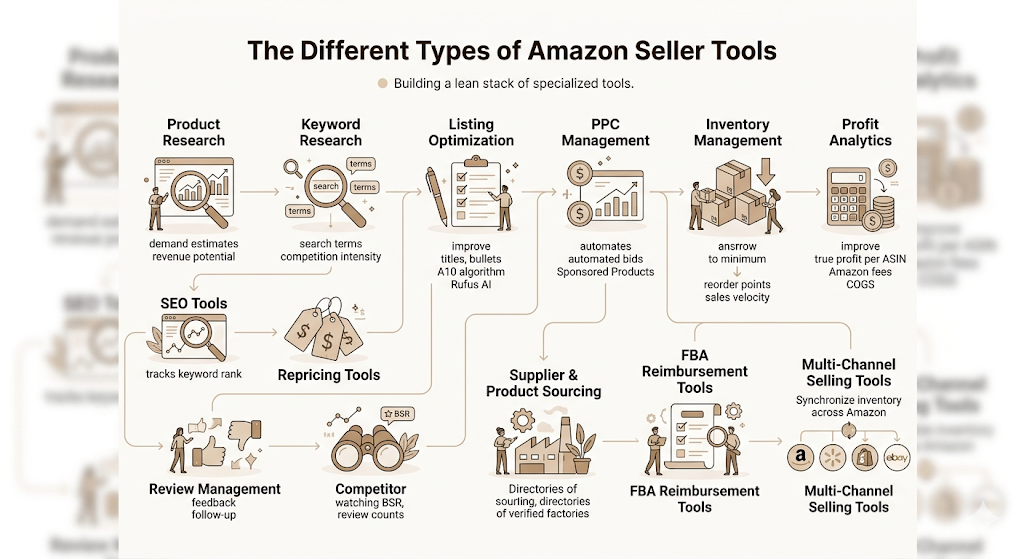
Most sellers underestimate how many distinct categories of software exist. Understanding the landscape helps you build a lean stack rather than buying an expensive all-in-one that does everything average.
Product Research Tools
These tools help you identify which products to sell before you commit to inventory spending. They show demand estimates, revenue potential, competition intensity, and trend trajectories. Examples: Helium 10 Black Box, Jungle Scout Opportunity Finder, AMZScout Pro Extension.
Keyword Research Tools
Keyword research tools for Amazon reveal what search terms buyers actually use, how often they search, and what the competitive landscape looks like for each term. They power both listing optimization and PPC targeting. Examples: Helium 10 Cerebro, MerchantWords, DataHawk.
Listing Optimization Tools
These take your product title, bullets, and description and improve them for Amazon’s A10 search algorithm and, increasingly, for Amazon’s Rufus AI shopping assistant. They suggest keyword placements, flag thin content, and some now generate full listing copy using AI. Examples: Helium 10 Scribbles, ZonGuru Listing Optimizer.
Amazon SEO Tools
Closely related to keyword research but more focused on tracking how your listings rank over time, and why rankings change. They monitor keyword position across multiple ASINs and alert you when you drop or gain rank for important terms.
PPC Management Tools
These are the automation-first tools that manage your Sponsored Products, Sponsored Brands, and Sponsored Display campaigns. Good ones adjust bids multiple times per day, harvest profitable keywords from auto campaigns, and shut down spend on terms that generate clicks without conversions. Examples: Helium 10 Adtomic, Teikametrics, Scale Insights.
Inventory Management Tools
Inventory tools track stock levels, calculate reorder points based on sales velocity, and some integrate directly with suppliers to automate purchase orders. Stockouts cost you ranking. Overstock ties up cash and incurs FBA storage fees. Examples: Sellerboard, SoStocked (now part of Carbon6).
Repricing Tools
Repricing tools adjust your price automatically in response to competitor price changes, Buy Box position, and your margin floor. AI-driven repricers respond in minutes rather than hours. Examples: BQool, Aura.
Review and Feedback Management Tools
These monitor incoming reviews, flag negative feedback for follow-up, and help sellers run legal review request sequences through Amazon’s Request a Review button. Examples: FeedbackFive, Helium 10 Follow-Up.
Profit Analytics Tools
Profit analytics tools import all your Amazon fees, ad spend, COGS, shipping costs, and refunds, then show you true profit per ASIN -not just revenue. Most sellers are shocked by what their actual margins look like when properly calculated. Examples: Sellerboard, ManageByStats.
Competitor Analysis Tools
These track what specific competitors are doing: their pricing changes, BSR movements, review counts, keyword ranking shifts, and new product launches. Examples: SmartScout, Helium 10 Market Tracker.
Supplier and Product Sourcing Tools
Tools that help you find and verify manufacturers and suppliers, primarily from directories of verified factories. Jungle Scout’s Supplier Database is the most widely used. Particularly valuable for private label sourcing.
FBA Reimbursement Tools
Amazon regularly makes errors -lost inventory, overcharged fees, damaged goods. FBA reimbursement tools identify and file claims on your behalf, typically on a commission basis. Examples: Seller Investigators (part of Carbon6), Helium 10 Refund Genie.
Multi-Channel Selling Tools
As 54% of Amazon sellers now also sell on at least one other marketplace, up from 42% in 2024 (Jungle Scout Seller Survey 2026), multi-channel tools that synchronize inventory and orders across Amazon, Walmart, Shopify, and eBay are growing in relevance. Examples: ChannelAdvisor, Linnworks.
Must-Have Features to Look For
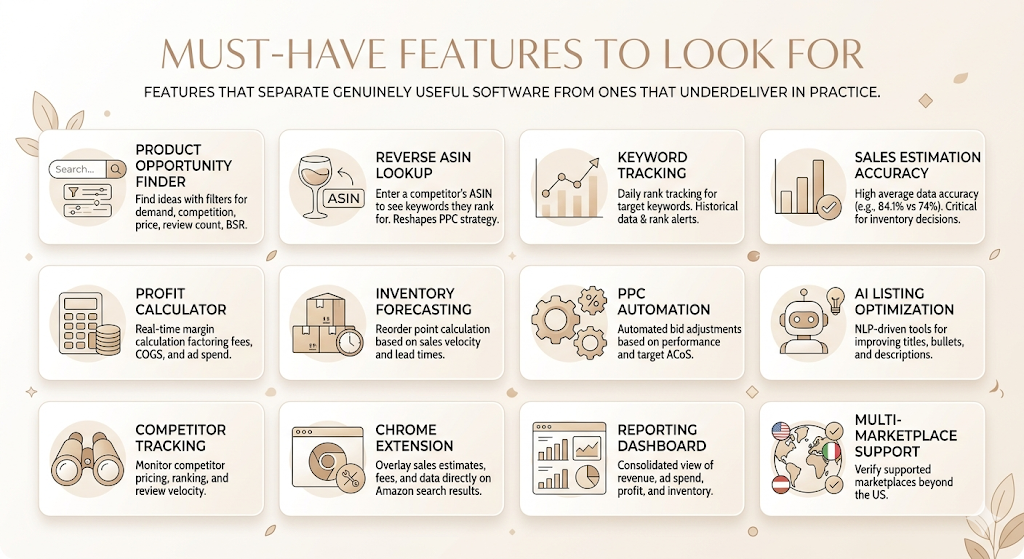
Not every tool needs every feature. But when evaluating any platform, these are the ones that separate genuinely useful software from ones that look good in demos but underdeliver in practice.
Product opportunity finder: A search tool with filters for demand, competition, price range, review count, and BSR -so you can surface product ideas without browsing category pages manually.
Reverse ASIN lookup: The ability to enter a competitor’s ASIN and see every keyword they rank for. This single feature alone can reshape your PPC strategy.
Keyword tracking: Daily rank tracking for your target keywords across your ASINs, with historical trend data and alert settings for significant rank changes.
Sales estimation accuracy: This varies widely between platforms. Jungle Scout’s average data accuracy is 84.1% across all metrics, compared to Helium 10 at 74% -a meaningful difference when you’re making inventory decisions.
Profit calculator: Real-time margin calculation that accounts for Amazon referral fees, FBA fees, COGS, and ad spend per unit.
Inventory forecasting: Reorder point calculation based on sales velocity and supplier lead times, with alerts before you hit critical stock levels.
PPC automation: Automated bid adjustments based on conversion data, keyword performance, and target ACoS (Advertising Cost of Sale).
AI listing optimization: NLP-driven tools that analyze top-performing listings in your category and suggest improvements to title, bullets, and description.
Competitor tracking: Ongoing monitoring of competitor pricing, ranking, and review velocity for specific ASINs.
Chrome extension: A browser extension that overlays sales estimates, FBA fees, and competition data directly on Amazon search results and product pages.
Reporting dashboard: Consolidated view of revenue, ad spend, profit, and inventory status without switching between multiple screens.
Multi-marketplace support: If you sell outside the US, verify which marketplaces the tool supports. Some platforms are US-only.
How These Tools Work Under the Hood
Understanding how the data is collected changes how you interpret what the tools tell you.
Data collection: Most tools connect to Amazon’s Selling Partner API, which gives them access to your account-level data (sales, inventory, ad performance). For market-level data -like search volume estimates -they use a combination of Amazon’s Product Advertising API and proprietary data models built on scraped and aggregated signals.
Sales estimation: No third-party tool has direct access to Amazon’s sales data. Estimates are built from BSR (Best Seller Rank) data using modelled relationships between rank and sales velocity. This is why accuracy varies -the models differ. Data accuracy is the only real moat left. If your sales estimate is off by 20%, storage fees and low-inventory surcharges will eat your entire margin, as Jungle Scout founder Greg Mercer noted.
Keyword analysis: Search volume estimates for Amazon keywords come from Amazon’s autocomplete data, Brand Analytics (available to Brand Registered sellers), and behavioural signals aggregated across tool user bases. The more users a platform has, the richer its keyword dataset.
Automation: PPC automation works through the SP-API, which allows approved software to create, pause, and modify campaigns on your behalf. The better tools use machine learning to adjust bids based on time of day, conversion rate, and ACoS targets -not just simple rules.
AI-powered recommendations: The newest generation of tools now use large language models to generate listing copy, interpret competitor review sentiment, and surface product opportunities based on gap analysis. Amazon’s Rufus AI shopping assistant and the Cosmo ranking system have changed how listings are discovered and evaluated, meaning sellers now need to optimize not just for traditional search ranking but for AI-mediated product recommendations.
Best Amazon Seller Tools in 2026
This is the section that matters most. Every tool below has been evaluated on features, pricing accuracy as of 2026, real user feedback, and the type of seller they serve best.
Helium 10
Overview: Helium 10 is the most comprehensive all-in-one platform for Amazon sellers. It covers product research, keyword research, listing optimization, PPC management, inventory, and profit tracking -all under one subscription. It’s the go-to for serious private label sellers who want one dashboard to run most of their business.
Key Features: Black Box (product research), Cerebro (reverse ASIN lookup), Magnet (keyword research), Scribbles and Frankenstein (listing optimization), Adtomic (PPC management), Alerts (competitor tracking), and Refund Genie (FBA reimbursement).
Pros: Widest feature set of any Amazon tool. Strong Chrome extension. Active seller community and training resources.
Cons: Helium 10 is not a suitable choice for beginners or sellers with a limited budget, especially given the price increases in 2026. Its learning curve is steep, and the feature volume can overwhelm new sellers. It can feel overwhelming for beginners and comes at a higher price point compared to alternatives.
Best For: Experienced private label sellers managing 10+ SKUs who want one platform rather than a tool stack.
Pricing: Helium 10 starts at $129/month for the Platinum plan as of 2026. Diamond and Elite plans are higher. A limited free account is available for testing.
Jungle Scout
Overview: Jungle Scout built its reputation on product research accuracy and beginner-friendliness, and that reputation holds in 2026. It has expanded into supplier sourcing, listing optimization, and basic inventory management while keeping its interface cleaner than Helium 10’s.
Key Features: Opportunity Finder, Product Tracker, Keyword Scout, Listing Builder, Supplier Database, and Sales Analytics.
Pros: For most sellers starting out, Jungle Scout’s Growth Accelerator plan at $49/month annually provides reliable keyword data, Supplier Database access, and all the core research tools needed to find and validate first products. Supplier Database is genuinely unique.
Cons: Less powerful than Helium 10 for PPC management. No free plan (only a 7-day money-back guarantee). Advanced listing features lag behind Helium 10.
Best For: New and intermediate sellers focused on product research and launching private label products.
Pricing: The Starter plan is $49/month, and the Growth plan at $79/month adds advanced analytics and higher usage limits.
SmartScout
Overview: SmartScout takes a fundamentally different angle from Helium 10 and Jungle Scout. Instead of starting from keywords, it starts from brands and sellers, giving you a top-down view of how Amazon’s marketplace is structured. It’s particularly powerful for wholesale and online arbitrage sellers.
Key Features: Brand and seller analysis across 43,000+ subcategories, Traffic Graph (showing where a product’s traffic comes from), Seller Map, and AI product discovery.
Pros: SmartScout is the undisputed leader for wholesale sourcing and brand intelligence. Its unique features give sellers a competitive edge that other tools can’t match. The Traffic Graph and Seller Map are capabilities that Helium 10 and Jungle Scout simply don’t offer.
Cons: Not built for private label beginners. Keyword research is secondary to market mapping. Can feel abstract without a clear wholesale or arbitrage use case.
Best For: Wholesale sellers, online arbitrage sellers, and brand managers who need category-level intelligence rather than individual keyword data.
Pricing: Starts at $25/month on annual billing.
Sellerboard
Overview: Sellerboard does one thing better than most all-in-one tools: profit analytics. It pulls in all your Amazon fees, advertising costs, COGS, and refunds and shows you actual margin per ASIN. The interface is clean and the data is granular.
Key Features: Real-time profit dashboard by ASIN, inventory management, PPC analytics, LTV tracking, and automated review requests.
Pros: Most affordable full-featured profit analytics tool available. 60-day free trial. Clean, easy-to-read dashboard. Excellent at surfacing which products are actually making money versus which ones look good on revenue.
Cons: Not a product research tool. No keyword tracking or listing optimization. You’ll need other tools alongside it.
Best For: Any seller who wants accurate profit tracking without paying Helium 10 prices for it.
Pricing: Starts at $15/month (annual billing), making it one of the best value tools in the market.
AMZScout
Overview: AMZScout is the budget-friendly product research option that covers the essentials without the complexity of Helium 10. It supports 14 Amazon marketplaces and is particularly well-suited to new sellers who want to validate product ideas quickly.
Key Features: Pro Extension (Chrome), Product Database, Keyword Tracker, and Stock Stats.
Pros: Clean interface, strong Chrome extension, accessible pricing. Good accuracy on sales estimates for high-volume products.
Cons: No PPC management. No listing optimization tools. Doesn’t go as deep on keyword data as Helium 10 or Jungle Scout.
Best For: New sellers on a tight budget who need product research without paying for features they won’t use for six months.
Pricing: AMZScout’s base plan starts around $32/month with significant discounts on annual plans.
ZonGuru
Overview: ZonGuru is a strong all-in-one alternative that emphasizes workflow: Niche Finder flows into Keywords on Fire, which flows into Listing Optimizer, which feels more guided than Helium 10’s open-ended interface. Review analysis groups customer complaints into recurring themes, so you can spot product improvements without reading every review. The AI listing writer pulls in target keywords and review insights to generate titles and bullets that match what buyers actually care about.
Key Features: Niche Finder, Keywords on Fire, Listing Optimizer (AI-powered), Review Automator, and Business Dashboard.
Pros: Guided workflow is less intimidating than Helium 10. AI listing tools are genuinely good. ZonGuru is an official Amazon partner through its SPN network.
Cons: Smaller feature set than Helium 10. Less data depth on keyword search volume at the high end.
Best For: Private label sellers who want a guided, structured workflow rather than an open-ended toolkit.
Pricing: Starts at $29/month (annual billing) with a 7-day free trial.
Keepa
Overview: Keepa is not a product research tool in the traditional sense. It’s a historical data tool, and that makes it something different -and irreplaceable.
Keepa tracks pricing history, stock movement, Buy Box fluctuations, and sales rank behaviour over time. This allows sellers to understand long-term product stability instead of relying only on current snapshots. A product might look profitable today, but show erratic pricing across the last 12 months -Keepa catches that.
Pros: Massive historical dataset going back years. Free base plan. Integrates with other tools as a validation layer.
Cons: Interface is dense and data-heavy. Not beginner-friendly. Not a standalone research tool -works best alongside Jungle Scout or Helium 10.
Best For: Any seller doing product validation. Arbitrage and wholesale sellers especially. Use it alongside your primary research tool, not instead of it.
Pricing: Free basic plan; paid plans start at around €19/month.
SellerApp
Overview: SellerApp is an all-in-one platform that covers product research, keyword research, listing optimization, and PPC management in one place. It’s positioned between budget tools and enterprise platforms.
Key Features: Product Intelligence, Keyword Research, Listing Quality Score, PPC Analyzer, and Business Reports.
Pros: Solid coverage across multiple function areas. Good for sellers who want a mid-market all-in-one without paying Helium 10 prices. Strong PPC reporting.
Cons: Less accurate sales estimates than Jungle Scout. Customer support response times can be slow.
Best For: Growing sellers who want an all-in-one at a lower price point than Helium 10.
Pricing: Starts at $39/month.
Teikametrics
Overview: Teikametrics is an enterprise-grade PPC automation platform. Its ARI (Artificial Retail Intelligence) engine that adjusts bids multiple times per day toward your stated goals, and its key differentiator is incrementality-aware bidding.
Teikametrics evaluates organic versus paid lift so it stops pouring spend into keywords you were already winning without ads. That is a genuinely smarter approach than the rule-based bidding most cheaper tools use.
Pros: Best-in-class PPC automation for high-volume sellers. Works across Amazon, Walmart, and TikTok Shop. Manages billions in ad spend annually.
Cons: Sellers under $5K a month routinely look at SellerApp or Helium 10 Adtomic instead. The 3% fee on ad spend over $10K per month erodes ROI for lower-margin brands.
Best For: Established Amazon brands spending $10K+ per month on advertising who need machine learning-driven automation, not rule-based bidding.
Pricing: Starts at $99/month base, plus 3% of ad spend over $10,000/month.
Scale Insights
Overview: Scale Insights is the PPC automation tool built specifically as an alternative to Teikametrics for sellers who don’t want ad-spend-based pricing. Scale Insights’ pricing model is tied to the number of ASINs you automate rather than your ad budget, regardless of spend level.
Key Features: AI bid management, dayparting (time-of-day bid adjustments), keyword harvesting from auto campaigns, and detailed ACoS tracking.
Pros: Predictable pricing that doesn’t scale with ad spend. Strong PPC automation without enterprise-level pricing.
Cons: Narrower feature set than full platforms like Helium 10. PPC-only -you’ll need other tools for research.
Best For: Sellers scaling PPC who want automation without the percentage-of-spend fee structure.
Pricing: Starts at $78/month with a 30-day free trial (no credit card required).
Carbon6
Overview: Carbon6 is really a suite of acquired tools wrapped into one company. SPS Commerce acquired Carbon6 for $210M in February 2025, so there’s real institutional backing behind the platform. Its tools include SoStocked (inventory), ManageByStats (analytics), PixelMe (external traffic attribution), and Seller Investigators (FBA reimbursement).
Carbon6 took a different approach: buy the best point solutions and stitch them into one platform. The result is an integrated Amazon seller suite covering inventory forecasting, PPC management, external traffic attribution, FBA reimbursement recovery, and Walmart expansion.
Pros: Best FBA reimbursement recovery in the market (claims 95.9% success rate on filed cases). Strong inventory forecasting via SoStocked. External traffic attribution is genuinely differentiated.
Cons: Each tool is priced separately, which can get expensive fast. The full suite can run $300–500/month or more, depending on the tools selected.
Best For: Established sellers looking for FBA reimbursement recovery, advanced inventory planning, and external traffic attribution in one ecosystem.
Pricing: Varies significantly by tool. SoStocked starts at $97/month; FBA reimbursement is commission-based (25% of recovered amount).
Carbon6’s FBA reimbursement tool (Seller Investigators) operates on a commission-only model, making it risk-free to start. The platform claims to have recovered $450M+ for Amazon sellers who didn’t know Amazon owed them money. For any FBA seller with significant volume, unclaimed reimbursements are a meaningful source of recovered profit.
MerchantWords
Overview: MerchantWords focuses purely on keyword data at scale, with one of the largest databases of Amazon search queries available to third-party sellers. It’s a keyword intelligence tool, not a full research platform.
Key Features: Global keyword database, seasonal search volume trends, ASIN Plus (keyword gap analysis), and Page 1 Products.
Pros: Excellent for content teams and listing writers who need keyword breadth rather than ASIN-level product data.
Cons: Not a product research tool. Limited integration with other workflows. Better as a supplement than a primary platform.
Best For: Sellers focused on listing optimization and keyword coverage who want a dedicated keyword database.
Pricing: Starts at $35/month.
SellerAmp (SAS)
Overview: SellerAmp is built specifically for online arbitrage and retail arbitrage sellers. It overlays product data directly on Amazon and retailer pages, showing you Buy Box prices, competition count, FBA fees, and profit calculations in one click.
Pros: SellerAmp at $19.95/month combined with Keepa’s free tier gives arbitrage sellers a powerful setup for under $20/month total. Extremely practical for sourcing runs.
Cons: Not useful for private label sellers. Focused narrowly on arbitrage use cases.
Best For: Online and retail arbitrage sellers who source from third-party retailers and need fast profitability checks.
Pricing: Starts at $19.95/month.
Feature Comparison Table
| Tool | Product Research | Keyword Research | PPC Management | Inventory | Profit Tracking | Starting Price | Best For |
| Helium 10 | ✅ Strong | ✅ Strong | ✅ Adtomic | ✅ | ✅ | $129/mo | All-in-one, private label |
| Jungle Scout | ✅ Strong | ✅ Good | ❌ | ✅ Basic | ✅ | $49/mo | Beginners, product research |
| SmartScout | ✅ Brand-level | ❌ Limited | ❌ | ❌ | ❌ | $25/mo | Wholesale, arbitrage |
| Sellerboard | ❌ | ❌ | ✅ Analytics | ✅ | ✅ Strong | $15/mo | Profit tracking |
| AMZScout | ✅ Good | ✅ Basic | ❌ | ❌ | ❌ | $32/mo | Budget beginners |
| ZonGuru | ✅ Good | ✅ Good | ❌ | ❌ | ✅ | $29/mo | Guided workflow |
| Keepa | ❌ | ❌ | ❌ | ❌ | ❌ | Free | Historical data validation |
| Teikametrics | ❌ | ❌ | ✅ Best-in-class | ❌ | ✅ | $99/mo + % | High-spend advertisers |
| Scale Insights | ❌ | ❌ | ✅ Strong | ❌ | ✅ | $78/mo | Mid-volume PPC |
| Carbon6 | ❌ | ❌ | ✅ | ✅ Strong | ✅ | $97/mo+ | Inventory + reimbursements |
| SellerAmp | ✅ Arbitrage | ❌ | ❌ | ❌ | ✅ | $19.95/mo | Arbitrage only |
Amazon Seller Tools vs Amazon Seller Central
Amazon has improved Seller Central meaningfully over the last two years. Amazon now offers built-in AI features like Dynamic Canvas and Enhance My Listing, making AI more accessible to everyday sellers. Brand Analytics (available to Brand Registered sellers) provides keyword data, purchase behaviour insights, and search funnel metrics that used to require third-party tools.
So, when is Seller Central enough?
Seller Central alone may be sufficient if you:
- Are you testing your first product with less than £500 in inventory
- Sell fewer than three active SKUs
- Are still learning how Amazon’s fundamentals work
- Run very low monthly ad spend (under $500)
You need third-party tools when:
- You’re researching product ideas and need competition and demand data
- You manage multiple SKUs and need accurate per-ASIN profitability
- Your ad spend exceeds $1,000/month and you want automated optimisation
- You’re tracking keyword rank changes over time
- You want competitor intelligence beyond what Brand Analytics provides
| Feature | Seller Central | Third-Party Tools |
| Sales reports | ✅ Basic | ✅ Detailed + ASIN-level profit |
| Keyword data | ✅ Brand Analytics (limited) | ✅ Full search volume + history |
| Product research | ❌ | ✅ |
| Competitor tracking | ❌ | ✅ |
| PPC automation | ❌ | ✅ |
| Inventory forecasting | ✅ Basic restock tool | ✅ Advanced velocity-based |
| FBA reimbursement | Manual | ✅ Automated |
| Price | Free | $15–$500+/month |
The honest answer is that Seller Central gives you the controls but not the intelligence. Third-party tools add the intelligence layer.
Amazon Seller Central is a management interface, not an intelligence platform. It tells you what happened. Third-party Amazon seller tools help you understand why it happened and what to do next. For any seller beyond the beginner stage, the two work together -not instead of each other.
Free vs Paid Amazon Seller Software
Not everything worth using costs money. But knowing where the free tier actually holds up versus where it becomes a liability matters.
| Factor | Free Tools | Paid Tools |
| Data accuracy | Variable, often limited | Generally higher (paid datasets) |
| Feature depth | Basic research, validation | Full stack -PPC, profit, automation |
| Usage limits | Strict (e.g. 5 searches/day) | Higher or unlimited |
| Automation | None | Core feature |
| Customer support | Community only | Dedicated support |
| Best use case | Testing, validation, and early research | Active selling at any meaningful scale |
The strongest free tools: Keepa (historical price data), Amazon Seller Central’s own Brand Analytics (for registered brands), and the limited free plan on Helium 10.
The general rule: start with free tools to learn the concepts, then move to paid when your product research starts informing real spend decisions.
How to Choose the Right Tool for Your Business
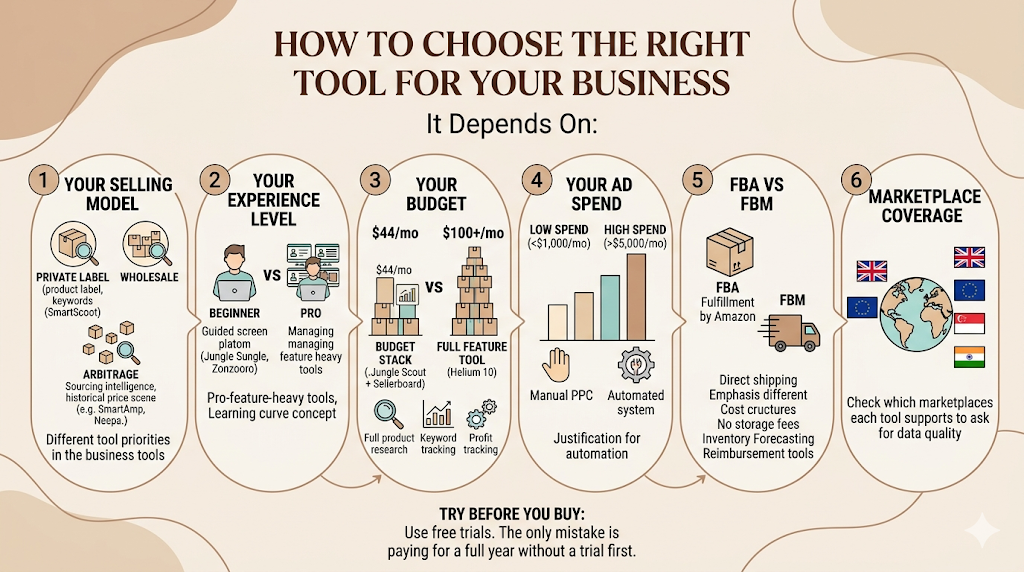
There’s no single right answer here, and anyone who tells you otherwise is trying to sell you something. The right tool depends on:
Your selling model: Private label needs different tools than wholesale or arbitrage. Private label sellers prioritize product research, keyword tracking, and listing optimization. Wholesale and arbitrage sellers need sourcing intelligence (SmartScout, SellerAmp) and historical price data (Keepa).
Your experience level: Beginners benefit from guided platforms like Jungle Scout or ZonGuru more than feature-heavy ones like Helium 10. The learning curve on Helium 10 is real, and most new sellers use 20% of its features.
Your budget: A stack of Jungle Scout ($29/month annual) plus Sellerboard ($15/month annual) totals $44/month and gives you full product research, keyword tracking, and accurate profit tracking -cheaper than Helium 10 alone with stronger profit analytics.
Your ad spend: Under $1,000/month, manual PPC management is manageable. Above $5,000/month, automation becomes financially justifiable very quickly.
FBA vs FBM: FBA sellers need inventory forecasting and FBA reimbursement tools. FBM sellers have different cost structures and don’t pay storage fees, so their tooling needs differ.
Marketplace coverage: Selling in the UK, EU, or India? Check which marketplaces each tool supports. Not all platforms cover all marketplaces with equal data quality.
Try before you buy: Almost every major tool offers a free trial. Use it. The only mistake is paying for a full year without running a trial first.
Common Mistakes When Buying Amazon Software
Most sellers who feel burned by their tools made one of these mistakes.
Buying too many tools that overlap: If you’re paying for Helium 10 and Jungle Scout simultaneously, you’re probably paying for two keyword research tools. Unless you have a specific reason for the overlap, that’s budget waste.
Choosing based only on price: The cheapest tool isn’t the right tool if its sales estimates are 30% off. One bad sourcing decision based on inaccurate data costs more than a year of a premium subscription.
Skipping free trials: Every major platform offers either a free tier or a trial period. There’s no reason to commit to annual billing without testing the product first.
Ignoring ROI: Tools need to pay for themselves. If a $129/month tool helps you find one product that generates $2,000 in monthly profit that you wouldn’t have found otherwise, the math is clear. Track what your tools are actually generating.
Not accounting for the learning curve: Helium 10 has a steep learning curve. If you subscribe and don’t invest time learning it properly, you’ll underuse it for months and then cancel, frustrated. Budget time for onboarding, not just money.
Paying for overlapping features: If your all-in-one tool has a profit analytics module and you’re also paying for Sellerboard, audit which one you’re actually using.
Tips to Get Maximum ROI From Your Tools
Build a lean stack, not a full one: Most successful sellers use 3-4 tools rather than 8-10. Identify the gaps in your workflow and fill those specifically.
Track KPIs weekly: If you’re not checking keyword ranking, ACoS, and profit per ASIN on a regular schedule, the tools become dashboards you pay for but don’t act on.
Automate the repetitive tasks first: PPC bid adjustments, inventory reorder alerts, and review request sequences are the highest-ROI automations. Set them up before anything else.
Monitor competitors consistently: Set up competitor tracking for your top five ASINs. Price changes, review spikes, and ranking gains from competitors all affect your business -and the right tools surface them immediately.
Use trial data to negotiate or cancel: Most tools allow you to export data. If you cancel a subscription, download what you can before you leave.
Use Keepa for validation regardless of your primary tool: Whatever primary platform you use for product research, run every serious product candidate through Keepa before committing. Historical pricing and rank stability data are too valuable to skip.
Future Trends in Amazon Seller Software
Amazon’s ad system is becoming predictive, analyzing conversion trends and competitor bidding patterns in real-time, making PPC automation tools more critical than ever. The software that powers those tools is getting smarter at the same rate.
Here’s where the category is heading:
AI-generated listing copy: Helium 10, ZonGuru, and AMZScout already offer AI listing writers. By the end of 2026, AI-drafted listings will be the baseline expectation, not a premium feature.
Rufus-optimized listings: Amazon’s Rufus AI shopping assistant and the Cosmo ranking system are changing how listings are discovered and evaluated. Sellers now need to optimize for AI-mediated recommendations in addition to traditional keyword ranking. Tools that help sellers optimize for conversational query formats will become essential.
Predictive demand forecasting: Advanced inventory systems forecast stockouts weeks in advance using live demand signals. AI tools that integrate with Amazon FBA inventory reports trigger restock alerts the moment projected sell-through hits 80%. This will become table stakes for any serious inventory tool.
Incrementality-aware PPC: The shift from rule-based to incrementality-aware bidding (already led by Teikametrics) will spread. Future PPC tools will measure whether paid ads are actually driving incremental sales or just capturing demand that would have converted organically anyway.
Cross-marketplace analytics: 54% of Amazon sellers already sell on at least one other marketplace (Jungle Scout Seller Survey 2026). Tools that unify inventory, advertising, and analytics across Amazon, Walmart, Shopify, and TikTok Shop will become a standard ask, not a differentiator.
Workflow automation: The next frontier isn’t smarter dashboards -it’s autonomous agents that take action. Tools that can identify a ranking drop, identify the cause, and implement a fix without human input are already in early development across the major platforms.
The direction of Amazon seller software in 2026 and beyond is toward AI systems that act, not just report. The shift from dashboards that show you what happened to agents that fix it in real time is underway. Sellers who learn how to supervise these systems rather than manage every task manually will have a structural efficiency advantage over those who don’t.
The Bottom Line
Amazon seller tools are no longer a competitive advantage. For anyone selling at any meaningful scale, they’re the table stakes. The market is more professional than it was three years ago, the data requirements are higher, and the sellers outperforming the competition are the ones who’ve built tight, well-chosen tool stacks -not necessarily the ones with the biggest budgets.
The smart move is to identify your current bottleneck, find the tool that solves it specifically, run the free trial, and measure ROI within 30 days. Don’t build a 10-tool stack on day one. Start with the gap that costs you the most time or money, and expand from there.
If you’re serious about growing your Amazon business with data-backed decisions, the tools are available. The question is whether you use them well.
FAQs
What are Amazon seller tools?
Amazon seller tools are third-party software platforms that connect to Amazon’s API and give sellers capabilities beyond Seller Central: product research, keyword tracking, PPC automation, profit analytics, inventory management, and competitor monitoring. They turn Amazon’s data into actionable decisions.
Which Amazon seller tool is best for beginners?
Jungle Scout is the most beginner-friendly paid option in 2026. Its interface is cleaner than Helium 10’s, its data accuracy is strong, and the Supplier Database is genuinely useful from day one. For sellers on a very tight budget, AMZScout or ZonGuru offer similar research capabilities at lower price points.
Are Amazon seller tools worth the investment?
Yes, for any seller beyond the exploration stage. A $49/month tool that helps you avoid one bad product sourcing decision typically justifies its entire annual cost in a single month. The ROI calculation gets even clearer at scale -automated PPC tools typically deliver ACoS improvements worth multiples of their subscription cost for sellers spending $3,000+ per month on ads.
Can I sell on Amazon without third-party tools?
Yes, especially at the start. Many sellers launch successfully using only Amazon Seller Central and Keepa (which is free). But the manual research and management time grows significantly as you scale, and data accuracy matters more as inventory investment increases. Third-party tools become harder to justify skipping above five SKUs.
What is the difference between Amazon Seller Central and Amazon Seller Software?
Seller Central is Amazon’s native management interface -it handles listing creation, order fulfillment, and basic reporting. Third-party Amazon seller software adds intelligence on top of that: market-level product research, historical keyword data, PPC automation, and competitor tracking that Seller Central doesn’t provide.
Which tools are best for Amazon product research?
Jungle Scout leads in data accuracy at 84.1%. Helium 10 Black Box offers the most filtering flexibility. SmartScout is best if you’re approaching research from a brand or category level rather than from individual keywords. For validation after research, Keepa’s historical data is irreplaceable.
Which Amazon seller tools help with PPC management?
For automation at scale: Teikametrics (enterprise) and Scale Insights (mid-market). For sellers within an all-in-one platform: Helium 10 Adtomic. SellerApp also has decent PPC tooling at a lower price point for smaller catalogues.
Are there free Amazon seller tools available?
Yes. Keepa offers a strong free tier for historical data. Helium 10 has a limited free plan. Amazon Seller Central itself (including Brand Analytics for registered brands) is free and more capable than many sellers realize. Free tools are useful for validation and learning -they become limiting when you need automation or deeper research capabilities.
Which Amazon seller tools are best for FBA sellers?
FBA sellers specifically benefit from inventory forecasting tools (SoStocked via Carbon6, Sellerboard), FBA reimbursement tools (Seller Investigators via Carbon6, Helium 10 Refund Genie), and profit analytics tools that account for FBA fee structures accurately (Sellerboard is the gold standard here).
How do I choose the right Amazon seller software?
Start with your selling model (private label vs arbitrage vs wholesale) and your biggest current bottleneck. If product research is slow, start with Jungle Scout or Helium 10. If your margins are unclear, start with Sellerboard. If PPC is eating your profit, look at Scale Insights or Teikametrics. Don’t buy what sounds impressive -buy what solves the constraint your business is actually hitting right now.