
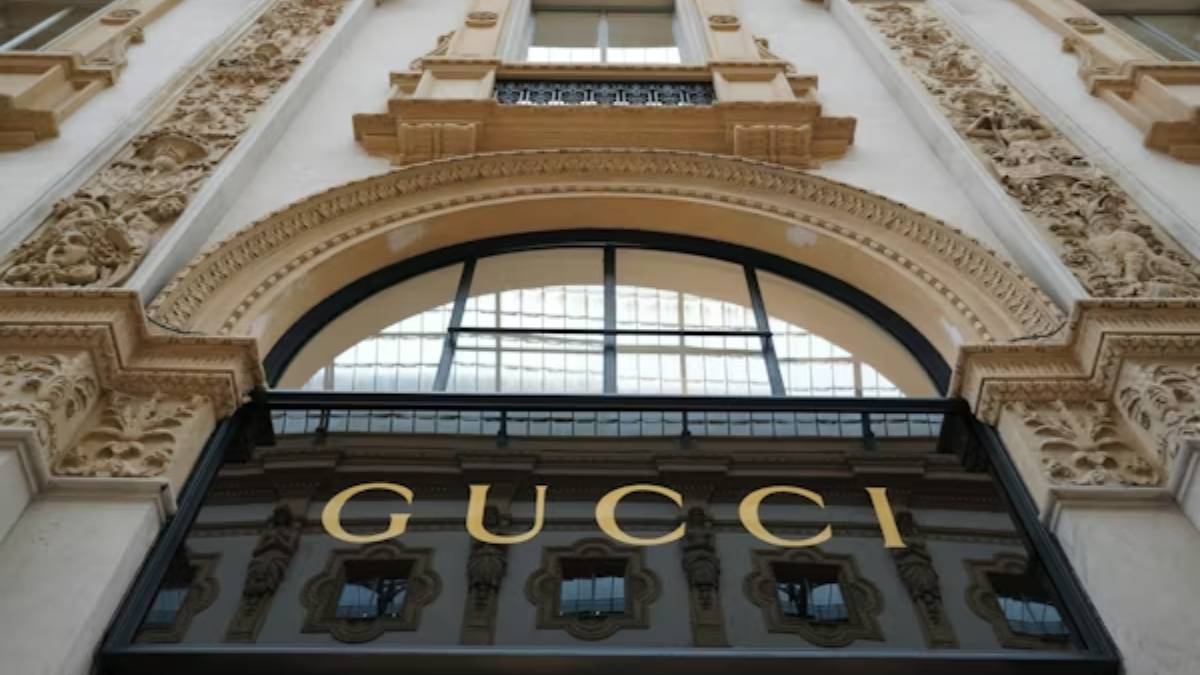
This Gucci case study breaks down one of the most studied and, honestly, most dramatic brand journeys in the history of luxury fashion. From a small leather goods shop in 1921 Florence, Gucci grew into a global powerhouse worth tens of billions. But it’s not a clean success story. There were family feuds, near-bankruptcy, multiple creative resets, and a very public revenue crash in 2023–2024.
This blog covers Gucci’s full arc: its marketing strategy, digital moves into the metaverse, sustainability commitments, revenue data, creative direction shifts, and what the brand is navigating right now. Whether you’re writing a Gucci case study for a course or just trying to understand how legacy luxury brands actually operate, this has the real numbers, the context, and the lessons, without the fluff.
Table of Contents
Introduction:
The Brand That Keeps Refusing to Die
There’s a reason Gucci shows up in business school decks, marketing podcasts, and rap songs in the same week.
It shouldn’t still be this relevant. A brand founded over a century ago, built around leather saddle bags, run for decades by a family that was eventually sued out of its own company, by all logic, it should be a niche archive label by now. Maybe a museum gift shop. But it’s not.
What the Gucci case study actually teaches, if you sit with it long enough, is something more useful than any single campaign breakdown: it’s a lesson in how a brand survives not by staying the same, but by reinventing itself just often enough, and just boldly enough, to stay in the conversation.
Right now, Gucci is going through one of those reinvention moments. Revenue fell in 2023 and dropped further in 2024. A new creative director came in. Then another. A new CEO took the seat in late 2024. The Chinese market, which had been a massive growth engine, went cold fast.
So this is a good moment to look closely at how Gucci got here, what’s actually worked, and what’s still an open question.
The Origin Story, And Why It Actually Matters for Marketing
Guccio Gucci Was Basically Doing Competitive Research Before It Had a Name
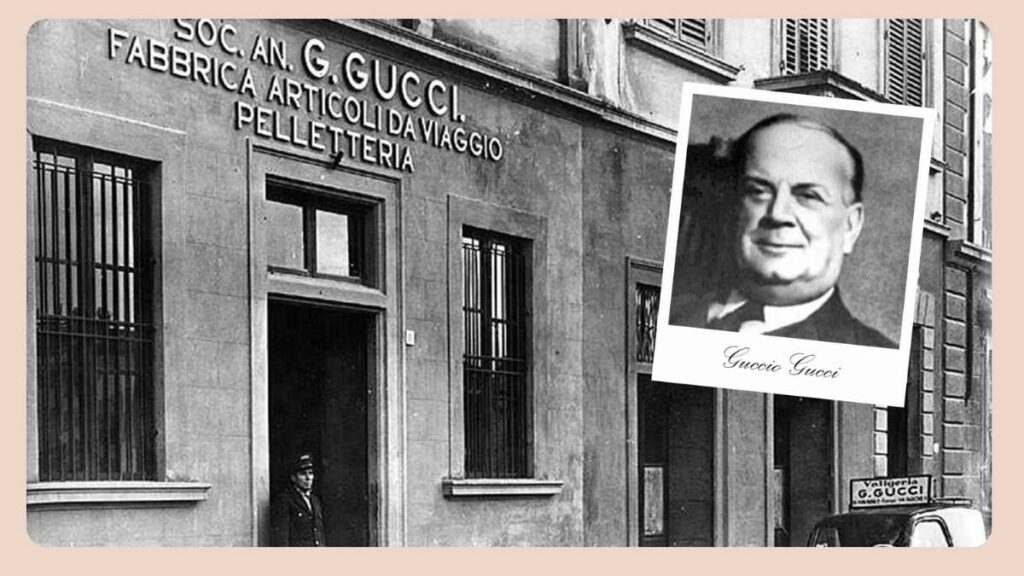
Gucci was founded in 1921 by Guccio Gucci in Florence, Italy. But here’s the part that doesn’t get mentioned enough: Guccio had observed the luggage and accessories used by wealthy travellers during his time working in London hotels. After returning to Florence, he opened a shop producing leather travel goods and equestrian-inspired accessories.
That’s not just a nice backstory. That’s a founder who understood aspiration before the word existed in marketing. He didn’t invent a product and hope people wanted it. He watched what wealthy people cared about, then built a version of that for them. That instinct, to understand the customer’s world before you design for them, is still at the core of how Gucci operates today.
The early products leaned heavily into equestrian imagery. Horsebit hardware. Stirrup motifs. Bamboo handles. The company started out as a leather goods manufacturer, dealing primarily in the sale of leather bags to people travelling on horseback. As methods of transport changed, so too did Gucci’s product offering. That last sentence is worth pausing on. The brand pivoted with its customer, not against them.
The Expansion Phase and What It Built
In 1953, Gucci opened its first store outside of Italy on Fifth Avenue in New York City. This milestone was soon followed by store openings in London, Paris, and Tokyo, marking Gucci’s emergence as a global luxury brand.
Under Aldo Gucci, Guccio’s son, the brand became a genuine status symbol. Celebrities wore it. Jet-setters carried it. The double-G logo became shorthand for a certain kind of success. Which is great, until it isn’t.
The Family Feud and Near-Collapse
This part of the story is genuinely messy. Following family feuds during the 1980s, the Gucci family was entirely ousted from the capital of the company by 1993. The brand had become overextended and was being heavily counterfeited. The logo was everywhere, which, in luxury, is usually not a compliment.
The recovery came through Tom Ford’s creative direction. Provocative, unapologetic, and completely unexpected for a heritage house. It worked. After this crisis, the brand was revived, and in 1999, Gucci became a subsidiary of Kering. Kering’s acquisition of Gucci began with a 42% stake in 1999, eventually leading to full ownership in 2004.
That corporate structure, sitting inside the Kering Group, is what gave Gucci the capital and stability it needed to reinvent itself not just once, but repeatedly.
The Revenue Reality, Where Gucci Actually Stands Financially
The Numbers First
In 2024, Kering’s Gucci brand generated a global revenue of about 7.65 billion euros. That sounds big, because it is. But context matters here.
As part of the Kering Group, Gucci contributes over 50% to its parent company’s revenue, with €9.9 billion in 2023 sales despite a 6% decline. So between 2023 and 2024, Gucci lost over two billion euros in revenue. That’s not a blip. That’s a structural problem the brand is actively trying to solve.
The negative trend was particularly evident in Q3 2024 when revenue decreased by 26% year-over-year. The downturn reflects not only internal challenges but also broader pressures in the luxury market, including shifting consumer preferences and economic uncertainty across many of its markets.
And the China situation deserves its own sentence: Gucci’s 38% year-over-year revenue decline in the Asia-Pacific region for Q3 2024 is the kind of number that makes boards nervous.
Brand Value vs. Revenue: The Gap Is Interesting
Even with that revenue decline, as of 2024, Gucci was the fourth most valuable luxury brand worldwide, behind Louis Vuitton, Hermès, and Chanel, with a brand value of about 23.8 billion U.S. dollars.
That gap, between brand perception and actual sales performance, is one of the most instructive things about the Gucci case study right now. The name still carries enormous weight. Converting that perception back into consistent revenue is the work.
Store Network and Headcount
In 2024, Gucci operated 529 stores with 20,032 employees. For comparison, Gucci operates 528 stores globally as of December 2022, featuring diverse luxury products like leather goods, shoes, and apparel, including 103 stores in Western Europe, 107 in North America, 73 in Japan, 181 in Asia-Pacific, and 64 in the Rest of the World.
The Asia-Pacific store count alone explains the exposure. When that market slows, Gucci feels it disproportionately.
What Actually Sells
More than half of the brand’s worldwide revenue comes from the sale of leather goods as of 2023. Shoes, ready-to-wear apparel, watches, and jewellery are the other main product categories. Despite all the digital experiments and metaverse launches, Gucci still runs on bags. That’s not a criticism, it’s just useful to remember when evaluating how the brand’s digital innovations actually fit into the overall business model.
Gucci’s Marketing Strategy, The Parts That Actually Worked
Going After Younger Buyers, Hard
The most consequential strategic call Gucci made in the last decade was betting on millennials and Gen Z when a lot of luxury brands were still treating those consumers as aspirational future customers, nice to have, not worth building around.
With 55% of Gucci’s sales coming from audiences aged under 35, their success in appealing to millennial consumers is evident.
That didn’t happen by accident. It required changing the visual identity of the brand, changing where it showed up (Instagram over print), changing who it worked with, and, crucially, changing what the products communicated culturally. Under Alessandro Michele, Gucci stopped feeling like your parents’ brand. It started feeling like a statement about identity, gender, art, and individuality.
Personalization That Goes Beyond “Hello, First Name”
Gucci’s focus on personalization in its marketing messages has greatly improved customer engagement and loyalty. By tailoring its communication to individual preferences, Gucci has increased the likelihood of conversions and repeat purchases.
AI-powered personalization, enhancing conversions by 18% through tailored recommendations, strengthens Gucci’s customer loyalty, leveraging its 340 million customer profiles.
340 million customer profiles. That’s not a CRM. That’s a serious data infrastructure, and Gucci has spent years building the capability to actually use it.
The Influencer Shift That Nobody Expected
Most luxury brands in 2024 were still chasing celebrities. Gucci moved in the opposite direction.
A key evolution in Gucci influencer marketing: a fashion content creator with just 42,000 followers delivered a 7.2% engagement rate, a far stronger result than mega-stars with over 50 million followers, whose campaigns brought in only 1.8% engagement.
Think about what that means practically. You’re paying a fraction of the price, reaching a smaller but more trusting audience, and getting four times the engagement. The math isn’t complicated. What’s hard is convincing a luxury brand, which has built its identity on being associated with the biggest names in the world, to bet on someone with 42,000 followers. Gucci did it anyway.
The 5% Rule: Budget Agility as Strategy
When Gucci saw its China numbers collapse in early 2024, it didn’t wait. Gucci moved about 15% of its China marketing funds to the U.S., where Gen Z consumers were still actively spending and engaging with luxury brands. This move contributed to a 3% net revenue increase, showing how agile budgeting can create immediate results.
They called it the “5% Rule”, a real-time reallocation method. Most large brands treat their media budgets as fixed. Gucci treated it like an investment portfolio: reduce exposure where returns are falling, double down where growth is happening. That’s the kind of operational nimbleness that doesn’t get talked about enough in marketing case studies.
Brand Collaborations as Revenue Architecture
Statistics show that 52% of companies engaging in brand collaborations earn 20% of their revenue through such partnerships. Gucci’s revenue has doubled since 2019, further reflecting the success of its brand collaborations in recent years.
One specific example worth citing: the Gucci x Oura ring partnership resulted in a product priced at nearly $1,000, significantly higher than the original Oura ring, priced at $250. This collaboration demonstrated Gucci’s ability to infuse luxury elements into everyday items.
That’s a 300% price premium applied to a tech product by simply putting the Gucci name on it. That’s what brand equity does in practice.
Omnichannel and E-Commerce Scale
Gucci’s e-commerce site received a staggering 100 million visitors in 2015, and online revenue for the Kering Group increased by 22% to $19.3 billion. The digital investment wasn’t just about brand image; it was a commercial channel that delivered real volume.

Enroll Now: Advanced Digital Marketing Course
Gucci in the Metaverse, First Mover, Real Results
This section of the Gucci case study tends to get oversimplified. People either dismiss the metaverse moves as PR stunts or overstate them as revolutionary. Reality is somewhere in the middle, with some genuinely impressive numbers attached.
The NFT Play and Gucci Garden
In May 2021, Gucci became the first luxury brand to release an NFT and partnered with Roblox to launch the immersive virtual experience Gucci Garden, which later received a Webby Award.
During the two-week Gucci Garden exhibition, 20 million users visited the space. Roblox users had the opportunity to explore Gucci Garden’s immersive themed rooms, as well as try on and purchase Gucci NFTs to be worn by their avatars.
The commercial angle is interesting: Gucci’s Queen Bee Dionysus virtual handbag sold for $4,000 on the Roblox platform, considerably more than the bag’s retail valuation. A digital item, no materials, no production cost, no shipping, sold for more than the physical equivalent. That’s either a sign of genuine brand desire or speculative mania or both.
Gucci Town: Making It Permanent
Rather than treating Roblox as a campaign medium, Gucci decided to build something that stays. Gucci Town includes Mini Game Heights, a Creative Corner for creating art pieces, an exhibition space called Vault Plaza, a shop that sells digital Gucci items, and a Power-up Place where community members can meet and interact. Users can earn in-game currency called GG Gems.
With Gucci Town, the luxury brand is looking to carve out a permanent space in Roblox that will evolve over time, demonstrating its commitment to the concept of a metaverse.
The Sandbox and Gucci Vault Land
Since the Gucci Garden launch, Gucci has expanded its digital footprint through various NFT initiatives, including Super Gucci with Superplastic, Gucci Vault on The Sandbox, and Gucci Cosmos Land, also in partnership with The Sandbox.
Gucci’s “Gucci Vault Land” in The Sandbox resulted in a 20% increase in online engagement and a notable spike in website traffic.
The AR Tool Becoming a B2B Revenue Stream
This one doesn’t get enough attention. The augmented reality try-on tool, originally developed to help Gucci customers preview products virtually, was later offered to competitors and partners as a white-label service. This move created a new revenue stream worth $10.5 million in 2024 alone.
That’s a luxury fashion brand becoming a tech vendor. Most companies build tools for their own use and stop there. Gucci looked at what it had built, realized it had value beyond its own use case, and monetized it externally. That’s not a marketing decision, it’s a business model expansion.
The Dream Big Team
In 2021, Gucci established the “Dream Big Team” to advance its metaverse and Web3 strategy. The team’s brief wasn’t just to produce activations, it was to chart a long-term course into digital ownership, virtual goods, and new consumer relationships. As the CEO put it at the time: Gucci is not afraid to be a first mover.
Sustainability, Genuinely Ambitious, Not Just Greenwashing (Mostly)

Luxury brands and sustainability are a complicated conversation. Gucci’s moves here are more substantive than most, but the tensions are real, too.
Carbon Neutral Since 2018
Gucci has been entirely carbon neutral since 2018. The company takes the remaining emissions across all the supply chain and offsets them into nature-based solutions that protect critical forests and biodiversity around the world.
That commitment covers Scopes 1, 2, and 3, meaning it includes the supply chain, not just Gucci’s own operations. That’s rare. A lot of brands claim neutrality while excluding their most emissions-intensive upstream activities.
Gucci Equilibrium and the Cultural Angle
Through its Gucci Equilibrium platform, the brand communicates its commitment to achieving a circular economy, carbon neutrality, and community empowerment, with a strong emphasis on gender equality, ethical supply chains, and climate action.
Gucci’s Changemakers initiative has impacted 9 million women and girls globally, empowering them with access to education, mentorship, and career opportunities in the fashion industry.
Measured Environmental Progress
Gucci’s Environmental Profit and Loss results revealed that the House reached a 44% reduction of total environmental impacts and a 47% decrease in greenhouse gas emissions, taking 2015 as a baseline, while surpassing its 2025 reduction target four years ahead of time.
The Gucci-Up circular programme recovered and regenerated around 27 tonnes of leather scraps between 2018 and 2020, in collaboration with non-profit organizations and social cooperatives in Italy. Between 2015 and 2020, 395 tonnes of textile waste from Gucci’s suppliers were collected and given new life in fashion’s supply chains.
Demetra, The Vegan Material Innovation
In 2021, Gucci debuted Demetra, an animal-free fabric made from plant-based and recycled raw materials. By 2023, its Horsebit 1955 bag in Demetra won PETA’s award for Best Vegan Bag.
Here’s the honest tension, though. Leather still accounts for almost 60% of Gucci’s sales. So the brand is making real innovation in materials while its commercial engine still runs almost entirely on animal products. That’s not a gotcha, it’s just the real picture. Sustainability in fashion is a direction of travel, not an arrival point.
Creative Direction, The Story Behind the Strategy
Alessandro Michele Changed Everything
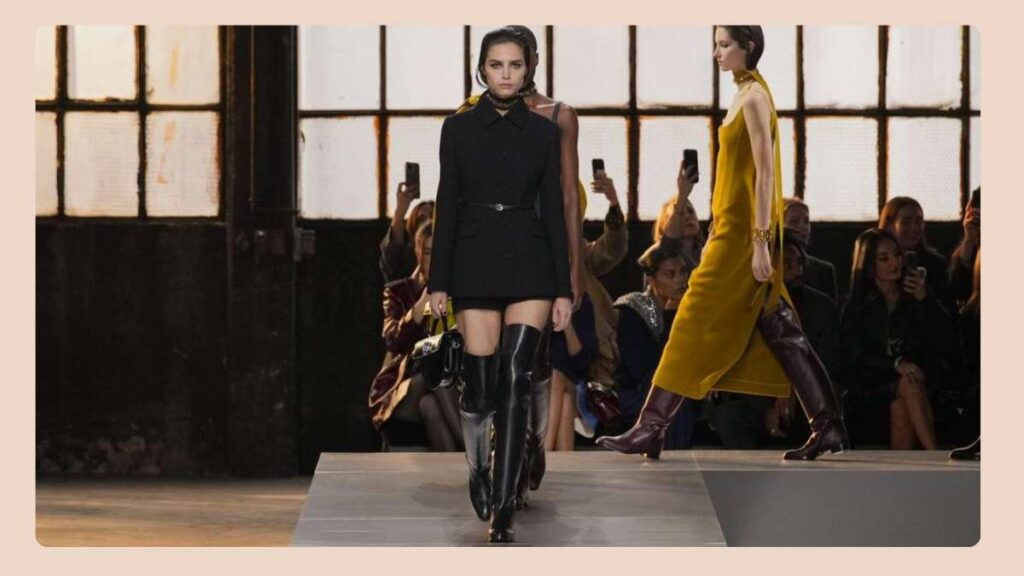
The appointment of Alessandro Michele as creative director in 2015 is probably the single most commercially impactful creative hire in luxury fashion in the last 20 years. His maximalist, gender-fluid, eccentrically Italian aesthetic was completely unexpected. And it worked in a way that’s hard to fully explain; it just resonated, deeply, with a generation of consumers who were tired of being told what luxury should look like.
Gucci’s revenue has doubled since 2019, further reflecting the success of its brand collaborations and marketing strategies in recent years. A significant portion of that growth was Michele’s creative vision translated into commercial reality.
Sabato De Sarno and the Quiet Reset
In January 2023, Sabato De Sarno was appointed creative director of Gucci to “reestablish Gucci’s edge” and “restore its brand equity.” His first collection, dubbed ‘Gucci Ancora,’ introduced a new It colour, the Gucci Rosso Ancora, a velvet burgundy with an oxblood hue.
But the market didn’t quite respond the way Kering hoped. Sell-through rates, a key retail performance metric, fell from 52% under Michele to 37% under De Sarno. When nearly a third of your inventory isn’t moving at full price, that’s a creative signal the market is sending loudly.
Demna: The Bold, Polarising Choice for 2025
Stefano Cantino has been CEO of Gucci since October 2024, and Demna has been creative director since March 2025. Demna, previously the creative director of Balenciaga, is one of the most provocative creative minds in fashion. His work is divisive by design. Whether that’s the right move for a brand trying to rebuild revenue is genuinely unclear, but it’s definitely a statement.
The Challenges Gucci Is Still Working Through
China Exposure
As of 2023, 39 percent of Gucci’s revenues were generated in the Asia-Pacific market. That’s not diversity, that’s dependency. And when China’s luxury consumption slowed significantly in 2024, Gucci’s 38% year-over-year revenue decline in the region for Q3 2024 showed exactly how exposed the brand was.
The Desirability Problem
Gucci’s sales growth slowed as the brand faced what analysts described as a “desirability gap”, a perception among high-net-worth consumers that the brand had become too accessible, too visible among aspirational buyers whose adoption the most discerning luxury customers tend to flee.
This is the classic luxury paradox. Growth requires wider adoption. Wider adoption threatens exclusivity. And once exclusivity is perceived to be gone, the core high-net-worth customer, the one who actually drives margin, starts drifting toward Hermès or a quieter niche label. Getting that customer back is harder than getting them in the first place.
Creative Transition Risk
Every time a luxury brand changes its creative director, there’s a window where neither the old customer nor the new customer is fully committed. Michele’s fans aren’t necessarily Demna’s fans. And Demna’s fans aren’t necessarily ready to spend €2,000 on a Gucci bag. That transition risk is real, and Gucci is navigating it in public.
What the Gucci Case Study Actually Teaches Us
Enough with the neutral summaries. Here’s what actually stands out.
Heritage without active management is just nostalgia. Gucci’s 100+ year history is an asset, but only because each generation of leadership found a way to make it feel current. Archive-only brands stagnate. Gucci kept dragging its past into the present.
The 5% Rule is something most brand teams could use right now. Treating a marketing budget like a static plan is wasteful. Real-time reallocation, pulling money from underperforming markets and deploying it where demand actually exists, created a 3% revenue lift in a down year. That’s not a small thing.
Nano-influencer ROI beats celebrity ROI at a fraction of the cost. The 7.2% vs 1.8% engagement data is not surprising to anyone who has run influencer campaigns at scale. What’s notable is that Gucci, a brand that built its cachet on celebrity association, was willing to act on that insight and restructure its approach.
Digital innovation can create business models, not just marketing moments. The AR tool becoming a $10.5 million B2B revenue stream in 2024 is the kind of outcome most brand teams don’t even think to plan for. Building for your own use first, then licensing to others, is a playbook that works in tech. Gucci proved it can work in fashion, too.
Sustainability needs to be structural to be credible with younger consumers. Carbon neutral since 2018, with a 44% reduction in environmental impact and measurable supply chain data, that’s not a PR position. That’s an operating commitment. The brands that treat sustainability as a campaign will get found out. The brands that build it into operations have a durable advantage.
Conclusion
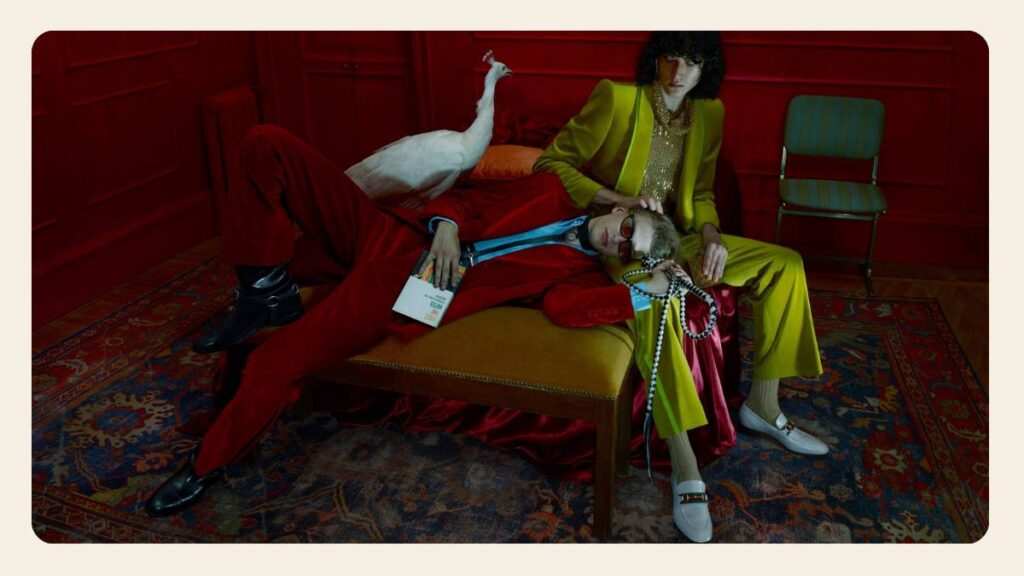
The Gucci case study is not a clean story of brilliance. It’s a story of repeated near-failures followed by hard decisions, bold hires, and enough creative courage to risk alienating loyal customers in pursuit of new ones.
Right now, Gucci is in one of those hard moments again. Revenue is down, creative direction is freshly changed, and the luxury market is more complicated than it’s been in years. But Gucci has been in hard moments before, in the 1980s, in the early 2000s, and again when Michele left. Each time, it found a way through.
Whether Demna’s vision reconnects the brand with high-net-worth consumers, whether the China market recovers, and whether the digital investments translate into durable commercial returns are open questions. But what’s not in question is that Gucci has both the institutional muscle and the brand equity to fight for relevance in a way that very few luxury houses can.
For anyone studying brand strategy, marketing, or business management, this is one of the best ongoing case studies available. Not because it’s a success story. Because it’s a real one.
FAQs: Gucci Case Study
1. When was Gucci founded, and who started it?
Gucci was founded in 1921 by Guccio Gucci in Florence, Italy. Guccio had worked at London’s Savoy Hotel before returning to Italy, where his observation of wealthy travellers’ luggage inspired him to open a leather goods workshop. That equestrian-inspired craftsmanship became the foundation of what is now one of the world’s most valuable luxury brands.
2. Who owns Gucci today?
Gucci is owned by Kering, a French luxury conglomerate. Kering acquired a 42% stake in Gucci in 1999, completing full ownership by 2004. The Kering portfolio also includes Balenciaga, Bottega Veneta, Saint Laurent, and Alexander McQueen. Gucci has consistently been Kering’s largest revenue-generating brand, contributing more than half of the group’s total revenue in most years.
3. How much revenue does Gucci generate?
In 2024, Gucci generated approximately €7.65 billion in global revenue, down from €9.9 billion in 2023. The decline was driven by a combination of factors, including a significant slowdown in the Chinese luxury market, a creative direction transition, and broader macroeconomic pressures across key luxury markets in Europe and Asia-Pacific.
4. What is Gucci’s current brand value?
As of 2024, Gucci’s brand value stands at approximately 23.8 billion U.S. dollars, ranking it fourth among the world’s most valuable luxury brands, behind Louis Vuitton, Hermès, and Chanel. Despite the recent revenue challenges, the brand’s global recognition and cultural weight have kept its valuation relatively stable compared to its commercial performance dip.
5. Who is Gucci’s target customer?
Gucci targets affluent consumers, with around 55% of its sales coming from buyers under the age of 35. The brand has deliberately oriented itself toward millennials and Gen Z through digital-first marketing, cultural collaborations, and inclusive creative direction. It still serves traditional high-net-worth luxury consumers, but its growth strategy has long been anchored in younger demographics.
6. Who are Gucci’s creative directors throughout history?
Key creative directors include Tom Ford (1994–2004), who revived the brand after near-collapse; Alessandro Michele (2015–2022), whose maximalist aesthetic drove the brand’s biggest commercial growth period; Sabato De Sarno (2023–early 2025), whose quieter vision underperformed commercially; and most recently Demna, who took over as creative director in March 2025, bringing a more provocative aesthetic from his Balenciaga tenure.
7. What is Gucci’s digital marketing strategy?
Gucci combines AI-driven personalization, social media campaigns, nano-influencer partnerships, and immersive digital experiences. The brand maintains a major e-commerce presence and has invested deeply in AR try-on technology, which it later licensed to third parties as a revenue stream. Its digital strategy is centred on reaching younger consumers where they already spend time, including gaming platforms and social media channels.
8. What is Gucci Equilibrium?
Gucci Equilibrium is the brand’s sustainability platform, launched alongside its 2018 carbon neutrality commitment. It tracks and publicly reports Gucci’s environmental and social progress, covering greenhouse gas reductions, supply chain transparency, circular economy initiatives, and community programmes. The Changemakers initiative under this platform has reached 9 million women and girls globally through education and mentorship.
9. Is Gucci genuinely carbon neutral?
Gucci has declared itself carbon neutral across its entire supply chain since 2018, covering Scopes 1, 2, and 3 of the Greenhouse Gas Protocol. This is achieved through emissions reduction programmes plus offsetting remaining emissions via REDD+ forest protection projects. By 2020, Gucci had achieved a 44% reduction in total environmental impact versus its 2015 baseline, surpassing its 2025 target four years early.
10. What was the Gucci Garden on Roblox?
Gucci Garden was an immersive virtual experience launched on Roblox in May 2021 to mark Gucci’s 100th anniversary. The two-week activation drew over 20 million visitors and allowed users to explore virtual rooms, try on digital Gucci fashion, and purchase collectible items. Notably, a virtual Gucci handbag sold for $4,000 on the platform, more than its physical retail price, highlighting the commercial potential of digital luxury goods.
11. Why did Gucci’s revenue fall in 2023 and 2024?
Gucci’s revenue decline was driven by a slowdown in Chinese luxury consumption, a perceived desirability gap as the brand had become too widely visible for its highest-net-worth customers, disruption from a significant creative leadership change, and broader macroeconomic softness. Q3 2024 saw a 26% global revenue decline year-over-year, with a 38% drop specifically in Asia-Pacific.
12. What marketing lessons can be drawn from the Gucci case study?
The most actionable lessons include: real-time budget reallocation outperforms static media planning; nano-influencers deliver better engagement ROI than celebrity endorsements; heritage brands need active creative management to stay culturally relevant; digital tools can be monetized beyond their original purpose; and sustainability commitments need to be structural and measurable to hold credibility with younger consumers.
13. How does Gucci approach influencer marketing?
Gucci shifted its influencer strategy in 2024, moving away from high-cost celebrity endorsements toward smaller, more engaged creators. A nano-influencer with 42,000 followers delivered 7.2% engagement versus 1.8% from a campaign featuring a mega-star with over 50 million followers. This reflects a data-driven understanding that authentic community connection generates better commercial results than reach alone.
14. What are Gucci’s main product categories?
Leather goods account for more than half of Gucci’s global revenue, with shoes, ready-to-wear apparel, watches, jewellery, fragrances, and accessories making up the rest. The brand also sells eyewear and fragrances under licensing arrangements. Despite significant investment in digital products and virtual fashion, the physical product range, particularly bags and leather goods, remains the commercial core of the business.
15. Who leads Gucci currently?
As of late 2024 and into 2025, Stefano Cantino serves as Gucci’s CEO, having taken over from interim CEO Jean-François Palus in October 2024. Demna became creative director in March 2025, taking the brand in a new aesthetic direction after the Sabato De Sarno chapter. Gucci remains a subsidiary of the Kering Group, led by François-Henri Pinault.