
ElevenLabs is still one of the best voice AI platforms on the market. That needs saying upfront, because most “alternatives” articles pretend the incumbent is bad to make the list feel more useful. It isn’t bad. It has the deepest voice library, the most polished studio tools, and a dubbing and sound-effects suite nothing else on this list fully matches.
But “best” and “right for you” aren’t the same question. Teams running high-volume voice agents need latency ElevenLabs’ cloud architecture wasn’t built for. Teams burning through six figures a year in API costs need a cheaper engine that still sounds good. Teams in regulated industries need to self-host, full stop, no cloud dependency at all. This article is for those teams.
We verified every price, license, and benchmark claim below against ElevenLabs’ own documentation and at least two independent sources dated within the last two months. Where sources disagreed, we’ve flagged it rather than picked the number that looked best.
Table of Contents
How to Choose the Right ElevenLabs Alternative
The right alternative depends entirely on what you’re building, and the four buckets below cover almost every real use case.
Content creation (YouTube, podcasts, courses, audiobooks): prioritise voice quality and ease of use over raw latency. A two-second delay before audio generates doesn’t matter if you’re producing pre-recorded content.
Real-time voice agents (customer support bots, IVR, conversational AI): latency is the dominant variable. A 300ms delay before the first word of audio is the difference between a conversation feeling natural and feeling broken.
Enterprise and regulated industries (healthcare, finance, legal): compliance certifications, data residency, and audit trails matter more than voice quality or price. You’re often choosing based on what your compliance team will approve, not what sounds best.
Zero-budget or self-hosted: you want full control, no per-character billing, and you’re willing to run your own GPU infrastructure. Open-source models are the only real option here.
The right ElevenLabs alternative depends on the dominant constraint for your use case, latency for real-time voice agents, cost-per-character at scale for high-volume content, or self-hosting for regulated industries, rather than any single “best overall” pick.
Read more: Why Compression Is A Must: Speed, Storage & Sharing Videos in 2026.
ElevenLabs Pricing in 2026 (Baseline)
Worth establishing this first, since every comparison below is relative to it. As of August 2026, verified directly against ElevenLabs’ pricing page: Free tier gives 10,000 credits a month (roughly 10 minutes of audio), no commercial license. Starter is $6/month for 30,000 credits and commercial rights. Creator is $22/month for 121,000 credits and Professional Voice Cloning. Pro runs $99/month for 600,000 credits. Scale and Business tiers scale further with custom enterprise pricing available.
On the API side specifically, ElevenLabs charges roughly $0.05 per 1,000 characters on Flash and Turbo models, and $0.10 per 1,000 characters on Multilingual v2 and v3, which works out to $50-$100 per million characters depending on the model.
That API rate is the number most of the alternatives below are competing against directly.
10 Best ElevenLabs Alternatives, Compared
Closed-Source and Commercial
1. Cartesia (Sonic 3) — Best for Real-Time Voice Agents
Cartesia is a developer-focused voice AI platform built on state-space models rather than the transformer architecture most TTS engines use, which is the technical reason it wins on latency. Sonic 3 claims sub-90ms time-to-first-audio, with independent measurement putting real-world streaming latency closer to 166-190ms, still meaningfully faster than ElevenLabs Streaming’s roughly 335ms.
Pricing starts free at 20,000 credits a month for personal use, with a Pro tier around $5/month for commercial use and voice cloning, scaling up to a Scale plan at $299/month for 8 million credits. That works out to roughly $5-$37 per million characters depending on tier, cheaper than ElevenLabs across the board. Cartesia also lists HIPAA, SOC 2 Type 2, GDPR, and PCI compliance, which is unusually thorough for a company this size and matters if you’re building in healthcare or finance.
Best fit: teams building phone agents, customer service bots, or any application where response time is the product experience, not an afterthought.
2. Fish Audio — Best Quality-to-Price Ratio
Fish Audio’s S2 Pro model is the most credible open-source-adjacent challenger to ElevenLabs on raw quality, and the evidence for that claim is unusually solid. In Fish Audio’s own blind A/B testing across more than 71,000 paired comparisons, S2 Pro beat ElevenLabs V3 roughly 60% to 40% in listener preference. Independent benchmark aggregators place the two closer together on crowdsourced arena scores, with ElevenLabs still ranking slightly ahead on the Artificial Analysis Speech Arena. The honest read: it’s close, and Fish Audio wins more often than not in longer, production-length listening tests specifically.
Fish Audio’s S2 Pro model and ElevenLabs V3 are close enough in blind listening tests that quality alone shouldn’t decide between them, but Fish Audio’s API pricing at roughly $15 per million characters, compared to ElevenLabs’ $50-100 per million, makes it the stronger choice for anyone shipping voice at real volume.
Fish Audio charges $15 per million characters on the API, a self-hostable open model line, and a Plus subscription around $11/month for regular creator use. Voice cloning needs just 10-30 seconds of reference audio, faster than ElevenLabs’ minimum. Where ElevenLabs still wins outright: long-form English narration with consistent prosody across 90-plus minutes, and its larger curated voice marketplace.
Best fit: teams that need ElevenLabs-adjacent quality at a fraction of the cost, especially at volume.
3. Murf AI — Best for Business Voiceovers
Murf is built for non-technical teams producing polished voiceovers, not developers building voice infrastructure. It’s the only platform on this list with native integrations into Canva, PowerPoint, and Google Slides, which matters enormously if your team is marketing or L&D rather than engineering.
Pricing runs Free (10 minutes total, no downloads or commercial rights), Creator at $19/month annual billing (24 hours of voice generation per year), Business at $66/month annual (96 hours per year), and custom Enterprise. The API is billed separately at $0.03 per 1,000 characters. One real limitation: voice cloning is locked behind the Enterprise tier, typically $1,000-5,000+ per year, a genuine disadvantage against ElevenLabs’ $5-6/month starting point for cloning.
Best fit: marketing teams, e-learning producers, and anyone who wants a polished editor over API flexibility.
4. Speechify — Best for Content Consumption, Not Creation
Speechify solves a different problem than the rest of this list. It’s primarily a reading tool, turning articles, PDFs, and documents into audio for people who prefer listening, students, professionals with ADHD or dyslexia, busy readers. Its Studio product, a separate subscription, handles voiceover creation more in line with the rest of this list.
Speechify Premium (the reading product) runs $139/year or $29/month, with a Studio tier starting around $19/month for voiceover creation. It includes 200+ voices and speeds up to 4.5x for content consumption.
Worth flagging: Speechify has documented billing friction in user reports, auto-renewal at full price and a multi-step cancellation flow, so read the terms before committing to annual billing.
Best fit: individuals who want to listen to written content, not teams producing voice content for others.
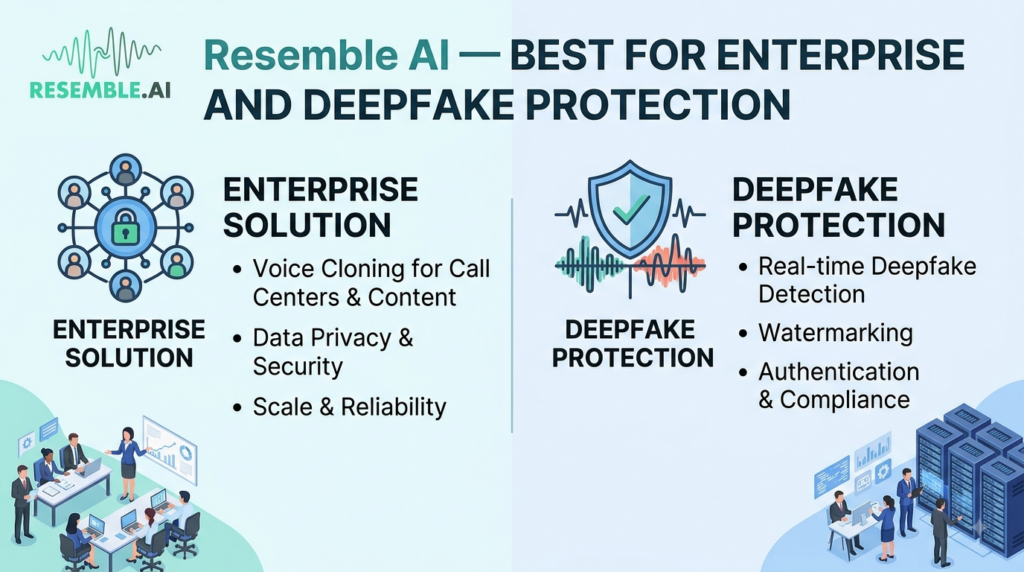
5. Resemble AI — Best for Enterprise and Deepfake Protection
Resemble AI occupies a distinct niche: voice cloning and synthesis paired with deepfake detection (their Detect product) and audio watermarking (Verify). That combination matters specifically for media companies, financial institutions, and any organisation worried about synthetic voice fraud, not just producing voice content.
The 2026 pricing model moved to consumption-based Flex pricing: no subscription, pay per use starting at $0, with API access to voice cloning and Detect from day one. Rates run around $0.0005/second for TTS and $0.001/second for voice agents, which can outpace a flat ElevenLabs tier at high volume, so model your usage before committing.
Best fit: enterprises that need voice cloning and fraud detection in a single vendor relationship, not a full voice-agent platform.
6. Google Cloud Text-to-Speech — Best for Ecosystem Integration
Google’s TTS product trades cutting-edge naturalness for reliability, breadth, and deep integration with the rest of Google Cloud. It supports 40-plus languages across 220-plus voices, and if your infrastructure already runs on GCP, the integration overhead of adding a separate voice AI vendor disappears entirely.
Pricing sits in the standard cloud-TTS range, roughly $4 per million characters for standard voices and higher for neural voices, generally cheaper than ElevenLabs but with a noticeably lower expressiveness ceiling. It won’t produce the emotional nuance ElevenLabs or Fish Audio can, but for straightforward narration, IVR systems, and accessibility features, it’s dependable and well-documented.
Best fit: teams already inside the Google Cloud ecosystem who need voice as a utility, not a differentiator.
Read more: How to Write Sora 2 Prompts for AI Video Generation.
Open Source and Self-Hosted
7. Chatterbox (Resemble AI) — Best Free, MIT-Licensed Model
Chatterbox is Resemble AI’s open-source TTS line, and it’s the most credible free alternative on this entire list. It’s MIT-licensed, meaning free commercial use, no royalties, no usage caps, full permission to self-host. In Resemble AI’s own blind evaluations against ElevenLabs, Chatterbox was consistently preferred by listeners, and it holds real community traction: roughly 25,000 GitHub stars and over a million Hugging Face downloads.
It supports zero-shot voice cloning from just 5-10 seconds of reference audio, emotion exaggeration control (a genuine first for an open-source model), and a Turbo variant built specifically for low-latency voice agents at around 200ms streaming latency. Every output carries Resemble’s PerTh watermark, an inaudible signal that keeps generated audio attributable and detectable, a meaningful responsible-AI feature most open models skip entirely.
The catch: you need your own GPU. Resemble also offers managed hosting if you’d rather not run infrastructure yourself.
Best fit: technical teams that want ElevenLabs-competitive quality with zero per-character cost and full self-hosting control.
8. Kokoro — Best Lightweight, Low-Compute Option
Kokoro is built for teams that want fast, free TTS without needing serious GPU infrastructure behind it. It’s smaller and less resource-hungry than Chatterbox, which makes it the practical choice for straightforward narration at volume rather than expressive voice cloning. It won’t match Chatterbox on cloning quality, but for batch-generating large amounts of standard TTS output cheaply, it’s a solid, low-friction pick.
Best fit: high-volume, straightforward text-to-speech where compute cost matters more than expressive range.
9. GPT-SoVITS — Best for Community Voice Cloning Experimentation
GPT-SoVITS has built a strong following in the open-source voice cloning community, particularly for character voices and creative projects. It requires more technical setup than Chatterbox and a decent GPU to run comfortably, but it rewards that investment with flexible fine-tuning options that let you push quality further for a specific voice than most out-of-the-box open models allow.
Best fit: hobbyists and technical creators willing to trade setup time for fine-grained control over a cloned voice.
10. F5-TTS / XTTS-v2 — Best for Full Self-Hosted Infrastructure
For teams that want complete infrastructure control, air-gapped deployment, or integration into an existing self-hosted pipeline, F5-TTS and Coqui’s XTTS-v2 remain solid, actively maintained options in the open-source ecosystem. Neither matches Chatterbox or Fish Audio on head-to-head quality benchmarks, but both are battle-tested, well-documented, and easier to integrate into custom pipelines that don’t want a dependency on a hosted API at all, including regulated or air-gapped environments where no external network call is acceptable.
Best fit: infrastructure teams building a fully self-contained voice pipeline with no external API dependency whatsoever.
Read more: The Science of the Viral Video: Deconstructing High-View Content.
A Warning Before You Migrate: PlayHT Is Dead
If you’re researching ElevenLabs alternatives, you will run into “PlayHT” on older lists, and it’s worth stating plainly: PlayHT no longer exists. Meta acquired the team in July 2025, the API went dark on July 26, 2025, weeks ahead of the announced timeline, and the platform shut down permanently on December 31, 2025. All accounts, saved audio, and voice clones were deleted with no export tool ever provided.
A few sites still list PlayHT as an active alternative, and at least one unaffiliated copycat site has appeared using a similar name. Neither is real. If you had projects built on PlayHT’s API, the only path forward is rebuilding your voice clones from your original source audio on a different platform, since Meta never opened a data export window.
This is worth flagging in an article like this one for a simple reason: platform mortality is a real risk factor when evaluating any voice AI vendor, not just PlayHT. Weigh vendor stability alongside quality and price, particularly for anything you’re building a product around long-term.
Open Source vs Closed Source: Which Should You Pick
Cost at scale favours open source decisively. Once you’re generating meaningful volume, self-hosted Chatterbox or Kokoro on your own GPU costs a fraction of any per-character API, closed or open.
Compliance and self-hosting requirements often make the decision for you. If your legal or security team requires that user audio never leaves your infrastructure, open-source self-hosting isn’t a preference, it’s a hard requirement, and no cloud API, however cheap, satisfies it.
Quality ceiling still tilts toward the best closed-source options for the most demanding use cases. ElevenLabs’ long-form English narration and Fish Audio’s expressive range are genuinely difficult for fully open models to match today, though Chatterbox has narrowed that gap faster than most predicted a year ago.
Maintenance burden is the tradeoff people underweight. A closed-source API means someone else handles uptime, scaling, and model updates. Self-hosting means your team owns GPU provisioning, model updates, and debugging inference issues at 2am. That’s a real cost, even when the model itself is free.

Comparison Table
| Platform | Type | Starting Price | Best For |
| ElevenLabs | Closed | Free / $6-$99+/mo | Full-featured studio, dubbing, largest voice library |
| Cartesia (Sonic 3) | Closed | Free / ~$5-$299/mo | Real-time voice agents, lowest latency |
| Fish Audio | Closed (open weights) | Free / ~$11/mo, $15 per 1M chars API | Best quality-to-price ratio |
| Murf AI | Closed | Free / $19-$66/mo | Business voiceovers, non-technical teams |
| Speechify | Closed | Free / $139/yr, $19+/mo Studio | Reading and content consumption |
| Resemble AI | Closed | Pay-per-use from $0 | Enterprise, deepfake detection |
| Google Cloud TTS | Closed | ~$4 per 1M chars | Ecosystem integration, reliability |
| Chatterbox | Open source (MIT) | Free (self-hosted) | Best free, commercial-ready open model |
| Kokoro | Open source | Free (self-hosted) | Lightweight, low-compute TTS |
| GPT-SoVITS | Open source | Free (self-hosted) | Community voice cloning experimentation |
Picking the Right Tool for the Job
There’s no single best ElevenLabs alternative, only the best one for what you’re actually building. If latency is your bottleneck, Cartesia. If cost at volume is the constraint, Fish Audio or a self-hosted Chatterbox deployment. If you need a polished, non-technical editor, Murf. If compliance dictates the decision, Resemble AI or Google Cloud TTS.
Voice AI is one of the fastest-moving categories in the AI Marketing space right now, and staying current on which tools actually work, not just which ones market themselves well, is part of what separates marketers who ship real AI-powered content systems from ones stuck relearning the landscape every quarter. YUP’s AI-Marketing track covers exactly this kind of tool evaluation and workflow-building, hands-on, with live cohort feedback.
Frequently Asked Questions
What is the best free alternative to ElevenLabs?
Chatterbox, from Resemble AI, is the strongest free alternative. It’s MIT-licensed for full commercial use with no usage caps, supports zero-shot voice cloning from a short audio sample, and performed well against ElevenLabs in blind listening evaluations, provided you have your own GPU to run it on.
Which ElevenLabs alternative has the lowest latency?
Cartesia’s Sonic 3 model is built specifically for low latency, with independently measured streaming performance around 166-190ms, faster than ElevenLabs Streaming’s roughly 335ms. It’s the strongest pick for real-time voice agents where response time is critical.
Is Fish Audio actually as good as ElevenLabs?
In blind A/B testing published by Fish Audio across more than 71,000 comparisons, listeners preferred S2 Pro over ElevenLabs V3 roughly 60% of the time. Independent crowdsourced benchmarks show the two closer together, with ElevenLabs holding a slight edge on some measures. The honest summary: they’re close in quality, and Fish Audio is substantially cheaper.
Can I self-host a voice AI model instead of using a cloud API?
Yes. Chatterbox, Kokoro, GPT-SoVITS, F5-TTS, and XTTS-v2 are all open-source models you can run on your own GPU infrastructure, with no per-character billing and full control over data. The tradeoff is you own the maintenance, scaling, and uptime that a cloud API would otherwise handle.
Is PlayHT still a valid ElevenLabs alternative?
No. PlayHT was acquired by Meta in July 2025 and permanently shut down on December 31, 2025, with all user data deleted. Any list still recommending it as an active alternative is out of date.
Which ElevenLabs alternative is cheapest for high-volume use?
Open-source, self-hosted models like Chatterbox or Kokoro have no per-character cost beyond your own compute. Among paid APIs, Fish Audio is the cheapest closed option at roughly $15 per million characters, compared to ElevenLabs’ $50-100 per million.
What’s the best ElevenLabs alternative for enterprise compliance requirements?
Resemble AI and Cartesia both list strong compliance credentials, Resemble with its Detect deepfake-detection product for fraud-sensitive industries, and Cartesia with HIPAA, SOC 2 Type 2, GDPR, and PCI compliance listed for regulated real-time applications.
Do open-source voice models require a GPU to run?
Yes, for practical use. Models like Chatterbox and GPT-SoVITS need a GPU with sufficient VRAM to run at usable speed. If you don’t have one, cloud GPU rental services offer hourly access starting at a low cost, which is often more practical than buying hardware for occasional use.
Which alternative is best for marketing teams without technical resources?
Murf AI is built specifically for non-technical users, with a visual editor and native integrations into Canva, PowerPoint, and Google Slides. Speechify Studio is a comparable option if your priority is quick, simple voiceover generation over granular editing control.