

Most ABM programs stall at the same point. The account list is built, the intent data is flowing, and the sales team is aligned in theory. Then Monday morning arrives and someone still has to manually check which of 200 target accounts moved, pull the right talking points, and get a personalized email out before the buying window closes. That gap between signal and action is where deals quietly slip away.
An AI Agents for Account-Based Marketing closes that gap. Instead of a dashboard that tells a marketer what happened, it’s software that watches account behavior continuously and takes the next step itself, inside guardrails you define. Account-Based Marketing has always promised precision over volume. AI agents are what finally make that precision possible at a scale a human team can’t match on their own.
This guide breaks down what that kind of AI-driven ABM setup actually does, which platforms are worth budget in 2026, and how real B2B teams are using them right now.
Table of Contents
What Is an AI Agents for Account-Based Marketing?
An agent, in the AI sense, is software that perceives data, decides what to do with it, and takes action on its own, rather than waiting for a person to click a button. In ABM specifically, that means something that can watch a target account’s website visits, ad engagement, and CRM activity, then trigger the right next move without a marketer manually connecting the dots.
That’s a meaningful shift from what most teams call “marketing automation.” Automation runs a fixed sequence: if this, then that, every time, the same way. An agent reasons. It weighs which signal actually predicts revenue, decides which account deserves attention today, and adjusts its own next action based on what happens after it acts.
This kind of agent is software that continuously monitors target-account signals, such as website visits, intent data, and CRM activity, and autonomously triggers actions like personalized outreach or ad targeting. Unlike static marketing automation, it adapts its next move based on outcomes rather than following a fixed rule set.
Why ABM Teams Are Adopting AI Agents Right Now
Two things happened at once. Buyer research moved almost entirely online, and the tools available to act on that research got dramatically better.
Gartner predicts that 40% of enterprise applications will include task-specific AI agents by 2026. For an ABM team, that prediction matters less as a headline stat and more as a practical reality: the gap between spotting a buying signal and acting on it is shrinking fast, and teams still working off weekly reports are falling behind teams that act same-day.
Demandbase CEO Gabe Rogol has pointed out that buying groups now use AI tools to research vendors, compare options, and score solutions before any committee member ever contacts a sales team. If your content and account signals aren’t structured for machines to parse quickly, you risk losing a shortlist spot before a human on the buying committee even reaches out.
There’s also a resourcing problem these tools solve directly. Most ABM teams run lean. BCG has noted that AI agents are moving B2B sales from theory toward practical execution, largely because sales teams are looking for real gains in productivity, engagement, and operating efficiency. Honestly, that’s the whole pitch in one line. Fewer people, more accounts covered, faster response time.
None of this means the strategy work disappears. It means the operational grind, the parts that used to eat a marketer’s entire week, gets handed to software that doesn’t sleep.
How AI Agents Change the ABM Workflow
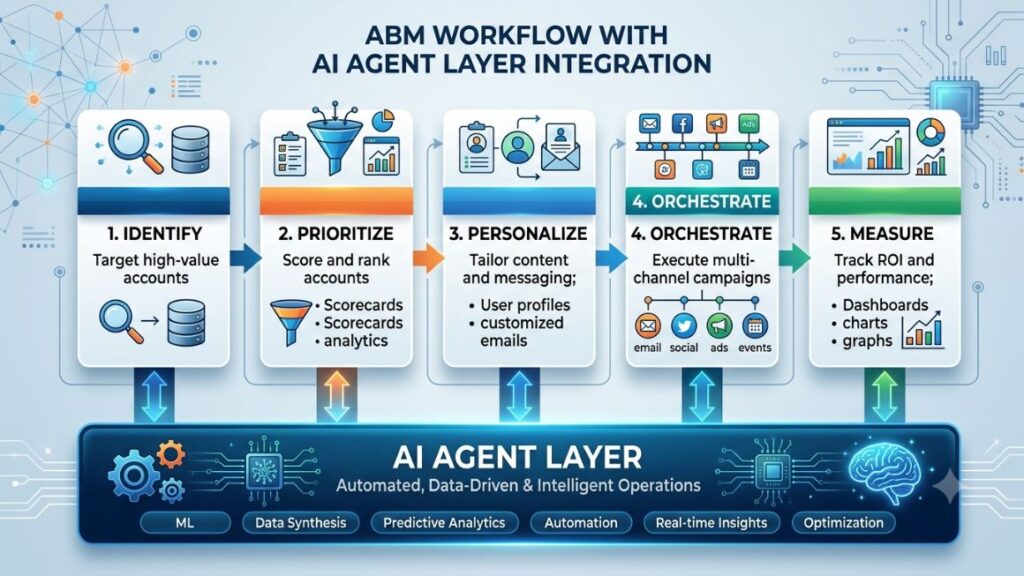
Traditional ABM runs in stages: identify accounts, score them, build campaigns, launch, then measure weeks later. AI agents don’t replace these stages. They compress the time between each one and often merge two or three into a single automated motion.
From Static Lists to Live Prioritization
An account list built in January is stale by March. A genuinely useful agent re-scores every target account continuously, factoring in new intent signals, job changes, and engagement, so the “top 50” list a rep sees on Monday reflects reality that morning, not a quarterly planning session.
From Manual Personalization to Automated Relevance
Writing a custom email for 300 target accounts by hand isn’t realistic for most teams, so most ABM programs settle for personalizing at the segment level instead of the account level. Agents remove that trade-off. They can pull account-specific context, like recent funding, tech stack, or a competitor mention on a call, and generate a message that reads as if a rep actually researched that one company, because in effect, the agent did.
From Delayed Follow-Up to Same-Day Response
When a target account visits pricing pages three times in a week, that account is telling you something. Most teams find out days later through a report. An agent can flag it, alert the right rep with context, and even queue the outreach within hours.
Core Capabilities to Look For in an ABM Agent
Not every tool marketed as “AI-powered” actually reasons or acts independently. Some just apply a smarter filter to old data. Before you commit budget, check that a platform actually delivers on these core capabilities.
- Continuous signal monitoring: tracks website behavior, intent data, and CRM activity in real time rather than in a nightly or weekly batch
- Autonomous prioritization: re-ranks target accounts on its own as new signals arrive, not just on a scheduled scoring run
- Personalization at the account level: generates messaging, landing pages, or ad creative specific to one company, not a segment average
- Cross-channel orchestration: coordinates ads, email, sales outreach, and web personalization from one signal instead of three disconnected tools
- Guardrails and human approval gates: lets a marketer set boundaries on budget, tone, and send limits so the system has agency without going rogue
A genuinely useful AI Agent watches these signals around the clock and only escalates to a human when the decision actually warrants judgment, not on every single action.
Top AI Agents for ABM: Platforms Worth Your Budget in 2026
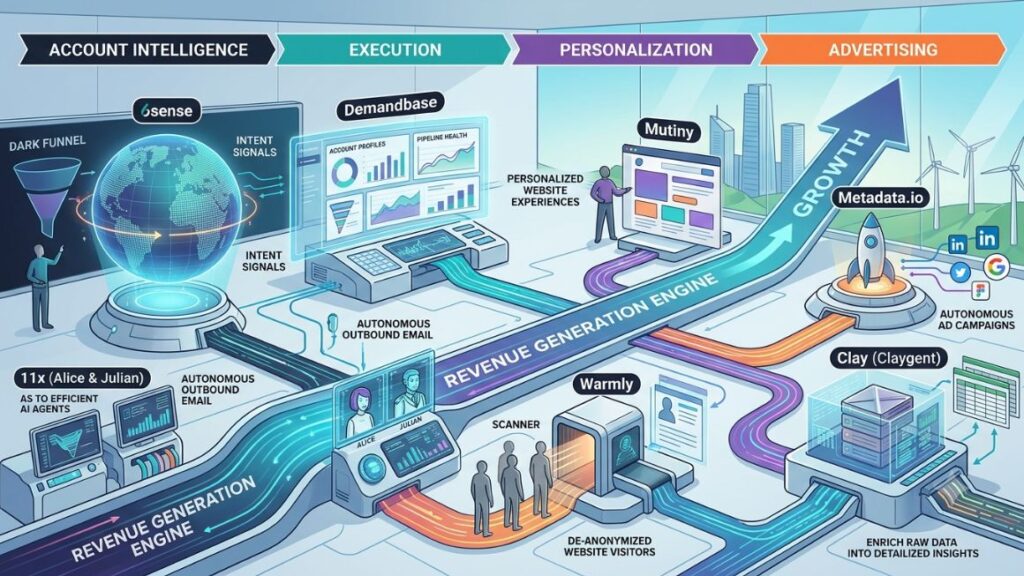
Here’s where theory turns into a buying decision. The tools below span the categories that matter most for account-level marketing: intelligence, execution, personalization, and advertising. Each does something genuinely different, and most serious programs end up running two or three of these together rather than relying on one platform for everything.
6sense
6sense built its reputation on intent data and has extended it into a full agentic layer. Its RevvyAI agent lets marketing and sales teams ask questions in natural language and get answers about campaign performance, account qualification, and pipeline influence instead of manually pulling reports.
Underneath RevvyAI sits 6sense’s core intelligence engine. The platform scores accounts against a buying-stage model of Awareness, Consideration, Decision, or Purchase by combining first-party website behavior, third-party intent data sourced through Bombora and other co-op networks, and firmographic fit, with the model trained directly on your own closed-won deal history. Its AI email agents then automate personalized outreach based on that behavior and can shift ad spend toward accounts showing active buying intent.
6sense was named a Leader in The Forrester Wave for Revenue Marketing Platforms for B2B in Q1 2026, a strong signal for teams evaluating serious analyst coverage before committing budget. That said, 6sense doesn’t publish pricing, and mid-market deployments covering roughly 1,000 to 5,000 target accounts on a single product line tend to run $60,000 to $120,000 per year, usually on a minimum 12-month contract. This is an enterprise-grade tool, not a starter platform.
Demandbase
Demandbase positions itself less as a single AI feature and more as an entire workforce of agents built into an ABM platform. Agentbase, its collection of AI agents, optimizes ad campaigns, summarizes account engagement for sellers, and builds audience segments through conversation rather than manual filtering.
What sets Demandbase apart operationally is what happens before any agent acts. The platform automatically identifies duplicate records, fills data gaps, and enriches accounts across your CRM and marketing automation systems, since every AI capability in the platform depends on that data staying clean. It’s an unglamorous feature, but it’s the one that determines whether every other agent on the platform actually works.
Demandbase also runs its own built-in demand-side platform for programmatic display, video, and Connected TV advertising, letting teams target specific accounts and buying committees directly instead of broad audiences. For teams already running account-based advertising, that native DSP removes a whole vendor from the stack.
11x (Alice and Julian)
11x takes a different angle. Instead of an intelligence layer, it’s an execution layer built entirely on AI sales agents. Alice handles outbound prospecting, research, personalization, outreach, reply handling, and meeting booking, while Julian supports inbound qualification, speed-to-lead response, scheduling, routing, and follow-up.
The idea is that teams feed account signals from their broader ABM stack into 11x, and Alice or Julian moves those accounts into actual qualified sales conversations. This makes 11x a strong pairing partner for a tool like 6sense or Demandbase rather than a replacement for either. One tells you which accounts matter; the other does the outreach work a full SDR team used to handle.
Warmly
Warmly solves a narrower but persistent problem: most website visitors never fill out a form, so a huge share of buying intent goes completely untracked. Warmly deanonymizes website visitors in real time and routes warm outbound signals to sales reps, connecting visitor identity to firmographic and technographic context.
It’s a strong fit for teams that want to act on website intent immediately rather than waiting for a lead form, though it performs best paired with a broader account intelligence layer for prioritization upstream. In practice, that means Warmly rarely replaces a platform like 6sense; it plugs a specific blind spot within one.
Mutiny
Most agents in this space handle research or outreach. Mutiny focuses on the asset itself. It functions as a system for creating customer-facing content at scale, including 1:1 landing pages, deal rooms, and executive business cases tailored to specific accounts.
For a target account in late-stage evaluation, that matters more than another email. A landing page that references a prospect’s specific tech stack or a deal room built around their actual objections converts differently than a generic case study PDF ever will.
Metadata.io
Metadata.io focuses squarely on the advertising layer of account-level marketing. It automates paid media experimentation for B2B marketers, reducing the manual effort required to manage and optimize campaigns. Its strength is execution efficiency rather than deep account intelligence, which means advanced targeting and scoring typically require a separate data layer such as 6sense or Demandbase feeding it the account list.
That’s not a weakness so much as a design choice. Metadata.io does one job, running and testing ad variants across channels, faster than a human team can manage manually.
Clay (Claygent)
Clay didn’t start as an ABM tool, but it’s become one of the most flexible pieces of infrastructure in modern GTM stacks. It combines 150+ data providers with AI agents that conduct research at scale and then automatically trigger an action, whether that’s updating a CRM record, sending a personalized email, or syncing an audience to LinkedIn Ads.
Claygent, its research agent, reads company websites, LinkedIn pages, and other sources to write structured data fields, but it works best with a specific task and a defined output rather than open-ended questions. Teams typically wire Clay into their stack as the enrichment and orchestration layer, pulling in signals from 6sense or Demandbase, then triggering outreach through a tool like 11x or Salesforge.
Salesforce Agentforce, HubSpot Breeze, and Adobe Sensei
Enterprise CRM and marketing suites have built agents directly into platforms most ABM teams already run. Salesforce with Einstein and Agentforce, Adobe with Sensei, and HubSpot are leading providers of AI agents for marketing, offering capabilities in personalized customer engagement, predictive analytics, and automation to improve marketing ROI.
The appeal here is integration depth rather than raw capability. If your ABM stack already lives inside Salesforce or HubSpot, native agents mean fewer data handoffs and fewer places for signals to get lost between systems.
Real Examples: AI Agents Running ABM Campaigns Today
None of this is theoretical anymore. Revenue teams are running these systems against live pipeline right now, and the patterns worth copying show up in how they’re combined, not used in isolation.
A common setup pairs an intelligence platform with an execution agent. A team using 6sense to spot an account moving into the Decision stage doesn’t stop at a Slack alert. The signal triggers a workflow where Alice from 11x researches the specific buying committee and sends a personalized outbound sequence within the same day the account showed intent, instead of the three to five days a manual process usually takes.
Another pattern runs through Clay as the connective layer. One documented workflow chains an intent signal from a sales call, enriches the account through Clay across multiple data providers, generates a personalized follow-up with an AI model, sends it through a multi-channel sequencing tool, then launches targeted ads through Metadata.io and syncs the whole thing back into HubSpot with a Slack alert to the rep. Teams running this kind of chained workflow report meaningful time savings on manual data entry and same-day response to buying signals instead of the multi-day lag that’s typical with manual handoffs.
B2B teams closer to home show a lighter version of this same shift. Indian B2B SaaS companies, for instance, increasingly use intent and enrichment tools to prioritize which enterprise accounts get a founder-led outreach motion versus a standard nurture sequence, freeing a small growth team to focus effort where it actually converts. This works well for teams selling into a defined enterprise segment; it applies less cleanly to high-volume SMB motions where account-level personalization doesn’t scale economically.
The most effective AI-driven ABM setups in 2026 chain multiple specialized agents together rather than relying on one all-in-one platform. An intelligence layer like 6sense or Demandbase identifies which accounts matter, while an execution layer like 11x or Clay handles the research, personalization, and outreach, cutting response time from days to hours.
How to Build a Strategy Around AI Agents in ABM
Buying a tool isn’t a strategy. Teams that get real results from an AI Agent for Account-Based Marketing follow a fairly consistent rollout pattern, and skipping steps here is usually what causes programs to stall six months in.
- Audit your current data foundation. A system trained on messy CRM data will make confidently wrong decisions. Clean up duplicate accounts and standardize firmographic fields before anything else.
- Define your target account list and ICP first. These tools amplify whatever targeting logic you feed them. A vague ideal customer profile just gets you faster, wider misses.
- Pick one workflow to automate before automating everything. Start with the highest-effort, most repetitive task, usually account research or first-touch outreach, and prove it works there.
- Set explicit guardrails. Decide upfront what can run without approval (research, scoring, internal alerts) versus what needs a human sign-off (sending, ad spend changes, pricing mentions).
- Run a 90-day pilot on one segment. Don’t roll this out across your entire account list on day one. Measure reply rates, meeting rates, and pipeline influence on a contained group first.
- Feed outcomes back into the system. The setups that improve over time are the ones connected to closed-won and closed-lost data, not just campaign clicks.
- Expand only after the pilot proves out. Scale to more accounts, more channels, or a second workflow once the first one is genuinely working, not before.
From what we’ve seen with YUP learners building out ABM motions on lean teams, step four gets skipped most often, and it’s usually the reason a promising pilot gets shut down after one overly aggressive email that went out without review.
Common Mistakes That Sink AI-Driven ABM Programs
Even strong tools fail in the hands of a team that treats them like magic instead of software that needs management.
The most common mistake is disconnected data. If your CRM’s closed-won revenue isn’t connected to your marketing platform’s campaign data, the system optimizes for mid-funnel metrics that don’t actually correlate with revenue, chasing webinar signups instead of the specific behavior pattern that predicts a closed deal.
The second is skipping the pilot phase entirely. Teams excited about a new platform often roll it out to the full account list immediately. When something goes wrong, and something usually does in the first month, it goes wrong at full scale instead of on a contained test group.
The third, and this one’s avoidable, is treating personalization systems as fully autonomous from day one. Most platforms, Mutiny and 6sense included, work best with an approval gate for the first several weeks while the team calibrates tone and accuracy. Removing that gate too early is how a brand ends up sending an oddly worded email to a Fortune 500 prospect with no human ever seeing it first.
And finally, teams underestimate the intelligence layer underneath it all. An execution tool like Alice or Julian from 11x is only as good as the signals it’s acting on. Skip the intelligence platform and plug an execution agent straight into a stale spreadsheet, and you’ve just automated a bad process faster.
Conclusion
The teams pulling ahead in ABM right now aren’t necessarily the ones with the biggest budgets. They’re the ones who’ve closed the gap between spotting a buying signal and acting on it, and that’s what makes this shift matter. Start with clean data, pick one workflow, and prove it on a contained account list before you scale.
If you’re building this muscle on your own marketing team, learning how to actually design and prompt these workflows matters more than picking the “best” tool on a list. YUP’s AI Marketing course walks through exactly that, from setting up your first agent workflow to knowing when a human still needs to be in the loop. You can also try the Hotskill app to practice prompting AI agents on real marketing scenarios before you put one in front of a live account.
FAQs
What does an AI agent actually do in ABM?
It monitors account-level signals like website behavior, intent data, and CRM activity, then autonomously decides on and takes the next action, such as sending an email or adjusting ad spend, rather than waiting for a marketer to act on a report.
Is AI-driven ABM the same as marketing automation?
Not quite. Marketing automation runs a fixed if-this-then-that sequence every time. An agent reasons about which signal actually matters, adjusts its next move based on outcomes, and can prioritize accounts on its own without a rule being pre-written for every scenario.
Which tool should a small B2B team start with?
Start with one intelligence layer, like 6sense or Warmly for smaller budgets, and one execution layer, like Clay or 11x, rather than buying a full enterprise suite. Prove the workflow on a contained account list before expanding the stack.
How much do these platforms typically cost?
It varies widely by category. Mid-market intent and intelligence platforms often run $60,000 to $120,000 per year for a few thousand target accounts, while tools like Clay and Metadata.io have far lower entry points and usage-based pricing.
Do I need a data team before deploying AI agents in ABM?
Not necessarily, but you do need clean CRM and firmographic data before launch. Most failures trace back to messy data rather than a missing data science hire.
Can AI agents fully replace an SDR team?
Not entirely, at least not yet. Alice and Julian handle high-volume research and first-touch outreach well, but complex negotiations, objection handling, and relationship-building on large enterprise deals still benefit from a human rep.
What’s the biggest risk of using AI agents in ABM?
Acting on bad data at scale. A system with no approval gate, working off disconnected or messy data, can send the wrong message to the wrong account faster than a human team ever could, and it does so consistently until someone catches it.
How long does it take to see results from an AI-driven ABM program?
Most teams run a 90-day pilot before drawing conclusions. Early signals like reply rate and meeting rate show up within weeks, but pipeline and revenue influence usually need a full sales cycle to measure properly.
Do these tools work for B2B teams outside the US?
Yes, though intent data coverage and advertising reach can vary by region. Teams targeting enterprise accounts in India or other growing B2B markets should confirm data coverage for their specific target geography before committing to a platform.
Is it worth combining multiple tools instead of picking one platform?
For most serious ABM programs, yes. The strongest setups pair an intelligence layer that identifies which accounts matter with an execution layer that acts on that intelligence, since very few single platforms do both exceptionally well.