

A marketing team of 40 people cannot personalize a million customer journeys by hand. It never could. For years, the workaround was static segmentation and rule-based automation: if opened, send X, if not, send Y. That workaround is breaking down fast, because customers now expect real-time relevance, and the volume of content, channels, and data points has outgrown what any human team can manually orchestrate. This is exactly the gap an AI Agent for Enterprise Marketing is built to close.
Unlike a chatbot or a simple workflow trigger, an AI agent perceives customer signals, makes a decision, and acts on it, often across multiple systems, without waiting for a marketer to click “send.” According to Gartner, 40% of enterprise applications are expected to include task-specific AI agents by the end of 2026, a sharp jump from under 5% in 2025. Marketing is one of the functions leading that shift.
This guide breaks down what these systems actually do, the core features worth evaluating, seven tools enterprise teams are actively using in 2026, and how real brands are deploying them today. You’ll also get a practical rollout plan and an honest look at where the technology still falls short.
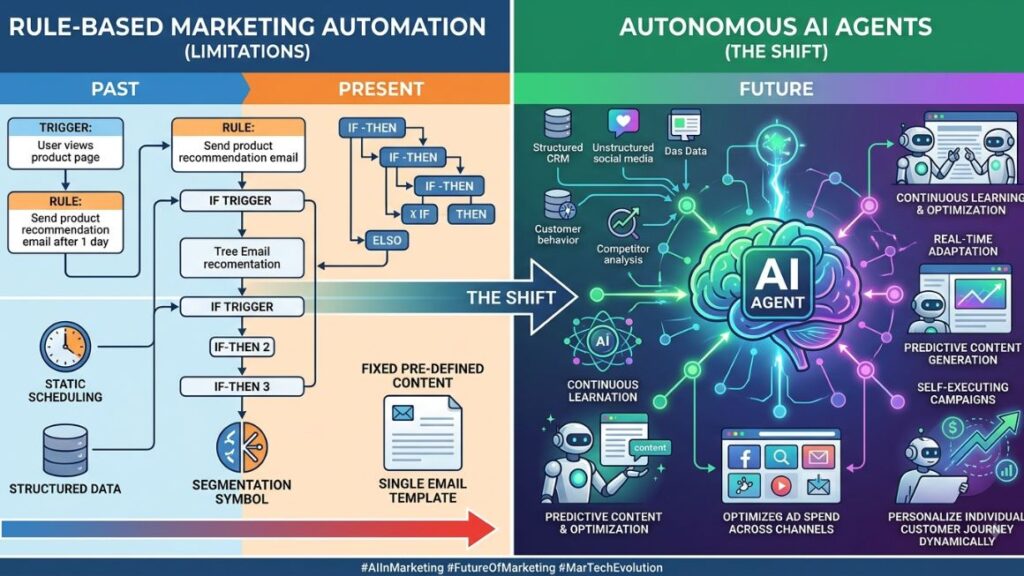
Table of Contents
What Is an AI Agent for Enterprise Marketing?
An AI Agent for Enterprise Marketing is a software system that can independently plan, execute, and adjust marketing tasks, such as building a customer segment, drafting a campaign, or triggering a journey, based on a goal you give it rather than a script you write for it. That’s the standalone definition worth remembering, because most of the confusion around this category comes from lumping agents in with older automation tools.
An AI Agent, at its core, combines three things: access to live data, a reasoning layer (usually a large language model), and the ability to take action inside connected systems. Give it a goal like “improve email open rates for lapsed customers” and it can pull segment data, draft subject lines, run a test, and adjust the send strategy based on results. A rules-based tool can’t do any of that on its own. It just executes whatever condition you pre-programmed.
An AI Agent for Enterprise Marketing combines real-time data access, LLM-based reasoning, and system-level execution to complete marketing tasks with minimal human input. It differs from a chatbot or a workflow trigger because it can plan multi-step actions toward a goal instead of following a fixed script.
That’s the whole point of the category. It really is.
How AI Agents Differ From Traditional Marketing Automation
Here’s the problem with most legacy platforms: they’re reactive, not adaptive. Traditional enterprise marketing automation runs on predefined triggers. A customer abandons a cart, an email fires three hours later, and that’s the entire logic. It works, but it treats every customer the same way inside that trigger.
Agentic systems replace that fixed logic with continuous decision-making. Braze’s own research illustrates the gap well: a conventional automated workflow sends an email when a cart is abandoned, while an agentic system decides which customers to target at all, determines the right message and channel for each one individually, deploys it, and learns from the outcome to improve the next decision. That’s not a minor upgrade. It’s a different operating model.
Salesforce frames this shift in similar terms. Early personalization depended on static segments and predefined rules, but now behavioral signals such as browsing activity, engagement timing, and product interest can dynamically influence what content gets delivered next, moving marketers away from scheduled batch thinking toward continuous responsiveness. This moves marketers away from scheduled batch thinking toward continuous responsiveness.
To be fair, not every use case needs full autonomy. A simple welcome series doesn’t need an agent reasoning about it every time. But anything involving segmentation logic that changes daily, content that needs to flex by audience, or decisions that used to require a strategist sitting and reviewing dashboards, that’s where agents earn their keep.
Core Features Enterprise Marketing Teams Should Look For
Not every tool marketed as “agentic” actually behaves like one. Before you evaluate vendors, it helps to know which capabilities separate a genuine agent from a rebranded automation workflow.
Autonomous Decision-Making and Multi-Step Execution
The agent should be able to complete a task from start to finish, briefing, drafting, approval routing, and execution, without a human manually handing it off at every step. HubSpot’s Breeze Agents are a clear example: unlike an assistant that responds to your questions, agents run independently, monitoring data, taking actions, and completing tasks on their own.
Integration With CRM, CDP, and Ad Platforms
An agent working from stale or disconnected data will make decisions that reflect that. This is where most enterprise AI marketing automation projects quietly fail. Braze’s 2026 Global Customer Engagement Review found that only 55% of marketers are updating and using customer information in real time, which limits how well any agent layered on top can actually perform.
Personalization at Scale
This is the feature enterprises usually buy for first. A well-integrated agent can generate individual message variants, choose the right channel per customer, and time delivery based on that person’s own engagement pattern rather than a blanket send schedule.
Real-Time Analytics and Reporting
You need to see what the agent did and why, not just what it produced. HubSpot’s Audit Cards, introduced in January 2026, are a good model here: they create a transparent record of exactly what an agent did during an interaction, including which CRM properties were updated. Without that kind of visibility, you’re trusting a black box with brand-facing decisions.
Seven AI Agent Tools Enterprise Marketers Are Using in 2026
AI-powered enterprise marketing now has a genuine vendor landscape, not just a handful of experimental add-ons. Below are seven platforms worth evaluating, based on what they actually ship today, not what’s still on a roadmap slide.
Salesforce Agentforce
Agentforce for Marketing Cloud is Salesforce’s agent framework applied specifically to marketing operations. It configures AI agents that act autonomously, consult CRM and Data Cloud context, and execute workflows through Flows, APIs, and Marketing Cloud tooling. Agents can generate campaign briefs, select audiences, draft content, and trigger journey actions, all grounded in your actual customer data rather than generic LLM output.
At Salesforce’s 2026 Connections event, the company demonstrated this at F1 scale: a global team of around 1,000 used agents to plan and launch full campaigns for 35,000 fans, segmenting by geography and building personalized email and SMS drafts, then optimizing in real time once campaigns were live. Salesforce says teams using these agents are saving up to 20 hours a week.
A trusted Salesforce implementation partner can help enterprises integrate Agentforce for Marketing Cloud with their existing Salesforce CRM, Data Cloud, Flows, APIs, and marketing workflows. This ensures AI agents are configured around the organization’s specific data, processes, and campaign goals, enabling teams to move from AI experimentation to scalable, automated marketing operations.
Best for: Enterprises already running Salesforce CRM and Data Cloud who want agents tightly bound to first-party customer data.
Adobe GenStudio (Experience Platform Agent Orchestrator)
Adobe’s approach centers less on a single agent and more on orchestration. Adobe Agent Orchestrator brings out-of-the-box AI agents directly into content and marketing workflows, coordinating tasks across products so teams move faster without losing governance. It connects Adobe Experience Manager, GenStudio, Adobe Journey Optimizer, and Customer Journey Analytics into one coordinated system rather than four separate tools bolted together.
Gartner recognized this approach in its 2026 Magic Quadrant for Content Marketing Platforms, describing how orchestration has fundamentally shifted from manual task tracking to AI-native, agent-orchestrated operations that coordinate both human and digital work across the content lifecycle.
Best for: Large enterprises with heavy content production needs across Adobe’s creative and experience stack, particularly retail and CPG brands managing high SKU counts.
HubSpot Breeze
Breeze is HubSpot’s full AI layer, split across an assistant, a set of autonomous agents, and a data enrichment engine. As of 2026, the core lineup includes Customer, Prospecting, and Data Agents, with more than 20 agents and assistants available through the Breeze Marketplace. The Customer Agent handles support conversations across nine channels including WhatsApp, SMS, and a Voice channel currently in beta.
Pricing runs on a credit system. Full agent access starts at $450 to $800 a month on the Professional Hub, with Enterprise plans running $1,500 to $3,600 a month. That range matters when you’re budgeting, since credit consumption scales with usage volume.
Best for: Mid-market to enterprise teams already on HubSpot’s CRM who want agents native to the platform rather than a bolt-on integration.
Braze Sage AI
Braze bundles its agent capabilities under BrazeAI, with Sage AI agents deployed directly inside customer journeys, referred to as Canvas steps, to generate copy, route users, and enrich product catalogs on the fly. The suite also includes Predictive Churn, Intelligent Timing, Intelligent Channel, and Decisioning Studio, which uses reinforcement learning to make individual-level decisions optimized against business KPIs.
In April 2026, Braze made its newer agent console generally available. BrazeAI Operator and BrazeAI Agent Console now let marketing teams build and manage agents that generate content, interpret data, and adapt campaigns in real time. One retail brand using Braze’s item recommendation agent reported a 35% increase in purchase conversion on out-of-stock emails.
Best for: Consumer apps and D2C brands running high-frequency, cross-channel lifecycle marketing where real-time decisioning matters more than static campaign calendars.
Jasper AI Enterprise
Jasper has moved from a content-generation tool into a broader marketing agent platform, with brand-voice controls and workflow templates built for legal and compliance-heavy industries. It’s narrower in scope than Salesforce or Adobe, focused mainly on content creation and campaign drafting rather than full-funnel orchestration, which makes it a faster deployment for teams that don’t want to overhaul their entire stack just to get agentic content production.
Best for: Enterprises that want agent-assisted content at scale without replacing their existing CRM or CDP.
Google AI Max and Performance Max Agents
Google’s ad platforms have moved into what the company calls the agentic era of advertising. Unlike traditional automation that follows preset rules, these systems actively analyze, recommend, optimize, and execute marketing tasks with minimal manual input, powered by Gemini. AI Max introduced AI Brief, which lets marketers describe a creative vision and targeting guardrails in plain language rather than manually configuring keyword lists.
Google recommends running AI Max and Performance Max together rather than choosing one. AI Max suits search-heavy, product-focused categories where control matters, while Performance Max fits broader, all-channel reach.
Best for: Enterprises running significant paid media spend across Search, YouTube, Shopping, and Display who want agentic bidding and creative generation without leaving Google’s ecosystem.
Microsoft Copilot for Dynamics 365 Customer Insights
Microsoft’s agent, the Journey Creation Agent, lets marketers describe a campaign goal in conversational language, and the agent proposes a full journey structure with steps, timing, and branching logic, arranging touchpoints across email, SMS, push, and custom channels. Before anything goes live, it presents a visual preview the marketer can revise.
Customer Insights also uses agentic AI to automatically recommend the next best message, journey, or offer for each customer, making campaigns both automated and adaptive. For enterprises already standardized on Microsoft 365 and Teams, the integration is genuinely seamless rather than bolted on.
Best for: Enterprises already running Microsoft’s business applications stack, particularly regulated industries that need centralized admin controls over agent behavior.
Real-World Examples of Enterprise Brands Using AI Agents
Beyond vendor demos, actual deployments show where this technology delivers and where it still needs a human in the loop.
Formula 1, working with Salesforce, used Agentforce to run coordinated campaigns for 35,000 fans across geographies during the 2026 Connections showcase, with agents handling briefing and asset creation while the marketing team retained decision-making and fine-tuning control.
KoRo Handels GmbH, a German food brand, used Braze’s AI item recommendation agent inside out-of-stock emails and saw a 3x increase in purchase rates, according to the company’s CRM team lead.
Sharpie, under Newell Brands, uses Adobe’s GenStudio for Performance Marketing along with Firefly Boards to manage its content supply chain across paid channels, generating and governing content variations from a single system rather than separate creative and media workflows.
Real-world deployments of AI agents in enterprise marketing show measurable gains, including a 3x conversion lift from Braze’s recommendation agent at KoRo and up to 20 hours saved weekly for teams using Salesforce Agentforce at scale. The common thread across every successful case is clean, unified customer data feeding the agent.
How to Implement AI Agents in Your Enterprise Marketing Stack
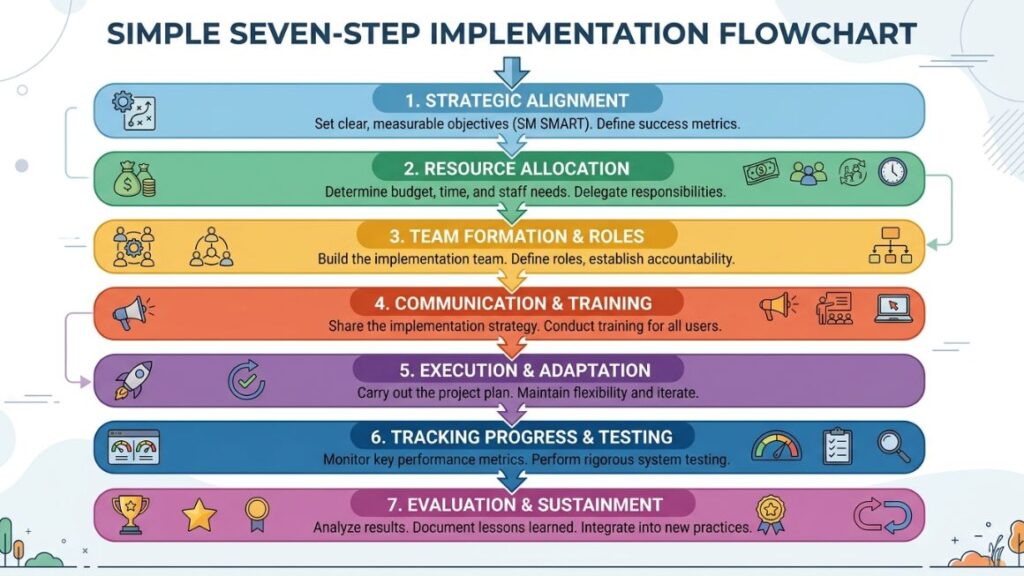
Rolling out an agent isn’t a plug-and-play decision. Here’s a practical sequence that avoids the most common failure points.
- Audit your data quality before anything else. An agent working from fragmented or duplicate CRM records will automate bad decisions faster, not better ones.
- Pick one bounded workflow to start. Lifecycle email, ad copy generation, or lead scoring are lower-risk starting points than full campaign orchestration.
- Set clear guardrails and approval thresholds. Decide upfront what the agent can execute without review and what still needs a human sign-off.
- Connect the agent to your CDP or unified customer profile, not just a single channel tool, so decisions reflect the full customer relationship.
- Run a controlled pilot with a measurable KPI. Track the specific metric the agent is meant to move, whether that’s open rate, conversion, or time saved per campaign.
- Review the audit trail weekly during the first month. Most platforms, including HubSpot and Braze, now surface logs of exactly what the agent changed and why.
- Scale to adjacent workflows only after the first one proves out. Expanding agent scope before validating the first use case is the fastest way to lose trust in the technology internally.
Challenges and Limitations to Plan For
Adoption numbers look strong on the surface, but the gap between piloting and scaling is wide. McKinsey’s research found that 88% of organizations use AI in at least one business function, yet only 23% are actually scaling an agentic system. That gap shows up in enterprise marketing AI projects too.
Governance is the biggest recurring problem. Agents that touch customer data need audit trails, and agents that generate customer-facing content need brand controls, or you end up with off-brand messaging shipped at machine speed instead of human speed. Gartner has gone as far as predicting that over 40% of agentic AI projects will be canceled by the end of 2027, mostly due to unclear business value or inadequate risk controls.
This matters most in regulated industries. A financial services or healthcare marketing team can’t hand full autonomy to an agent without compliance review baked into every step, which means the “autonomous” part of the pitch gets scaled back considerably in practice. That’s a legitimate trade-off, not a flaw in the technology itself.
The Future of AI Marketing Agents in Enterprise Teams
The direction is clear even if the pace varies by vendor. Google’s Marketing Live 2026 previewed agent-to-agent commerce, where autonomous buyer agents negotiate directly with a brand’s product feed instead of clicking through an ad. Analysts expect this to capture a meaningful share of e-commerce volume by 2027, though the timeline is still speculative.
Inside marketing teams specifically, AI marketing agents are moving from single-task tools toward coordinated systems that hand work between each other, a content agent briefing a compliance agent, which briefs a distribution agent, with a human reviewing only the exceptions. HubSpot’s 2026 AI Trends data shows marketers already recovering an average of 6.1 hours a week from current-generation agents, with senior practitioners saving even more. As orchestration matures, that number is likely to climb, though the honest expectation is incremental gains layered over 2026 and 2027, not an overnight replacement of marketing teams.
Conclusion
The core takeaway is simple: an AI Agent for Enterprise Marketing earns its place when it’s connected to clean, unified customer data and given a bounded task to own, not when it’s treated as a magic replacement for strategy. The brands seeing real results, from Salesforce’s F1 rollout to Braze’s recommendation engine at KoRo, all share the same pattern of tight data foundations and clear human oversight layered on top of agent execution.
Start with one workflow, measure it honestly, and expand only once it proves out. That’s a far better path than trying to automate everything at once and losing trust in the technology when the first pilot underdelivers.
If you want to go deeper on how to actually build and prompt these systems for your own campaigns, YUP’s AI Marketing course walks through the practical setup, from choosing your first use case to writing the guardrails that keep an agent on brand. It’s a solid next step if this guide left you wanting the hands-on version.
FAQs
What is an AI agent in enterprise marketing?
An AI agent in enterprise marketing is a software system that can independently plan and execute marketing tasks, like building a segment or drafting a campaign, based on a goal rather than a fixed script. It combines live data access, an LLM reasoning layer, and the ability to act inside connected marketing systems.
How is an AI agent different from marketing automation software?
Traditional automation runs on predefined triggers, like sending an email three hours after a cart abandonment, using the same logic for every customer. An AI agent makes an individual decision for each customer, adjusts based on real-time signals, and can complete a multi-step task without a human configuring every condition in advance.
Which AI agent tool is best for enterprise marketing teams?
It depends on your existing stack. Salesforce Agentforce suits teams already on Salesforce CRM and Data Cloud, Adobe GenStudio fits heavy content production environments, HubSpot Breeze works well for mid-market to enterprise teams on HubSpot, and Microsoft Copilot for Dynamics 365 fits organizations standardized on Microsoft’s business applications.
Do AI agents replace marketing teams?
No, not in their current form. Every successful deployment covered in this guide, from Salesforce’s F1 campaign to Braze’s recommendation agent, still has marketers reviewing strategy, approving content, and fine-tuning outcomes. Agents handle execution volume; people still own judgment calls.
How much do enterprise AI marketing agent tools cost?
Pricing varies widely by platform and usage volume. HubSpot’s Breeze agents, for example, run from roughly $450 to $800 a month on the Professional tier and $1,500 to $3,600 a month on Enterprise plans, with additional credit-based charges for high-volume use. Salesforce, Adobe, and Braze typically price through custom enterprise contracts.
Is it worth investing in AI agents if my team is small?
If your team is under 15 people, a full agent rollout is probably overkill. Simpler automation may cover your needs. Agents earn their cost when campaign volume, channel count, or personalization complexity has outgrown what a human team can manage manually, which is usually a mid-market or enterprise-scale problem.
Why do most AI agent pilots fail to scale?
The most common cause is poor data quality feeding the agent. An agent working from fragmented or outdated CRM records will automate bad decisions rather than good ones. Weak governance and unclear ROI targets are the next biggest reasons pilots stall before reaching production.
What data do AI agents need to work well?
Agents perform best with a unified customer profile that combines behavioral, transactional, and demographic data updated in real time. Braze’s own research found that only 55% of marketers currently update customer information in real time, which limits how well any agent layered on top can actually perform.
Can AI agents work across multiple marketing channels at once?
Yes, most enterprise-grade agents are built for this. HubSpot’s Customer Agent supports nine channels including WhatsApp and SMS, and Microsoft’s Journey Creation Agent structures campaigns across email, SMS, push notifications, and custom channels within a single conversational request.
How do I know if an AI agent is actually working correctly?
Check its audit trail. Platforms like HubSpot now provide Audit Cards showing exactly which records the agent updated and why, and Salesforce’s Agentforce Trust Layer governs how agents handle data. If a platform can’t show you a clear log of agent actions, that’s a governance gap worth flagging before you scale usage.