

Most professionals send 150 to 200 cold messages to land ten real conversations. Cold outreach reply rates for B2B campaigns typically sit between 3% and 6%, according to Apollo’s 2026 outreach benchmarks. That’s before you factor in the ones who read it, don’t reply and forget your name by lunch. Building a personal brand that gets you inbound client requests flips that math. This isn’t about chasing attention one message at a time. The right person finds your post, reads three others and messages you first.
That shift doesn’t come from posting more. It comes from a handful of specific decisions. Focus on who you’re for, what you say on repeat and what proof you show instead of just claiming. This piece walks through all of it. Learn to pick a niche narrow enough that people refer you by name to know whether any of it is actually working.
Table of Contents
Why “Posting Content” Isn’t the Same as Building a Personal Brand That Gets You Inbound Client Requests
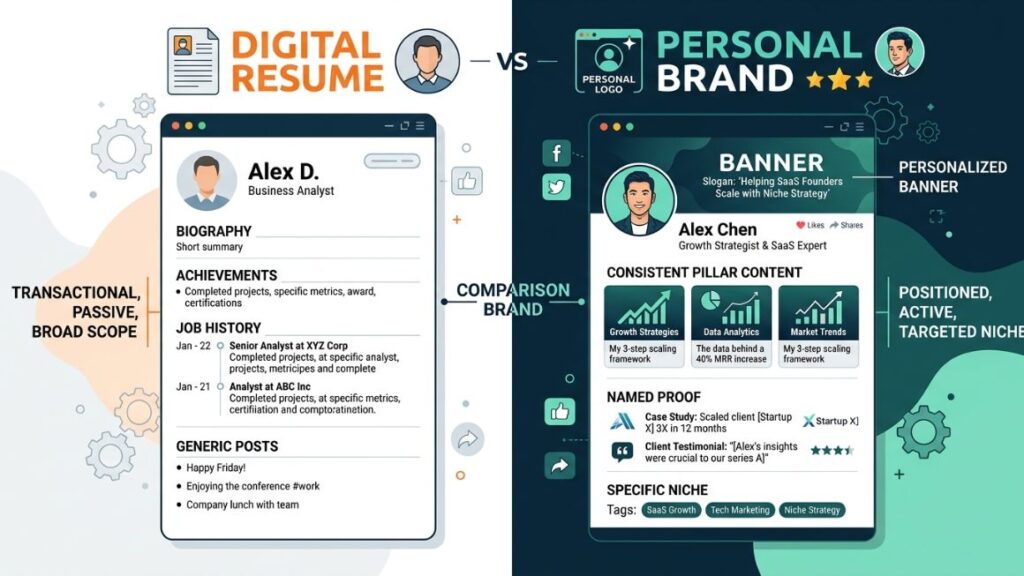
A digital resume tells people what you’ve done. A personal brand tells people what to expect from you next. That difference is the whole game.
Plenty of professionals post consistently and still get zero inbound interest. They share achievements, congratulate their team, repost industry news. It reads fine. It also reads like everyone else’s feed, which means it does nothing to make a stranger stop scrolling and think “I need to talk to this person.”
A personal brand is a consistent, recognizable point of view that makes your audience associate you with a specific outcome. That’s the standalone definition worth remembering, because it’s the difference between activity and strategy. Activity is showing up. Strategy is showing up as someone specific.
The stakes here are bigger than they look. According to the 2025 Edelman–LinkedIn B2B Thought Leadership Impact Report, 64% of target decision-makers spend more than an hour a week consuming thought leadership content, while 56% say they use it as part of their vendor-vetting process. Among hidden decision-makers, the figures are 63% and 55%, respectively. That means potential buyers are not simply scrolling past thought leadership. Many are using it to learn about problems, form opinions and evaluate potential vendors before a sales conversation takes place.
Follower count is the vanity metric everyone chases and almost nobody should. A profile with 3,000 followers and a sharp, consistent angle can out-convert a profile with 30,000 followers and no clear point of view. Inbound quality, meaning the number of messages that turn into real conversations, is the only number that pays your bills. Chase that instead.
Read More: How to Generate Leads in Sales: Proven Strategies for High-Quality Conversions
Pick a Niche Narrow Enough That People Refer You by Name
Here’s the problem with “social media manager” as a positioning line: there are a few hundred thousand of them on LinkedIn, and none of them come to mind when someone needs help. “Instagram management for D2C beauty brands under ₹5 crore ARR” is a completely different sentence. It’s specific enough that when someone in that exact situation comes up in conversation, your name gets said out loud.
Why “Social Media Manager” Loses to “Instagram Management for D2C Beauty Brands”
Broad positioning tries to be relevant to everyone and ends up memorable to no one. Narrow positioning trades total addressable market for referability, and referability is what actually generates inbound requests. Nobody refers “a good social media manager.” People refer “the person who fixed our Instagram conversion problem for beauty brands.”
This isn’t about limiting your skills. You can still take broader work. It’s about what you lead with publicly. That’s the label that sticks in someone’s head when they need to recommend a person fast.
How to Test if Your Niche Is Specific Enough?
Run the referral test. If a stranger heard your positioning line once, can they repeat it accurately to a friend three days later? If the honest answer is no, it’s still too broad. “I help brands with marketing” fails instantly. “I help D2C skincare brands fix cart abandonment through email flows” passes. That’s because it’s concrete enough to repeat without losing meaning.
Shagun Mahajan of Brand Carving built her consultancy specifically around personal branding for executives and entrepreneurs, not marketing services in general.
As freelancers gain experience, clearer positioning can make referrals easier because existing clients and contacts have a simpler description of what to recommend them for. The first two or three clients come from your network regardless of positioning. Somewhere around client three, generalist freelancers hit a wall because nobody outside their existing circle knows what to refer them for. Specialists blow past that wall because strangers can describe exactly who they’re right for.
Read More: How to Build a Digital Marketing Strategy for Startups
The Four Content Pillars That Actually Attract Clients, Not Just Views
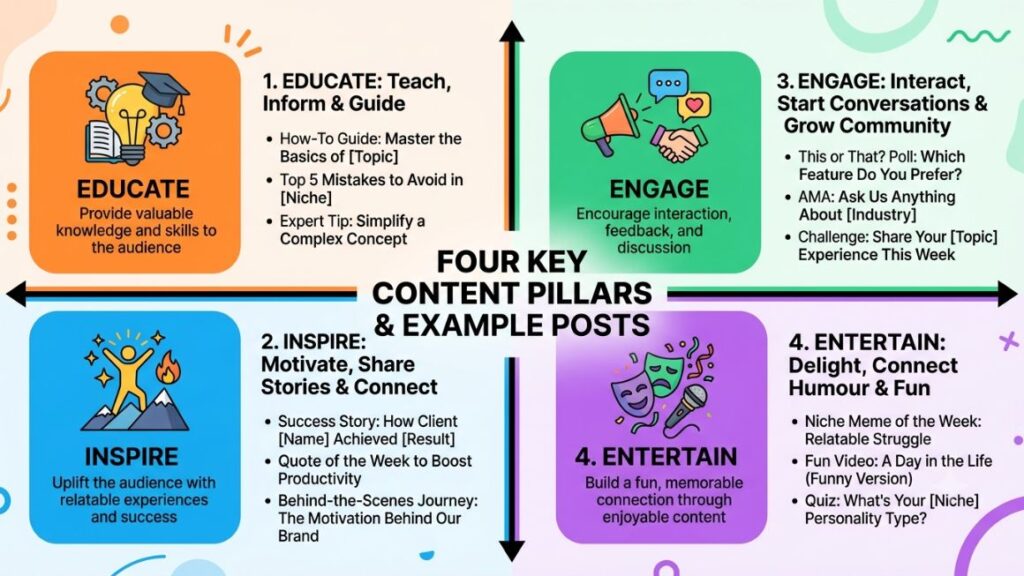
Content pillars are the four recurring categories your posts fall into. Getting this mix right is what separates an account that gets views from one that gets client messages.
Problem Posts
These name the exact pain your buyer has, in their language instead of yours. Not “brands struggle with engagement” but “your Instagram engagement rate dropped 40% the same month you switched to Reels-only, and nobody on your team can explain why.” Specificity here mostly does the heavy lifting. Vague problems don’t make anyone feel seen.
Proof Posts
Screenshots, results, before and after numbers. This is the pillar most professionals skip out of modesty. But it’s the single biggest inbound driver of the four. A results screenshot with context beats a claim every time, because readers trust what they can verify over what they’re told.
The context matters as much as the number itself. “Grew engagement 3x” means nothing without the starting point, the timeframe, and what actually changed. “Took a stalled account from 200 to 600 profile visits a week over eight weeks by switching from generic tips to problem-specific carousels” gives a reader something they can mentally test against their own situation, which is exactly what nudges a lurker into a DM.
Process Posts
These show how you actually work, not the polished output. A quick breakdown of your content calendar process, your client onboarding checklist, or how you structure a first call. Process posts build trust before a prospect ever talks to you, because they’ve already watched you think.
Point-of-View Posts
The specific lesson from the specific moment, not a generic listicle. “5 tips for better content” is forgettable. “I watched a client’s engagement triple after we cut their posting frequency in half” is a story with a claim attached. It’s the format that gets saved and shared.
A personal brand built for inbound requests runs on four repeating content types: problem posts that name a specific pain point, proof posts that show verifiable results, process posts that reveal how the work actually happens and point-of-view posts built from a real and specific moment rather than generic advice.
Where to Build It First: LinkedIn vs. Instagram vs. a Website
LinkedIn is a natural starting point for many B2B professionals. That is because its audience is built around professional identities, companies, expertise and business relationships. LinkedIn’s own research positions the platform as an important channel for influencing B2B decision-makers. The platform’s own audience is already in a professional headspace. It is actively vetting people before hiring or partnering with them. That is exactly the mindset that converts a stray post into a direct message.
An owned blog or website matters for a different reason. It makes your proof searchable instead of buried three scrolls down in a feed. When someone Googles your name after seeing your LinkedIn post, a website with case studies and a clear service page closes the loop LinkedIn opens. Without it, that curiosity has nowhere to land.
This search moment is where branded search becomes a real, trackable signal rather than a vague idea. If someone typed your name or the name of your service into Google after reading your post, that’s demand you generated, not demand you paid to reach. A website gives that demand somewhere concrete to land, whether it’s a portfolio page, a case study, or a simple contact form, instead of leaving the prospect to hunt for your Instagram handle in the comments of an old post.
Instagram still matters, just not for the same audience. It’s the stronger channel for consumer-facing and creative niches, personal stylists, wedding photographers, D2C-focused consultants, where the buying decision is more visual and less procurement-driven.
| Platform | Best For | Role in Inbound | What to Show |
| B2B professionals, consultants, freelancers | Build authority and start conversations | Expertise, insights, case studies, client results | |
| Creators, D2C consultants, visual businesses | Show your work and attract attention | Portfolio, Reels, visual results, behind-the-scenes | |
| Website | Professionals offering services | Turn interest into enquiries | Case studies, services, testimonials, contact details |
Read More: How to Build a Marketing Portfolio With No Experience (Step-by-Step)
How Often to Post Without Burning Out (Based on 2026 Data)
You do not need to post daily, and the newest research says daily posting can actively work against you.
According to Buffer’s 2026 analysis of more than 2 million LinkedIn posts across 94,000-plus accounts, moving from one post a week to a cadence of two to five weekly posts produced roughly 1,182 more impressions per post and a 0.23 percentage point lift in engagement rate. That’s the single biggest jump in the entire dataset. Pushing past five posts a week kept improving the numbers in Buffer’s data, but for most solo professionals managing this alongside client work, two to five posts weekly is the realistic, sustainable range.
Format matters here too, not just frequency. A separate 2026 study from Metricool found that personal profiles posted at an average of 3.05 times a week compared to 2.34 for company pages, consistently outperformed those pages at every posting frequency measured. If you’re building this brand as an individual rather than through a company account, that gap is worth remembering. It’s one more reason the personal profile, not a business page, should carry the weight of your content strategy.
Three specific posts beat seven generic ones. This isn’t a slogan. It’s the practical result of the content pillar structure above. A problem post that names a real pain point pulls harder than three vague “here’s what I learned this week” updates, because specificity is what makes someone stop scrolling.
A sustainable weekly mix for most professionals looks like two problem or proof posts, one process post, and one point-of-view piece, alternating text and carousel formats so the feed doesn’t feel repetitive.
Why Authenticity Is Beating Polish in 2026
Corporate-polish content is dying. LinkedIn itself confirmed it’s actively working against the trend. LinkedIn stated in an April 2026 announcement that it is cracking down on automation tools and content that appears polished but lacks genuine perspective, working with its editorial team to identify posts that add real context or expertise versus content that only feels produced.
That’s a direct signal. Stock-photo aesthetics and generic, ghostwritten-sounding lessons are getting deprioritized in distribution. That said, they are disliked by readers. Real experience is winning as the primary source of content. That matters if your posting habit has quietly drifted toward safe and sanitized takes that can belong to anyone.
Here’s where a ghostwriter can still help without costing you your voice: bring them your actual stories, your actual client moments, your actual opinions, and have them handle structure and polish, not substance. The failure mode is handing a ghostwriter a topic and letting them invent the perspective. Readers and the algorithm can tell the difference.
Building “Opportunity Gravity”: Making Clients Come to You Instead of Chasing Them
Opportunity gravity is what happens when your profile and content work together to pull inbound interest toward you, instead of you pushing outreach out toward prospects.
Profile Optimization as a Landing Page, Not a Resume
Treat your headline and About section the way you’d treat a landing page. Focus on what specific outcome you deliver and for whom. A resume lists what you did. A landing page tells a visitor what happens if they hire you. Your Featured section should function the same way. That is pinned proof for someone who’s curious but not ready to message yet.
The 80/20 Rule
Roughly 80% of your content should be educational and useful on its own with nothing to sell. The remaining 20% can be direct, results, case studies, service mentions. Flip that ratio and the account starts to feel like an ad feed, which is exactly what makes people scroll past instead of engaging.
Video and Carousels
Multi-format content compounds reach because different formats surface to different segments of your audience and get redistributed differently by each platform’s algorithm. A carousel breaking down a framework, followed later by a short video explaining the same idea conversationally, reaches people who’d have skipped one format entirely.
There’s a quieter lever in this section that most professionals skip entirely: commenting. Leaving 10 to 20 thoughtful comments a week on posts in your niche, not generic “great post!” filler but a genuine addition to the conversation, puts your name and photo in front of an audience you haven’t earned yet through your own posts. It compounds the same way your own content does, just slower and with less effort per touch, and it’s often the first place a future client notices you before ever visiting your profile.
How to Track Whether Your Personal Brand Is Actually Working?
The metrics that matter are qualified inbound inquiries, your inquiry-to-call conversion rate, branded search volume for your name, referral mentions you hear about secondhand and content-assisted sales. That means deals where a prospect mentions having read your posts before reaching out.
Vanity metrics like likes and follower growth tell you basically almost nothing about revenue. A post with 40 likes and one qualified inbound message has done its job. A post with 4,000 likes and zero messages hasn’t.
Branded search is the easiest of these to actually track and the one most people never check. If you own a website, Google Search Console can show you how many people searched your name or your specific positioning phrase over time. A steady upward trend in those searches, even a small one, is early proof that your content is making people curious enough to go looking for you outside the platform where they first saw your post.
Realistically, expect an early signal within 90 days. These are usually a handful of DMs or comments from people you don’t know. Consistent and dependable inbound flow tends to take six to twelve months of steady posting against a clear niche. That’s slower than most people want to hear. But it’s also far more durable than a cold-outreach pipeline that dries up the moment you stop sending messages.
Read More: Brand Awareness Strategies: The Complete Guide for 2026
Common Mistakes That Quietly Kill Inbound Growth
Posting for the algorithm instead of the audience is the first one. Chasing whatever format the algorithm is rewarding this month, at the expense of the specific problem your actual buyer has, trains your audience to expect generic content and trains the algorithm to show your posts to people who’ll never hire you.
Chasing virality over specificity is the second. A post that goes broadly viral often attracts the wrong audience entirely, people who found it funny or relatable in a general sense, not people who need what you sell. Specific, less-viral posts convert at a far higher rate because they’re filtering for the right reader on purpose.
The third is having no system to capture and follow up on inbound interest. A DM that sits unanswered for four days because there’s no process for triaging them is a wasted opportunity that a cold outreach campaign would never have generated in the first place. Something as simple as a saved reply template and a same day response habit closes this gap.
Conclusion
A personal brand that gets you inbound client requests comes down to three decisions repeated consistently: a niche narrow enough to be referable, proof shown instead of claimed, and a posting rhythm you can actually sustain without burning out. None of that happens in a week, and honestly, that’s what makes it work. Anything that took six months to build isn’t going to disappear the moment you take a week off.
Start with one decision this week: write down the single sentence that describes exactly who you help and with what. Test it on someone outside your industry. If they can repeat it back accurately three days later, you’ve got your starting positioning.
Want more frameworks like this one delivered straight to your inbox? Subscribe to the Crystal Clear Newsletter for practical, no-fluff marketing breakdowns you can actually use.
Frequently Asked Questions
What is a personal brand and how is it different from a personal profile?
A personal profile is a record of your career history. A personal brand is a consistent and recognizable point of view tied to a specific outcome. That is built through repeated content, not a one-time bio update. The profile is static. The brand is what you actively build over months of posting.
How long does it take to start getting inbound clients from a personal brand?
Most professionals see early signal, comments, DMs and connection requests from strangers within about 90 days of consistent and niche-specific posting. Dependable and recurring inbound flow typically takes six to twelve months. That depends on your posting consistency and how narrow the positioning is.
How often should I post to attract clients?
Two to five times a week is the sweet spot that is based on Buffer’s 2026 analysis of over 2 million LinkedIn posts. Posting less than twice weekly makes it hard to stay visible. Three focused and specific posts will outperform seven generic ones every time.
Do I need to be on video to build a personal brand in 2026?
No, but multi-format content compounds reach. Text posts and carousels can carry a personal brand entirely on their own, especially early on. Adding video later helps you reach segments of your audience who engage more with that format. But it isn’t a prerequisite to getting inbound requests.
Is LinkedIn or Instagram better for getting inbound client requests?
LinkedIn is the stronger channel for B2B and professional services in India. That is because the audience is already in a hiring or vetting mindset. Instagram works better for consumer-facing and creative niches where buying decisions are more visual.
Can I use a ghostwriter and still have an authentic personal brand?
Yes, as long as the stories, opinions and experiences come from you and the ghostwriter handles structure and polish rather than inventing the perspective. LinkedIn’s 2026 push against generic and low perspective content makes this distinction matter more than it used to.
How do I know if my personal brand is actually working?
Track qualified inbound inquiries, inquiry-to-call conversion, branded search for your name, referral mentions and content-assisted sales. Ignore follower count and like counts, since neither correlates reliably with revenue.
Do I need a large following to get inbound clients?
No. A smaller and specifically-positioned audience converts better than a large and generic one. Referrals and inbound requests come from people remembering exactly what you do, not from raw reach.