
Most marketing debates end up being false choices. “Should we run paid ads or focus on content?” “Should we do email or social?” The same thing happens with direct and indirect marketing. Brands pick one, call it their strategy, and wonder why growth eventually plateaus.
The truth is that direct and indirect marketing aren’t competing approaches. They’re doing completely different jobs. One captures demand that already exists. The other creates demand where none exists yet. You need both, and the brands doing this well -Amazon, Nike, HubSpot -figured this out a long time ago.
This article breaks down what direct and indirect marketing actually mean, where each one works, how real brands use them, and how you can combine both to get the most out of your marketing budget. Whether you’re just starting out or trying to fix a strategy that’s stopped working, understanding direct and indirect marketing is one of the most useful things you can do.
Table of Contents
What Is Direct Marketing?
Direct marketing is any marketing activity that communicates with a specific, identified audience with a clear, measurable call to action. The goal is an immediate response -a click, a purchase, a sign-up, a call.
What makes it “direct” is the targeting. You know exactly who you’re reaching: a customer segment, a list of prospects, a demographic profile. There’s no broadcast to a wide, undefined audience. Every message goes to someone you’ve already chosen to talk to.
This is different from advertising that builds awareness broadly. Direct marketing is about getting a specific person to do a specific thing right now. That’s why it’s also the easier one to measure -you can track exactly how many people received your message and how many took action.
Direct marketing is a targeted communication strategy in which brands reach out to a specific, identified audience with a clear call to action and an expected, measurable response. Unlike broad advertising, direct marketing is designed to produce an immediate, trackable outcome -a purchase, a sign-up, or an inquiry. It’s most effective when the audience is well-defined and the offer is relevant to their current needs.
Top 5 Channels Used in Direct Marketing
1. Email Marketing
Email is still the highest-ROI direct marketing channel available. According to a 2023 report by Litmus, email marketing delivers an average return of $36 for every $1 spent -a figure that’s held consistently across industries for years.
The reason email works so well is precision. You’re sending to people who have already expressed interest. You can personalise by purchase history, behaviour, location, or lifecycle stage. And you can test everything: subject lines, send times, content structure, offers.
For brands with any kind of customer list, email should be doing significant work.
2. SMS Marketing
SMS has an open rate of roughly 98%, compared to around 20-25% for email, according to SimpleTexting’s 2023 SMS Marketing Statistics report. That sounds almost too good to be true, but it makes sense -most people read every text they receive.
The constraint is intent. SMS works best for time-sensitive messages: flash sales, appointment reminders, order updates, and limited-time offers. Sending too frequently or without a clear value destroys opt-out rates fast.
Brands like Domino’s Pizza use SMS well: they push promotional codes during low-traffic hours and drive direct orders with a clear deadline attached.
3. Telemarketing
Telemarketing has a mixed reputation, mostly because it’s been done badly at scale for decades. But done well -with permission, relevance, and a trained team -it still works, particularly in B2B contexts and high-value product categories.
Insurance, financial services, and SaaS companies with complex products use telemarketing to qualify leads, book demos, and close deals that email alone can’t convert. The key distinction is inbound vs. outbound. Inbound telemarketing (responding to customers who call you) is almost universally effective. Outbound requires careful targeting and strict compliance with TRAI regulations in India.
4. Direct Mail
Physical mail sounds old-fashioned, but it has a notable advantage: almost no competition for attention. Your inbox gets dozens of messages a day. Your physical mailbox gets far fewer.
Direct mail ROI varies widely by category. For premium products and financial services, a well-designed physical mailer can outperform digital channels significantly. IKEA’s catalog mailings remain one of the most famous examples in marketing history -more on that below.
In India, direct mail is underused as a channel, which means the brands that do it well stand out.
5. Paid Online Ads Targeting Specific Demographics
Paid advertising through platforms like Meta Ads and Google Ads is direct marketing when it’s built around a specific audience, a specific offer, and a measurable conversion goal. Retargeting campaigns especially fit this description -you’re reaching people who’ve already interacted with your brand and delivering a message designed to bring them back.
This is different from broad awareness-focused paid campaigns, which behave more like indirect marketing.
Read More: email marketing strategy
Top Brands and Their Direct Marketing Examples
1. Amazon -Personalised Email Campaigns
Amazon’s email marketing is one of the most studied examples in e-commerce. Their recommendation engine pulls browsing and purchase history to generate personalised product suggestions that feel individually curated. The subject lines reference specific products the user viewed. The email content changes based on what category you last shopped in.
This isn’t just personalisation for its own sake. According to McKinsey’s 2021 research on personalisation, 71% of consumers expect personalised interactions, and companies that do it well generate 40% more revenue than those that don’t. Amazon’s approach makes email a direct revenue engine, not just a newsletter.
2. IKEA -Catalog Mailing
For decades, IKEA’s annual catalog was the highest print-run publication in the world. At its peak, they distributed over 200 million copies across 50 countries -more than the Bible in the same year. The catalog wasn’t just a product list. It was a design document that sold a lifestyle.
IKEA eventually discontinued the print catalog in 2021, shifting to digital formats. But their direct mail strategy taught the marketing world something important: a well-designed physical touchpoint creates a depth of engagement that digital often can’t replicate.
3. American Express -Targeted Direct Mail
American Express has long used targeted direct mail to acquire premium cardholders. They source data on high-income demographics, purchase behaviour, and spending categories to send pre-approved card offers to prospects who match their ideal customer profile.
The offers are tailored to the segment: a frequent traveller gets highlighted airline benefits; a restaurant-heavy spender sees dining rewards. The personalisation makes the mailing feel relevant rather than generic, which is why their direct mail response rates consistently outperform industry averages.
4. Domino’s Pizza -SMS Marketing
Domino’s uses SMS as a loyalty channel and an urgency driver. In India, their SMS campaigns typically combine a time-limited discount code with a direct link to order online or call the nearest outlet. The campaigns are short, specific, and designed for one action: order now.
This is textbook direct marketing. There’s a named recipient (loyalty program member), a clear offer, a deadline, and a single response option. The measurability is built in from the start.
Brands like Amazon, IKEA, American Express, and Domino’s Pizza have demonstrated that direct marketing is most effective when messages are personalised, offers are specific, and the desired action is singular and easy to complete. Personalisation can increase email revenue by up to 40%, according to McKinsey’s 2021 research. The common thread across successful direct marketing campaigns is a clear understanding of who the recipient is and what they need right now.
What Is Indirect Marketing?
Indirect marketing is any activity that builds brand awareness, trust, or preference over time without a direct call to action. There’s no “buy now” or “call us today.” The goal is to make people aware of, and eventually attached to, your brand -so that when they’re ready to buy, they think of you first.
The defining characteristic of indirect marketing is patience. You’re investing in relationships and reputation before there’s any transaction on the table. A blog post that answers a question your potential customer is searching for is indirect marketing. An Instagram video that entertains your target audience is indirect marketing. A PR story that makes people trust your brand is indirect marketing.
This is why indirect marketing is harder to measure in the short term. There’s often no direct line between a piece of content you published today and a sale that happens six weeks later. But that doesn’t mean it isn’t working.
Top 5 Channels Used in Indirect Marketing
1. Social Media Marketing
Social media is the largest indirect marketing channel for most consumer brands today. Platforms like Instagram, YouTube, and LinkedIn allow brands to consistently reach their target audience with content that entertains, educates, or inspires -without a direct sales pitch.
The value here is in the relationship built over time. A brand that shows up consistently with relevant, useful content earns the kind of trust that paid ads can’t manufacture. When that audience eventually needs what you sell, you’re already in their consideration set.
Read More: social media marketing strategy
2. Content Marketing (Blog Posts, Videos, Infographics)
Content marketing works by making your brand the most useful source of information in your category. When someone searches “how to track marketing ROI” and lands on your blog, they haven’t been sold to. But they’ve learned something valuable from you. That’s a deposit in a trust account that compounds over time.
HubSpot built its entire business on this model. Their blog drives millions of organic visits every month, and a significant portion of those readers become CRM customers -not because HubSpot pushed them, but because they became the go-to resource in the marketing and sales space.
3. Public Relations (PR)
PR is earned media: coverage, mentions, and citations that come from journalists, analysts, and influencers choosing to write about your brand rather than you paying for placement.
A strong PR mention in a credible publication does several things at once. It reaches an audience you might not have access to otherwise. It signals third-party validation. And it can drive organic search authority when the article links back to your site. For startups and challenger brands, early PR coverage can compress the awareness-building timeline significantly.
4. Search Engine Optimisation (SEO)
SEO is long-term indirect marketing. When you optimise your content to rank for search queries your audience is typing, you’re building a distribution channel that works for you continuously once it’s established.
The limitation is time -SEO takes months to show results. But the advantage is compounding: a well-ranked page can drive traffic for years without ongoing ad spend. Brands like Zepto, Mamaearth, and Nykaa in India have invested heavily in content and SEO as a way to reduce their dependence on expensive performance marketing over time.
Read More: SEO strategy
5. Influencer Marketing
Influencer marketing sits at the intersection of indirect and, sometimes, direct marketing depending on how it’s set up. At its core, it’s indirect: a trusted voice in a community recommends your brand to their audience, building awareness and credibility through association.
What makes influencer marketing powerful is borrowed trust. An influencer who has spent years building a loyal audience in a specific niche can introduce your brand to that audience with far more credibility than you could build on your own from scratch.
In India, the influencer marketing space has matured rapidly. Brands like boAt, Mamaearth, and Manyavar have used creator-led content across YouTube, Instagram Reels, and podcasts to reach audiences that traditional advertising struggles to access.
Top Brands and Their Indirect Marketing Examples
1. Coca-Cola -Social Media Content Marketing
Coca-Cola doesn’t run many ads that say “drink Coke.” Most of their social media output is about happiness, celebration, shared moments, and human connection. The product is often incidental to the content.
This is deliberate. Coca-Cola understands that brand preference is emotional, not rational. You don’t choose Coke over Pepsi because of a superior value proposition. You choose it because of decades of association with good feelings. Their indirect marketing is the ongoing work of reinforcing that emotional positioning.
2. Nike -Brand Storytelling Through Content
Nike’s “Just Do It” campaigns rarely sell shoes. They tell stories about athletes overcoming odds, about perseverance, about the meaning of competition. The product appears at the end, almost as an afterthought.
But those stories have made Nike one of the most valuable brands in the world, with a brand valuation of over $33 billion according to Interbrand’s 2023 Best Global Brands report. The ROI on brand storytelling is real -it just shows up in pricing power, customer loyalty, and retention rather than in a cost-per-acquisition report.
3. Red Bull -Event Sponsorships and Content Creation
Red Bull is one of the most remarkable indirect marketing operations ever built. They sponsor extreme sports events, produce documentary films, run a record label, and own sports teams -none of which directly sell energy drinks. All of which associates Red Bull with a specific lifestyle: high-performance, high-adrenaline, boundary-pushing.
Red Bull Media House produces content that competes with professional broadcasters in terms of quality. This content builds an audience before it builds customers. And it works: Red Bull sold over 12.1 billion cans in 2023, according to the company’s annual report.
4. HubSpot -Educational Blog and Content Marketing
HubSpot’s marketing blog is one of the clearest examples of content-as-acquisition in B2B marketing. The blog publishes hundreds of long-form articles every month on marketing, sales, and business strategy. Most articles don’t mention HubSpot’s products at all.
But each reader who finds the blog through a search engine is a potential customer. HubSpot captures some of them with free tools, email sign-ups, and content upgrades. The indirect marketing does the demand generation work. The CRM sales process handles the conversion.
Successful indirect marketing builds brand equity, awareness, and trust over time by consistently delivering value to a target audience without a direct sales pitch. Brands like Nike, Red Bull, and HubSpot have demonstrated that long-term indirect marketing creates sustainable competitive advantages that paid advertising alone cannot replicate. The payoff is customer loyalty, pricing power, and an audience that seeks the brand out rather than needing to be found.
Direct vs. Indirect Marketing: Key Differences
Here’s a direct comparison across the dimensions that actually matter for decision-making:
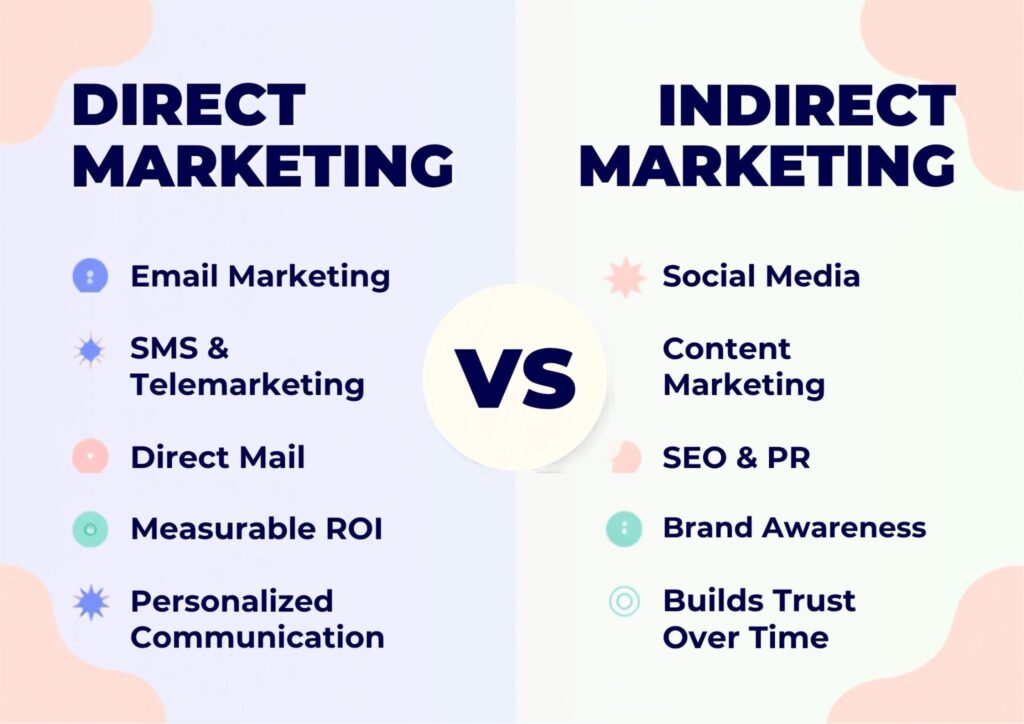
Goal: Direct marketing targets an immediate, measurable action. Indirect marketing builds long-term awareness and preference.
Targeting: Direct marketing is highly specific -you know who you’re reaching. Indirect marketing is broader, reaching audiences by category rather than by name.
Measurement: Direct marketing is easy to measure in the short term: open rates, click-through rates, conversion rates, cost per acquisition. Indirect marketing requires longer attribution windows and often relies on brand tracking, share of voice, or assisted conversion metrics.
Timeline: Direct marketing produces faster results. Indirect marketing compounds over months and years.
Cost structure: Direct marketing has higher variable costs (every email, every SMS, every ad impression costs money). Indirect marketing typically has higher fixed costs upfront (content production, PR) but lower ongoing costs once assets are live.
Audience relationship: Direct marketing speaks to people who know you or have been specifically targeted. Indirect marketing speaks to anyone who might eventually need what you offer.
Neither approach is inherently better. They serve different stages of the customer journey and different business objectives. And that’s exactly why the best brands don’t choose -they combine both.
Which Is Best for Your Business?
Honestly, the question isn’t which one is better. The more useful question is which one your business needs more of right now.
If you have no existing customer base and no brand awareness, pure direct marketing will be expensive and inefficient. You’ll pay high acquisition costs because nobody knows who you are, and cold audiences don’t convert well.
If you have brand awareness but no conversion mechanism, all your indirect marketing investment is generating interest that somebody else is capturing. You need a direct marketing layer to convert that interest into revenue.
Most businesses sit somewhere in the middle. They have some brand presence, some customer list, and some mix of both already running. The question is whether that mix is calibrated correctly for their current stage.
When to Choose Direct, Indirect -or Both?
Best Use Cases for Direct Marketing
Direct marketing works best when:
- You have a well-defined audience you can identify and reach
- You have a time-sensitive offer or a limited inventory situation
- Your product solves a specific, immediate problem
- You’re trying to reactivate lapsed customers who already know your brand
- You need measurable short-term revenue and can’t wait for content to compound
E-commerce brands running end-of-season sales, SaaS companies onboarding trial users, and financial services companies targeting pre-approved segments are all classic direct marketing situations.
Best Use Cases for Indirect Marketing
Indirect marketing works best when:
- You’re entering a new category where no one knows your brand
- Your product has a long consideration cycle (cars, insurance, enterprise software)
- You’re building pricing power and want to compete on value, not just price
- You want to reduce long-term dependence on expensive paid acquisition
- Your audience needs to trust you before they’ll buy from you
Startups building brand identity, D2C brands trying to create a loyal community, and B2B companies in competitive markets all benefit disproportionately from strong indirect marketing.
Read More: brand building strategy
Common Types of Direct and Indirect Marketing Activities
It helps to have a clear reference for which activities fall into which category. In practice, some channels can serve both purposes depending on how you use them.
Primarily direct:
- Transactional emails (receipts, confirmations, cart abandonment)
- Promotional SMS campaigns
- Retargeting ads with a specific offer
- Telemarketing and sales calls
- Direct mail with a coupon or offer code
- PPC ads targeting high-intent keywords
Primarily indirect:
- SEO-optimised blog content
- Organic social media posts
- YouTube channel content
- Podcast sponsorships
- Event sponsorships and participation
- PR and media coverage
- Influencer partnerships without a direct promotional code
Can be either, depending on execution:
- Email newsletters (educational = indirect; promotional = direct)
- Social media ads (brand awareness campaigns = indirect; conversion campaigns = direct)
- Influencer campaigns (brand building = indirect; discount code with link = direct)
- Content marketing (educational = indirect; gated lead magnet = direct)
Understanding which category an activity falls into helps you set the right success metrics from the start. Measuring a brand awareness campaign on cost-per-acquisition is like measuring a marathon runner on sprint speed.
Combining Direct and Indirect Marketing for Maximum ROI
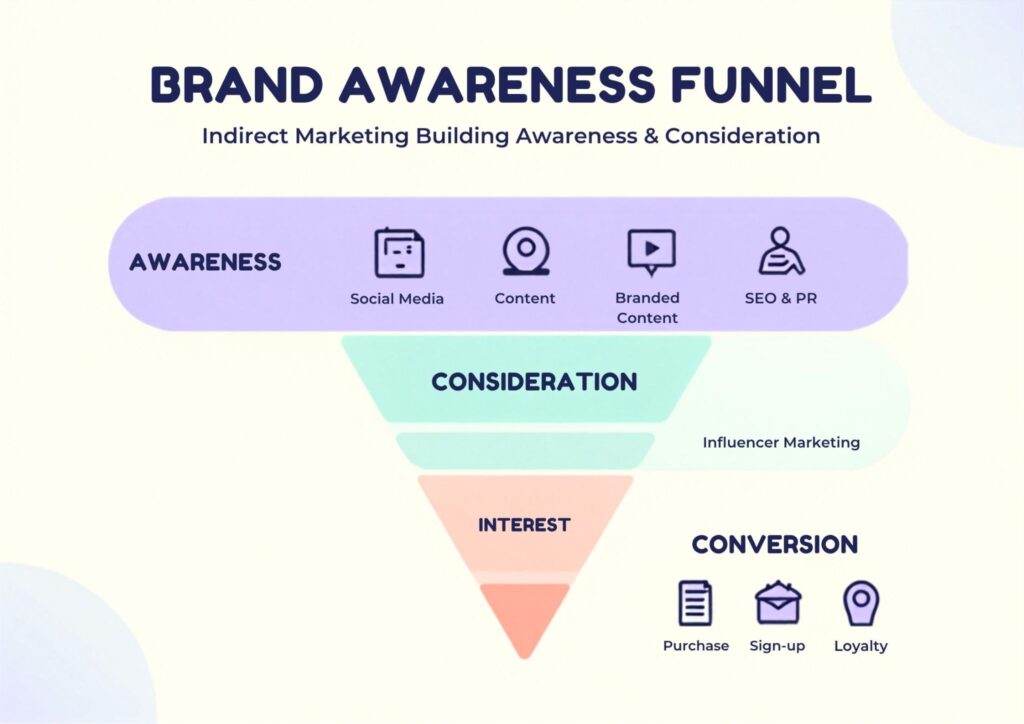
The brands that consistently outperform their category aren’t choosing between direct and indirect. They’re building a funnel where indirect marketing creates awareness and trust, and direct marketing converts that awareness into revenue.
Here’s what that looks like in practice:
Stage 1 -Awareness (indirect): A potential customer finds your blog through a search. They read an article that solves a problem they’re dealing with. They’ve never heard of your brand before. Now they have, and the first impression is positive.
Stage 2 -Consideration (indirect + direct): They follow you on LinkedIn. A few weeks later, they see a post about a related topic. You’ve now shown up for them multiple times. They sign up for your email newsletter (this is the transition point from indirect to direct).
Stage 3 -Conversion (direct): You send them a targeted email with a relevant offer based on what they’ve been reading. They click. They buy.
Stage 4 -Retention (direct): Post-purchase emails, SMS updates, loyalty campaigns. You’re maintaining the relationship directly.
This funnel doesn’t work if either layer is missing. Without the indirect marketing at the top, the direct marketing at the bottom has no warm audience to convert. Without the direct marketing at the bottom, all the indirect investment generates interest that never becomes revenue.
Combining direct and indirect marketing creates a full-funnel strategy where indirect efforts build brand awareness and trust among a broad audience, and direct efforts convert that trust into measurable action. Brands that use only one approach leave money on the table: pure direct marketing suffers from high cold-audience acquisition costs, while pure indirect marketing generates awareness without a mechanism to capture it. The most effective marketing mix aligns channel choice with the customer journey stage.
Why Brand Awareness Still Matters Even for Performance-Focused Marketers
There’s a tendency among performance marketers to dismiss brand work as untrackable and therefore not worth investing in. This is a costly mistake.
Research by the Ehrenberg-Bass Institute -one of the most respected marketing science bodies in the world -consistently shows that mental availability (the likelihood that a brand comes to mind in a buying situation) is the single biggest driver of long-term market share growth. You can’t build mental availability through direct marketing alone.
What this means practically: if you’re spending 90% of your budget on conversion-focused campaigns and 10% or less on brand building, you’re likely paying higher CPAs over time because your brand isn’t staying top of mind between purchase cycles. The indirect marketing investment actually makes your direct marketing more efficient.
From what we’ve seen with YUP learners working at D2C brands in India, a common pattern is this: brands that cut brand awareness spend during cost pressure periods experience a lag in CAC increases 6-12 months later. The two are connected, even if the connection isn’t obvious in a dashboard.
How to Track Your Marketing ROI Without a Dedicated Analytics Team
One of the most common objections to investing in indirect marketing is “we can’t measure it.” That’s partly true and partly an excuse. Here’s a practical framework for tracking ROI across both direct and indirect activities without needing a full analytics team.
For direct marketing -these metrics are non-negotiable:
- Open rate and click-through rate (email/SMS)
- Conversion rate per campaign
- Cost per acquisition (CPA) by channel
- Revenue attributed to the campaign within a defined window
For indirect marketing -shift your measurement frame:
- Organic traffic growth month-over-month (SEO and content)
- Share of voice in your category (social listening tools like Brandwatch or Talkwalker)
- Branded search volume growth (Google Search Console)
- Direct traffic growth (a proxy for increasing brand recognition)
- Assisted conversions in Google Analytics 4 (content that influenced a later purchase)
Blended metrics that capture both:
- Marketing Efficiency Ratio (MER): total revenue divided by total marketing spend across all channels. This is the one number that tells you whether your overall marketing investment is paying off, regardless of attribution complexity.
- Customer Lifetime Value (CLV): If your CLV is increasing, your brand-building is probably working, even if individual campaigns don’t show it.
Read More: marketing analytics
The goal isn’t perfect attribution. It’s good enough direction to make better investment decisions.
The Bottom Line on Direct and Indirect Marketing
Here’s what it comes down to: direct marketing without indirect marketing is expensive. You’re buying attention from cold audiences every time, with no brand equity, reducing your cost. Indirect marketing without direct marketing is inefficient. You’re building goodwill that never converts.
The brands doing this well -Nike, HubSpot, Amazon, Mamaearth -have figured out that the two approaches are complementary, not competing. Indirect marketing does the long-term work of making people want to buy from you. Direct marketing makes sure they actually do.
If you’re a marketer trying to build a strategy that works beyond the next quarter, start with this question: What’s the balance between my demand-creation activities and my demand-capture activities? If one side is significantly heavier than the other, that’s where you start.
Marketing that only captures is fragile. Marketing that only creates is incomplete. Build both, measure both, and let each one make the other more effective over time.
Frequently Asked Questions
What is the difference between direct and indirect marketing?
Direct marketing involves communicating with a specific, identified audience with a clear call to action and an expected measurable response -like email campaigns, SMS promotions, or targeted ads. Indirect marketing builds brand awareness and trust over time through channels like content, PR, SEO, and social media without an immediate ask. The simplest way to think about it: direct marketing captures existing demand; indirect marketing creates future demand.
Which is more effective, direct or indirect marketing?
Neither is universally more effective. The right answer depends on your business stage, budget, category, and customer journey. Direct marketing delivers faster, more measurable results. Indirect marketing builds sustainable competitive advantages over time. Most successful brands use both, with the balance shifting based on growth stage and market conditions.
Can small businesses afford indirect marketing?
Yes, and they often can’t afford to do it. Many of the most effective indirect marketing channels -SEO, social media, PR, and content marketing -require time and effort rather than large budgets. A small D2C brand in India can build significant organic reach through consistent Instagram content and a well-maintained blog without spending heavily on paid media. The constraint is usually consistency and patience, not money.
What is an example of combining direct and indirect marketing?
A common example: a brand publishes an educational blog post (indirect) that ranks on Google. A reader discovers the article, finds value, and signs up for the newsletter (transition point). The brand then sends personalised email campaigns to that subscriber (direct) based on their reading behaviour. The indirect marketing created the relationship; the direct marketing converted it.
How do I know when to use direct vs. indirect marketing?
Use direct marketing when you have a warm audience, a specific offer, and a measurable conversion goal. Use indirect marketing when you’re building brand presence, entering a new market, or trying to create trust with an audience that doesn’t know you yet. If you’re not sure, look at your funnel: if people don’t know who you are, start with indirect. If people know you but aren’t buying, add more directness.
Is social media direct or indirect marketing?
Social media is primarily indirect marketing when used organically -posting content to build an audience and brand association. It becomes direct marketing when you run conversion-focused paid campaigns with specific targeting, an offer, and a call to action. Many brands use the same platform for both purposes simultaneously, which is why social media sits in a hybrid category.
What does direct marketing look like in the Indian market?
In India, direct marketing is most commonly executed through email campaigns, SMS promotions, and targeted Meta and Google ads. WhatsApp Business is also a significant direct marketing channel, particularly for small businesses and local retail. Brands like Mamaearth and Zepto use a mix of loyalty programs, SMS, personalised emails, and retargeting ads to drive repeat purchases from their existing customer base.
Is influencer marketing direct or indirect?
Most influencer marketing is indirect because the goal is brand awareness and credibility through association. But it can become direct when influencers share a specific promo code, a direct link to purchase, or a time-limited offer. In those cases, the campaign has a measurable conversion goal attached, which makes it function more like direct marketing -even if the channel is a social media personality.
How long does indirect marketing take to show results?
SEO typically takes 3-6 months to show meaningful organic traffic growth. Content marketing compounds over a year or more. PR impact can be faster but harder to predict. Brand awareness metrics usually require a minimum of 6 months of consistent investment before showing clear trend movement. This is why indirect marketing needs to run alongside direct marketing rather than replacing it -the two operate on different time horizons.
What is the most common mistake brands make with direct and indirect marketing?
The most common mistake is treating them as separate, unconnected strategies. Brands often have one team running performance marketing (direct) and another team running content or brand (indirect), with no shared measurement framework or audience strategy. The result is indirect marketing that generates awareness with no capture mechanism, and direct marketing that exhausts audiences because there’s no brand warmth to reduce resistance. The fix is a unified funnel view where both types of activity feed each other.