

Most candidates fail brand interviews the same way. They know the theory, can recite the 4Ps in their sleep, then freeze when someone asks how they’d fix a brand that’s losing shelf space. Brand management interview questions don’t test what you memorised. They test how you think when the answer isn’t in the textbook.
This guide gives you 50+ brand management interview questions and answers, grouped by type. Each one has the reason it’s asked, what a strong answer contains and a sample you can adapt. Short on time? Skim the brand manager interview questions and answers in the middle, then read the fresher or MBA section that fits you.
The samples are written in first person so they sound natural out loud. Don’t copy them. Interviewers can smell a rehearsed answer from across the room.
Table of Contents
Understanding the Role of a Brand Manager
A brand manager is accountable for how a brand is perceived and how it performs commercially. That means setting positioning, steering campaigns and checking whether customers remember, choose and recommend the brand. It’s a strategy job that gets judged on execution.
Amul shows what that looks like over time. According to GCMMF’s April 2026 statement, the Amul brand’s turnover crossed ₹1 lakh crore in FY26, while GCMMF’s own sales rose 11.4% to ₹73,450 crore. PrintWeek reports that Amul spends less than 1% of its revenue on advertising. So where does the growth come from? Partly from a mascot, a topical voice and decades of discipline about what the brand will and won’t say. Somebody has to guard that.
To be fair, Amul’s farmer-owned cooperative model is unusual. Treat it as a lesson in consistency, not a template for your next launch.
Key responsibilities of a brand manager
Brand manager roles and responsibilities shift with company size, but six jobs show up almost everywhere:
- Developing brand strategy: who the brand is for and what it promises.
- Understanding consumer behaviour: what customers do, not only what they say.
- Managing identity and positioning: staying distinct from competitors.
- Planning marketing campaigns: briefs, budgets and channels.
- Coordinating with sales, creative and digital teams: one message, many departments.
- Monitoring brand performance: awareness, sentiment, loyalty and sales.
Skills employers look for in candidates
Panels screen for brand management skills in a fairly predictable order, and the brand management interview questions below are built to surface them. Strategic thinking comes first, because everything else sits on it. Analytical thinking follows, since a brand manager who can’t read a funnel report is guessing. Creativity matters as a way to solve problems, not as taste. Leadership, problem-solving and the habit of doing market research fill out the list.
Honestly, communication is the one candidates underrate. A brand manager rarely has authority over creative, sales or agencies. They have influence, and influence is mostly clear explanation.
A brand manager owns how a brand is perceived and how it performs in the market. The role covers positioning, campaign planning and performance tracking, and it’s judged on business results as much as creative quality. Amul’s FY26 brand turnover of over ₹1 lakh crore, with advertising reported at under 1% of revenue, shows how far consistency can carry a brand.
50+ Brand Management Interview Questions and Answers
Brand management interview questions fall into six types: general, technical, strategy, behavioural, digital and advanced. The 50 below follow that order. Each gives you why the interviewer asks it, what a strong answer includes, a sample answer and, where it helps, a tip. Warm-up questions get short answers on purpose. The scenario ones get more room, because that’s where interviews are won.
General Interview Questions
Start here. These eight look easy, which is exactly why people coast through them.
1. Tell me about yourself.
Why they ask: A two-minute test of how you structure a story.
Strong answers include: your current role or studies, one proof point and why brands.
Sample answer: “I’m a marketing graduate who ran social media for a skincare start-up. Testing content formats taught me that brand work is mostly consistency, and I’d like to do that at scale.”
Tip: Stop at ninety seconds.
2. What do you understand by brand management?
Why they ask: To see whether you treat it as strategy or just design.
Strong answers include: a clean definition, then perception, positioning, consistency and results.
Sample answer: “Brand management is shaping how people perceive a brand and making sure every touchpoint backs that up, while tracking whether awareness and loyalty actually move.”
3. Why do you want to become a brand manager?
Why they ask: Motivation, and whether you know the job involves numbers. Strong answers include: a real trigger, not “I’m creative.”
Sample answer: “I ran our college fest campaign, and watching ticket data confirm or kill my ideas within days hooked me. Brand management is that loop, full time.”
Tip: Everyone opens with “I love creativity.” Don’t.
4. What makes a brand successful?
Why they ask: It reveals your mental model of the whole job.
Strong answers include: a clear promise, delivery on it, consistency and results.
Sample answer: “People choose it without comparing every option. That takes a clear promise, delivery on it and years of consistency. Amul is my example: same tone, same value for money, decades running.”
Tip: Pick an example from the interviewer’s own category.
5. What is the difference between a brand and a product?
Why they ask: A quick clarity filter.
Strong answers include: product as what’s sold, brand as the meaning attached to it.
Sample answer: “A product is what a company sells. A brand is what customers believe about it. Rivals can copy a product in a quarter. Copying trust takes years.”
6. Which brands do you admire, and why?
Why they ask: Taste and analysis in one go.
Strong answers include: one brand, one specific move and the business reason behind it.
Sample answer: “Nykaa. It built beauty authority through content and later stores, so shoppers trust its advice, not only its prices. In a low-trust category, that’s a moat.”
Tip: Skip Apple unless you’ve got something new to say. Panels have heard it forty times.
7. What are the most important qualities of a successful brand manager?
Why they ask: Self-awareness.
Strong answers include: three qualities, each with proof.
Sample answer: “Judgement, customer curiosity and influence. A brand manager decides with incomplete data and rarely controls the creative, sales or agency teams they depend on.”
8. Why do you want to work with our company?
Why they ask: Did you do your homework?
Strong answers include: a campaign, a competitor and a problem you’d like to tackle.
Sample answer: “Your latest campaign reached younger buyers without pushing loyal ones away. That’s a hard balance, and I’d like to work on it.”
Tip: Generic praise gets spotted in ten seconds.
Technical Brand Management Questions
Technical brand management interview questions check that your vocabulary has understanding behind it. Brand positioning questions turn up in almost every round, so rehearse those aloud.
9. What is brand positioning?
Why they ask: It’s the foundation of the role.
Strong answers include: a definition, the competitor comparison, the audience and a reason to believe.
Sample answer: “Brand positioning is the space a brand occupies in the customer’s mind relative to competitors. Mamaearth built its name around toxin-free products for parents, which set it apart from legacy beauty brands.”
10. What is brand equity, and how can it be measured?
Why they ask:Brand equity interview questions separate people who memorised a definition from people who’ve worked with data.
Strong answers include: a definition, Keller’s model, and both customer and business metrics.
Sample answer: “Brand equity is the extra value a brand adds beyond the product. I’d track awareness, consideration, perceived quality and loyalty, then price premium, repeat rate and share.”
Tip: Say that no single number captures equity. It’s honest and it sounds senior.
Kevin Lane Keller introduced his customer-based brand equity model in 1993. It stacks six building blocks: salience, performance, imagery, judgments, feelings and resonance. Kantar’s BrandZ rankings take another route, combining financial analysis with brand equity research to put a dollar value on brands.
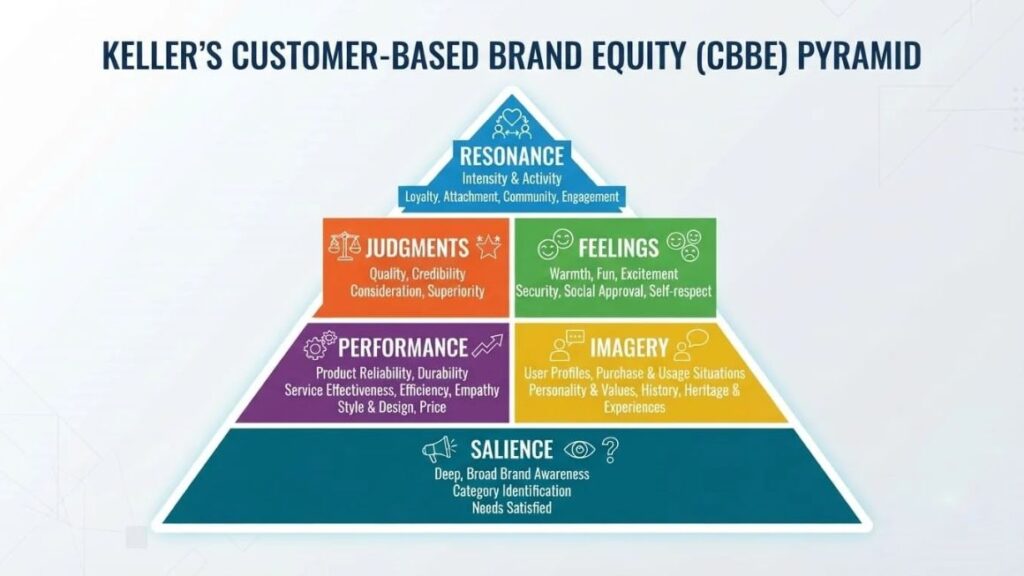
Brand equity is the extra value a brand adds beyond its product. Keller’s 1993 customer-based model builds it from salience to resonance, while Kantar BrandZ combines financial analysis with consumer research to value brands. No single metric captures it, so strong candidates talk about both customer and business measures.
11. What is the difference between brand identity and brand image?
Why they ask: To see if you notice the gap.
Strong answers include: who controls each one.
Sample answer: “Identity is what the company projects. Image is what customers perceive. Brand management is largely the work of closing the gap.”
12. How do you develop a brand strategy from scratch?
Why they ask:Brand strategy interview questions like this one test for a method, not opinions.
Strong answers include: research, positioning, promise, voice, rollout and metrics, in that order.
Sample answer: “Research first: customer, category, gaps. Then position, promise and voice. Roll out small, with metrics agreed up front so we know what working looks like.”
Tip: Research before you create. That’s what they’re checking.
13. What is brand architecture?
Why they ask: It matters most in multi-brand companies.
Strong answers include: a definition and two or three models.
Sample answer: “It’s how a company organises its brands. A branded house like Tata puts one name behind many businesses. A house of brands like P&G lets Tide and Pampers stand alone.”
14. What is the importance of market research in brand management?
Why they ask: Do you check assumptions?
Strong answers include: audience, category and a baseline.
Sample answer: “It stops me building around what I assume customers want, and it gives me a baseline to prove later that something changed.”
15. How do you conduct a brand audit?
Why they ask: A practical method question.
Strong answers include: internal review, external review, competitor comparison and ranked gaps.
Sample answer: “Four passes: internal consistency, customer perception, competitor comparison, then I rank the gaps by impact and effort.”
Tip: Audited a college club’s channels? Say so. It counts.
16. What is brand differentiation?
Why they ask: It’s the core of positioning.
Strong answers include: a reason to choose you that customers care about and rivals can’t easily copy.
Sample answer: “It’s why customers pick you over a similar option. It has to matter to them and be hard to copy. Differentiation nobody cares about is decoration.”
17. How do you build customer loyalty?
Why they ask: Retention is cheaper than acquisition, and panels know it.
Strong answers include: delivering the promise, reducing friction and tracking repeat behaviour.
Sample answer: “Deliver every time, then cut friction after the sale: easy returns, quick support. Then track repeat rate and retention.”
Tip: Separate loyalty from discounts. Discount buyers leave when the discount does.
18. How do you maintain brand consistency across different marketing channels?
Why they ask: Inconsistency is the most common real-world brand problem.
Strong answers include: guidelines, ownership and audits.
Sample answer: “Guidelines, shared templates and one approval owner. Consistent doesn’t mean identical, though. An Instagram Reel and a LinkedIn post should feel like one brand, not one file.”
Also Read: Brand Management Framework: Building Strong Brand Strategy, Identity & Equity
Brand Strategy and Marketing Questions
These brand management interview questions move from knowing to doing. Interviewers want a method.
19. How would you launch a new product in a competitive market?
Why they ask: Structured thinking under ambiguity.
Strong answers include: customer first, then competitors, position, pilot and success measures.
Sample answer: “Customer first: who’s switching, from what, and why. Then I’d map competitors and find a position nobody owns, and pilot in one or two cities before national rollout. Trial shows the message works. Repeat shows the product does.”
Tip: Ask one clarifying question before you answer.
20. How do you identify a brand’s target audience?
Why they ask: Wrong audience, wrong everything.
Strong answers include: data sources and behavioural segmentation.
Sample answer: “Sales data, social listening and a few customer interviews, segmented by behaviour and need, not only age and city.”
21. How would you reposition an existing brand?
Why they ask: It tests restraint as much as ambition.
Strong answers include: diagnosis first, protecting equity and staged change.
Sample answer: “Diagnose first. If awareness is fine but relevance has dropped, that’s a different fix from a perception problem. I’d keep the equity worth keeping, test with a small group and shift in stages.”
22. How do you conduct competitor research?
Why they ask: They want a repeatable method.
Strong answers include: direct and indirect rivals, several lenses.
Sample answer: “I map direct and indirect rivals, then compare positioning, pricing, messaging and reviews. Reviews show what customers wish the competitor did. That’s usually the opening.”
23. How do you create a compelling brand message?
Why they ask: Messaging is strategy made visible.
Strong answers include: one idea, customer language and proof.
Sample answer: “One idea, in the customer’s words, with proof. I test versions on a small audience and keep the one people repeat back accurately.”
24. How do you measure the success of a branding campaign?
Why they ask: Many candidates only say sales.
Strong answers include: metrics tied to the goal, with a baseline.
Sample answer: “Tie metrics to the goal: recall for awareness, search interest and sentiment for consideration, conversion for sales. Judging a brand campaign only on this month’s sales is a common mistake.”
25. How do you balance short-term sales objectives with long-term brand building?
Why they ask: It’s the central tension of the job.
Strong answers include: honesty that both matter, and a way to protect the brand.
Sample answer: “They compete for the same budget. I’d protect a floor of brand investment and avoid promotions that undercut the position. A deep discount can lift a quarter and teach customers never to pay full price.”
26. How would you improve a brand that is losing market share?
Why they ask: A diagnosis test.
Strong answers include: isolating where the loss happens before proposing fixes.
Sample answer: “Diagnose before prescribing. Which region, channel or customer group? Price, distribution, product or perception? Sales data, churn and reviews will say. Then fix the right thing.”
27. How do you develop a marketing strategy with a limited budget?
Why they ask: Most real budgets are limited.
Strong answers include: focus and low-cost channels.
Sample answer: “Narrow everything: one audience, one message, two or three channels where they already are. Lean on owned content, partnerships and small creators.”
Also Read: Brand Management Strategy: The Discipline Behind Enduring Brands
Behavioural and Situational Questions
Behavioural brand management interview questions ask for proof. Use the STAR method (Situation, Task, Action, Result), stay honest and swap the placeholder details below for your own.
28. Tell me about a challenging marketing project you handled.
Why they ask: Past behaviour predicts future behaviour.
Strong answers include: a real constraint, your actions and a result.
Sample answer: “At a start-up we had six weeks and half the usual budget for a launch. I narrowed it to one audience and two channels, aligned sales and design on one message, and we launched on time. Early trial beat target.”
29. Describe a time when a campaign did not deliver the expected results.
Why they ask: They’re checking for ownership.
Strong answers include: what went wrong, what you found and what changed.
Sample answer: “A festive campaign had strong reach but weak conversions. The data showed the landing page didn’t match the ad. We fixed it, re-ran a smaller version and conversions improved.”
Tip: Interviewers forgive failure. They don’t forgive blame.
30. How do you handle disagreements with creative or marketing teams?
Why they ask: The job runs on influence.
Strong answers include: curiosity about the other side, then evidence.
Sample answer: “I find out what each side is protecting. Then back to the brief and the customer. If data can’t settle it, we run a small test and follow the result.”
31. How would you respond to negative feedback about your brand?
Why they ask: A live test of composure.
Strong answers include: telling a pattern from a one-off.
Sample answer: “Is it one loud voice or a pattern? If a pattern, acknowledge it, fix it and say what changed. Deleting criticism almost always makes things worse.”
32. Describe a situation where you had to make a decision using limited information.
Why they ask: Brand decisions rarely come with complete data.
Strong answers include: how you reduced risk, not how you guessed.
Sample answer: “I had no time for research, so I read customer reviews, picked the strongest theme and ran two versions as a small test. One won. I couldn’t be certain, but I made the decision cheap to reverse.”
33. How do you manage multiple projects and deadlines?
Why they ask: Launches, agencies and reporting all land at once.
Strong answers include: a prioritisation rule and early communication.
Sample answer: “I rank by business impact and dependency, not by who’s loudest, and keep one visible tracker. I’d rather flag a trade-off on Monday than apologise on Friday.”
34. Tell me about a time when you used customer feedback to improve a campaign.
Why they ask: Do you actually listen?
Strong answers include: the feedback, the change and the outcome.
Sample answer: “Comments said the product looked too premium for daily use. We reshot the creative around everyday moments and engagement rose. The feedback was free research.”
35. How would you manage a brand reputation crisis?
Why they ask: One bad week can undo years.
Strong answers include: speed, honesty, ownership and internal alignment.
Sample answer: “Get the facts, form a small team and pick one spokesperson. Say what happened, what we’re doing and when we’ll update. Silence reads as hiding.”
Tip: Use a hypothetical, not a real company’s scandal.
Digital Branding and AI-Related Questions
Digital brand management interview questions have changed more in two years than in the previous ten, mostly because of AI.
36. How has digital marketing changed brand management?
Why they ask: Is your thinking current?
Strong answers include: two-way communication, speed and measurement.
Sample answer: “Customers now talk back in public, in real time, and search, reviews and social shape perception as much as ads. You listen as much as you broadcast.”
Also Read: Digital Brand Management: Strategy and Best Practices
37. How do social media platforms influence brand perception?
Why they ask: Social is where many people first judge a brand.
Strong answers include: content, community and responsiveness.
Sample answer: “It’s where many people form a first opinion. Tone, responsiveness and consistency all show, and a slow reply to a complaint can undo a month of polished posts.”
38. How would you use AI tools in brand management?
Why they ask: Every panel asks this now.
Strong answers include: specific uses, human oversight and limits. Gartner’s 2026 CMO Spend Survey found marketing leaders put an average of 15.3% of their budgets into AI, yet 70% say their processes aren’t mature enough to scale it.
Sample answer: “AI handles speed work: summarising research, drafting variants, spotting patterns in reviews. Humans own strategy, voice and the final call, because generic output flattens brand voice.”
Tip: Have one workflow ready, with the tool named.
39. How do you measure brand engagement online?
Why they ask: Likes alone impress nobody.
Strong answers include: a short list of meaningful metrics matched to the goal.
Sample answer: “Past likes: saves, shares, substantive comments, branded search, direct traffic and sentiment. I pick two or three tied to the goal.”
40. What role does influencer marketing play in building a brand?
Why they ask: Judgement about trust and fit.
Strong answers include: benefits, risks and how you’d pick creators.
Sample answer: “It borrows trust. The risks are fit and authenticity, so I’d choose creators whose audience matches ours and judge results by more than reach.”
41. How would you maintain brand voice across digital platforms?
Why they ask: Voice drifts fast across teams and agencies.
Strong answers include: a guide, platform adaptation and an owner.
Sample answer: “A written voice guide with examples of what we’d say and wouldn’t, adapted per platform, with one owner for final review.”
42. How can businesses use customer data to improve brand experiences?
Why they ask: Personalisation is useful and risky.
Strong answers include: benefits, consent and restraint.
Sample answer: “Use it to improve relevance and fix friction, with consent and restraint. Personalisation that feels invasive damages trust faster than generic messaging.”
Tip: Mention India’s Digital Personal Data Protection Act, 2023. It shows you think about trust, not just targeting.
Advanced and Experience-Based Questions
Advanced brand management interview questions show up in senior rounds. They care less about definitions and more about judgement under constraints.
43. How do you manage multiple brands under one organisation?
Why they ask: Portfolio thinking is a senior skill.
Strong answers include: a distinct role per brand and shared resources.
Sample answer: “Give each brand a distinct role so they don’t compete for the same customer, share what scales (research, data, agency contracts) and be honest about which brands deserve more investment.”
44. How do you allocate a brand marketing budget?
Why they ask: Money is where strategy becomes real.
Strong answers include: objectives first, a split between building and activation, and a testing reserve. For context, Gartner’s 2026 CMO Spend Survey puts marketing budgets at 7.8% of company revenue.
Sample answer: “Objectives first, then work backwards. Split between long-term building and short-term activation, reserve some for testing and review quarterly. If budgets get cut, cut channels before the core message.”
45. How do you evaluate the return on investment of brand campaigns?
Why they ask: Brand ROI is hard, and they want to see how you handle that.
Strong answers include: a mix of measures and honesty about uncertainty.
Sample answer: “Brand ROI is slower and fuzzier than performance ROI, so I’d combine brand-lift studies, share of search, sales lift against control regions and retention, and be upfront that it’s rarely exact.”
46. How do you identify opportunities for brand expansion?
Why they ask: Growth ideas need discipline.
Strong answers include: adjacent needs, permission to extend and protection of the core.
Sample answer: “Look for adjacent needs the brand has permission to serve. Amul went well beyond butter because trust travelled with the name. I’d test demand first and check the extension won’t dilute the core.”
47. How would you manage a brand entering an international market?
Why they ask: Adaptation versus consistency.
Strong answers include: local research and a clear line between what stays global and what adapts.
Sample answer: “Research local competitors, culture and distribution. Decide what stays global, like the promise and identity, and what adapts, like messaging, pricing and channels. Pilot in one market. Amul’s fresh milk launch in Europe and the US is a recent test of exactly that move.”
48. How do you influence stakeholders who disagree with your brand strategy?
Why they ask: Seniority means persuading without authority.
Strong answers include: listening, evidence and openness.
Sample answer: “Listen for the worry underneath. Sales leaders respond to revenue risk, finance to payback. A small pilot often wins people over where a deck can’t. And sometimes they’re right.”
49. What would your first 90 days as a brand manager look like?
Why they ask: It shows how you’d actually operate.
Strong answers include: listening, then diagnosis, then a plan with a quick win.
Sample answer: “Month one, listen: customers, sales, agencies, past data. Month two, audit and find the biggest gap. Month three, a plan with priorities and one early win.”
Tip: Ask what the team already thinks is broken.
50. Where do you see the future of brand management heading?
Why they ask: They want a view, not a forecast.
Strong answers include: a clear position backed by one current data point. Kantar’s 2026 BrandZ report valued the Global Top 100 brands at a record $13.1 trillion, up 22%, and linked much of that shift to AI.
Sample answer: “AI will take over more production and analysis, so human judgement on positioning, taste and trust matters more. Brands that are clear about who they are will use AI well. The rest will sound like everyone else.”
Also Read: Brand Management Challenges: How to Build and Protect a Strong Brand
Brand Management Interview Questions for Freshers
Freshers are judged on reasoning, not résumé. Panels want to see that you can analyse a brand, back an opinion with evidence and learn fast.
Brand manager interview questions for freshers lean on hypotheticals, since there’s no work record to probe. So bring proof from elsewhere: a college fest campaign, a student club’s Instagram, a live project for a local business, an internship where you wrote copy or pulled reports. It all counts if you can say what you did and what changed.
Name the decision, not the assignment. “I analysed a brand” says nothing. “I recommended moving a café’s messaging from price to ambience after surveying its regulars” says plenty. Then add commercial awareness: what the idea would cost and how you’d know it worked.
Expect these five on top of the brand management interview questions above:
- Why did you choose brand management as a career? Point to a specific moment, not a general love of ads.
- How would you promote a new brand with no marketing budget? Pick one audience, then use owned channels, partnerships and word of mouth.
- What would you do if customers did not recognise a new brand? Work out whether it’s awareness, relevance or distribution before spending more.
- How would you identify the right audience for a product? Start with who already buys or needs it, then test the segments.
- What makes you suitable for this position despite having limited experience? Link your projects to the job’s tasks and show how fast you learn.
Interview Preparation for MBA Students and Marketing Graduates
MBA and marketing graduates get tested on frameworks, then pushed to apply them to real brands. Knowing STP isn’t enough. You need to say what it reveals about a specific company.
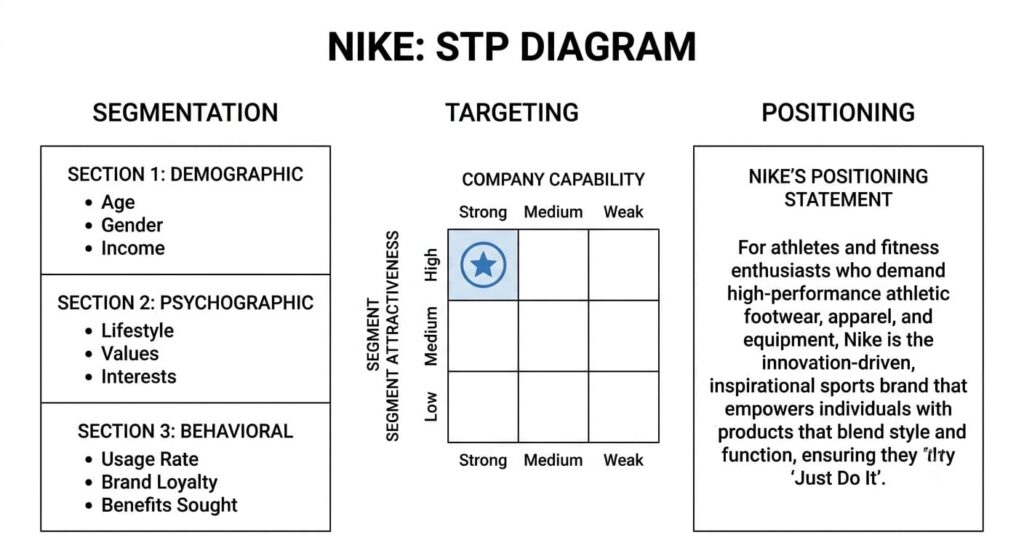
Brand management questions for MBA students usually come from placement panels and case rounds. Revise the 4Ps (product, price, place, promotion), STP (segmentation, targeting, positioning), SWOT (strengths, weaknesses, opportunities, threats), consumer behaviour and one or two strategy frameworks. Don’t recite them. Apply them.
Try it on Nike. Segment by need and you get competitive athletes, fitness regulars and lifestyle wearers. Positioning sits on performance and aspiration, and brand pull is a clear strength. But Kantar’s 2026 BrandZ report has Zara overtaking Nike as the world’s most valuable apparel brand, which Kantar links to personalised, AI-powered shopping. That’s a threat worth debating.
In case discussions, say your framework out loud, ask one clarifying question and finish with a recommendation. A tidy analysis with no recommendation scores lower than a bold one with sound logic.
Advanced Interview Preparation for Experienced Professionals
Senior interviews move from “what do you know” to “what did you decide, and what happened.” Expect pressure on budgets, people and results.
Brand manager interview questions for experienced candidates dig into six areas: large budgets, cross-functional teams, strategic calls, brand crises, agency relationships and measurable outcomes. On budgets, Gartner’s 2026 CMO Spend Survey reports that 56% of CMOs say their budgets are insufficient to deliver their 2026 strategy. So expect to be asked how you prioritise.
Three scenarios to rehearse:
- A competitor cuts prices by 20% and your sales dip. Confirm the dip is price-driven, check which segments moved and protect your position before you consider matching.
- Your agency delivers an off-brief campaign two weeks before launch. Separate what’s fixable from what’s fatal, decide fast and tighten the next brief.
- The CFO wants brand spend cut by a third mid-year. Show what the cut costs in long-term metrics, protect core activity and offer where to trim.
Practical Brand Management Case Studies to Prepare For
Case exercises test how you structure an unfamiliar problem live. Marketing case study interview questions rarely have a right answer. They have a clear method and a defensible recommendation. The three below are hypothetical practice exercises, not real company cases.
Case study 1: Launching a new beverage brand
Imagine a new ready-to-drink sharbat brand entering a crowded beverage shelf. Work through it in order:
- Identify the audience: who buys cold drinks today, and who’s dissatisfied?
- Run market research: quick surveys, store visits, review mining.
- Map competitors: price, flavour, pack size, positioning.
- Choose a position nobody owns, such as a specific occasion or ingredient story.
- Plan a pilot launch in one or two cities with a clear channel mix.
- Define measurement: trial rate, repeat rate and awareness against a baseline.
Case study 2: Rebuilding a declining brand
Sales are falling and nobody agrees why. Start by splitting the decline: which products, regions and channels? Then separate causes: price, distribution, product quality or perception. Customer reviews and churn data usually point to the answer faster than internal opinion. Recovery comes after diagnosis, and it usually means fixing one thing well before touching the logo.
Case study 3: Managing negative brand publicity
A viral post accuses your brand of a safety lapse. Investigate first: is it true, partly true or false? Respond quickly with what you know and what you’re checking. Align customer care, legal and leadership on one message. Then rebuild trust with visible action, not just a statement.
How to Prepare for a Brand Management Interview?
Prepare in four layers: the company, your stories, the STAR structure and the metrics. Most candidates do the first and skip the rest, which is why brand management interview questions catch them out.
Research the company and its competitors
Study the brand’s latest campaigns, its social channels, its reviews and its two closest rivals. Form one opinion about what you’d change. Having a view beats reciting facts.
Prepare examples from your experience
Keep four or five stories ready: a campaign, a teamwork moment, a research project and a problem you solved. Most behavioural answers can be built from these.
Practise the STAR method
STAR stands for Situation, Task, Action, Result. A short example: “Our festive campaign had weak conversions (Situation). I had two weeks to fix it (Task). I audited the funnel and rebuilt the landing page (Action). Conversions improved the next week (Result).”
Understand important marketing metrics
Know what each of these measures, and don’t mix them up:
- Brand awareness: the share of your target audience that recognises the brand.
- Customer retention: the share of customers who keep buying.
- Market share: your sales as a share of the category.
- Customer acquisition cost (CAC): what it costs to win one new customer.
- Customer lifetime value (CLV): the revenue a customer is expected to bring over the relationship.
- Return on marketing investment (ROMI): the return generated per rupee of marketing spend.
- Brand sentiment: the overall tone of what people say about the brand.
Different metrics measure different outcomes. Not every branding campaign should be judged by immediate sales, and saying so clearly in an interview signals maturity.
Brand awareness, retention, market share, CAC, CLV, ROMI and brand sentiment each measure a different outcome. A brand campaign should be judged against its own objective, such as recall or consideration, not only against immediate sales. Gartner’s 2026 CMO Spend Survey puts average marketing budgets at 7.8% of company revenue, which is why choosing the right metric matters.
Common Mistakes to Avoid During the Interview
Most rejected candidates don’t fail on knowledge. They fail on these seven habits:
- Giving memorised answers that fall apart at the first follow-up.
- Not researching the company, so every answer sounds generic.
- Ignoring customer behaviour and talking only about the brand.
- Focusing on creativity and ignoring business results.
- Making unsupported claims, such as “this would double sales.”
- Failing to give practical examples.
- Not asking questions at the end.
Questions You Should Ask the Interviewer
You’ll be judged on your own questions too, so close the interview well. Pick from these five:
- What are the biggest challenges currently facing the brand?
- How does the company measure brand success?
- What would you expect from someone in this position during the first 90 days?
- How do the branding, sales and digital marketing teams collaborate?
- What opportunities are available for professional development?
Conclusion
Practical knowledge beats theory every time. The strongest answers to brand management interview questions pair creativity with analytics, rest on real research into the company and use genuine examples instead of memorised lines.
So practise out loud, build your story bank and walk in with one opinion about the brand you’re interviewing for. For more practical marketing and career thinking you can apply this week, subscribe to YUP’s Crystal Clear Newsletter.
FAQ: Frequently Asked Questions About Brand Management Interviews
What are the most commonly asked questions in a brand management interview?
The most common brand management interview questions cover brand positioning, brand equity, target audience, campaign measurement, declining brands and crisis handling. Most panels also add behavioural questions about past campaigns and at least one scenario exercise.
How should a fresher prepare for a brand management interview?
Build two or three examples from projects or internships, learn the core frameworks and study the company’s competitors. Practise aloud and use STAR for experience questions. Brand management interview questions for freshers reward clear reasoning over memorised definitions.
What qualifications are required to become a brand manager?
Most employers want a bachelor’s degree, often in marketing, business or communications. An MBA in marketing helps at large FMCG companies, but a strong portfolio and relevant internships can substitute at start-ups and D2C brands.
What skills are most important for brand management?
Strategic thinking, analytical ability, creativity, communication and leadership matter most, backed by market research habits. Employers weigh the ability to link creative ideas to business results above any single tool.
Is brand management a good career option for MBA graduates?
Yes, if you like mixing creativity with numbers. AmbitionBox lists brand manager salaries in India from roughly ₹3.5 lakh to ₹33 lakh a year, based on thousands of reported salaries, rising with experience and employer.
How many rounds are generally involved in a brand manager interview?
It varies, but two to four rounds is common: a screening call, one or two interviews with the hiring manager and team, and sometimes a case exercise or presentation. Larger FMCG firms tend to run more rounds.
What is the difference between brand management and marketing?
Marketing covers everything that gets a product sold: research, pricing, promotion and distribution. Brand management focuses on long-term perception and positioning, making sure every marketing action builds the same identity.
How can I demonstrate brand management skills without prior work experience?
Run a live project: audit a local business’s social presence, redesign a campaign for a student club or write a brand teardown. Document the decision, the reasoning and the result. A visible portfolio beats a vague claim.