
Two different brands sell the same product at almost the same price. One of them has a queue outside its stores on launch day. The other is running discount ads just to move inventory.
That gap is brand equity.
Brand equity management is the process of building, measuring, and protecting the value your brand holds in the minds of customers. It is not just a marketing concept. It is a business asset that directly affects pricing power, customer retention, and long-term revenue. Brands with strong equity do not compete on price. They do not have to.
The brands that get this right, think Coca-Cola, Apple, and India’s boAt, have turned a name and a logo into billions of rupees of competitive advantage. The ones that ignore it spend more on ads every quarter just to maintain their position.
This article covers everything you need to know about brand equity management: what it is, why it matters, how to build it step by step, how to measure it, and how the world’s best brands have used it to grow.
Table of Contents
What Is Brand Equity?
Brand equity is the additional value a product or service carries because of its brand name, compared to an identical unbranded product. It lives in customer perception, not on a balance sheet.
Think about it this way. A plain white T-shirt from a no-name manufacturer might cost you Rs. 299. The same T-shirt with a Nike swoosh on the chest sells for Rs. 2,499. That difference is not the fabric. It is brand equity.
The concept was formalised by marketing academic David Aaker in the early 1990s and has been the foundation of brand strategy ever since. Aaker defined brand equity as a set of assets and liabilities linked to a brand’s name and symbol that add to or subtract from the value a product provides. It is built over time through consistent experience, trust, and association.
Brand equity is distinct from brand value, though the two are related. Brand value is the monetary quantification of brand equity, the number you see when companies are acquired or listed. Brand equity is the perception and relationship that produces that value.
Why Is Brand Equity Important?
Brand equity is important because it gives a business options that competitors without it simply do not have.
A brand with strong equity can charge premium prices without losing customers. It can launch new products and see immediate adoption. It can weather a PR crisis without permanent damage. And it spends less on customer acquisition because people come to it, not the other way around.
Here is why marketers and founders need to take brand equity seriously:
Pricing power. Customers with high brand loyalty consistently show a willingness to pay more. According to a 2023 Kantar BrandZ study, strong brands generate 5x higher total returns to shareholders than weak brands over 20 years. That is not a marginal advantage.
Lower acquisition costs. Strong brands benefit from word-of-mouth and organic reach. Mamaearth built its initial growth almost entirely on content and community before spending heavily on media. That early brand equity kept their CAC (customer acquisition cost) well below category average.
Resilience. When Maggi noodles were temporarily banned in India in 2015, the brand bounced back to regain market leadership within two years. That recovery was powered almost entirely by accumulated brand equity. No unestablished brand survives that.
Talent and partnerships. Companies with strong brand equity attract better talent and better business partners. The best engineers want to work for brands they respect. Retailers give shelf priority to brands that customers ask for.
And that is exactly why brand equity management cannot be treated as an afterthought.
Brand equity gives businesses pricing power, lower acquisition costs, and crisis resilience. According to Kantar BrandZ’s 2023 study, strong brands deliver 5x higher total shareholder returns over 20 years compared to weak brands. For any brand competing in a crowded market, equity is the single most durable competitive advantage.
Elements of Brand Equity
Brand equity is not a single thing. It is built from several components working together, and each one can be strengthened or weakened independently.
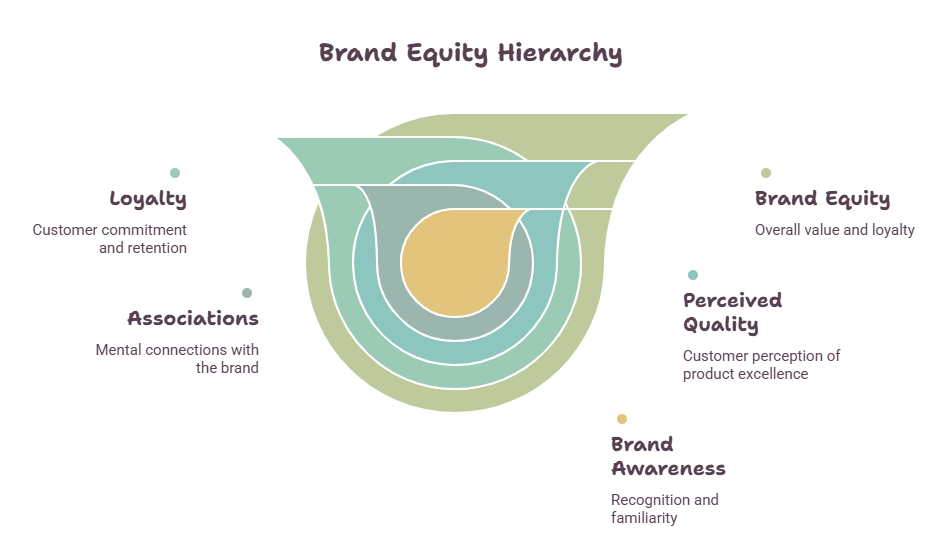
David Aaker’s model identifies five core components of brand equity. Understanding each one helps you know where to invest and where you might be losing ground.
Brand Awareness
Brand awareness is how well consumers recognise and recall your brand. It is the foundation. If people do not know you exist, no other equity element can function.
Brand awareness is defined as the ability of a potential buyer to recognise or recall a brand as a member of a certain product category. Without it, the rest of your equity is invisible.
There are two levels: aided recall (does the person recognise your brand when prompted?) and unaided recall (does your brand come to mind spontaneously?). Top-of-mind awareness is the highest level, and it is what brands like Zepto are building aggressively in the quick commerce space right now.
Perceived Quality
Perceived quality is the customer’s overall judgment of a product’s excellence relative to its purpose and alternatives. Notice the word “perceived.” It does not have to match the objective quality. It just has to feel superior to the alternatives.
This is why premium packaging matters. It is why Apple’s unboxing experience is carefully engineered. Perception and reality are not the same thing in branding.
Brand Associations
Brand associations are the attributes, beliefs, and feelings consumers connect with a brand. These can be functional (Dettol kills 99.9% of germs) or emotional (Tanishq represents trust and tradition in Indian weddings).
Strong, positive brand associations make a brand easier to recall and easier to choose. They also create barriers to switching.
Brand Loyalty
Brand loyalty is the tendency of customers to repeatedly purchase from a brand instead of switching to competitors. It exists on a spectrum from habitual buying to genuine advocacy.
The most valuable form is advocacy, where customers do not just repurchase, they recommend. boAt’s community of “Squadrons” (super fans) generates word-of-mouth that no paid campaign can replicate.
Other Proprietary Assets
This includes patents, trademarks, channel relationships, and distribution advantages that give a brand a structural moat. These are the harder-to-copy elements that legal and commercial teams build over time.
Read More: “brand awareness strategies.”
What’s the Difference Between Positive and Negative Brand Equity?
Brand equity can work for you or against you. And the direction it takes depends largely on how well you manage it.
Positive brand equity means customers trust the brand, are willing to pay more, and choose it over equally priced or even cheaper alternatives. They associate it with quality, reliability, or emotional value. Brands with positive equity can extend into new categories and expect initial uptake.
Tata Motors’ launch into electric vehicles had an easier market entry than a completely unknown EV brand would. The trust accumulated through decades of automobiles and commercial vehicles transferred to the new category.
Negative brand equity means the brand name actively hurts the product. Customers see the name and think twice. This happens when a brand has repeatedly broken trust, delivered inconsistent quality, or been associated with a controversy it never fully addressed.
Negative brand equity can hit hard and fast. A single viral customer experience, a product recall, or a tone-deaf campaign can flip perception in weeks. Rebuilding it takes years.
The critical point here is that neutral is not really an option in established markets. If you are not actively managing brand equity, it is probably declining.
Positive brand equity allows brands to command premium pricing, enter new categories with initial trust, and retain customers at lower cost. Negative brand equity does the opposite, making every sale harder and more expensive. Brands that do not actively invest in equity management are likely to see it erode over time, especially in competitive consumer markets.
How to Build Brand Equity: A 5-Step Process
Building brand equity is not a campaign. It is a discipline that requires consistent input over months and years. Here is a practical five-step process.
Step 1: Invest in Marketing
This sounds obvious, but most brands underinvest in brand-building and overinvest in performance campaigns that deliver short-term results. The Binet and Field IPA Databank research (updated in 2023) continues to show that the optimal split for most consumer brands is roughly 60% brand-building spend to 40% performance spend. Most brands do the opposite.
Brand-building investment includes things like consistent social presence, content that tells your brand story, creator partnerships where your brand values are visible, and media placements that shape perception over time. These do not show up in your ROAS reports. But they are what make your performance campaigns work better.
Step 2: Educate Your Consumer
Customers who understand what your brand stands for and why it exists are far more loyal than customers who only know your product’s features. Nykaa has done this exceptionally well by turning its platform into a beauty education resource: tutorials, expert advice, skin-type guides. The result is that Nykaa customers do not just buy products; they trust Nykaa’s judgment.
Brand education builds perceived authority. And authority is a precursor to loyalty.
Step 3: Develop and Communicate Customer Behaviors
Brand equity is partly built by showing customers what your brand community looks like. When people see others like them using and loving a brand, it reinforces their own identification with it.
This is why user-generated content (UGC) matters beyond just reach. When boAt’s customers post workout videos with boAt earphones, they are communicating to other fitness-conscious young Indians that this is the brand for people like them. You are not just selling a product; you are signalling belonging.
Step 4: Build Firm-Based Equity
Firm-based equity refers to the structural elements your brand owns, things like proprietary technology, exclusive partnerships, distribution depth, and design assets. These are not easy to copy and create a durable competitive advantage.
Swiggy Instamart’s dark store network is firm-based equity. A competitor cannot match their delivery speed overnight. It took years of infrastructure investment.
Step 5: Increase Shareholder Value
Strong brand equity translates to business value. For public companies, this shows up in market capitalisation premiums. For startups and D2C brands, it affects fundraising valuations, acquisition offers, and the multiple at which the business is sold.
Tracking how your brand equity investments flow through to business metrics matters. Brands that can demonstrate equity growth through pricing power, LTV increases, and CAC efficiency build the case for sustained brand investment internally.
Read More: “Brand marketing vs performance marketing.”
How to Measure Brand Equity: 3 Methods
Brand equity is not invisible. There are concrete ways to track it. The challenge is that no single metric captures the full picture, so smart brand managers use multiple methods together.
Brand Awareness Measurement
The most direct measure of brand equity starts with awareness. You can track this through:
- Unaided recall surveys: Ask customers to name brands in your category without prompting. Your position in that list matters.
- Search volume trends: Rising branded search (people searching your brand name directly) is a reliable signal that awareness is growing. Google Trends and Google Search Console both show this data.
- Social mentions and share of voice: Tools like Brandwatch or Sprout Social track how often your brand is mentioned relative to competitors. Rising share of voice typically precedes sales growth.
Brand Relevance Measurement
Awareness without relevance does not convert. Brand relevance measures whether consumers actually consider your brand when making a purchase decision in your category.
Measuring brand relevance typically requires primary research, surveys that ask consumers which brands they consider when buying a product like yours. The conversion rate from “aware” to “considered” tells you whether your brand associations are landing.
A brand that everyone knows but no one considers is a brand with awareness but no relevance. That is a common problem for legacy brands entering new categories without refreshing their positioning.
Brand Power Measurement
Brand power is the ability to translate equity into commercial outcomes. The clearest indicators:
- Price premium: What premium over category average can your brand command while maintaining market share?
- Customer lifetime value (LTV): Brands with strong equity show higher LTV because customers stay longer and buy more.
- Net Promoter Score (NPS): How willing are customers to recommend you? NPS is a reasonable proxy for loyalty and advocacy.
- Market share stability: Strong equity brands hold market share more consistently through economic downturns and competitive attacks.
The Kantar Brand Strength Index and YouGov BrandIndex are two established tools that track brand power metrics at the category level and can benchmark your brand against competitors.
What Factors Affect Brand Equity?
Several forces shape brand equity, both positively and negatively. Understanding them helps you anticipate where your equity is at risk.
Customer experience is probably the most powerful factor. Every touchpoint, from the first ad a customer sees to the post-purchase support email, either adds or subtracts equity. A brilliant product with terrible customer service will bleed equity continuously.
Consistency is another major driver. Inconsistent brand presentation across channels fragments the mental picture customers build of your brand. Research by Lucidpress (2023) found that consistent brand presentation across all platforms increases revenue by up to 23%.
Cultural relevance affects equity significantly in markets like India, where consumer values shift quickly. A brand that resonates with aspirational young Indians in 2018 may feel dated by 2024 if it has not evolved its voice and associations.
Media coverage and earned PR shape perceptions at scale. A positive story in a trusted publication builds equity faster than a paid ad. Negative coverage can reverse years of investment.
Product quality and innovation feed perceived quality over time. Brands that consistently release products customers love accumulate equity through those experiences. Those that stagnate or ship quality issues slowly erode it.
Employee and founder behaviour increasingly affects brand equity, especially for D2C and startup brands. The founder’s public voice, team culture leaks, and internal controversy all have equity implications.
Real-World Examples of Brand Equity
Tylenol
Tylenol, the American pain relief brand owned by Johnson and Johnson, is a textbook case of brand equity resilience. In 1982, someone tampered with Tylenol bottles on store shelves in Chicago, lacing capsules with cyanide. Seven people died. The brand faced what should have been a terminal crisis.
Johnson and Johnson recalled 31 million bottles, redesigned packaging with tamper-proof seals, and communicated transparently throughout the process. Within a year, Tylenol had recovered to its original market share. The accumulated equity of trust and reliability was so strong that consumers distinguished the brand from the act of a criminal.
That is what positive brand equity looks like under extreme pressure.
Starbucks
Starbucks does not just sell coffee. It sells an experience, a ritual, and a sense of identity. That is why a Rs. 500 cold brew from Starbucks competes successfully against Rs. 50 chai from the outlet next door.
The brand’s equity is built on consistency (the same experience in every store, globally), community (the third-place concept), and personalisation (your name on the cup). When Starbucks stumbled with rapid over-expansion and declining store experience in 2008, it lost equity fast. CEO Howard Schultz returned, closed 7,000 stores for a day of retraining, and rebuilt. Equity requires active management. It does not run on autopilot.
Coca-Cola
Coca-Cola’s brand equity is among the most studied in the world. The brand has been the world’s most valuable non-tech brand for decades, according to Interbrand’s Global Brand Rankings. Its equity is built on emotional association (happiness, sharing, celebration), visual consistency (the red and white palette has barely changed in a century), and cultural ubiquity.
When New Coke replaced the original formula in 1985, the consumer backlash was immediate and overwhelming. People were not just upset about a taste change; they were upset because the brand had altered something they had an emotional relationship with. Coca-Cola reversed the decision within 79 days. The episode became the most powerful evidence in marketing history that brand equity is real, that it lives in customers’ hearts and not just their habits.
Porsche
Porsche’s brand equity lives in two words: performance heritage. The brand commands among the highest price-to-cost ratios in the automotive sector. A Porsche Cayenne SUV starts at a significant premium to comparable SUVs from BMW or Mercedes, despite overlapping features.
That premium is pure brand equity. Buyers are not just purchasing a car. They are associated with Porsche’s racing DNA, German engineering reputation, and the status it signals. And Porsche’s management of that equity is meticulous: they control which segments they enter, how they communicate, and how dealerships present the brand.
The world’s most valuable brands, including Coca-Cola, Starbucks, and Porsche, demonstrate that brand equity can command price premiums, sustain through crises, and create durable competitive moats that competitors cannot replicate through product features alone. These outcomes are the direct result of long-term, intentional brand equity management.
Brand Equity vs. Brand Awareness
These two terms get conflated regularly. They are not the same thing, and confusing them leads to misallocated marketing budgets.
Brand awareness is one component of brand equity. It is the starting point. Brand equity is the full system that awareness feeds into, including associations, loyalty, perceived quality, and commercial leverage.
A brand can have very high awareness and very low equity. Many fast-moving consumer goods brands achieve wide recognition through heavy media spend but fail to build any emotional connection or loyalty. Customers know them, but they would switch without hesitation the moment a cheaper option appeared.
Conversely, a brand can have moderate awareness but extremely strong equity within its audience. Many D2C brands in India operate this way. They are not household names, but within their specific customer segment, the trust and loyalty are deep. Bombay Shaving Company is known to a fraction of the population but commands strong equity among urban male grooming consumers.
The strategic implication is that brand awareness campaigns are not automatically brand equity campaigns. Reach and frequency build awareness. Experience, consistency, and emotional resonance build equity.
Strategies to Build Brand Equity
Create a Clear and Differentiated Brand Strategy
To build brand equity, your brand must stand out, and it must stand for something specific. Vague positioning builds no equity. Brand equity management begins with a sharp answer to the question: what do we stand for that our competitors do not?
Differentiation does not have to be product-based. Mamaearth differentiated on values (toxin-free, natural ingredients, sustainability) in a space where product formulations are largely similar. That values-based differentiation became their equity driver.
Your brand strategy should define your positioning, your core brand associations, and the experience you are going to deliver consistently. Without that clarity, marketing investment is scattered, and equity is hard to accumulate.
Deliver on Your Brand Promise Consistently
Brand equity is built through repeated, consistent experiences. Every interaction a customer has with your brand either confirms or undermines the promise you have made.
This is where most brands fall short. The brand strategy says “premium and effortless,” but the customer support queue is 48 hours. The Instagram content says “community-first,” but the brand never responds to comments. The disconnect erodes equity faster than any competitor’s campaign can.
Consistency has to be managed operationally, not just as a brand guideline. It means training customer support teams on brand voice, ensuring packaging matches the premium positioning, and making sure the checkout experience on your website is as carefully considered as your hero creative.
From what we’ve seen with YUP course learners working in brand roles, the biggest gap between brands that build equity and those that do not is almost always in execution consistency, not brand strategy quality.
Strengthen Customer Engagement
Engaged customers build brand equity for you. They post, recommend, defend, and return. Building genuine engagement requires giving customers something to participate in, not just something to buy.
This can look like community building (Cult.fit’s fitness community), co-creation (boAt’s community design input for limited edition products), or content programming that goes beyond product promotion.
The brands winning on brand equity in India right now are the ones treating customers as participants, not recipients. Zepto’s rapid expansion was partly fuelled by an intensely engaged early adopter community who genuinely felt invested in the brand’s success.
Read More: “customer engagement strategies.”
Managing Brand Equity Over Time
Building brand equity is hard. Sustaining it is harder. The history of marketing is full of brands that built strong equity and then let it erode through neglect, bad decisions, or failure to adapt.
Audit regularly. Brand perception shifts. A brand that resonated with 25-year-olds in 2015 may feel irrelevant to 25-year-olds in 2025 if it has not evolved. Regular brand health tracking, measuring awareness, relevance, associations, and NPS, helps you catch drift before it becomes a crisis.
Respond to cultural shifts. Equity built on associations that fall out of cultural favour can become a liability. Brands whose identity was built on aspirational westernisation are navigating this tension in India right now, as the appeal of Indian cultural identity in branding grows stronger.
Protect the core while allowing evolution. The brands that sustain equity over decades are the ones that identify what is immutable in their brand (Tata’s trust; Coca-Cola’s happiness) and evolve everything else around that core. Updating visual identity, refreshing tone of voice, entering new categories: all of these are fine. Compromising the core association is the risk.
Invest through downturns. The temptation to cut brand-building investment during revenue pressure is understandable and almost always wrong. Brands that maintain brand investment through difficult periods exit those periods with stronger relative equity than competitors who went dark.
Strengthening Brand Equity Through Visibility
Visibility and equity are not the same thing, but visibility is a prerequisite. A brand that people cannot find, see, or encounter cannot build equity regardless of how good its underlying offering is.
Strategic visibility means showing up where your audience is making decisions and forming opinions, not just where impressions are cheapest.
For D2C brands in India, this increasingly means being present in both performance channels (Google, Meta) and brand channels (influencer content, PR, organic social). The performance channels convert existing demand. The brand channels create it.
SEO is an underused equity driver. When a brand consistently shows up with authoritative, useful content on topics its audience cares about, it builds authority that transfers to brand perception. This is why content marketing is not just a traffic strategy; it is a brand equity strategy.
Physical presence still matters for brand equity in India, even for digital-native brands. Nykaa’s physical store expansion was partly a brand equity play: the stores reinforce the brand’s premium positioning in a way that a website cannot fully replicate.
Visibility is the foundation that brand equity is built on, but the two are not the same. Strategic visibility means showing up consistently across the touchpoints where your audience forms opinions and makes decisions. In India’s digital-first but physical-world-influenced consumer market, the most effective brand equity building combines performance media, content authority, creator partnerships, and selective physical presence.
Brand Equity Management: Putting It All Together
Brand equity management is not a one-time project. It is the ongoing work of building, measuring, and protecting the value your brand holds in customers’ minds.
The brands that get this right do a few things consistently. They invest in brand-building, not just performance. They deliver on their promise every time, across every touchpoint. They track brand health metrics with the same rigour as financial metrics. And they protect the core associations that make their brand distinctive while allowing everything else to evolve.
There is no shortcut here. Brand equity compounds like interest. Small, consistent investments in the right direction build something competitors cannot easily replicate or undercut. The brands that treat equity as an asset to be managed, not a tagline to be promoted, are the ones that achieve durable pricing power, customer loyalty, and business value.
The question worth asking of your brand today is not “what is our campaign?” but “what are we building?”
If you are working in brand management or aspiring to, this is the discipline that separates functional marketers from strategic ones.
Conclusion
Brand equity does not build itself. It is the result of deliberate investment in the right experiences, associations, and promises kept over time.
The brands that dominate their categories, that command premiums, generate loyalty, and recover from setbacks, are the ones that treat brand equity management as a core discipline and not a side effect of their marketing campaigns.
Start by understanding what associations your brand currently holds. Then compare those to what you want it to stand for. The gap between those two things is your brand equity management agenda.
If you want to build a career in brand strategy or get better at the commercial thinking behind great brands, the YUP Crystal Clear Newsletter breaks down exactly this kind of marketing decision-making with real brand cases every week.
Frequently Asked Questions
What is brand equity in simple terms?
Brand equity is the extra value your brand name adds to a product or service beyond its functional features. It is built through customer experiences, associations, and trust over time. A product with strong brand equity can charge more, retain customers longer, and recover from setbacks faster than an equivalent unbranded product.
What are the main elements of brand equity?
David Aaker’s brand equity model identifies five elements: brand awareness (how well customers recognise and recall the brand), perceived quality (the customer’s overall judgment of excellence), brand associations (the attributes and feelings connected to the brand), brand loyalty (the tendency to repurchase and recommend), and proprietary assets like trademarks and distribution advantages.
How is brand equity different from brand value?
Brand equity is the perception, relationship, and trust that customers have with a brand. Brand value is the monetary figure that results from that equity, the number that shows up in acquisitions or brand valuation reports. Think of brand equity as the cause and brand value as the financial effect.
How do I measure brand equity for my brand?
You can measure brand equity through three methods. First, brand awareness tracking via surveys, branded search volume, and share of voice. Second, brand relevance research measures how often your brand is considered when customers are making a purchase decision. Third, brand power metrics, including price premium capability, customer LTV, NPS, and market share stability. No single metric captures the full picture; use all three together.
Can a small brand build strong equity?
Yes. Equity is about depth of connection within your audience, not breadth across the general population. Many Indian D2C brands have built powerful equity within specific segments, such as Bombay Shaving Company in urban male grooming or The Moms Co. in safe baby care. The principles are the same; the scale of investment adjusts to the brand’s size and stage.
What is negative brand equity, and how does a brand recover from it?
Negative brand equity occurs when the brand name actively reduces the appeal of a product, usually because of accumulated trust failures, quality issues, or reputation damage. Recovery requires acknowledging the problem publicly, demonstrating genuine change through actions rather than messaging, and rebuilding associations through consistent positive experiences over an extended period. The Maggi and Tylenol recoveries both show it is possible, but it takes time and sustained effort.
Is brand awareness the same as brand equity?
No. Brand awareness is one input into brand equity but not the whole picture. A brand can be widely known but still have low equity if customers do not trust it, do not see it as relevant to their needs, or would switch without hesitation. Equity requires awareness plus positive associations, perceived quality, and loyalty.
Why do strong brands spend less on customer acquisition over time?
Brands with strong equity benefit from word-of-mouth, organic search, and direct traffic that unrecognised brands do not. Loyal customers recommend the brand to others. Content and reputation drive discovery without paid distribution. Over time, the accumulated equity does some of the marketing work that paid ads have to do for weaker brands, which is why CAC tends to drop as equity grows.
What is customer-based brand equity, and why does it matter?
Customer-based brand equity, a framework developed by Kevin Lane Keller, focuses on the brand knowledge that exists in customers’ minds: the associations, beliefs, and feelings they have developed through experience. It matters because brand equity ultimately only exists in customer perception. A brand that thinks it has strong equity but has not earned it in the minds of its target customers has a valuation problem waiting to happen.
How often should a brand audit its equity?
Brand health audits should happen at a minimum annually, and for high-growth or high-competition brands, quarterly tracking is worth the investment. The risk of infrequent auditing is that equity drift becomes a crisis before anyone notices it. Regular tracking lets brand teams catch early signals and course-correct before the damage compounds.